This Week in London – Van Gogh’s Sunflowers reunited; Sir Leslie Constantine’s Blue Plaque; and, the ‘Anatomy of a Suit’…

• Two versions of Vincent van Gogh’s iconic Sunflowers have been reunited for the first time in 65 years in London at the National Gallery. The two paintings – one from the National Gallery and the other from the Van Gogh Museum in Amsterdam – come from a five-painting series the artist created in 1888 while staying in Arles. They were apparently painted while he was waiting for his friend Paul Gaugain to arrive and were to decorate the bedroom Gaugain would stay in as gift to him. The free display in Room 46 of the Trafalgar Square Gallery and will be shown until 27th April. Meanwhile, the gallery is celebrating the donation of another van Gogh – Head of a Peasant Woman, the first early work by the artist to enter its collection. It is one of a series of around 40 portraits of the peasants of the village of Nuenen, in The Netherlands, which were painted in late 1884/early 1885. For more, see www.nationalgallery.org.uk.

West Indian cricketer and politician Sir Learie Constantine’s former home in Earl’s Court has been commemorated with an English Heritage Blue Plaque. Constantine, who played a significant role in securing the independence of Trinidad and Tobago and as an advocate for black people, was the first person of African descent to sit in the House of Lords. He lived at the property at 101 Lexham Gardens between 1949-1954. For more, see www.english-heritage.org.uk/discover/blue-plaques/.

On Now: The Anatomy of a Suit. This free display at the Museum of London looks at  the technicalities of making a suit and the city’s influence on menswear globally. Exhibits include a double-breasted pinstripe jacket from about 1965, a morning jacket from about 1927 and a black dress suit from about 1933 – all of which was sourced by curator Timothy Long from markets including Brick Lane, Broadway and Portobello Road. Runs until June. For more, see www.museumoflondon.org.uk.

Send all items of interest for inclusion to exploringlondon@gmail.com.
Around London – The Cheapside Hoard revealed; Queen Elizabeth I at the NPG; 3D printing at the Science Museum; and, Viennese portraits…

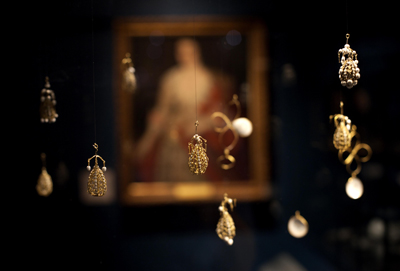
Cheapside-Hoard-1The ‘secrets’ of the Cheapside Hoard – the world’s finest and largest collection of 16th and 17th century jewels – are revealed in a new exhibition opening tomorrow at the Museum of London. The
Cheapside-Hoard-2Cheapside Hoard: London’s Lost Jewels
 publicly displays the hoard of Elizabethan and early Stuart jewellery and gemstones in its entirety for the first time since its discovery more than 100 years ago. The hoard, consisting of as many as 500 pieces including rings, necklaces, cameos, scent bottles and a unique Colombian emerald watch, was discovered buried in a cellar on Cheapside in the City of London in 1912. The exhibition uses new research and state-of-the-art technology to showcase the hoard as it explores the questions of who owned the hoard, when and why was it hidden, and why was it never reclaimed. New information revealed by the research shows that the hoard was buried between 1640 and 1666 (the critical clue was a previously overlooked intaglio – a gemstone engraved with the heraldic badge of William Howard, Viscount Stafford, who lived between 1612-1680). It also reveals Thomas Sympson was the “dodgy” jeweller responsible for two counterfeit rubies contained within the hoard (he apparently had a trade in selling counterfeit gems for as much as £8,000 each). Entry charge applies. Runs until 27th April. For more, see www.museumoflondon.org.uk.  PICTURED: Above: gold and pearl cage pendants from the Cheapside Hoard; and right: a bejewelled scent bottle.

A previously unknown painting of Queen Elizabeth I is on display as part of a new exhibition, Elizabeth I and Her People, opening at the National Portrait Gallery today. The small painting, which has been attributed to miniaturist Isaac Oliver and which is a reworking of the classical story of the Judgement of Paris, was recently acquired by the gallery. It will sit among a selection of other portraits of the “Virgin Queen” in a display which endeavours to show how during her 50 year reign she portrayed the image of a strong monarch. The portraits are just some of the 100 items featured in the exhibition which also includes costumes, coins, jewellery and crafts and examines the rise of new social classes in Elizabethan society. Other portraits in the exhibition feature images of courtiers such as William Cecil and Christopher Hatton along with images of merchants, lawyers, goldsmiths, butchers, calligraphers, playwrights and artists. There is also a little known painting of three Elizabethan children and what may be the first portrait of a guinea pig. The exhibition, supported by the Weiss Gallery, runs until 5th January. Admission charge applies. For more, see www.npg.org.uk.

Printed objects including replacement body organs, aeroplane parts and a music box have gone on display at the Science Museum in South Kensington as part of a new exhibition, 3D: printing the future. The exhibition looks at the rapidly evolving field of 3D printing and its growing impact on society through stories such as the use of 3D printing by engineers to create lighter aeroplane parts and the ways in which the medical industry is researching the use of the technology to create replacement body parts. The display will also include miniature 3D printed figures created from scans of visitors who took part in workshops during the summer holidays. This free exhibition runs in the Antenna gallery for nine months. For more, see www.sciencemuseum.org.uk.

On Now: Facing the Modern: The Portrait in Vienna 1900. On at the National Gallery, the first major UK exhibition devoted to the portrait in Vienna features iconic works by Gustav Klimt, Egon Schiele, Richard Gerstl, Oskar Kokoschka and Arnold Schonberg alongside those of lesser known artists such as Bronica Koller and Isidor Kaufmann. Highlights include Klimt’s Portrait of Hermine Gallia (1904) and Portrait of a Lady in Black (about 1894), Schiele’s The Family (Self Portrait) (1918) and Nude Self Portrait by Gerstl (1908). Runs until 12th January. Admission charge applies. For more, see www.nationalgallery.org.uk.

Around London – ‘Hidden Treasures’; Open House programme; and the Isabella Plantation celebrates 60 years…

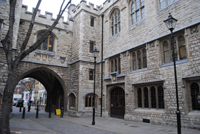
St-John's-GateHidden Treasures – the national initiative to celebrate the UK’s museum and archive collections – kicks off for its second year next Thursday, 22nd August, and runs over the bank holiday weekend until 27th August. Among the London institutions taking part this year are the British Library, the British Postal Museum and Archive in Houghton, the Museum of the Order of St John in Clerkenwell (pictured) and Orleans House Gallery in Twickenham. Hidden Treasures is an initiative of the Collections Trust and the Independent newspaper. All events are free but some have to be pre-booked and have limited spaces so make sure you check out the details at www.hiddentreasures.org.uk/?page_id=118.

The programme for Open House London – held over the weekend of 21st and 22nd September – will be made available online from today (or alternatively you can order a hard copy via the Open House London website). It’s important to note that a few of the buildings involved can only be entered by those successful in a ballot – they include 10 Downing Street, The View from The Shard, EDF Energy London Eye and Gray’s Inn. Head to the website – www.londonopenhouse.org – to enter the ballots which close on 13th September.

The Isabella Plantation – a 40 acre ornamental woodland garden located in the south west area of Richmond Park – is celebrating 60 years since its creation and they’ve kicked off a fortnight’s programme of free events community to mark the occasion. The events, which will be focused around the yurt by Peg’s Pond in the plantation,  include guided walks, a showcase of art for young people and a Teddy Bears picnic on the bank holiday weekend. One of the most visited parts of Richmond Park, the plantation is home to the Wilson 50 National Collection of Evergreen Azaleas, more than 150 hardy hybrid Rhododendrons, 50 species of Rhododendron and a large collection of camellias and magnolia as well as many rare and unusual trees and shrubs. While the plantation can be dated as far back as 1771 (then named Isabella Slade), it was planted for timber in 1831, and in 1953 the present garden was established and the old name Isabella adopted for it. For more on the events, see www.royalparks.org.uk.

As Muslims mark the end of Ramadan this weekend, the festival of Eid-ul-Fitr will be celebrated in Trafalgar Square on Saturday. As well as the chance to sample foods from across the Islamic world, there will also be entertainment on stage, exhibitions and children’s activities. The festival, put on by the Mayor of London Boris Johnson, runs between 1.30pm and 6pm. For more, see www.london.gov.uk/eid.

On Now: Take One Picture – Discover, Imagine, Explore: Children Inspired by Willem Kalf. This display at the National Gallery focuses on Willem Kalf’s Still Life with Drinking-Horn (about 1653) and features alongside it responsive works created by children from 25 schools across the UK and as far afield as Turkey with works from other schools captured in a slide-show. Located at the Annenberg Court (Getty Entrance), admission is free. Runs until 12th September. For more, see www.nationalgallery.org.uk.

Around London – The City of London Festival; last chance to see the Temperate House; and, Vermeer and music at the National Gallery…

City-of-London-FestivalThe City of London Festival kicked off last Sunday and runs for the next month in what is being billed as an “extravaganza of music, dance, art, film, poetry, family and participation events” in the Square Mile. Among the highlights of this year’s festival – the 51st – is a series of musical performances at St Paul’s Cathedral and a range of other locations including livery halls, churches and Mansion House – home of the Lord Mayor of London – as well as walks and talks including a two-day conference this Friday and Saturday, Worlds in Collision, which will explore questions surrounding the healing power of music in the treatment of post-traumatic stress disorders resulting from conflict. There’s also a range of free events such as a family day on Hampstead Heath celebrating Northern Irish culture and heritage and artistic installations such as that by artist Konstantin Dimopoulos which this week saw the trees of Festival Gardens near St Paul’s turn bright blue. Trees around Devonshire Square are also expected to be ‘coloured’ and both sites will form part of a ‘Tree Trail’ in the square mile which is aimed at revealing the ‘secret stories’ of some of the city’s trees and the locations they inhabit. The festival, which runs until 26th July, will be reflecting on a number of significant historical landmark anniversaries taking place this year, including the 400-year relationship between the City of London and the Northern Irish community of Derry-Londonderry, the 300th anniversary of the Treaty of Utrecht and the 100th anniversary of the birth of composer Benjamin Britten. For more information and a full programme of events, see www.colf.org. PICTURE: London Symphony Orchestra at St Paul’s Cathedral, © City of London Festival/Robert Piwko

The next month represents the last chance to visit Kew Gardens’ historic Temperate House – the world’s largest surviving Victorian glasshouse – for five years. The Grade I-listed building is about to undergo a five year restoration project, funded by a £14.7 million grant from the Heritage Lottery Fund. It is home to Kew’s rarest plant, the South African cycad Encephalartos woodii while other rarities include the St Helena ebony (Trochetiopsis ebenus). The Temperate House will close on 4th August and won’t reopen until May 2018. For more, see www.kew.org.

On Now: Vermeer and Music: The Art of Love and Leisure. Opened yesterday, this landmark exhibition at the National Gallery explores the motif of music in Dutch painting, in particular in the works of Johannes Vermeer and his contemporaries. Displayed alongside actual examples of 17th century virginals, guitars, lutes and other instruments, visitors will be able to see for themselves how accurate the painters were and discover why they may have taken artistic liberties. At the centre of the exhibition are three works by Vermeer – A Young Woman Standing at a Virginal and A Young Woman seated at a Virginal (both of which form part of the gallery’s collection) and The Guitar Player (on loan from Kenwood House). A fourth Vermeer, The Music Lesson, has been loaned from the Queen. Other artists featured in the exhibition include Gerard ter Borch, Gabriel Metsu, Jan Steen, Pieter de Hooch and Godfried Schalcken. Live musicians from the Academy of Ancient Music will be playing at the gallery three days each week. Runs until 8th September. Admission charge applies. For more, see www.nationalgallery.org.uk.

Around London – Museums at night; Propaganda at the BL; MoL Docklands celebrates 10 years; and, Steadman at the Cartoon Museum…

Expect people to be out and about around London at all hours this weekend with the kick-off tonight of Museums At Night, Culture24’s annual festival of after hours visits. This year’s packed program features everything from ‘Arts on Ice’ – a look at the Victorian ice trade – at the London Canal Museum to art nights at the Government Art Collection building, nocturnal tours of Greenwich’s Old Royal Naval College, and, for the first time, the chance for adults to sleep over at Hampton Court Palace and kids at Kensington Palace. Other London organisations taking part include the Handel House Museum, the Kew Bridge Steam Museum, Benjamin Franklin House, the National Gallery and Somerset House (and that’s just a few off the list!). For more information on the night – including a full program of events – check out the Culture24 Museums at Night website.

Propaganda-v9-cmyk Government spin comes under the spotlight in a major new exhibition which opens tomorrow at the British Library in King’s Cross. Propaganda: Power and Persuasion examines how state have used propaganda in the 20th and 21st centuries and features more than 200 exhibits including Nazi propaganda and everyday objects such as banknotes and badges. Admission charge applies. There’s a series of events running to coincide with the exhibition which runs until 17th September. For more, see www.bl.uk/whatson/exhibitions/propaganda/index.html.

It’s 10 years since the Museum of London Docklands opened in a converted Georgian warehouse on West India Quay and to celebrate they’re holding an exhibition celebrating the Thames estuary. Titled (appropriately enough), Estuary, the exhibition features the work of 12 artists in a variety of mediums – from film and photography to painting. Entry is free. The exhibition, which opens tomorrow, runs until 27 October. The museum is also holding a special day of family activities to celebrate its creation this Saturday. For more, see www.museumoflondon.org.uk/Docklands/.

On Now: STEADman@77. This exhibition at The Cartoon Museum in Bloomsbury looks at the work of graphic artist Ralph Steadman (who is celebrating his 77th birthday) and features more than 100 original works published in magazines ranging from Private Eye to Rolling Stone, Punch and the New Statesmen as well as his illustrated books (these include Sigmund Freud, Alice in Wonderland Through the Looking-Glass, I, Leonardo, The Bid I Am, and Animal Farm). Runs until 8th September. Admission charge applies. For more, see www.cartoonmuseum.org.

Around London – Aliens at the Royal Observatory; celebrating spring at the British Library; Blue Plaques for Heal and Mendelssohn; and, Barocci at the National Gallery…

It’s alien season at the Royal Observatory in Greenwich and to kick off a series of special events around all things extra-terrestrial, a new exhibition looking the history with things not of this earth opens tomorrow. Alien Revolution, which looks at man’s obsession with intelligent alien life – a trend which began in the century following Copernicus’ discovery that the earth was a planet and the sun a star, will be held in the observatory’s Astronomy Centre until August. Runs until 8th September. Admission is free. Other events include shorts courses looking at science fiction and astronomy, family events and special planetarium shows such as We Are Aliens which runs in April. For more on the events, see www.rmg.co.uk.

The British Library’s Spring Festival kicks off tomorrow with five days of film, design and fashion including the unveiling of a new artwork by fashion illustrator and artist Julie Verhoeven. Verhoeven – who has worked for fashion houses Louis Vuitton, Versace and Mulberry – will be joined by Dylan Jones, editor-in-chief of GQ, to talk about what inspires them while others among fashion’s leading names will be contributing postcards in a one night only pop-up exhibition – Late at the Library: Fashion Flashback – which will also feature talks involving Jones and illustrator Tanya Ling. The event also features a spring market held in the library’s piazza at which designers will be selling wares inspired by the library’s collection. Other events include the showing of a series of short films.  For more about the Spring Festival events, head to www.bl.uk/whatson/exhibitions/spring-festival-2013/index.html.

Furniture designer Sir Ambrose Heal was honoured with the unveiling of an English Heritage Blue Plaque at his former home in Pinner yesterday – the date marking 120 years since he joined the family firm, Heal’s. The house – at Fives Court, Moss Lane in Pinner – was Sir Ambrose’s home from 1901-1917 during the period when he began exerting his influence over the business, having won a silver medal at the 1900 Paris Exhibition for a bedroom suite. Heal was knighted in 1933 and appointed a royal designer for industry in 1939. Meanwhile, a Blue Plaque for 19th century composer Felix Mendelssohn was unveiled at 4 Hobart Place earlier this month, commemorating the house he stayed in at the height of his career during his numerous visits to London. The house was the home of the Hanoverian embassy secretary, Karl Klingemann, at the time. For more on Blue Plaques, see www.english-heritage.org.uk.

On Now: Barocci – Brilliance and Grace. This landmark exhibition at the National Gallery is the first major monographic exhibition dedicated to the art of 16th and 17th century Italian artist Frederico Barocci – pioneer of the Baroque style. Highlights include his spectacular altarpiece, The Entombment of Christ, from the coastal town of Senigallia, the Last Supper – painted for Urbino Cathedral, as well as two altar pieces from Rome – Visitation from the Chiesa Nuova and Institution of the Eucharist from Santa Maria sopra Minerva. Also included are portraits, smaller devotional paintings, Aeneas’ Flight From Troy – his only secular narrative, and more than 65 preparatory drawings, pastel studies and oil sketches. Runs until 19th May. Admission charge applies. For more, see www.nationalgallery.org.

Around London – Celebrating the art of the Underground and art on the web; Picasso at the Courtauld; and, Frederic Church at the National…

A new exhibition celebrating the art of the Underground opens at the London Transport Museum in Covent Garden tomorrow. Poster Art 150 – London Underground’s Greatest Designs showcases 150 posters with examples taken from each decade over the past 100 years. Artists include the likes of Edward McKnight Kauffer, Paul Nash and Man Ray. The posters were selected from the museum’s archive of more than 3,300 by a panel of experts. Visitors to the exhibition will be able to vote on their favorite poster as well as online with the most popular poster to be revealed at the end of the exhibition. The last major exhibition of Underground posters – the first commission of which was in 1908 – was held in 1963 to celebrate the system’s centenary. The exhibition is based around six themes – ‘Finding your way’, ‘Brightest London’, ‘Capital culture’, ‘Away from it all’, ‘Keeps London going’ and, ‘Love your city’. Runs until 27th October. Admission fee applies. For more on the exhibition and surrounding events, see www.ltmuseum.co.uk.

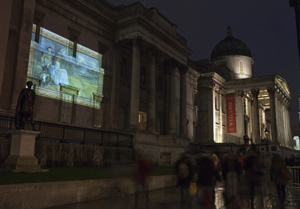
National-Gallery The external facade of the National Gallery in Trafalgar Square was decorated with artworks last Friday night (pictured right) in celebration of the completion of Your Paintings – a website which hosts the UK’s entire national collection of oil paintings (more than 210,000!). The projections – which were happening in 28 UK cities simultaneously – featured two National Gallery paintings – Van Gogh’s Sunflowers and Gainsborough’s Mr and Mrs Andrews. To see the website, head to www.bbc.co.uk/arts/yourpaintings/. PICTURE: © The National Gallery, London.

• On Now: Becoming Picasso: Paris 1901. This exhibition at The Courtauld Gallery in Somerset House on The Strand tells the story of Pablo Picasso’s break-through year as an artist – 1901 – when the then 19-year-old launched his career in Paris at a summer exhibition. The display follows Picasso from his debut and into the start of his Blue period. Works exhibited are among the first to bear his famous signature. Runs until 26th May. There is an admission charge. For more, see www.courtauld.ac.uk/gallery/index.shtml.

On Now: Through American Eyes: Frederic Church and the Landscape Oil Sketch. This free exhibition of 30 works at the National Gallery focuses on the work of Frederic Church (1826-1900), a member of the Hudson River School of artists and considered by many to be the greatest of the American landscape oil sketch artists. Works on display include those made at exotic locations such as Ed Deir, Petra, painted in Jordan in 1868, and Distant View of the Sangay Volcano, Ecuador, painted in 1857, as well as the paintings created closer to home, such as Hudson, New York at Sunset, painted in 1867. The exhibition is held in Room 1. Runs until 28th April. For more see www.nationalgallery.org.uk.

Around London – Chinese New Year; Orchids at Kew; Lucian Freud’s donation to the National Gallery; and, Man Ray at the NPG…

Chinese New Year celebrations will go off with a bang in Chinatown in the West End this Saturday. The festivities, which are the largest outside Asia, will include a lion dance, fireworks, and a variety of performers – all gathered to herald the start of the Year of the Snake. The celebrations will kick off with a parade which will leave Trafalgar Square at 10am and end at Rupert Street in Chinatown at 11am. At 12pm, dignitaries will gather in Trafalgar Square for the Dotting of the Eye ceremony which will bring the dragons and lions to life and performances will the take place until 5.30pm. At 5.55pm a fireworks display will mark the end of the day’s celebrations. For more, see www.chinatownlondon.org/page/chinese-new-year-2013/378.

Like orchids? Want to escape the gloom of winter? Kew Gardens are celebrating the exotic plant with a dazzling display in the Princess of Wales Conservatory. Thousands of orchids will be on show as part of ‘Orchids at Kew’ and the plants will be used to recreate the giant waterlily flower, Victoria amazonica, which can normally be seen in the conservatory in the summer months. There are special behind the scenes tours, food and an adult education course for the truly interested. Charges apply. Opening on Saturday, 9th February, the display can be seen until 3rd March. For more, see www.kew.org.

The late artist Lucian Freud has donated a treasured portrait – Jean-Baptiste Camille Corot’s L’Italienne ou La Femme à la Manche Jaune (The Italian Woman, or Woman with Yellow Sleeve) – to the nation in gratitude for the welcome his family received when they arrived as refugees from Berlin. The Corot has been allocated to the National Gallery by the Arts Council England and was done under the Acceptance in Lieu scheme, which allows people to transfer works of art into public ownership instead of paying inheritance tax.  The painting – which was last seen in a show at the Louvre, Paris, in 1962, and was previously owned by Hollywood Golden Age star Edward G. Robinson – is on display on Room 41 of the gallery. For more, see www.nationalgallery.org.uk.

On Now: Man Ray Portraits. The first museum exhibition to focus on the photographic portraiture of the 20th century artist Man Ray, this display at the National Portrait Gallery features more than 150 vintage prints taken between 1916 and 1968. Subjects include everyone from Catherine Deneuve and Ava Gardner to Salvador Dali and Aldous Huxley. The majority of works have never been exhibited in the UK before. Runs until 27th May. Admission charge applies. For more, see www.npg.org.uk.

Like to tell others about your upcoming event in London? If you’ve got an event coming up, please send any press releases or details to exploringlondon@gmail.com.

Around London – Henry Stuart at the NPG; the Lord Mayor’s Show; prehistoric Japanese pots; and, photography at the National Gallery…

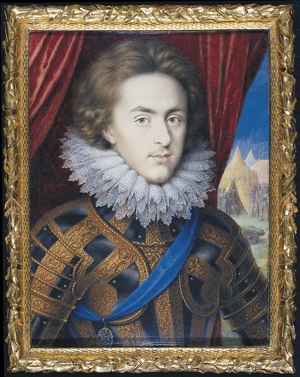
• The first ever exhibition focusing on Henry Stuart, older brother of King Charles I, has opened at the National Portrait Gallery. The Lost Prince: The Life and Death of Henry Stuart features more than 80 exhibits including paintings, miniatures, manuscripts, books and armour gathered from museums and personal collections around the UK and abroad – with some of the objects being displayed in public for the first time. Opened on 18th October – the 400th anniversary of the Prince’s death, among the paintings displayed in the exhibition are works by Holbein, Nicholas Hilliard and Isaac Oliver as well as Robert Peake as well as masque designs by Inigo Jones and poetry  by Ben Jonson. Henry, Prince of Wales, was the eldest son of King James I and Queen Anne of Denmark, and died at the age of 18 of typhoid fever. As well as looking at his short life, the exhibition covers the extraordinary reaction to his premature death (and the end of hope that King Henry IX would sit next upon the throne). The exhibition runs until 13th January. An admission fee applies. For more, see www.npg.org.uk. PICTURE:  Henry, Prince of Wales by Isaac Oliver, c. 1610-12; Copyright: The Royal Collection Photo: Supplied by Royal Collection Trust / © HM Queen Elizabeth II 2012

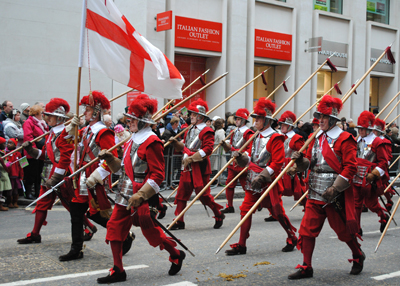
The Lord Mayor’s Show – the largest unrehearsed procession in the world – will be held on 10th November. This year’s procession – celebrating the election of the 685th Lord Mayor of London, Alderman Roger Gifford – will feature more than 6,500 people winding their way through the City of London in a three-and-a-half mile-long display including 22 marching bands, 125 horses, 18 vintage cars, 21 carriages, an original American stagecoach, a Sherman tank, a steamroller and a Japanese Taiko drum band. While there will be no fireworks after this year’s parade, following the success of last year’s trial there will be an early morning flotilla with the Lord Mayor conveyed in the barge QRB Gloriana from Vauxhall up the Thames to HMS President, just below St Katharine Docks, from where he will make his way to the Mansion House to join the procession as it heads first to St Paul’s and then on to the Royal Courts of Justice before returning (via a different route). There are no grand stand seats left but plenty of places you can watch it for free (for a chance to win free Grandstand tickets, head to the Lord Mayor’s Show Facebook page and ‘like’ it). We’ll be talking about this more next week, but in the meantime, for maps and details of a new smart phone app, head to www.lordmayorsshow.org.

Two prehistoric Japanese pots have gone on display at the British Museum. Loaned from the Nagaoka Municipal Science Museum, the pots date from the Middle Jomon period (3,500-2,500 BCE) and consist of a ‘flame’ and a ‘crown’ pot which were excavated in Nagaoka city. The pots form part of the Asahi Shimbun Displays in room 3 and will be there until 20th January. Meanwhile, continuing the Asian theme, an exhibition of more than 100 contemporary carved Chinese seals by artist Li Lanqing is on display in room 33 until 15th January. Admission to both is free. For more, see www.britishmuseum.org.

• On Now: Seduced by Art: Photography Past and Present. The National Gallery’s first major exhibition of photography, the display looks at the relationship between historical paintings and photography, both its early days in the mid-19th century and the work of contemporary photographers – in particular how photographers have used the traditions of fine art to “explore and justify” their own works. Almost 90 photographs are displayed alongside a select group of paintings for the show. Admission is free. Runs until 20th January in the Sainsbury Wing. For more, see www.nationalgallery.org.uk.

Famous Londoners – Grinling Gibbons…

A late 17th and early 18th century wood carver and sculptor, the curiously named Grinling Gibbons is remembered for his magnificent carvings in numerous English buildings including such London icons as St Paul’s Cathedral and Hampton Court Palace.

Not much is known about Gibbons’ early life. The son of English parents (his father was apparently a draper), he was born in Rotterdam in The Netherlands on 4th April, 1648, and, as a young man, is believed to have undertaken an apprenticeship as a sculptor in that country.

Around the age of 19, he moved to England – first to York and to Deptford in the south. It was the quality of his work which led diarist John Evelyn, having discovered Gibbons working on a limewood relief of Tintoretto’s Crucifixion in a small cottage near Deptford in early 1671, that led him to introduce him to Christopher Wren, the architect of the age, and fellow diarist Samuel Pepys and to eventually present him (and his relief) to King Charles II at Whitehall Palace on 1st March the same year.

But Gibbons’ work apparently failed to initially impress at court and it was only following his ‘discovery’ later that year by the court artist Sir Peter Lely that he began to receive major commissions.

It’s apparently not known when Gibbons married his wife Elizabeth and moved to London they were living there by 1672 and were having the first of their at least 12 children (while at least five of their daughters survived into adulthood, none of their sons did).

In 1672, they were living in an inn, called La Belle Sauvage or The Bell Savage, located on Ludgate Hill near St Paul’s, and, while Gibbons continued to maintain a workshop here into the 1680s, the family moved to Bow Street in Covent Garden around the end of the 1670s (the house here apparently collapsed in 1702 and was subsequently rebuilt in brick).

Gibbons, who was admitted to the Draper’s Company in 1672 and held various posts within it over ensuing years, reached the pinnacle of his success when he was made master sculptor and carver in wood to King William III in 1693, and was later made master carpenter to the king, then King George I, in 1719.

Having worked mostly in limewood, Gibbons, recently called the “British Bernini”, is known for his distinct and exuberant style which features cascading foliage, fruit, animals and cherubs. While he worked on numerous important buildings outside of London – including carvings in the Chapel Royal and king’s dining room at Windsor Castle, in a chapel at Trinity College in Oxford, at Blenheim Palace in Oxfordshire and a famous ‘carved room’ at Petworth House in Sussex – and beyond (he also created two presentation panels – known as the ‘Cosimo’ and ‘Modena’ panels which were sent to Italy as royal gifts), Gibbons is also noted for his work on a number of prominent buildings in London.

Among the buildings he worked on or in around London are the churches of St James’s in Piccadilly, St Mary Abchurch, St Michael Paternoster Royal and, famously, St Paul’s Cathedral (where he carved choir stalls, the bishop’s thrones and choir screen) as well as Hampton Court and Kensington Palaces.

While he is primarily remembered for his limewood carvings, Gibbons’ workshop was also responsible for sculpting statues, memorials and decorative stonework. A couple of the workshop’s statues can still be seen in London – one of King Charles II in Roman dress at the Royal Hospital in Chelsea and another of King James II outside the National Gallery in Trafalgar Square – while the magnificent Westminster Abbey memorial to Admiral Sir Clowdisley Shovell is also attributed to him.

Gibbons died at his Bow Street home on 3rd August, 1721, and was buried in St Paul’s Church in Covent Garden (his wife had been buried there several years before).

For more on Grinling Gibbons, check out David Esterly’s Grinling Gibbons and the Art of Carving.

What’s in a Name?…Trafalgar Square

It wasn’t until some time after Admiral Lord Nelson’s victory over the French fleet in the Battle of Trafalgar off the coast of Spain on 21st October, 1805, that the large public space in Westminster we now know as Trafalgar Square took its name.

Prior to the development of the square, much of the area it covers was occupied the King’s Mews – stables linked to the Palace of Whitehall – and was simply seen as part of the district known as Charing Cross (named for the memorial cross which stood close to where the equestrian statue of King Charles I now stands – for more on this, see our earlier post and follow the links).

Following the relocation of the Mews in the early 19th century, plans were drawn up by architect-of-the-age John Nash to redevelop the area while the square itself, completed in 1845, was designed by Sir Charles Barry (best known for his work on the Houses of Parliament).

The final design incorporated a statue of Admiral Lord Nelson atop a column, known as ‘Nelson’s Column’, in the centre – apparently against Barry’s wishes (see our earlier post for more on Nelson’s Column).

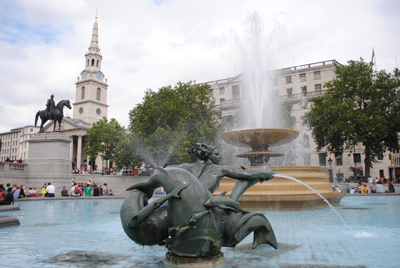
Originally designed with an upper terrace and a lower piazza linked by stairs at the eastern and western end of the terrace, the square contains two fountains on either side of the column – the current fountains were designed by Sir Edwin Lutyens in 1937-9 and replaced earlier ones.

It was originally suggested that the square be named King William IV Square but it was apparently architect George Ledwell Taylor who provided the alternative of Trafalgar Square in honor of Nelson’s great battle.

Bordered by significant landmarks including the National Gallery to the north, the church of St Martin’s-in-the-Fields to the north-east, South Africa House to the east and Canada House to the west, the square stands at the confluence of a number of major roadways including Whitehall, Strand, Charing Cross Road and The Mall.

Aside from the aforementioned statue of King Charles I, monuments within the square include Nelson’s Column along with plinths set in the four corners of the square. These bear statues of King George IV, Victorian military figures General Sir Charles James Napier and Major-General Sir Henry Havelock while the fourth plinth, located in the north-west corner, was originally intended to bear an equestrian statue of King William IV.

Instead, it was left empty for many years before the advent of the Fourth Plinth project under which a variety of contemporary artworks – most recently a massive sculpture of a boy astride a rocking horse – have occupied the space (you can see a picture of the current work in our earlier post here).

The square, once known as the home of thousands of pigeons before these were banished midway through last decade to allow greater public use of the space, also features the busts of three admirals – John Jellicoe, David Beatty and Andrew Cunningham, located against the north wall under the terrace.

There are also two statues on a lawn in front of the National Gallery – these are of US President George Washington and King James II. Curiously, the square also features a small pillar box in the south-east corner, referred to by some as the smallest police station in London.

A renovation project in 2003 pedestrianised the roadway along the north side of the square and installed a central stairway between the the upper and lower levels along with lifts, public toilets and a cafe.

For some more on the history of Trafalgar Square, see Jean Hood’s Trafalgar Square: A Visual History of London’s Landmark Through Time.

Around London – Museums at Night; Ballgowns at the V&A; Edward Lear plaqued; and, the Queen’s portrait at the NPG…

• It’s Museums at Night weekend which means its your chance to see some of London’s best museums after hours. Culture24’s annual event, which runs from 18th to 20th May, features more than 5o late openings and special events in London – from after dark visits to Aspley House, the former home of the Duke of Wellington, to the chance to hear about the history of ‘Bedlam’, one of the world’s oldest psychiatric facilities, at the Bethlem Archives & Museum and Bethlem Gallery, and a “Cinderella shoe” workshop at the Design Museum. As well as organisations like the British Museum and National Gallery, among the lesser known museums taking part are the Cuming Museum in Southwark, the British Dental Association Museum, and the Ragged School Museum in Mile End. For all the details, follow this link

Saturday sees the opening of a new V&A exhibition featuring more than 60 ballgowns dating from 1950 to the present day – the first exhibition to be held in the newly renovated Fashion Galleries. Among those gowns on display as part of Ballgowns: British Glamour Since 1950 will be royal ballgowns including a Norman Hartnell gown designed for Elizabeth, the Queen Mother, Catherine Walker’s ‘Elvis Dress’ worn by Princess Diana (pictured), and gowns worn by today’s young royals. There will also be gowns worn by celebrities including Sandra Bullock, Liz Hurley and Bianca Jagger and works by the likes of Alexander McQueen, Jenny Packham and a metallic leather dress designed by Gareth Hugh specifically for the exhibition. Runs from 19th May to 6th January. Admission charge applies. See www.vam.ac.uk for more. PICTURE: Victoria and Albert Museum, London

The man credited with popularising the modern-day limerick, Edward Lear, has been honored with a green plaque at his former house in Westminster. The Westminster Council plaque was unveiled on Saturday – what would have been his 200th birthday – at 15 Stratford Place where he lived from 1853 until 1869. Lear, who was born in Holloway and raised in Grays Inn Road, was famous for his work The Owl and the Pussycat, and as well as for his writings, was also noted as an artist and illustrator. Councillor Robert Davis reportedly had a go himself at a limerick in honour of the artisy: “There once was man named Lear, who lived in a spot close to here. This plaque unveiled today, is a fitting way, to pay tribute on his two hundreth year”.

• On Now: The Queen: Art and Image. Having been on tour across Britian, this exhibition features some of the most remarkable images ever created of the Queen opened at the National Portrait Gallery this week. Containing works by Cecil Beaton and Annie Leibovitz, Pietro Annigoni and Andy Warhol, the exhibition is the most wide-ranging exhibition of images in different media ever devoted to a single royal sitter. Highlights include full-length 1954-55 painting by Annigoni (pictured, right, it’s displayed with his 1969 portrait), Lucian Freud’s 2000-01 portrait and Thomas Struth’s recent large-scale photograph of both the Queen and the Duke of Edinburgh as well as a never previously loaned 1967 portrait by Gerhard Richter and a specially commissioned holographic portrait. Runs until 21st October. Admission charge applies. For more, see www.npg.org.uk. PICTURE: Queen Elizabeth II, Queen Regent by Pietro Annigoni, 1954-5. The Fishmongers’ Company

Around London – Europe’s oldest intact book at British Library; 100 days to the Games; world’s largest archaeological archive; the London Marathon; and, Turner at the National Gallery…

• The British Library has paid £9 million for a 7th century text, the St Cuthbert Gospel, which is also the oldest intact European book. The acquisition follows the library’s most successful fund-raising effort ever – it included a £4.5 million grant from the National Heritage Memorial Fund. The book – a Gospel of John bound in beautifully tooled red leather – was produced in north-east England in the late 7th century and was placed in the saint’s coffin after his death on the Isle of Lindisfarne in 698. It was retrieved when the coffin was opened at Durham Cathedral in 1104. The Gospel is on display in the Sir John Ritblat Treasures Gallery at the library in St Pancras and following a conservation review, it is anticipated it will soon be displayed with the pages open for the first time. There will be a public event celebrating the acquisition on 15th May. For more, see www.bl.uk/whatson/events/may12/index.html.

• London this week marked 100 days until the Opening Ceremony of the 2012 Olympic Games. This included unveiling the latest installation of the Olympic rings – made of 20,000 plants the 50 metre long rings are located in the Royal Botanic Gardens at Kew in the city’s west and can be seen from planes on the Heathrow flight path. The organising committee also announced the Red Arrows aerobatic display team will perform a nine-ship flypast in ‘big battle’ formation on the day of the Opening Ceremony (27th July) and stated that the games motto will be ‘Inspire a Generation’. For more, see www.london2012.com.

• The Museum of London’s archaeological archive – known as the London Archaeological Archive and Research Centre (LAARC) – is officially the largest in the world according to Guinness World Records. The archive contains more than five million artefacts and the records of almost 8,500 excavations dating back to 1830. Items in the archive include shoes dating back to Roman times, a 200-year-old set of false teeth, ‘witching bottles’ including one with human hair and toenails, and coffin plates from London’s cemeteries. The world record has been recorded as part of World Record London, a series of world record breaking events being held in the run-up to the Olympics. Others have included the Faberge Big Egg Hunt.

• Thousands of people are expected to take part in the Virgin London Marathon this Sunday. The 26.2 mile route starts in Blackheath, passes through Woolwich and Greenwich and crosses the Thames at Tower Bridge before looping around the east end of London, through Canary Wharf, and the west along The Highway (formerly known as The Ratcliffe Highway) and Embankment to Parliament Square, Birdcage Walk and finally to Buckingham Palace. The first London marathon was run in 1981. For more, see www.virginlondonmarathon.com.

• On Now: Turner Inspired – In the Light of Claude. The first major presentation of 17th century artist Claude Gellée’s influence on the English romantic artist J M W Turner, the exhibition focuses on Claude-inspired themes which run through Turner’s work including “the evocation of light and air in landscape, the effect of light upon water and his often radical reworking of contemporary scenes”. The display includes works from large scale oils on canvas through to leaves from Turner’s pocket sketchbooks. Interestingly, the exhibition also explores the story behind the so-called Turner Bequest – that on his death, Turner linked himself to Claude forever by leaving the National Gallery two pictures – Dido building Carthage (1815) and Sun rising through Vapour: Fishermen cleaning and selling Fish (before 1807) –  on condition that they were hung between two pictures by Claude, Seaport with the Embarkation of the Queen of Sheba (1648) and Landscape with the Marriage of Isaac and Rebecca (1648). Runs until 5th June. Admission charge applies. For more, see www.nationalgallery.org.uk.

Around London – Of a dramatic Boat Race; celebrating bluebells; Cockney slang; WT Stead; and, Titian’s early masterpiece…

 • Cambridge took the line honours over Oxford in this year’s Boat Race on the Thames in what has been billed as one of the most dramatic races in its 158 race history. The race was interrupted when a swimmer, described as an anti-elitist protestor, was spotted in the water and, following a restart near the Chiswick Eyot, the boat crews clashed oars and one of the Oxford crew lost his oar’s spoon. Cambridge pulled steadily ahead with Oxford an oar down and was declared the winner by four and a quarter lengths. The presentation ceremony was subsequently not held after Oxford’s bow man collapsed and was rushed to hospital where was reported to be recovering well. The win takes Cambridge’s victories to 81 compared to Oxford’s 76. For more, see http://theboatrace.org. (For more on the history of the Boat Race, see our entry from last year).

Epping Forest’s bluebells are out in force and to celebrate the City of London Corporation is holding a series of events including an art exhibition at The Temple in Wanstead Park. The exhibition, Out of the Blue, celebrates the bluebells of Chalet Wood and features a “miscellany of bluebell images, artwork, folklore and fairies”. A free event, it runs until 27th May. This Sunday the Temple will also host an art afternoon with local artist Barbara Sampson and on 29th April photographer Robert Good will hold a course on photography around the forest. Both are free events. For more details, see www.cityoflondon.gov.uk/epping.

• “Porky pies” (lies) is the most used Cockney phrase, according to a survey of Britons on their knowledge and use of Cockney. The Museum of London survey of 2,000 people, including 1,000 from London, also found that “apples and pears” (stairs) was the most well-known Cockney phrase and that while a majority of people knew what common phrases like “brown bread” meant (in this case dead), only small percentages of people used them. And while 63 per cent of respondents believed Cockney slang was crucial to London’s identity, 40 per cent were convinced it is dying out and 33 per cent were sad at its passing. Strictly speaking, a ‘Cockney’ is someone who was born within the sound of bow bells at the church of St Mary-le-Bow in Cheapside, but according to Alex Werner, head of history collections at the museum, “people from all corners of London identify themselves as being Cockney”. He said that while for many people “Cockney rhyming slang is intrinsic to the identity of London”, the research the Cockney dialect “may not be enjoying the same level of popularity”. The research found that among the least known Cockney rhyming slang phrases included “white mice” (ice), “donkey’s ears” (years), and “loop de loop” (soup). For more from the museum, see www.museumoflondon.org.uk.

• The life of influential newspaper editor and Titanic victim, William Stead, will be celebrated at a two day conference next week. Hosted by the British Library, in association with Birkbeck College and the University of Birmingham, the conference will feature 40 speakers from around the world. Stead, who was editor of The Pall Mall Gazette, was a controversial figure who is credited with being one of the inventors of the modern tabloid. He died on the Titanic‘s maiden voyage – the 100th anniversary of which is being marked this month. W.T. Stead: A Centenary Conference for a Newspaper Revolutionary takes place from 16th to 17th April, 2012. Tickets (£45 for one day or £85 for two days) can be booked by visiting the box office in the St Pancras building or phoning 01937 546546. The programme for the conference can be found at https://sites.google.com/site/stead2012/.

• On Now: Titian’s First Masterpiece: The Flight into Egypt. The National Gallery is hosting a new exhibition focused on the then young artist’s creation of the magnificent painting The Flight into Egypt in the 16th century. The artwork, lent to the National Gallery by the Hermitage Museum, St Petersburg, has recently been restored and the exhibition represents the first time the painting has been seen outside Russia since 1768 when Empress Catherine the Great purchased it in Venice. Admission is free. Runs until 19th August. For more, see www.nationalgallery.org.uk.

Around London – The Lord Mayor’s Show goes on; London 2012 Festival launched; dowry tradition lives on; and, Leonardo da Vinci at the National Gallery…

On Saturday the annual Lord Mayor’s Show will crawl its way across London’s Square Mile in a three mile long procession that will involve 123 floats and 6,200 people. The show (a scene from last year’s procession is pictured) is held each year as the first public outing of the newly elected Lord Mayor – this year it’s David Wootton, the City of London’s 684th Lord Mayor, who officially takes up his new office tomorrow (11th November). Organisers have said the procession will follow its usual route despite the protestors currently encamped outside St Paul’s. Leaving Mansion House, the official residence of the Lord Mayor, at 11am, it will make its way down Cheapside to St Paul’s Cathedral, where the new Lord Mayor will be blessed, before heading onto the Royal Courts of Justice, where the Lord Mayor swears an oath of allegiance to Queen Elizabeth II, and then returning to Mansion House. The the procession, the origins of which date back to 1215, will feature representatives of livery companies, educational and youth organisations, military units and other London-associated organisations and charities like St Bart’s Hospital. There will be a fireworks display at 5pm on the Thames between Blackfriars and Waterloo. For more information, see www.lordmayorshow.org.

• Organisers have unveiled plans for the London 2012 Festival, a 12 week nationwide cultural celebration of music, theatre, dance, art, literature, film and fashion held around next year’s Games. We’ll be providing more details in upcoming weeks and months but among the highlights in London will be a British Museum exhibition on the importance of Shakespeare as well as “pop-up” performances by actor Mark Rylance – both held as part of the World Shakespeare Festival, a musical tribute to the history of jazz at the Barbican by the London Symphony Orchestra and Jazz at the Lincoln Center Orchestra, an exhibition of the work of artist Damien Hirst at the Tate Modern and another on Yoko Ono at the Serpentine Gallery, and ‘Poetry Parnassus’ at the Southbank Centre – the largest poetry festival ever staged in the UK. The festival is the finale of the “Cultural Olympiad” – launched in 2008, it has featured a program of events inspired by the 2012 Olympics – and will see more than 10 million free events being held across the country. For more details, see www.london2012.com.

In a tradition which dates back to the late 1800s, three “poor, honest (and) young” women have been awarded a dowry by the City of London Corporation. Susan Renner-Eggleston, Elizabeth Skilton, and Jenny Furber have each received around £100 under the terms of a bequest Italian-born Pasquale Favale made to the City in 1882. Inspired by the happiness he found is his marriage to his London-born wife Eliza, Favale bequeathed 18,000 Lira to the City in 1882 and stipulated that each year a portion of the money was to be given to “three poor, honest, young women, natives of the City of London, aged 16 to 25 who had recently been or were about to be married”. To be eligible the women must have been born in the City of London or currently reside there.

• On Now: Leonardo da Vinci: Painter at the Court of Milan. Billed as the year’s blockbuster art event in London, this exhibition at the National Gallery focuses on Da Vinci’s time as a court painter in Milan in the 1480s-90s and features 60 paintings and drawings. Thanks to a collaboration between the National Gallery and the Louvre, they include two versions of the Virgin of the Rocks (it is the first time the two versions are being shown together). Other paintings include Portrait of a Musician, Saint Jerome, The Lady with an Ermine (an image of Cecilia Gallerani, mistress of Milan’s ruler at the time – Ludovico Maria Sforza, ‘Il Moro’) and Belle Ferronniere as well as a copy of Da Vinci’s painting, The Last Supper, by his pupil Giamopietrino. Runs until 5th February and an admission charge applies. For more, see www.nationalgallery.org.uk.

Around London – Website to showcase UK’s oil paintings; Arctic explorer John Rae gets Blue Plaque; sharing experiences of kindness; and Toulouse-Lautrec and Jane Avril hit the Courtauld…

• A new website has been launched to showcase the UK’s vast national collection of oil paintings. While the website, which is a partnership between the BBC, the Public Catalogue Foundation, and participating collections and museums, currently hosts around 60,000 works, it is envisaged that by the end of 2012 it will carry digitised images of all 200,000 oil paintings in the UK (in an indicator of how many there are, the National Gallery currently has around 2,300 oil paintings, about one hundredth of all those in the nation). The works on the site will eventually include almost 40,000 by British artists. The 850 galleries and organisations participating so far include 11 in London – among them the National Gallery, the Tate Gallery, the Victoria and Albert Museum, the Bank of England, the Imperial War Museum and Dr Johnson’s House. For more, see www.bbc.co.uk/arts/yourpaintings/

• Arctic explorer John Rae has had a Blue Plaque unveiled in his honor at his former home in Holland Park. Although his feats were relatively unsung in his lifetime, the explorer’s expeditions in the Canadian Arctic saw him travel 13,000 miles by boat and foot and survey more than 1,700 miles of coastline. He is also credited with having “signposted” the only north-west passage around America that is navigable without icebreakers. Rae, who died in 1893, lived at the property at 4 Lower Addison Gardens in Holland Park for the last 24 years of his life.

Transport For London is calling on Londoners to share experiences of “kindness” that they have witnessed or participated in while travelling on the Underground. Artist Michael Landy has created a series of posters which are calling on people to submit their stories. Some of the stories will then be shown at Central Line stations (the first four posters go up on 23rd July at stations including Hollard Park, Holborn and Liverpool Street). For more, go to www.tfl.gov.uk/art.

On the Olympic front, the City of London Corporation has announced Tower Bridge will be bedecked with a set of giant Olympic Rings and the Paralympic Agitos during the 45 days of next year’s Games. Meanwhile, the Corporation has also unveiled it will host next week the launch of a London-wide campaign to get people involved in sport and activity in the lead-up to the Games. More to come on that.

On Now: Toulouse-Lautrec and Jane Avril Beyond the Moulin Rouge. The Courtauld Gallery, based at Somerset House, is running an exhibition celebrating the “remarkable creative partnership” between Jane Avril, a star of the Moulin Rouge in Paris during the 1890s, and artist Henri de Toulouse-Lautrec. Lautrec created a series of posters featuring Avril which ensured she became a symbol of Lautrec’s world of “dancers, cabaret singers, musicians and prostitutes”. Runs until 18th September. See www.courtauld.ac.uk for more.


LondonLife – The visit of the American President…

President Barack Obama has been in London for the past two days, so Exploring London decided to take a break from our series on King James’ I’s London and instead, in honor of the president’s visit, take a look at where you’ll find some other US presidents in London.

First up, it’s President George Washington. A life-sized statue of the first US president stands outside the National Gallery on the north side of Trafalgar Square. It’s a replica of an eighteenth century marble statue by Jean Antoine Houdon which stands in the State Capitol building in Richmond, Virginia. A gift of the Commonwealth of Virginia in 1924.

Civil War President Abraham Lincoln stands looking toward Parliament Square and the Houses of Parliament (pictured). The statue dates from 1920 – it was originally proposed to put a statue of President Lincoln in Parliament Square to mark the 1915 centenary of the last time the US and Britain were at war but the plans were put on ice until several years later. The statue, a gift of the US government, is a replica of the Chicago Lincoln Memorial by Augustus Saint-Gaudens. (There is also a bust of Lincoln inside the Royal Exchange building).

Next in the chronology is President Franklin D. Roosevelt, whose statue can be found on the north side of Grosvenor Gardens (overlooked by the vast and soon-to-be replaced US embassy). This bronze was unveiled by the president’s wife, Eleanor, on the third anniversary of FDR’s death- 12th April, 1948. The statue depicts the president standing – apparently at Mrs Roosevelt’s insistence – instead of seated in a wheelchair.

Across the gardens stands another wartime president, President Dwight D. Eisenhower. A bronze by sculptor Robert Dean, this life-size statue was the gift of the US city of Kansas in 1989 and was unveiled by British PM Margaret Thatcher and US Ambassador Charles Price. It stands only a short distance from Eisenhower’s wartime HQ. (Grosvenor Square has also been home to then future US President John Adams who lived at number nine as the first US Ambassador to the Court of St James between 1786-97).

A bronze bust of the 35th president, President John F. Kennedy, can be found on the corner of Park Crescent and Marylebone Road. Unveiled by his brother, Senator Robert Kennedy, in 1965, it’s a copy of a bust located in the Library of Congress in Washington DC.

Among those mooted for the future is one of President Ronald Reagan (also in Grosvenor Square), planning permission for which was granted by Westminster City Council in 2009.

Around London – See museums after hours; the White Tower is white again; and, foundation stone for Bomber Command is laid…

• The annual Museums at Night event returns to London (and Britain) this weekend with hundreds of museums and galleries across the country opening their doors for special after hours events. Among those places in London taking part is the Churchill War Rooms, which is hosting a 1940s evening on Friday night, the London Canal Museum which is hosting”candle-lit tours, atmospheric lighting, and exhibits of art and film in dark places”, and the Petrie Museum of Egyptian Archaeology which is hosting a double hill of Hammer films and a “Gothic Egypt” trail. Other institutions taking part include the Sir John Soane Museum, the National Gallery, the Bank of England Museum, and Orleans House Gallery in Twickenham.  For more information about what’s on see www.museumsatnight.org.uk

King William the Conqueror celebrated at the Tower of London this week following the completion of a £2 million, three year project to clean the White Tower. First built shortly after the Norman Conquest of 1066, the tower had become blackened by pollution but has now been restored to its original color. For more information on visiting the Tower, see www.hrp.org.uk/toweroflondon/.

A foundation stone has reportedly been laid for a Bomber Command Memorial in Green Park. The memorial, which is due to be completed for the Queen’s Jubilee celebrations in 2012, will be constructed of Portland stone and will feature a nine foot tall statue of a bomber command aircrew. Bomber Command lost more than 55,000 airmen during World War II. The foundation stone was laid by the Duke of Gloucester. Supporters of the monument’s construction have included former Bee Gee Robin Gibb, Sir Michael Beetham, Marshal of the RAF, and  The Daily Telegraph newspaper which is running an appeal to help raise funds for the memorial.

Treasures of London – ‘The Ambassadors’

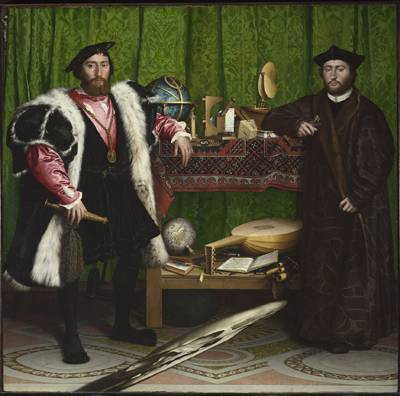
A stunning portrait on a grand scale, The Ambassadors depicts two influential figures from the 16th century – Jean de Dinteville, the then 29-year-old French ambassador to England and Georges de Selve, the then 25-year-old bishop of Lavaur and sometime French ambassador to the Emperor, the Venetian Republic and the Holy See.

The oil on oak work, which is housed in room four of the National Gallery and is also one of the images featured online as part of the Google Art Project, was painted by Hans Holbein the Younger in 1533 and is meant as a portrait to show the men’s power, learning and wealth – they are surrounded by objects which include celestial and terrestrial globes, a portable sundial, a lute (and its case), and books including one of hymns and another of arithmetic as well as richly decorated furnishings.

Yet there’s more to this painting than initially meets the eye – a closer look reveals a distorted skull in the foreground which, when viewed from the painting’s right-hand side comes into its proper perspective. A reflection on mortality perhaps?

And though no typically viewed as a religious work, there are also some striking religious overtones to this image including a broken string on the lyre – often seen as a Christian symbol of disharmony – and, partly hidden behind the curtain on the far left of the painting as you look at it, a crucifix hanging on the wall.

Holbein painted the work during his second stint in England while depicting life at the Tudor court. Among his most famous other images are one of King Henry VIII (held in the National Portrait Gallery) and another of Christina of Denmark (also in the National Gallery – painted to show Henry VIII the image of a potential future wife although the relationship never went any further than that).

PICTURE: Ng1314, Hans Holbein the Younger, Detail of Jean de Dinteville and George de Selve (‘The Ambassadors’), 1533 © The National Gallery, London.

WHERE: Room 4, National Gallery, Trafalgar Square (nearest tube stations Leicester Square and Charing Cross); WHEN: 10am to 6pm (Fridays 10am to 9pm); COST: Free; WEBSITE: www.nationalgallery.org.uk. The image is also available online as part of the Google Art Project here:www.googleartproject.com/museums/nationalgallery/the-ambassadors.

Around London – Year of the Rabbit celebrations; virtual art galleries; and, to the moon and back on ‘Boris bikes’

London will celebrate Chinese New Year this Sunday as it once again hosts the largest celebrations outside of Asia attracting some 250,000 people from around the globe. The event programme, which celebrates 2011 as the Year of the Rabbit, kicks off at 11am on the main stage in Trafalgar Square with firecrackers at noon, a Lion and Dragon performance at 1.10pm and dance and song during the afternoon culminating in a finale just before 6pm. There will also be a stage in Shaftesbury Avenue with performances throughout the day. Roads in the area will be closed for the event.

You no longer have to be in London to walk through the galleries of the Tate Britain or the National Gallery. Both institutions are among 17 around the world taking part in the Google Art Project which allows web surfers to virtually “walk” around the museum using the organisation’s Street View technology and turn 360 degrees to view the artworks in situ on the walls. The project also allows viewers to look through images of more than 1,000 artworks and, in addition, each institution has selected one artwork which then captured in “super high resolution” and then placed on line (Hans Holbein’s The Ambassadors‘ for the National Gallery, Chris Ofili’s No Woman, No Cry for the Tate). See www.googleartproject.com for more.

Cyclists have ridden the distance to the moon and back 13 times – 10 million kilometres – since the launch of Mayor Boris Johnson’s cycle scheme. Transport for London released figures this week showing riders have made more than 2.5 million journeys on the “Boris bikes” since the scheme was launched six months ago. The TfL has announced plans to expand the Barclays Cycle Hire scheme to new areas of east London including all of the Borough of Tower Hamlets, North Shoreditch, Bethnal Green, Bow, Canary Wharf, Mile End and Poplar by spring 2012. Almost 110,000 people are now signed up to the scheme. www.tfl.gov.uk.

The youngest Spitfire pilot in the Battle of Britain is to be granted the Freedom of the City of London in a special ceremony next month. Squadron Leader Geoffrey Wellum was awarded the Distinguished Flying Cross for his service in a front line squadron during the battle.