Where is it? #16

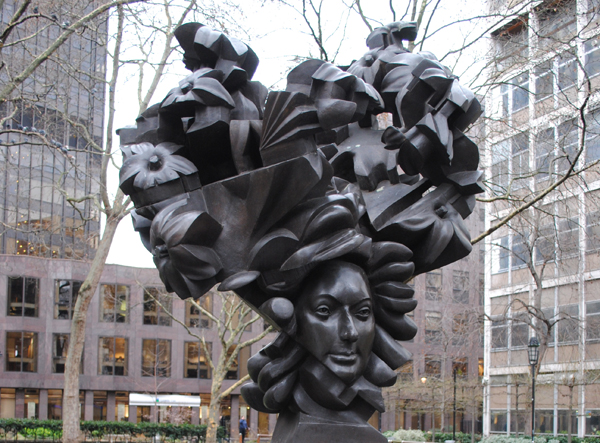
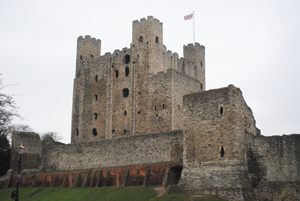
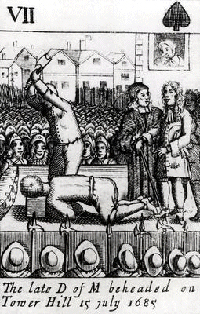
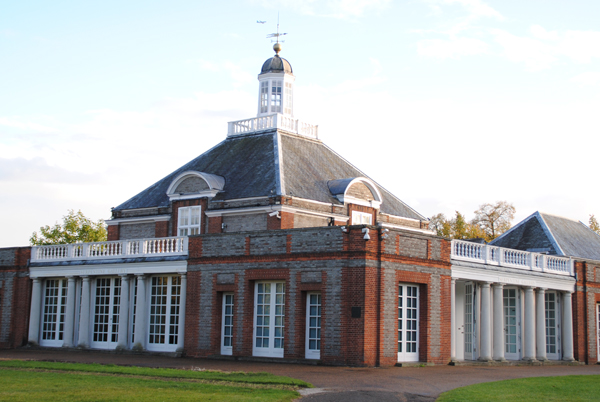
The latest in the series in which we ask you to identify where in London this picture was taken and what it’s of (or in this case who is the person named?). If you think you can identify this picture, leave a comment below. We’ll reveal the answer early next week. Good luck!

Thanks to those who had a guess at where and what this was and congratulations to Janet for correctly stating that it is located in Finsbury Avenue Square in the City of London’s Broadgate development. The group of bronze figures, located in front of the UBS building, dates from the 1980s and is the work of US sculptor George Segal. It is called Rush Hour and depicts office workers making the grim daily march to the office (or away from it!).

Lost London: Gates Special – Cripplegate

Originally the northern gate of the Roman fort constructed in about 120 AD, Cripplegate was rebuilt several times during the medieval period before finally being demolished in 1760 as part of road widening measures.

The origins of the gate’s name are shrouded by the mists of time but it has been suggested that it was named for the beggars or cripples that once begged there or that it could come from an Anglo-Saxon word crepel which means a covered walkway.

The name may even be associated with an event which took place there in 1100 when, fearful of marauding Danes, Bishop Alwyn ordered the body of Edmund the Martyr, a sainted former Anglo-Saxon king, to be tranferred from its usual home in Bury St Edmunds to St Gregory’s Church near St Paul’s in London so that it could be kept safe. It was said that when the body passed through the gate, many of the cripples there were miraculously healed.

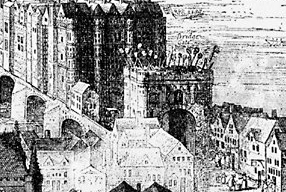
The gate (pictured here in an 18th century etching as it would have looked in 1663 in an image taken from a London Wall Walk plaque), which gave access in medieval times to what was then the village of Islington, was associated with the Brewer’s Company and was used for some time as a prison.

It was defensive works, known as a barbican, built on the northern side of the gate in the Middle Ages which are apparently responsible for the post World War II adoption of the name Barbican for that area of London which once stood outside the gate’s northern facade (the gates stood at what is now the intersection of Wood Street and St Alphage Garden).

The gate’s name now adorns the street known as Cripplegate as well as the name of the church St Giles Cripplegate, which originally stood outside the city walls. It is also the name of one of the 25 wards of the City of London. The original site of the gate is marked with a blue plaque.

Around London – Butler’s Retreat reopens in Epping Forest; Designs of the Year; and, Lucian Freud’s last work…

• Epping Forest’s historic Butler’s Retreat has reopened its doors as a cafe following a refurbishment project to restore the building to its former glory. The building was constructed in the 19th century and is one of the last remaining Victorian-era ‘retreats’ within the forest. Named for its 1891 occupier, John Butler, it was one of a number of retreats built to serve refreshments as part of the Temperance movement – said to have been “extremely popular” with visitors from the East End. The building, which now forms part of the Epping Forest visitor hub, is expected to host a range of events this summer and will have its opening hours extended with the slated opening of a restaurant upstairs in the evenings. Owned by the City of London, Epping Forest is the largest public open space in the London area, stretching across 12 miles from Manor Park in East London to a spot past Epping in Essex. The cafe, the refurbishment of which was carried out with funding provided via the Heritage Lottery’s Branching Out project, will be open from 9am to 5pm weekdays and 8am to 5pm weekends. For more on the cafe, see www.worldslarder.co.uk. For more on Epping Forest, see www.cityoflondon.gov.uk/eppingforest

• On Now – Designs of the Year Exhibition: The London Olympic Torch and the Duchess of Cambridge’s wedding dress are among 90 objects nominated as one of the “best designs in the world” in this year’s Design of the Year competition. The objects, which go on display at the Design Museum today, have been entered in seven categories – architecture, digital, fashion, furniture, graphics, product and transport – with winners to be announced on 24th April. Among the other objects nominated are a wind-propelled landmine detector, a pop-up cinema in Hackney, the London 2012 velodrome and the first Tesco virtual store. An admission charge applies for the exhibition which runs until 15th July.  For more information, see designsoftheyear.com.

On Now – Lucian Freud Portraits. The last work of the late artist Lucian Freud is on show for the first time in this exhibition at the National Portrait Gallery. The unfinished painting, Portrait of the Hound 2011, which depicts Freud’s assistant assistant David Dawson and his dog Eli, is a highlight of the exhibition which also includes works dating back as far as the 1940s. The 130 paintings and works on paper – which feature sitters including artists Francis Bacon and David Hockney along with the likes of Andrew Parker Bowles and Baron Rothschild – have been loaned from museums and private collections around the world. Runs until 27th May, 2012. Admission charge applies. See www.npg.org.uk.

10 London sites to celebrate Charles Dickens – 1. The Charles Dickens Museum

In the first of a new special series written in honor of the bicentenary of the birth of author Charles Dickens (he was born on 7th February, 1812), we take a look at the Charles Dickens Museum.

Housed in one of Dickens’ former London residences at 48 Doughty Street in Bloomsbury, this property is now the focal point for people wanting to find out more about the writer and his life as evidenced by the visit of Prince Charles and Camilla, the Duchess of Cornwall, on Tuesday to officially mark Dickens’ birth.

Dickens lived in the property from 1837 to 1839 and it was here that significant family events, such as the birth of two of his children – Mary and Kate – and the death of his wife Catherine’s 17-year-old sister Mary took place (Mary’s tragic death is believed to be the inspiration for that of the character Little Nell in the novel The Old Curiosity Shop). It was also at the property that he wrote some of his most famous novels, including Oliver Twist, Nicholas Nickleby, and The Pickwick Papers.

A growing demand for space, however, led Dickens to move his household to 1 Devonshire Terrace in 1839. The Doughty Street house meanwhile, the only one of Dickens’ London homes to have survived, remained a residential property but in 1923 it was threatened with demolition and subsequently acquired by the Dickens Fellowship. The museum opened there two years later.

The museum now claims to hold more than 100,000 Dickens-related artifacts. The house is displayed as it might have been when Dickens lived there – artifacts on display over four floors include his personal possessions and furnishings as well as manuscripts, letters, first edition copies of some of his books and portraits, including R.W. Buss’ spectacular (and unfinished) Dickens’ Dream, showing the author at his country home of Gads Hill Place in Kent surrounded by many of the characters that he had created.

It’s important to note that from 9th April, the museum will be closed as it undergoes a £3.2 million project, called Great Expectations, which will involve the restoration and expansion of the museum. It is expected to reopen in December this year in time to celebrate a Dickensian Christmas.

For more on events celebrating Charles Dickens and his works this year, see www.dickensfellowship.org or www.dickens2012.org.

WHERE: 48 Doughty Street, Bloomsbury (nearest Tube stations are Russell Square, Chancery Lane or Holborn). WHEN: 10am to 5pm Monday to Sunday (last admission 4.30pm) COST: £7 adults/£5 concessions/£3 children (under 10 free); WEBSITE: www.dickensmuseum.com.

LondonLife – A look back at Queen Elizabeth II’s reign…

In celebration of Queen Elizabeth II’s Diamond Jubilee (the 60th anniversary of her reign officially passed on Monday), the Victoria and Albert Museum is holding an exhibition of portraits of the Queen taken by the acclaimed late photographer Cecil Beaton, including this one of Queen Elizabeth II in Coronation Robes taken in June, 1953. The exhibition, Queen Elizabeth II by Cecil Beaton: A Diamond Jubilee Celebration, depicts the Queen in various roles – as princess, monarch and mother – and includes a number of never-before-seen photographs as well as excerpts from Beaton’s diaries and letters. Runs from tomorrow (8th February to 22nd April). For more, see http://www.vam.ac.uk.

Image: Copyright, Victoria and Albert Museum, London

LondonLife Special – Long-serving royals…

Today marks 60 years since Queen Elizabeth II ascended to the throne, making her Britain’s second-longest serving monarch. While the celebrations are yet to kick off in earnest (the Diamond Jubilee weekend will be officially held over the 2nd to 5th June), we thought we’d take a quick look at the top 10 longest-serving monarchs who were crowned at Westminster Abbey in London:

1. Queen Victoria – 63 years (20th June, 1837-22nd January, 1901)

2. Queen Elizabeth II – 60 years (6th February, 1952-current)

3. King George III – 59 years (25th October, 1760-29th January, 1820)

4. King James I (VI of Scotland) – 57 years (24th July, 1567-27th March, 1625)

5. King Henry III – 56 years (18th October, 1216-16th November, 1272)

6. King Edward III – 50 years (25th January, 1327-21st June, 1377)

7. Queen Elizabeth I – 44 years (17th November, 1558-24th March, 1603)

8. King Henry VI – 38 years (31st August, 1422-4th March,1461, and, 31st October, 1470-11th April, 1471)

9. King Henry VIII – 37 years (22nd April, 1509-28th January, 1547)

10. King Henry I – 35 years (3rd August, 1100-1st December, 1135)

Treasures of London – Painted Hall, Greenwich

Often described as the “finest dining hall in Europe”, the Painted Hall in Greenwich was originally designed to be the Royal Hospital for Seamen’s communal dining hall. 

But the domed hall, which forms part of King William Court – the image, right, is taken from the west end, wasn’t used as such following its completion in the mid 1720s – designed by Sir Christopher Wren and his assistant Nicholas Hawksmoor with spectacular interior paintings by Sir James Thornhill, it was deemed too grand for such a mundane purpose and instead the veteran seamen, who had moved their dining hall to the undercroft, acted as tour guides for those who would pay to see its splendour.

The paintings, for which Thornhill received his knighthood, took almost 20 years to complete. They were designed to show Britain’s naval power as well as a variety of royal subjects in their splendour. The Stuart dynasty are featured on the ceiling of the Lower Hall while the West Wall depicts the Hanoverians – King George I surrounded by his children and grandchildren including the future King George II. Thornhill himself is also present on the lower right hand section of the West Wall painting while in the background is the dome of St Paul’s Cathedral – a reference to Sir Christopher Wren.

The hall has since served a variety of purposes but among the most significant events to take place there was the lying in state of the body of Admiral Lord Nelson following his death in the Battle of Trafalgar in October, 1805. A plaque at the top of the hall marks the spot where the coffin stood.

Between 1834 and 1936, the Painted Hall served as the National Gallery of Naval Art during which more than 300 paintings around naval themes were displayed there (today these form part of the basis of the National Maritime Museum’s art collection).

After an extensive restoration, in 1939 it was again used as a dining room for officers attending the Royal Naval College and for other grand dinners, including one celebrating the formation of the United Nations in 1946.

It’s now available for hire and has also served as a film location – including for films such as The Madness of King George, Quills and the more recent film Pirates of the Caribbean: On Stranger Tides.

An appeal has been launched to restore the hall with the expected nine month, £450,000 restoration of the West Wall paintings slated to begin after the Olympic Games. To donate, head here.

WHERE: King William Court, Old Royal Naval College, Greenwich (nearest Docklands Light Rail station is Cutty Sark for Maritime Greenwich). WHEN: 10am to 5pm daily COST: Free; WEBSITE: www.ornc.org/visit/attractions/painted-hall.

Around London – ‘Cathedral of Middlesex’ to be opened in west London; Roman brothel token on display; wifi in Westminster and Kensington; and, looking at the Hajj at the British Museum…

• A medieval barn in west London, said to be the “Cathedral of Middlesex”, will open to the public in April. The Grade I listed Harmondsworth Barn was built in 1426 by Winchester College, who owned a manor farm at Harmondsworth, and was used to store grain. Nearly 60 metres long, the roof is held up by 13 massive oak trusses. In 2006, the barn was bought by an off-shore company who subsequently agreed to sell it to English Heritage following the issuing of a notice for emergency repairs. English Heritage say the barn, called the “Cathedral of Middlesex” by the late poet-laureate Sir John Betjeman, will now be “run by and for the local community”. “Harmondsworth Barn is one of the greatest medieval buildings in Britain, built by the same skilled carpenters who worked on our magnificent medieval cathedrals,” says Simon Thurley, chief executive of English Heritage. “Its rescue is at the heart of what English Heritage does – protecting this nation’s architectural treasures and helping people discover our national story through them. We will complete the repair of this masterpiece and working with local people, will open it to the public to enjoy.” For more, see www.english-heritage.org.uk. (Image: Copyright English Heritage; Photographer Boris Baggs).

The oldest Roman brothel token to have been discovered in London has gone on temporary display at the Museum of London. The token, which may be the oldest of its kind to have been found in Britain (or, indeed, even the only one of its kind ever found in Britain), was known as a spintria and depicts two reclining human figures on one side and the Roman numeral 14 on the other. It was found on the Thames foreshore near Putney Bridge by a mudlarker using a metal detector. Only the size of a 10 cent piece, its use remains something of a mystery – it may have been exchanged for sexual services or used as gaming piece. The token is on display at the museum until April. For more, see www.museumoflondon.org.uk.

Free wifi is being rolled out across Westminster, Kensington and Chelsea as part of deal between Westminster City Council, the Royal Borough of Kensington and Chelsea and network operator, O2. The network, installation of which began last month, is initially being rolled out in a limited number of areas but will eventually cover all of the boroughs and create the largest free wireless hub in Europe.

Now On: Hajj: journey to the heart of Islam. This exhibition at the British Museum is the first to focus on the pilgrimage to Mecca in Saudi Arabia – a central tenet of the Islamic faith. Organised in partnership with the King Abdulaziz Public Library in Riyadh, it’s based around three central themes: the pilgrim’s journey to Mecca with an emphasis on the major routes taken; the Hajj today and its associated rituals; and the origins and importance of the Hajj to Mecca. Objects featured in the exhibition include a seetanah which covers the door of the Ka’ba as well as gifts offered to the sanctuary and souvenirs taken back home. It’s the first of three exhibitions at the British Museum focused on spiritual journeys. Runs until 15th April. Admission charge applies. For more, see www.britishmuseum.org.

10 curiously named churches of London – 10. St Olave Hart Street

One of a few London churches to have escaped the Great Fire of 1666 (the flames are said to have come within 100 metres before the wind changed direction), St Olave Hart Street is named after the patron saint of Norway, St Olaf – a figure more known for his ability as a warrior than as a saint.

King Olaf II was King of Norway in the early 11th century and an ally of the Saxon King, Ethelred the Unready. The Norwegian king won the thanks of the English after he fought alongside Ethelred against the Danes in 1014 in what some refer to as the Battle of London Bridge.

According to some, the church was built on the site of where the battle was fought – many also believe the battle was also the inspiration for the nursery rhyme, London Bridge Is Falling Down, for it was during that battle that Olaf, who was helping Ethelred retake London, is credited with using his longships to pull down London Bridge in a effort to thwart the Danish occupiers.

The church, meanwhile, was rebuilt a couple of times in the Middle Ages, when it was said to have been known as St Olave-towards-the-Tower. The church which now stands on the site was built in 1450 with the distinctive red brick on the tower added in the early 18th century.

Having survived the Great Fire in 1666, the church was not so fortunate during the Blitz when it was struck by German bombs. It was subsequently restored with King Haakon VII of Norway attending the re-opening in the mid-1950s (there is a stone laid in front of the sanctuary which he brought from Trondheim Cathedral).

Other features inside include a recently returned 17th century bust of a prominent physician Dr Peter Turner – part of a monument which went missing after World War II, it resurfaced at an auction in 2010.

The church’s most famous parishioner was the 17th century diarist Samuel Pepys who lived and worked in the nearby Naval Office (for more on Pepys see our earlier entry here). The door through which he would have entered the church is marked with a 19th century memorial.

Pepys and his wife Elizabeth are both buried in the church (the memorial Pepys commissioned for her is still there) as is his brother John. Samuel Pepys’ life is commemorated at a service held close to the day he died – 26th May – each year.

Others associated with the church include Sir William Penn, an admiral and father of the William Penn who founded Pennsylvania in what is now the United States, and Charles Dickens, who gave it the name “Ghastly Grim” thanks to the skulls above its Seething Lane entrance.

St Olave’s is also the chapel of the The Clothworker’s Company, The Worshipful Company of Environmental Cleaners and Trinity House, a charitable organisation dedicated to the safety, welfare and training of mariners established by Royal Charter from King Henry VIII in 1514.

WHERE: Corner of Hart Street and Seething Lane in the City (nearest Tube stations are Tower Hill and Monument). WHEN: See website for detailsCOST: Free; WEBSITE: www.sanctuaryinthecity.net/St-Olaves.html

LondonLife – The Ceremony of the Dues…

The Constable of the Tower of London, General Lord Richard Dannatt, was presented with a barrel of wine in the Ceremony of the Constable’s Dues by the commander and crew of the Royal Navy destroyer, the HMS Liverpool,  last Saturday. The annual ceremony dates back to the 14th century and relates to the right of the tower’s constable to demand tolls from vessels on the Thames on behalf of the king. Previous offerings have included  barrels of rum, oysters, mussels and cockles. The HMS Liverpool, commanded by Colin N O Williams, was berthed at West India Docks before the ceremony and the wine escorted to the Tower where, after being challenged by Yeoman Warders it was delivered to the constable at the Queen’s House. The ship is to be decommissioned in spring after 30 years of service in which it saw service in Iraq, the Caribbean and during the recent Libyan conflict. For more on the Tower of London, see www.hrp.org.uk/TowerOfLondon/

PICTURE: Courtesy of Historic Royal Palaces

Where is it? #15

The latest in the series in which we ask you to identify where in London this picture was taken and what it’s of (or in this case who is the person named?). If you reckon you know the answer, leave a comment below. We’ll reveal the answer early next week. Good luck!

Of course, as those below noted, this is Admiralty Arch, an ornate archway which stands between The Mall and Trafalgar Square. Commissioned by King Edward VII to honor the memory of his mother, Queen Victoria, it was designed by Sir Aston Webb and completed in 1912. Named for the fact that it joins the Old Admiralty Buildings in Whitehall, the structure contains office space and up until last year were occupied by the Cabinet Office. It is currently on the market with a reported price tag of £75 million. Mooted future uses include it being transformed into a swanky hotel.

10 curiously named churches of London – 9. St Michael Paternoster Royal

This triple-monikered church was first recorded in the 1200s. Far from unique in its dedication to the Archangel St Michael (there were apparently seven churches which were dedicated to him before the Great Fire), it was distinguished from the others by the name Paternoster Royal.

Surprisingly, the name has nothing to do with royalty or the clergy, at least not directly. The name Paternoster comes from the church’s location on what was Paternoster Lane (it’s now College Hill) – it was named for the number of paternoster or rosary seller that were based there.

The name Royal, meanwhile, is a little bit more obscure. First applied in the 1300s, it apparently comes from the close proximity of another street called Le Ryole which was itself a corruption of the French town of La Reole in the wine districts near Bordeaux. The street is believed to have been given the name thanks to the number of wine merchants who traded there.

Like other London churches, this one has been rebuilt several times – notably after the Great Fire of London (to the designs of Sir Christopher Wren) and again after World War II during which the church was all but destroyed by a V1 flying bomb. Since its reopening in 1968 it has served as the international headquarters of the Christian organisation, the Mission to Seafarers, which supports chaplains working in ports around the world.

The walls date from Wren’s time and the stone steeple, which wasn’t completed until 1717, is the work of Nicholas Hawksmoor. The interior features carved figures of Moses and Aaron which stand before the reredos – these apparently came from All-Hallows-the-Great (demolished in 1894) as did the chandelier which bears the words ‘Birmingham 1644’).

High profile parishioners over the years have included the four time Lord Mayor of London, Dick Whittington (see our earlier post on him) – he paid for a substantial extension of the church and founded a college of priests there (it’s from this college, which was dissolved in the mid-1500s and then re-established soon after, that College Hill is believed to have derived its name) as well as an almshouse next door.

Whittington and his wife were both buried inside but he was apparently exumed since several times and the location of his body is now unknown. There’s a stained glass window depicting Whittington and his famous cat inside and the gardens just outside also bear his name.

London Pub Signs – The Mayflower

Located on the Thames waterfront in Rotherhithe, The Mayflower’s history is intertwined with that of the more famous ship of the same name.

For it was from a quay near the pub (then named The Shippe) that in July, 1620, Captain Christopher Jones embarked upon the vessel, The Mayflower, and set sail for Southampton to load supplies before boarding the Pilgrim Fathers and making the journey to what is now the United States of America, landing in Plymouth, Massachusetts, on 21st December of that year.

Captain Jones was to return to Rotherhithe the following year and died shortly after. He and the ship’s co-owners are buried in an unmarked grave in the nearby churchyard of St Mary’s where a modern monument to Jones has been erected.

The pub, meanwhile, was rebuilt the following century – in 1780 – and renamed the Spread Eagle and Crown. It took on the name of Mayflower following a restoration in 1957, thanks to its associations with the historic voyage of The Mayflower.

Now part of the Greene King family of pubs, inside the building features oak beams and wooden panelling and boasts fine views of the Thames from an outside deck.

Lost London: Gates Special – Bishopsgate

Another of London’s gates which had its origins in Roman times, it was built as the city exit for Ermine Street which ran all the way to York.

The gate is believed by many to have taken its name from Bishop Erkenwald, a seventh century Anglo-Saxon Bishop of London who is said to have ordered the gate’s reconstruction on the gate’s Roman foundations.

Bishopsgate – the site of which is marked by a bishop’s mitre attached to the facade of a building near the junction of Wormwood Street (pictured) – was rebuilt several times over the centuries (its first known mention was in the 12th century). This included in the 1470s when it is said to have been rebuilt by Hansa merchants who did so apparently in return for exemptions from tolls (or, according to some, other trade privileges).

The gate – which was known for having the heads of traitors displayed on spikes upon its top – took its final form in 1735 before it was finally demolished along with several other London gates in 1760 as part of road widening measures.

The name Bishopsgate is remembered in the street of the same name as well as one of the City of London wards. Among the notable people associated with Bishopsgate are William Kemp, an Elizabethan comic actor who, in a remarkable feat, is said to have performed a Morris dance starting at the gate and finishing in Norwich.

10 curiously named churches of London – 8. St Lawrence Jewry

The reason for the name of this church, founded in 1136, may seem obvious – it was associated with London’s Jewish community, thanks to its location on the edge of the area in which they lived (this area was centred on the street just to the south still known as Old Jewry).

What is perhaps more amazing may be the fact that the name stuck despite the expulsion of all Jews from London in 1291, the name was still used to distinguish it from other churches.

The church – named in honor of St Lawrence, a Roman era martyr who was slow grilled over a fire – was among those consumed in the Great Fire of London and rebuilt by Sir Christopher Wren afterwards. This new church had the honor of being reopened by King Charles II in 1677 – it was badly damaged in the Blitz before being rebuilt by Cecil Brown to Wren’s original design.

Located just off Guildhall Yard – home of the City’s authorities – St Lawrence Jewry is the official church of the Corporation of London and as such hosts a number of special services for the Lord Mayor and Aldermen during the year. Some 11 livery companies have links with the church – among them are those of tallow chandlers, loriners, girders, haberdashers and actuaries.

Worth noting on the inside is the painting of the martyrdom of St Lawrence – this survived the Blitz along with the tower and outer walls – and the many beautiful stained glass windows, painstakingly restored after World War II. There’s also a pond, complete with fish, outside the main entrance.

WHERE: Guildhall Yard (nearest Tube stations are St Paul’s, Bank and, a little further off, Moorgate and Mansion House). WHEN: 8am to 6pm Monday to FridayCOST: Free; WEBSITE: www.stlawrencejewry.org.uk.

Where’s London’s oldest…music hall?

Wilton’s Music Hall  seems to be regularly making news these days so the revelation that it’s London’s oldest (in fact, according to the venue’s website, it’s the oldest surviving grand music hall in the world) probably comes as no surprise.

The hall, located in Graces Alley, Whitechapel, started out life as a pub which stood in the middle of a row of terrace houses. Named the Prince of Denmark, it is said to have had the first mahogany counters in London (hence the ‘Mahogany Bar’ at the front of the music hall today) and incorporated a concert room built at the rear of the ground floor.

The building was taken over by John Wilton in the 1850s. He also bought up the neighbouring terrace homes and subsequently built the grand music hall which still stands today – one of what were then a new generation of large music halls which appeared in London in the mid to latter part of the 19th century but had all but disappeared by 1900.

Wilton’s Music Hall opened on 27th March, 1859, and continued to operate under Wilton’s management for the next couple of decades. In 1877 it was badly damaged in a fire an rebuilt the following year.

Ten years later, however, the Wesleyan Mission took over the building and used it as a hall – dockers were served meals here during their first ever strike in 1889, it was used as a safe house during the so-called Battle of Cable Street of 1936 in which police clashed with protestors opposing a march by the British Union of Facists, and during World War II it was used as shelter for people bombed out of their homes.

The Methodists left in the 1950s and in 1964, the building was scheduled for demolition. Thanks to the intervention of poet John Betjeman, however (he led a campaign to prevent its destruction), the hall was saved. While it’s been undergoing restoration work ever since, more work is still required and the hall is still looking for donations to help fund it.

As well as operating once again as a music venue, it has since appeared in numerous films including Chaplin, The Krays, and the latest Sherlock Holmes film – Sherlock Holmes: A Game of Shadows.

There is a more detailed history of Wilton’s Music Hall at www.arthurlloyd.co.uk/Wiltons.htm, a music hall and theatre site. Wilton’s website can be found here.

Treasures of London – Big Ben…

Often used to describe the clock on the Houses of Parliament (or the tower in which it is located), the name Big Ben was actually first given to the bell that resides within.

Officially known as the Great Bell, it is believed the popular nickname of Big Ben came from Sir Benjamin Hall,  First Commissioner for Works (there is an alternative theory that it was named after Ben Caunt, a popular heavyweight boxer in the 1850s but the parliamentary website describes this as “unlikely”).

The initial bell intended for the clocktower of the Houses of Parliament was cast by Warners of Norton, near Stockton-on-Tees, in August, 1856. Transported to London, it was tested in Palace Yard (where a clock tower had stood in medieval times) but a crack appeared during testing and so the bell had to be recast.

With Warners apparently asking too much for the recasting, George Mears at the Whitechapel Bell Foundry was appointed instead. The new bell was cast on 10th April, 1858.

With a diameter of 2.7 metres, the bell was too big to fit up the clocktower’s shaft vertically so it was turned on its side and the 13.7 tonne bell was winched up to the belfry in October that year. Four quarter bells, which chime on the quarter hour and varying in weight from 1.1 to 4 tonnes, were already in place (interestingly, all of the bells are fixed in position and struck on the outside rather than being allowed to swing and have a hammer strike the inside).

Big Ben debuted on 11th July, 1859 (the clock had been started on 31st May), but in September that year the second bell also cracked. It took four years to find a solution (during that time, the bell was struck on the fourth quarter bell) and it was the Astronomer Royal, Sir George Airy, who found it.

The solution involved turning the bell a quarter turn so the hammer didn’t restrike the crack site and replacing the hammer with a lighter one (the current hammer still weighs 200 kilograms!). A small square was also cut into the bell’s crack to prevent it spreading.

Apart from occasional stoppages, the bell has struck ever since.

For more on Big Ben, visit www.parliament.uk/bigben. Tours are only available to UK residents and can be arranged via local MPs (see here for more) or there are virtual tours for those who either don’t live in the UK or can’t get there (see here for more).

IMAGE: Big Ben with a quarter bell in the fourground. PICTURE: Courtesy of UK Parliament.

10 curiously named churches of London – 7. St Margaret Pattens

It’s not often you’d come across a church named after a type of shoe, but that’s the case with the church of St Margaret Pattens.

Located in Eastcheap, a church dedicated to St Margaret – a saint who was martyred in Antioch in the Middle East – has stood on the current site for at least 900 years. The earliest reference dates from 1067 and the church was rebuilt at least once in the medieval period, with the costs of construction apparently partly funded out of gifts presented to a crucifix or rood which stood in Rood Lane close to the church.

It’s only since the 17th century, however, when the church was rebuilt to the design of Sir Christopher Wren after the Great Fire of London, that it took on the name ‘Pattens’ to distinguish itself from other churches dedicated to St Margaret.

Pattens were wooden undershoes which were trapped beneath normal footwear and raised the wearer above the street, allowing them to walk across muddy roads and still arrive at their destination cleanshod. This footwear was apparently made and sold near which the church was located.

The trade of pattenmaking, incidentially, died out as streets became paved – according to the church’s website, the last pattenmaker died in the 19th century. There’s still a sign in the church asking women to remove their pattens before entering.

It’s worth noting before we move on that there is an alternative theory as to the origins of the name – this is that it commemorates a benefactor, possibly a canon at St Paul’s named Ranulf Patin – but it’s the former interpretation which is more widely accepted.

St Margaret Pattens, which was united with that of St Gabriel Fen after the latter was destroyed in the Great Fire, was damaged by bombing in World War II but was restored in the mid 1950s.

While the church lost many of its valuables during the Reformation (with the exception of a silver gilt communion cup dating from 1545 – on loan to the Victoria & Albert Museum), notable features inside include a memorial to King Charles I (since 1890, the king has been remembered in a special service each year held on the nearest Thursday to the date of his execution – 30th January) and a Royal Stuart Coat-of-Arms believed to be those of King James II.

There’s also a reredos containing a painting by Italian Carlo Maratta (1625-1713), two unusual canopied pews reserved for churchwardens, an hourglass dating from 1750 used to time the sermons, and a bell which dates from before the Great Fire. It’s also possible to view a set of pattens.

Among those who have been associated with the church is famed medieval Lord Mayor of London, Dick Whittington, apparently at one time the church’s patron (you can see our earlier post on him here), as well as livery companies including, as one would expect, the Worshipful Company of Pattenmakers, and the Worshipful Company of Basketmakers.

WHERE: Corner of Eastcheap and Rood Lane (nearest Tube stations are Monument, Bank and Tower Hill). WHEN: Weekdays from 10.30am (check website for services)COST: Free; WEBSITE: www.stmargaretpattens.org.

Famous Londoners – William Hogarth

An artist with a social conscience, William Hogarth’s sketches and paintings summed up much of what was rotten with 18th century England – the society in which he lived – much as Dickens’ writing did in the following century.

Hogarth was a native Londoner – he was the son of Richard Hogarth, a Latin teacher and publisher, in Smithfield in 1697. Despite the ups and downs of his father’s fortunes (during Hogarth’s childhood, Richard Hogarth was confined to the Fleet Prison for debt for five years following an unsuccessful venture running a coffee house), at the age of 16 William was apprenticed to an engraver named Ellis Gamble.

Following his apprenticeship, he set up his own shop in 1720 and it was at this time that he started producing political satires. Hogarth was also painting  and around this time met with artist Sir James Thornhill. He became a regular visitor to Thornhill’s art academy in Covent Garden and their friendship grew, so much so that Hogarth eventually married Thornhill’s daughter Jane in 1729.

In the early 1730s, having established himself as a painter – both of portrait groups and some early satirical painting – Hogarth turned to painting his ‘moral tales’, the first of which, A Harlot’s Progress, was published in 1732 and tells the story decline of a country girl after coming to London. It was followed by A Rake’s Progress in 1733-35 (now at the Sir John Soane’s Museum).

In 1735 Hogarth was also successful in lobbying to have an act passed to protect the copyright of artistic works – it was unofficially known as “Hogarth’s Act”. The same year he also established St Martin’s Lane Academy – a school for young artists and a guild for professionals.

In the late 1730s, Hogarth turned his hand to individual portraits of the rich and famous. Among his most famous works at this time is a magnificent portrait of Captain Thomas Coram (founder of the Foundling Hospital – it can still be seen at what is now the Foundling Museum), and another of actor David Garrick as Richard III for which he was paid the substantial sum of £200, an amount he apparently claimed was more than any other artist had received for a single portrait.

In 1743, Hogarth completed his landmark work Marriage a-la-mode, a series of six paintings which can now be seen at the National Gallery. He was also painting historical scenes – like Moses brought before Pharoah’s Daughter (for the council room of the Foundling Hospital) and Paul before Felix (for Lincoln’s Inn). In 1747, he published a series of 12 engravings, Industry and Idleness, which tells the parallel stories of two apprentices – one successful, the other not – and this was followed by a series of prints such as Beer Street, Gin Lane, and The Four Stages of Cruelty illustrating some of the less savory aspects of everyday life.

Other works completed around this time included The March of the Guards to Finchley – which looks back to the mid-1740s when the Scottish Pretender’s Army was believed to be about to threaten London, The Gate of Calais – which draws on Hogarth’s own experience of being arrested as a spy when he visited France in 1748, and the Election series – four painting which take for their subject the Oxfordshire election of 1754.

There were some clouds on his horizon at this time with unfavourable criticism of his works and beliefs about art but even as he was engaging in a robust debate with critics of his works (largely through a written work he produced called The Analysis of Beauty), Hogarth was appointed in 1757 to the post of Sergeant-Painter to King George II (he commemorated the event in a painting).

Hogarth ran into further trouble in his later years with works deliberately created to provoke – among the more famous was The Times, a work which led to a breach in his friendship with influential MP John Wilkes who then launched a personal and devastating attack on Hogarth in his newspaper The North Briton. Hogarth responded with a non-flattering engraving of Wilkes.

His last work – The Bathos, an apocalyptic piece – seems to capture his gloomy mood at the time, and having suffered a seizure in 1763, Hogarth died at his house in Leicester Fields on the 25th or 26th October, 1764, possibly of an aneurism. Buried in the churchyard of St Nicholas in Chiswick, he was survived by his wife Jane to whom he left his properties – these included his country home in Chiswick, now known as Hogarth’s House. She made her living reprinting his works until her own death five years later.

Hogarth’s legacy lies in the impact of his works which not only attacked some of the evils of his day but have since inspired countless artists and been adapted in all manner of artistic endeavours over the ensuring centuries. Hogarth’s works can still be seen at various galleries around town – including that of the Foundling Museum – and there is a fine statue of him and his pug dog, Trump, in Chiswick High Road (pictured) as well as a bust in Leicester Square.

Lost London: Gates Special – Aldgate

Once the eastern-most gateway into London, Aldgate is another of London’s gates which dates from Roman times.

The gate, which stood over the short street in the City now simply known as Aldgate, was rebuilt several times during the Middle Ages before, thanks again to the need for road widening, it was demolished in 1761.

Some sections of the gate were apparently taken to Bethnel Green, just to the east, where they were rebuilt as an addition to a 17th century mansion known as Aldgate House.

The name Aldgate is generally thought to mean ‘Old Gate’ but alternative theories suggest it derives from ‘Ale Gate’ (a connection with a local alehouse perhaps?) or ‘All Gate’ (that, is, all are free to enter).

The most famous person associated with the gate is the Middle English writer Geoffrey Chaucer – he lived in apartments above it for more than 10 years – from 1374 to 1386 – while working as a customs official.

Aldgate is also one of the wards of the City of London.

PICTURE: An artist’s impression of how Roman Aldgate may have looked as seen on a plaque marking the site of the former gate (part of a series of plaques on the former London Wall Walk).