Lost London – Queenhithe…

Not, strictly speaking, lost, Queenhithe – a dock on the north bank of the Thames – is nonetheless these days merely a shadow of its former self.

There has been a dock here since Saxon times when it is recorded that King Alfred (he of ‘The Great’ fame), established a harbour here in 883. It was then known as Ethelred’s Hythe (the Ethelred being that of his brother-in-law and ‘hythe’ being a Saxon word for a trading shore where goods could be traded directly out of boats).

Queenhithe took its name from Queen Matilda, the wife of King Henry I, who was granted dues from goods being traded at the dock in the early 1100’s – a right which was later inherited by future English queens.

The dock reached the peak of its popularity in the 13th century when it became the principal site for the landing of grain and other food supplies to feed London but in the 15th century, the dock’s importance waned as other docks downstream, better suited to larger watercraft, took over much of its trade.

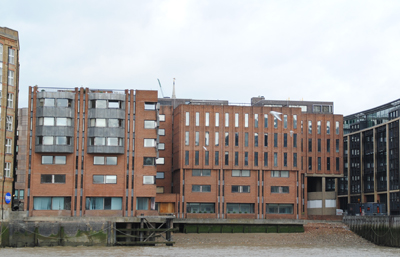
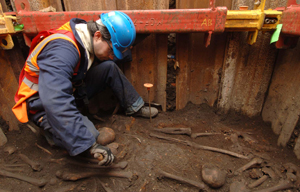
Remains of the wooden timbers which in medieval times lined the Thames waterfront have been found here. The inlet for Queenhithe’s harbour (pictured above) is one of few left on The Thames.

The name these days gives itself to Queenhithe street (which leads to the inlet) and the Queenhithe Ward, one of 25 wards in the City of London. There was also a former church known as St Michael Queenhithe – it was destroyed in the Great Fire of 1666, rebuilt to the designs of Sir Christopher Wren and then demolished in the late 19th century.

Around London – Cecil Beaton at the IWM; a night of bicycles at the Design Museum; and, Dickens and the Foundling…

A major new exhibition featuring stunning images captured by the late renowned society and fashion photographer Cecil Beaton during World War II opens at the Imperial War Museum in Lambeth today. Cecil Beaton: Theatre of War features some of the 7,000 photographs the photographer took between 1940 and 1945 with many of them exhibited for the first time. The photographs were taken in an array of locations – from Britain and Europe to the Middle East and Africa, India, Burma, China and the US – and depict everything from “ordinary” people in civilian life through to some of the era’s most famous military leaders. The exhibition will also look at how the war affected Beaton personally including his own brushes with death including in a major air crash and suffering from the likes of dengue fever and dysentery. Admission charge applies. Runs until 1st January. For more, see www.iwm.org.uk.

• A celebration of all things bicycle will be held at the Design Museum tomorrow (Friday, 7th September) night. Bike V Design, which kicks off at 6.30pm, will feature talks exploring the design of bikes, a mini cinema and live performances including BMX stunts and circus trick cycling as well as a demonstration of saddle manufacturing. Visitors are encouraged to bring their own bikes or enjoy the selection of bespoke bicycles on display. The night is being held to coincide with Designed to Win, the museum’s current exhibition exploring the tension between sport and design. An admission charge applies. For more, see www.designmuseum.org.

• On Now: Dickens and the Foundling. In case you’ve missed it, this exhibition at the Foundling Museum in Bloombury explores the relationship between the writer and the Foundling Hospital through a series of objects selected for display by six people with an interest in Dickens including actress Gillian Anderson, Dickens’ descendent Mark Dickens, comedian Armando Iannucci, Camden councillor Tulip Siddiq, poet Lemn Sissay and journalist Jon Snow. Among the objects on show are a letter from Dickens to the editor of The Times in which he objects to public hangings, the writing desk at which Dickens wrote what we have of the unfinished The Mystery of Edwin Drood, and a manuscript page from Oliver Twist, written when Dickens lived in a house at nearby Doughty Street. The exhibition runs until the end of October. Free with museum admission. For more, see www.foundlingmuseum.org.uk.

LondonLife – John Donne at St Paul’s Cathedral…

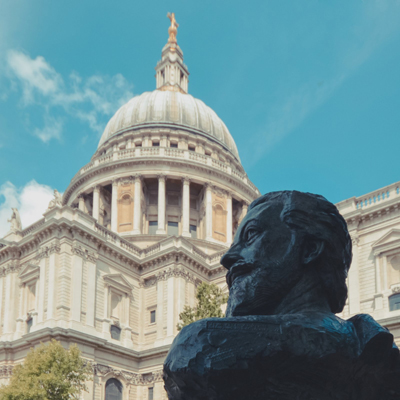
A new bust of priest and poet John Donne was unveiled outside St Paul’s Cathedral earlier this year. Donne was made  Dean of St Paul’s in 1621, a position he held until his death 10 years later. He was subsequently buried in Old St Paul’s Cathedral and a memorial to him – a likeness apparently based on a drawing of him in his shroud – was the only monument to survive the Great Fire of London in 1666. It’s still inside the cathedral. The new bronze bust, located in the garden to the south of the cathedral, was the work of artist Nigel Boonham and has Donne looking east towards his birth place in nearby Bread Street. The text “Hence is’t, that I am carried towards the West/This day, when my Soul’s form bends to the East” – taken from the poem Good-Friday, 1613, Riding Westward – is inscribed underneath the bust. Commissioned by the City of London, the sculpture was unveiled in June by the artist and Professor Peter McCullough, one of the cathedral’s Lay Canons. For more on St Paul’s, see www.stpauls.co.ukPICTURE: Graham Lacdao / The Chapter of St Paul’s Cathedral. 

Where is it? #41….

The latest in the series in which we ask you to identify where in London this picture was taken and what it’s of. If you think you can identify this picture (and try and be as precise as possible), leave a comment below. We’ll reveal the answer early next week. Good luck!

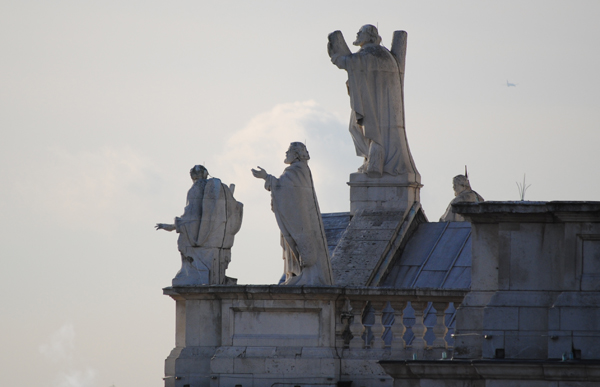
Yes, you guessed it, these are indeed the 3.7 metre high statues which sit above the south transept of St Paul’s Cathedral. The statues include those of St Andrew and St Thomas, both of which are attributed to Caius Gabriel Cibber (1630-1700) and Grinling Gibbons (1648-1721). We had originally said they were the work of Francis Bird (1667-1731), who also completed the famous panel depicting the Conversion of St Paul on the cathedral’s west front and the original version of the statue of Queen Anne outside the main entrance (more on that another time), but while he was responsible for other statues on the cathedral, turns out he wasn’t for these two. The image was taken from the viewing deck of One New Change on Cheapside.

Treasures of London – King Lud and his sons…

A mythical figure from early Britain, King Lud is said to have been a pre-Roman king of Britain who rebuilt London (which according to legend had been originally founded by the exiled Trojan Brutus) and from whom London derives its name.

Lud is said by some to have given his name to the gateway known as Ludgate (although others say it comes from an Old English term meaning swing or postern gate – see our earlier post here for more on Ludgate).

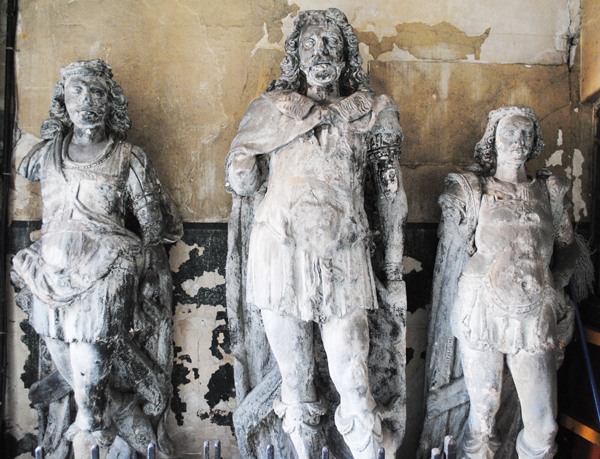
This series of badly weathered statues – depicting King Lud and his two sons, apparently named Androgeus and Theomantius – was originally located on the gate. In fact, the legend goes, the king was buried under it.

Following the gate’s demolition, the statues – said to date from 1586 with the name of the sculptor now lost to time – were moved here at some point to the vestry porch of St Dunstan-in-the West in Fleet Street.

Olympics Special – London bridges aglow…

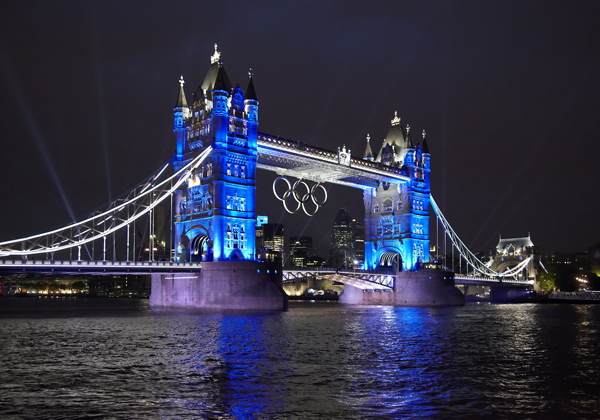
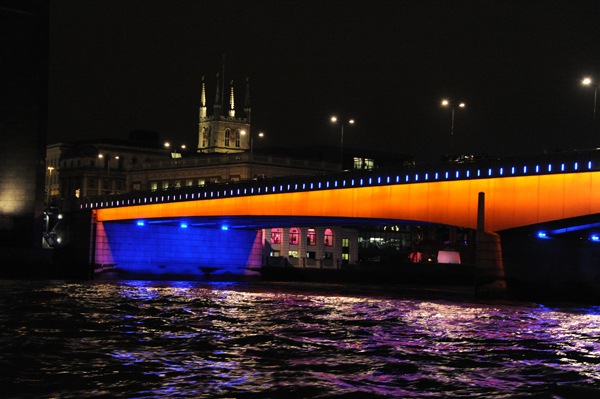
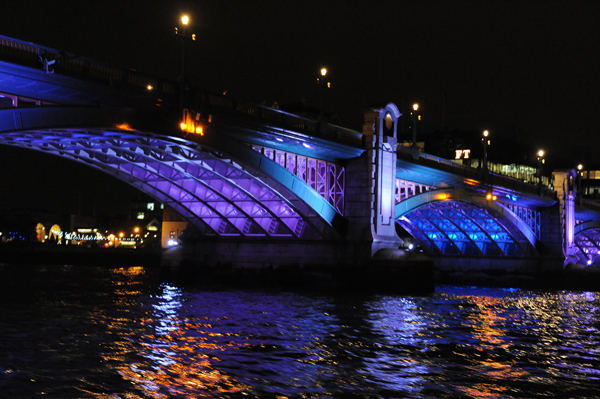
Seven of London’s bridges are being lit up at night until 10th September in an initiative called “Dazzle”. Being run under the Mayor of London Presents program, it celebrates the 50 evenings of the Olympic and Paralympic Games. Here’s just a sample of what you can see…

The most iconic of London’s bridges, Tower Bridge has been a focal point for Olympic celebrations. One of the great structures of Victorian London, it was opened in 1894 and at the time was largest bascule bridge ever built (for more on Tower Bridge, see our earlier post here).

The most recent version of London Bridge, this links Borough High Street in Southwark (you can see Southwark Cathedral in the background) and King William Street in the City and was built in the late 1960s/early 1970s and opened by Queen Elizabeth II in 1973. There have been bridges in this vicinity since as far back as Roman times (for more on the history of London Bridge, see our earlier post here).

The current Southwark Bridge – which links the City of London with the heart of Southwark – dates from 1921 and replaced an earlier bridge designed by John Rennie.

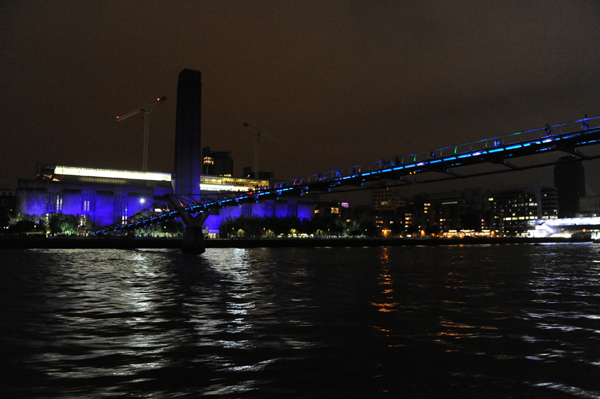
Initially plaqued by the wobbles, the steel suspension walk bridge known as Millennium Bridge is the newest of the bridges that cross the Thames in central London, linking St Paul’s Cathedral on the north bank with the Tate Modern on the south (the looming bulk of which is pictured here). First opened in July 2000, it was closed after concerns over its movement and then reopened to the public in 2002.

Other bridges taking part in Dazzle but not shown here include the Golden Jubilee footbridges, Waterloo Bridge and Blackfriars Bridge.

For more on the program, see www.molpresents.com/dazzle.

PICTURES: All images courtesy of the City of London Corporation.

Around London – Celebrating the Olympics; Camden Lock’s night market; and, images of London at the Tate…

We’ll kick off this week with just a few more of the plethora of Olympic-related events which are happening around town:

Tower Bridge, site of some spectacular fireworks last Friday night, is currently hosting an exhibition celebrating the 26 cities which have hosted the modern Olympics. Cities of the Modern Games, located on the bridge’s walkways, runs alongside an interactive exhibition looking at the bridge’s construction. Follow the link for details.

The Guildhall Art Gallery is showcasing sculpture and art inspired by sport and the “Olympic values”. The art works are all winning entries from a contest organised by the International Olympic Committee. The chosen works were selected from among 68 submissions made by an international jury. Follow the link for details.

The Design Museum is hosting a new exhibition celebrating the nexus between sport and design. Designed to Win looks at everything from the design of F1 cars to running shoes, bats and bicycles and explores the way in which design has shaped the sporting world. Runs until 9th September. Admission charge applies. See www.designmuseum.org.

• The London Metropolitan Archives is holding an exhibition of playing cards featuring an Olympic theme. Sporting Aces – Playing Cards and the Olympic Games features cards drawn from the collection of the Worshipful Company of Makers of Playing Cards which have an Olympic theme. Admission is free. Runs until 13th September. See www.cityoflondon.gov.uk/lma.

And in other news…

A night market has been launched at Camden Lock over the summer period. Street food stalls and vintage fashion, arts and crafts and book shops will be open until 10pm every Thursday with extras including live music and film screenings. For more, see www.camdenlockmarket.com.

• On Now: Another London: International Photographers and City Life 1930-1980. This exhibition at Tate Britain in Millbank features more than 150 classic photographs of the city and its communities by foreign photographers including such luminaries as Henri Cartier-Bresson. The exhibition features iconic works such as Robert Frank’s London (Stock Exchange) 1951, Cartier-Bresson’s images of King George VI’s coronation, Elliot Erwitt’s depiction of a rain-washed London bus stop, and Bruce Davidson’s image of a child with pigeons in Trafalgar Square alongside works such as Wolfgang Suschitzky’s images of working class families in the East End, from the 1940s, and Karen Knorr’s images of punks in the 1970s. The photographs all come from the Eric and Louise Franck London Collection, which includes more than 1,200 images of London and has been promised as a gift to the Tate. Runs until 16th September. Admission charge applies. See www.tate.org.uk. 

Have we missed something we should be telling others about? Send details in an email to exploringlondon@gmail.com.

Around London – Bells…and more bells; Olympic memorabilia; free wifi in the West End; The Arch returns to Kensington Gardens; and, Impressionists at the RA…

• It’s all about the Olympics in London this week and many of the events – like the Opening Ceremony and Torch Relay (see last week’s post) – are well covered elsewhere, but we thought we’d mention a couple of things in relation to the Games: 

The first is the ‘All the Bells’ project which will see bells across London being rung at 8:12am on Friday to “ring in” the first day of the Olympic and Paralympic Games. Work No. 1197: All the bells in a country rung as quickly and as loudly as possible for three minutes, commissioned as part of the London 2012 Festival, is the brainchild of Turner Prize-winning artist and musician Martin Creed and will involve thousands of bells across the nation. Speaking of bells, the City of London has announced that some of the City’s churches will be ringing continuously during the three Olympic marathon events – the men’s, women’s, and Paralympic events. As many as 57 of the country’s most experienced bell ringers, co-ordinated by the Ancient Society of College Youths (a ringing society created in London in 1637) will be working for three to four hours continuously at churches including St Paul’s Cathedral, St Mary le Bow, St Lawrence Jewry, St Magnus the Martyr, St Vedast and St Katharine Cree. During the women’s marathon, an all-female band will be attempting a peal at St Paul’s, the first all-woman attempt on the bells. (Apologies, this article had originally had the time for the bell ringing at 8.12pm – it is in the morning, not the evening!)

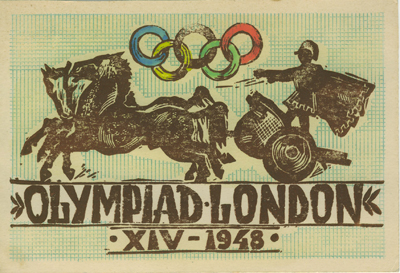
A new exhibition exploring London’s Olympic history has opened at the British Library. Olympex 2012: Collecting the Olympic Games features a range of memorabilia including a swimming costume and the finishing tape broken by – later disqualified – marathon runner Dorando Pietri  from the 1908 London Games (see our earlier post for more on him) as well as posters and artworks, stamps, letters and postcards. The exhibition also features audio interviews with Olympians including William (Bill) Roberts, a relay runner in the 1936 Berlin Olympics, and Dorothy Tyler, a medal-winning high jumper who competed in the 1936 and 1948 Olympics. Presented by the British Library and International Olympic Committee, the exhibition runs until 9th September at the library in St Pancras. Entry is free. For more, see www.bl.uk. PICTURE: Rare 1948 postcard by an unknown artist (c) Private collection/IOC

• A new free wifi network has been launched in London’s West End. Westminster City Council and telco O2 launched the network this week. It will initially cover Oxford and Regent Streets, Trafalgar Square, Leicester Square, Piccadilly Circus and Parliament Square with further areas in Westminster and Covent Garden the next to be included in the network. A once-only registration process is required to join.

• Henry Moore’s famous sculpture, The Arch, has been returned to its original home in Kensington Gardens. The six metre high work was presented to the nation by Moore in 1980 and was positioned on the north bank of the Long Water until 1996 when the structure became unstable and was placed in storage. In late 2010, the Royal Parks began a project with The Henry Moore Foundation to see if the work could be returned to the gardens. Work began to restore the piece – which consists of seven stones weighing 37 tonnes – to its original location earlier this year. For more on Kensington Gardens, see www.royalparks.org.uk/parks/kensington-gardens.

• On Now: From Paris: A Taste for Impressionism. This Royal Academy of Arts exhibition at Burlington House features 70 works from the Sterling and Francine Clark Art Institute in Williamstown, Massachusetts, and includes works by Manet, Monet, Pissarro, Degas, Sisley, Morisot and Renoir as well as those of post-Impressionist artists Corot, Théodore Rousseau and J-F. Millet, and ‘academic’ paintings by Gérôme, Alma-Tadema and Bouguereau. Runs until 23rd September. Admission charge applies. See www.royalacademy.org.uk for more.

Around London: Olympic Torch Relay hits London; mascots pop-up all over the city; and Shakespeare at the British Museum…

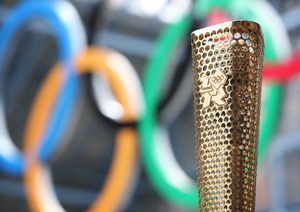
• The Olympic Torch Relay arrives in London tomorrow night before working its way around all of the city’s 33 boroughs and reaching the Olympic Stadium for the Opening Ceremony next Friday.  The torch will arrive in the city by helicopter from Guildford tomorrow night and then be abseiled into the Tower of London where it will spend the night ensconced with the Olympic medals. The relay will travel 200 miles over the next week, carried by more than 980 torchbearers. The route is as follows:

  • Saturday, 21st July – Greenwich via Newham, Tower Hamlets and Hackney to Waltham Forest (highlights include a visit to the Cutty Sark);
  • Sunday, 22nd July – Redbridge via Barking & Dagenham and Havering to Bexley (highlights include a ride on the London Eye and a crossing of the Thames);
  • Monday, 23rd July – Lewisham via Bromley, Croydon, Sutton and Merton to Wandsworth (highlights include a visit to a live filming of Eastenders);
  • Tuesday, 24th July – Kingston via Richmond, Hounslow, Hillingdon and Denham to Ealing (highlights include a visit to Kew Gardens);
  • Wednesday, 25th July – Harrow via Brent, Barnet and Enfield to Haringey (highlights include a visit to Wembley Arena);
  • Thursday, 26th July – Camden via Islington, the City of London, Southwark, Lambeth, Wandsworth, Kensington & Chelsea and Hammersmith & Fulham  to Westminster (the many landmarks to be visited include St Paul’s Cathedral, Shakespeare’s Globe, Trafalgar Square, Buckingham Palace and Hyde Park);
  • Friday, 27th July – From Hampton Court Palace (where it will be taken into the maze) on board Gloriana via the Thames to Olympic Park for the Opening Ceremony.

The 70 day torch relay, which kicked off on 19th May, will have travelled a total distance of about 8,000 miles and have involved 8,000 torchbearers by the time it reaches its end. LOCOG and Transport for London have advised people to see the relay at a location closest to their home given the expected crowds. For more detailed route information, see www.london2012.com/torch-relay/route/. PICTURE: LOCOG

Still talking all things Olympics and London’s largest ever ‘pop up’ shop – where you can buy Olympic merchandise – was officially opened by multiple gold medalist Sir Steve Redgrave in Hyde Park last week. The shop, located on Rotten Row, will be the site of special athlete visits during the Games and visitors can have their photo taken with the Olympic Torch.

• Meanwhile, life-sized versions of the Olympic mascot Wenlock and Paralympic mascot Mandeville are popping up at some of London’s key tourist locations. The 83 two metre tall sculptures capture various elements of life in London with incarnations including a Beefeater, a giant red phone box and a replica of Big Ben. The figures can be found on the routes of Stroll, six new discovery trails designed to help both tourists and Londoners get more out of the city. A QR code on the bottom of each of the sculptures directs smartphone users to further information about the discovery trails. The discovery trails are part of the Mayor of London Presents, a city-wide programme featuring free events, shows and activities. For more on what’s happening in your area, see www.molpresents.com. Some of these events are also being run as part of the Festival of London 2012. For more on this, see http://festival.london2012.com.

• On Now: Shakespeare: staging the world. Part of the World Shakespeare Festival taking place in London, this exhibition at the British Museum looks at the then emerging role of London as a “world city” as interpreted through Shakespeare’s plays and examines the role the playhouse performed in this. The museum has collaborated with the Royal Shakespeare Company to produce the exhibition which features more than 190 objects including paintings, jewels and rare manuscripts. These include the Ides of March coin, a Roman gold aureus commemorating the assassination of Julius Caesar (Julius Caesar), the Lyte Jewel, presented to Thomas Lyte in 1610 in thanks for his work in tracing King James I’s lineage back through Banquo (Macbeth), and a 1610 bird’s-eye view of Venice (Othello and The Merchant of Venice). Runs until 25th November. Admission charge applies. For more, see www.britishmuseum.org.

Around London – Richmond’s upsized Olympic rings; cart marking; ‘Sam’ Mussabini honored; and, Tudor twins at the NPG…

• The largest official Olympic Rings were unveiled at Richmond Park National Nature Reserve in London’s south-west this week, having been mown into the grass by the Royal Parks’ shire horses. The rings, which lie on Heathrow’s flight path and are 300 metres wide and more than 135 metres tall, will welcome athletes as they fly in to compete in the Games which kick off later this month. It took six shire horses to create the giant rings – which represent five continents – but they’ll be maintained by just two – Jim and Murdoch. Horses have worked in Richmond Park since as far back 1637 when King Charles I had the park enclosed as a royal hunting ground. Eleven Olympic events will be held on Royal Parks during the Games including road race cycling in Richmond Park. For more on Richmond Park, see www.royalparks.org.uk/parks/richmond-park. PICTURE: LOCOG.

• Almost 50 vehicles, ranging from handcarts to horse drawn carriages, steam powered vehicles to a new London bus, took part in the Worshipful Company of Carmen’s traditional ‘Cart Marking’ procession through the City of London yesterday. The ‘trade’ of carmen dates back to the 13th century when City authorities passed a bye-law controlling carters. At the ceremony, the carmen bring a variety of vehicles which are branded by placing a red hot iron on a wooden plate, with the year letter and the car number, in the continuation of an ancient tradition. The Worshipful Company of Carmen is said to be the oldest transportation organisation in the world. For more on the livery company, see www.thecarmen.co.uk.

• The late athletics coach Scipio Africanus “Sam” Mussabini (1867-1927) was honored this week with the unveiling of an English Heritage Blue Plaque at his former home in Herne Hill in London’s south. Mussabini, whose role in helping 100 metre sprinter Harold Abrahams win gold at the 1924 Olympics was depicted in the film Chariots of Fire (he was played by Ian Holm),  lived at the house at 84 Burbage Road from 1911 to about 1916. It backs onto the Herne Hill Stadium where he worked as a cycling and athletics coach from the 1890s, a period during which he trained several medal-winning Olympic athletes. All up, Mussabini’s runners won a total of 11 Olympic medals including five golds, between 1908 and 1928. For more, see www.english-heritage.org.uk.

On Now: Double Take: Versions and Copies of Tudor Portraits. This display at the National Portrait Gallery features five pairs of nearly identical Tudor portraits and explores how and why they were made. Among the portraits from the gallery’s collection on display are those of King Henry VIII, his wife Anne Boleyn, Archbishop William Warham, the merchant Thomas Gresham and Lord Treasurer Thomas Sackville – all of which are paired with paintings on loan from other collections. Admission is free. Runs until 9th September. For more information on the Making Art in Tudor Britain research project – of which this is a part – see www.npg.org.uk/research/programmes/making-art-in-tudor-britain.

Around London – The Shard celebrates; Crossrail archaeology; new sheriffs named; and, Blackpool at Wellington Arch…

• Europe’s tallest building marks the completion of its exterior structure today with a spectacular light show. The Shard, a £450 million development located over London Bridge Station in Southwark, stands 310 metres tall and was designed by Italian architect Renzo Piano. The controversial glass clad structure, work on which commenced in 2009, features a jagged top with the design reportedly referencing the city’s many church spires. While the exterior of the building is now complete, work is expected to continue on the building’s interior – which will contain offices, luxury shops and restaurants, a five star hotel and 10 top-end apartments (the highest in the UK) – until next year. It is expected that the building’s viewing decks – which offer panoramic 360 degree views over the city – will become a major new tourist attraction in the city. The Shard will be formally opened today by Qatari Prime Minister Hamad bin Jassem al-Thani and Prince Andrew, Duke of York. The hour long light show, which features lasers and searchlights, kicks off at 10pm and those who can’t see it in person can watch it streamed live at the-shard.com.

• A skeleton from the St Bethlehem Burial Ground and 55 million-year-old fragments of amber are among the artefacts which will go on display this Saturday at a special public exhibition of archaeological discoveries made during the construction of Crossrail. Almost 100 objects found at 10 different sites will be in the Bison to Bedlam – Crossrail’s archaeology story so far exhibition which marks the halfway point of the Crossrail archaeology program, first launched in 2009. Finds have dated from prehistoric times through to the Industrial Revolution and, as well as those aforementioned, also include some medieval ceramic wig curlers, 17th century gravestone markers and stakes made out of animal bone. All the items will be eventually donated to the Museum of London or Natural History Museum. The exhibition will be held from 10am to 5pm this Saturday at the Music Room, Grays Antiques, 26 South Molton Street (nearest Tube station is Bond Street). For more, see www.crossrail.co.uk.

• Alderman Jeffrey Evans (Ward of Cheap) and Nigel Pullman have been elected the new sheriffs of the City of London in a poll held late last month. The office of the sheriffs dates back to the Middle Ages – current duties include assisting the Lord Mayor of London in his official duties and attending sessions of the Central Criminal Court at the Old Bailey. The two new sheriffs take up their post in late September.

• On Now: Blackpool: Wonderland of the World. A new exhibition held in the Quadriga Gallery at the Wellington Arch, Hyde Park Corner, this looks at how Blackpool transformed in the 19th century from a small village to become became the first resort in the world to cater for the working classes. Focusing on two of the town’s key attractions – the Winter Gardens and the Blackpool Tower – the exhibition’s highlights include a silver model of Blackpool Tower dating from 1893, rare Victorian and vintage posters advertising performances by some of the stars who shone there, and early 20th century photographs of the interiors of the Winter Gardens. In addition, two crowns will illuminate the top of Wellington Arch in a taste of Blackpool’s famous light show. Organised by English Heritage in partnership with Blackpool Council, it runs until 27th August. Admission fee applies. See www.english-heritage.org.uk/daysout/properties/wellington-arch/exhibitions-at-the-arch/current-exhibition/ for more.

Where’s London’s oldest…manufacturing company?

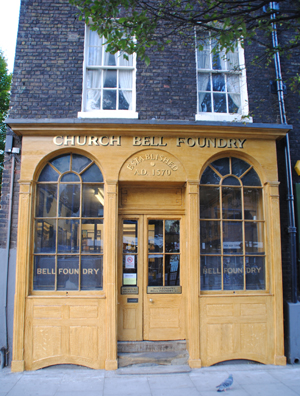
London’s oldest manufacturing company is the same as Britain’s oldest and is, according to the Guinness Book of Records, the Whitechapel Bell Foundry.

The company was established in 1570 (although founders have been discovered operating in the area as far back as 1420) and, according to its website, still concentrates solely on the manufacture of bells and their fittings with large church bells accounting for 80 per cent of the company’s business. The remainder of the business is involved in manufacturing handbells and other smaller bells.

The foundry’s current buildings, apparently originally used as a coaching inn named The Artichoke, date from 1670 and are presumed to have replaced structures consumed in the Great Fire of London. The foundry had earlier been located in smaller premises on the other side of Whitechapel Road.

The foundry has typically operated under the name of the master founder and owner but since 1968 has apparently operated under its current name.

The most famous bells cast at the foundry include the Liberty Bell (1752) – the symbol of American independence which cracked when first rung and was recast in Philadelphia, the Great Bell of Montreal Cathedral, ‘Great Tom’ of Lincoln Cathedral, and, of course, Big Ben (1858) – at 13,760 kilograms, the largest bell ever cast at the foundry.

Westminster Abbey and St Paul’s Cathedral also feature bells cast at the foundry and replacement bells for St Mary-le-Bow and St Clement Danes made here following their destruction in World War II and bells from the foundry have been sent as far afield as Australia and India.

Among the most recent bells to be cast at the foundry are the Royal Jubilee Bells, used in the Thames Diamond Jubilee Pageant and now housed at St James Garlickhythe in the City of London (each of the bells, which bear the Royal Arms, is named after a member of the Royal Family – Elizabeth being the largest with others named Philip, Charles, Anne, Andrew, Edward, William and Henry.)

There is a small exhibition on bell-making in the foundry shop looking at the history of the foundry and bell-making in general, and one-and-a-half-hour tours of the foundry run Saturdays (booking well in advance is usually required). Additional tours are being held every day during the Olympics.

WHERE: 32/34 Whitechapel Road; WHEN: Tours are usually held on Saturdays when no work is being undertaken – see website for dates – but special tours are being held daily from 10am to 5pm, 28th July to 12th August, 2012; COST: The exhibition/museum is free but tours are usually £12 a head for over 14s (Olympic period tours are £10 a head/£25 a family – children under 14 not admitted without adult supervision) – see website for more details on purchasing tickets; WEBSITE: www.whitechapelbellfoundry.co.uk.

Around London – Olympic Rings unveiled on Tower Bridge; London from above; Blake on Primrose; V&A illustrations; and, Munch at the Tate Modern…

• The Olympic Rings were unveiled on Tower Bridge yesterday to mark one month until the Opening Ceremony of the 2012 Games. Each of the rings weighs three tonnes and are 25 metres wide and 11.5 metres tall. A light show featuring thousands of LED lights brings them to life at night. The rings retract when the bridge is raised. Among those at the unveiling were Lord Sebastian Coe, chairman of LOCOG, London Mayor Boris Johnson and the Culture Secretary Jeremy Hunt.

• Several hundred images of London have been included in Britain from Above, a new website launched by English Heritage and the Royal Commissions on the Ancient and Historical Monuments of Scotland and Wales. The website, which boasts more than 15,000 images taken between 1919 and 1953 includes some of the oldest and most valuable images from the Aerofilms Collection, an archive of more than a million photographs taken between 1919 and 2006. A search for London brings up 283 results, among them stunning images of Tower Bridge, The Tower of London and St Paul’s Cathedral. Users are encouraged to download images, customise their own themed photo galleries and share information to add to the knowledge behind each of the images. For more, see www.britainfromabove.org.uk.

• A quote from William Blake has been inscribed on stone on the summit of Primrose Hill, famous for its views of the London skyline. The quote – “I have conversed with the spiritual sun. I saw him on Primrose Hill” – was selected, according to Nick Biddle, The Regent’s Park manager, “because it sums up so well the experience of standing on Primrose Hill in the early morning light”. “It is always a wonderful experience,” he says. The unveiling of the inscription signalled the end to a series of improvement works on the hill. For more, see http://www.royalparks.org.uk.

• On Now: V&A Illustration Awards display. Features works by the 14 artists short-listed for the V&A’s annual illustration awards. Drawn from more than 1,000 entries the panel – fashion designer Orla Kiely, broadcaster and cultural commentator Emma Freud and Moira Gemmill, V&A director of design – selected their favorite entries in three categories – book illustration, book cover and jacket illustration – while winners of last year’s award judged a fourth category for students’ work. Runs until 31st December. Admission is free. For more, see www.vam.ac.uk/illustrationawards.

• On Now: Edvard Munch: The Modern Eye. This major exhibition at the Tate Modern reassesses the work of this Norwegian painter and aims to show how he engaged with the 20th century world, in particular his interest in the rise of modern media including photography, film and stage production. Organised in conjunction with the Centre Pompidou in Paris and the Munch Museum in Oslo, the exhibition features more than 60 paintings and 50 photographs as well as Munch’s lesser-known work in film. They include different versions of celebrated works like The Sick Child and The Girls on a Bridge as well as his last work, a self protrait. Runs until 14th October. Admission charge applies. For more, see www.tate.org.uk.

Around London – Celebrating the City; Syon Park dig; Westminster’s rubbish; and, 1000 years of British literature…

• The City of London today kicks off Celebrate the City – four days of mostly free music, art and cultural events.The events include musical performances in many of the City’s churches, walks and talks at various locations around the Square Mile, new exhibitions including Butcher, Baker, Candlestock Maker – 850 years of Livery Company Treasures at the Guildhall Art Gallery, Livery Hall and historic building openings, family entertainment at the Cheapside Street Fayre at Saturday (including free ice-cream and tuk-tuk rides for children) and activities at the Barbican Centre and the Museum of London. The celebrations start in Guildhall Yard (pictured) at 6pm tonight when musicians from the Guildhall School of Music & Drama perform Tchaikovsky’s 1812 Overture, complete with firing cannons. Among the many other highlights will be the chance to play golden street pianos, to join in the Midsummer street part at the climax of the Spitalfields Music Summer Festival, to enjoy a sunset from the Tower Bridge walkways and to see the transformation of St Helen’s Square into a sculpture space. The weekend will also host the Open House Junior Festival, London’s first ever child-friendly City architecture festival. To see detailed listings of what’s on, head to www.visitthecity.co.uk/index.php/celebrate/.

• The Museum of London will next week launch its annual community and training dig at Syon Park in Hounslow. The dig, which will be open to school and community groups, will run from 25th June to 7th July and will focus on the area of Sir Richard Wynne’s house. A Parliamentarian, in 1659 he was implicated in a Royalist insurrection and was imprisoned. The house, which featured in the Battle of Brentford when Royalist troops advanced on Parliamentary forces in London in 1641, was later purchased by the Duke of Northumberland and demolished to extend Syon’s parkland. For more, see www.museumoflondon.org.uk.

• We couldn’t resist mentioning this one: Westminster City Council has released a top 10 list of the strangest objects people have dumped on London’s streets. They include an inflatable Margaret Thatcher and other inflatable dolls, wedding dresses, stuffed animals and a range of film props. The council say that, on average, enough litter is picked up off Westminster’s streets every two days to fill the entire 864 cubic metres of Marble Arch. They add that if just half of the annual waste collected off the street is recycled properly in the correct bins it would save them nearly £1million.

• On Now: Writing Britain: Wastelands to Wonderlands. The major summer exhibition at the British Library, it explores how the last 1,000 years of English literature have been shaped by the country’s places. The exhibition  features more than 150 works with highlights including John Lennon’s original lyrics for The Beatles’ song In My Life, JK Rowling’s handwritten draft of Harry Potter and the Philosopher’s Stone, JRR Tolkein’s original artwork for The Hobbit and original manuscripts from the likes of Jane Austen, William Blake, Charlotte Bronte, Arthur Conan Doyle, JG Ballard and Charles Dickens. As part of the exhibition, the Library is inviting people to “Pin-a-Tale” on an interactive map of Britain, that is, take a literary work and pin it on the map along with a description of how the work links with that particular location – head to www.bl.uk/pin-a-tale to take part. The exhibition runs until 25th September. Admission fee applies. For more, see www.bl.uk.

LondonLife – The Cromwell Trial Plate…

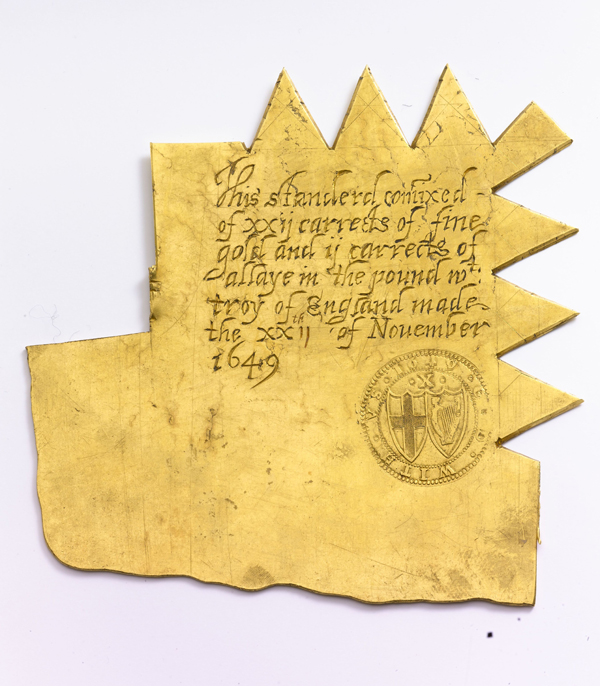
This is a section of the Cromwell Trial Plate used in the Trial of the Pyx in 1649. The Trial of the Pyx, still held every year in February, dates back to the 12th century; its purpose was to ensure, in a public demonstration, that coins produced at the Royal Mint were within set parameters surrounding weight, size and metallic composition. It is named after the box in which coins were transported, known as a pyx (from the Latin pyxis for box or chest – these were historically kept in the Chamber of the Pyx at Westminster Abbey), and involves melting down samples of coins and measuring the gold and silver content against a benchmark piece of metal known as a Trial Plate. This Trial Plate, created by the Goldsmith’s Company during the first year of the Commonwealth, is among 400 treasures on show as part of Gold: Power and Allure, a landmark exhibition celebrating the story of gold and Britain being held at the Goldsmiths’ Hall in association with the World Gold Council. Runs until 28th July. Admission is free. For more, head to www.thegoldsmiths.co.uk. PICTURE: © Royal Mint.

Where is it? #31…

The latest in the series in which we ask you to identify where in London this picture was taken and, importantly in this case, what it’s of. If you think you can identify this picture, leave a comment below. We’ll reveal the answer early next week. Good luck!

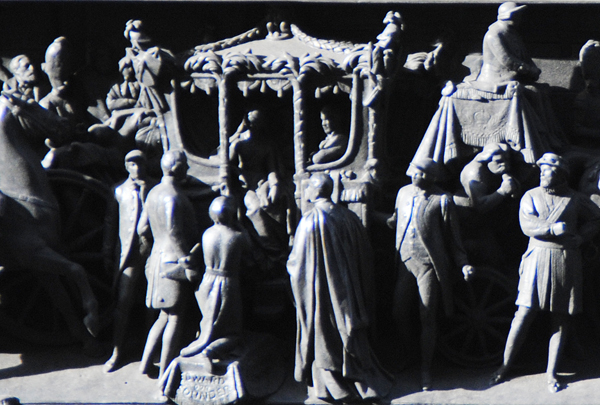
Well done to Jameson Tucker, this is indeed a relief on the Temple Bar Memorial, which stands where the Strand turns into Fleet Street. It depicts Queen Victoria on a royal progress to the Guildhall in 1837, a few months after her accession, when she was met at this spot by the Lord Mayor and Aldermen and presented with the sword of state and keys to the city.

According to a tradition said to date back to 1215, the Temple Bar is the only place where the monarch may enter London after first seeking permission from the Lord Mayor and being presented with the City’s Pearl Sword (one of five City swords, this is said to have been first given to the City by Queen Elizabeth I).

The monument itself was designed by Sir Horace Jones and erected in 1880 to mark the location where the Temple Bar – the ceremonial entrance to the City of London – originally stood (the last incarnation of the Temple Bar, designed by Sir Christopher Wren, is now located near in Paternoster Square near St Paul’s – see our earlier post for more on Wren’s Temple Bar).

On top of the granite and bronze monument stands a rearing griffin (actually it’s supposed to be a dragon), one of the city’s official boundary markers, sculpted by Charles Birch while on either side are bronze statues, by Sir Joseph Edgar Boehm, of Queen Victoria and Edward, Prince of Wales (later King Edward VII), who in 1872 were the last of the Royal family to pass through the Temple Bar gateway before its demolition in 1878 (they were on their way to St Paul’s to attend a thanksgiving service following the prince’s recovery from typhoid).

This is depicted in a relief on the north side of the monument by Charles Kelsey. Charles Mabey’s relief showing the Queen’s progress is located on the south side of the monument; he also designed one on the east side which shows a curtain being drawn over the old Temple Bar.

Around London – Diamond Jubilee celebrations special…

UPDATED: Excitement has been building for months ahead of this weekend’s Diamond Jubilee celebrations which include a 1,000 boat flotilla which will sail down the Thames on Sunday, the Diamond Jubilee concert on Monday and National Service of Thanksgiving at St Paul’s Cathedral on Tuesday which will be followed by a ceremonial procession back to Buckingham Palace.

• First to the flotilla. The formal river procession will be held between 2pm and 6pm, starting upriver of Battersea Bridge and finishing downriver of Tower Bridge. The Queen and her family will be boarding the Royal barge, the Spirit of Chartwell, near Albert Bridge at 2.30pm and will travel upriver at the centre of the flotilla with the aim of pulling up alongside HMS President, near Tower Bridge, at 4.15pm.

The flotilla will be one of the largest ever assembled on the river and feature rowing, working and pleasure boats of all shapes and sizes decked out for the occasion. In addition as many as 30,000 people will be aboard passenger boats and there will also be music barges and boats spouting geysers as well as specially constructed craft like a floating belfry. It is estimated that it will take the flotilla around 75 minutes to pass any static point along the route.

Downriver of London Bridge, near the end of the pageant’s seven mile (11 kilometre) course, a gun salute will be fired and the procession will pass through an ‘Avenue of Sail’ formed by traditional sailing vessels, oyster smacks, square riggers, naval vessels and others. For more on the pageant (including the location of large viewing screens – these positions will be regulated from 8am onwards – and road closures as well as an interactive map of the route), head to www.thamesdiamondjubileepageant.org.

• Diamond Jubilee Concert and Beacons. To be held outside Buckingham Palace, close to the Victoria Memorial, on the evening of Monday, 4th June, the concert – which starts at around 7.30pm and features everyone from Elton John to Paul McCartney and Shirley Bassey – will be televised live by the BBC (unless you’re lucky enough to have one of the 10,000 balloted tickets meaning you get to have a picnic in the palace gardens and see the concert). For those who can’t go but would like to experience some of the atmosphere, Royal Parks are setting up screens along The Mall, in St James’s Park and in Hyde Park.

At 10.30pm that night, the Queen will light the National Beacon outside Buckingham Palace, the last in a network of beacons to be lit across the country. More than 4,000 beacons will be lit by communities across the UK and in Commonwealth countries around the world between 10-10.30pm that night (for more on the beacons, see www.diamondjubileebeacons.co.uk).

• National Service of Thanksgiving and Carriage Procession. On Tuesday, the Queen and the Duke of Edinburgh will leave Buckingham Palace at 10.15am and travel by car to St Paul’s Cathedral via the Mall, through Trafalgar Square, down the Strand and Fleet Street and up Ludgate Hill to St Paul’s. There they and the 2,000 invited guests will attend the National Service of Thanksgiving, conducted by the Dean of St Paul’s, the Very Rev Dr David Ison (the Archbishop of Canterbury will preach).

At 11.30am, the Queen and Duke will then head to Mansion House for a reception (via St Paul’s Churchyard and Queen Victoria Street), hosted by the Lord Mayor of London David Wootton, Court of Aldermen and Court of Common Council. Other members of the Royal family will attend a reception at Guildhall. At 12.30pm, the  Queen and members of the Royal Family will then head to Westminster Hall (via Queen Victoria Street, St Paul’s Churchyard, Ludgate Hill, Fleet Street, the Strand, Whitehall and Parliament Square), entering through the Sovereign’s Entrance of the Palace of Westminster (Houses of Parliament) at 12.40pm. There, they will attend the Diamond Jubilee Lunch.

At 2.20pm, the Queen and Prince Philip will lead a carriage procession from the Palace of Westminster to Buckingham Palace (via New Palace Yard, Whitehall, Trafalgar Square and The Mall), riding in a 1902 State Landau. They will be followed by the Prince of Wales and Duchess of Cornwall in a State Landau, and the Duke and Duchess of Cambridge (Prince William and Kate) and Prince Harry in another State Landau. If it’s raining, these will be replaced by the Australian State Coach, Queen Alexandra’s State Coach and the Glass Coach. Military personnel will line the route, a 60 gun salute will be fired and a Guard of Honor will await them in the Buckingham Palace forecourt.

At 3.30pm, the Queen and members of the Royal Family in the carriage procession will appear on the balcony at Buckingham Palace to wave to the crowds and witness an RAF flypast and a Feu de Joie – a celebratory volley of rifle fire – which will be given as a salute in the palace forecourt.

There’s plenty more happening over the weekend including many local street parties – far too much for us to record here. So for more, head to the official Diamond Jubilee site, www.thediamondjubilee.org (or The Big Lunch for local lunches – www.thebiglunch.com). You can purchase a copy of the official souvenir programme online at www.royalcollectionshop.co.uk/diamond-jubilee-1/diamond-jubilee-official-souvenir-programme.html or download it at www.itunes.co.uk.

Reckon you can take a good photo? We’re looking for great images of this weekend’s Diamond Jubilee celebrations (just email us at exploringlondon@gmail.com).

Want to read more about the Queen? Why not check out Sixty Glorious Years: Queen Elizabeth II, Diamond Jubilee, 1952-2012, Queen Elizabeth II: A Diamond Jubilee Souvenir Album, or Debrett’s: The Queen – The Diamond JubileeFor related music, check out Diamond Jubilee: A Classical CelebrationThe Diamond Jubilee Album or Gary Barlow & the Commonwealth Band’s Sing EP (featuring Prince Harry).

Where is it? #30…

The latest in the series in which we ask you to identify where in London this picture was taken and, importantly in this case, what it’s of. If you think you can identify this picture, leave a comment below. We’ll reveal the answer early next week. Good luck!

Well done to Parktown and Carol who both correctly named this as a cabman’s shelter at Temple Place near Temple Tube station. This shed is one of only 13 now left out of what were 61 shelters built by the Cabmen’s Shelter Fund between 1875 and 1914 (others, painted in the same distinctive green colour, can be in places like Russell Square, on Chelsea Embankment and on Kensington Road). The fund was established by the Earl of Shaftesbury and other well-meaning philanthropists to provide cabbies, who were prohibited from leaving their cabs unattended at a stand, with refreshments at affordable prices so they could have a hot meal while at work. The shelters, which were built on public highways, were, thanks to Metropolitan Police rules, allowed to be no bigger than a horse and cart, hence the rather small size (although they can seat up to 13 men as well as providing a kitchen). Only cabbies are allowed inside the shelters but anyone can order takeaway!

Lost London – The Roman basilica and forum…

In its ultimate grandiose form, Londinium’s basilica, the city’s first civic centre, was the largest building of its day, and in fact was the largest building of its type west of the Alps.

Located where Gracechurch Street now stands, the first basilica, which served as a town hall and law courts, was first erected in 70AD on high ground to the east of the now hidden Walbrook stream. It stood at one end of the forum or marketplace, enclosed on its other sides by shops and offices.

Twenty years after the first complex containing the basilica had been constructed, work began on a second, far larger basilica and forum on the same site. This took 30 years to complete and involved the removal of surrounding houses and other nearby structures.

The new basilica, which consisted of a large hall with a nave, was three stories high and apparently could be seen from all over the city. At the eastern end of the building’s nave was a raised platform, known as a tribune, where judges would have sat. The new forum’s central rectangular courtyard measured 100 metres by 85 metres in size.

The buildings were variously repaired over the years before being largely destroyed at the start of the 4th century. Speculation is that the destruction was carried out as punishment for London’s support of Carausius, who had declared himself emperor of Britain and northern Gaul in the late 200s. It is believed the eastern end of the basilica was perhaps retained and used as a temple or perhaps even an early church.

Sections of the walls of the basilica and forum apparently still survive in basements around Gracechurch Street today (including apparently in the basement of hairdressers Nicholson and Griffin at 90 Gracechurch Street). The eastern end of the complex now lies under the Leadenhall Market.

For more, see www.museumoflondon.org.uk/Collections-Research/Research/Your-Research/Londinium/analysis/publiclife/structures/15+Forum.htm

Interesting reads on Roman Londinium include Jenny Hall’s Roman London (The Museum of London), and John Morris’ Londinium: London In The Roman Empire. It also worth getting hold of Londinium: A New Map and Guide to Roman London, an invaluable resource for those wanting to come to grips with the city in Roman times.

Where is it? #29…

The latest in the series in which we ask you to identify where in London this picture was taken and what it’s of. If you think you can identify this picture, leave a comment below. We’ll reveal the answer early next week. Good luck!

Bit of a harder one this week – these Escher-like patterns are found on a series of tiles located a wall in Waithman Street in the City of London (they are actually on the back of a building at 100 Bridge Street). According to the Tiles & Architectural Society Ceramics Society’s Gazetter, the 23 handmade stoneware tile panels were the 1992 creation of potter Rupert Spira, carried out at the behest of developers Rosehaugh Stanhope. While Spira apparently made 18,000 tiles for a garden in Paris, the tiles in Waithman Street were his only ever  British commission for tiles. Waithman Street, incidentally, is named for Robert Waithman, a draper and MP who was elected Lord Mayor of London in 1823.