Where’s London’s oldest…manufacturing company?

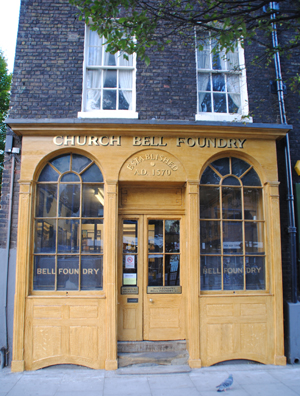
London’s oldest manufacturing company is the same as Britain’s oldest and is, according to the Guinness Book of Records, the Whitechapel Bell Foundry.

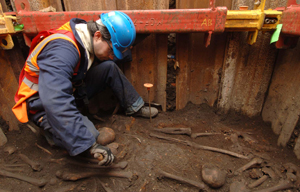
The company was established in 1570 (although founders have been discovered operating in the area as far back as 1420) and, according to its website, still concentrates solely on the manufacture of bells and their fittings with large church bells accounting for 80 per cent of the company’s business. The remainder of the business is involved in manufacturing handbells and other smaller bells.

The foundry’s current buildings, apparently originally used as a coaching inn named The Artichoke, date from 1670 and are presumed to have replaced structures consumed in the Great Fire of London. The foundry had earlier been located in smaller premises on the other side of Whitechapel Road.

The foundry has typically operated under the name of the master founder and owner but since 1968 has apparently operated under its current name.

The most famous bells cast at the foundry include the Liberty Bell (1752) – the symbol of American independence which cracked when first rung and was recast in Philadelphia, the Great Bell of Montreal Cathedral, ‘Great Tom’ of Lincoln Cathedral, and, of course, Big Ben (1858) – at 13,760 kilograms, the largest bell ever cast at the foundry.

Westminster Abbey and St Paul’s Cathedral also feature bells cast at the foundry and replacement bells for St Mary-le-Bow and St Clement Danes made here following their destruction in World War II and bells from the foundry have been sent as far afield as Australia and India.

Among the most recent bells to be cast at the foundry are the Royal Jubilee Bells, used in the Thames Diamond Jubilee Pageant and now housed at St James Garlickhythe in the City of London (each of the bells, which bear the Royal Arms, is named after a member of the Royal Family – Elizabeth being the largest with others named Philip, Charles, Anne, Andrew, Edward, William and Henry.)

There is a small exhibition on bell-making in the foundry shop looking at the history of the foundry and bell-making in general, and one-and-a-half-hour tours of the foundry run Saturdays (booking well in advance is usually required). Additional tours are being held every day during the Olympics.

WHERE: 32/34 Whitechapel Road; WHEN: Tours are usually held on Saturdays when no work is being undertaken – see website for dates – but special tours are being held daily from 10am to 5pm, 28th July to 12th August, 2012; COST: The exhibition/museum is free but tours are usually £12 a head for over 14s (Olympic period tours are £10 a head/£25 a family – children under 14 not admitted without adult supervision) – see website for more details on purchasing tickets; WEBSITE: www.whitechapelbellfoundry.co.uk.

Around London – Olympic Rings unveiled on Tower Bridge; London from above; Blake on Primrose; V&A illustrations; and, Munch at the Tate Modern…

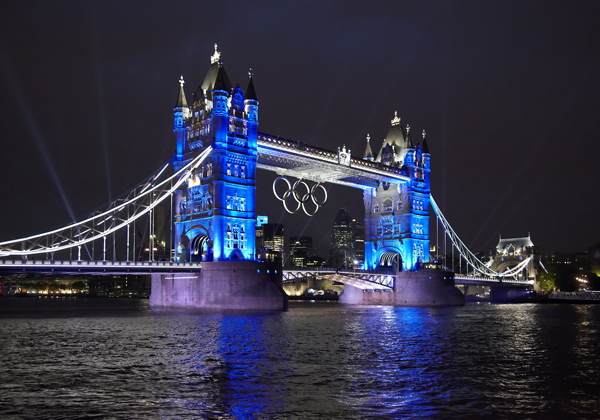
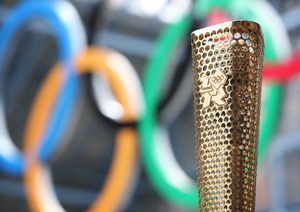
• The Olympic Rings were unveiled on Tower Bridge yesterday to mark one month until the Opening Ceremony of the 2012 Games. Each of the rings weighs three tonnes and are 25 metres wide and 11.5 metres tall. A light show featuring thousands of LED lights brings them to life at night. The rings retract when the bridge is raised. Among those at the unveiling were Lord Sebastian Coe, chairman of LOCOG, London Mayor Boris Johnson and the Culture Secretary Jeremy Hunt.

• Several hundred images of London have been included in Britain from Above, a new website launched by English Heritage and the Royal Commissions on the Ancient and Historical Monuments of Scotland and Wales. The website, which boasts more than 15,000 images taken between 1919 and 1953 includes some of the oldest and most valuable images from the Aerofilms Collection, an archive of more than a million photographs taken between 1919 and 2006. A search for London brings up 283 results, among them stunning images of Tower Bridge, The Tower of London and St Paul’s Cathedral. Users are encouraged to download images, customise their own themed photo galleries and share information to add to the knowledge behind each of the images. For more, see www.britainfromabove.org.uk.

• A quote from William Blake has been inscribed on stone on the summit of Primrose Hill, famous for its views of the London skyline. The quote – “I have conversed with the spiritual sun. I saw him on Primrose Hill” – was selected, according to Nick Biddle, The Regent’s Park manager, “because it sums up so well the experience of standing on Primrose Hill in the early morning light”. “It is always a wonderful experience,” he says. The unveiling of the inscription signalled the end to a series of improvement works on the hill. For more, see http://www.royalparks.org.uk.

• On Now: V&A Illustration Awards display. Features works by the 14 artists short-listed for the V&A’s annual illustration awards. Drawn from more than 1,000 entries the panel – fashion designer Orla Kiely, broadcaster and cultural commentator Emma Freud and Moira Gemmill, V&A director of design – selected their favorite entries in three categories – book illustration, book cover and jacket illustration – while winners of last year’s award judged a fourth category for students’ work. Runs until 31st December. Admission is free. For more, see www.vam.ac.uk/illustrationawards.

• On Now: Edvard Munch: The Modern Eye. This major exhibition at the Tate Modern reassesses the work of this Norwegian painter and aims to show how he engaged with the 20th century world, in particular his interest in the rise of modern media including photography, film and stage production. Organised in conjunction with the Centre Pompidou in Paris and the Munch Museum in Oslo, the exhibition features more than 60 paintings and 50 photographs as well as Munch’s lesser-known work in film. They include different versions of celebrated works like The Sick Child and The Girls on a Bridge as well as his last work, a self protrait. Runs until 14th October. Admission charge applies. For more, see www.tate.org.uk.

Around London – Celebrating the City; Syon Park dig; Westminster’s rubbish; and, 1000 years of British literature…

• The City of London today kicks off Celebrate the City – four days of mostly free music, art and cultural events.The events include musical performances in many of the City’s churches, walks and talks at various locations around the Square Mile, new exhibitions including Butcher, Baker, Candlestock Maker – 850 years of Livery Company Treasures at the Guildhall Art Gallery, Livery Hall and historic building openings, family entertainment at the Cheapside Street Fayre at Saturday (including free ice-cream and tuk-tuk rides for children) and activities at the Barbican Centre and the Museum of London. The celebrations start in Guildhall Yard (pictured) at 6pm tonight when musicians from the Guildhall School of Music & Drama perform Tchaikovsky’s 1812 Overture, complete with firing cannons. Among the many other highlights will be the chance to play golden street pianos, to join in the Midsummer street part at the climax of the Spitalfields Music Summer Festival, to enjoy a sunset from the Tower Bridge walkways and to see the transformation of St Helen’s Square into a sculpture space. The weekend will also host the Open House Junior Festival, London’s first ever child-friendly City architecture festival. To see detailed listings of what’s on, head to www.visitthecity.co.uk/index.php/celebrate/.

• The Museum of London will next week launch its annual community and training dig at Syon Park in Hounslow. The dig, which will be open to school and community groups, will run from 25th June to 7th July and will focus on the area of Sir Richard Wynne’s house. A Parliamentarian, in 1659 he was implicated in a Royalist insurrection and was imprisoned. The house, which featured in the Battle of Brentford when Royalist troops advanced on Parliamentary forces in London in 1641, was later purchased by the Duke of Northumberland and demolished to extend Syon’s parkland. For more, see www.museumoflondon.org.uk.

• We couldn’t resist mentioning this one: Westminster City Council has released a top 10 list of the strangest objects people have dumped on London’s streets. They include an inflatable Margaret Thatcher and other inflatable dolls, wedding dresses, stuffed animals and a range of film props. The council say that, on average, enough litter is picked up off Westminster’s streets every two days to fill the entire 864 cubic metres of Marble Arch. They add that if just half of the annual waste collected off the street is recycled properly in the correct bins it would save them nearly £1million.

• On Now: Writing Britain: Wastelands to Wonderlands. The major summer exhibition at the British Library, it explores how the last 1,000 years of English literature have been shaped by the country’s places. The exhibition  features more than 150 works with highlights including John Lennon’s original lyrics for The Beatles’ song In My Life, JK Rowling’s handwritten draft of Harry Potter and the Philosopher’s Stone, JRR Tolkein’s original artwork for The Hobbit and original manuscripts from the likes of Jane Austen, William Blake, Charlotte Bronte, Arthur Conan Doyle, JG Ballard and Charles Dickens. As part of the exhibition, the Library is inviting people to “Pin-a-Tale” on an interactive map of Britain, that is, take a literary work and pin it on the map along with a description of how the work links with that particular location – head to www.bl.uk/pin-a-tale to take part. The exhibition runs until 25th September. Admission fee applies. For more, see www.bl.uk.

LondonLife – The Cromwell Trial Plate…

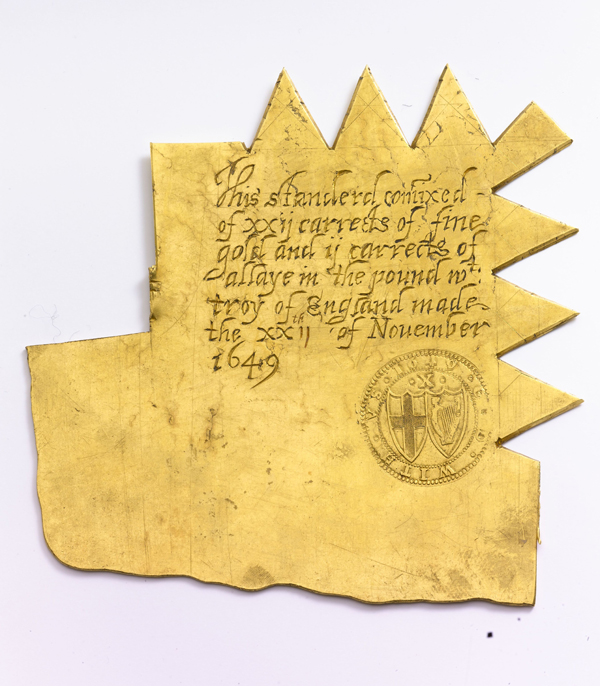
This is a section of the Cromwell Trial Plate used in the Trial of the Pyx in 1649. The Trial of the Pyx, still held every year in February, dates back to the 12th century; its purpose was to ensure, in a public demonstration, that coins produced at the Royal Mint were within set parameters surrounding weight, size and metallic composition. It is named after the box in which coins were transported, known as a pyx (from the Latin pyxis for box or chest – these were historically kept in the Chamber of the Pyx at Westminster Abbey), and involves melting down samples of coins and measuring the gold and silver content against a benchmark piece of metal known as a Trial Plate. This Trial Plate, created by the Goldsmith’s Company during the first year of the Commonwealth, is among 400 treasures on show as part of Gold: Power and Allure, a landmark exhibition celebrating the story of gold and Britain being held at the Goldsmiths’ Hall in association with the World Gold Council. Runs until 28th July. Admission is free. For more, head to www.thegoldsmiths.co.uk. PICTURE: © Royal Mint.

Where is it? #31…

The latest in the series in which we ask you to identify where in London this picture was taken and, importantly in this case, what it’s of. If you think you can identify this picture, leave a comment below. We’ll reveal the answer early next week. Good luck!

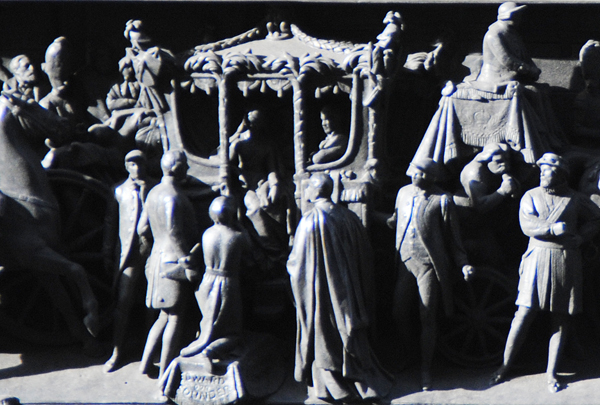
Well done to Jameson Tucker, this is indeed a relief on the Temple Bar Memorial, which stands where the Strand turns into Fleet Street. It depicts Queen Victoria on a royal progress to the Guildhall in 1837, a few months after her accession, when she was met at this spot by the Lord Mayor and Aldermen and presented with the sword of state and keys to the city.

According to a tradition said to date back to 1215, the Temple Bar is the only place where the monarch may enter London after first seeking permission from the Lord Mayor and being presented with the City’s Pearl Sword (one of five City swords, this is said to have been first given to the City by Queen Elizabeth I).

The monument itself was designed by Sir Horace Jones and erected in 1880 to mark the location where the Temple Bar – the ceremonial entrance to the City of London – originally stood (the last incarnation of the Temple Bar, designed by Sir Christopher Wren, is now located near in Paternoster Square near St Paul’s – see our earlier post for more on Wren’s Temple Bar).

On top of the granite and bronze monument stands a rearing griffin (actually it’s supposed to be a dragon), one of the city’s official boundary markers, sculpted by Charles Birch while on either side are bronze statues, by Sir Joseph Edgar Boehm, of Queen Victoria and Edward, Prince of Wales (later King Edward VII), who in 1872 were the last of the Royal family to pass through the Temple Bar gateway before its demolition in 1878 (they were on their way to St Paul’s to attend a thanksgiving service following the prince’s recovery from typhoid).

This is depicted in a relief on the north side of the monument by Charles Kelsey. Charles Mabey’s relief showing the Queen’s progress is located on the south side of the monument; he also designed one on the east side which shows a curtain being drawn over the old Temple Bar.

Around London – Diamond Jubilee celebrations special…

UPDATED: Excitement has been building for months ahead of this weekend’s Diamond Jubilee celebrations which include a 1,000 boat flotilla which will sail down the Thames on Sunday, the Diamond Jubilee concert on Monday and National Service of Thanksgiving at St Paul’s Cathedral on Tuesday which will be followed by a ceremonial procession back to Buckingham Palace.
• First to the flotilla. The formal river procession will be held between 2pm and 6pm, starting upriver of Battersea Bridge and finishing downriver of Tower Bridge. The Queen and her family will be boarding the Royal barge, the Spirit of Chartwell, near Albert Bridge at 2.30pm and will travel upriver at the centre of the flotilla with the aim of pulling up alongside HMS President, near Tower Bridge, at 4.15pm.

The flotilla will be one of the largest ever assembled on the river and feature rowing, working and pleasure boats of all shapes and sizes decked out for the occasion. In addition as many as 30,000 people will be aboard passenger boats and there will also be music barges and boats spouting geysers as well as specially constructed craft like a floating belfry. It is estimated that it will take the flotilla around 75 minutes to pass any static point along the route.

Downriver of London Bridge, near the end of the pageant’s seven mile (11 kilometre) course, a gun salute will be fired and the procession will pass through an ‘Avenue of Sail’ formed by traditional sailing vessels, oyster smacks, square riggers, naval vessels and others. For more on the pageant (including the location of large viewing screens – these positions will be regulated from 8am onwards – and road closures as well as an interactive map of the route), head to www.thamesdiamondjubileepageant.org.

• Diamond Jubilee Concert and Beacons. To be held outside Buckingham Palace, close to the Victoria Memorial, on the evening of Monday, 4th June, the concert – which starts at around 7.30pm and features everyone from Elton John to Paul McCartney and Shirley Bassey – will be televised live by the BBC (unless you’re lucky enough to have one of the 10,000 balloted tickets meaning you get to have a picnic in the palace gardens and see the concert). For those who can’t go but would like to experience some of the atmosphere, Royal Parks are setting up screens along The Mall, in St James’s Park and in Hyde Park.

At 10.30pm that night, the Queen will light the National Beacon outside Buckingham Palace, the last in a network of beacons to be lit across the country. More than 4,000 beacons will be lit by communities across the UK and in Commonwealth countries around the world between 10-10.30pm that night (for more on the beacons, see www.diamondjubileebeacons.co.uk).

• National Service of Thanksgiving and Carriage Procession. On Tuesday, the Queen and the Duke of Edinburgh will leave Buckingham Palace at 10.15am and travel by car to St Paul’s Cathedral via the Mall, through Trafalgar Square, down the Strand and Fleet Street and up Ludgate Hill to St Paul’s. There they and the 2,000 invited guests will attend the National Service of Thanksgiving, conducted by the Dean of St Paul’s, the Very Rev Dr David Ison (the Archbishop of Canterbury will preach).

At 11.30am, the Queen and Duke will then head to Mansion House for a reception (via St Paul’s Churchyard and Queen Victoria Street), hosted by the Lord Mayor of London David Wootton, Court of Aldermen and Court of Common Council. Other members of the Royal family will attend a reception at Guildhall. At 12.30pm, the  Queen and members of the Royal Family will then head to Westminster Hall (via Queen Victoria Street, St Paul’s Churchyard, Ludgate Hill, Fleet Street, the Strand, Whitehall and Parliament Square), entering through the Sovereign’s Entrance of the Palace of Westminster (Houses of Parliament) at 12.40pm. There, they will attend the Diamond Jubilee Lunch.

At 2.20pm, the Queen and Prince Philip will lead a carriage procession from the Palace of Westminster to Buckingham Palace (via New Palace Yard, Whitehall, Trafalgar Square and The Mall), riding in a 1902 State Landau. They will be followed by the Prince of Wales and Duchess of Cornwall in a State Landau, and the Duke and Duchess of Cambridge (Prince William and Kate) and Prince Harry in another State Landau. If it’s raining, these will be replaced by the Australian State Coach, Queen Alexandra’s State Coach and the Glass Coach. Military personnel will line the route, a 60 gun salute will be fired and a Guard of Honor will await them in the Buckingham Palace forecourt.

At 3.30pm, the Queen and members of the Royal Family in the carriage procession will appear on the balcony at Buckingham Palace to wave to the crowds and witness an RAF flypast and a Feu de Joie – a celebratory volley of rifle fire – which will be given as a salute in the palace forecourt.

There’s plenty more happening over the weekend including many local street parties – far too much for us to record here. So for more, head to the official Diamond Jubilee site, www.thediamondjubilee.org (or The Big Lunch for local lunches – www.thebiglunch.com). You can purchase a copy of the official souvenir programme online at www.royalcollectionshop.co.uk/diamond-jubilee-1/diamond-jubilee-official-souvenir-programme.html or download it at www.itunes.co.uk.

Reckon you can take a good photo? We’re looking for great images of this weekend’s Diamond Jubilee celebrations (just email us at exploringlondon@gmail.com).

Want to read more about the Queen? Why not check out Sixty Glorious Years: Queen Elizabeth II, Diamond Jubilee, 1952-2012, Queen Elizabeth II: A Diamond Jubilee Souvenir Album, or Debrett’s: The Queen – The Diamond JubileeFor related music, check out Diamond Jubilee: A Classical CelebrationThe Diamond Jubilee Album or Gary Barlow & the Commonwealth Band’s Sing EP (featuring Prince Harry).

Where is it? #30…

The latest in the series in which we ask you to identify where in London this picture was taken and, importantly in this case, what it’s of. If you think you can identify this picture, leave a comment below. We’ll reveal the answer early next week. Good luck!

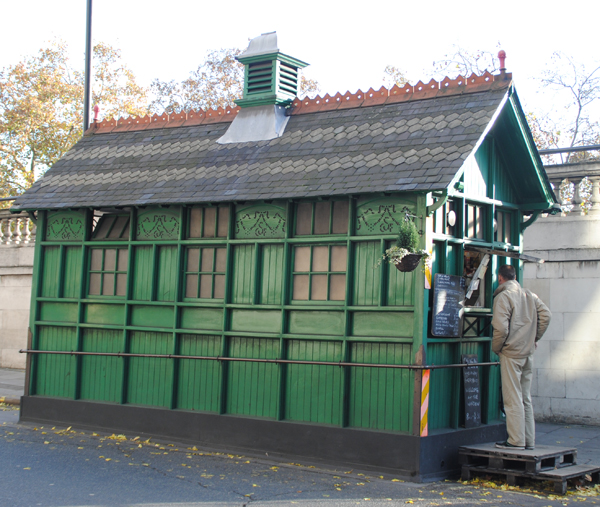
Well done to Parktown and Carol who both correctly named this as a cabman’s shelter at Temple Place near Temple Tube station. This shed is one of only 13 now left out of what were 61 shelters built by the Cabmen’s Shelter Fund between 1875 and 1914 (others, painted in the same distinctive green colour, can be in places like Russell Square, on Chelsea Embankment and on Kensington Road). The fund was established by the Earl of Shaftesbury and other well-meaning philanthropists to provide cabbies, who were prohibited from leaving their cabs unattended at a stand, with refreshments at affordable prices so they could have a hot meal while at work. The shelters, which were built on public highways, were, thanks to Metropolitan Police rules, allowed to be no bigger than a horse and cart, hence the rather small size (although they can seat up to 13 men as well as providing a kitchen). Only cabbies are allowed inside the shelters but anyone can order takeaway!

Lost London – The Roman basilica and forum…

In its ultimate grandiose form, Londinium’s basilica, the city’s first civic centre, was the largest building of its day, and in fact was the largest building of its type west of the Alps.

Located where Gracechurch Street now stands, the first basilica, which served as a town hall and law courts, was first erected in 70AD on high ground to the east of the now hidden Walbrook stream. It stood at one end of the forum or marketplace, enclosed on its other sides by shops and offices.

Twenty years after the first complex containing the basilica had been constructed, work began on a second, far larger basilica and forum on the same site. This took 30 years to complete and involved the removal of surrounding houses and other nearby structures.

The new basilica, which consisted of a large hall with a nave, was three stories high and apparently could be seen from all over the city. At the eastern end of the building’s nave was a raised platform, known as a tribune, where judges would have sat. The new forum’s central rectangular courtyard measured 100 metres by 85 metres in size.

The buildings were variously repaired over the years before being largely destroyed at the start of the 4th century. Speculation is that the destruction was carried out as punishment for London’s support of Carausius, who had declared himself emperor of Britain and northern Gaul in the late 200s. It is believed the eastern end of the basilica was perhaps retained and used as a temple or perhaps even an early church.

Sections of the walls of the basilica and forum apparently still survive in basements around Gracechurch Street today (including apparently in the basement of hairdressers Nicholson and Griffin at 90 Gracechurch Street). The eastern end of the complex now lies under the Leadenhall Market.

For more, see www.museumoflondon.org.uk/Collections-Research/Research/Your-Research/Londinium/analysis/publiclife/structures/15+Forum.htm

Interesting reads on Roman Londinium include Jenny Hall’s Roman London (The Museum of London), and John Morris’ Londinium: London In The Roman Empire. It also worth getting hold of Londinium: A New Map and Guide to Roman London, an invaluable resource for those wanting to come to grips with the city in Roman times.
Where is it? #29…

The latest in the series in which we ask you to identify where in London this picture was taken and what it’s of. If you think you can identify this picture, leave a comment below. We’ll reveal the answer early next week. Good luck!

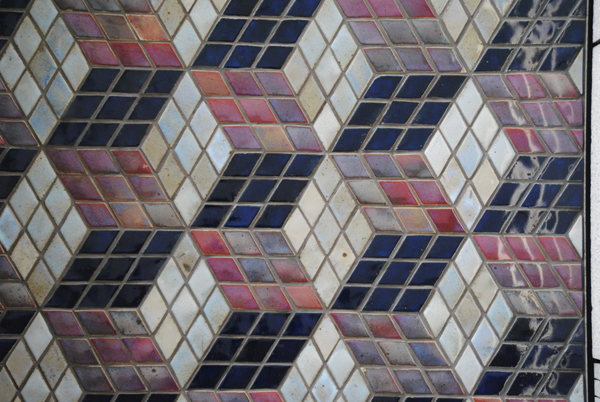
Bit of a harder one this week – these Escher-like patterns are found on a series of tiles located a wall in Waithman Street in the City of London (they are actually on the back of a building at 100 Bridge Street). According to the Tiles & Architectural Society Ceramics Society’s Gazetter, the 23 handmade stoneware tile panels were the 1992 creation of potter Rupert Spira, carried out at the behest of developers Rosehaugh Stanhope. While Spira apparently made 18,000 tiles for a garden in Paris, the tiles in Waithman Street were his only ever  British commission for tiles. Waithman Street, incidentally, is named for Robert Waithman, a draper and MP who was elected Lord Mayor of London in 1823.

Celebrating Charles Dickens – 9. Dickens’ literary connections, part 2…

In which we continue our look at some of London’s connections with Dickens’ writings…

• ‘Oliver Twist’ workhouse, Cleveland Street. The building, recently heritage listed following a campaign to save it, is said to have served as the model for the workhouse in Oliver Twist and was apparently the only building of its kind still in operation when Dickens wrote the book in the 1830s. Dickens had lived as a teenager nearby in a house in Cleveland Street and was living less than a mile away in Doughty Street (now the Charles Dickens Museum) when he wrote Oliver Twist. Thanks to Ruth Richardson – author of Dickens and the Workhouse: Oliver Twist and the London Poor – for mentioning this after last week’s post.

• Clerkenwell Green. It is here that Mr Brownlow first comes into contact with Oliver Twist and, mistakenly suspecting him of stealing from him, chases him through the surrounding streets. Interestingly, the grass (which you would expect when talking about a green) has been gone for more than 300 years – so it wasn’t here in Dickens’ time either.

• Barnard’s Inn, Fetter Lane. It was here, at one of London’s Inns of Court, that Pip and Herbert Pocket had chambers in Great Expectations. Barnard’s Inn, now the home of Gresham College, is only one of a number of the Inns of Court with which Dickens and his books had associations – the author lived for a time at Furnival’s Inn while Lincoln’s Inn (off Chancery Lane) features in Bleak House and the medieval Staple Inn on High Holborn makes an appearance in his unfinished novel, The Mystery of Edwin Drood. And, as mentioned last week, Middle Temple also features in his books.

• ‘Dickens House’, Took’s Court. Renamed Cook’s Court in Bleak House, the house – located in a court between Chancery and Fetter Lane – was where the law stationer Mr Snagsby lived and worked in the book. It’s now occupied by music promoter and impresario Raymond Gubbay.

• London Bridge. The bridge, a new version of which had opened in 1831 (it has since been replaced), featured in many of Dickens’ writings including Martin Chuzzlewit, David Copperfield and Great Expectations. Other bridges also featured including Southwark Bridge (Little Dorrit) and Blackfriars Bridge (Barnaby Rudge) and as well as Eel Pie Island, south-west along the Thames River at Twickenham, which is mentioned in Nicholas Nickleby.

We’ve only included a brief sample of the many locations in London related in some way to Dickens’ literary works. Aside from those books we mentioned last week, you might also want to take a look at Richard Jones’ Walking Dickensian London,  Lee Jackson’s Walking Dickens’ London or, of course, Claire Tomalin’s recent biography, Charles Dickens: A Life.

Famous Londoners – Jack Ketch

A 17th century public executioner famed for his botched executions, Jack Ketch looms as an infamous figure in British history and a byword for brutality and executioners in general.

Ketch’s origins are unknown (he’s also known as John Catch) but he is believed to have received his appointment as a public hangman sometime in the early to mid 1660s – the first recorded mention of him in that role, in a pamphlet celebrating his handiwork, dates from 1678. Such was his self-importance that he apparently adopted the title Esquire and apparently asked for his letters to be addressed to Dr John Ketch.

Among those who died at his hand were those accused of involvement in the Popish Plot against the Crown – a Catholic conspiracy to assassinate King Charles II which was all apparently fabricated by Titus Oates. These included William Staley and Edward Coleman both of whom were hung, drawn and quartered in 1678 (Ketch was also charged with whipping Oates following his perjury conviction).

But Ketch’s most infamous executions, the only two beheadings he is known to have performed, became notorious because of the botched manner in which they were carried out.

It was reported that it took Ketch three blows to strike off the head of William, Lord Russell, when he was executed for treason on 21st July, 1683 (he had opposed the succession of James II and was accused of involvement in the Rye House Plot), although Ketch apparently denied suggestions he had turned up drunk and blamed Lord Russell for flinching.

The beheading of James Scott, the Duke of Monmouth (and illegitimate son of King Charles II), on 15th July, 1685 (pictured above in a print from the time), was apparently even worse – it took Ketch five blows to take off his head and he apparently finished the job with a knife after having almost given up halfway through. Monmouth had been captured following the Battle of Sedgemoor in July 1685 in which he led an army having declared himself king (more on that another time).

Ketch fell out of favor with the authorities later that year and was briefly gaoled in Bridewell prison. He was reinstated but his return to the job of public executioner was only short-lived for he died in 1686 and is believed to have been buried in St James’ in Clerkenwell on 29th November, 1686.

He was survived by his wife Katherine, who apparently stood by her man despite the public feeling against him, and is it generally assumed a girl Susanna who was baptised at the church in Clerkenwell in 1668 – some 18 years before his death – was his daughter.

Following his death, Ketch’s name was adopted by subsequent public hangmen – he even appeared as an ongoing character in Punch and Judy shows.

For more on Ketch, see Tim Wales’ article Jack Ketch in the Oxford Dictionary of National Biography (a subscription is required for access).

PICTURE: Wikipedia.

Around London – Crown Jewels polished for Diamond Jubilee; Diana’s dresses at Kensington Palace; a plaque for Ziggy Stardust; and At Home with the World…

• A revamped Crown Jewels display opens today at the Tower of London to mark the Diamond Jubilee of Queen Elizabeth II. The new display features graphics, music and newly restored film footage and will focus on the coronation ceremony as its central theme, exploring how the regalia are used in the ceremony. The regalia – which includes some of the most extraordinary diamonds in the world such as the Star of Africa and Koh-i-Nur – is being displayed in the order in which it is used at the coronation ceremony. The Crown Jewels have been on show to the public at the Tower of London since at least 1661 after they were remade for King Charles II’s coronation. The previous collection had been largely destroyed in the Civil War although some pieces survived including a gilt silver spoon probably made for King Henry II or King Richard I (the “Lionheart”). For more information, see www.hrp.org.uk/TowerOfLondon/.

Five dresses worn by Diana, Princess of Wales, have gone on display at Kensington Palace  which re-opened to the public this week following a £12 million overhaul. The five dresses include a black silk taffeta gown (designed by Emanuel) which Diana wore to a fundraising event at the Goldsmith’s Hall in 1981 – her first official engagement with Prince Charles as well as a formal dinner dress of ivory silk (Catherine Walker) created for a State Banquet for the King and Queen of Malaysia in 1993 and a black ribbed silk shift evening dress (Gianni Versace) worn to the London premiere of Apollo 13 in Hammersmith in 1995. For more on the revamp of the palace see our earlier post. Or visit www.hrp.org.uk/KensingtonPalace/.

• A plaque commemorating the site where the iconic image for the cover of David Bowie’s 1972 album The Rise and Fall of Ziggy Stardust and the Spiders of Mars was photographed has been unveiled in the West End. The plaque at the somewhat innocuous site at 23 Heddon Street, just off Regent Street, was installed by the Crown Estate and unveiled this week by Gary Kemp of Spandau Ballet. The image for the album cover was shot by the late photographer Brian Ward who managed to persuade Bowie to step outside the ‘studio’ space he had rented upstairs despite the fact it was a cold, wet January night.

• On Now: At Home with the World. This exhibition at the Geoffrye Museum explores the cosmopolitan nature of London’s homes over the past 400 years and looks at how diverse cultures have helped shaped the homes – covering everything from Chinese porcelain and the tea craze of the 1700s to the use of Islamic and Indian patterns in the 1800s, the popularity of Scandinavian and American design in the 1900s and the globalism of today. The period rooms on show at the museum have been reinterpreted to highlight the international influences. This is one of a series of Stories of the World: London exhibitions taking place across the city which are exploring four aspects of life – home, identity, journeys and place – as part of the London 2012 Cultural Olympiad program. Runs until 9th September. Entry is free. For more, see www.geffrye-museum.org.uk.

Celebrating Charles Dickens – 8. Dickens’ literary connections, part 1…

London is redolent with sites which appeared in the books of Charles Dickens and, having had a look at his life, it’s time we turn our attention to some of the sites relevant to his writing. For the next two weeks, we’re looking at just a few of the many, many sites which feature in his novels. So, here’s seven places to get us going…

• Saffron Hill, Clerkenwell. Once a notorious slum akin to St Giles (see last week’s entry) and the city’s Italian Quarter, Saffron Hill is where Fagin and his gang of thieves operate in Oliver Twist and have their den.

• Chancery Lane, Holborn. Much of the novel Bleak House is set around this narrow street between High Holborn and Fleet Street – Tom Jarndyce kills himself in a coffee shop here in the novel and Lincoln’s Inn Hall – formerly home of the High Court of Chancery – also features.

• The Old Bailey. Some have suggested Dickens worked here as a court reporter although there is no compelling evidence he did so. But the the Old Bailey (the current building dates from the early 20th century, well after Dickens’ death) and Newgate Prison certainly featured in his books – it is here that Fagin is eventually hung in Oliver Twist.

• Child & Co’s Bank, Fleet Street. While the present building dates from 1878, Dickens is believed to have used the bank as the model for Tellson’s Bank in A Tale of Two Cities.

• St Dunstan-in-the-West, Fleet Street. In David Copperfield, David and his aunt, Betsy Trotwood, make a special trip to see the giants Gog and Magog strike the church bells. It also features in Barnaby Rudge and Dickens dedicated his Christmas story, The Chimes, to the church.

• Garden Court and Fountain Court (pictured), Middle Temple. Garden Court is where Pip lived in Great Expectations and where Abel Magwitch turned up to reveal himself as Pip’s benefactor. Fountain Court features in Martin Chuzzlewit as the site for the romance of Ruth Pinch and John Westlock.

• Golden Square, Soho. Mentioned in Nicholas Nickleby – Nicholas’ uncle, Ralph Nickleby, was thought to live in a previous building at number seven.

There’s some great books about London sites which appear in Dickens’ books – among them are Ed Glinert’s Literary London: A Street by Street Exploration of the Capital’s Literary Heritage and Michael Paterson’s Inside Dickens’ London as well as Paul Kenneth Garner’s 
A Walk Through Charles Dickens’ London.

Around London – Your Roman influences; celebrating the City; and, of Journeys and kinship…

• The Museum of London is calling on Londoners to submit images showing “Roman influences in London today” as part of its forthcoming Our Londinium 2012 exhibition, a revamping of the museum’s Roman gallery. In what is the largest update made to the museum’s Roman gallery since it opened in 1994, the  reworked gallery looks at parallels between Roman London and the city today and features important Roman artifacts such as a bust of the Emperor Hadrian found on the Thames foreshore (part of the British Museum’s collection, this will be displayed for six months before being replaced by a replica) alongside modern objects such as the V for Vendetta masks worn by protestors in the Occupy movement. The exhibition is being co-curated by young people from Junction, the Museum of London’s youth panel, and they’re calling on people to submit their images showing how the city’s Roman past still resonates even today (see example pictured). For details on how to submit images via email of Flickr, head to www.museumoflondon.org.uk/ol2012map.

Secrets will be revealed, we’re promised, as part of the City of London’s Celebrate the City: four days in the Square Mile event to be held from 21st to 24th June. Events held in the City our the four days, many of which will be free, include a musical extravaganza to launch the event in Guildhall Yard as well as exhibitions, walks and talks, a chance to explore buildings like Livery Company Halls, the Bank of England and the Mansion House, family entertainment at the Cheapside Fayre and music and activities at sites across the Square Mile including the Barbican Centre, Museum of London and churches. We’ll have more to come on this. For now, head to www.visitthecity.co.uk/culture2012 for more information.

• Architectural historian and former director of the Sir John Soane Museum, Sir John Summerson, has been honored with an English Heritage blue plaque at his former home  London’s north-west. Sir John (1904-1992) lived at the property at 1 Eton Villas in Chalk Farm for more than 40 years. He was the director of the Sir John Soane Museum from 1945 to 1984. For more, see www.english-heritage.org.uk/discover/blue-plaques/.

• Architecture students are being invited to submit designs for a new stone seating area on the City thoroughfare of Cheapside. The winning student will work with trainee masons from the Cathedral Works Organisation and The Mason’s Company with the new seating area unveiled in October. For an application pack and full brief, see For an application pack and full brief, please contact Melanie Charalambous, Department of the Built Environment, City of London Corporation, PO Box 270, Guildhall, London, EC2P 2EJ or call 020 7332 3155 or email stonebench@cityoflondon.gov.uk.

• Now On: Journeys and kinship. This display at the Museum of London Docklands showcases the creative output of a community collaboration project which involved a group of young Londoners working with visual artist Jean Joseph, Caribbean Calypso musician Alexander D Great and Yvonne Wilson from training organisation Equi-Vision. The centrepiece of the exhibition – which explores themes highlighted in the museum’s permanent gallery, London, Sugar and Slavery, on the city’s involvement in the trans-Atlantic slave trade  – is an artwork by Joseph entitled Sales Over Centuries, 2010, which features plaster face casts of 42 people from the African diaspora who were born in or currently live in London. In response to it, the young Londoners have created their own works including face casts, music, film and photography. Runs until 4th November. Entry is free. For more, see www.museumoflondon.org.uk/Docklands/.

Where is it? #21

The latest in the series in which we ask you to identify where in London this picture was taken and what it’s of. If you think you can identify this picture, leave a comment below. We’ll reveal the answer early next week. Good luck!

Congrats to Jameson Tucker who correctly placed this in the gardens which now occupy the site of the former church of St John Zachary which lie, as Mike Paterson correctly pointed out, near the Goldsmiths’ Hall.

In fact, the gardens, located at the corner of Gresham and Noble Streets in the City (opposite the Goldsmith’s Hall), are also known as the Goldsmith’s Garden and were laid out following bomb damage during the Blitz (the church of St John Zachary had been destroyed in the Great Fire of London and not rebuilt).

The gardens were redesigned in 1957 by landscape architect Sir Peter Shepheard and have been added to and amended over the years since (including by landscape architect Anne Jennings in the mid-Nineties).

The iron arch, which was commissioned by the Blacksmith’s Company and put here in 1994, features the leopard’s head which is the hallmark of the Goldsmiths’ Company Assay Office, the premier hallmark in the UK (the term hallmark dates from the 15th century when London craftsmen were first required to bring their creations to the Goldsmiths’ Hall for verification and marking although the mark of the leopard’s head has been in use since the early 1300s).

For more on the Goldsmiths, see www.thegoldsmiths.co.uk.

Lost London: Gates Special – Newgate

Better known now as the name for the infamous former prison which whom its history is intertwined, Newgate was originally one of the seven principal gates of London and, like five others, originally dates back to Roman times.

The gate, which apparently took the name ‘new’ thanks to a rebuild in the early medieval era, possibly in the reign of King Henry I or King Stephen, was located close to where the street known as Newgate meets the Old Bailey (see picture – there’s a blue plaque marking the spot on Newgate).

It was used as a prison from the 12th century for housing debtors and felons  – in the 13th century King Henry III is recorded as having issued orders for the prison’s repair (You can see our earlier entry on the prison here.)

The gate’s prison function – this was really no more than a few ‘cells’ – was substantially added to in the 1420s when, apparently as required under the terms of former Mayor Richard Whittington’s will, the gate was rebuilt and a new prison building was constructed to the south on what is now the site of the Old Bailey (home of the Central Criminal Court).

The gate was eventually demolished in the mid 18th century apparently due to urban planning issues. The prison, meanwhile, continued to be used until 1902 and was finally pulled down two years later.

10 London sites to celebrate Charles Dickens – 5. Seven pubs associated with Dickens (including one he never visited)…

There hardly seems to be a pub in London which doesn’t claim some connection with the Victorian author but we thought we’d confine ourselves to five pubs with more well-established credentials…

• Ye Olde Cheshire Cheese. This pub is a Fleet Street institution with parts of the current building dating back to 1667 when it was rebuilt following the Great Fire. Dickens was among numerous literary figures who frequented the premises – the pub is perhaps most famously associated with the lexicographer Dr Samuel Johnson (although there is apparently no recorded evidence he ever attended here); other literary figures who came here include Mark Twain and Sir Arthur Conan Doyle – and, according to a plaque in Wine Court, worked out of the pub for a period while producing his journal All The Year Round.

• The One Tun, Saffron Hill. Said to have been established as an ale house on its present site in 1759, the pub was rebuilt in the mid-Victorian era  and was apparently patronised by Dickens between 1833 and 1838. It’s also apparently the inspiration for the pub called The Three Cripples in Oliver Twist (The Three Cripples was actually a lodging house next door to the One Tun and didn’t sell ale). For more, see www.onetun.com

• The George Inn, Southwark. Dating from the 17th century, the George Inn in Borough High Street is the last galleried coaching inn left standing in London and is now cared for by the National Trust (and leased for use by a private company). Dickens is known to have come here when it was running as a coffee house and he mentions it in the book, Little Dorrit. For more, see     www.nationaltrust.org.uk/george-inn/.

• George & Vulture, Castle Court (near Lombard Street). Established in the 18th century on the site of an older inn, this well-hidden pub was not only frequented by Dickens but is mentioned in The Pickwick Papers more than 20 times.

• The Grapes, Limehouse. Formerly known as The Bunch of Grapes, there has been a pub on the site for almost more than 430 years. Dickens was known to be a patron here (his godfather lived in Limehouse) and mentioned the pub – renamed The Six Jolly Fellowship Porters – appears in his novel Our Mutual Friend. For more, see www.thegrapes.co.uk.

• Ye Olde Mitre, Ely Place. This pub dates from the mid 1500s by Bishop Goodrich of Ely to house his retainers and later rented out to Sir Christopher Hatton (it still houses the remains of a cherry tree which Sir Christopher is said to have danced around during a May Day celebration with none other than the future Queen Elizabeth I). Dickens (and the ubiquitous Dr Johnson) are both said to have drunk here.

• And lastly, The Dickens Inn in St Katharine Docks. It’s worth noting up front that Charles Dickens had nothing to do with this pub – dating back to at least 1800, it was once a warehouse and is thought to have been used to either house tea or play a role in a local brewing operation – but it was his great grandson, Cedric Charles Dickens, who formally opened the pub in 1976, apparently declaring, “My great grandfather would have loved this inn”. For more, see www.dickensinn.co.uk.

This list is by no means comprehensive – we’d love to hear from you if you know of any other pubs Dickens frequented…

Lost London: Gates Special – Moorgate

Originally a postern (small or secondary) gate built by the Romans, Moorgate came into its own as a larger gate in the 15th century and survived for more than 300 years before it was demolished in 1761.

The name comes from the area in which it stands – Moorfields, one of the last open pieces of space within the City of London – stood just to the north of the gate. It was originally a sparsely populated marshy expanse – so much so that when the gate was first built, the area around it was often flooded and some local residents used boats as a means of transport – but was later drained. Many people were evacuated here during the Great Fire of London in 1666 and some apparently then settled in the area which later also gained a reputation as a hiding place for highwaymen like Jack Sheppard – we’ll take a closer look at Moorfields in a later post.

The gate known as Moorgate, meanwhile, was first rebuilt as a full sized gate with towers in 1415 on the orders of then Mayor Thomas Falconer to provide access to the fields without. It was enlarged several times in medieval years before being damaged in the Great Fire. It was replaced with a ceremonial stone gate in 1672 to provide access to the now well-drained fields before being demolished in 1761 (some of the stone was apparently later used to support the newly widened central arch of London Bridge).

The gate’s name now lives on in the street known as Moorgate (originally formally known as Moorgate Street after it was first constructed in 1846) – worth noting is that the Romantic poet John Keats was born in the street. The area around the street also is also known by the name Moorgate and is home to some of the City’s key financial institutions.

There’s a plaque near where the site of Moorgate once stood at the corner of Moorgate and London Wall.

PICTURE: Moorgate in its final, ornate form. Taken from a London Wall Walk plaque.

Lost London: Gates Special – Cripplegate

Originally the northern gate of the Roman fort constructed in about 120 AD, Cripplegate was rebuilt several times during the medieval period before finally being demolished in 1760 as part of road widening measures.

The origins of the gate’s name are shrouded by the mists of time but it has been suggested that it was named for the beggars or cripples that once begged there or that it could come from an Anglo-Saxon word crepel which means a covered walkway.

The name may even be associated with an event which took place there in 1100 when, fearful of marauding Danes, Bishop Alwyn ordered the body of Edmund the Martyr, a sainted former Anglo-Saxon king, to be tranferred from its usual home in Bury St Edmunds to St Gregory’s Church near St Paul’s in London so that it could be kept safe. It was said that when the body passed through the gate, many of the cripples there were miraculously healed.

The gate (pictured here in an 18th century etching as it would have looked in 1663 in an image taken from a London Wall Walk plaque), which gave access in medieval times to what was then the village of Islington, was associated with the Brewer’s Company and was used for some time as a prison.

It was defensive works, known as a barbican, built on the northern side of the gate in the Middle Ages which are apparently responsible for the post World War II adoption of the name Barbican for that area of London which once stood outside the gate’s northern facade (the gates stood at what is now the intersection of Wood Street and St Alphage Garden).

The gate’s name now adorns the street known as Cripplegate as well as the name of the church St Giles Cripplegate, which originally stood outside the city walls. It is also the name of one of the 25 wards of the City of London. The original site of the gate is marked with a blue plaque.

Around London – ‘Cathedral of Middlesex’ to be opened in west London; Roman brothel token on display; wifi in Westminster and Kensington; and, looking at the Hajj at the British Museum…

• A medieval barn in west London, said to be the “Cathedral of Middlesex”, will open to the public in April. The Grade I listed Harmondsworth Barn was built in 1426 by Winchester College, who owned a manor farm at Harmondsworth, and was used to store grain. Nearly 60 metres long, the roof is held up by 13 massive oak trusses. In 2006, the barn was bought by an off-shore company who subsequently agreed to sell it to English Heritage following the issuing of a notice for emergency repairs. English Heritage say the barn, called the “Cathedral of Middlesex” by the late poet-laureate Sir John Betjeman, will now be “run by and for the local community”. “Harmondsworth Barn is one of the greatest medieval buildings in Britain, built by the same skilled carpenters who worked on our magnificent medieval cathedrals,” says Simon Thurley, chief executive of English Heritage. “Its rescue is at the heart of what English Heritage does – protecting this nation’s architectural treasures and helping people discover our national story through them. We will complete the repair of this masterpiece and working with local people, will open it to the public to enjoy.” For more, see www.english-heritage.org.uk. (Image: Copyright English Heritage; Photographer Boris Baggs).

The oldest Roman brothel token to have been discovered in London has gone on temporary display at the Museum of London. The token, which may be the oldest of its kind to have been found in Britain (or, indeed, even the only one of its kind ever found in Britain), was known as a spintria and depicts two reclining human figures on one side and the Roman numeral 14 on the other. It was found on the Thames foreshore near Putney Bridge by a mudlarker using a metal detector. Only the size of a 10 cent piece, its use remains something of a mystery – it may have been exchanged for sexual services or used as gaming piece. The token is on display at the museum until April. For more, see www.museumoflondon.org.uk.

Free wifi is being rolled out across Westminster, Kensington and Chelsea as part of deal between Westminster City Council, the Royal Borough of Kensington and Chelsea and network operator, O2. The network, installation of which began last month, is initially being rolled out in a limited number of areas but will eventually cover all of the boroughs and create the largest free wireless hub in Europe.

Now On: Hajj: journey to the heart of Islam. This exhibition at the British Museum is the first to focus on the pilgrimage to Mecca in Saudi Arabia – a central tenet of the Islamic faith. Organised in partnership with the King Abdulaziz Public Library in Riyadh, it’s based around three central themes: the pilgrim’s journey to Mecca with an emphasis on the major routes taken; the Hajj today and its associated rituals; and the origins and importance of the Hajj to Mecca. Objects featured in the exhibition include a seetanah which covers the door of the Ka’ba as well as gifts offered to the sanctuary and souvenirs taken back home. It’s the first of three exhibitions at the British Museum focused on spiritual journeys. Runs until 15th April. Admission charge applies. For more, see www.britishmuseum.org.