Around London – Margaret Thatcher’s funeral; telling the Jewel Tower’s story; depot open weekend; and, Designs of the Year…

Margaret Thatcher’s funeral will be held next Wednesday at St Paul’s Cathedral from 11am with Queen Elizabeth II among those attending (the first time she has attended the funeral of a British politician since Sir Winston Churchill’s in 1965). The funeral procession of the former Prime Minister, who died on Monday aged 87, will start at the Houses of Parliament and make its way down Whitehall to Trafalgar Square before moving down the Strand, Fleet Street and Ludgate Hill to St Paul’s Cathedral. Baroness Thatcher’s coffin will carried in a hearse for the first part of the journey and will be transferred to a gun carriage drawn by six horses of the King’s Troop Royal Horse Artillery at St Clement Danes church on the Strand for the final part of the journey. There will be a gun salute at the Tower of London. Meanwhile, a Book of Condolence has opened at St Margaret’s Church, beside Westminster Abbey, this morning and will be available for people to pay their respects until 17th April, during the church’s opening hours. St Margaret’s – which stands between Westminster Abbey and the Houses of Parliament – is commonly known as the parish church of the House of Commons.

The story of the Jewel Tower – one of the last remaining parts of the medieval Palace of Westminster – is told in a new exhibition at the historic property. Now in the care of English Heritage, the tower – located to the south of Westminster Abbey, was built in 1365 to house King Edward III’s treasury, later used as King Henry VIII”s ‘junk room’, the record office for the House of Lords, and, from 1869, served was the “testing laboratory” for the Office of Weights and Measures. The exhibition, which opened this month, is part of the English Heritage celebrations commemorating the centenary of the 1913 Ancient Monuments Act. The Jewel Tower is open daily until November. Admission charge applies. For more, see www.english-heritage.co.uk.

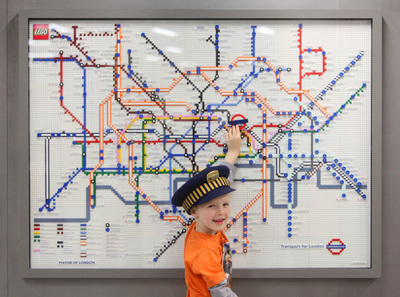
See some of the earliest underground trains, a Lego version of Baker Street station and ride the Acton Miniature Railway. The London Transport Museum’s depot in Acton is holding it’s annual spring open weekend this Saturday and Sunday and in celebration of the Underground’s 150th anniversary, attractions will include the Metropolitan Steam Locomotive No. 1 and the recently restored Metropolitan Carriage 353 along with model displays, rides on the miniature railway, film screenings, talks, and workshops. Wales’ Ffestiniog Railway team – celebrating their own 150th anniversary – will also be present with the narrow gauge train, Prince. Open from 11am to 5pm both days. Admission charge applies. For more, see www.ltmuseum.co.uk.

Now On: Designs of the Year. The Design Museum has unveiled contenders for the sixth annual Designs of the Year competition and you can what they are in this exhibition. Consisting of more than 90 nominations spanning seven categories, the nominated designs include the Olympic Cauldron by Heatherwick Studio, The Shard – western Europe’s tallest building – by Renzo Piano, a non-stick ketchup bottle invented by the Varanasi Research Group at MIT, and Microsoft’s Windows phone 8. The exhibition runs until 7th July – the winners will be announced this month. Admission charge applies. For more, see www.designmuseum.org.

LondonLife – New pelicans fly into St James’s Park from Prague…

Pelicans

Following a tradition that dates back to 1664, three new pelicans have taken up residence in St James’s Park in front of Buckingham Palace. A gift from the City of Prague in the Czech Republic (the birds were donated by Prague Zoo), one of the pelicans is named Tiffany (in honour of New York-based The Tiffany & Co Foundation – which funded transport of the birds) while the other two have yet to be named with the public invited to join in the process by voting for their favourite name for one of the birds from a shortlist published on the Royal Parks Foundation website, www.supporttheroyalparks.org (the poll closes on 16th April). Choices include Bela, Karola, Queenie and Isla. The first pelican to live in the Royal Parks was a gift to King Charles II from the Russian ambassador in 1664 and they have been there ever since. The new arrivals, join the existing ‘scoop’ of pelican residents in the park – Gargi, Vaclav and Louis. PICTURE: Courtesy of Royal Parks Foundation.

Where’s London’s oldest…Catholic church?

Hidden away to the north-west of the City of a quiet cul-de-sac, the oldest still-in-use Roman Catholic church in London (indeed, in England) is St Etheldreda’s Church in Holborn.

St-EtheldredaLocated in Ely Place, this atmospheric church – named for Etheldreda, seventh century female abbess of Ely – opened as a Roman Catholic Church in 1878, although the building in which it is lodged is much older, indeed a rare survivor from the 13th century. It was built in 1290 by John De Kirkeby, the Bishop of Ely and Treasurer of England during the reign of King Edward I, as a chapel to a residence he constructed on the site.

It and the adjoining palace remained in use by subsequent bishops and other nobles (including John of Gaunt who lived here after his own residence, Savoy Palace , was burnt down during the Peasant’s Revolt) up to and after the Reformation – the first reformer Bishop to use it was Thomas Goodrich, who built the nearby Mitre Tavern. (Worth noting is that the church also has some strong links to Shakespeare – there’s a great article on the church’s website exploring these).

In 1620, the Spanish Ambassador, the Count of Gondomar, moved into Ely Place and the chapel was used once again for Catholic masses (the residence was considered part of Spanish territory) – this was a relatively short-lived development for, thanks to deteriorating relations between England and Spain following a failed match between Prince Charles (later King Charles I) and the Infanta of Spain, the next ambassador was refused permission to live there.

Having escaped destruction in the Great Fire of London, the chapel was requisitioned by Parliament as a prison and hospital during the Civil War and subsequently fell into disuse before in 1772, the property – including the chapel – was sold to the Crown who in turn sold it to a surveyor and builder, Charles Cole.

Cole demolished the palace buildings with the exception of the chapel and had the current Ely Place built with neat rows of Georgian homes, modernising the chapel for the use of residents as an Anglican place of worship. The church attracted few worshippers, however, and in 1820 was taken over by the National Society for the Education of the Poor.

In 1873, the chapel was again to be sold and following a somewhat controversial auction was bought by the Catholic Institute of Charity (aka the Rosminians) and restored under the eye of Father William Lockhart (the Catholic Emancipation Act had been passed in 1829, allowing Catholics to have churches and say mass).

Interestingly, it was during this work that 18 bodies were discovered buried in the crypt – they had died in the ‘Fatal Vespers’ of 1623 when, during a secret meeting of Catholics at the French ambassador’s house in Blackfriars, the floor collapsed and more than 100 were killed. Not able to be buried publicly due to anti-Catholic feeling, they were buried in secret with some of them buried here.

A mass commemorated the completion of the restoration work on 23rd June, 1878, and the church has been in use as a Roman Catholic Church ever since (although years of repairs were needed following significant bomb damage in World War II). Further restoration work was carried out in the 1990s when Flemish tiles from the original cloister were discovered.

These days the church – which features a relic of St Etheldreda contained in a bejewelled cask sitting by the altar – is a quiet oasis in the midst of the bustling city – a great place to take some time out in the midst of a busy day. Also of note is the east window – the work of Joseph Edward Nuttgens, it was completed in 1952 and, like all the other windows, replaced a Victorian window destroyed in the Blitz (look for the image of St Etheldreda) – and the  west window – the work of Charles Blakeman, it is apparently the largest stained glass window in London and depicts a series of English Catholic martyrs.

WHERE: St Etheldreda’s Church, Ely Place (nearest Tube stations are Chancery Lane and Farringdon); WHEN: 8am to 5pm Monday to Saturday; 8am-12.30pm Sunday; COST: Free; WEBSITE: www.stetheldreda.com.

Around London – Olympics at the Museum of London; Oxford wins the Boat Race; restoration project at Kew; and, Phantom Ride at the Tate…

 Diver Tom Daley’s swimming trunks, cyclist Bradley Wiggins’ yellow jersey and a Mary Poppins outfit worn in last year’s Olympic Games’ opening ceremony are among the items on display as part of the Museum of London’s 2012 display. The free display, which opened last week, exactly 200 days after the Paralympics closing ceremony, features a selection of 70 items connected with the Games. Runs in the Galleries of Modern London until 31st October. For more, see www.museumoflondon.org.uk.

Oxford took line honours at the 159th Boat Race, held on the River Thames last weekend. The Dark Blues – whose crew included Olympic medalists Constantine Louloudis and Malcolm Howard – still trail Cambridge (the Light Blues) – whose crew included another Olympic medallist, George Nash, however, with 77 wins to 81 wins. For more, see www.theboatrace.org or our previous articles – here and here.

Kew Garden’s historic Temperate House has received a £14.7 million Lottery Fund grant for conservation of the Grade One listed building, the largest Victorian glasshouse in the world. The grant – which adds to £10.4 million from the government and £7.7 million from private donors – will also be used to create a “more inspiring” public display for visitors with the overall £34.3 million project completed by May, 2018. The building opened in 1863 and was last refurbished 35 years ago. It houses some of the world’s rarest plants, including a South African cycad (Encephalartos woodii). For more, see www.kew.org.

On Now: Phantom Ride. This “haunting” film installation by artist Simon Starling was commissioned by the Tate Britain in Millbank and is located in the neo-classical Duveen galleries. Referencing the late nineteenth century tradition of ‘phantom rides’ – films, often made by cameramen strapped to the front of a train, that gave a dramatic sense of motion as if one is aboard an invisible vehicle – the installation includes a “compelling flow of images” of artworks that once filled the Duveen galleries, creating a sense of movement as the works move up and down the walls. Admission is free. Runs until 20th October. For more, see www.tate.org.uk.

10 of London’s greatest Victorian projects – 10. The final wrap-up…

For the final in our series on 10 of London’s greatest Victorian projects, we’re taking a quick look at some of the great Victorian projects that we’ve previously examined on Exploring London…

Tower Bridge – An eight year project which opened in 1894. For more, see our earlier post, Treasures of London – Tower Bridge.

Albert Memorial – Completed in 1876, the memorial to the Prince Consort is a masterpiece of the Gothic Revival style. For more, see Curious London memorials – 2. The Albert Memorial.

Trafalgar Square – While plans were drawn up by John Nash, it was Sir Charles Barry who designed the basic layout we see today. See our earlier post – What’s in a Name?…Trafalgar Square for more.

You can see all the previous entries in this series here.

What do you think is the most iconic Victorian building in London?

LondonLife – Farewell to the BBC Television Centre…

BBC-Television-CentreThe BBC Television Centre in London’s west closed its doors on Sunday, almost 53 years after it was officially opened on 29th June, 1960.  The 14 acre site in Wood Lane, White City, was sold for £200 million to developers Stanhope Plc. It will be redeveloped into new premises including a hotel, offices, flats, townhouses and a cinema. The Television Centre – the main building of which was affectionately known as the ‘doughnut’ thanks to its circular shape – has hosted some of the UK’s most iconic television shows – from The Two Ronnies to NewsnightMonty Python’s Flying Circus to Dr Who, Fawlty Towers and Blue Peter. It’s far from the end of the relationship between the site and the BBC. Various arms of the BBC will return to the site in coming years and other plans reportedly include the creation of a ‘virtual attraction’ where visitors can experience the creation of shows like Top Gear and EastEnders. BBC stars including Sir Michael Parkinson, Penelope Keith, Ronnie Corbett, Sir Terry Wogan and Sir David Jason have paid tribute to the building in a TV special, Goodbye Television Centre, broadcast on 22nd March. For more, see www.bbc.co.uk.

Around London – Bedchamber secrets at Hampton Court; Roman remains at the British Museum; Easter chocolate at Kew Gardens; Harry Beck’s blue plaque; and, Underground art…

Happy Easter! We’re taking a break over the Easter weekend…Our next update will be on Tuesday, 2nd April.

Mary-of-Modena's-bedA new exhibition exploring the secrets of the bedchambers of the Stuart and Hanoverian courts of the 17th and 18th centuries opened at Hampton Court Palace this week. At the heart of Secrets of the Royal Bedchamber are six royal beds which tell the story of why the bedchamber became the most important part of the palace and detail some of the events that took place there before an audience of courtiers, politicians and family members – from births and deaths to the consummation of marriages and the discussion of important affairs of state. It tells of why courtiers would fight for positions such as the ‘groom of the stool’ or ‘necessary woman’ and how beds which could cost the same as a London townhouse were sometimes never slept in. Among the beds on display is the ‘Warming Pan Bed’ (pictured), the State Bed of King James II’s queen, Mary of Modena, and scene of the royal birth that ultimately led to the end of the Stuart line, and the ‘Travelling Bed’ of King George II which travelled as far afield as Hanover and the battlefields of Europe. The exhibition also gives rare access into the Prince of Wales’ Apartments, designed by 17th and 18th architect Sir John Vanbrugh, and now open for the first time in 20 years.  Admission charge applies. Runs until 3rd November. For more, see www.hrp.org.uk. PICTURE: HRP

The Roman cities of Pompeii and Herculaneum are the subject of a major exhibition opening at the British Museum today. Life and death in Pompeii and Herculaneum brings together more than 250 objects from the two cities which were buried in just 24 hours during the eruption of Mount Vesuvius in 79 AD. The objects include celebrated finds and recent discoveries, many of which have never before been seen outside Italy, and help explore what daily life was like for the inhabitants. Artefacts include a beautiful wall painting from Pompeii showing baker Terentius Neo and his wife, wooden furnishings including a linen chest, inlaid stool, and even a baby’s crib from Herculaneum, and casts of victims including a family of four and a dog who died at Pompeii. Runs until 29th September. Admission charge applies. For more, see www.britishmuseum.org.

Find out more about the history of chocolate at Kew Gardens this Easter, from the ritualistic use of cacao in ancient Mayan and Aztec cultures to the arrival of chocolate in 17th century London, where it was a luxury item for high society to indulge in at newly fashionable chocolate houses. Running from tomorrow until 14th April, there will be a range of workshops taking place at the gardens around the chocolate theme along with a traditional Easter Egg Hunt on Easter Sunday (31st March). The garden’s cocoa tree can be found in the Princess of Wales Conservatory. Admission charge applies. See www.kew.org.

Harry Beck, designer of the innovative first diagrammatic Tube map, has been honoured by an English Heritage blue plaque – inscribed in the Underground’s new Johnston typeface – at his birthplace in Leyton in London’s east. Beck, who was born in a small terraced house at 14 Wesley Road in 1902, was working with London Transport as a draughtsman in the London Underground Serial Engineer’s Office, when, in 1931, he produced his first design for a diagrammatic map. He continued to update the map with new stations and lines even after leaving London Transport with the last version of his map published in 1960. Beck died in 1974. Meanwhile, a blue plaque commemorating railway engineer Sir Nigel Gresley (1876-1941) has been returned to King’s Cross station following the completion of building work. It can be found on platform 8. For more, see www.english-heritage.org.uk/discover/blue-plaques/.

On Now: The Underground. A commission from Art on the Underground, this exhibition of artist Mark Wallinger’s work at the Anthony Reynolds Gallery (60 Great Marlborough Street) features some examples of 270 labyrinth designs – one representing each of the Underground stations – which are being installed at the Tube stations themselves. Among those stations represented at this showing are Westminster, St James’s Park, Oxford Circus, Victoria, Embankment, Green Park, King’s Cross St Pancras, Baker Street and Tottenham Court Road. While labyrinths are already in place at these locations, the remainder of Wallinger’s labyrinth designs will be appearing at Tube stations over the coming months. Runs until 27th April. For more, see www.anthonyreynolds.com.

10 of London’s greatest Victorian projects – 9. The Underground…

Apologies for the delay in posting this piece – next week we’ll post the final in this series!

The first underground railway system in the world, the London Underground – fondly known as the ‘Tube’ –  is this year celebrating the 150th anniversary of its creation. 

Born out of an idea to link the inner city with the various large rail termini on the outskirts, the first section of what is now the underground system – a six kilometre stretch between Paddington and Farringdon – opened on 9th January, 1863, and was run by the Metropolitan Railway, known less formally as the ‘Met’.

South-Kensington-stationIt was constructed using the ‘cut and cover’ method in which streets were dug up and tracks laid in a trench before being covered by brick-lined tunnels and the street above replaced (the method was later abandoned, apparently due to the disruption it caused to traffic). The first trains were steam-driven locomotives and drew gas-lit wooden carriages behind them (the first journey was re-enacted earlier this year – see our earlier post here. Other events commemorating the 150th included a visit to Baker Street Station by Queen Elizabeth II, Prince Philip and the Duchess of Cambridge).

The idea proved a success – 26,000 people used the new railway every day during the first six months of its operation – and the Metropolitan District Railway opened a new line between Westminster and South Kensington (station is pictured) in December, 1868, while the first Tube tunnel under the Thames, from the Tower of London to Bermondsey, opened in 1880, and what is now the Circle Line was completed in 1884.

In December 1890, the world’s first deep-level electric railway opened, running between King William Street in the City and passing under the Thames to Stockwell. Ten years later the ‘Twopenny Tube’, more formally known as the Central London Railway, opened between Shepherd’s Bush and Bank (it was from this that the use of the word ‘Tube’ to describe the Underground system caught on).

The uniting of the system began the following year with the creation of the Underground Electric Railway Company of London and by World War I, all but the Met were within a single group organisation. The name Underground first appeared on stations in 1908, the same year electric ticket machines were introduced.

In 1933, the Underground came under the control of the London Passenger Transport Board – the same year that Harry Beck’s first diagrammatic map of the underground system appeared.

Stations in the system were used as air raid shelters during World War II – part of the Piccadilly Line was closed and used as a storage site for treasures from the British Museum. Following the war, the organisation running the system went through various name changes until the formation of London Underground in 1985.

The system has since expanded – the Victoria Line was opened in the late 1960s and the Jubilee Line a decade later – and now consists of more than 408 kilometres of railway lines and 275 stations which serve more than three million passengers a day – equating to more than a billion a year, the same as the entire national rail network.

For more on the history of the Underground, see our earlier 10 Questions with London Transport Museum curator Simon MurphyPoster Art 150 – London Underground’s Greatest Designs runs at the London Transport Museum until October. Admission charge applies. For more (including the many events around the exhibition), see www.ltmuseum.co.uk/whats-on/events/events-calendar#posterart150.

For more, check out David Bownes’ Underground: How the Tube Shaped London or Andrew Martin’s Underground, Overground: A Passenger’s History of the Tube.

What’s in a name?…Canary Wharf

No, Canary Wharf is not so named because it was the centre of London’s lucrative trade in canaries.

Canary-WharfRather it received its name from the fact that it was at a quay here that ships from the Spanish Canary Islands and the Mediterranean landed laden with cargos of fruit.

The wharf, part of the West India Docks on the Isle of Dogs, was built in 1936 by Fruit Lines Limited and a warehouse the following year.

The area where the wharf was once located was redeveloped under a massive regeneration project starting in the late 1980s and is now one of London’s key financial districts, filled with modern, multi-storey office towers and home to the second-tallest tower in the UK, One Canada Square (seen above with the pyramid-shaped roof).

Lost London – Euston Arch…

The original entrance to Euston Station, Euston Arch was not so much an arch as a colonnaded monumental gateway, formally known as a propylaeum, which resembled the entrance to a Greek temple.

Euston-ArchBuilt in 1837 (pictured here in 1851), it was designed by architect Philip Hardwick and inspired by the ancient architecture he had encountered on a trip to Europe – in particular the grand entrance to the Acropolis in Athens.

Commissioned by the London and Birmingham Railway as the grand entrance to the company’s new station then facing on to Euston Square (the site is now covered by the station structure), it was designed to complement the existing structure which had been built at the other end of the line in Curzon Street Station in Birmingham.

The building, which rose to a height of 21.5 metres and was built from Yorkshire-sourced sandstone, featured four columns behind which stood large iron gates. Rather controversial even when built, it led to an apparently unexciting courtyard lined with offices. There were lodges to either side.

While there had been a couple of proposals to relocate the arch – particularly after notice was given in 1960 that it would be demolished so the station could be rebuilt – none of the proposals came to fruition, and despite some intense last minute lobbying to preserve the arch by conservationists (among those lobbying were poet Sir John Betjeman and architectural scholar Sir Nikolaus Pevsner), demolition – viewed by some as an “architectural crime” – started in December 1961.

While sections of the arch was subsequently used as fill in the Prescott Channel in East London (numerous sections have since been recovered from the water), the main gates were saved and given to the National Railway Museum in York.

There has been talk of rebuilding the arch particularly since the formation of the Euston Arch Trust in 1994 (the patron of which is Michael Palin) with the aim of reusing some of the lost stonework. While rebuilding hasn’t yet eventuated, the proposed redevelopment of Euston Station in more recent years has given the project new impetus.

PICTURE: Wikipedia.

Dr Livingstone honoured; David Bowie at the V&A; Damian Lewis receives Freedom; pocket parks; and, try a new sport…

The President of Malawi, Joyce Banda, attending a wreath-laying ceremony at Westminster Abbey on Tuesday night to mark the bicentenary of the birth of Scottish missionary and explorer Dr David Livingstone. The ceremony took place at the grave of Dr Livingstone – his body was repatriated to London following his death in Zambia in 1873 from malaria and dysentery. The Very Reverand Dr John Hall, the Dean of Westminster, said the ceremony honored a “Scot of humble origins, but clear determination and courage”. “140 years after his death, he remains respected throughout these islands, and especially in Africa, where, for 30 years, he laboured to spread the Gospel, to explore the land’s secrets, and to map what he discovered,” he said. “Treating all people as his equals, he worked to abolish the slave trade in Africa.” Livingstone conducted several expeditions into the interior of Africa – while they included a failed attempt to find the source of the Nile, he is credited with documenting numerous geographical features including Victoria Falls (he named it after Queen Victoria) and Lake Malawi. Celebrated as a hero of the Victorian age, his meeting with Henry Stanley in October 1871 – Stanley had been sent to find him after he had lost contact with the outside world – gave rise to the expression “Dr Livingstone, I presume?” (though whether he actually said the phrase remains a matter of debate).

A landmark exhibition on the career of David Bowie opens at the V&A on Saturday. David Bowie is features more than 300 objects including handwritten lyrics, costumes, photographs, films, Bowie’s instruments and album artwork selected by the V&A’s theatre and performance curators, Victoria Broackes and Geoffrey Marsh. The exhibition takes an in-depth look at Bowie’s music and how it and his “radical individualism” has influenced and been influenced by wider movements in art, design and contemporary culture. Among the more than 60 costumes on display will be a Ziggy Stardust bodysuit (1972) and costumes made for the 1973 Aladdin Sane tour as well as some of Bowie’s own sketches, musical scores and diary entries. This exhibition, which is sponsored by Gucci and Sennheiser,  runs until 11th August. Admission charge applies. For more, see www.vam.ac.uk/davidbowieis.

Homeland star Damian Lewis has received the Freedom of the City of London in a ceremony at Guildhall on Tuesday in recognition of his “outstanding achievements in acting”. Lewis, who graduated from the City of London’s Guildhall School of Music & Drama in 1993, has appeared in The Forsyte Saga, US mini-series Band of Brothers and, of course, in Homeland. Interestingly, his maternal grandfather, Sir Ian Bowater, was Lord Mayor of the City of London from 1938 to 1939. For more, see www.cityoflondon.gov.au.

Work is underway on the first of the Mayor of London, Boris Johnson’s, “pocket parks”. The size of a tennis court, the pocket parks are set to “reinvent some of London’s forgotten nooks and crannies”. Among the first will be an edible park featuring vegetable, herbs, fruit trees and hops located on ‘dead space’ behind a Stockwell bus stop (the hops will be sold to the Brixton Beer Cooperative). All 100 of the pocket parks will be finished by March 2015 at a cost of £2 million. For more, see www.london.gov.uk/priorities/environment/greening-london/parks-green-spaces/pocket-parks.

It’s the chance to try a new sport for the first time in a day of free games and activities which will be held at the Queen Mother Sports Centre in Vauxhall Bridge Road on Saturday. From 10am to 3pm, visitors will be able to try a range of different sporting activities including football, basketball and swimming with athletes and coaches on hand to offer advice. For more, see www.westminster.gov.uk.

LondonLife – 14th century burial ground unearthed underneath Charterhouse Square…

Crossrail---FarringdonA lost London burial ground has been unearthed in Farringdon by archaeologists working on the £14.8 million Crossrail project.

Thirteen adult skeletons, believed to be up to 660 years old, have been discovered lying in two rows 2.5 metres below the ground on the edge of Charterhouse Square.

It is likely based on the depth at which the bodies were buried and other evidence (including pottery found at the site and a similarity between the layout of the bones and those of 14th century plaque victims unearthed at the East Smithfield Burial Ground in the 1980s), that the skeletons were buried here in 1349 during the Black Death.

Historical records suggest that as many as 50,000 people may have been buried here in the three years from the burial ground’s opening in 1348. The burial ground remained in use until the 1500s but has never been located in modern times.

The skeletons are being excavated and taken to the Museum of London Archaeology for laboratory testing.

Crossrail Lead Archaeologist Jay Carver described the discovery as “highly significant”.

“We will be undertaking scientific tests on the skeletons over the coming months to establish their cause of death, whether they were Plague victims from the 14th Century or later London residents, how old they were and perhaps evidence of who they were,” he said.

“However, at this early stage, the depth of burials, the pottery found with the skeletons and the way the skeletons have been set out, all point towards this being part of the  14th century emergency burial ground.”

It is likely more remains will be found according to experts.

Archaeologists working on the Crossrail project have previously uncovered more than 300 burials at the New Cemetery near the site of the Bedlam Hospital at Liverpool Street from the 1500s to 1700s.

For more on Crossrail, see www.crossrail.co.uk.

London Pub Signs – The Lord Aberconway…

Located just off Liverpool Street in Old Broad Street in the City, The Lord Aberconway is named after the last chairman of the Metropolitan Railway Company, operator of the world’s first underground railway (keep an eye out for our extended piece on the history of the Underground later this week).

Lord-AberconwayCharles McLaren – Lord Aberconway – (1850-1934) was a landowner, industrialist and MP who was raised to the peerage in 1911, a year after he had left the House of Commons. He served as chairman of ‘The Met’ from 1904 to 1933.

While the current building – the interior of which features booths and an L-shaped bar – dates from the 19th century, there has been a pub on the site, close to Liverpool Street Station, for much longer and its previous names included the King and Keys and the Metropolitan Railway’s ‘Refreshment Room’ and ‘Railway Buffet’.

The pub, which stands not far from the Monument commemorating the Great Fire of London, is reputed to be haunted by victims of the fire (only four people are said to have officially died in the blaze but it’s believed the death toll would have actually been much higher). You’re more likely to see city traders there however.

The pub is now run by the Nicholson’s. For more on the Lord Aberconway, see www.nicholsonspubs.co.uk/thelordaberconwayliverpoolstreetlondon/.

Where is it?…#60…

Where-is-it--#60
Can you identify where in London this picture was taken and what it’s of? If you think you can, leave a comment below. We’ll reveal the answer early next week. Good luck!

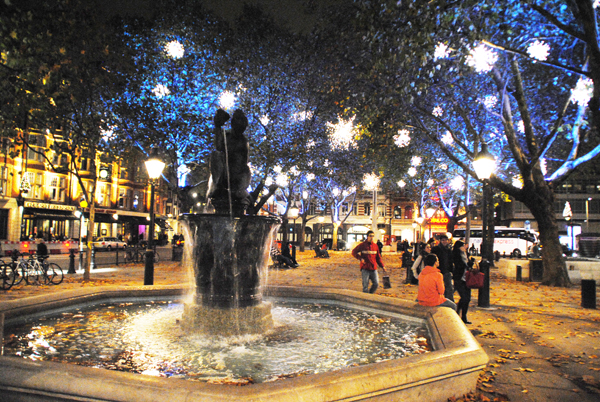
Well done to Jameson, this is indeed located in St James’s Square. Called – rather aptly – Stag, the sculpture dates from 2001 and is the work of Marcus Cornish. The larger-than-life bronze sculpture is located in the south-west corner of the West End square. For more on the work of Mr Cornish, see www.marcuscornish.com. Other statues in the square include an equestrian statue of King William III, the work of John Bacon Senior and Junior, which was installed in 1808.

Treasures of London – Siborne’s Large Model…

An amazing feat of model-making, Siborne’s Large Model is a painstakingly detailed model reconstruction of the Battle of Waterloo on display at the National Army Museum. Controversial even to this day, the story behind the model’s creation is an incredible tale of one man’s perseverance.

Siborne's-modelA career soldier, Captain William Siborne was commissioned in 1830 by Lord Rowland Hill, then Commander-in-Chief of the British Army, to construct a model of the Battle of Waterloo, fought between British and allied forces under the command of the Duke of Wellington and Prussian field marshal Gebhard von Blücher and French forces under the command of the Emperor Napoleon on 18th June, 1815.

Siborne, who hadn’t been present at the battle but had previously been involved in the construction of a model of the Battle of Borodino, extensively researched it before beginning work including spending eight months surveying the entire field where the battle took place and corresponding with hundreds of those who had fought there.

The model wasn’t completed until 1838, partly due to the fact that Siborne still had military duties to perform and also due to the fact that he ran out of funds and, when the authorities refused to pay up, ended up financing the project out of his own pocket (and then spent much time trying to recover the funds).

In his fascinating book, Wellington’s Smallest Victory: The Duke, the Model Maker and the Secret of Waterloo (well worth a read if you’re interested in learning more about the history of this amazing model), Peter Hofschroer writes in detail about the acrimonious relationship the Duke of Wellington developed with Siborne, thanks to a clash over the model’s depiction of the battle which shows the crisis point in the battle at 7pm – when the French Imperial Guard attacked Wellington’s centre – and has the Prussians helping to win the day.

The model was placed on public display in October 1838 at the Egyptian Hall in Piccadilly after which it went on tour around the UK. He went on to write up his research in a book on the battle, published in 1844, and it was while preparing this – in 1841 – that he announced he had changed his mind and would revise the model, eventually removing figures representing some 40,000 Prussians from the model and thus reducing the role they played at the decisive moment of the battle – a move which could only be seen as a win for Wellington.

It’s also worth mentioning that Siborne created a second, larger scale model of just part of the battlefield, exhibited in 1844 in London and later in Berlin (it’s now on display at the Royal Armouries Museum in Leeds). Siborne’s subsequent efforts to sell either model didn’t bear fruit before he died, said to have been a “broken man”, on 13th January, 1849.

After his death the large model was subsequently purchased by the United Service Museum and can now be found at the National Army Museum in Chelsea.

WHERE: National Army Museum, Royal Hospital Road, Chelsea (nearest Tube station is Sloane Square); WHEN: 10am to 5.30pm daily; COST: Free; WEBSITE: www.nam.ac.uk.

Around London – John Snow’s legacy; a spotlight on the music hall; Alice Kettle at the Queen’s House; and, Sydney Lee at the RA…

A new exhibition on the work and legacy of John Snow – who traced the source of a deadly cholera outbreak in the 1850s to a Soho water pump – opened at the London School of Hygiene and Tropical Medicine this week. Cartographies of Life & Death – John Snow and Disease Mapping – part of a series of events planned for the bicentenary of Snow’s birth – features both historical treasures, such as disease maps from the school’s archives, and new artworks inspired by science with the entire display presented as a disease mapping ‘detective trail’. There will be a pop-up water bar and street lectures and performances. Snow (1813-1858) is considered the founder of modern epidemiology, the study of patterns and causes of health and disease in populations. His work remain influential even today. Admission is free. The exhibition runs until 17th April at the school in Keppel Street. For more, see www.johnsnow.org.uk.

A new installation at the V&A opening on Saturday will explore the rise – and fall – of the music hall. Music Hall: Sickert and the Three Graces picks up on artist Walter Sickert’s obsession with the New Bedford Music Hall in Camden Town and features film, music and objects presented in a ‘theatrical narrative’ which focuses on the world of the Edwardian Music Hall. Highlights include filmed extracts of Tanika Gupta’s specially produced play The Boy I Love (directed by Katie Mitchell) which takes its name from George Ware’s celebrated music hall song The Boy I Love is Up in the Gallery. Admission is free. The exhibition, which is in the Theatre and Performance Galleries of the V&A, runs until 5th January next year. For more see www.vam.ac.uk.

Three specially commissioned artworks by British textile artist Alice Kettle will be unveiled today at the Queen’s House in Greenwich. The Garden of England – Royal Museums Greenwich’s first contemporary arts program – features Flower Helix (hanging in the Tulip Stairs), Flower Bed (a “textile garden” found in the North West Parlour), and Queen Henrietta Maria (a stitched portrait of the wife of King Charles I also found in the North West Parlour). The display is accompanied by a program of events – for more on them, see www.rmg.co.uk. Entry is free – the exhibition is on show until 18th August.

On Now – From the Shadows: The Prints of Sydney Lee RA. This exhibition at the Royal Academy represents a reappraisal of the work of painter-printmaker Sydney Lee (1866-1949) and features more than 50 prints and two major paintings. Lee studied in Manchester and Paris before coming to London where he lived in a house and studio in Holland Park Road in Kensington. He was elected a Royal Academician in 1930 and served as Treasurer from 1932-1940. The first exhibition devoted to his art since 1945, the event coincides with the publication of the first book on Lee written by its curator Professor Robert Meyrick, head of the School of Art at Aberystwyth University. Runs until 26th May. Admission charge applies. For more, see www.royalacademy.org.uk.

10 of London’s greatest Victorian projects – 8. London’s railways…

London’s railway network stands out as one of the greatest achievements of the Victorian age for it was during the 19th century that much of the railway infrastructure still in use today was first established.

St-PancrasThe first railway line in London opened in February 1836 (six years after the UK’s first line opened) and ran between Spa Road in Bermondsey and Deptford on the south bank of the River Thames. The line was extended to London Bridge in December that same year and again to Greenwich, from cross-Channel steamers left – in April the following year.

That same year – 1837 – the station at Euston opened as the final stop for trains from Birmingham (an earlier terminus as Chalk Farm was deemed too far out). It was followed by Paddington in 1838, Fenchurch Street – the first permanent terminus in the City – in 1841, Waterloo in 1848 and King’s Cross in 1850.

Having seen a boom period during the 1840s, development of new lines took a back seat in the 1850s but resumed apace the following decade with the opening of Victoria Station, connecting the city to Brighton and Dover. Stations followed at Charing Cross, Ludgate Hill and Cannon Street and alongside the grand terminus’ around the outskirts of London where trains arriving from distant destinations arrived, numerous smaller railways began to be built, such as the West End of London and Crystal Palace Railway and the Victoria Station and Pimlico Railway, which took passengers on only short journeys across the city (these smaller railway companies all disappeared by 1923 when the 1921 Railways Act resulted in the creation of what are known as the “Big Four” British railway companies).

And, of course, the London Underground, has its first journey in 1863 but we’ll look at that in more detail next week.

Interesting to note that there were three classes of rail travel and while first and second class passengers had seats, this wasn’t always the case in third class where, writes Michael Paterson in Inside Dickens’ London, passengers, such as those on the Greenwich line, were initially forced to stand in open topped carriages known by some as ‘standipedes’.

Naturally, with the building of the railways came some spectacular stations – among the most spectacular is the late Victorian building which stood at the front of St Pancras Railway Station and housed the Midland Grand Hotel (pictured above). An exemplar of the Gothic Victorian style, it was designed by Sir George Gilbert Scott and, following a massive recent refurbishment, is now home to the five star Renaissance London Hotel and apartments.

We can, of course, only touch on the history of the railways in such a brief article – but we will be looking in more detail at some more specific elements of the system in later posts.

LondonLife – Yuri Gagarin relocates to Greenwich…

Elena-Gagarina-and-Dr-Kevin-Fewster

A statue of Russian cosmonaut and first man in space Yuri Gagarin has been relocated to the newly named Yuri Gagarin Terrace outside the Royal Observatory in Greenwich. First unveiled in The Mall, not far from Admiralty Arch, on 14th July 2011, the statue was a gift from the Russian federal space agency, Roscosmos, to mark the 50th anniversary of manned space flight (you can read more at our earlier post here). But it was only granted permission to remain on the site for 15 months and so has now been relocated to Greenwich where it as officially unveiled last Thursday in the week of Gagarin’s birthday by his daughter Elena Gagarina (pictured here with Royal Museums Greenwich director Dr Kevin Fewster). The statue – a 3.5 metre high zinc alloy figure – shows Gagarin dressed in a spacesuit and standing on a globe. It stands just outside the observatory’s Astronomy Centre. For more on the Royal Observatory Greenwich – the “home” of Greenwich Mean Time, see www.rmg.co.uk.

Where’s London’s Oldest…wine bar?

The honour of being London’s oldest winebar goes to Gordon’s Wine Bar at 47 Villiers Street in the West End (just up from Embankment Tube Station or down from Charing Cross Station, whichever you prefer).

Gordon's-Wine-BarThe venerable establishment – still a favoured place to stop for a drink for many Londoners – opened its doors in the 1890s and still conveys a powerful sense of old world charm with the decor pretty much unchanged (there’s been no fancy makeover here) and the wine still served from wooden casks behind the bar.

The site on which the bar is located was once occupied by York House (home to, among others during its centuries of life, Robert Devereaux – 2nd Earl of Essex and favourite of Queen Elizabeth I and Sir Francis Bacon – Lord Chancellor during the reign of King James I) and then, later on, by a large house lived in by diarist Samuel Pepys in the late 1600s before, thanks to its position close to the river, a building was built upon it in the 1790s which served as a warehouse.

The usefulness of the warehouse came to an end when Victoria Embankment was built and the river pushed back and the building was subsequently used for accommodation. Writer Rudyard Kipling was among tenants who lived here (from 1889-1891 during which wrote The Light that Failed – in fact, the building was renamed after him, Kipling House, in 1950.

It was Angus Gordon, a “free vintner” meaning he didn’t have to apply for a licence thanks to the largesse of King Edward III in 1364, who established the premises in the vaults here in the 1890s (interestingly the current owners are also Gordons, but not related). Among the other uses of the building, of which Gordon’s only occupies a part, was apparently as a brothel in the 1920s.

For more on Gordon’s head to www.gordonswinebar.com.

Lost London – The Cockpit at Whitehall…

Once part of the Palace of Whitehall, the Cockpit (also referred to as Cockpit-in-Court or the Royal Cockpit) was initially built as a pit in which to watch cockfighting as part of renovations carried out by King Henry VIII after he “acquired” Cardinal Wolsey’s former property of York Place and before transforming it into a royal palace.

It was one of a number of entertainment related buildings constructed by the king in the new palace precinct – others included a real tennis court, bowling alley and a tiltyard.

By Jacobean times, the use of the octagonal-shaped cockpit – located between today’s Downing Street and Horse Guards Parade – had changed into that of a private royal theatre and in 1629 Inigo Jones was given the task of redesigning it to accommodate King Charles I’s elaborate court masques (Jones had previously redesigned the Cockpit Theatre in Drury Lane).

Following the Restoration in 1660, the Cockpit again returned to its use as a theatre and King Charles II had new dressing rooms added and the decor given an overhaul (the ever-present diarist Samuel Pepys was among those who attended theatrical presentations during this period and Ben Jonson among those whose work was presented here).

The theatre building is believed to have been demolished around 1675 and the site subsequently used to house government officials including those of the Foreign Office (see our earlier post here) and Privy Council.

In the 1730s, William Kent designed the building (which although since expanded and modified) now stands on the site and is currently the home of the Cabinet Office.

While the Cockpit is long gone, its name lives on in ‘Cockpit Passage’ – a gallery inside the Cabinet Office from where one could once watch tennis being played.