Around London – Celebrating the art of the Underground and art on the web; Picasso at the Courtauld; and, Frederic Church at the National…

A new exhibition celebrating the art of the Underground opens at the London Transport Museum in Covent Garden tomorrow. Poster Art 150 – London Underground’s Greatest Designs showcases 150 posters with examples taken from each decade over the past 100 years. Artists include the likes of Edward McKnight Kauffer, Paul Nash and Man Ray. The posters were selected from the museum’s archive of more than 3,300 by a panel of experts. Visitors to the exhibition will be able to vote on their favorite poster as well as online with the most popular poster to be revealed at the end of the exhibition. The last major exhibition of Underground posters – the first commission of which was in 1908 – was held in 1963 to celebrate the system’s centenary. The exhibition is based around six themes – ‘Finding your way’, ‘Brightest London’, ‘Capital culture’, ‘Away from it all’, ‘Keeps London going’ and, ‘Love your city’. Runs until 27th October. Admission fee applies. For more on the exhibition and surrounding events, see www.ltmuseum.co.uk.

National-Gallery The external facade of the National Gallery in Trafalgar Square was decorated with artworks last Friday night (pictured right) in celebration of the completion of Your Paintings – a website which hosts the UK’s entire national collection of oil paintings (more than 210,000!). The projections – which were happening in 28 UK cities simultaneously – featured two National Gallery paintings – Van Gogh’s Sunflowers and Gainsborough’s Mr and Mrs Andrews. To see the website, head to www.bbc.co.uk/arts/yourpaintings/. PICTURE: © The National Gallery, London.

• On Now: Becoming Picasso: Paris 1901. This exhibition at The Courtauld Gallery in Somerset House on The Strand tells the story of Pablo Picasso’s break-through year as an artist – 1901 – when the then 19-year-old launched his career in Paris at a summer exhibition. The display follows Picasso from his debut and into the start of his Blue period. Works exhibited are among the first to bear his famous signature. Runs until 26th May. There is an admission charge. For more, see www.courtauld.ac.uk/gallery/index.shtml.

On Now: Through American Eyes: Frederic Church and the Landscape Oil Sketch. This free exhibition of 30 works at the National Gallery focuses on the work of Frederic Church (1826-1900), a member of the Hudson River School of artists and considered by many to be the greatest of the American landscape oil sketch artists. Works on display include those made at exotic locations such as Ed Deir, Petra, painted in Jordan in 1868, and Distant View of the Sangay Volcano, Ecuador, painted in 1857, as well as the paintings created closer to home, such as Hudson, New York at Sunset, painted in 1867. The exhibition is held in Room 1. Runs until 28th April. For more see www.nationalgallery.org.uk.

LondonLife – ‘White Shirt Week’ in St James’s…

Freddie-Fox-launches-White-Shirt-Week-in-St-James's-London


Freddie Fox (who plays Lord Alfred Douglas opposite Rupert Everett as Oscar Wilde in David Hare’s The Judas Kiss now playing at the Duke of York Theatre) marks the start of ‘White Shirt Week’ which kicked off in St James’s on Monday. The West End area is home to Jermyn Street which apparently boasts “the highest number of world renowned shirt makers on one luxury shopping street” with each shirt maker having their own signature design. While the origins of the white shirt date back as far as ancient Egypt, it was only in more recent centuries that in the UK the white shirt developed from being simply an undergarment to a fashion item in its own right – in fact, by the 19th century, the white shirt was worn by gentlemen as a statement that they weren’t engaged in manual labour and could employ servants to launder it. For more on St James’s, see www.stjameslondon.co.uk.

Where’s London’s oldest….shopping arcade?

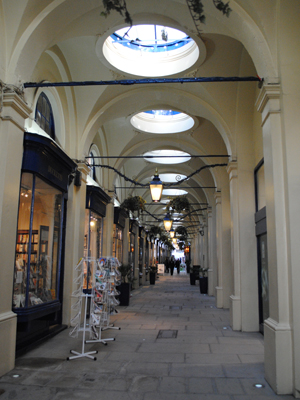
Royal-Opera-ArcadeFollowing our recent article on John Nash (see the earlier post here), we’re taking a look at one of his projects as part of our series on London’s oldest. Built between 1816-18,  the Royal Opera Arcade – which features a series of shops running down the side of a covered central hall – is not only the oldest existing shopping arcade of its type in London but apparently in the world.

The 12 foot wide covered arcade was built on the west side of what was previously the Royal, King’s or Haymarket Opera House – Nash and George Repton completed the exterior of the property originally built by Sir John Vanbrugh at the same time the arcade was built – but is now the site of Her Majesty’s Theatre (the former theatre was destroyed in a fire in 1867).

It extends between Pall Mall and Charles II Street in the West End, running parallel with Haymarket. Burlington Arcade, frequently cited as the city’s oldest, was in fact completed a year later.

The arcade originally had 19 shops – each with a cellar and mezzanine level – running down its west side. It now features shops which sell everything from fine wines and art to books and sandwiches.

For more on the Royal Opera Arcade, see www.royaloperaarcade.com.

Around London – Chinese New Year; Orchids at Kew; Lucian Freud’s donation to the National Gallery; and, Man Ray at the NPG…

Chinese New Year celebrations will go off with a bang in Chinatown in the West End this Saturday. The festivities, which are the largest outside Asia, will include a lion dance, fireworks, and a variety of performers – all gathered to herald the start of the Year of the Snake. The celebrations will kick off with a parade which will leave Trafalgar Square at 10am and end at Rupert Street in Chinatown at 11am. At 12pm, dignitaries will gather in Trafalgar Square for the Dotting of the Eye ceremony which will bring the dragons and lions to life and performances will the take place until 5.30pm. At 5.55pm a fireworks display will mark the end of the day’s celebrations. For more, see www.chinatownlondon.org/page/chinese-new-year-2013/378.

Like orchids? Want to escape the gloom of winter? Kew Gardens are celebrating the exotic plant with a dazzling display in the Princess of Wales Conservatory. Thousands of orchids will be on show as part of ‘Orchids at Kew’ and the plants will be used to recreate the giant waterlily flower, Victoria amazonica, which can normally be seen in the conservatory in the summer months. There are special behind the scenes tours, food and an adult education course for the truly interested. Charges apply. Opening on Saturday, 9th February, the display can be seen until 3rd March. For more, see www.kew.org.

The late artist Lucian Freud has donated a treasured portrait – Jean-Baptiste Camille Corot’s L’Italienne ou La Femme à la Manche Jaune (The Italian Woman, or Woman with Yellow Sleeve) – to the nation in gratitude for the welcome his family received when they arrived as refugees from Berlin. The Corot has been allocated to the National Gallery by the Arts Council England and was done under the Acceptance in Lieu scheme, which allows people to transfer works of art into public ownership instead of paying inheritance tax.  The painting – which was last seen in a show at the Louvre, Paris, in 1962, and was previously owned by Hollywood Golden Age star Edward G. Robinson – is on display on Room 41 of the gallery. For more, see www.nationalgallery.org.uk.

On Now: Man Ray Portraits. The first museum exhibition to focus on the photographic portraiture of the 20th century artist Man Ray, this display at the National Portrait Gallery features more than 150 vintage prints taken between 1916 and 1968. Subjects include everyone from Catherine Deneuve and Ava Gardner to Salvador Dali and Aldous Huxley. The majority of works have never been exhibited in the UK before. Runs until 27th May. Admission charge applies. For more, see www.npg.org.uk.

Like to tell others about your upcoming event in London? If you’ve got an event coming up, please send any press releases or details to exploringlondon@gmail.com.

Famous Londoners – John Nash…

Arguably the greatest architect of Regency London, John Nash’s imprint can still be seen in numerous sites around the city, from the master-planning of Regent’s Park and Regent Street to the beautiful buildings of All Soul’s Church in Langham Place and Marble Arch on the edge of Hyde Park.

Born the son of a Welsh millwright in Lambeth, London, on 18th January, 1752, Nash – who went on to work in a range of different architectural styles – trained as a draughtsman under the tutelage of architect Sir Robert Taylor and in 1777 established his own business as a builder and surveyor.

John-NashBut he certainly didn’t meet with immediate success and, following failure as a building speculator (he built properties in Bloomsbury Square and Great Russell Street but failed to make enough money from the venture – there’s a blue plaque on one of the houses, which he lived in, at 66 Great Russell Street), was declared bankrupt in 1783.

Meanwhile, his personal life was also in turmoil during these years – in 1775 he had married, Jane Kerr, the daughter of a Surrey surgeon, but separated from her in the early 1780s after various troubles including her eventually apparently having a child with a Welshman named Charles Charles, who is said to have died in prison after he was jailed for adultery.

Brought down by his misfortune, in the mid 1780s Nash moved to Carmarthen in Wales where he had family. Taking up work here, by the late 1780s he was designing prisons – the first was at Carmarthen – and worked on a number of other prominent buildings including St David’s Cathedral and various country houses.

Rising to prominence in Carmarthen society, by 1797, however, Nash was again working in London, initially in partnership with the renowned landscape architect Humphrey Repton with whom he had formed a business relationship some years earlier (although the partnership had soured over finances by 1800).

He built a substantial home at 29 Dover Street in Mayfair and in 1798, his first wife presumably dead, he married his second wife, Mary Anne Bradley, and soon started work on building a Gothic-inspired residence for them, known as East Cowes Castle, on the Isle of Wight. It was completed in 1802 but enlarged some years later.

Nash designed numerous country properties in the early 19th century, inspired by everything from castles to Italianate architecture, both in England and Ireland and soon came to the attention of the Prince Regent, the future King George IV (there was a rumour his wife was one of the prince’s discarded mistresses).

In 1806 he was officially made Deputy Surveyor General in the Office of Woods and Forests – the office which managed the Crown estate, and from 1815 on, he largely worked for the prince alone. Among the major London commissions from his royal patron were the design of Regent Street (he and his wife moved into number 14 in 1823) and the development of Regent’s Park on land formerly known as Marylebone Park and surrounding housing estates (for more on The Regent’s Park, see our earlier entry here). He also redeveloped St James’s Park.

In 1815, he was commissioned to develop the Prince Regent’s Marine Pavilion in Brighton and by 1822 had transformed the building into the spectacular Royal Pavilion which can be visited there today.

Nash was also involved in the development of The Regent’s Canal – which linked the Grand Union Canal in London’s west to the River Thames in London’s east and was completed in 1820 – and built many of the grand villas which still line it (for more on Regent’s Canal, see our earlier entry here).

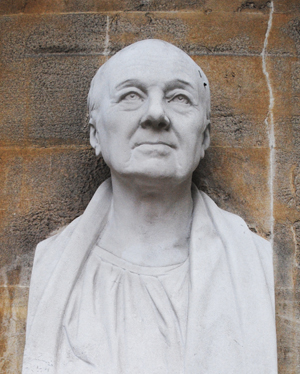
Becoming an official architect to the Office of Works in 1813 (an appointment which only ended in 1832, three years before his death), Nash went on to design churches – including All Soul’s in Langham Place (he’s depicted above in a bust at the church) – as well as West End theatres including the Haymarket Theatre and the Royal Opera House (which burnt down in 1867) as well as the adjacent Royal Opera Arcade and residences including Carlton House Terrace and Clarence House (for more on this, see our earlier entry here).

Other major commissions included the redevelopment of Buckingham Palace (parts of the current building are his work but the main facade isn’t – for more on the palace history, see our earlier entry here) and the Royal Mews, and the creation of Marble Arch, originally envisaged as the main gateway to the palace (see our earlier entry here). Nash also designed a conservatory for Kew Gardens.

Nash’s close relationship with the Prince Regent (who become King George IV on 29th January, 1820), meant that when the king died in 1830, he found himself on the outer (and his reputation took many years to recover thanks to his association with the unpopular king). With no knighthood forthcoming for his efforts (unlike many of his contemporaries) and the chance of further work unlikely (his work on Buckingham Palace had been left unfinished due to concerns over rising costs), Nash retired to his house on the Isle of Wight.

He died there on 13th May, 1835, and was buried in the churchyard at St James’s Church in East Cowes. He was survived by his wife who, having settled his debts, retired to Hampstead.

For an in-depth study of Nash, try Geoffrey Tyack’s book, John Nash: Architect of the Picturesque.

Around London – Duchess of Cambridge at the NPG; Imperial War Museum closed for now; and, Frozen London…

The controversial first official painted portrait of Kate Middleton, the Duchess of Cambridge, has gone on display at the National Portrait Gallery. Unveiled on 11th January, the portrait by Paul Emsley has already sparked considerable criticism. Emsley, the 2007 winner of the gallery’s BP Portrait Award competition, was chosen by the gallery’s director Sandy Nairne to paint the portrait which took three-and-a-half months to paint. It is now on permanent display in the gallery as part of Contemporary Collections in the Lerner Galleries in Room 36, on the ground floor. Admission is free. For more (including a film on the making of the portrait), see  www.npg.org.uk.

The Imperial War Museum has closed its doors until July this year as the museum undergoes an extensive refurbishment. In July, the museum will launch a new exhibition –  Horrible Histories®: Spies, and also reopen of The Lord Ashcroft Gallery: Extraordinary Heroes, The Holocaust Exhibition, Secret War, A Family in Wartime and the Explore History Centre. The redevelopment, meanwhile, will continue until summer 2014 when the brand new First World War Galleries will be opened, marking the 100-year anniversary of the start of the First World War. For more, see www.iwm.org.uk/visits/iwm-london.

On Now: Frozen London. This exhibition at the London Metropolitan Archives looks at the impact of some of the most severe winters the city has ever experienced which occurred between 1683 and 1895. A highlight is a look at the Frost Fairs which took place on the River Thames during that time. Runs until April 25th. Admission is free. For more, follow this link. Correction: Opened 21st January-25th April.

LondonLife – Forget the halls, they’re decking the city…part two…

There’s still a weekend to go before Christmas and if, having finished all Christmas shopping, you’re still in the mood for seeing some light displays, here’s some more places to look for some amazing (and in some cases historic), Christmas decorations (for the first part of this overview, head here)…

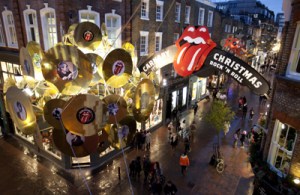
Carnaby-StreetLast week we mentioned some of the key sites to look for light displays in the West End this Christmas. Some of the other places to look include: the iconic shopping strip of Carnaby Street (decorations there this year are inspired by the 50th anniversary of the Rolling Stones – pictured) as well as South Molton Street, off Oxford Street (which again features some beautiful illuminated archways), and streets throughout St James (the St James Christmas lights were this year switched on by opera star Katherine Jenkins who earlier led a carol service at St James’s Church) and Mayfair.

Around Bow Lane and Watling Street in the City of London. Daubed with more than 10,000 lights, these narrow streets provide a wonderful sense of London past.

Marylebone. The lights here are well worth venturing out for. Turned on this year by Strictly Come Dancing‘s Claudia Winkleman.

Historic West End arcades. Still a place for fashionable shopping and tasteful Christmas decor, these include the Burlington Arcade, Royal Arcade, Princes Arcade and the Piccadilly Arcade.

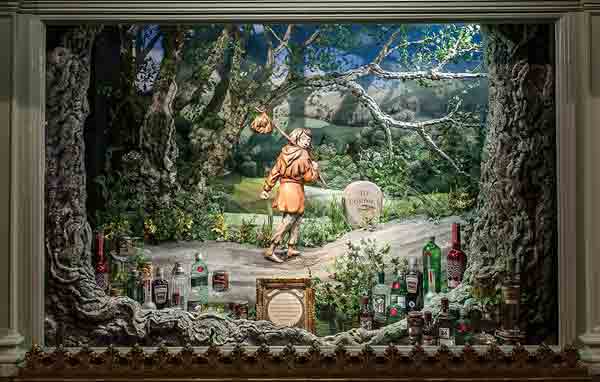
And, of course, throughout London many shops have Christmas window displays. They include that of Fortnum & Mason in Piccadilly which this year have a Dick Whittington theme (see our earlier post here); Harvey Nichols in Knightsbridge which have gone with an oriental theme; Harrods in Brompton Road which have a Disney Princess theme; and Liberty in Great Marlborough Street which have gone with a theme inspired by the age of steam trains.

Of course, our list is by no means been comprehensive and is only confined to London’s heart – please share any other sensational Christmas decorations you’ve come across elsewhere in the city…

Around London – Christmas at the Tower and Kew Gardens; Old Flo on display; African Diaspora on show at MoL Docklands; and, Mariko Mori at the Royal Academy…

Victorian-Christmas The Tower of London is going Victorian this Christmas with visitors able to experience some of what the Yuletide celebrations in the foreboding, much storied buildings were like in the mid-to-late 1800s. Visitors will be shown how many of the Christmas customs we now participate in each year – like writing cards, pulling crackers and the setting up of family Christmas trees – owe their origins to the Victorian era. The Yeoman Warders will be receiving a Victorian makeover and writer of the age – Charles Dickens – will be reciting some of his works before joining in a “raucous” lunch party with some of his fellow writers, artists and benefactors. It’s even rumoured that Queen Victoria and Prince Albert themselves may make an appearance (take that as a given). Bah! Humbug! A Very Merry Victorian Christmas runs from 27th until 31st December. The festivities will all be included in the usual admission price. For more, see www.hrp.org.uk. PICTURE: Nick Wilkinson/NewsTeam.

Kew Gardens are celebrating Christmas with a host of events including a “Twelve trees of Christmas” family trail. The trail, a map of which can be picked up as you enter, includes facts about trees along the route. Volunteer guides are also leading free tours of seasonal highlights and the Kew Christmas tree can be seen at Victoria Gate. Other festive treats at Kew include the chance to see Father Christmas in his grotto (until Sunday only) and a vintage carousel on the Kew Palace Lawn. Many of the Christmas-related events end on 6th January. See www.kew.org for more.

A display focusing on the history of Henry Moore’s sculpture, Draped Seated Woman (better known as Old Flo), has opened at the Museum of London Docklands. Henry Moore and the East End provides a glimpse into 1950s East London and looks at why public art was considered important at the time. It features some of the maquettes (scale models) Moore used in creating the piece. The exhibition was opened following a decision by the Mayor of Tower Hamlets, Lutfur Rahman, to sell Old Flo (now at the Yorkshire Sculpture Park) rather than display the artwork in a public space. The move is being contested by the Museum of London Docklands who have offered to put the work on public display. An online exhibition can be seen at www.museumoflondon.org.uk/oldflo and a ‘pop-up exhibition’ on Old Flo will be launched in January. The museum is also encouraging people to tweet their views about the selling of the sculpture under the hashtag #saveoldflo.

On Now: Take Another Look. Still at the Museum of London Docklands, this exhibition focuses on the visual representation of people from the African Diaspora who were living and working in Britain in the late 18th and early 19th century. The display of 17 exhibits in the London, Sugar and Slavery gallery features prints by artists including Thomas Rowlandson and George Cruikshank as well as newspaper cuttings, mostly dating from 1780-1833, which show black Britons in perhaps what were unexpected roles – soldiers, musicians and sportsmen – during what was the period in which the abolition of slavery occurred. There are a series of events planned around the exhibition which runs until 4th August. Entry is free. For more see www.museumoflondon.org.uk/Docklands/.

On Now: Mariko Mori: Rebirth. The first major museum exhibition of the New York-based Japanese artist Mariko Mori in London since 1998 has opened at the Royal Academy of Arts in Piccadilly. The exhibition features some of the artist’s most acclaimed works from the last 11 years, many of which have never before been seen in the UK, as well as works created just for the exhibition. Highlights include Tom Na H-iu, a five metre high glass monolith lit by hundreds of LED lights and connected back to the Institute for Cosmic Ray Research at the University of Tokyo; Transcircle, described as a “modern day Stonehenge”; and, Flatstone, an installation of “22 ceramic stones assembled to recreate an ancient shrine”. Runs until 17th February. Admission charge applies. For more, see www.royalacademy.org.uk.
LondonLife – Dick Whittington at Fortnum & Mason…

Dick-Whittington-at-FM
“Turn again, Dick Whittington!” This year’s Christmas window display at Piccadilly’s Fortnum & Mason tell the story of thrice Lord Mayor of London (and popular panto figure), Dick Whittington. The windows were unveiled by the current Lord Mayor of London, Roger Gifford (his wife Clare has just written a new version of the story) and the cast from Hackney Empire’s Dick Whittington. For more on the story of Dick Whittington, see our earlier post here. For more on Fortnum & Mason see our earlier post here. PICTURE: Courtesy of Fortnum & Mason.

Around London – A West End institution reopens; Barnet’s Foundling Hospital under the spotlight; English landscape masters at the RA…

• A West End institution which has hosted a who’s who of Londoners – including the likes of Oscar Wilde, Arthur Conan Doyle, Rudyard Kipling and Winston Churchill as well as, more recently, David Bowie, Mick Jagger and Princess Diana – has reopened its doors to the public after a four year redevelopment. Originally opened in 1865 by French wine merchant Daniel Nicholas Thévenon and his wife Celestine, Café Royal at 68 Regent Street – overlooking Piccadilly Circus – has been relaunched as five star hotel featuring more than 150 rooms, six historic suites and a variety of dining venues – including the spectacular Grill Room – as well as a private members club, meeting rooms and wellbeing centre. The redevelopment of this storied building, which centres on the original premises – retaining John Nash’s Grade I-listed facade, has seen the restoration of grand public rooms, originally dating from the 1860s and 1920s, as well as an expansion into neighbouring buildings – all under the watchful eye of David Chipperfield Architects and Donald Insall Associates. For more, see www.hotelcaferoyal.com.

 • One of six small hospitals set up by the Bloomsbury-based Foundling Hospital, the Barnet branch operated in Monken Hadley in west London from 1762-1768. It’s now the subject of one of two new exhibitions which opened at the Barnet Museum at the beginning of the month. The Barnet Foundling Hospital, Monken Hadley, 1762-1768, features a range of objects relating to some of the children placed in the hospital including identifying coin tokens left by mothers, and letters written by manager Prudence West. The exhibition initially runs until 14th January – after which objects will be replaced with prints – and then until 28th February. The second exhibition, Foundling Voices, is on tour from the Foundling Museum and features oral histories of some of the last people to be cared for by the Foundling Hospital in Berkhamsted which closed in 1954. This runs until 13th January. Admission to both is free. For more, see www.barnetmuseum.co.uk.

On Now: Constable, Gainsborough, Turner and the Making of Landscape. This exhibition, recently opened in the John Madejski Fine Rooms and Weston Rooms at the Royal Academy of Arts, features works of art by three “towering figures” of English landscape painting – John Constable, Thomas Gainsborough and JMW Turner. The 120 works on display includes paintings, prints, books and archival material. Highlights include Gainsborough’s Romantic Landscape (c 1783), Constable’s The Leaping Horse (1825) and Boat Passing a Lock (1826), and Turner’s Dolbadern Castle (1800). There are also works by their 18th century contemporaries and artifacts including letters written by Gainsborough, Turner’s watercolour box, and Constable’s palette. Admission charge applies. Runs until 17th February. For more, see www.royalacademy.org.au.

LondonLife – Forget the halls, they’re decking the city…

We’ve decided not to kick off our next Wednesday series until the new year so in the meantime, we’ll take a look at where you can find some of the best – and some of the most historic – Christmas decorations in London (and we’d love to hear your thoughts as well!). Here is some of what you’ll find in the West End this year…

Trafalgar-Square-Christmas-Tree1. Trafalgar Square Christmas Tree:  A symbol of Christmas in London since 1947, this massive tree (usually a Norwegian spruce) is an annual gift from the people of Norway as thanks for British support during Norway’s years of occupation in World War II. The tree – which is usually around 50 to 60 years old, more than 20 metres high and resident in the forests around Oslo – is felled in November in a ceremony attended by the Lord Mayor of Westminster, the Mayor of Oslo and the British ambassador to Norway before being brought to the UK by sea. This year’s tree lighting ceremony took place on 6th December and a program of choirs will be singing at the tree during evenings in the lead-up to Christmas.

2. Regent Street Christmas Lights: The street’s stunning Christmas light displays apparently date back to the early 1950s when the lifting of wartime lighting restrictions allowed the display. The lighting ceremony has since become an annual event – this year’s lights – which stretch over a mile and tell the story of the 12 Days of Christmas – were turned on by some 40 Olympians and Paralympians in November and will remain up until early January next year.

3. Oxford Street Christmas Lights: Switched on in early November by singer Robbie Williams (with supporting act Leona Lewis), the Oxford Street Christmas display – this year more properly known as the Marmite Oxford Street Christmas Lights – has been a West End tradition since 1959. This year’s mile long display involves 300,000 LED bulbs. Among the stars who have switched on the lights over the display’s 53 year history are the Spicegirls, Westlife and The Saturdays, who held the honor last year.

4. Bond Street Christmas Lights: A more boutique display than its more celebrated neighbours, this year’s lights were switched on by Gareth Malone and the Military Wives Choir.

5. Covent Garden decorations: This year’s decorations include an innovative display from United Visual Artists in the Market Building as well as a giant Lego advent calendar with a new window opened each day at 4pm in the lead-up to Christmas. Other Christmas-related features include a 32 foot high topiary reindeer as well as the chance for kids to pet a real reindeer on Saturdays. There’s also a food market and choir singing.

Around London – Christmas at the Geffrye; a Kensington Palace advent calendar; new furniture gallery at the V&A; and, last chance to see Bronze…

Christmas is looming and at the Geffrye Museum in Hoxton that means the museum’s many period rooms have been transformed for the Christmas festivities. The rooms span 400 years of history, from 1600 until today, and show how the middle class have lived over that time. The Christmas display will also provide insights into such Christmas traditions as kissing under the mistletoe, hanging up stockings, sending Christmas cards and decorating trees. The Christmas theme carries through to the restaurant and gift shop. Entry to the exhibition is free. Runs until 6th January. For an online gallery showing some of the rooms, click here. For more on the museum, see www.geffrye-museum.org.uk.

• Meanwhile Kensington Palace is to be transformed into giant advent calendar in the lead-up to Christmas with a daily ‘reveal’ inspired by Princess Victoria’s Christmas diary entries and letters. The halls of the palace will be decorated with 24 specially designed mirrored baubles, Christmas music will be played throughout and a sparkling 25 foot high Christmas tree will be placed in the gardens. As part of the Christmas festivities, an evening of carol singing will be held on 5th December in the King’s Gallery with carols sung by the Hampton Court Palace Royal Chapel Choir. Other events include a Midwinter Masquerade Ball on 13th December and an Eerie Evening Tour on 20th December. For more, see www.hrp.org.uk/KensingtonPalace/.

• A new permanent furniture gallery opens at the V&A this Saturday. The Dr Susan Weber Gallery – the first at the museum dedicated to furniture – will display more than 200 pieces of British and European furniture, spanning a period stretching from the Middle Ages through to present day, as well as examples of American and Asian furniture. Each piece is examined in detail with information provided about the materials and techniques used in creating it. Among the designers represented will be Thomas Chippendale, Grinling Gibbons, Robert Adam, Ron Arad and Tom Dixon. Highlights include a 20th century Frank Lloyd Wright-designed dining chair, a gilded cassone made for the Duke of Urbino in about 1509, and a scagliola decorated table which was formerly at Warwick Castle and dates from 1675. Twenty-five ‘key’ pieces have been selected for a central chronological display including a storage unit by Charles and Ray Eames dating from 1949-50, a Gothic revival cradle dating from 1861 and designed by Richard Norman Shaw and one of the museum’s newest acquisitions, the 2011 ‘Branca’ chair, designed by Industrial Facility. The display includes the use of touch screen interfaces, films and audio recordings. Entry is free. For more, see www.vam.ac.uk.

• On Now: Bronze. Last chance to see this exhibition at the Royal Academy of Arts which closes on 9th December. The exhibition brings together more than 150 of the finest bronzes in the world, spanning 5000 years of history, with many of the pieces on display never seen before in the UK. Among the earliest works are the 14th century BC bronze and gold Chariot of the Sun from Denmark, ancient Chinese ritual vessels including an elephant-shaped vessel dating from the Shang Dynasty (1100-1050 BC) and an Etruscan masterpiece – Chimera of Arezzo, dating from about 400 BC. Other highlights include a Roman cavalry helmet found in Cumbria in 2010 and the Portrait of King Seuthes III, dating from the early Hellenistic period, and found in Bulgaria in 2004 as well as a series of Renaissance bronzes and more recent works like Rodin’s The Age of Bronze (c 1876). Admission charge applies. For more, see www.royalacademy.org.uk.
Around London – Henry Stuart at the NPG; the Lord Mayor’s Show; prehistoric Japanese pots; and, photography at the National Gallery…

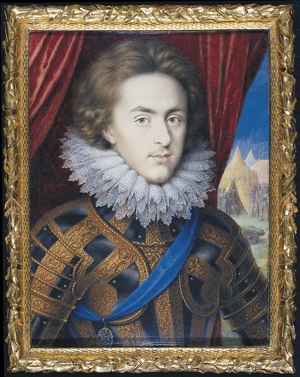
• The first ever exhibition focusing on Henry Stuart, older brother of King Charles I, has opened at the National Portrait Gallery. The Lost Prince: The Life and Death of Henry Stuart features more than 80 exhibits including paintings, miniatures, manuscripts, books and armour gathered from museums and personal collections around the UK and abroad – with some of the objects being displayed in public for the first time. Opened on 18th October – the 400th anniversary of the Prince’s death, among the paintings displayed in the exhibition are works by Holbein, Nicholas Hilliard and Isaac Oliver as well as Robert Peake as well as masque designs by Inigo Jones and poetry  by Ben Jonson. Henry, Prince of Wales, was the eldest son of King James I and Queen Anne of Denmark, and died at the age of 18 of typhoid fever. As well as looking at his short life, the exhibition covers the extraordinary reaction to his premature death (and the end of hope that King Henry IX would sit next upon the throne). The exhibition runs until 13th January. An admission fee applies. For more, see www.npg.org.uk. PICTURE:  Henry, Prince of Wales by Isaac Oliver, c. 1610-12; Copyright: The Royal Collection Photo: Supplied by Royal Collection Trust / © HM Queen Elizabeth II 2012

The Lord Mayor’s Show – the largest unrehearsed procession in the world – will be held on 10th November. This year’s procession – celebrating the election of the 685th Lord Mayor of London, Alderman Roger Gifford – will feature more than 6,500 people winding their way through the City of London in a three-and-a-half mile-long display including 22 marching bands, 125 horses, 18 vintage cars, 21 carriages, an original American stagecoach, a Sherman tank, a steamroller and a Japanese Taiko drum band. While there will be no fireworks after this year’s parade, following the success of last year’s trial there will be an early morning flotilla with the Lord Mayor conveyed in the barge QRB Gloriana from Vauxhall up the Thames to HMS President, just below St Katharine Docks, from where he will make his way to the Mansion House to join the procession as it heads first to St Paul’s and then on to the Royal Courts of Justice before returning (via a different route). There are no grand stand seats left but plenty of places you can watch it for free (for a chance to win free Grandstand tickets, head to the Lord Mayor’s Show Facebook page and ‘like’ it). We’ll be talking about this more next week, but in the meantime, for maps and details of a new smart phone app, head to www.lordmayorsshow.org.

Two prehistoric Japanese pots have gone on display at the British Museum. Loaned from the Nagaoka Municipal Science Museum, the pots date from the Middle Jomon period (3,500-2,500 BCE) and consist of a ‘flame’ and a ‘crown’ pot which were excavated in Nagaoka city. The pots form part of the Asahi Shimbun Displays in room 3 and will be there until 20th January. Meanwhile, continuing the Asian theme, an exhibition of more than 100 contemporary carved Chinese seals by artist Li Lanqing is on display in room 33 until 15th January. Admission to both is free. For more, see www.britishmuseum.org.

• On Now: Seduced by Art: Photography Past and Present. The National Gallery’s first major exhibition of photography, the display looks at the relationship between historical paintings and photography, both its early days in the mid-19th century and the work of contemporary photographers – in particular how photographers have used the traditions of fine art to “explore and justify” their own works. Almost 90 photographs are displayed alongside a select group of paintings for the show. Admission is free. Runs until 20th January in the Sainsbury Wing. For more, see www.nationalgallery.org.uk.

10 Historic London Markets – 5. Covent Garden Market…

We’ve had a quick look at the origins of Covent Garden before (as part of our What’s in a name? series) but it’s worth a recap.

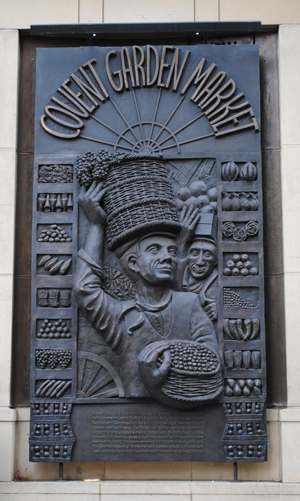
Now a favorite of tourists visiting London, Covent Garden is these days largely known as a specialty shopping and entertainment precinct in the West End. But its beginnings as a market go back at least to the 1600s when a licence was formally granted to hold a market in the piazza.

The land had been formerly owned by the Abbey (or Convent) of St Peter in Westminster which had established 40 acre kitchen garden here (hence ‘Convent Garden’) and had passed into the hands of the Crown at the Dissolution. Later owned by the Earls of Bedford, it was the 4th earl, Francis Russell, who commissioned Inigo Jones to design a great residential square- including St Paul’s Church, known as the Actor’s Church – on the site.

By 1650, fruit and vegetable markets were regularly been held on the site and, interestingly, around this time the market adopted the pineapple, a symbol of wealth, as its emblem (it was also around this time that Punch and Judy shows were introduced to the area (see our earlier post on Mr Punch here)). Covent Garden’s rise to prominence as a market came when the Great Fire of London destroyed many of London’s other markets leaving it as the foremost fruit, vegetable and flower market. In May 1670, the 5th Earl of Bedford, William Russell (later 1st Duke of Bedford), obtained the formal right to hold a market on the site from King Charles II.

The growth of the market and the development of fashionable residential developments further west in Soho and Mayfair saw many of the affluent people who had lived around the market move out and the character of the square changed (in an indication of this, a list of Covent Garden prostitutes was published in 1740).

In 1813, the 6th Duke of Bedford, John Russell, secured an Act of Parliament regulating the market and in the late 1820s began to redevelop the site, commissioning architect Charles Fowler to design new buildings (up until then the market was housed in makeshift stalls and sheds). These include the grand main market building which still stands on the site today.

The market continued to grow – there is said to have been 1,000 porters employed at the market’s peak – and in 1860 a new flower market was built on the south piazza (where the London Transport Museum now stands), while in the 1870s, a glass roof was added to the market building. A “foreign” flower market opened in what is now Jubilee Hall in 1904.

In 1918, the Bedford family sold the market to the Covent Garden Estate Company. The next major installment in the market’s life came in 1974 when the market, which had outgrown the West End site, moved out to a new site in Nine Elms at Vauxhall in London’s inner south.

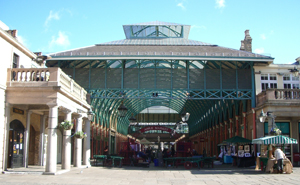
The Covent Garden site was left to fall into disrepair but, saved from demolition and redevelopment largely through the efforts of Geoffrey Rippon, then Secretary of State for the Environment, it subsequently underwent restoration, reopening as a speciality shopping centre in 1980 with areas including the Apple Market (pictured above), the East Colonnade Market and the Jubilee Market. Now owned by Capital & Counties who purchased it in 2006, the market – along with the larger 97 acre Covent Garden area – remain under the care of the Covent Garden Area Trust.

Meanwhile, the New Covent Garden Market at Nine Elms is these days the largest fruit, vegetable and flower market in the UK and boasts more than 200 businesses. There are currently plans to redevelop the 57 acre market site which will include providing more space for market tenants as well as new homes, shops and community facilities like parks.
.
Covent Garden
WHERE: King Street, Covent Garden (nearest Tube stations are Covent Garden, Leicester Square and Embankment); WHEN: Public areas are open 24 hours; check with individual shops for opening times; COST: Free; WEBSITE: www.coventgardenlondonuk.com
.
New Covent Garden Market
WHERE: New Covent Garden Market, Nine Elms, Vauxhall (nearest Tube station is Vauxhall); WHEN: The fruit and vegetable market’s core trading hours are between midnight and 6am, Monday to Saturday, while the flower market’s core trading hours are between 2am and 8am, Monday to Saturday (times may vary for individual businesses); COST: Free (charge for cars); WEBSITE: www.newcoventgardenmarket.com.
.
PICTURE: Apple Market Picture courtesy of www.coventgardenlondonuk.com.

10 Historic Sporting Events in London – 10. The first Peter Pan Cup…

In this, the final in our series on historic sporting events in London we take a look at the first time the Peter Pan Cup was presented at the annual Serpentine Swimming Club’s Christmas Day race in Hyde Park.

While the origins of the annual 100 yard Christmas Day day race – and the club itself – go back to 1864, it wasn’t until 1904 that author JM Barrie (writer of Peter Pan, or The Boy Who Wouldn’t Grow Up and later knighted), first presented the Peter Pan Cup to the race’s winner (Peter Pan was first performed at the Duke of York’s Theatre the same year). Previous winners had received a gold medal.

Barrie’s involvement apparently came from the fact that he lived nearby in Bayswater and had often seen the swimmers.

The race, which starts at 9am on Christmas Day on the south side of the Serpentine near the cafe, is only open to club members (so don’t turn up expecting to be able to join in) and operates on a handicap system (pictured are swimmers in the 2009 race). Last year’s winner was Neil Price.

It’s worth noting that while this is the club’s most famous event, members swim every weekend throughout the year.

For more on the Serpentine Swimming Club, see http://serpentineswimmingclub.com/.

PICTURES: Serpentine Swimming Club

Around London – Cecil Beaton at the IWM; a night of bicycles at the Design Museum; and, Dickens and the Foundling…

A major new exhibition featuring stunning images captured by the late renowned society and fashion photographer Cecil Beaton during World War II opens at the Imperial War Museum in Lambeth today. Cecil Beaton: Theatre of War features some of the 7,000 photographs the photographer took between 1940 and 1945 with many of them exhibited for the first time. The photographs were taken in an array of locations – from Britain and Europe to the Middle East and Africa, India, Burma, China and the US – and depict everything from “ordinary” people in civilian life through to some of the era’s most famous military leaders. The exhibition will also look at how the war affected Beaton personally including his own brushes with death including in a major air crash and suffering from the likes of dengue fever and dysentery. Admission charge applies. Runs until 1st January. For more, see www.iwm.org.uk.

• A celebration of all things bicycle will be held at the Design Museum tomorrow (Friday, 7th September) night. Bike V Design, which kicks off at 6.30pm, will feature talks exploring the design of bikes, a mini cinema and live performances including BMX stunts and circus trick cycling as well as a demonstration of saddle manufacturing. Visitors are encouraged to bring their own bikes or enjoy the selection of bespoke bicycles on display. The night is being held to coincide with Designed to Win, the museum’s current exhibition exploring the tension between sport and design. An admission charge applies. For more, see www.designmuseum.org.

• On Now: Dickens and the Foundling. In case you’ve missed it, this exhibition at the Foundling Museum in Bloombury explores the relationship between the writer and the Foundling Hospital through a series of objects selected for display by six people with an interest in Dickens including actress Gillian Anderson, Dickens’ descendent Mark Dickens, comedian Armando Iannucci, Camden councillor Tulip Siddiq, poet Lemn Sissay and journalist Jon Snow. Among the objects on show are a letter from Dickens to the editor of The Times in which he objects to public hangings, the writing desk at which Dickens wrote what we have of the unfinished The Mystery of Edwin Drood, and a manuscript page from Oliver Twist, written when Dickens lived in a house at nearby Doughty Street. The exhibition runs until the end of October. Free with museum admission. For more, see www.foundlingmuseum.org.uk.

Around London – Liberty Festival’s 10th; teddy bears at Royal Parks; Cosmati pavement on the web; and animal crackers at Cartoon Museum…

• This weekend London host’s the 10th Liberty Festival, a showcase of deaf and disabled artists. Free events – including live music, dance, street theatre, film and cabaret – are being held at several locations across the city over Saturday, Sunday and Monday, including in Trafalgar Square, the National Theatre, South Bank Centre, BFI Southbank and Picture, the Mayor of London’s Live Site at Potters Fields Park next to City Hall on the south bank of The Thames. Highlights of the event – a centrepiece of the Paralympic celebrations – include a “cabaret showcase of comedy, film and music” at Royal Festival Hall on Saturday, and a “jazz, blues and R&B spectacular” at BT London Live Trafalgar Square on Sunday. This year’s event, produced by the Mayor of London with Greenwich+Docklands Festivals, coincides with Unlimited, the London 2012 Festival’s showcase of disabled artists. For more details, see www.molpresents.com/liberty. For more on BT London Live Trafalgar Square, see www.btlondonlive.com.

• If you go down the woods (read Royal Parks) today…you will find a Teddy Bear’s picnic! Royal Parks is inviting children up to the age of 12 to attend three Teddy Bear’s picnics it’s holding in Richmond Park and Bushy Park this week. While one event has already gone (it was held yesterday), there’s still two to go – one at the Kingston Gate Playground in Richmond Park from 11.30am to 3.30pm today, and another at the Bushy Park Playground between 11.30am and 3.30pm tomorrow (Friday). Both afternoons feature free craft activities, games and a “best dressed ted” competition. For more, see www.royalparks.org.uk.

Tragedy on the Thames: Princess Alice Disaster. This talk at the London Metropolitan Archives looks at an event which took place on 3rd September, 1878 when a day trip to Rosherville Pleasure Gardens in Gravesend turned to tragedy with more than 650 people dead after a collision on the Thames. The talk will discuss the coroner’s inquests and witness accounts before looking at some original documents held at the LMA. The free event is held on Monday from 2pm to 3pm. Booking essential (020 7332 3851). For more on the LMA, follow this link.

Westminster Abbey has unveiled a new website showing how the spectacular Cosmati pavement was brought back to life in a two year restoration project. The 13th century floor mosaic, which covers the floor in front of the High Altar, was hidden under carpets for more than 100 years before the restoration work was carried out. The new website features more than 40 films showing all elements of the restoration and interviews with experts about the pavement as well as an interactive map of the pavement. For more, see www.westminster-abbey.org/conservation. You can also see our Treasures of London article on the pavement here.

• On Now: Animal Crackers – A Cartoon and Comic Bestiary. This exhibition at the Cartoon Museum in Bloomsbury features characters including Mickey Mouse, Wallace and Gromit, Fred Basset and Rupert Bear as well as icons like the American Eagle, Russian Bear and financial Fat Cat and joke cartoons from publications including Punch, Private Eye, The Spectator and many national newspapers. More than 140 cartoons, caricatures, comics and graphic novels, created by more than 60 artists, are included in the display. Runs until 21st October. Admission charge applies. For more, see www.cartoonmuseum.org.

10 Historic Sporting Events in London – 8. The first London Marathon…

Now one of the world’s largest long distance running events, the first London Marathon was held on 29th March, 1981, and saw some 6,255 people lead across the finish line by American Dick Beardsley and Norwegian Inge Simonsen, who finished in a dead heat. The first woman to finish was the UK’s Joyce Smith.

The idea of holding such an event in London arose after John Disley and the late Chris Brasher (a former Olympian), both members of Richmond’s Raneleigh Harriers running club, decided to enter the New York Marathon in 1979. Returning to London exhilarated by their experience, they began investigating the possibly of holding such an event here and, meeting with a positive response from authorities, pushed ahead with it.

About 20,000 people applied to enter the first London Marathon but only 7,747 people were accepted to run. The course, which is still roughly the same, starts at various locations in Blackheath and passes through Charlton, Woolwich and Greenwich before crossing the Thames at Tower Bridge, looping around through the East End and Docklands before following the river into Westminster.

While the first race finished at Constitution Hill, between Green Park and Buckingham Palace, the race now finishes in The Mall (although for many years in between it finished on Westminster Bridge).

Such was the success of the first event – which was covered by the BBC – that the following year more than 90,000 people applied to run in the race from all around the world. Slightly more than 18,000 were accepted to run.

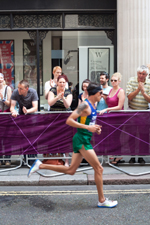
At the end of this year’s event – held on 22nd April (a runner from which is pictured) – more than 882,000 people have now completed the race. Now formally known as the Virgin London Marathon, a record high of 37,227 completed the run this year.

This year’s men’s race was won by Kenyan Wilson Kipsang who completed the race in  2:04:44 – the second fastest time over the London course – while the women’s was also won by a Kenyan – Mary Keitany – who, in taking back-to-back titles, completed the course in 2:18:37.

Since its inception, one of the key aspects of the race has been its fund-raising for a variety of charitable causes. Key among these is The London Marathon Charitable Trust which, established at the race’s outset, helps fund community sports facilities and develop recreational projects around the city.

For more on the Virgin London Marathon, see www.virginlondonmarathon.com.

PICTURE: © photocritical/istockphoto.com

London Pub Signs – Tom Cribb…

In keeping with the sporting theme, we decided to take a look at a pub that bears that name of a sportsman – in this case Tom Cribb, a celebrated early nineteenth century boxer.

Born in 1781, Cribb moved to London from his home in Gloucestershire at just the tender age of 13 and worked in various jobs including as a bellhanger and a porter on the wharves before in taking up the sport of bare knuckle boxing with his first public bout in 1805 (he was known as the ‘Black Diamond’ thanks to his previous work as a coal porter).

Further fights followed and Cribb’s skill was such that in 1809 he won the British title and the following year he fought American and former slave Tom Molineaux to become world champion, a feat he repeated the in 1811 by beating Molineaux again.

Cribb retired from boxing in 1812 and later became a publican, running a couple of different pubs before taking up the job the Union Arms, located at 26 Panton Street, in the West End. He did apparently marry and in 1821 was among the prize fighters who guarded the entrance to Westminster Hall on the day of King George IV’s coronation.

Forced to give up his pub to creditors to pay off gambling debts, he retired to Woolwich in 1839 and died there in 1848 – he was buried in St Mary’s Churchyard where there is a memorial to him.

The pub which now bears his name is located on the same site as the Union Arms, although it is numbered 36 due to a numbering change. Inside it features a boxing theme with photos of some of Britain’s greatest boxers adorning the wall.

For more, see www.shepherdneame.co.uk/pubs/london/tom-cribb.

For a book on Tom Cribb, try Tom Cribb: The Life of the Black Diamond.

PICTURE: Tom Cribb in an engraving published in 1842. Source – Wikipedia.

LondonLife – Hats…err, on to London’s statues…

One of the stranger sights in London during this week of Olympic celebration are the many statues around the city adorned with hats – including Trafalgar Square’s iconic statue of Admiral Lord Nelson which now wears a Union Jack hat featuring a replica of the Olympic flame. Designed by Sylvia Fletcher and made by London’s oldest hatters Lock & Co, makers of Nelson’s original bicorn hat, the hat is one of 20 which has been placed upon London statues. It’s all part of Hatwalk, an initiative which aims to take visitors on a tour of the city by bringing some of its most well-known statues to life. Other statues wearing hats include those of former US President Franklin D Roosevelt and former British PM Winston Churchill in Bond Street, the Duke of Wellington near Wellington Arch, and William Shakespeare in Leicester Square. Hatwalk, which features hats designed by some of the UK’s top milliners, was commissioned by the Mayor of London, in partnership with BT, Grazia magazine, the British Fashion Council and the London 2012 Festival. The hats, which appeared on the statues yesterday, will remain on the statues for only four days before they are auctioned for charity. For more on Hatwalk and a map of where the hats are, see www.molpresents.com/hatwalk