10 curiously named churches of London – 5. St Magnus the Martyr

St Magnus the Martyr has to be one of the most oddly dedicated churches in London. Indeed, for many years there was confusion over which St Magnus it was dedicated to – candidates including  a second and a third century martyr and a Viking who was slain in the Orkney Isles around 900 years ago.

Revived interest in the latter St Magnus in the early 20th century thanks to the discovery of his remains hidden in a pillar in the Orkney ‘capital’ of Kirkwall , however, led to a confirmation of the church’s dedication in 1924.

There is believed to have been a church on the site since Roman times (a fact which has contributed to the confusion over it’s more recent dedication) but its first known mention as that of St Magnus is shortly after the Norman Conquest.

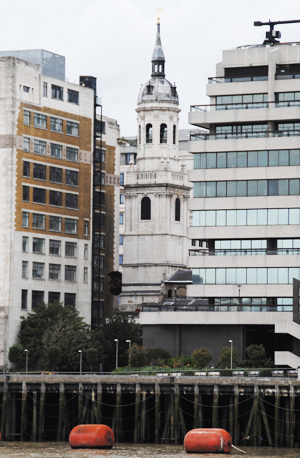
The church’s location, on the approach to London Bridge (see the picture, right, of the church tower overlooking the Thames), meant it occupied an important place in the life of medieval London. Following the Reformation, the patronage of the church was held alternately by the Abbey of Bermondsey and the Abbot and Convent of Westminster – this later passed into the hands of the Bishop of London, Edmund Grindall, and it was he who appointed the church’s most famous rector, Miles Coverdale, best remembered today as a Bible translator (there is a large monument to him in the church).

The church had been repaired in the early 17th century but was destroyed completely in the Great Fire of 1666. It was subsequently rebuilt to the designs of the ubiquitous Sir Christopher Wren.

A fire in 1760 did considerable damage to Wren’s building but it was restored and improvements continued to be made on a sporadic basis until 1831 when Sir John Rennie’s new London Bridge was opened and the old bridge demolished, meaning St Magnus no longer occupied the ‘gateway’ position it had for centuries prior.

The church only received relatively minor damage during World War II when a bomb struck London Bridge but was later restored. Features of the church now include the exterior clock, which dates from 1700, and a piece of wood believed to have one formed part of the Roman wharf which has been placed under the porch.

Among those buried at St Magnus’ during medieval times were Henry Yevele, master mason to King Edward III and King Richard II (his monument was destroyed in 1666). The church still has connections to the Fishmonger’s Company and the Plumber’s Company.

WHERE: Lower Thames Street, London (nearest Tube stations are Monument and London Bridge); WHEN: 10am to 4pm Tuesday to FridayCOST: Free; WEBSITE: www.stmagnusmartyr.org.uk.

Lost London: Gates Special – Aldersgate

Its name now more well known as one of the City of London’s 25 wards, Aldersgate was a gate opening to the city’s north, located close to where the Museum of London now stands, and was one of the city’s four original gates.

A plaque in Aldersgate Street marks where the gate once stood (there’s also an explanatory ‘London Wall’ plaque nearby) – it was finally knocked down in 1761.

The gate’s origins go back to late Roman times – it was apparently created to strengthen the city’s northern defences against Saxon incursions – and was built with two roadways passing through the wall protected by semi-circular towers. (The name apparently has nothing to do with the age of the gate as many believe but may be a corruption of a Saxon name Ealdred or come from a type of tree which grew nearby.)

An important link to places like the fair at Smithfield, St Bartholomew’s Priory and the Charterhouse in the Middle Ages, it was used as a prison and even as late as 1660, diarist Samuel Pepys writes of seeing the limbs of executed traitors displayed upon it. It was also had residential quarters above it – these were said to have been occupied at times by the City Crier and in the mid-1500s were used by printer and stationer John Day (he is said to have printed an early copy of the Bible, dedicated to King Edward VI, there in 1549).

In 1603, it was through Aldersgate that King James I entered London (his arms were later placed over the gate), and just 14 years later, in 1617, the entire gate was rebuilt. Repaired in the aftermath of the Great Fire of London in 1666 (it’s final form was said to feature, as well as the arms of King James I, statues of the Biblical figures Jeremiah and Samuel), it was finally demolished in 1761 to improve the flow of traffic.

PICTURE: Site of where Aldersgate once stood. To the right of the picture is the Church of St Botolph-without-Aldersgate.

Lost London: Gates Special – Ludgate

We’re launching a new ‘Lost London’ special looking at some of the now disappeared gates of London. First up is Ludgate which once stood on the western side of the city.

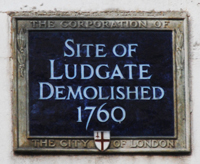
The gate is believed to have been constructed in Roman times and is known to have been rebuilt a several times – once in 1215 and another time after it was destroyed in the Great Fire – before being demolished in 1760 to allow for the road to be widened.

The origins of the name – which is today commemorated in street names like Ludgate Hill and Ludgate Circus – are sketchy but may have been named after the mythical pre-Roman King Lud, who was, so the legend goes, buried underneath this portal (this myth was popularised by the 12th century writer Geoffrey of Monmouth). Others have suggested ‘lud’ is a corruption of ‘flud’ or ‘flood’ and the gate was so named because it prevented the city being flooded by the River Fleet. Another possibility is that ‘lud’ is simply an old English word for a postern gate, a small secondary gate.

Whatever the origins of its name, it has been suggested it was through Ludgate that William the Conqueror passed when first entering the city. In 1377 it became a prison for petty criminals like debtors and trespassers – serious criminals were sent to Newgate – and this lasted until its final destruction.

There is a blue plaque on the wall of the church of St Martin-within-Ludgate in Ludgate Hill marking where Ludgate once stood (pictured above). It is believed that some badly corroded statues standing under a porch at the church of St Dunstan-in-the-West on Fleet Street are of Lud and his sons and were taken down from the gate before its demolition. William Kerwin’s statue of Queen Elizabeth I which dates from 1586 sits in a niche on the front of the church is also believed to have been removed from Ludgate.

The Royal Parks – 6. Greenwich Park

The oldest of the royal parks, the 74 hectare (183 acre) Greenwich Park has been associated with royalty since at least the 15th century.

The area covered by the park had been occupied by the Romans (there are some remains of a building, possibly a temple, near Maze Hill Gate) and later the Danes, who raised protective earthworks here in the 11th century. After the Norman Conquest, it became a manor.

Its enclosure only happened in 1433 after the land came into the possession of Humphrey of Lancaster, Duke of Gloucester and brother of King Henry V. At the time regent to the young King Henry VI, Duke Humphrey also built a tower on the heights above the park – where the Royal Observatory now stands.

Following the duke’s death in 1447, the land was seized by Margaret of Anjou – wife of King Henry VI – and subsequently became known as the Manor of Placentia. King Henry VII later rebuilt the manor house, creating what was known as Greenwich Palace or the Palace of Placentia.

Not surprisingly, it was King Henry VIII, who, having been born at Greenwich Palace, introduced deer to the park. Indeed the park was to have strong associations with others in his family – the king married Catherine of Aragorn and Anne of Cleeves at Greenwich Palace, and his daughters, later Queen Mary I and Queen Elizabeth I, were born there while his son, King Edward VI, died there in 1553 at the age of only 15. (There’s a tree in the park known as Queen Elizabeth’s Oak, which is said to be where she played as a child).

In 1613, King James I gave the palace and accompanying park – which he had enclosed with a high wall – to his wife, Queen Anne of Denmark, apparently as an apology after swearing at her in public when she accidentally shot one of his favorite dogs. Queen Anne subsequently commissioned Inigo Jones to design what is now known as the Queen’s House – for more on that, see our earlier post.

Following the Restoration, King Charles II ordered the palace rebuilt and while this work remained unfinished, the king did succeed in having the park remodelled – it is believed that Andre Le Notre, gardener to King Louis XIV of France, had a role in this.

The works included cutting a series of terraces into the slope – these were known as the Great Steps and lined with hawthorn hedges – as well as creating a formal avenue of chestnut trees (now known as Blackheath Avenue), and some woodlands. Work is currently taking place on restoring an orchard which dates from 1666 at the park.

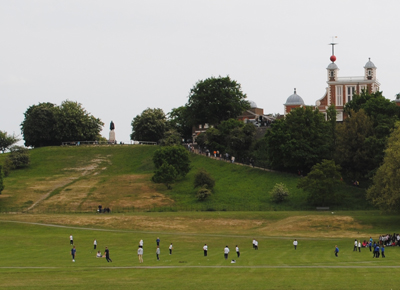
King Charles II also commissioned Sir Christopher Wren to build the Royal Observatory that still stands on the hill overlooking the park – it stands on the site once occupied by the Duke Humphrey Tower (the Royal Observatory is home of the Prime Meridian – see our earlier post on the Royal Observatory for more).

King James II was the last monarch to use the palace and park – his daughter Queen Mary II donated the palace for use as a hospital for veteran sailors and the park was opened to the pensioners in the early 1700s. The hospital later become the Royal Naval College and the National Maritime Museum later moved onto the site (for more on this, see our earlier post).

As an aside, Royal Parks say the truncated shape of some of the trees in the park is apparently due to the fact that when anti-aircraft guns were positioned in the flower garden during World War II, the trees had to be trimmed to ensure a clear field of fire.

Facilities in the park today include a tea house, a children’s playground, sporting facilities such as tennis courts and, of course, the Wilderness Deer Park where you can see wildlife at large. Statues include that of Greenwich resident General James Wolfe, an instrumental figure in establishing British rule in Canada – it sits on the crest of the hill opposite the Royal Observatory looking down towards the Thames.

The park, which is part of the Greenwich World Heritage Site, is slated as a venue for next year’s Olympics – it will host equestrian events and the shooting and running events of the pentathlon.

WHERE: Greenwich Park (nearest DLR station is Cutty Sark – other nearby stations include Greenwich, Maze Hill and Blackheath); WHEN: 6am to at least 6pm (closing times vary depending on the month); COST: Free entry; WEBSITE: www.royalparks.gov.uk/Greenwich-Park.aspx

Treasures of London – The London Stone

The London Stone was once considered to be one of the City’s most important relics with the very existence of the city depending on its survival. Yet, hidden away behind an iron grille set into the front of a building at 111 Cannon Street, the block of Clipsham limestone is these days all but forgotten, occupying an ignominious position opposite the gleaming new Cannon Street Station.

The stone’s origins lie shrouded in mystery but the legend, propagated in the 19th century, goes that it once formed part of an altar built by Trojan wanderer and founder of London, Brutus. Yet, according to the Museum of London, the saying often associated with the legend  – “So long as the Stone of Brutus is safe, so long will London flourish” – was apparently invented in 1862.

It has been suggested the stone, which is a Grade II* listed structure, may be a relic of the city of the Roman city of Londinium, although no-one seems to know for sure. The earliest mention of it was apparently around 1100 AD and it was subsequently associated with some of London’s most famous characters.

It is said that Jack Cade, leader of the 15th century Kentish rebellion, struck it with his sword after entering London in a symbolic gesture designed to reflect his taking control of the city and naming himself ‘Lord of London’. The poet William Blake is said to have believed it to be associated with druidism – perhaps it was part of an altar? – and even the great 17th century architect Christopher Wren had a view on it – he thought it was part of a Roman ruin after seeing its foundations.

One widely believed and circulated theory was that it was the stone from which all distances from London were measured during Roman times. Its heritage listing says it may have been a Roman milestone. It has also been suggested it is the base of an Anglo-Saxon waymarker or cross.

The stone was located in its current position after World War II. Since the 18th century it had been set into the wall of a Wren-designed church, St Swithin London Stone, which had stood on the site where the stone now sits but which was demolished in 1962 after being bombed in the Blitz. Prior to being moved to the church, the stone stood upright on the south side of Cannon Street. It was moved to the church after becoming a traffic hazard.

There has been talk in recent years of moving the stone to a better home but for the moment it remains behind the grill by the footpath.

What’s in a name?…Strand

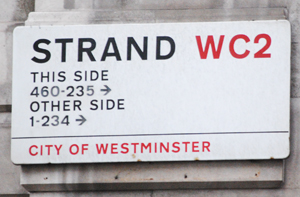
Now one of the major thoroughfares of the West End, the origins of the roadway known as the Strand go back to the Roman times leading west out of the city.

Later part of Saxon Lundenwic which occupied what is now the West End, it ran right along the northern shore of the Thames and so became known as the Strand (the word comes from the Saxon word for the foreshore of a river). During the following centuries the river was pushed back as buildings were constructed between the road and the river, leaving it now, excuse the pun, ‘stranded’ some distance from where the Thames flows.

Sitting on the route between the City of London and Westminster, seat of the government, the street proved a popular with the wealthy and influential and during the Middle Ages, a succession of grand homes or palaces was built along its length, in particular along the southern side.

All are now gone but for Somerset House – originally the home of the Dukes of Somerset, it was built in the 16th century but rebuilt in the 18th century after which it served a variety of roles including housing the Navy Office, before taking on its current role as an arts centre. Others now recalled in the names of streets coming off the Strand include the Savoy Palace, former residence of John of Gaunt which was destroyed in the Peasant’s Revolt, and York House, once home of the Bishops of Norwich and later that of George Villiers, favorite of King James I (see our earlier Lost London entry on York Watergate for more).

After the aristocracy decamped further west during the 17th and 18th centuries, the road and surrounding area fell into decline but was resurrected with a concerted building effort in the early 19th century (this included the creation of the Victoria Embankment which pushed the Thames even further away) which saw it become a favorite of the those who patronised the arts, including the opening of numerous theatres. Among those which still stand on the Strand today are the Adelphi and Savoy Theatres (this was apparently the first in London to be fitted with electric lights and sits on a site once occupied by the Savoy Palace).

Among the other landmarks along the Strand are the churches of St Mary-le-Strand (the present building which sits on what amounts to a traffic island) dates from 1717 and was designed by James Gibbs, and St Clement Danes, designed by Sir Christopher Wren and completed in 1682 (it is now the Central Church of the Royal Air Force). The Strand is also home to the Victorian-era Royal Courts of Justice (it boasts more than 1,000 rooms), Australia House (home of the oldest Australian diplomatic mission), the Strand Palace Hotel (opened in 1907) and Charing Cross Railway Station.

Around London – Yuri Gagarin honored; Londinium by iPhone; celebrating a year to the Olympics; and, British Museum hopes to buy Europe’s oldest book…

Earlier this month it was former US President Ronald Reagan’s turn to be honored with statue in Grosvenor Square. Last week it was the turn of former Soviet Cosmonaut Yuri Gagarin – the first man in space – to be so honored with a new statue located outside the British Council’s offices in the Mall (opposite another explorer, Captain James Cook). The statue, a gift of the Russian Space Agency Roscosmos, was unveiled to mark the 50th anniversary of Gagarin’s celebratory visit to London on 14th July, 1961, just three months after he completed his orbit of the earth on 12th April that year. The 3.5 metre high zinc alloy figure stands close to Admiralty Arch which was where Gagarin met then Prime Minister Harold MacMillan after he was invited to the UK by the National Union of Foundrymen. Among those present for the unveiling of the statue – which is a replica of one in the town of Lubertsy where Gagarin worked as a foundryman as a teenager – was Gagarin’s daughter Elena Gagarina, now director of the Kremlin Museums, and Vladimir Popovkin, head of the Russian Federal Space Agency. The British Council is running an exhibition, Gagarin in Britain, which looks at the life of Gagarin and the early Soviet space programme, until 14th September – among the objects on display is the first space suit and an ejector seat similar to that Gargarin used when he ejected out of Vostok 1. Entry is by registration only and space is limited – email gargarin@britishcouncil.org is you’d like to register for a place. For more information, see www.britishcouncil.orgPICTURE: Frank Noon/British Council

A new iPhone app which directs people to key sites in what was Roman London (Londinium) will go live on Monday. Developed by the Museum of London and the History Channel, Streetmuseum Londonium will bring to life some of the city’s most significant Roman sites, such as the amphitheatre at Guildhall, using “augmented reality video” which will overlay scenes of Roman London over the modern city while soundscapes will allow users to listen to a ritual at the Temple of Mithras or traders at the forum. In addition, users will be able to ‘digitally excavate’ Roman artifacts including leather bikini briefs and an ancient manicure set. Navigation to these “immersive experiences” will be via a specially created new map of Roman London which will be superimposed on a modern map of the capital, allowing users to see how the city has changed. The launch follows the earlier creation of the Streetmuseum app which guides people to more than 200 sites across the city. More than 200,000 people from across the world have so far downloaded this. Streetmuseum Londinium will be available free to download from 25th July. See www.museumoflondon.org.uk/apps for more.

London will mark one year to go until the Olympic Games next Wednesday with a ceremony in Trafalgar Square which will be broadcast live on BBC1. Among those present with be the International Olympic Committee (IOC) President Jacques Rogge, London Organising Committee of the Olympic and Paralympic Games (LOCOG) chairman Sebastian Coe and Mayor of London Boris Johnson. The event will also feature a live cross to the Aquatics Centre in Olympic Park where Olympic hopeful Tom Daley will make the first dive into the pool.

• The British Library hopes to raise £2.75 million to acquire the world’s earliest surviving intact European book, the 7th century St Cuthbert Gospel. A copy of the Gospel of St John, the book was buried with St Cuthbert on the isle of Lindisfarne in 698 and later found in the saint’s coffin in Durham Cathedral in 1104. The National Heritage Fund Memorial has already awarded £4.5 million to obtain the St Cuthbert Gospel and the Art Fund and The Garfield Weston Foundation have donated £250,000 each. The book has been on long-term loan to the library since 1979 and is regularly on view in the Sir John Ritblat Treasures Gallery. The library was approached last year and given first option to acquire the text after the Society of Jesus (British Province) decided to sell it. A price of £9 million has been agreed, of which £2.75 million remains outstanding. For more, see www.bl.uk.

Where’s London’s oldest…public park?

Dating from the early 1600s, London’s oldest public park is Finsbury Circus Gardens, located just to the north of London Wall and east of Moorgate.

The now heritage-listed gardens were open as a public park from 1606 (and was originally known as Moor Fields – the moors were drained and gravel walks laid out in 1527 but it wasn’t until 1606 that the area was laid out with elm trees and benches).

The park wasn’t enclosed until 1815-17 when City of London surveyor William Montague laid the area out according to the designs of prominent London architect George Dance the Younger.

The gardens were acquired by the City of London Corporation in 1900 and in 1909 were replanned. The oval-shaped park, the largest of the City’s gardens, is these days home to the City of London Bowling Club, the only bowling club in the City (founded in 1924; the bowling green dates from the following year and the current pavilion from 1968).

During World War II a barrage balloon was anchored here to deter low level air raids. Among it’s other claims to fame is the Tudor era bat (apparently a forerunner of the modern cricket bat) found on the site in the 1980s and skulls which have also been found dating from the Roman period.

The gardens are currently partly closed due to the Crossrail development.

PICTURE: Wikipedia

What’s in a name?…King’s Cross

The location now known as King’s Cross, north-west of the City, takes its name from a monument adorned with an 11 foot high statue of King George IV which once stood on a site now occupied by King’s Cross Railway Station.

The area had been previously known as Broadford Bridge or Battlebridge – the latter a name many associated with the apparently erroneous belief that it was here, at a bridge which once crossed the River Fleet, the Iceni Queen Boudicca (also known as Boadicea) ill-fatedly confronted the Roman Army under the command of Gaius Suetonius Paulinus.

From the 1830’s (King George IV ruled from 1820 to 1830), however, the area took on the name of King’s Cross thanks to the erection of what Walter Thornbury described in his 1878 text, Old and New London, as a “ridiculus octagonal structure crowned by an absurd statue of George IV”.

The structure, said to be 60 feet high, was erected at the intersection of Gray’s Inn Road, Pentonville Road and what we now know as Euston Road, and during its relatively short lifespan, was employed at different times as a police station and as a pub (complete, apparently, with a camera obscura in the upper level).

It was completely removed by 1845 (King’s Cross Railway Station officially opened in 1852).

The area of King’s Cross has been settled back as far as Roman times – St Pancras Old Church is one of the oldest sites of Christian worship in England although the current church is Victorian – but it wasn’t until the 1700s and 1800s that it was transformed in to an urban area with the arrival of canals – including The Regent’s Canal – and the railways.

Traditionally one of London’s poorest areas, it survived World War II bombings but subsequently suffered as the railways declined in the post-war period. By the 1980s, it had become notorious as a red light district.

It has since gone through – and is still going through – a gradual gentrification process, however, with the 67 acre development King’s Cross Central among the projects currently under construction.

Key attractions of the area include The British Library, The London Canal Museum, arts centre King’s Place, and the recently refurbished St Pancras Renaissance London Hotel.

It’s also now home to St Pancras International – London’s Eurostar terminus (having been moved here from Waterloo) – as well as King’s Cross Railway Station which is believed by many, despite the lack of any evidence, to be the burial site of Queen Boadicea (it’s said she still lies beneath platform 9 or 10) and which is the home of the fictitious platform 9 and 3/4 from which Harry Potter catches the train to Hogwarts.

Roman London – 5. Remains under St Bride’s

Our final entry in our short series on Roman London concerns the Roman remains found under St Bride’s Church in Fleet Street.

Following heavy bombing during World War II, much of the church was destroyed. But the bombing did reveal hitherto unknown secrets below the church.

As well as the remains of what were thought to be numerous plague and cholera victims (dating from 1665 and 1854 respectively), these included remains dating back to the 2nd century AD which featured the foundations of a somewhat mysterious Roman building and pavement, both of which were built outside the later Roman wall. There are also the remains of a ditch which is believed by some to be part of what was a quarry.

The remains can now be viewed in the church’s crypt along with those of the earlier churches. For more on St Brides, see our previous entry here.

WHERE: Fleet Street (nearest tube St Paul’s); WHEN: 8am to 6pm Monday to Friday, 11am to 3pm Saturday, 10am to 1pm and 5pm to 7.30pm Sunday; COST: Entry is free but guided tours are available on Tuesday afternoons at 3pm for £5 a person; WEBSITE: www.stbrides.com.

Roman London – 4. Timber from a Roman quay

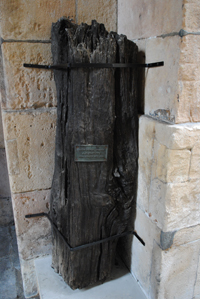
Hidden away in the porch of the church of St Magnus the Martyr on Lower Thames Street, next to London Bridge, is a timber beam which is believed to date from the city’s Roman era and which once formed part of the city’s wharves.

Found, according to a plaque upon the wood, in 1931 under Fish Street Hill, the wood dates from around 75 AD, shortly after the first attempt to create wharves along the riverbank in about 50 AD and about 10 years after Boudicca and her rebels torched the city.

The Roman port did become an important trading centre, continuing to expand during the following two centuries before decline set in during the 400s.

The first controlled excavation of a Roman quay took place in 1973 and have continued sporadically since.

WHERE: St Magnus the Martyr (nearest tube station is Monument); WHEN: Access to the site can be undertaken at any reasonable time; COST: Free.

Lost London – London Bridge

In the first of a new regular series looking at “lost” London, Exploring London takes a look at London Bridge.
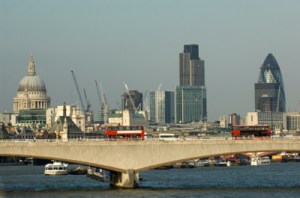
It’s a commonly confused fact that many first-time visitors to London think Tower Bridge and London Bridge are the same. As Londoners know, London Bridge (pictured right with St Paul’s and the city in the background) lies west of Tower Bridge. It’s not a particularly inspiring bridge having been built in the early Seventies. But there’s been a bridge spanning the Thames here for almost 2,000 years. So what happened to Old London Bridge?

The first bridge built across the River Thames on or close to the current site of London Bridge is thought to have been a wooden pontoon bridge constructed by the Romans around 50 AD. It was quickly followed by a more permanent bridge (rebuilt after it was destroyed by Boudicca and her marauding army in 60 AD).

Following the end of the Roman era, the bridge fell into disrepair although it’s known that there was a wooden Saxon bridge on the site by around the year 1,000. A succession of Norman bridges followed the Conquest and in 1176, during the reign of Henry II, construction of a new stone bridge began under the supervision of the priest Peter de Colechurch to service to growing numbers of pilgrims travelling from London to Thomas a Becket’s shrine in Canterbury. The new bridge, which had a chapel dedicated to St Thomas at the centre, wasn’t finished until 1209.

The bridge had 19 arches sitting on piers surrounding by protective wooden ‘starlings’ and a drawbridge and defensive gatehouse. The design of the bridge meant the water shot rapidly through the arches, leading boatmen to describe the practice of taking a vessel between the starlings as “shooting the bridge”.

King John, in whose reign the bridge was completed, licensed the building of houses on the bridge and it soon became a place of business with some 200 shops built upon its length, many of them projecting over the sides and reducing the space for traffic to just four metres. Many of the buildings actually connected at the top, creating a tunnel-like effect.

One of the more remarkable buildings on the bridge was Nonsuch House, built in 1577. A prefabricated building, it had been assembled in the Netherlands before being taken apart, shipped to London, and then reassembled. No nails were used in its construction, just timber pegs.
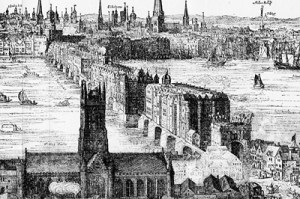
The practice of putting the heads of traitors on pikes above the southern gatehouse (see picture right, dating from 1660) started in 1305 with Scottish rebel William Wallace’s head and continued until it was stopped after 1678 when goldsmith William Stayley’s head was the last to be displayed there. Famous heads to adorn the gateway over the years included Peasant’s Revolt leader Wat Tyler in 1381, rebel Jack Cade in 1450, the former chancellor Sir Thomas More and Bishop John Fisher in 1535, Thomas Cromwell in 1540 and Guy Fawkes in 1606.

Some of the bridge’s arches collapsed over the years and had to be restored and there were several fires which destroyed houses upon it, including those which occurred during the Peasants’ Revolt in 1381 and Jack Cade’s rebellion in 1450.

Congestion reached such a state by the 18th century that in 1756 Parliament passed an act which allowed for the demolition of all the shops and houses upon it (it had remained the only bridge spanning the Thames east of Kingston until Westminster Bridge was completed in 1750). This was carried out in 1758-62 along with the removal of two central arches which were replaced with a single wider span.

With traffic only increasing – by 1896, 8,000 people and 900 vehicles were reportedly crossing the bridge every hour – it was clear a new bridge was needed and work on a new stone bridge with five arches – following a design competition won by John Rennie – began in 1824. The old bridge, located about 30 metres east of the new one, remained in use until the new one was opened in 1831. Widening work carried out the early 20th century, however, was too much for the bridge’s foundations and it began to sink.

What followed was one of the strangest episodes in the bridge’s history when in 1967 the Common Council of the City of London decided to sell the bridge. It was sold the following year to Missourian entrepreneur Robert P. McCulloch of McCulloch Oil for $US2.5 million.

Carefully taken apart piece by piece, the bridge was then transported to the desert resort of Lake Havasu City in Arizona in the US and rededicated in 1971.

The current London bridge, designed by Mott, Hay and Anderson, was built from 1967 to 1972 and opened by Queen Elizabeth II in 1973. It stands on the same site as the previous bridge.

As for the song, “London Bridge is falling down”? There’s several stories to explain its origins – one being that it came about as the result of an attack by a joint force of Saxons and Vikings on Danish held London in 1014 during which they pulled the bridge down, and another being that it became popular after Henry III’s wife, Queen Eleanor, was granted the tolls from the bridge by her husband but instead of spending them on maintenance, used it for her own personal use. Hence, “London Bridge is falling down, my fair lady”.

PICTURES: Top: © Steven Allan (istockphoto.com); Bottom – London Bridge (1616) by Claes Van Visscher. SOURCE: Wikipedia.
Roman London – 3. The amphitheatre

Only discovered underneath Guildhall Yard in the 1980s, remains of London’s Roman-era amphitheatre can today be seen in the basement of the Guildhall Art Gallery.

Built around 70 AD initially as a simple wooden structure and then remodelled shortly after 120 AD with masonry foundations and walls and timber stands, the amphitheatre would have held as many as 7,000 spectators and was probably used for events such as public executions and other public entertainments including animal fighting and gladitorial combat.

The amphitheatre – the size of which is marked in a black line on the yard above (see picture right) – was abandoned by the mid 4th century.

Don’t expect too much – these days only remnants of the walls remain at what was ground level in the Roman era but they and the accompanying digital reconstruction give a reasonable indication of what it may have once been like.

The Museum of London runs tours of the amphitheatre with the next scheduled for 25th January, 2011. Click here for more details.

WHERE: Entry via Guildhall Art Gallery, Guildhall Yard, off Gresham Street (nearest tube stations are Bank, St Paul’s, Mansion House and Moorgate); WHEN: Monday to Saturday 10am to 5pm; Sunday 12pm to 4pm ; COST (included in gallery admission): £2.50 adults/£1 concessions/children under 16 free (free on Fridays and after 3.30pm any day and to people living and working in the City) ; WEBSITE: http://www.cityoflondon.gov.uk/Corporation/LGNL_Services/Leisure_and_culture/Museums_and_galleries/Guildhall_Art_Gallery/visitor_info.htm

PICTURE: Google maps

Roman London – 2. The Temple of Mithras

Also known as the Mithraeum, the remains of the Temple of Mithras were only discovered in the City during building work in 1954.

The temple was originally located some 18 feet (5.4 metres) below Walbrook Street on the bank of what was Walbrook but was moved to its current location at the eastern end, and south side, of Queen Victoria Street. It is presently again surrounded by building work hoardings so you’ll have to ignore those if you’re trying to soak up some ancient atmosphere.

The temple was built around 240 AD and remained in use until around 350AD when, after it suffered severe subsidence, it was rebuilt and dedicated to the god Bacchus. The original stone temple was dedicated to Mithras, a Persian sun deity and a particular favorite of Roman soldiers, and perhaps to several other gods as well.

These days all that remains are foundations, but you can see the basic layout with a sunken nave – which would have had benches on either side – leading to an altar, remains of which are at the northern end of the site.

Numerous artefacts have been found at the temple site, including a head of Mithras, a sculpture showing a scene of Mithras killing a bull (he apparently did so in a cave so  Mithraeum were built partly or even totally underground), and heads of the Roman gods Minerva and Serapis, all of which can be seen at the Museum of London.

WHERE: Queen Victoria Street (nearest tube station is Bank); WHEN: Open to the public at all times; COST: Free. WEBSITE: The Museum of London’s website has some good information on the temple, http://bit.ly/hzsBrW

Roman London – 1. The Roman wall

This year marks 1,600 years since what many posit was the “end of Roman Britain” based on a letter Emperor Honorius is said to have written in 410 AD telling Britain to look to its own defence. So we thought we’d take a look at Roman London – Londinium – in a short series running until the year’s end.

To kick it off, we’re taking a look at one of the easier to find Roman remnants, that of the city wall which encircled first Roman and later the medieval City of London.

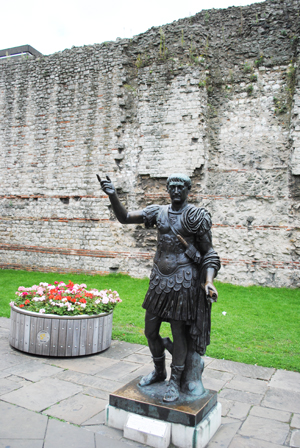
The wall can be seen in several places, but one of the easiest places to see it is next to Tower Hill tube station, where one of the best preserved sections of the wall can be seen (along with a statue believed to be that of the Emperor Trajan – see right).

Standing to a height of more than 35 feet or 10.6 metres, the Roman section extends as high as 14.5 feet or 4.4 metres with the upper part dating from later periods. The Roman wall would have originally been around 20 feet or 6.3 metres high and would have had a V-shaped ditch running along its outside.

First built around 200 AD, the city wall largely ran along the same course over the ensuing centuries. There were initially five gates with another added in the Roman period and another in medieval times. None of these now survive.

Further substantial remains of the Roman wall can be seen in a courtyard at nearby Cooper’s Row (head around the corner from Tower Hill tube station along Cooper’s Row and then turn right, past a hotel, into a courtyard) and on what was the north-west corner of the city at Noble Street, not far from the Museum of London, where a Roman base supports a later brick wall.