10 fictional character addresses in London – 2. ‘Whitehaven Mansions’…

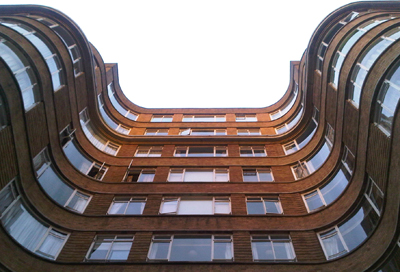
Florin-Court

Since we’re talking about the homes of detectives, we’ll continue on that trend with a look at the home of Agatha Christie’s creation Hercule Poirot as it appears in the TV series of the same name (now in its 13th and final season).

The Belgian-born detective, who featured in some 33 novels and 65 short stories, rose to the rank of the police chief of the city Brussels before the outbreak of World War I forced him to leave his home for England. There he met up with his friend Captain Arthur Hastings – they had apparently previously met – and undertakes some government work before eventually embarking upon his new career as a private detective.

He subsequently moves into an art deco flat which becomes his workplace and home at 56B Whitehavens Mansions (he apparently chose the building based on its symmetry).  In the TV show, the art deco block chosen to represent this building is the Grade II-listed Florin Court, located on the eastern side of Charterhouse Square in Smithfield.

Actually built in 1936 – well after Poirot apparently moved in – the nine floor building has a curvaceous facade and boasts some 120 flats along with a basement swimming pool and rooftop garden. Interestingly, last July there was a fire in a first floor flat causing the entire building to be evacuated.

Poirot apparently lived in a couple of different apartments in the building and was also known at times to reside in The Savoy Hotel and The Park Lane Hotel.

PICTURE: Goodwillgames/Wikimedia Commons

Around London – Open House London; Yinka Shonibare at Greenwich; Bankside transformed; and Michael Peto at the NPG…

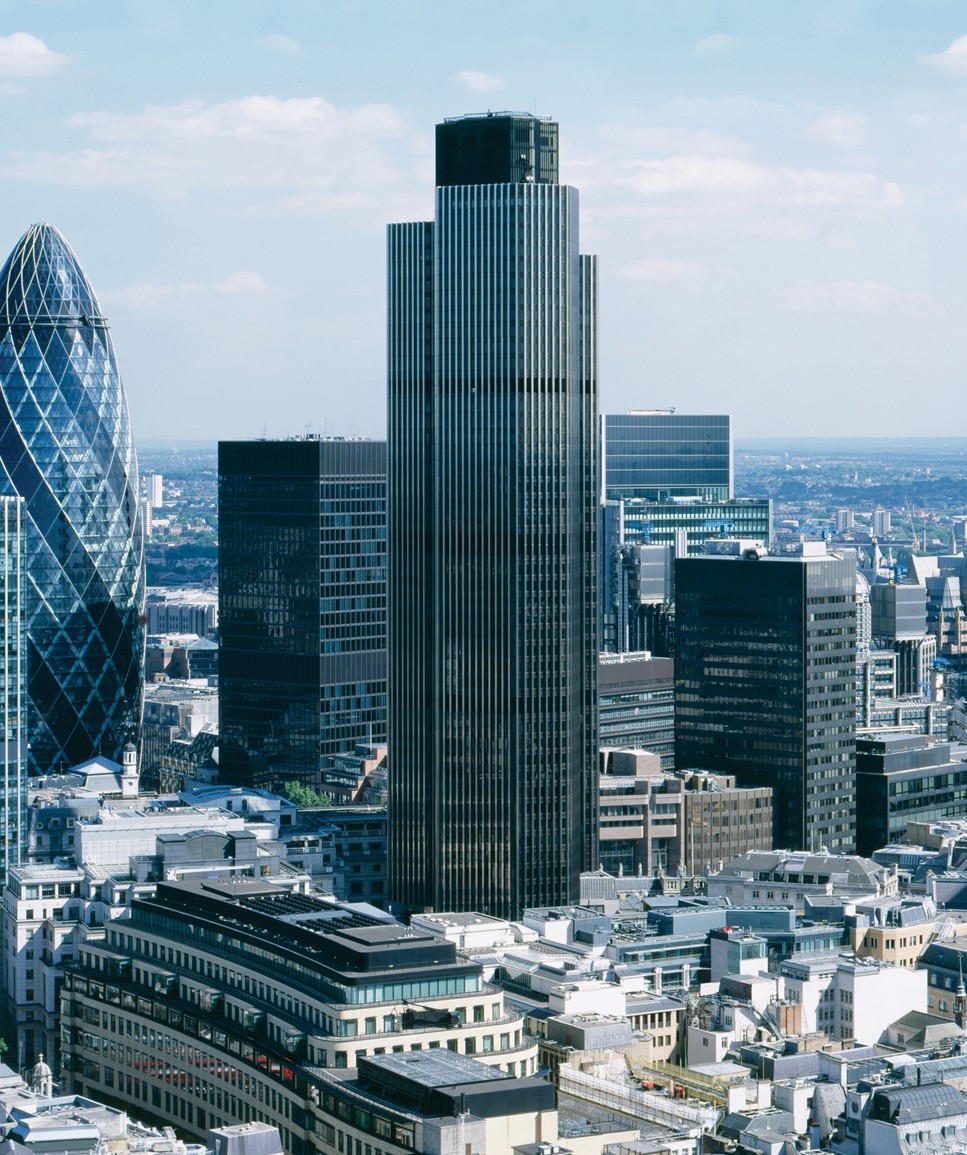
Tower 42_external It’s finally here. Open House London kicks off on Friday and with more than 800 buildings opening their doors, the only difficulty you’ll have this weekend will be choosing what you end up doing! This year’s theme is ‘celebrating architecture, people and place’ and among the highlights will be the opening of landmark structures like Battersea Power Station, Tower 42 (pictured), and the Gherkin (30 St Mary Axe) as well as 100 private homes, architects’ homes and “ground-breaking” housing developments and everything from the Shri Swaminarayan Temple in Brent to Horse Guards in Whitehall (certain buildings, like 10 Downing Street and The View from the Shard, are only open to people who won tickets in an earlier ballot). This year’s festivities also include a moonlit “culture crawl” through London on Friday night. If you haven’t ordered a hardcopy programme, you can check the listings online at www.openhouselondon.org. There’s also an Open House iPhone app available from the appstore.

A series of works by Yinka Shonibare – including some never before seen in the UK – went on display at Greenwich yesterday, thanks to Royal Museums Greenwich. The works, which explore notions of “Britishness, trade and empire, commemoration and national identity”, can be found inside and around buildings including the Queen’s House, National Maritime Museum and Royal Observatory and include Fake Death Pictures – a series of five vision of the death of naval hero Vice-Admiral Lord Nelson, Wind Sculpture – a gravity-defying object located on the Queen’s House lawn, Cheeky Little Astronomer – a specially commissioned sculpture located in the Flamsteed House at the Royal Observatory, and Nelson’s Ship in a Bottle – last seen on Trafalgar Square’s Fourth Plinth. Yinka Shonibare MBE at Greenwich, which is supported by a range of talks, debates and tours, runs until 23rd February. For more, see www.rmg.co.uk.

Bankside will be transformed this weekend as artists will be transforming disused hoardings and derelict buildings with original artworks as part of the Merge Festival. The work’s include Candy Chang’s Before I Die, Alex Chinnick’s Miner on the Moon, and Marcus Lyall and Mark Logue’s House of Pain. Until 20th October. For more on the festival celebrating Bankside, see www.mergefestival.co.uk.

On Now: Michael Peto Photographs: Mandela to McCartney. This new exhibition at the National Portrait Gallery just off Trafalgar Square features a previously unexhibited photo of Elizabeth Taylor and Richard Burton, taken at the beginning of their love affair. It’s one of 10 portraits taken by the late Hungarian-born photographer Michael Peto in London during the 1950s and 1960s – others feature Samuel Beckett, Jennie Lee, Paul McCartney and Ian McKellen. Admission is free. For more, see www.npg.org.uk.

10 (more) curious London memorials…7. D’Oyly Carte Memorial…

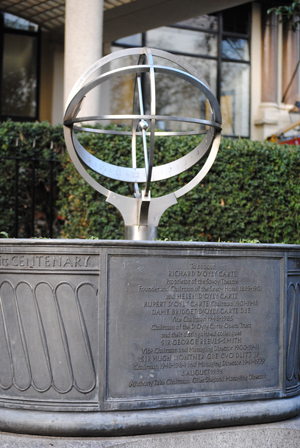
DOyly-CarteThis strange looking globe standing in Victoria Embankment Gardens just off Savoy Place may appear just another random piece of street art but in fact it’s a memorial to a man and his family who established the hotel now housed nearby.

Theatre impresario Richard D’Oyly Carte is known for having formed his own opera company – the D’Oyly Carte Opera Company, it was known for staging Gilbert and Sullivan’s ‘Savoy operas’ –  and for having founded the Savoy Hotel, which stands across the road from the memorial’s location.

The memorial, which was placed here in 1989 to mark the hotel’s centenary, takes the form of an armillary sphere – a model of objects circling the earth – standing in the middle of a cistern.

The inscription accompanying the memorial states that it honors not only Richard D’Oyly Carte but also others – including members of his family – who have since been involved in the hotel’s management. There’s also a note on the rim of the cistern, stating that the garden was “given to London by the Savoy in celebration of its centenary” while inscribed on the armillary sphere’s rings are the words “Savoy Centenary 1989, ‘For excellence we strive.'” and a line from dramatist WS Gilbert (of Gilbert and Sullivan fame) – “Every season has its cheer, life is lovely all the year”.

LondonLife – Battersea Power Station…

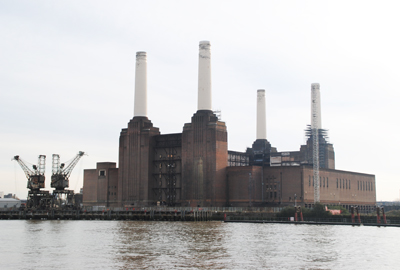
Battersea-Power-StationThe weekend of 21st and 22nd September represents the final chance to go inside and explore the Grade II*-listed Battersea Power Station before it is transformed as the centrepiece of a new £8 billion riverside development featuring a blend of residences, offices, shops, leisure and hospitality facilities. The former power station, built on the south bank of the River Thames in the 1930s, is one of the highlights of this year’s Open House London and will take visitors on a walking route which starts at the 2.5 acre ‘pop up park’ which appeared on the riverside earlier this year and then leads through to the remains of vast central boiler house and the 1950’s turbine hall B. It’s the first time the building has taken part in Open House London and the last chance to see inside before works begin in October. The power station will be open from 11am to 4pm on both days with last entries at 3pm. Entry is free. For more, see www.batterseapowerstation.co.uk or check out www.londonopenhouse.org.

Treasures of London – Freud’s collection of antiquities…

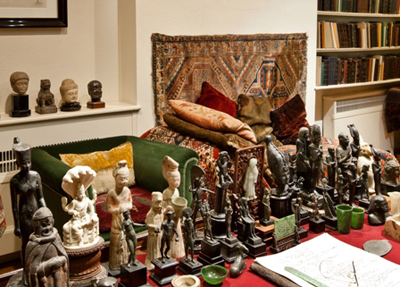
Freud's-DeskThis group of antiquities sits upon the desk of Sigmund Freud – the “founding father” of psychoanalysis –  at what was his home in Hampstead.

It’s part of an extensive collection of around 2,000 items which is on display at house – now the Freud Museum – located at 20 Maresfield Gardens.

The antiquities – which include Egyptian, Greek, Roman, and Oriental artefacts fill a series of cabinets and sit on almost every available surface in Freud’s study including the desk upon which Freud typically wrote until the early hours of the morning.

Collected by Freud from the 1890s onward, they include everything from a bronze statuette of the Greek goddess Athena (dating from the 1st or 2nd century AD – it’s mentioned in one of his manuscripts and, one of Freud’s favorite objects, was one of only three items he chose to have smuggled out of Vienna when his entire collection was threatened in 1938), a small bronze head of the Egyptian God Osiris believed to date from between 1075-716 BC, and a silver Roman ring featuring a blue glass intaglio depicting a pastoral scene which dates from between the 1st century BC and the 1st century AD (it was given as a gift from Freud to German psychoanalyst Ernst Simmel in 1928).

The museum has launched a conservation fund to repair and conserve the most fragile of the items and is aiming to raise £40,000 for the work. It follows a successful campaign earlier this year to raise funds for the conservation of Freud’s famous couch, brought from his former home in Vienna (seen in the background of this image).

Freud and his family lived at the home after escaping from Austria following the country’s annexation by Nazi Germany in 1938. It remained the family home until the death of Freud’s daughter, Anna, in 1982. The museum opened to the public in 1986.

PICTURE: Courtesy of the Freud Museum.

WHERE: Freud Museum, 20 Maresfield Gardens, Hampstead (nearest Tube stations are Finchley Road and Swiss Cottage);  WHEN: Noon to 5pm, Wednesday to Sunday; COST: £6 adults; £4.50 seniors; £3 concessions (including children 12-16); children under 12 free; WEBSITE: www.freud.org.uk.

10 (more) curious London memorials…6. 7 July Memorial…

77-Memorial

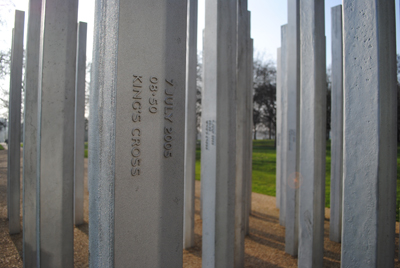
It’s not immediately obvious what this series of upright stainless steel pillars standing on the eastern edge of Hyde Park has been placed there for.

But look a little closer and you’ll see inscribed upon a date which any long-term Londoner immediately recognises – 7th July, 2005: the day when a series of bombs claimed 52 lives on three trains and a bus at various locations around central London.

The memorial, designed by architects Carmody Groarke and engineering team Arup working in consultation with victims’ representatives, Royal Parks and the Department for Culture, Media & Sport, consists of 52 pillars – one for each victim of the bombings.

The 3.5 metre high, 850 kilogram pillars are clustered together in four groups representing the four locations of the bomb attacks – Tavistock Square, Edgware Road, King’s Cross and Aldgate. They are marked with the times, dates and locations of the bombings and there’s also a 1.4 tonne stainless steel plaque upon which are written the names of the victims located nearby.

The RIBA award-winning memorial, which is located just to the north of the colossal statue Achilles and Hyde Park Corner, was unveiled by Prince Charles and Lady Camilla on the fourth anniversary of the attack in 2009.

For more, see the Royal Parks website www.royalparks.org.uk/parks/hyde-park/hyde-park-attractions/7-july-memorial.

10 (more) curious London memorials…5. National Police Memorial…

National-Police-Memorial

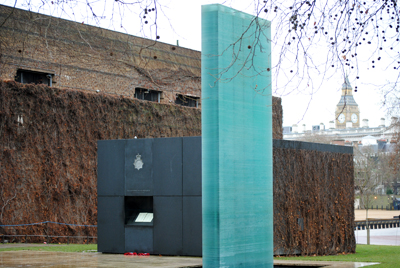
The unobtrusive box-like structure and adjacent glass pillar located on the corner of The Mall and Horse Guards Road in Whitehall is another memorial that is easy to overlook.

Unveiled by Queen Elizabeth II in 2005, it commemorates the 4,000 police officers who have been killed in the course of their duty in the UK and was commissioned by the Police Memorial Trust.

Police-Memorial-TrustThe trust was formed in the mid-1980s by the late film director Michael Winner following the shooting death of WPC Yvonne Fletcher, who was killed while policing a protest outside the Libyan Embassy in St James’s Square on 17th April, 1984.

The Trust ensured an individual memorial to WPC Fletcher now marked the spot of her death and was followed by further memorials to individual police officers before the trust began a campaign for a larger, national memorial in the mid-1990s.

As much as £2.3 million was raised from the public for the memorial which was designed by architectural firm Foster + Partners.

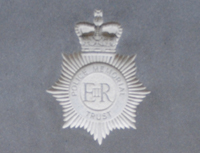
The memorial, which won a RIBA award, consists of a black granite clad wall with a glass chamber set into its face, inside which is a Book of Remembrance listing the names of all UK police officers killed in the course of duty (the pages of the book are apparently turned every two weeks). Above the chamber is carved the Metropolitan Police Crest.

The tall glass pillar which stands nearby in a reflecting pool was designed to pay homage to the blue lamps that once burned outside police stations.

For more on other police memorials in the UK, see www.policememorial.org.uk.

LondonLife – Recalling the Queen’s Coronation…

Coronation

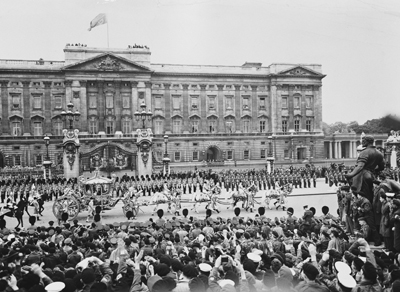
The Gold State Coach passes in front of Buckingham Palace on 2nd June, 1953. The image is among the displays at the special exhibition marking the 60th anniversary of the coronation of Queen Elizabeth II which forms part of the summer opening of Buckingham Palace’s State Rooms. The exhibition, which runs until 29th September, features dresses, uniforms and robes worn by the principal royal party on the day along with works of art, paintings and other objects related to it. Admission charge applies. For more, check out www.royalcollection.org.ukPICTURE: Royal Collection Trust/All Rights Reserved.

Famous Londoners – The Tower Ravens…

Ravens

OK, so they’re not people as such, but the ravens at the Tower of London are renowned the world over.

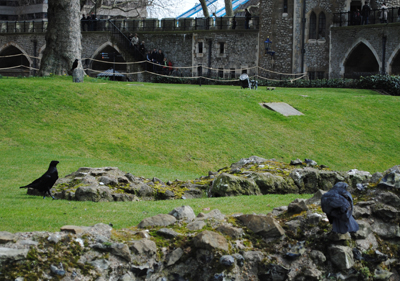
Known as the “Guardians of the Tower”, there are currently as many as eight ravens living at the tower, lodged in a space on the grass next to the Wakefield Tower.

Raven-pensLegend has it that there must be at least six ravens living at the Tower – should they leave, not only will the Tower fall but the kingdom as well (although we hasten to add that it’s been argued this tradition only started in the Victorian age and that there have been times when the numbers of ravens dropped below the required six, such as at the end of World War II when only one raven remained).

It was King Charles II who first ordered the ravens be protected – an order which must have upset Astronomer Royal John Flamsteed who complained after he found that the birds were interfering with the observation work he was carrying out from the Tower’s north-east turret. He later moved out to Greenwich.

The eight ravens who now live at the tower include Rocky, Merlin, Hugine and the latest additions Jubilee – given to the Tower last year to celebrate the Queen’s Diamond Jubilee – and Grip, named after Charles Dickens’ pet raven.

The birds are looked after by a team of four headed by the raven master, Chris Skaife, who each day feed them 170 grams (six ounces) of raw meat and special biscuits soaked in animal blood.

Not all ravens can cut the mustard to work at the Tower – one recent addition Pearl was apparently bullied by other ravens and had to be withdrawn. And while the birds have the feathers on one wing trimmed to stop them escaping to a new life on the wing, that hasn’t stopped some from doing so including Grog who took off in 1981 and was last seen outside an East End pub.

The oldest raven to ever live at the Tower was Jim Crow, who died at age of 44 in 1928.

WHERE: Tower of London (nearest Tube station Tower Hill); WHEN: 9am to 5.30pm, Tuesday to Saturday, 10am to 5.30pm Sunday to Monday; COST: £21.45 adults; £10.75 children under 15; £18.15 concessions; £57.20 for a family; WEBSITE: www.hrp.org.uk/toweroflondon/.  

LondonLife – A new season for the Fourth Plinth…

Hahn_Gautier1

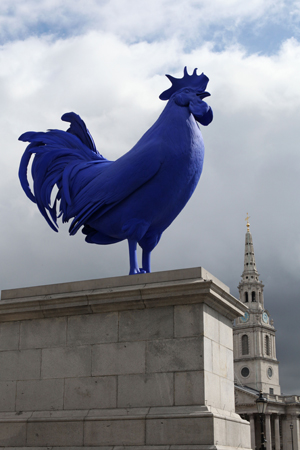
The latest commission for Fourth Plinth was unveiled in Trafalgar Square last Thursday. Katharina Fritsch’s Hahn / Cock, 2013, depicts a 4.72 metre high sculpture of a domestic farmyard cockerel completely coloured in vivid ultramarine blue. Fritsch, one of Germany’s leading contemporary artists, has works featured in the permanent collections of prominent galleries around the world including New York’s Museum of Modern Art. Originally designed by Sir Charles Barry to hold an equestrian statue (which was never completed), the fourth plinth has been most recently occupied by a series of works specially commissioned for the spot under the Mayor of London’s Fourth Plinth Programme. Recent commissions include Yinka Shonibare’s Nelson’s Ship in a Bottle and Antony Gormley’s One and Other. For more details, check out www.london.gov.uk/priorities/arts-culture/fourth-plinthPICTURE: Gautier Deblonde.

Around London: Masques of the Stuart Court; saving London’s heritage; IEDs at the NAM; and, Eighties fashion at the V&A…

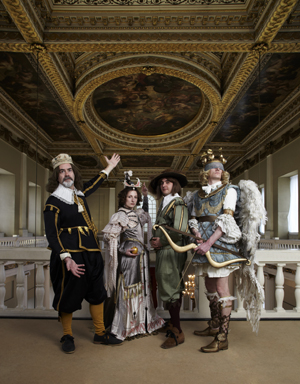
Stuart-masque-at-Banqueting-HouseThe sights and sounds of the elaborate masques of the early Stuart Court – described as a cross between a ball, an amateur theatrical, and a fancy dress party – are being recreated at the Banqueting House in Whitehall. Historic Royal Palaces have joined with JB3 Creative to create an “immersive theatrical experience” for visitors to the building – one of the last surviving parts of the Palace of Whitehall – with the chance to try on costumes, learn a masque dance and witness performance rehearsals for Tempe Restored, last performed in the building in 1632. Inigo Jones will be ‘present’ as masque designer to talk about his vision for the performance. Weekends will also see musicians performing period music and on 27th July there will be a one-off evening event at the Banqueting House based on Tempe Restored. Admission charge applies. Performing for the King opens tomorrow and runs until 1st September. For more, see www.hrp.org.uk/BanquetingHouse/. PICTURE: HPR/newsteam.

A new exhibition looking at how some of London’s great Georgian and Victorian buildings were lost to bombs and developers before, after and during World War II – and how people such as poet John Betjeman campaigned to save them – opened in the Quadriga Gallery at Wellington Arch near Hyde Park Corner yesterday. Pride and Prejudice: The Battle for Betjeman’s Britain features surviving fragments and rare photographs of some of the “worst heritage losses” of the mid-20th century. They include Robert Adam’s Adelphi Terrace (1768-72) near the Strand, the Pantheon entertainment rooms (1772) on Oxford Street, and Euston Arch (1837). The English Heritage exhibition runs until 15th September. Admission charge applies. For more, see www.english-heritage.org.uk/daysout/properties/wellington-arch/.

IEDs (Improvised Explosive Devices) will be ‘uncovered’ in a new exhibition opening tomorrow at the National Army Museum. Unseen Enemy will tell the stories of the men and women in Afghanistan who search for, make safe and deal with the impact of the IEDs through personal interviews, images and mementoes. The exhibition has been developed with “unprecedented access” from the British Army, Royal Air Force and Royal Navy and will include a range of equipment used in detecting and disarming the devices, such as bombsuits and robots as well as medical equipment used to help those injured in explosions. The exhibition is free. For more, see www.nam.ac.uk.

On Now: Club to Catwalk – London Fashion in the 1980s. This exhibition at the V&A explores the “creative explosion” of London fashion during the decade and features more than 85 outfits by designers including John Galliano, Vivienne Westwood and Katherine Hamnett as well as accessories by designers such as Stephen Jones and Patrick Cox. While the ground floor gallery focuses on young fashion designers who found themselves on the world stage, the upper floor focuses on club wear, grouping garments worn by ‘tribes’ such as Fetish, Goth, High Camp and the New Romantics and featuring clothes such as those worn by the likes of Boy George, Adam Ant and Leigh Bowery. The exhibition also includes a display of magazines of the time. Entry charge applies. Runs until 16th February, 2014. For more, see www.vam.ac.uk. Meanwhile, tomorrow (Friday) night the V&A will celebrate the 25th anniversary of designer Jenny Packham with a series of four free catwalk shows in its Raphael Gallery. Booking is essential. Head to the V&A website for details.

LondonLife – A look into London’s wartime past…

StreetMuseum

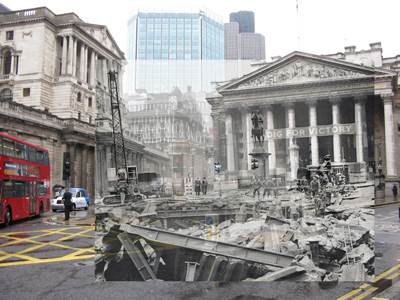
Images from the Museum of London’s Streetmuseum app give a glimpse into London’s past – in this case, its wartime history. The image above, taken by Police Constable Arthur Cross, official photographer of the City of London Police, and his assistant PC Fred Tibbs, shows bomb damage at Bank Underground Station, following a direct hit on 10th January, 1941. An estimated 111 people who had been sheltering in the Tube died, some of them thrown into the path of an incoming train. The crater that was left outside the Royal Exchange was so large the Royal Engineers had to build a bridge across it. For details on how to download the app, head to www.museumoflondon.org.uk/Resources/app/you-are-here-app/home.htmlPICTURE: © Museum of London/By Kind Permission of The Commissioner of the City of London Police.

10 Historic London Garden Squares…10. Charterhouse Square…

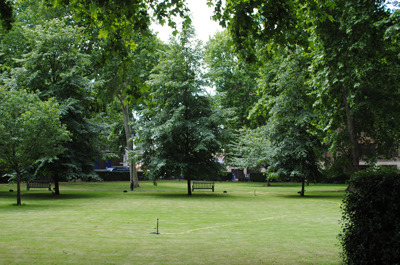
Charterhouse-Square-GardensThe final in our series on historic garden squares in London (for this year, anyway), we’re taking a look at Charterhouse Square.

The five sided square, located just to the east of Smithfield, takes its name from a Carthusian monastery which was established in 1371 on what is now its north side. Prior to this, what is now the square had from 1348 served as a location for a plaque burial pit (a number of skeletons from the plaque pit have been unearthed as part of the Crossrail project – for our earlier story on this, follow this link).

The monastery was dissolved in 1537 after the monk’s refused to recognise King Henry VIII’s Act of Supremacy (some were later executed at Tyburn) and it was subsequently transformed into a manor house with Thomas Howard, the 4th Duke of Norfolk, among its residents over the years (in fact he was imprisoned there around 1570 for allegedly plotting to marry Mary, Queen of Scots – he was later executed by Queen Elizabeth I for treason).

Under the will of Thomas Sutton, an almshouse and school was subsequently established on the site – the almshouse remains there while the school, whose students had included Methodism founder John Wesley and writer William Makepeace Thackeray, moved out to Godalming in Surrey in 1872. As well as the almshouse (which is open for guided tours, check this site for details), some of the buildings are now occupied by medical related institutions.

In the 1600s, the square was also home to numerous other large residences among them Rutland House, which had been the residence of the Venetian ambassador. It lost its aristocratic inhabitants in the ensuing centuries but remained mainly residential up until the late 19th century when it gradually became taken over by businesses and other organisations. Interesting to note is that the east side of the square is still home to the residential unit complex known as Florin Court, better known as Whitehaven Mansions, the home of Hercule Poirot in the TV series which bears his name.

The area of the garden square itself was variously referred to as the Charterhouse Churchyard, the Charterhouse Yard and Charterhouse Close over the years and has gone through numerous incarnations with efforts to improve and formalise its look dating back to at least the 16th century. It was at least partly enclosed by the late 1600s and the fences replaced several times, notably in 1742 when an Act of Parliament was passed allowing residents to fine those who entered without authorisation. The enclosing fences have since been modified several more times.

One of the major changes to the shape of the square occurred in 1860 when the Metropolitan Railway was extended between Farringdon and Moorgate. It was at this time that the road surface which surrounds the central garden, which has a Grade II heritage listing, was laid down.

Today the gardens in the centre of the square remain under the management of the Charterhouse (and hence aren’t open to the general public except on tours) but even without a tour it’s still a quiet place to walk around the outside of, evoking a strong sense of years gone past.

Treasures of London – Henry Moore altar at St Stephen Walbrook…

Henry-Moore-altar

A beautiful church in the round, St Stephen Walbrook has a rich history with one of its stand-out features is an altar designed by world renowned sculptor Henry Moore. 

The centrally located circular altar, carved between 1972 and 1983 of polished travertine marble (the marble was taken from the same quarry as that used in Michelangelo’s work), is eight foot across and weighs several tons.

It was commissioned  by property developer and churchwarden, Lord Palumbo, as part of a £1.3 million restoration of the church – built under the supervision of Sir Christopher Wren in the 1670s, replacing an earlier church which burnt down in the Great Fire – which took place between 1978 and 1987.

It was deliberately designed to be placed at the centre of the church and didn’t take up its new position without controversy with objectors to it taking the matter to the Court of Ecclesiastical Cases Reserved (they ruled the altar was acceptable for use in a Church of England church).

WHERE: St Stephen Walbrook, 39 Walbrook (nearest tube stations are Bank and Cannon Street); WHEN: 10am to 4pm weekdays (check website for changes); COST: Free; WEBSITE: www.ststephenwalbrook.net.  

Around London – Sculpture in the City; Taste of London; Paddington’s 1st Festival; and, Gauguin at the Courtauld…

LoveA free outdoor exhibition of nine artworks by world famous artists can be seen in the City of London from today. Works featured in this year’s Sculpture in the City exhibition – the third year the event has run – include Robert Indiana’s iconic LOVE sculpture (found at 99 Bishopsgate), Shirazeh Houshiary’s five spiralling stainless steel ribbons String Quintet (St Helen’s Square), and three giant steel dinosaurs, The Good, The Bad and The Ugly, made by the Jake & Dinos Chapman (30 St Mary Axe). Other artists whose work is featured include Antony Gormley, Keith Coventry, Richard Wentworth, Jim Lambie and Ryan Gander. The works will be on display in the Square Mile for the next 12 months. For more – including the locations of all nine installations – see www.cityoflondon.gov.uk/sculptureinthecity. PICTURE: Robert Indiana ‘LOVE’ (1966)  ∏ Morgan Art Foundation, Artists Right Socienty (ARS), New York – DACS, London. Photograph – A et cetera

The 10th Taste of London festival – London’s biggest outdoor food festival – kicks off in Regent’s Park today and runs over the weekend. This year sees amateur BBQ enthusiasts going head-to-head in a “battle of the BBQs” on Saturday while professionals will hit the grills on Sunday with the winners crowned champions of the Weber BBQ Challenge. Meantime, visitors can experience the food of 40 of the city’s top restaurants, shop at 200 food and drink stalls, enjoy fine wine tasting and watch demonstrations by some of the world’s top chefs including three generations of the Roux dynasty – Albert Roux, Michel Roux Jr and Emily Roux – as well as Rene Redzepi, Raymond Blanc, Ben Tish, Pascal Aussignac and Bruno Loubet. For more, see www.tastefestivals.com/london.

The first ever Paddington Festival – an 11 week showcase of art and culture supported by the City of Westminster – kicks off this weekend. Events include a “puppet theatre barge” at Little Venice and a launch event featuring an appearance by Chucky Venn (Eastenders) and steelpan and performances from local dance group, The Phoenix Dancers, at the Maida Hill Market. For more on the festival and for the full programme, see www.paddingtonfestival.co.uk. Other festivals kicking off this weekend include Shubbak 2013 – an international festival of Arab culture (www.shubbak.co.uk).

On Now: Collecting Gauguin: Samuel Courtauld in the 20s. Opening today, this exhibition at the Courtauld Gallery at Somerset House features the gallery’s collection of works by the Post-Impressionist master Paul Gauguin. The most important collection of Gauguin’s works in the UK, it was assembled by Samuel Courtauld between 1923 and 1929 and includes major paintings and works on paper by  along with one of only two marble sculptures the artist ever created. The exhibition, the gallery’s “summer showcase”, also features two important works formerly in the Courtauld’s collection and now on loan – Martinique Landscape and Bathers at Tahiti. Runs until 8th September. Admission charges apply. Meanwhile, The Courtauld Institute of Art’s MA Curating the Art Museum programme is also launching its annual exhibition, Imagining Islands: Artists and Escape, in response to the gallery’s summer showcase. A “trans-historical” exhibition displayed in two rooms, it explores artists’ fascination with other worlds and the search for utopia. Works include a 1799 engraving of Jan Brueghel the Elder’s Adam and Eve in Paradise, Barbara Hepworth’s 1957 work Icon and John Everett Millais’ 1862 painting, The Parting of Ulysses. For more, see www.courtauld.ac.uk.

Where is it?…#65…And the answer is…

Where-is-it--#65

Can you identify where in London this picture was taken? If you think you can, leave a comment below. We’ll reveal the answer early next week. Good luck!

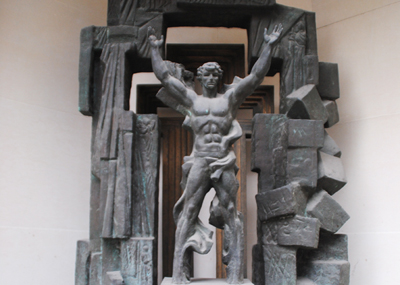
Apologies for the delay in revealing the answer to this. The picture shows a bronze sculpture entitled ‘Break the Wall of Distrust’, located in a niche at the corner of Cannon Street and Laurence Poutney Lane (number 108 Cannon Street). Designed by Soviet artist Zurab Tsereteli, it dates from 1990.

10 Historic London Garden Squares…7. Bloomsbury Square

Initially known as Southampton Square, Bloomsbury Square – located just to the east of the British Museum – was first developed in the mid-1660s, making it London’s oldest formal square.
Bloomsbury-SquareIt was the fourth Earl of Southampton, Thomas Wriothesley, who developed the square – his rather grand house, Southampton House, was located on the northern side of the square which initially featured gardens at the centre laid out in a cruciform pattern.

In 1723 – via the marriage of Southampton’s daughter, Lady Rachel Vaughan, to the ill-fated William, son of the 5th Earl of Bedford (he was implicated in the Rye House Plot and beheaded) – it passed to the Dukes of Bedford, becoming part of the Bedford Estates (and with it the earl’s house, later renamed Bedford House). The square took on its new name of Bloomsbury Square around this time.

Initially popular among the well-to-do, it had fallen somewhat from favour by the 19th century and with the 5th Duke preferring to live in the West End, in 1800 Bedford House was auctioned off and demolished. Terraced houses were later built along the now vacant north side of the square.

About 1806, the 5th Duke commissioned Humphry Repton to redesign the square and by the 1820s a garden including trees in the centre and a perimeter shrubbery. The gardens have gone through several makeovers since, including in the 1960s when an underground carpark was built underneath.

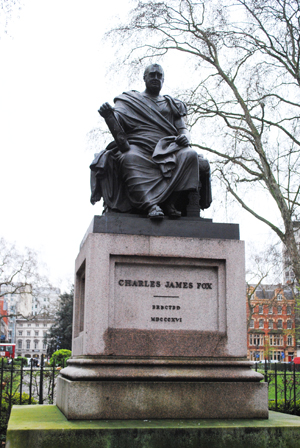
Most recently refurbished in 2006-2007 so they once again reflect Repton’s design, the gardens – which have been open to the public since 1950 – also contain a bronze statue of Whig politician (and friend of the Dukes of Bedford) Charles James Fox, which was designed by Sir Richard Westmacott and erected in 1816 (pictured, it was restored in 2006 to mark the bicentenary of Fox’s death).

It remained popular among middle class professionals, however, and among its most notable residents were the writer Isaac D’Israeli, father of the future Prime Minister Benjamin Disraeli, who lived at number six in the early 19th century (his son with him) while architect Sir Edwin Lutyens lived and worked at number 29 for more than 15 years after his marriage in 1897. Literary and artistic figures like Leonard and Virginia Woolf and Lytton Strachey, who became part of what was known as the ‘Bloomsbury Group’, were also famously known to have lived in the area around the square.

Most of the houses in the square are now used as offices but among the notable buildings there are the former home of the Royal Pharmaceutical Society of Great Britain (based in a building partly credited to architect John Nash) and, dating from 1930, Victoria House.

One of the more famous events to have taken place in the square occurred in 1780 during the anti-Catholic Gordon Riots when rioters burned down the house of the Lord Chief Justice. Almost 100 years earlier, in 1694, the square was site of a deadly fencing duel between Scottish financier John Law and Edward Wilson. Law killed Wilson, was subsequently convicted of his murder and sentenced to death but escaped by fleeing to the continent. He later become the founder of the Mississippi Company.
What’s in a name?…Sloane Square

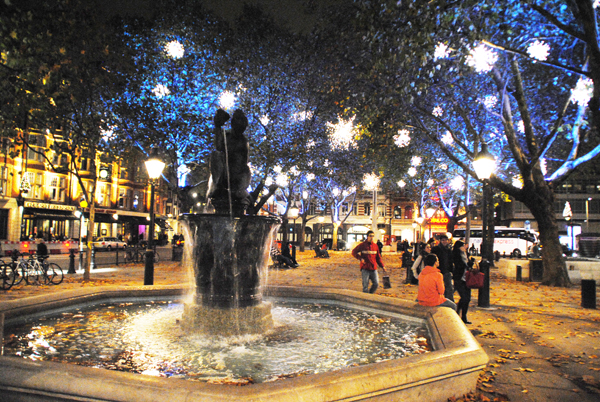
Sloane-SquareThis upmarket square in west London is named in honor of Sir Hans Sloane, the physician come botanist who bought the manor of Chelsea in 1712 and, in doing so, provided grounds for the Chelsea Physic Garden.

Sloane Square was developed by architect Henry Holland Sr and his son Henry Holland Jr in 1771 as part of a residential development they called Hans Town (also named after Sir Hans, it’s still a ward in the Royal Borough of Kensington and Chelsea). For more on Sir Hans Sloane, see our earlier post here.

The square, pictured above as it looks decorated for Christmas, initially consisted of a village green bordered with posts and chains and the surrounding buildings were all residential. Apparently the square initially failed to attract the right sort of residents (it was a little too far from Mayfair) but despite this initial setback, it gradually became the centre of a desirable residential precinct.

Private houses began making way for other buildings in the square in the nineteenth century – in 1810, the New Chelsea Theatre opened, subsequently renamed the Royal Court Theatre (this was later moved to another site still on the square and remains there today), and in 1812, the Chelsea, Brompton and Belgrave Dispensary was established for the relief of the sick and the poor.

The Sloane Square Underground station opened in 1868 and rebuilt after it was damaged by bombs in World War II (it’s interesting to note that the River Westbourne actually runs through some iron conduit over the top of the platforms on its way to the River Thames).

Other notable buildings in the square today include the Peter Jones department store which first arrived in the square in the late nineteenth century.

The square itself was redesigned in the 1930s when the war memorial was put in its current position. The Venus Fountain (pictured above) which now stands there – the work of Gilbert Ledward – was erected in 1953.

LondonLife – Paternoster Square from St Paul’s…

Paternoster-Square

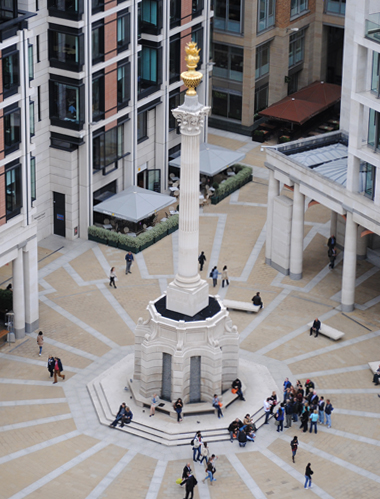
Looking down on Paternoster Square from St Paul’s Cathedral. The 23.3 metre tall pillar at the centre of the square is the  Paternoster Square Column. Designed by architects Whitfield Partners (responsible for the square’s redevelopment in the early 2000s) and topped by a gilded copper urn with flames coming out of the top, it serves as a ventilation shaft for a carpark underneath. The redevelopment of the square – home to the London Stock Exchange since 2004 – followed an earlier redevelopment in the 1960s (needed after aerial bombing destroyed the area in World War II, the second time the area had been destroyed – the first was when the Great Fire of London swept through in 1666). The square takes it name from Paternoster Row which once ran through it. For more, see www.paternostersquare.info.

PICTURE: David Adams

Around London – Chiswick House furnishings; Miniature German Bibles; free buses to Isabella Plantation; and, marking the 50th anniversary of the Profumo Affair…

A collection of furniture originally belonging to the 5th Duke of Devonshire and his wife, Georgiana, the Duchess of Devonshire, has been returned to the Palladian masterpiece, Chiswick House, in west London. The furniture – which includes four French fauteuils (open arm chairs) by the leading Parisian chair maker Jean-Baptiste Tilliard, four neo-classical chairs with caned backs and seats and a ladies’ roll-top writing desk – was purchased by English Heritage at an auction in 2010 with the assistance of Art Fund. It had been removed from the house to the family estate in the late 1800s. Extensive conservation work on the furnishings was carried out thanks to the support of The Art Fund, Chiswick House Friends and The Pilgrim Trust prior to their being restored to the house. They are now displayed in the bedchamber while a mahogany pole-screen – designed in about 1730 by William Kent, protégé and collaborator of the house’s first owner and architect, Richard Boyle, 3rd Earl of Burlington – has also been acquired and will be displayed in Lord Burlington’s Blue Velvet Room. Admission charge applies. For more information, see  www.english-heritage.org.uk/daysout/properties/chiswick-house/ or www.chgt.org.uk.

German miniature picture Bibles are the subject of a new exhibition at The Courtauld Gallery. The third display in the gallery’s Illuminating Objects programme, the display centres on Bibles created by two sisters who belonged to a family of printmakers, Johanna Christina (Or Christiana) and Maria Magdalena Kusel, in Augsburg in the late 17th century. While many of the 17th century ‘thumb’ Bibles were created for children, the Kusel sisters most likely made theirs for private devotion. It is believed this is the first time the two Bibles have gone on public display. Visitors to the Courtauld website are also able to turn the Bible’s pages. Runs until 22nd July. For more, see www.courtauld.ac.uk/gallery/exhibitions/2013/illuminating/bible.

Royal Parks are offering free travel to the newly improved Isabella Plantation – a 40 acre ornamental woodland garden in Richmond Park – this Sunday. The minibus service, which will travel from the traffic lights on Ham Common to the plantation, will be running between 10am and 4pm. The plantation, which features azaleas, rhododendrons, camellias, magnolias, daffodils and bluebells, has recently been the subject of a £1.5 million improvement project funded by the Heritage Lottery Fund and BIG Lottery Fund. Improvements have included enhancements to ponds and streams and upgrades to the existing path network. For more, see www.royalparks.org.uk/parks/richmond-park.

A display commemorating the 50th anniversary of the Profumo Affair has opened at the National Portrait Gallery. Scandal ’63: The Fiftieth Anniversary of the Profumo Affair looks in depth at the scandal in which Secretary of State for War John Profumo was found to have had a brief affair with nightclub hostess and model Christine Keeler who happened to also romantically involved with Yevgeny Ivanov, a senior Russian naval attache (rather controversial during the Cold War). The display features a vintage print of one of Lewis Morley’s seated nude portraits of Keeler as well as press images of other key protagonists in the matter including her friends Mandy Rice-Davies and Paula Hamilton-Marshall. Also featured is on-set photographs of Keeler taken to publicise The Keeler Affair, a film which was banned in Britain (and later remade in 1989), images of a now lost work of pop art by Pauline Boty featuring four of the key players (it was titled Scandal ’63), and a pastel of Keeler by Stephen Ward (pictured). Admission is free. Runs until 15th September. For more, see www.npg.org.uk.