What’s in a name?…Waterloo…

Waterloo-Bridge

Given the recent commemorations surrounding the bicentenary of the Battle of Waterloo (including a re-enactment of the arrival of news of Wellington’s victory in London where it was delivered to the Prince Regent), we thought it only fitting to take a look at the use of the name in London.

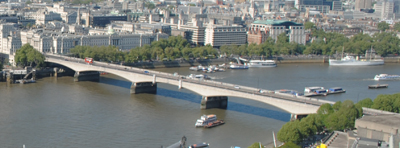
The name Waterloo, which now refers to a district in Lambeth centred on Waterloo Station, was first used to designate the bridge which crosses the Thames here.

Opened in 1817 as a toll bridge, the John Rennie-designed structure was known as Strand Bridge during its construction but renamed Waterloo at its opening two years after the battle. (Rennie’s bridge was later demolished and rebuilt in the 20th century – the current bridge is pictured above).

The name was also used to designate Waterloo Road and in the early 1820s was given to the church St John’s Waterloo (now St John’s and St Andrew’s at Waterloo) located on the road.

In 1848, Waterloo Station opened and it was after this that the surrounding district, known in past ages for its swampiness (hence streets like Lower Marsh), generally became known as Waterloo.

Landmarks in the Waterloo district include the historic Old Vic Theatre, which opened in 1818, and the Young Vic Theatre as well as the Lower Marsh Market.

On 3rd July, Waterloo will host the Waterloo Carnival with a picnic on Waterloo Millennium Green and a procession (for more on that, see www.waterlooquarter.org/news/come-and-support-this-years-waterloo-carnival) while the month-long Waterloo Food Festival kicks on on 1st July. For more on events in Waterloo commemorating bicentenary, see www.wearewaterloo.co.uk/waterloo200/.

This Week in London – The Waddesdon Bequest has a new home; history painted at the Tate; and, early release NYE tickets…

Holy-Thorn-ReliquaryThe Waddesdon Bequest, a collection of medieval and Renaissance treasures left to the British Museum by Baron Ferdinand de Rothschild in 1898, has a new home. Redisplayed in a new gallery which opened at the museum last week, the collection features the Christian relic known as Holy Thorn Reliquary (pictured) – a concocotion of gold, enamel and gems set around a thorn supposedly taken from Christ’s Crown of Thorns, the Lyte Jewel – a diamond-studded locket made in London in 1610-11 to hold a miniature of King James I and presented by the king to Thomas Lyte as thanks for a genealogy he created representing the king as a descendant of the Trojan Brutus, and the Cellini Bell – cast from silver in Nuremberg around 1600 and later displayed by Horace Walpole at his west London villa in Strawberry Hill. The bequest collection, which must always be displayed in a room of its own under its original terms, was first displayed at Baron Ferdinand’s country home of Waddesdon Manor in Buckinghamshire (now a National Trust property) and moved to the museum after his death. The redisplay reconnects the collection with its past at the manor and the history of the museum – the room where it is now displayed, Room 2a, was the museum’s original Reading Room and part of a neo-classical suite of rooms designed by Robert Smirke in 1820. It has been given the “most ambitious digital treatment” of any permanent gallery in the institution. Admission is free. For more, see www.britishmuseum.org.

The “enduring significance and emotional power” of British history painting is under examination in a new exhibition which opened at Tate Britain on Millbank last week. Fighting History features everything from the large scale works of 18th century painters John Singleton Copley and Benjamin West through to 20th century and contemporary works by Richard Hamilton and Jeremy Deller and looks at how they reacted, captured and interpreted key historical events. Works on show include Singleton Copley’s 1778 work The Collapse of the Earl of Chatham in the House of Lords, 7 July, William Frederick Yeames’ 1877 work Amy Robsart, John Minton’s 1952 work The Death of Nelson and Deller’s 2001 work The Battle of Orgreave, a re-enactment of 1984 protest in South Yorkshire. The exhibition also compares traditional and contemporary renderings of events from scripture, literature and the classical world and features a room dedicated to interpretations of the great Biblical flood of Noah. Runs until 13th September. Admission charges apply. For more, see www.tate.org.uk.

A limited number of early release tickets to London’s New Year’s Eve celebrations will go on sale from noon tomorrow (Friday, 19th June). The tickets, the bulk of which will be released in September, cost £10 a person with the proceeds being used to cover costs including printing and infrastructure. As was the case last year, people without tickets will not be able to access the event. To get hold of tickets, head to www.london.gov.uk/nye.

Send all items for inclusion to exploringlondon@gmail.com.

LondonLife – Exposing London’s criminal past…

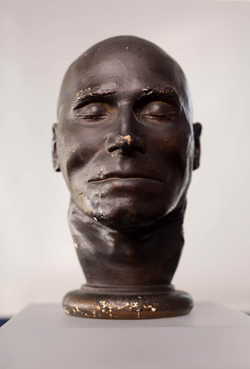
Daniel-GoodThe death mask of Daniel Good, executed outside Newgate prison on 23rd May, 1842, for the murder of his wife Jane Jones. It was thanks to delays in apprehending Good caused by communication problems that a dedicated detective was formed within the Metropolitan Police. Good’s death mask is just one of the many items from the Metropolitan Police’s Crime Museum which will be on display at the Museum of London’s forthcoming exhibition, The Crime Museum Uncovered. Opening in October, the display will feature never-before-seen objects from the police museum which are usually only accessible to police professionals and their invited guests. Along with the death mask, other objects to be seen in the display will include a memoir by Donald Swanson, senior investigating officer on the investigation into the Jack the Ripper killings in the late 1880s, a pin cushion embroidered with human hair by Annie Parker, who died in 1879 after having been arrested more than 400 times for alcohol-related offences, and ‘microdots’ containing secret messages along with a microdot reader founder in Mrs Helen Kroger’s handbag when she was arrested for involvement in the Portland Soviet Spy Ring in 1961. The exhibition will run from 9th October to 10th April, 2016. Admission charges apply. For more, see www.museumoflondon.org.uk.

What’s in a name?…Houndsditch…

This City of London thoroughfare runs between St Botolph and Outwich Streets and its name – first recorded in the 13th century – apparently relates to its location on the outer side of the wall, dating from the Roman era, which once encircled the city.

HoundsditchOn the outer side of the wall lay a ditch which, although filled and redug several times in its history, was eventually filled permanently in the 16th century (and became the street you can now walk upon).

Dogs were associated with this ditch – the skeletons of some dogs were found here in 1989 during an archaeological dig at the wall, possibly dating back to Roman times – although there’s a couple of theories on exactly how.

According to one version, the ditch, before it was finally filled, had become the repository of all sorts of rubbish but was particularly known as a site to deposit the corpses of dogs. An alternate theory, meantime, suggests that kennels which housed dogs used in hunting were once located here.

The name ‘houndsditch’ was apparently used for many sections of the ditch which lay outside the city wall before it came to be associated with this particular stretch of ditch.

The street (and the area in which it sits, also known as Houndsditch) has apparently been associated with several different trades over its history including bell founding, gunmaking and cannon founding and, later for the rag trade. In the 20th century, it was the site of department store, The Houndsditch Warehouse.

It was in Houndsditch that Dr Thomas Barnardo found 11 boys sleeping huddled together on the roof of the old rag market – a fact which helped push him to found the first of the Barnardo’s homes for the destitute in Stepney.

Famously, of course, it was also the scene of an attempted robbery and shoot-out in 1910 which led to the infamous Siege of Sidney Street (see our earlier post here).

For more on the Houndsditch murders, see Donald Rumbelow’s The Houndsditch Murders and the Siege of Sidney Street.

Lost London – East India House…

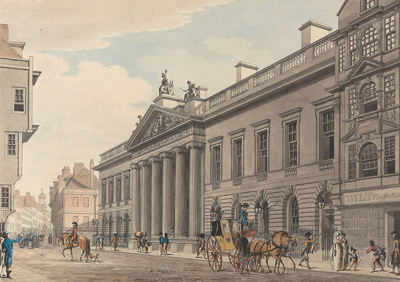
East-India-HouseThe headquarters of the East India Company, the ‘New’ East India House, was built in the 1720s at the corner of Leadenhall and Lime Streets on the site of what had been a late Elizabethan mansion known as Craven House.

The company, which was founded in 1600, was housed in several different properties (including Crosby Hall – now located at Chelsea) until it moved into Craven House in 1648 – built by a former Lord Mayor, Sir Robert Lee, and named after one of its later occupants Sir William Craven. In 1661 an ornamental wooden structure featuring paintings of some of the Company’s ships and a wooden sculpture of a seaman, was added to the facade of the building.

By the 1720s, the mansion was crumbling and so construction began on a new building on the site designed by Theodore Jacobsen (the Company was relocated to a temporary premises in Fenchurch Street while it was built).

The three storey building on Leadenhall Street was designed with five bays and beyond the facade featured grand meeting rooms including the Directors’ Court Room, offices for the directors as well as a hall, courtyard, garden and warehouses. Famous art works inside included the fresco The East Offering its Riches to Britannia by then little known Greek artist Spiradone RomaThe East Offering its Riches to Britannia which once adorned the ceiling of the Revenue Committee Room (it’s now in the collection of the British Library).

The building was renovated and extended significantly in the 1790s creating what was essentially a grand new neo-classical building. Among the new additions – although it seems a matter of some debate the building was apparently designed by Henry Holland with the work was overseen by the Company’s surveyor Richard Jupp until his death in 1799 – were a museum and library. A new pediment topped by Brittania dominated the facade.

When the East India Company was wound up in 1858 after the Indian Mutiny its assets were transferred to the government and the building briefly became home to the India Office (which subsequently moved to a new purpose-built building which still stands in Whitehall).

In 1861, the building was sold for redevelopment and subsequently demolished. Many of its fittings, art collection and furnishings were transferred elsewhere including the British Library, V&A and the Foreign and Commonwealth Office in Whitehall where many of the fittings of the Directors’ Court Room – including a great marble chimneypiece – were reused.

The location of the property is now covered by the landmark Lloyd’s building with little to indicate such a grand premises had once stood here.

PICTURE: The extended East India House in about 1800, by Thomas Malton the Younger (1748-1804)/via Wikipedia.

For more on the history of the East India Company, see John Keay’s The Honourable Company: A History of the English East India Company.

What’s in a name?…Downing Street…

Downing-Street

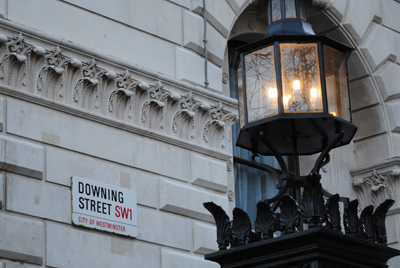
One of the most famous streets (and photographed) in London (though sadly not open to the public), Downing Street in Whitehall is these days most well-known for being the location, at Number 10, of the official residence of the British Prime Minister.

But Downing Street’s history dates back to a time before the first British PM moved in (this was Sir Robert Walpole in the 1735 and even after that, it didn’t become a regular thing for Prime Ministers to live here until the Twentieth century). And its name bears testimony to its creator, Sir George Downing, a soldier and diplomat described as “a miserly and at times brutal” man who served first under both Oliver Cromwell and, following the Restoration, King Charles II (and was, coincidentally, one of the first graduates of Harvard University).

In the 1650s, Sir George took over the Crown’s interest in land here, just east of St James’s Park, and intended to build a row of townhouses upon it. His ambitions were delayed, however, due to an existing lease with the descendants of Elizabethan courtier Sir Thomas Knyvet who had once lived in a large home on the site of what is now Number 10 Downing Street.

By the 1680s, however, the lease had expired and between 1682-84, Downing was able to construct a cul-de-sac, closed at the St James’s Park end, featuring either 15 or 20 two storey terraced townhouses with stables and coach-houses, designed by no less than Sir Christopher Wren.

While the homes were apparently of shoddy craftsmanship and stood upon poor foundations (Churchill famously wrote that Number 10 was “shaky and lightly built by the profiteering contractor whose name they bear”), the street apparently attracted some notable residents from the start.

These included the Countess of Yarmouth, who briefly lived at Number 10 in the late 1680s, Lord Lansdowne and the Earl of Grantham, and even, briefly, apparently the diarist James Boswell in the mid 1700s. Downing himself isn’t thought to have ever lived here – he retired to Cambridge a few months after the houses were completed.

The houses between Number 10 and Whitehall – on the north side of the street – were taken over by the government and eventually demolished in the 1820s to allow for the construction of offices for the Privy Council, Board of Trade and Treasury while the houses on the south side remained until they were demolished in the early 1860s to make way for the Foreign, India, Colonial and Home Offices.

The numbers in the street have changed since Downing’s houses were first built. Of the original homes in the street only Number 10 (home of the PM) and Number 11 (home of the Chancellor of the Exchequer) survive.

Access to the street has been restricted since the 1980s with the current black steel gates put in place in 1989.

An underground tunnel apparently runs under the street connecting number 10 with Buckingham Palace and the underground bunker, Q-Whitehall, built in the 1950s in the event of nuclear war.

London Pub Signs – The Knights Templar…

The-Knights-Templar

Located in a former bank at the corner of Chancery Lane and Carey Street, this pub takes its name from the Crusader order known as the Knights Templar who once owned the land upon which the lane was constructed.

The Knights Templar was founded in Jerusalem in 1118 to protect Christian pilgrims and took its name from the Temple of Solomon upon the remains of which its headquarters in Jerusalem was built.

The order arrived in London later that century and Chancery Lane was created to connect the site of their original headquarters in Holborn with their subsequent home which lay between Fleet Street and the Thames – with the latter centred on a chapel (consecrated in 1185) which still stands and is now known as the Temple Church.

The pub, which opened in 1999, was formerly the home of the Union Bank of London Ltd, built in 1865 to the design of architect FW Porter.

Original features inside the Grade II-listed building – built in the ‘high Renaissance’-style – include cast iron columns and ornate detailing.

It is now part of the Wetherspoon’s chain. For more information, see www.jdwetherspoon.co.uk/home/pubs/the-knights-templar-chancery-lane.


This Week in London – Wellington Arch marks the Battle of Waterloo; Shakespeare’s Globe celebrates the Bard’s birth; and the ‘cathedral on the marsh’ open day…

The Battle of Waterloo comes under the microscope in a new exhibition opening at Wellington Arch on Hyde Park Corner tomorrow. Wellington Arch: Waterloo 1815 – The Battle for Peace provides an overview of the battle and the reasons which led to it, the people involved and the battle’s legacy. Displayed items include the sword the Duke of Wellington carried at the battle, his handwritten battle orders and an original pair of ‘Wellington boots’ as well as, of course, the arch itself, which was built in 1825-27 as a monument to Wellington’s victories over Napoleon. Admission charge applies. For more, see www.english-heritage.org.uk/visit/places/wellington-arch/.

Shakespeare’s Globe in Southwark celebrates the Bard’s birthday with a Hamlet-themed day of free family events this Sunday. Along with an Elsinore bouncy castle, there will be sword-fighting demonstrations, ‘skull’ coconut shies and a grave-digging ball pool while actors who have taken on the role of Hamlet over the years while appear on stage attempting to deliver the quickest ever reading of the play and famous film adaptions of Hamlet will be playing on screen around the site. The day will also mark almost a year since Shakespeare’s Globe embarked on an unprecedented two year global tour of Hamlet taking in every country in the world in honour of last year’s 450th anniversary of Shakespeare’s birth. The birthday event at the Globe runs between 11am and 4.30pm. For more, see www.shakespearesglobe.com.

The famous “cathedral on the marsh” – the Crossness Pumping Station –  is open to the public this Sunday, the first of five days it will be open this year. The pumping station at Abbey Wood in south-east London was built by Sir Joseph Bazalgette as part of a general sewerage system upgrade and was opened by the Prince of Wales in 1865. The Grade I-listed Beam Engine House was constructed in the Romanesque-style and features some of the “most spectacular ornamental Victorian cast ironwork” to be found today. The day runs from 10.30am to 4pm. Admission charges apply but no booking is required. For more, see www.crossness.org.uk.

Send all items for inclusion to exploringlondon@gmail.com. 

What’s in a name?…Farringdon

Farringdon is a name that crops up quite a bit in London. As well as Farringdon Road, Farringdon Street and Farringdon Lane, there’s a Tube/overground train station which also bear the name along with two of the 25 wards of the City of London.

These latter are named Farringdon Within and Farringdon Without – a distinction which relates to their placement within and without the City’s walls and dates to the late 14th century.

While the name Farringdon, which can be found elsewhere in England, apparently meant ‘ferny hill’ in Old English, its origins in London apparently relate to two medieval London goldsmiths, William de Faringdon (also spelt de Farindon and various other ways) and his son Nicholas.

Both William and Sir Nicholas were aldermen and Lord Mayors of London in the late 13th and early 14th centuries.

Sir Nicholas was apparently well favoured by King Edward II – he was several times appointed mayor, a job the king apparently said he could hold for “as long as it pleased him”. He was buried at St Peter-le-Chepe, destroyed in the Great Fire of London.

Interestingly, another well-known alderman of this ward was the radical MP John Wilkes, who was elected while in Newgate Prison.

Farringdon Street, which becomes Farringdon Road, runs along the course of the former Fleet River and dates from the 1730s when the river was arched over.

A Moment in London’s History – The first Crufts show…

The annual Crufts dog show has been making headlines around the world recently (sadly not all for good reasons), so we thought it was a good chance to take a look back at where it all began.

While the event is this year being held in Birmingham, the first Cruft’s Show was actually held in London in the late 1800s.

Crufts-catalogueCharles Cruft – the show’s founder – had left college in 1876 and instead of joining the family’s jewellery business, had taken up employment in Holborn with James Spratt’s business selling ‘dog cakes’ (aka dog biscuits).

While he started off as an office boy, he was soon promoted to travelling salesman and he was soon travelling across Europe. So impressed were his customers that in 1878, just two years after leaving school, he was invited to organise the promotion of the canine section of the Paris Exhibition.

Eight years later in 1886, back in England, he took up the role of managing the Allied Terrier Club Show at the Royal Aquarium in Westminster.

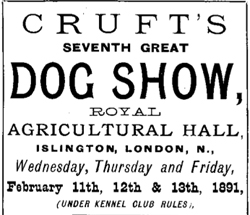
The first show bearing the Crufts name – known then as ‘Cruft’s Great Dog Show’ – followed five years later in 1891 (although this was actually called Cruft’s Seventh Great Dog Show thanks to his involvement with the earlier shows).

Held at the Royal Agricultural Hall in Islington (now a Grade II-listed building) on 11th, 12th and 13th February, the show boasted 2,437 entries spanning 36 different dog breeds.

Among the entries in 1891 were six Pomeranians owned by Queen Victoria – one of them, Gena, placed equal first (apparently the judges didn’t want to mark down the monarch’s dogs!)

It’s not the only landmark Crufts event held in London. In 1948, with Charles Cruft having died 10 years earlier his widow Emma handed over control of the show to the Kennel Club. The first show under the club’s auspices was held at Olympia with 84 different breeds entered (there are now around 200 entered annually). In 1979 the show moved to Earl’s Court before eventually, in 1991, moving to Birmingham.

For more on Crufts, see www.crufts.org.uk

Lost London – The Great Wheel at Earl’s Court…

Built for the Empire of India Exhibition at Earls Court, this 308 foot (94 metre) high wheel opened to the public on 17th July, 1895.

Measuring 270 foot (82 metres) in diameter, the wheel – which had 40 cars each apparently carrying up to 40 passengers – had a design based on that of the famous original Ferris wheel which had been built for the Chicago Exhibition of 1893.

Weighing 1,100 tons (including its eight column supports), it had taken a year to build with much of the work carried out at Maudslay, Son and Field in Greenwich before assembly on the site at the Earls Court Exhibition Ground (located on surplus railway lands).

The wheel, which took around 20 minutes to make a full rotation and was powered by two 50 horse power steam engines, remained in service for just more than a decade (there was at least one report of it getting stuck and stranding passengers for several hours).

Having carried more than 2.5 million passengers over its life, it closed in 1906 after last being used at the Imperial Austrian Exhibition. It was demolished just a year later.

This Week in London – Rarely seen Goya at the Courtauld; Wolsey Angels saved; and, A Victorian Obsession…

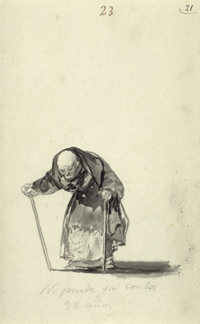
He-can-no-longer-at-theA “ground-breaking” exhibition of works of 18th and 19th century Spanish painter and printmaker Francisco Goya opens to the Courtauld Gallery at Somerset House today. Goya: The Witches and Old Women Album brings together the previously widely scattered pages of one of the artist’s most celebrated private albums in the first exhibition to ever recompile one of them. The album – which features themes of witchcraft, dreams and nightmares and has been reconstructed into its original sequence – is thought to have been made between 1819-23, a period during which Goya completed the murals known as the Black Paintings. Runs until 25th May. Admission charges applies. For more, see www.courtauld.ac.uk/goya. PICTURE: © The Courtauld Gallery (He can no longer at the age of 98, c. 1819-23, J. Paul Getty Museum).

The ‘Wolsey Angels’ have been “saved for the nation” after a campaign to acquire them by the V&A. The museum has reported that more than £87,000 was raised in a national public appeal – around £33,000 of which was raised via donations and through the purchase of badges at the South Kensington premises – which, along with grants including a £2 million National Heritage Memorial Fund grant and a £500,000 Art Fund grant, will be used to acquire the four bronze angels which were originally designed for the tomb of Cardinal Thomas Wolsey, chief advisor to King Henry VIII. The four bronze angels, which have been in display at the V&A, will now undergo conservation treatment before going back on display. For more on the history of the angels, see our earlier post here. For more information on the V&A, see www.vam.ac.uk.

Closing Soon – A Victorian Obsession: The Pérez Simón collection at Leighton House Museum. This exhibition at the former Holland Park of Lord Leighton presents more than 50 rarely exhibited paintings by leading Victorian artists including Albert Moore, Dante Gabriel Rossetti, Edward Burne-Jones, John Everett Millais, John William Waterhouse, Edward Pointer, John Strudwick and John William Godward as well as six pictures by Leighton himself and the highlight, Lawrence Alma-Tadema’s The Roses of Heliogabalus. Runs until 29th March. Admission charge applies. See www.rbkc.gov.uk/subsites/museums/leightonhousemuseum/avictorianobsession.aspx for more.

This Week in London – John Singer Sargent (and friends); Chinese New Year in Soho; and, ‘Cravings’ at the Science Museum…

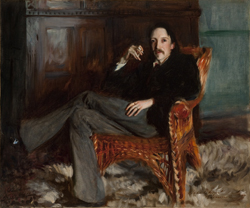
NPG_920_1362_RobertLouisSteA major exhibition of the works of John Singer Sargent has opened at the National Portrait Gallery off Trafalgar Square this week. Sargent: Portraits of Artists and Friends – which has been organised in conjunction with the Metropolitan Museum of Art in New York – brings together a collection of the artist’s intimate and informal portraits of his friends including Robert Louis Stevenson, Claude Monet and Auguste Rodin. Sargent (1856-1925), born the son of an American doctor in Florence, studied in Italy and France before scandal led him to move to England where he established himself as the country’s leading portrait painter. He made several visits to the US during his career, painting portraits as well as decorative paintings for public buildings including the Boston Public Library and Museum of Fine Arts. The exhibition runs until 25th May. Admission charge applies. For more, see www.npg.org.uk. PICTURE: Courtesy of the Taft Museum of Art, Cincinnati, Ohio

It’s Chinese New Year and the celebrations kick off in London’s Chinatown in Soho this Sunday. The day starts with a parade at 10am which runs from Duncannon Street to Shaftesbury Avenue featuring floats and Chinese lion and dragon teams. It will be followed by a free programme of events in Trafalgar Square which, starting at noon, include music, dance, acrobatics and martial arts. Other events are taking place at a range of locations across the West End. For more information, check out www.london.gov.uk/get-involved/events/chinese-new-year-2015.

Ever wondered how your appetite is shaped by food? A new free exhibition at the Science Museum in South Kensington, Cravings: Can Your Food Control You? explores how the brain, ‘gut brain’ and bacteria influence our diets. Along with personal stories and objects as well as the use of science and tech to present the display, those who attend the exhibition will also be able to take part in a ground-breaking neurogastronomy experiment to explore how our senses influence appetite (the experiment is also available online – follow the link below). There’s also a digital quiz where you can consider the ethical challenges that cravings, appetite control and food regulations pose. Runs until January next year. For more, see www.sciencemuseum.org.uk/cravings.

The history of the Foundling Hospital’s Boy’s Band is the subject of a display at the Foundling Museum in Bloomsbury. Foundlings at War: Military Bands is part of a series of exhibits supported by the Heritage Lottery Fund exploring the hospital’s links with the military. The Boy’s Band was established in 1847 and boys who joined increasingly went on to serve in the military. Runs until 10th May. For more, see www.foundlingmuseum.org.uk.

Send all items for inclusion to exploringlondon@gmail.com.

London Pub Signs – The George and Devonshire…

The-George-and-Devonshire

The last remaining pub in old Chiswick village in west London, The George and Devonshire has a history dating back to the 1650s.

The-George-and-Devonshire2Initially known simply as The George (like so many taverns and pubs, apparently after England’s patron saint), by the 1820s the name had changed to The George and Devonshire – the Duke of Devonshire’s former showpiece property, Chiswick House, can still be found nearby (for more on Chiswick House, see our earlier post here). The coat of arms of the Dukes of Devonshire now hang over the door.

The Grade II-listed building at 8 Burlington Lane, which is conveniently located just metres from a Fullers brewery, dates from the 18th century.

There was apparently once a secret passageway which led from the pub under the nearby St Nicholas’ Church (burial place of artist William Hogarth) to an opening located among a group of small cottages near the Thames – it is said to have been used by rum and spirits smugglers in the 1700s. The remains of the entrance can still apparently be seen in the pub’s cellar.

For more, see www.georgeanddevonshire.co.uk.

This Week in London – Churchill’s Scientists; Waterloo online; a Chelsea murder case reopened; exploring Crossrail; and, astronomical photography…

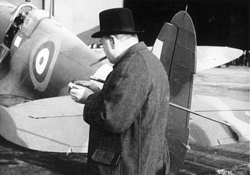
Churchill-with-a-Spitfire-from-Castle-Bromwich,-credit-Philip-Insley,-CBAF-Archive-Vickers-ArchiveSyndics Marking the 50th anniversary of the death of Winston Churchill, a new exhibition at the Science Museum in South Kensington looks at his passion for science and the influence that had on bringing World War II to an end. Churchill’s Scientists celebrates the individuals who flourished under Churchill’s patronage (and , as well as helping to bring about the end of World War II, also launched a post-war “science renaissance”) – from Robert Watson-Watt (inventor of radar) through to Bernard Lovell (creator of the world’s largest telescope) – and also delves into more personal stories of Churchill’s own fascination with science and tech. The display include objects from the museum’s collection as well as original archive film footage, letters and photographs. Highlights include the high speed camera built at Aldermaston to film the first microseconds of the detonation of the UK’s first home grown atomic bomb, the cigar Churchill was smoking when he heard news of his re-election as PM in 1951, and a one-piece green velvet “siren suit” designed by Churchill to wear during air raids (only one of three originals known to exist, it’s never been on public display outside of the tailors who created it). The free exhibition runs until 1st March and is part of the Churchill 2015 programme of events. Visit www.sciencemuseum.org.uk/churchill for more. PICTURE: Churchill with a Spitfire from Castle Bromwich (Philip Insley, CBAF Archive Vickers ArchiveSyndics).

The National Army Museum and Waterloo2oo have launched an online gallery which will eventually comprise images and information on more than 200 artefacts associated with the Battle of Waterloo ahead of the 200th anniversary in June. Among the objects featured on Waterloo200.org are the Duke of Wellington’s boots, a French eagle standard captured in battle and the saw used to amputate the Earl of Uxbridge’s leg. One hundred items – drawn from the Army Museum’s collection as well as from European museums and private collections – can already be seen on the site with a further 100 to be added before the bicentenary on 18th June.

The Talk: Death in Disguise: The Amazing True Story of the Chelsea Murders. On 12th February, the Guildhall Library in the City of London will host Gary Powell as he examines the facts of this double murder which took place in Chelsea in May, 1870, and left Victorian society reeling. For more events at the library, follow this link.

On Now: Breakthrough: Crossrail’s tunnelling story. This exhibition at the London Transport Museum in Covent Garden brings a new perspective on the massive Crossrail project currently underway in the city. Visitors will experience the tunnel environment through a five metre high walk-through installation featuring a computer simulation of a giant boring machine as well as learn about how the project is shaping up, play interactive tunnelling games and hear firsthand from those who work underground. Admission charge for adults applies. Runs until August. For more, see www.ltmuseum.co.uk.

Extended: Astronomy Photographer of the Year Exhibition. This exhibition at the Royal Observatory Greenwich features the winning images from last year’s competition. They include the Briton James Woodend’s image of a vivid green aurora in the Icelandic night sky; American Patrick Cullis’ view of earth taken from 87,000 feet above ground; and, New Zealander Chris Murphy’s image of dusty clouds dancing across the Milky Way. The exhibition can be seen for free in the Observatory’s Astronomy Centre until 19th July. For more, see www.rmg.co.uk/astrophoto.

• Send all items for inclusion to exploringlondon@gmail.com. 

Lost London – The London Colosseum…

Designed by architect Decimus Burton (he of the Kew Palm House fame), the London Colosseum was a vast, 16-sided domed structure erected in the 1820s to the east of Regent’s Park to house a panoramic view of the city.

ColosseumSaid to be the largest ever painting created at the time, Thomas Hornor – a land surveyor – oversaw the creation of the work which was based on drawings he had made from the top of St Paul’s Cathedral (he had apparently sat in a special, temporary hut or “crow’s nest” positioned where the cross and ball would normally sit – but it was in the process of being replaced). Several artists – led by the renowned ET Parris – were involved in creating the work which took four years to make before it was completed in 1829.

The building – located where Cambridge Gate now stands – had been modelled on the Pantheon in Rome (not the Colosseum as the name would suggest) and was constructed from brick rendered with cement to imitate the appearance of stone. It featured a portico with Doric columns at the front and had inside an “ascending room” or lift to take people to see the panorama.

It’s opening was apparently delayed after Horner and his chief backer, MP Rowland Stevenson, took off to the US after running up rather large debts, leaving the property in the hands of trustees.

The Colosseum changed hands several times over the years and its purpose evolved. At one stage it was reinvented as a museum of sculpture displaying some 180 works while other attractions added to the great rotunda and its surrounding gardens over the years included a “Gothic aviary”, a Swiss chalet from which a visitor could look at a real waterfall and a stalactite cavern as well as a theatre and various other panoramas depicting everywhere from Paris to Lisbon.

Among visitors to the attraction were Queen Victoria and Prince Albert.

The Colosseum was put up for auction in 1855 but failed to attract a bid of the size required and, having passed through several hands (with some of the owners at one stage flirting with the idea of turning it into a grand hotel), it was eventually was demolished in the 1870s.

PICTURE: Via Wikipedia.

8 structures from the London that never was – 8. Primrose Hill’s Pyramid of Death…

We started this series with a pyramidal-shaped structure (see A pyramid in Trafalgar Square), so we thought it only fitting that we end with one as well. 

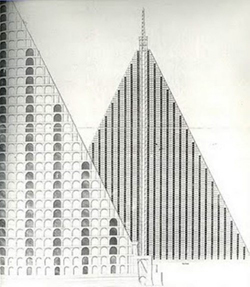
PyramidThis time, it’s not so much a monument, however, as a place to house some of London’s ever increasing population of dead.  The over-crowded graveyards of early Victorian London (and the horror stories that went with them of bodies bursting forth from their graves), led to proposals for a range of innovative solutions in the early nineteenth century.

Among them was a pyramidal-shaped necropolis for Primrose Hill. Architect Thomas Willson came up with the 94 storey-high structure – which would have stood higher than St Paul’s Cathedral – to provide storage for some five million corpses with steam-powered lifts to carry the bodies to their place of rest.

Made from brick with granite facings, the base of the vast structure would have covered 18 acres. Its design, which included quarters for staff, four entrances and a central ventilation shaft, drew upon the Victorian fascination for all things Egyptian.

“It was supposed to be compact, hygienic and ornamental,” author Catharine Arnold told the BBC. “Willson hoped people would come to admire this huge pyramid from far and wide, picnicking on Primrose Hill and enjoying this splendid monument. But it would be rather like a giant car-park of the dead.”

According to the prospectus Willson, who trained at the Royal Academy, issued for potential investors, the pyramid – which was to cost £2,500 to build – would have raised a staggering sum of more than £10 million in profit when it was full.

Still, it was not to be and the idea never left the drawing board. But Willson did go on to join the board of the General Cemetery Company.

For more on London and its dead, see Catharine Arnold’s Necropolis: London and Its Dead.

LondonLife – Mary and infant Jesus back on display in St Paul’s…

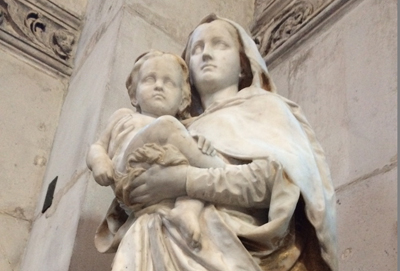
The-Madonna-and-ChildThis Victorian-era marble statue of the Virgin and Child has gone back on show in St Paul’s Cathedral more than 70 years after it taken down following bombing during World War II. Part of an ornate high altar and reredos installed at the cathedral’s east end in 1888, the statue – the work of Thomas Garner – was put into storage after that part of the cathedral took a direct hit during the Blitz of 1940 and what remained of the altar was dismantled (the statue and a crucifix were the only parts retained by the cathedral). It can now be seen in the Chapel of St Erkenwald and St Ethelburga (also known as the Middlesex Chapel) in the north transept. For more, see www.stpauls.co.uk. PICTURE: The Chapter of St Paul’s Cathedral.


London Pub Signs – The Nell of Old Drury…

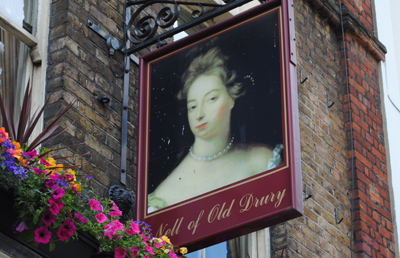
Nell-of-Old-DruryThis Covent Garden pub in London’s West End is named after Nell Gwyn, the 17th century orange seller turned actress who became most famous for being the mistress of King Charles II (for more on Nell, see our earlier post here)

‘The Nell’, as its known, is one of the area’s oldest pubs – a sign says there has apparently been a pub on the site since before 1660 when the Theatre Royal Drury Lane – located opposite – was built.

Nell-of-Old-Drury2There’s supposedly an underground tunnel that connects the theatre and the pub which is said to have been used by the king when he was visiting Nell (we’re not sure if it was Nell or the king who was in the pub). It was also apparently used by other theatre-goers who were warned to return to the theatre when intermission was over by a bell located inside the pub.

Now located at 29 Catherine Street pub (the street was formerly known as Brydges Street – we’ll deal with its renaming in an upcoming post), was apparently originally called The Lamb and then renamed the Sir John Falstaff in the nineteenth century, during which period it hosted exhibitions featuring a tattooed man from the South Seas and a Zulu warrior woman, before assuming its current moniker.

The pub was also apparently a regular for many prominent literary and theatrical figures, not to mention market traders from nearby Covent Garden. The exterior of the pub appears in the Alfred Hitchcock film, Frenzy.

For more on the pub, see www.nellofolddrury.com.


This Week in London – Hampton Court Palace lights up; doll house histories; more on Christmas; and, memories of a royal progress at The Queen’s Gallery…

Hampton Court Palace’s world famous gardens have been transformed into an “illuminated wonderland” which can be explored using a specially created trail. From tomorrow, visitors can use a glow-in-the-dark map to follow the trail which starts at the palace’s hedge maze – the UK’s oldest – and meanders through various locations around the grounds – including the formal gardens – before ending up at the palace’s East Front where, through the use of interactive technology, visitors can ‘paint’ the building’s facade just by moving around. Allow about an hour. Entry is timed between 5pm and 8pm. Runs until 23rd December. Admission charge applies. For more, see www.hrp.org.uk/HamptonCourtPalace/.

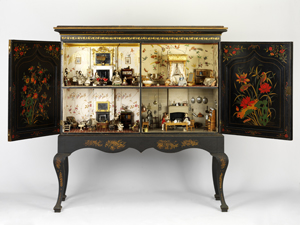
Killer_Cabinet_1840sThe stories behind some of the UK’s best-known dolls’ houses are the focus of a new exhibition which opens at the V&A Museum of Childhood in Bethnal Green on Saturday. Small Stories: At home in a dolls’ house tells the story of 12 dolls’ houses dating as far back as 300 years. Each of the houses – which are displayed chronologically – has been set up to represent a particular time of day and, using interactive technology, tells the story of those who live and work in the building in a series of stories featuring marriages, parties, politics and even crimes. Highlights include: the Tate Baby House – dating from 1760, it features original wallpapers and painted panelling in the style of Robert Adam; the Killer House (pictured) – a gift from surgeon John Egerton Killer to his wife and daughters in the 1830s, this Chinese-style cabinet has gilded wallpapers, a four poster bed and liveried servants; Whiteladies House – a Modernist country villa designed by artist Moray Thomas and built in the 1930s; the Hopkinson House – based on the homes built in the 1930s in the London County Council suburb, the St Helier Estate; and, the Kaleidoscope House – designed by Laurie Simmons to suit a “design conscious step-family living in the new millennium”. There’s a further 20 dolls’ houses, dating from 1673 to 2014, on display in the museum’s permanent galleries (just some of the more than 100 in the museum’s collection). Admission is free. Runs until 6th September, 2015. For more, see www.museumofchildhood.org.uk. PICTURE: Victoria and Albert Museum, London.

The V&A has unveiled its 2014 Christmas Tree at the grand entrance to its South Kensington building. Designed by Gareth Pugh, Ceremony stands at more than four metres in height and, along with a shape not unlike a traditional Christmas tree, features nine tiered gold pyramids located around a central beacon of light to represent the nativity. For more, see www.vam.ac.uk/content/articles/c/christmas-tree-installation-by-gareth-pugh/Meanwhile Winter Wonderland continues to entertain in Hyde Park with rides, markets, ice-skating and all the usual attractions. Open 10am to 10pm every day until 4th January (closed on Christmas Day). For more, see www.hydeparkwinterwonderland.com.

On Now: Cairo to Constantinople: Early Photographs of the Middle East. This exhibition at The Queen’s Gallery, Buckingham Palace, features objects collected by the 20-year-old Prince of Wales, Albert Edward (later King Edward VII), during an educational tour of the Middle East in 1862. The display, which also features photographs taken by Francis Bedford – the first photographer to join a royal tour, follows the prince as he progresses through Egypt, Palestine and the Holy Land, Syria, Lebanon, Turkey and Greece. The exhibition is being show alongside Gold, a display of 50 gold items drawn from the Royal Collection. They include the Rillaton Cup, found in a Bronze Age burial dating from between 1700 and 1500 BC, a gold crown from Ecuador that predates the Incas, and an 18th century tiger’s head made from gold and rock crystal and taken from the throne of the Tipu Sultan of Mysore in India. Both run until 22nd February. Admission charge applies. For more, see www.royalcollection.org.uk.

Send all items for inclusion to exploringlondon@gmail.com.