Vikings at the British Museum; World War I portraits; and, Ruin Lust…

RoskildeThe Vikings come to the British Museum from today with the first major exhibition in more than 30 years. Vikings: life and legend, the first exhibition to be held in the new Sainsbury Exhibition Gallery, was developed with the National Museum of Denmark and the Staatliche Museen zu Berlin (National Museums in Berlin) and looks at the Viking period from the late 8th century to the early 11th century. Featuring many new archaeological discoveries and objects never seen before in the UK alongside items from the British Museum’s own collection, the exhibition is centred on the surviving timbers of a 37 metre long Viking warship excavated from the banks of the Roskilde fjord in Denmark (pictured). Other items include skeletons recently excavated from a mass grave of executed Vikings in Dorset, the Vale of York Hoard (discovered in 2007) and a stunning hoard of silver from Gnezdovo in Russia. A unique live broadcast event presented by historian Michael Wood taking cinema audiences around the exhibition will be shown in cinemas across the nation on 24th April. Admission charge applies. Runs until 22nd June. For more, see www.britishmuseum.org/whats_on/exhibitions/vikings.aspx. PICTURE: Copyright of the National Museum of Denmark. 

The commemorations of the World War I centenary have commenced at the National Portrait Gallery with The Great War in Portraits. The first of a four year programme of events and displays at the gallery, the exhibition features iconic portraits of figures such as Winston Churchill, Kaiser Wilhelm, Siegfried Sassoon and Wilfred Owen as well as major art works by the likes of Lovis Corinth, Max Beckmann, and Kirchner, whose painting Selbstbildnis als Soldat (Self-portrait as a Soldier) is featured, and Harold Gillies’ photographs of facially injured soldiers from the Royal College of Surgeons. Among the highlights are Jacob Epstein’s The Rock Drill, a contrasting pair of British and German films about the Battle of the Somme, and a press photograph of Gavrilo Princip, the student who sparked the flames of war when he assassinated Archduke Franz Ferdinand. Elsewhere among the 80 works on display are portraits of war heroes such as VC winners are contrasted with those of soldiers disfigured by war, POWs and those shot for cowardice. Admission is free. Runs until 15th June. For more, see www.npg.org.uk/whatson/firstworldwarcentenary/exhibition.php.

Our fascination with ruins is the subject of a new exhibition which opened this week at Tate Britain. Including more than 100 works from the likes of JMW Turner, John Constable, John Martin, Eduardo Paolozzi, Rachel Whiteread and Tacita Dean, Ruin Lust examines the craze for ruins that overtook creative types in the eighteenth century and the subsequent revisiting – and at times mocking – of this fascination by later figures. Works on show include Turner’s Tintern Abbey: The Crossing and Chancel, Looking towards the East Window 1794, Constable’s Sketch for ‘Hadleigh Castle’ c 1828-9, Graham Sutherland’s Devastation series 1940-1 – showing the aftermath of the Blitz, Jon Savage’s images of London in the late 1970s, and Whitehead’s Demolished – B: Clapton Park Estate 1996, showing the demolition of Hackney tower blocks. Runs until 18th May. Admission charge applies. For more, see www.tate.org.uk/whats-on/tate-britain/exhibition/ruin-lust.

10 significant sites from Georgian London – 2. Burlington House…

Now the home of the Royal Academy of Arts, the origins of Burlington House on Piccadilly go back to the 1660s but it was Richard Boyle, the 3rd Earl of Burlington, who had the property reworked into the Palladian building it is today. 

It was Sir John Denham, Surveyor-General of the King’s Works for King Charles II, who first began building a red brick mansion on the site in the 1660s before he sold the still unfinished building to Richard Boyle, the 1st Earl of Burlington, in about 1667. He completed the house the following year.

Burlington-HouseThe property next underwent major changes during the minority of the 3rd Earl (also Richard Boyle, 1612-1698) – his mother, the 2nd Countess, Lady Juliana, had architect James Gibbs carry out some alterations including the addition of a semi-circular colonnade at the front of the house and reconfiguration of the main staircase.

But around 1717-1718, the 3rd Earl (1694-1753), who himself was something of an architect, commissioned architect Colen Campbell to take over from Gibbs. The property was then reworked to a Palladian design – particularly the southern front of the building and William Kent was summoned to redesign interiors – the surviving interior of the Saloon is credited as the first ‘Kentian’ interior in England.

Lord Burlington soon shifted his attention to Chiswick House (see our earlier post here), and on his death in 1753, the house passed to the Dukes of Devonshire before it was eventually purchased by the 4th Duke’s younger son, Lord George Cavendish, around 1812. He had some of the interiors reworked by Kent admirer Samuel Ware, keeping them sympathetic to the Palladian vision.  Four years after the purchase, Burlington Arcade was built along the western side of the premises.

In 1854, the property was sold to the British Government who initially intended demolishing the structure and using the site for the University of London but after strong opposition to the plan, it was occupied by the Royal Society, the Linnean Society and the Chemical Society while the Royal Academy – which had been founded by King George III in 1768 – took over the main block on a 999 year lease in 1867.

The building subsequently underwent further alterations – among them Sidney Smirke added a third floor to the main building – the Diploma Galleries – and the Main Galleries and the Art School on a garden to the north of the house. Later, three story ranges were raised around the courtyard and the three aforementioned learned societies moved into these and were later joined by the Geological Society of London, the Royal Astronomical Society and the Society of Antiquities.

The Royal Society left in 1968 and the British Academy moved in but this august institution moved out in 1998, leaving the building now home to the Royal Academy and the five learned societies, the Geological Society of London, the Linnean Society of London, the Royal Astronomical Society, the Society of Antiquaries of London, and the Royal Society of Chemistry.

More recent works at the property – the last survivor of four townhouses built along Piccadilly in the 1660s – have included a 1991 remodelling of the Diploma Galleries by Norman Foster – now known as The Sackler Wing of Galleries – and the restoration of the former state rooms including The Saloon, reopened as the John Madejski Fine Rooms.

WHERE: Royal Academy of Arts, Burlington House, Piccadilly (nearest Tube stations are Piccadilly Circus and Green Park);  WHEN: 10am to 6pm Saturday to Thursday/10am-10pm Friday (opening times for the John Madejski Fine Rooms may vary); COST: Varies depending on the exhibition (there are free guided tours of the John Madejski Fine Rooms – check the website for details); WEBSITE: www.royalacademy.org.uk

PICTURE: Installation by Ãlvaro Siza, part of the Sensing Spaces: Architecture Reimagined exhibition which runs until 6th April. Photo: Royal Academy of Arts. Photography: James Harris/Ãlvaro Siza 

10 significant sites from Georgian London – 1. Chiswick House…

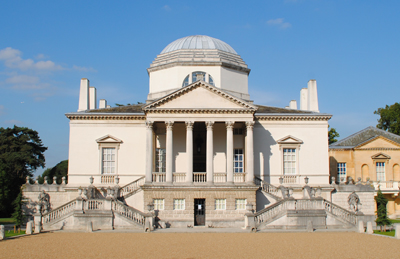
Chiswick-HouseAn icon of the Georgian era, Chiswick House in west London is one of the pre-eminent examples of neo-Palladian architecture in Britain and exemplifies the elegance of the time.

Designed by Richard Boyle, the third Earl of Burlington (1694-1753), the two storey, domed villa was inspired by what Lord Burlington had seen of ancient and sixteenth century architecture during his tours of Italy – in particular the work of Andrea Palladio – as well as the work of Palladio admirer, famed English architect Inigo Jones (his statue along with that of Palladio can be seen outside),

Chiswick-House2It was constructed in the 1720s, most likely between 1727 and 1729, on a site which had been purchased by the first Earl of Burlington (his grandfather) in 1682 and which was already occupied by a Jacobean-era house (this property, which the third Earl significantly renovated, was eventually pulled down in 1788). The interiors were designed by William Kent in collaboration with Burlington and feature luxurious rooms with velvet-covered walls such as the magnificently restored Blue Velvet Room.

The exact purpose of the property remains something of a mystery – it’s been suggested it was built to as a pavilion for private contemplation, grand entertainments and to house the Earl’s art collection and the fact it had no kitchen is supportive of such a conclusion. But there is evidence it was also used as a functioning house – the fact Lady Burlington died in her bedchamber in the premises in 1758 and the link which was eventually built by Lord Burlington between it and the older property on the estate are suggestive of this.

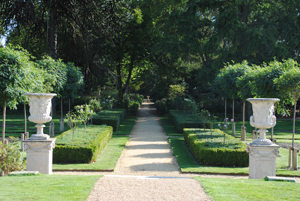
Chiswick-House3Whatever its purpose, the architectural and artistic masterpiece was complemented by formal gardens which Lord Burlington, again, along with the aid of Kent, extensively altered to create a highly planned but naturalistic-looking landscape. Known as the “birthplace of the English Landscape Movement”, the gardens have influenced everyone from ‘Capability’ Brown to the design of New York City’s Central Park.

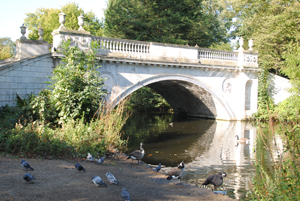
Following Lord Burlington’s death in 1753, the house passed into the hands of his grandson, the fifth Duke of Devonshire (his wife was the rather infamous Duchess Georgiana). He extended the house into a large mansion, adding new wings (these weren’t removed until the 1950s) and improved the gardens, adding the stone bridge (pictured) that still stands over the lake.

Upon the fifth Duke’s death in 1811, the house passed into the hands of the sixth Duke, known as the ‘Bachelor Duke’. He made considerable use of the property and guests included Tsar Alexander I of Russia, King Fredrick William III of Prussia, Queen Victoria and Prince Albert, and Tsar Nicholas I (again, of Russia). The Bachelor Duke also extended the grounds and brought a range of exotic animals into them, including an elephant, kangaroos and emus.

Upon his death in 1858, he left the property to his sister and after her death only four years later, it was subsequently let to some rather high-brow tenants including the Prince of Wales who received the Shah of Persia there in 1873,

The estate was eventually sold by the ninth Duke to the Middlesex County Council and after the war, gifted to the Minister of Works. In 1984, care for the house was transferred to English Heritage. The gardens are now owned by the London Borough of Hounslow.

Along with the Chiswick House and Gardens Trust, English Heritage recently completed a £12 million restoration of the gardens which, this year will host the fourth annual Camellia Festival next month. But this stunning property is well worth a visit any time of the year.

WHERE: Chiswick House, Burlington Lane, Chiswick (nearest Tube station is Turnham Green/nearest train station is Chiswick);  WHEN: 10am to 4pm Saturday and Sunday (until 31st March); COST: £5.90 adults/£3.50 children (5-15 years)/£5.30 concession/£15.30 family; WEBSITE: www.english-heritage.org.uk/daysout/properties/chiswick-house/ or www.chgt.org.uk.

London Pub Signs – The Viaduct Tavern…

Located on a crossroads opposite the Old Bailey (or Central London Criminal Court as it’s formally known) and the Church of St Sepulchre-without-Newgate, The Viaduct Tavern is a gem of the Victorian era.

The-Viaduct-TavernThe name is relatively easy to explain – built in 1874 (and remodelled around the turn of the 19th century), the tavern lies just east of the Holborn Viaduct – central London’s first flyover – which opened in 1869.

The ornate interior of the Grade II-listed pub at 126 Newgate Street features etched and gilded glass panels, three representative “pre-Raphaelite-style” paintings – including one representing Industry and the Arts which was apparently shot by a soldier, no doubt the worse for wear from drink, celebrating the end of World War I – and a small cashier’s booth, all of which attest to its past as a Victorian gin palace.

Under the pub is a cellar – it’s commonly suggested these were cells were part of Newgate Prison (once located nearby on the site of the Old Bailey) or part of a debtor’s prison associated with Newgate – some believe it to have been the site of the Giltspur Street Compter, but both stories have been disputed by guide Peter Berthould.

Past patrons of the pub – which is reputedly haunted – are said to have included writer Oscar Wilde, who apparently frequented the tavern during his trials over the road in the late 1800s.

The pub is now part of the Fullers chain.

~ http://viaducttavern.co.uk

10 fictional character addresses in London – 7. Saffron Hill…

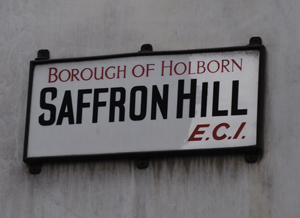
Saffron-Hill2Once at the heart of one of London’s most infamous rookeries or slums, Saffron Hill – located between Holborn and Clerkenwell – is forever associated with Charles Dickens’ 1838 novel, Oliver Twist, and in particular with the arch criminal Fagin.

In the text, Fagin’s den is located “near Field Lane” (the southern extension of Saffron Hill beyond Greville Street) and it is here that Fagin’s young associate, Jack Dawkins (better known as the Artful Dodger), takes Oliver after first encountering him.

As Oliver is led down Saffron Hill, Dickens records his thoughts and it’s worth quoting to get a flavour of the place as he saw it: “A dirtier of more wretched place he had never seen. The street was very narrow and muddy, and the air was impregnated with filthy odours. There were a good many small shops; but the only stock in trade appeared to be heaps of children, who, even at that time of night, were crawling in and out at the doors, or screaming from the inside. The sole places that seemed to prosper amid the general blight of the place, were the public-houses; and in them, the lowest orders of Irish were wrangling with might and main. Covered ways and yards, which here and there diverged from the main street, disclosed little knots of houses, where drunken men and women were positively wallowing in filth; and from several of the door-ways, great ill-looking fellows were cautiously emerging, bound, to all appearance, on no very well-disposed or harmless errands.” (Oliver Twist, p. 55, Vintage, 2007)

Saffron-Hill3Saffron Hill, known as London’s Italian quarter in the 19th century, takes its name from the saffron which was once grown here but which was not to be seen by the time Dickens’ wrote his book. As well as Fagin’s lair, the street is also home to salubrious pub The Three Cripples, Bill Sikes’ favoured watering-hole (The Three Cripples was apparently the name of a lodging house in Saffron Hill during Dickens’ time – it was located next to a pub called The One Tun) .

It’s worth noting that this is only one of many addresses in London associated with Dickens’ characters but the ill-fated Fagin does stand out as one of his most memorable.

PICTURE: Saffron Hill as it is now.

For more on Dickens’ London, check out Alex Werner’s  Dickens’s Victorian London: The Museum of London.

Where’s London’s oldest…public library?

While the designation of London’s oldest public library depends on your definition, for the purposes of this article we’re awarding the title to the Guildhall Library.

Its origins go back to about 1425 when town clerk John Carpenter and John Coventry founded a library – believed to initially consist of theological books for students, according to the terms of the will of former Lord Mayor, Richard (Dick) Whittington (for more on him, see our previous post here).

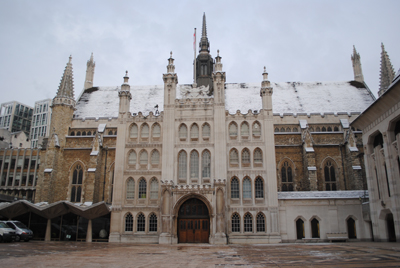
Guildhall2Housed in Guildhall (pictured above), this library apparently came to an end in the mid-1500s when Edward Seymour, the Duke of Somerset and Lord Protector for the young King Edward VI, apparently had the entire collection loaded onto carts and taken to Somerset House. They were not returned and only one of the library’s original texts, a 13th century metrical Latin version of the Bible, is in the library today.

Some 300 years passed until the library was re-established by the City of London Corporation. Reopened in  1828, it was initially reserved for members of the Corporation but the membership was soon expanded to include”literary men”.

By the 1870s, when the collection included some 60,000 books related to London, the library moved into a new purpose-built building, located to the east of Guildhall. Designed by City architect Horace Jones, it opened to the public in 1873.

The library lost some 25,000 books during World War II when some of the library’s storerooms were destroyed and after the war, it was decided to build a new library. It opened in 1974 in the west wing of the Guildhall where it remains (entered via Aldermanbury).

Today, the 200,000 item collection includes books, pamphlets, periodicals including the complete London Gazette from 1665 to the present, trade directories and poll books as well as the archive collections such as those of the livery companies, the Stock Exchange and St Paul’s Cathedral and special collections related to the likes of Samuel Pepys, Sir Thomas More, and the Charles Lamb Society.

The library also holds an ongoing series of exhibitions.

Where: Guildhall Library, Aldermanbury; WHEN: 9.30am to 5pm, Monday to Saturday; COST: Entry is free and no membership of registration is required but ID may be required to access rarer books; WEBSITE: www.cityoflondon.gov.uk/things-to-do/visiting-the-city/archives-and-city-history/guildhall-library/Pages/default.aspx.

10 fictional character addresses in London – 4. 186 Fleet Street…

OK, so the debate may continue over whether Sweeney Todd was an actual person (according to author Peter Haining, the real Todd, born in Brick Lane, is supposed to have been hanged in 1802) or a fictional character, but, suspending that debate for the moment, we’re including the infamous Fleet Street barber in this list.

186-Fleet-StreetKnown as the “demon barber of Fleet Street”, Todd first appeared in literature as a murderer in the Victorian serial, The String of Pearls: A Romance, published in a weekly periodical, and soon became a staple of the Victorian theatre, later appearing in numerous plays and films including the 2007 Johnny Depp vehicle, Sweeney Todd.

His MO usually involved cutting his unsuspecting victim’s throat and then, using a specially constructed barber’s chair, dropping the body into the cellar. There, he and his associate, Mrs Lovett, would rob them (alternatively, other versions have him dropping the customers into the cellar first and then, if needed, finishing them off).

Mrs Lovett would then dispose of the remains by baking them into pies and selling them via her pie shop located nearby in Bell Yard. The story goes that the cellar was linked to nearby Bell Yard via tunnels.

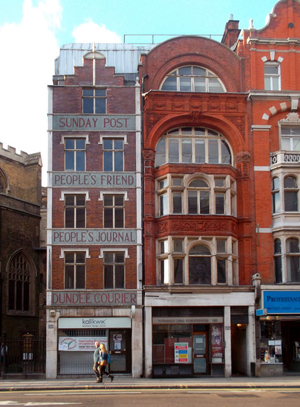
Sweeney Todd was supposed to have terrorised London in the late 18th century and his barber shop was apparently located at 186 Fleet Street in London – right next to St Dunstan-in-the-West. The site is now occupied by a former newspaper office – that of the Dundee Courier (pictured above, left).

For Peter Haining’s book on Sweeney Todd, see Sweeney Todd: The Real Story of the Demon Barber of Fleet Street.

PICTURE: 186 Fleet Street, Sweeney Todd’s (Des Blenkinsopp) / CC BY-SA 2.0

London Pub Signs – The Counting House…

The-Counting-House

This pub, as the names suggests, is located in the City. But more than just being located in a part of London that was traditionally associated with finance, the pub is also actually located in a former bank.

The grand building located at 50 Cornhill was built in 1893 for bankers Prescott, Dimsdale, Cave, Tugwell and Co. (and interestingly, its foundations partly rest on a wall which was once part of the city’s Roman basilica).

The Grade II-listed building, designed by Henry Cowell Boyes and built by William Cubitt, was occupied by several different banks over the years – the last apparently being NatWest – before it was purchased by the Fuller’s Ale and Pie House chain in 1997.

This pub still offers plenty of period atmosphere with a central island bar, large mirrors, old world railing and a magnificent central dome. There’s also a World War I memorial on the wall.

For more on the pub, check out www.the-counting-house.com.

Famous Londoners – Sir Arthur Conan Doyle…

Given our current Wednesday series, we thought it only fitting that we take a quick look at the life of Scottish-born Sir Arthur Conan Doyle, a physician and author most famous for his creation of fictional detective Sherlock Holmes.

Born in Edinburgh on 12 May, 1859, to a wealthy Irish-Catholic family, Doyle was educated at a Jesuit preparatory school in England before  undertaking a medical degree at the University of Edinburgh. It was there where he met his mentor, Dr Joseph Bell, a figure who at least partly inspired the creation of Holmes, and it was also during his time here that he first began writing – his first short story was The Mystery of Sasassa Valley. Having taken a voyage to the Arctic Circle in the post of ship’s surgeon and worked in Birmingham as a doctor’s assistant, he was awarded a medical degree in 1881 (he became MD in 1885).

His first job after graduation was aboard another ship – this time sailing to Africa – and after the voyage he settled back in England, briefly in Plymouth and then in Portsmouth where he opened his first medical practice. For the next few years, he continued  practising as a doctor while writing and in 1885 married his first wife Louisa Hawkins.

In 1886, he started writing A Study in Scarlet. Introducing Sherlock Holmes and Dr John Watson to the world,  it was eventually published in Beeton’s Christmas Annual in 1888. Doyle went on to write some 60 stories about Holmes over the ensuing years but also wrote other books including historical novels, fantasy and science-fiction stories (The Lost World), romances (The White Company), plays (including one about Sherlock Holmes), poetry and written works which reflected his interest in Spiritualism – an interest which had started while he was at university.

In 1890, having studied opthalmology in Vienna, he established a practice at 2 Upper Wimpole Street, Marylebone, London (the location lies only a short distance from his creation’s famous address at 221b Baker Street) and, with his family, took up residence in Montague Place and later at 12 Tennison Road in South Norwood (marked by a Blue Plaque). But with no patients, he spent his time writing, deciding to kill Holmes off in 1893 but subsequently bringing him back to life after a public outcry. He toured the US in 1894 (other countries he visited during his life included Australia) and later served as a surgeon in the Boer War (1899-1902), for which he was knighted in 1902.

Following the death of his first wife form tuberculosis in 1906 (with whom he had two children), Doyle married Jean Elizabeth Leckie in 1907. Moving to Windlesham in Sussex (it was here Doyle would live for the rest of his life while keeping a flat in London), they had three further children. Meanwhile his interest in Spiritualism continued to grow, particularly following the death of his son, Kingsley, in World War I.

His final 12 stories about Sherlock Holmes were published in 1928 in a compilation called The Casebook of Sherlock Holmes. The following year, despite poor health, he embarked on a Spirtualism tour on the continent but had to break it off and return home to Crowborough, East Sussex, in England. There he died on 7th July, 1930, leaving behind a literary legacy which has continued on unchecked. His grave can be found in Minstead Churchyard in New Forest.

For more on Sherlock Holmes, see our earlier posts Famous Londoners – Sherlock Holmes and 10 fictional character addresses in London – 1. 221b Baker Street….

Treasures of London – The lions of Trafalgar Square…

Lion

Dwarfed by the towering form of Nelson’s Column in the southern part of Trafalgar Square, the four lions at the base of the column’s plinth – known to some as Landseer’s Lions – are now a favourite of tourists and Londoners alike. But it wasn’t always so.

While the column was erected in 1843 and the fountains in 1845, it wasn’t until 1867 that the lions – designed by Sir Edwin Landseer – appeared in the square. The reasons for the delay were apparently several including arguments over the artistic vision of the sculptures and funding and Landseer’s own ill-health.

Indeed, Landseer, best known as a painter of animal subjects, wasn’t the first choice as sculptor but was only commissioned after the models of the first sculptor – Thomas Milnes –  was rejected (there’s a terrific painting by John Ballantyne of Landseer working on the lions in the National Portrait Gallery).

As a result when the lions were eventually unveiled, they were held to general ridicule when they finally arrived, costing thousands of pounds more than what had been budgeted for them.

While the lions were initially going to be made of granite, Landseer’s 20 foot long lions were cast by Baron Marochetti in bronze at his Kensington studio. The form of the lions was apparently modelled on a dead lion which, according to Ed Glinert in The London Compendium, were brought to his studio in St John’s Wood by cab from the London Zoo, although all four lions have distinct faces.

Legend has it that the Grade I-listed lions will come to life if Big Ben chimes 13 times.

There has been concern in recent years about the damage people are doing to the lions in climbing on them with one report recommending that the public be banned from climbing on them.

For more, see our previous posts on Nelson’s Column and Trafalgar Square.

For more on London’s monuments, check out Peter Matthews’ London’s Statues and Monuments (Shire Library).

10 (more) curious London memorials…9. The Speke Monument…

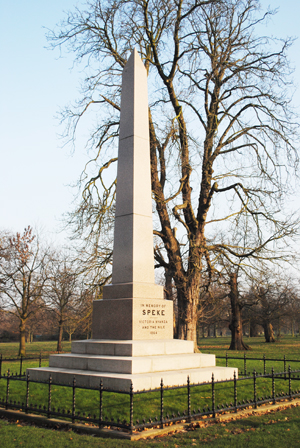
Speke-MonumentWhile thousands walk past this obelisk in Kensington Gardens each day, few probably realise it commemorates the life of John Hanning Speke, a Victorian-era explorer who discovered Lake Victoria in East Africa and named its northern outflow as the source of the Nile.

The red granite monument, designed by Philip Hardwicke and made from stone quarried in Scotland, was paid for by public donations and sponsored by Sir Roderick Murchison, president of the Royal Geographic Society which had paid for two of Speke’s expeditions. It was installed in 1866 and is located near the junction of Lancaster Walk and Budges Walk.

Speke, who had been on several expeditions in Africa, had only died at the age of 37 two years before in relatively controversial circumstances. He was shot by his own gun only the day before he was to participate in a debate with another explorer, Sir Richard Burton, about the source of the River Nile (Speke claimed the source of the Nile was Rippon Falls which flowed out of Lake Victoria; Sir Richard disputed this claim – it was later proven correct). Some have claimed Speke’s death to be suicide; others that it was an accident.

The monument itself was circumspect with regard to Speke’s success – it didn’t directly credit him as being the discoverer of the river’s source. This was rectified in 1995 when a plaque giving credit where it was due was placed on the ground in front of the monument by the Friends of Hyde Park and Kensington Gardens.

Lost London – Enon Chapel…

Built in what was then Clement’s Lane, just off the Strand, in the early 1820s, Enon Chapel became something of a byword for scandal thanks to its rather stuffed crypt.

The Baptist chapel had two functions: the upper floor served as a chapel for worship while beneath it – separated only by a timber floor –  lay a crypt where, for a small sum – said to be the very affordable amount of 15 shillings – people could bury their loved ones. (The smell can’t have been very pleasant from the get-go – apparently an open sewer ran under the chapel).

Despite the apparent smell and the fact people in the chapel fainted and even became sick from the mouldering bodies beneath their feet, it wasn’t until 1844 that, during the works to cover the sewer beneath the chapel, it was discovered the minister – who had since died – had interred an estimated 12,000 people plus people in the crypt, some of whom were buried under a shallow layer of earth while others were simply stacked in their coffins (or remains thereof).

The works were put on hold following the discovery but the remains weren’t removed until 1847 when they were taken out to West Norwood Cemetery, in the city’s south. In the meantime, the building was used as a dancing saloon, albeit with a new brick floor separating it from the crypt (the fact of the bodies beneath the floor certainly wasn’t hidden – the saloon even advertised the dancing events as “dancing on the dead”). In fact, it also became something of a tourist attraction with thousands of people visiting the site to view the remains before they were carted off.

While the scandal may not have resulted in instant action at Enon Chapel, it did help bring attention to the deplorable state of many of the City’s burial grounds which eventually resulted in the passing of the Burial Act of 1852 under which London’s burial grounds were closed and cemeteries built out in the countryside.

The building has long since gone.

Around London – The Mayor’s Thames Festival; celebrating the Olympics and Paralympics legacy; and, Victorian revivalism at Guildhall…

A-Ship's-OperaThe Mayor’s Thames Festival kicks off tomorrow and runs for 10 days until 15th September. This year’s highlight’s include the day long A Ship’s Opera which culminates in a sound and light “spectacular” at Tower Bridge, large-scale artworks placed on boards along the river, an exhibition of more than 50 artworks inspired by the Diamond Jubilee Pageant along the Thames, a film celebrating the people who live and work on the river which will be shown for free on an outdoor screen, riverside choral performances, boat races – including the world’s slowest river race and the longest race on the Thames – and the Source to Sea River Relay in which a bottle of Thames water, filled at the Thames’ source, will be relayed by walkers, swimmers, rower and sailors for the entire length of the river. Most activities will be focused on the stretch of river between Lambeth Bridge and St Katharine Docks. For a full program of all events, check out www.thamesfestival.org.

Last year’s Olympics and Paralympics will be celebrated again in events taking place this weekend. On Saturday – a year since the Paralympic Games closed – disabled athletes and performers will descend on Queen Elizabeth Olympic Park for a day of celebration to mark National Paralympic Day. Part of the Mayor’s Liberty Festival, an annual showcase of deaf and disabled artists, highlights will include an aerial and sway performance – ‘The Limbless Knight’ – and the ‘Miracoco Luminarium’, an interactive light sculpture. The free day runs from noon to 8pm. For more information, see queenelizabetholympicpark.co.uk/events/2013/6/disability-sport (note that registration is required to watch paralympians in action in the newly reopened venue, the Copper Box). Meanwhile on Sunday, Hampstead Heath will host the annual Give it a Go! Olympic legacy festival. Kids will have the chance to take part in everything from penalty shootouts and street dance, boxing and fancy dress and circus workshops as well as martial arts and rugby sessions, and free tennis lessons. The day runs from 1pm to 5.45pm. For more, see www.cityoflondon.gov.uk/hampsteadheath.

• Victorian revivalism is under examination in a new exhibition at the City of London’s Guildhall Art Gallery. The multi-media, multi-sensory show Victoriana: The Art of Revival explores the work of contemporary artists inspired by the 19th century – including Yinka Shonibare, Grayson Perry and Paula Rego – and features graphic design, film, photography, ceramics, taxidermy, furniture, textiles and fine art. More than 70 works are included – among them is a piece created specially for the show, Paul St George’s ‘Geistlich Tube’ – and they’re grouped under four themes – the Neo-Victorian Identity, Time Travel, The Cute and the Curious, and The Reimagined Parlour. The exhibition opens on Saturday and runs until 8th December. Admission charge applies. For more, see www.cityoflondon.gov.uk/victoriana.

Where’s London’s oldest…drinking fountain?

A rather humble looking fountain set into the railing outside the Church of St Sepulchre-without-Newgate at the corner of Giltspur Street and Holborn Viaduct, it’s easy to overlook this important part of London’s historic fabric.

FountainBut this free water fountain is London’s oldest and was installed here on 21st April, 1859, by the then Metropolitan Drinking Fountain Association. Established by Samuel Gurney – an MP and the nephew of social reformer Elizabeth Fry, the organisation aimed to provide people with free drinking water in a bid to encourage them to choose water over alcohol.

Within two years of the fountain’s creation, the organisation – which later changed its name to Metropolitan Drinking Fountain and Cattle Trough Association in reflection of its expanded role in also helping animals – had placed as many as 85 fountains across London.

Such was the need for a clean water supply that, according to the Drinking Fountain Association, as many as 7,000 people a day used the fountain when it was first installed.

The fountain on Holborn Hill was removed in 1867 when the nearby street Snow Hill was widened during the creation of the Holborn Viaduct and the rails replaced but it was returned there in 1913. Rather a poignant reminder of the days when water wasn’t the publicly available resource it is today, the marble fountain still features two small metal cups attached to chains for the ease of drinking and carries the warning, “Replace the Cup!”.

PICTURE: Wikipedia/JustinC

Famous Londoners – The Tower Ravens…

Ravens

OK, so they’re not people as such, but the ravens at the Tower of London are renowned the world over.

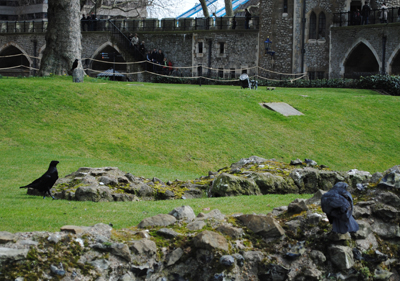
Known as the “Guardians of the Tower”, there are currently as many as eight ravens living at the tower, lodged in a space on the grass next to the Wakefield Tower.

Raven-pensLegend has it that there must be at least six ravens living at the Tower – should they leave, not only will the Tower fall but the kingdom as well (although we hasten to add that it’s been argued this tradition only started in the Victorian age and that there have been times when the numbers of ravens dropped below the required six, such as at the end of World War II when only one raven remained).

It was King Charles II who first ordered the ravens be protected – an order which must have upset Astronomer Royal John Flamsteed who complained after he found that the birds were interfering with the observation work he was carrying out from the Tower’s north-east turret. He later moved out to Greenwich.

The eight ravens who now live at the tower include Rocky, Merlin, Hugine and the latest additions Jubilee – given to the Tower last year to celebrate the Queen’s Diamond Jubilee – and Grip, named after Charles Dickens’ pet raven.

The birds are looked after by a team of four headed by the raven master, Chris Skaife, who each day feed them 170 grams (six ounces) of raw meat and special biscuits soaked in animal blood.

Not all ravens can cut the mustard to work at the Tower – one recent addition Pearl was apparently bullied by other ravens and had to be withdrawn. And while the birds have the feathers on one wing trimmed to stop them escaping to a new life on the wing, that hasn’t stopped some from doing so including Grog who took off in 1981 and was last seen outside an East End pub.

The oldest raven to ever live at the Tower was Jim Crow, who died at age of 44 in 1928.

WHERE: Tower of London (nearest Tube station Tower Hill); WHEN: 9am to 5.30pm, Tuesday to Saturday, 10am to 5.30pm Sunday to Monday; COST: £21.45 adults; £10.75 children under 15; £18.15 concessions; £57.20 for a family; WEBSITE: www.hrp.org.uk/toweroflondon/.  

Where’s London’s oldest…Tube station?

In this, the year of the 150th anniversary of the creation of what we now know as the London Underground, it’s only fitting that we take a look at the city’s oldest Tube station – Baker Street.

Opened on 10th January, 1863, by the Metropolitan Railway, the Grade II* listed property was designed by John Fowler, the company’s engineer in chief. While some stations on the initial railway – which stretched from Paddington to Farringdon – had platforms located in open cuttings, Baker Street was one of only three initial stations (the other two were at what was then named Gower Street (now Euston Square) and Great Portland Street) which was genuinely located underground, with subterranean platforms covered by brick barrel-vaults and lit by gaslights as well as natural light brought from the surface by “lunettes”.

The station was subsequently extended and further developed and, thanks to the company’s desire to make Baker Street its headquarters and “flagship” station, it underwent a major overhaul in 1911-13 with Charles Walter Clark, another Metropolitan Railway employee, designing a new grand booking hall and concourse featuring a lost property office, “ladies’ room” and a WH Smith bookstall.

Features inside include a cast-iron screen – complete with clock –  installed at the entrance to the lower concourse in 1925 to help control passenger flow during the British Empire Exhibition at Wembley, a marble memorial to Metropolitan Railway employees who died in World War I, and, in a nod to the proximity of his fictitious Baker Street residence, large and small Sherlock Holmes silhouettes on tiles located at various places inside (there’s a statue of him outside the station).

For more on the 150th anniversary, see www.tfl.gov.uk/tube150.

10 Historic London Garden Squares…10. Charterhouse Square…

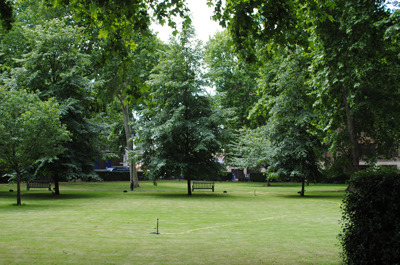
Charterhouse-Square-GardensThe final in our series on historic garden squares in London (for this year, anyway), we’re taking a look at Charterhouse Square.

The five sided square, located just to the east of Smithfield, takes its name from a Carthusian monastery which was established in 1371 on what is now its north side. Prior to this, what is now the square had from 1348 served as a location for a plaque burial pit (a number of skeletons from the plaque pit have been unearthed as part of the Crossrail project – for our earlier story on this, follow this link).

The monastery was dissolved in 1537 after the monk’s refused to recognise King Henry VIII’s Act of Supremacy (some were later executed at Tyburn) and it was subsequently transformed into a manor house with Thomas Howard, the 4th Duke of Norfolk, among its residents over the years (in fact he was imprisoned there around 1570 for allegedly plotting to marry Mary, Queen of Scots – he was later executed by Queen Elizabeth I for treason).

Under the will of Thomas Sutton, an almshouse and school was subsequently established on the site – the almshouse remains there while the school, whose students had included Methodism founder John Wesley and writer William Makepeace Thackeray, moved out to Godalming in Surrey in 1872. As well as the almshouse (which is open for guided tours, check this site for details), some of the buildings are now occupied by medical related institutions.

In the 1600s, the square was also home to numerous other large residences among them Rutland House, which had been the residence of the Venetian ambassador. It lost its aristocratic inhabitants in the ensuing centuries but remained mainly residential up until the late 19th century when it gradually became taken over by businesses and other organisations. Interesting to note is that the east side of the square is still home to the residential unit complex known as Florin Court, better known as Whitehaven Mansions, the home of Hercule Poirot in the TV series which bears his name.

The area of the garden square itself was variously referred to as the Charterhouse Churchyard, the Charterhouse Yard and Charterhouse Close over the years and has gone through numerous incarnations with efforts to improve and formalise its look dating back to at least the 16th century. It was at least partly enclosed by the late 1600s and the fences replaced several times, notably in 1742 when an Act of Parliament was passed allowing residents to fine those who entered without authorisation. The enclosing fences have since been modified several more times.

One of the major changes to the shape of the square occurred in 1860 when the Metropolitan Railway was extended between Farringdon and Moorgate. It was at this time that the road surface which surrounds the central garden, which has a Grade II heritage listing, was laid down.

Today the gardens in the centre of the square remain under the management of the Charterhouse (and hence aren’t open to the general public except on tours) but even without a tour it’s still a quiet place to walk around the outside of, evoking a strong sense of years gone past.

10 Historic London Garden Squares…8. Russell Square

The largest garden square in Bloomsbury (and one of the largest in London), Russell Square was first laid out by Humphry Repton in 1806 and was located on what were the gardens of the home of the Dukes of Bedford, Bedford House.

Duke-of-BedfordIts name is that family name of the 5th Duke of Bedford, Francis Russell, who initially ordered the creation of the square and owned the land upon which it stands. The Russell family still hold the title today – the current duke, the 15th, is Andrew Russell – and still run the Bedford Estates upon which the square still stands.

The square was originally lined with grand terraced homes aimed at the upper middle class – the survivors, which can be found largely on the southern and western side of the square, are these days occupied by offices and the University of London. The eastern side of the square is these days dominated by the French Gothic Hotel Russell – designed by Charles Fitzroy Doll, it was built in 1898.

Famous residents and inhabitants have included TS Eliot, who worked at a building in the square’s north-west corner when he was poetry editor at Faber & Faber, 19th century painter Sir Thomas Lawrence who had a studio at number 67, poet William Cowper, who lived at number 62 in the 1830s as a schoolboy, and George Williams, founder of the YMCA, who lived at number 13 in the late 19th and early 20th centuries. It also appears in William Thackeray’s novel, Vanity Fair, and Virginia Woolf’s Night and Day.

The gardens were overhauled in 2002 in view of Repton’s original design and a new ornamental fountain installed in the middle. A cafe was also added.

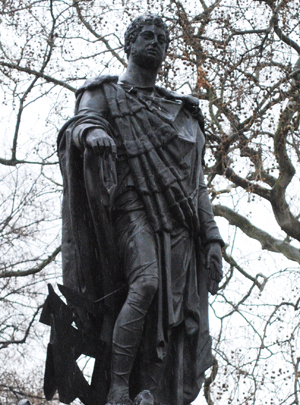
Russell Square still houses one of London’s 13 extant Cabmen’s Shelters while monuments within the gardens include a small memorial to the 7th July, 2005, bombings – two of which occurred nearby – and a statue of the 5th Duke of Bedford, another which is the work of Sir Richard Westmacott and which was erected in 1807-08 (pictured).

10 Historic London Garden Squares…7. Bloomsbury Square

Initially known as Southampton Square, Bloomsbury Square – located just to the east of the British Museum – was first developed in the mid-1660s, making it London’s oldest formal square.

Bloomsbury-SquareIt was the fourth Earl of Southampton, Thomas Wriothesley, who developed the square – his rather grand house, Southampton House, was located on the northern side of the square which initially featured gardens at the centre laid out in a cruciform pattern.

In 1723 – via the marriage of Southampton’s daughter, Lady Rachel Vaughan, to the ill-fated William, son of the 5th Earl of Bedford (he was implicated in the Rye House Plot and beheaded) – it passed to the Dukes of Bedford, becoming part of the Bedford Estates (and with it the earl’s house, later renamed Bedford House). The square took on its new name of Bloomsbury Square around this time.

Initially popular among the well-to-do, it had fallen somewhat from favour by the 19th century and with the 5th Duke preferring to live in the West End, in 1800 Bedford House was auctioned off and demolished. Terraced houses were later built along the now vacant north side of the square.

About 1806, the 5th Duke commissioned Humphry Repton to redesign the square and by the 1820s a garden including trees in the centre and a perimeter shrubbery. The gardens have gone through several makeovers since, including in the 1960s when an underground carpark was built underneath.

Most recently refurbished in 2006-2007 so they once again reflect Repton’s design, the gardens – which have been open to the public since 1950 – also contain a bronze statue of Whig politician (and friend of the Dukes of Bedford) Charles James Fox, which was designed by Sir Richard Westmacott and erected in 1816 (pictured, it was restored in 2006 to mark the bicentenary of Fox’s death).

It remained popular among middle class professionals, however, and among its most notable residents were the writer Isaac D’Israeli, father of the future Prime Minister Benjamin Disraeli, who lived at number six in the early 19th century (his son with him) while architect Sir Edwin Lutyens lived and worked at number 29 for more than 15 years after his marriage in 1897. Literary and artistic figures like Leonard and Virginia Woolf and Lytton Strachey, who became part of what was known as the ‘Bloomsbury Group’, were also famously known to have lived in the area around the square.

Most of the houses in the square are now used as offices but among the notable buildings there are the former home of the Royal Pharmaceutical Society of Great Britain (based in a building partly credited to architect John Nash) and, dating from 1930, Victoria House.

One of the more famous events to have taken place in the square occurred in 1780 during the anti-Catholic Gordon Riots when rioters burned down the house of the Lord Chief Justice. Almost 100 years earlier, in 1694, the square was site of a deadly fencing duel between Scottish financier John Law and Edward Wilson. Law killed Wilson, was subsequently convicted of his murder and sentenced to death but escaped by fleeing to the continent. He later become the founder of the Mississippi Company.

10 Historic London Garden Squares…6. Grosvenor Square

Grosvenor-Square-1

The largest square in Mayfair, Grosvenor Square was laid out in the 1720s on the orders of  Sir Richard Grosvenor of Cheshire.

Sir Richard owned the Grosvenor Estate, a considerable tract of land in London’s west which includes in its northern part the land upon which the square was created (the estate is now owned by Gerald Cavendish Grosvenor, the 6th Duke of Westminster).

It’s proximity to Hyde Park and Whitehall quickly made it, like many other historic squares, a fashionable place for politicians to live – among those who lived here in the late 18th century were three prime ministers.

The oval-shaped gardens in the middle of the square – which was only opened to the public in 1948 – were once home to a statue of King George I but this was removed at some point. Originally thought to have been laid out by gardener John Alston, they took on their current form in 1948 when they were redesigned by architect BWL Gallannaugh (interestingly, Grosvenor Square is also said to have been the last part of London to exchange gas lighting for electric lighting).

There’s almost no residential buildings on the square these days but among the most prominent buildings (in fact it dominates the west end of the square) is the US Embassy. Designed by Eero Saarinen, the building was completed in 1960 with US President John F Kennedy one of the first visitors.

Grosvenor-Square-2The hulking embassy is only one of the many American connections to the square, connections which at one point led to it being known as “Little America”. Dwight Eisenhower, commander of the US armed forces in World War II, based his headquarters at number 20 in 1944, while number nine – one of the few residences to survive – was home to John Adams, first American ambassador to the Court of St James and later the country’s second president.

The American theme, which has meant the square has been the focus of demonstrations such as those protesting the Vietnam War as well as outpourings of support such as in the wake of the September 11 attacks, is also evident in the statutory in the square’s gardens with grand, full size statues of  President Franklin D. Roosevelt (a bronze by William Reid Dick unveiled by Eleanor Roosevelt on the third anniversary of the president’s death – 12th April, 1948 – it is pictured above), President Eisenhower (a bronze by Robert Dean dating from 1989), and President Ronald Reagan (unveiled on 4th July, 2011, pictured right).

On the eastern side of the garden square is the September 11 Memorial Garden opened in 2003 while on the south side is the Monument to the Eagle Squadrons, the three RAF squadrons in World War II mostly composed of American volunteers before the US entered the war. There’s also a set of memorial “Diplomatic Gates”, installed in 1984 to commemorate the bicentennial of the Treaty of Paris and honour US and UK politician who have worked in the service of peace.

Other notable buildings include number one, the Canadian High Commission (previously the US embassy); and number four, one of  square’s oldest houses. Now demolished, number 44 was the home of the Earl of Harrowby and where the British Cabinet were dining when word arrived of Wellington’s victory at Waterloo.