Around London – Lord Mayor’s Show; Remembrance Sunday; Ansel Adams at the NMM; and, Mughal India at the British Library…

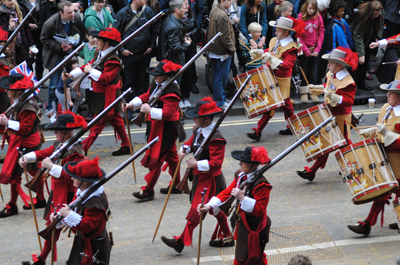
• The 2012 Lord Mayor’s Show is just about upon us and while you may not have a grandstand seat, there’s still plenty of places you can stand and watch the parade of more than 6,500 people pass by. Saturday’s parade – which celebrates the election of the 685th Lord Mayor of London, Alderman Roger Gifford – leaves Mansion House at 11am and travels via Poultry and Cheapside to St Paul’s Cathedral where it pauses for the Lord Mayor and his officials to receive a blessing – before continuing on via Ludgate Hill and Fleet Street to the Royal Courts of Justice, arriving there at about 12.30pm. There the Lord Mayor gives his oath of loyalty to the Crown (while in the surrounding streets the participants and 125 horses are fed and watered) before the parade reassembles and sets off from Embankment at 1pm, heading back to Mansion House via Queen Victoria Street – the Lord Mayor arrives sometime between 2pm and 2.30pm. (The website has a terrific one page map of the route you can download and print). There’s no fireworks display after the parade – although there’s a host of other activities taking place in the City of London – but if you’re up and about early enough, you may want to watch the Lord Mayor as he boards the barge QRB Gloriana at the Westminster Boating Base in Vauxhall at 8.30am and, escorted by a flotilla, makes his way up the Thames to HMS President, just below St Katharine Docks, arriving at about 9.35am after Tower Bridge opens in salute. For more, head to www.lordmayorsshow.org.

• The annual Remembrance Sunday service – commemorating the contribution of British and Commonwealth servicemen and women in the two World Wars and later conflicts – will take place at the Cenotaph on Whitehall at 11am this Sunday. While no tickets are required to watch the event, the Department of Culture, Media and Sport, who organise the service, advise arriving early if you wish to secure a good viewing space (and leave time for security checks at the entrance to either end of Whitehall). Whitehall opens at 8am. For more details, see www.culture.gov.uk/what_we_do/honours/3333.aspx.

A new exhibition of the work of US photographic pioneer Ansel Adams opens at the National Maritime Museum in Greenwich tomorrow (Friday). Ansel Adams: Photography from the Mountains to the Sea, which comes from the Peabody Essex Museum in Salem, Massachusetts, will feature more than 100 original prints, many of which have never been exhibited before in the UK. It is said to be the first exhibition to focus on his “lifelong fascination” with water and the display features some of Adams’ finest images based on this subject including what are some of the most famous photographs of the 20th century. Highlights include the first photograph Adams’ ever image – taken at age 14 – which features a pool located at the Panama Pacific Exhibition at the 1915 World’s Fair, the three American Trust murals produced in the 1950s on an “unprecedented scale”, Adam’s favorite work – Golden Gate before the Bridge – which hung above his desk, and iconic images such as Clearing Winter Storm, Yosemite and Stream, Sea, Clouds, Rodeo Lagoon, Marin Country, California. There is an admission charge. Runs until 28th April. For more details on the exhibition, see www.rmg.co.uk.

Also opening tomorrow (Friday) is the British Library’s major autumn exhibition – Mughal India: Art, Culture and Empire. The exhibition focuses on the Mughal dynasty – which once ruled over much of the Indian sub-continent – and is the first to document the period spanning the 16th to 19th centuries. Featuring more than 200 manuscripts and paintings, most of which come from the library’s own collection, highlights include Akbar ordering the slaughter to cease in 1578 – a work attributed to the artist Miskina in 1595, Abu’l Hasan’s early 17th century painting Squirrels in a plane tree, the historically important illustration Prince Aurangzeb reports to the Emperor Shah Jahan in durbar, and a portrait of Prince Dara Shikoh, favorite son and heir-apparent of 17th century Emperor Shah Jahan. Runs until 2nd April. Admission charge applies. For more on the exhibition and accompanying events, see www.bl.uk.
Where is it?…#48

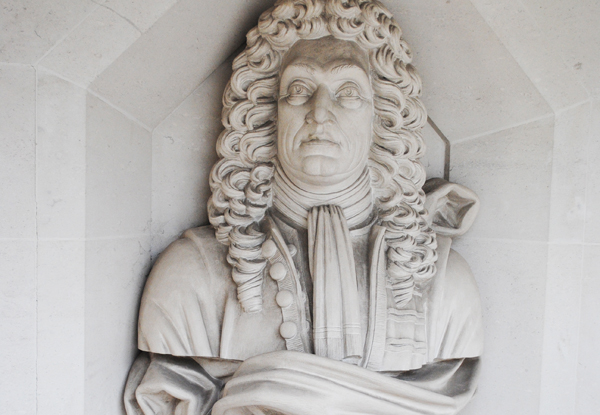
The latest in the series in which we ask you to identify where in London this picture was taken and who it’s of. If you think you can identify this picture, leave a comment below. We’ll reveal the answer early next week. Good luck!

Well done to Angelo (and, I suspect the correct location for Mike), this is indeed a bust of Sir Christopher Wren and is located in a loggia outside the Guildhall Art Gallery facing into Guildhall Yard. It and three other larger than life busts of notable Londoners – playwright William Shakespeare, statesman Oliver Cromwell and diarist Samuel Pepys – are all the work of Tim Crawley and were installed when the gallery was completed in 1999. Along with them is a full length statue of Dick Whittington and his famous cat – these are the work of Laurence Tindall.

Treasures of London – The State Coach…

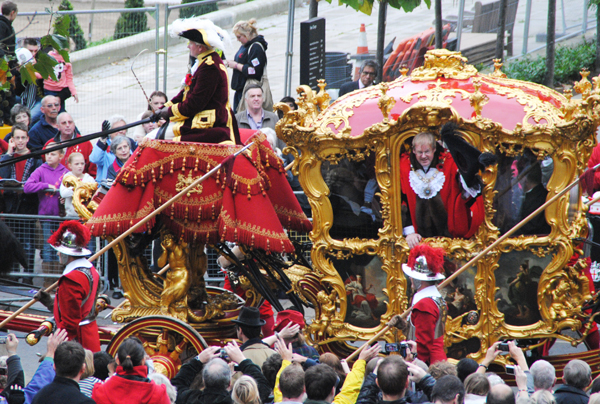
Eight days from now, the Lord’s Mayor’s Show will be winding its way through the streets of the City London with star of the show, the new Lord Mayor of London, Roger Gifford, riding in a spectacular gilt State Coach.

The coach’s origins go back to the mid 18th century although the reason why a coach is used go back some years earlier – to 1711, in fact, when then Lord Mayor Sir Gilbert Heathcote fell off the horse he was riding in the procession and broke his leg. It’s worth noting that up until the 1420s, the Lord Mayor rode all the way to the Palace of Westminster to swear fealty to the monarch – after that they went on a river barge down the Thames, a practice which continued until 1857 (although they still had to ride to and from the watercraft which is when Sir Gilbert had his accident).

While a stand-in coach was used for some years after Sir Gilbert’s fall, in 1757 Sir Charles Asgill, a banker who was set to be the next Lord Mayor, commissioned Joseph Berry of Leather Lane in Holborn to make the splendid vehicle still in use today (the coach was designed by architect Sir Robert Taylor). Built at a cost of £1,065.0s.3d, the substantial sum was met by the Aldermen. It’s now apparently worth more £2 million.

Richly ornate, many of the four ton coach’s features emphasise the role of the City of London as a centre of world trade – the cherubs at each of the coach’s four corners, for example, represent the four continents of Asia, Africa, America and Europe. The City’s coat-of-arms is on the back of the coach, the front panel has an image of Hope pointing at St Paul’s Cathedral and the side panels are decorated with representations of moral virtues.

The coach, which has undergone many restorations (in an indication of this, it’s said there’s as many as 100 coats of paint and varnish on the ceiling), has since been used in every Lord Mayor’s Show and when not in use, can be seen in the Museum of London.

PICTURE: The State Coach at last year’s Lord Mayor Show/© David Adams

Around London – Henry Stuart at the NPG; the Lord Mayor’s Show; prehistoric Japanese pots; and, photography at the National Gallery…

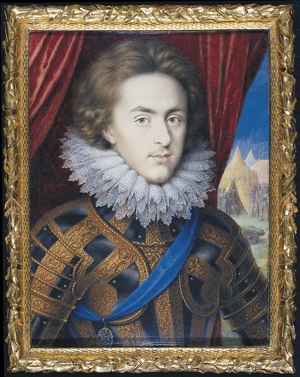
• The first ever exhibition focusing on Henry Stuart, older brother of King Charles I, has opened at the National Portrait Gallery. The Lost Prince: The Life and Death of Henry Stuart features more than 80 exhibits including paintings, miniatures, manuscripts, books and armour gathered from museums and personal collections around the UK and abroad – with some of the objects being displayed in public for the first time. Opened on 18th October – the 400th anniversary of the Prince’s death, among the paintings displayed in the exhibition are works by Holbein, Nicholas Hilliard and Isaac Oliver as well as Robert Peake as well as masque designs by Inigo Jones and poetry  by Ben Jonson. Henry, Prince of Wales, was the eldest son of King James I and Queen Anne of Denmark, and died at the age of 18 of typhoid fever. As well as looking at his short life, the exhibition covers the extraordinary reaction to his premature death (and the end of hope that King Henry IX would sit next upon the throne). The exhibition runs until 13th January. An admission fee applies. For more, see www.npg.org.uk. PICTURE:  Henry, Prince of Wales by Isaac Oliver, c. 1610-12; Copyright: The Royal Collection Photo: Supplied by Royal Collection Trust / © HM Queen Elizabeth II 2012

The Lord Mayor’s Show – the largest unrehearsed procession in the world – will be held on 10th November. This year’s procession – celebrating the election of the 685th Lord Mayor of London, Alderman Roger Gifford – will feature more than 6,500 people winding their way through the City of London in a three-and-a-half mile-long display including 22 marching bands, 125 horses, 18 vintage cars, 21 carriages, an original American stagecoach, a Sherman tank, a steamroller and a Japanese Taiko drum band. While there will be no fireworks after this year’s parade, following the success of last year’s trial there will be an early morning flotilla with the Lord Mayor conveyed in the barge QRB Gloriana from Vauxhall up the Thames to HMS President, just below St Katharine Docks, from where he will make his way to the Mansion House to join the procession as it heads first to St Paul’s and then on to the Royal Courts of Justice before returning (via a different route). There are no grand stand seats left but plenty of places you can watch it for free (for a chance to win free Grandstand tickets, head to the Lord Mayor’s Show Facebook page and ‘like’ it). We’ll be talking about this more next week, but in the meantime, for maps and details of a new smart phone app, head to www.lordmayorsshow.org.

Two prehistoric Japanese pots have gone on display at the British Museum. Loaned from the Nagaoka Municipal Science Museum, the pots date from the Middle Jomon period (3,500-2,500 BCE) and consist of a ‘flame’ and a ‘crown’ pot which were excavated in Nagaoka city. The pots form part of the Asahi Shimbun Displays in room 3 and will be there until 20th January. Meanwhile, continuing the Asian theme, an exhibition of more than 100 contemporary carved Chinese seals by artist Li Lanqing is on display in room 33 until 15th January. Admission to both is free. For more, see www.britishmuseum.org.

• On Now: Seduced by Art: Photography Past and Present. The National Gallery’s first major exhibition of photography, the display looks at the relationship between historical paintings and photography, both its early days in the mid-19th century and the work of contemporary photographers – in particular how photographers have used the traditions of fine art to “explore and justify” their own works. Almost 90 photographs are displayed alongside a select group of paintings for the show. Admission is free. Runs until 20th January in the Sainsbury Wing. For more, see www.nationalgallery.org.uk.

Lost London – Greyfriars…

A now long gone Franciscan friary located in the north-west of the City of London near Newgate (just to the north of St Paul’s Cathedral), Greyfriars, so known for the color of the friars’ clothing, was the second Franciscan religious house to have been founded in England.

The foundations of the friary date from the early part of the 13th century – the Franciscans, as members of the Order of Friars Minor were known, had arrived in 1224 and are recorded as settling on land granted to them by a rich mercer, John Iwyn, just inside the City wall, in 1225, in the butcher’s quarter of the city.

King Henry III apparently gave them some oak to build their own friary in 1229 and by the mid 1200s, there were more than 80 friars living on the site which was gradually extended over the ensuing years to the north and the west.

Using funds given them by Sir William Joyner, Lord Mayor of London in 1239, they built a chapel which was later extensively enlarged and improved in the late 13th and early 14th centuries – the new church was said to be 300 feet long – with much of the work funded by Queen Margaret, second wife of King Edward I, and later in the 14th century, Queen Isabella, wife of Edward III. It apparently suffered some damage in a storm in 1343 but was restored by King Edward III.

When it was finally completed in 1348, the church is said to have been the second largest in London. A library was later added to the buildings, founded by the famous Lord Mayor of London, Richard “Dick” Whittington.

Such was the fame of the church that, the heart of Queen Eleanor, wife of King Henry III, was buried here after her death in 1291 while, despite dying at her castle in Marlborough, Queen Margaret was also buried here in 1318 (apparently wearing a Franciscan habit).

But perhaps the most notorious person to be buried here was Queen Isabella, wife of King Edward II and known by many as the “She-Wolf of France”, after her death in 1358. In fact, it’s said that the ghost of Isabella still haunts the former location of Greyfriars, driven forth from the grave for her role in deposing her husband.

Other non royal luminaries said to have been buried here include the 15th century writer Sir Thomas Mallory, author of Le Morte d’Arthur and 16th century Catholic nun Elizabeth Barton, the so-called ‘mad maid of Kent’ who was executed for her rather unwise prophecies predicting King Henry VIII’s death if he married Anne Boleyn.

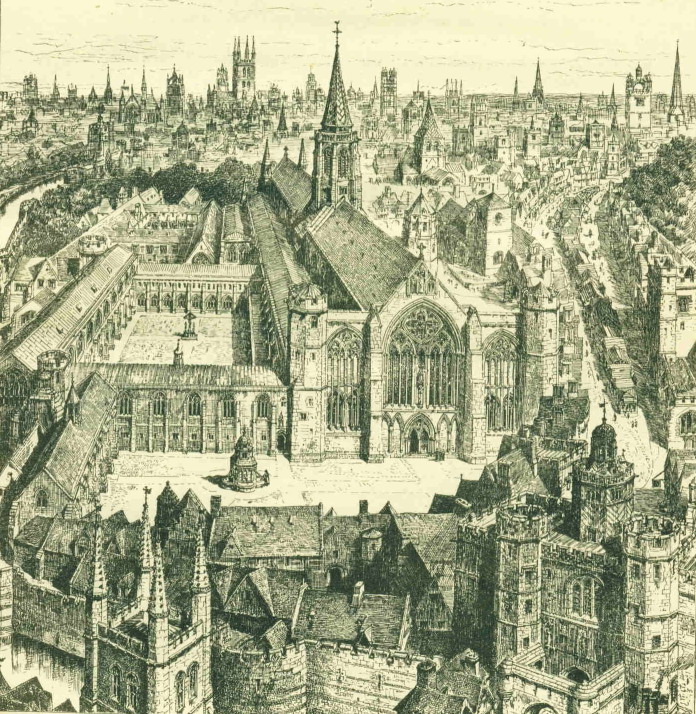
The end of the friary, pictured above in the sixteenth century, came in 1538 when it fell victim to King Henry VIII’s policy of dissolving monasteries and was surrendered to his representatives.

Some of the houses were subsequently converted for private use and the church, which was somewhat damaged during this period with many of the elaborate tombs destroyed, was briefly closed before it and other buildings were given to the City of London Corporation who reopened it again in 1547 as Christ Church Greyfriars, a parish church serving the now joined parishes of St Nicholas Shambles and St Ewen.

Only a few year’s later King Edward IV founded a school for poor orphans in some of the old friary buildings known as Christ’s Hospital or informally as The Bluecoat School thanks to the uniforms students wore. Some of the school buildings, along with part of the church which was also used by the school, was destroyed by the Great Fire of London in 1666, but the school was rebuilt and remained in use until the late 1800s when the last of the students were relocated to a new facility in Sussex (where the school still exists today).

The church (also known as Christ Church Newgate Street), meanwhile, was also rebuilt after the Great Fire – it was one of Sir Christopher Wren’s designs and was completed in 1704. The church remained in use until World War II when a firebomb struck it during a German raid on 29th December, 1940, all but destroying it.

The church was not rebuilt and the parish merged with the nearby St Sepulchre-without-Newgate – the largest parish church in London – and eventually what’s left of the church – the tower with rebuilt steeple and the west and north walls – were converted into a public garden (rose beds were planted where the pews once stood and there are wooden towers representing the church’s pillars). Pictured right, it’s now a terrific place to sit and have lunch pondering the past which the bustle of the city goes on about you.

PICTURE: (top) Wikipedia

For a great biography of Isabella, the She-Wolf of France, see Alison Weir’s Isabella: She-Wolf of France, Queen of England. For more on Sir Christopher Wren’s churches in London, see John Christopher’s Wren’s City of London Churches.

10 Historic London Markets – 2. Smithfield Market…

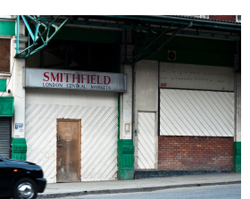
Now the largest wholesale meat market in the UK and one of the biggest in Europe, the connections between the site of Smithfield Market, officially known as the London Central Markets, and livestock go back to at least 800 years.

Since the 12th century animals were routinely traded here thanks to the site’s position on what was then the northern edge of the city. Smithfield was also known for being an area for jousting and tournaments and was the location of the (in)famous St Barthlomew Fair (this closed in 1855) as well as an execution ground – among those executed here were Wat Tyler, leader of the Peasant’s Revolt, and ‘Braveheart’, Sir William Wallace (1305).

Skip ahead several hundred years and, by the the mid-1800s, traffic congestion led to the livestock trade being relocated to a new site north of Islington. Plans were soon launched to locate a cut meat market on the Smithfield site.

Following the passing of an Act of Parliament, work on the new market began in 1866 with Sir Horace Jones (he of Tower Bridge fame), the City Architect, overseeing the design. Constructed of ornamental cast iron, stone, Welsh slate and glass, the initial market buildings were completed in 1868 with the result being two vast buildings, separated by a grand central avenue, but linked under a single roof. The new market was opened amid much pomp by the Lord Mayor of London on 24th November, 1868.

Four further buildings were soon added – only one, the Poultry Market, which opened in 1875, is still in use – and in the 1870s the market began to see the arrival of frozen meat imported from as far afield as Australia and South America.

Closed briefly during World War II – when the site was used for storage and an army butcher’s school – it reopened afterwards. The main poultry building was destroyed in a fire in 1958 and a replacement featuring a domed roof – the largest clear spanning dome roof in Europe at the time – was completed by 1963.

More recently, the market underwent a major upgrade in the 1990s. Queen Elizabeth II opened the refurbished East Market Building in June, 1997.

WHERE: London Central Markets, Charterhouse Street and West Smithfield (nearest Tube Stations are Barbican, St Paul’s and Moorgate); WHEN: From 3am Monday to Friday (visitors are told to arrive by 7am to see the market in full swing) (There are walking tours available – see www.cityoflondontouristguides.com for details); COST: Free entry; WEBSITE: www.smithfieldmarket.com.

PICTURE: Rossella De Berti/www.istockphoto.com

Where is it? #36…

The latest in the series in which we ask you to identify where in London this picture was taken and what it’s of. If you think you can identify this picture, leave a comment below. We’ll reveal the answer early next week. Good luck!

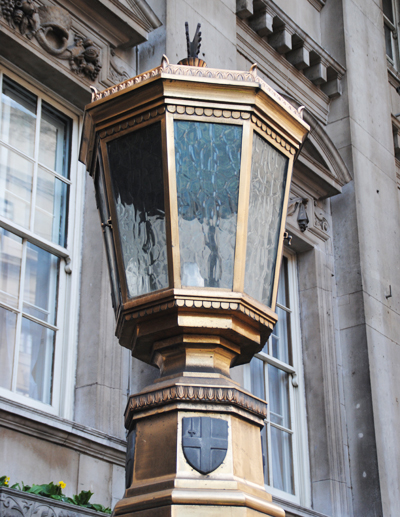
Of course, as Parktown, Carol Stanley and Alma Lewis all pointed out, this is one of the lanterns outside of Mansion House, home of the Lord Mayor of London (the giveaway was the coat-of-arms of the City of London on the lamp stand).

The Mansion House, designed in the Palladian style by George Dance the Elder, was specifically built for the Lord Mayor of London in the mid 1700s and features accommodation for the Lord Mayor and Lady Mayoress as well as grand state rooms for entertaining including the Old Ballroom and the Great Egyptian Hall.

We’ll be looking in more detail at the history of the Mansion House in a future post.

For more on touring the house, see www.cityoflondon.gov.uk/Corporation/LGNL_Services/Leisure_and_culture/Local_history_and_heritage/Buildings_within_the_City/Mansion_house/Tours_of_Mansion_House.htm.

Where’s London’s oldest…bank?

While it may not be the oldest (that remains a matter of some dispute), we can say that one of London’s oldest banks stands at 1 Fleet Street.

Child & Co’s origins go back to the mid-1600s when Francis Child entered into a partnership with Robert Blanchard to run a goldsmith’s business. In 1673, the business, now known as Blanchard & Child moved to the premises it now occupies.

Child later married Blanchard’s step-daughter and on Blanchard’s death in 1681, he inherited the entire company, renaming it Child & Co (knighted in 1689, Child later served as a Lord Mayor of London and as an MP) and in 1698 was appointed “jeweller in ordinary” to King William III.

Following Child’s death in 1713, his sons continued the business, transforming it into a bank. It’s first banknote was issued in 1729.

The bank passed into the ownership of the Earls of Jersey in the mid-1800s and in 1880, following the removal of the Temple Bar gate, rebuilt its premises.

The bank, which at one stage had a branch in Oxford, was later sold to London-based commercial bank Glyn, Mills, Currie, Holt & Co and this in turn was acquired by the Royal Bank of Scotland. They remain the current owners.

Interestingly, the bank is said to be the model for Tellson’s Bank in Charles Dickens’ novel, A Tale of Two Cities.

For a book on the financial history of the City of London, check out David Kynaston’s City of London: The History: 1815-2000.

Where is it? #31…

The latest in the series in which we ask you to identify where in London this picture was taken and, importantly in this case, what it’s of. If you think you can identify this picture, leave a comment below. We’ll reveal the answer early next week. Good luck!

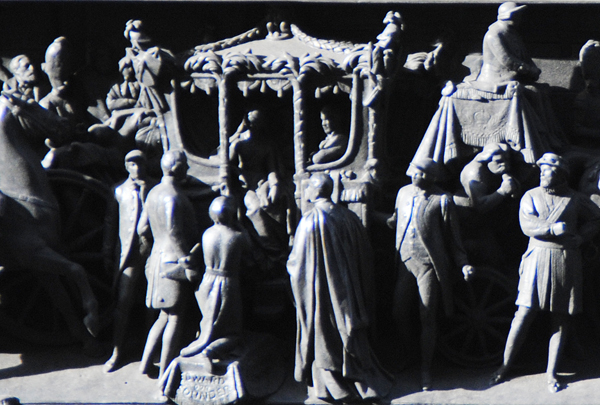
Well done to Jameson Tucker, this is indeed a relief on the Temple Bar Memorial, which stands where the Strand turns into Fleet Street. It depicts Queen Victoria on a royal progress to the Guildhall in 1837, a few months after her accession, when she was met at this spot by the Lord Mayor and Aldermen and presented with the sword of state and keys to the city.

According to a tradition said to date back to 1215, the Temple Bar is the only place where the monarch may enter London after first seeking permission from the Lord Mayor and being presented with the City’s Pearl Sword (one of five City swords, this is said to have been first given to the City by Queen Elizabeth I).

The monument itself was designed by Sir Horace Jones and erected in 1880 to mark the location where the Temple Bar – the ceremonial entrance to the City of London – originally stood (the last incarnation of the Temple Bar, designed by Sir Christopher Wren, is now located near in Paternoster Square near St Paul’s – see our earlier post for more on Wren’s Temple Bar).

On top of the granite and bronze monument stands a rearing griffin (actually it’s supposed to be a dragon), one of the city’s official boundary markers, sculpted by Charles Birch while on either side are bronze statues, by Sir Joseph Edgar Boehm, of Queen Victoria and Edward, Prince of Wales (later King Edward VII), who in 1872 were the last of the Royal family to pass through the Temple Bar gateway before its demolition in 1878 (they were on their way to St Paul’s to attend a thanksgiving service following the prince’s recovery from typhoid).

This is depicted in a relief on the north side of the monument by Charles Kelsey. Charles Mabey’s relief showing the Queen’s progress is located on the south side of the monument; he also designed one on the east side which shows a curtain being drawn over the old Temple Bar.

Around London – Diamond Jubilee celebrations special…

UPDATED: Excitement has been building for months ahead of this weekend’s Diamond Jubilee celebrations which include a 1,000 boat flotilla which will sail down the Thames on Sunday, the Diamond Jubilee concert on Monday and National Service of Thanksgiving at St Paul’s Cathedral on Tuesday which will be followed by a ceremonial procession back to Buckingham Palace.

• First to the flotilla. The formal river procession will be held between 2pm and 6pm, starting upriver of Battersea Bridge and finishing downriver of Tower Bridge. The Queen and her family will be boarding the Royal barge, the Spirit of Chartwell, near Albert Bridge at 2.30pm and will travel upriver at the centre of the flotilla with the aim of pulling up alongside HMS President, near Tower Bridge, at 4.15pm.

The flotilla will be one of the largest ever assembled on the river and feature rowing, working and pleasure boats of all shapes and sizes decked out for the occasion. In addition as many as 30,000 people will be aboard passenger boats and there will also be music barges and boats spouting geysers as well as specially constructed craft like a floating belfry. It is estimated that it will take the flotilla around 75 minutes to pass any static point along the route.

Downriver of London Bridge, near the end of the pageant’s seven mile (11 kilometre) course, a gun salute will be fired and the procession will pass through an ‘Avenue of Sail’ formed by traditional sailing vessels, oyster smacks, square riggers, naval vessels and others. For more on the pageant (including the location of large viewing screens – these positions will be regulated from 8am onwards – and road closures as well as an interactive map of the route), head to www.thamesdiamondjubileepageant.org.

• Diamond Jubilee Concert and Beacons. To be held outside Buckingham Palace, close to the Victoria Memorial, on the evening of Monday, 4th June, the concert – which starts at around 7.30pm and features everyone from Elton John to Paul McCartney and Shirley Bassey – will be televised live by the BBC (unless you’re lucky enough to have one of the 10,000 balloted tickets meaning you get to have a picnic in the palace gardens and see the concert). For those who can’t go but would like to experience some of the atmosphere, Royal Parks are setting up screens along The Mall, in St James’s Park and in Hyde Park.

At 10.30pm that night, the Queen will light the National Beacon outside Buckingham Palace, the last in a network of beacons to be lit across the country. More than 4,000 beacons will be lit by communities across the UK and in Commonwealth countries around the world between 10-10.30pm that night (for more on the beacons, see www.diamondjubileebeacons.co.uk).

• National Service of Thanksgiving and Carriage Procession. On Tuesday, the Queen and the Duke of Edinburgh will leave Buckingham Palace at 10.15am and travel by car to St Paul’s Cathedral via the Mall, through Trafalgar Square, down the Strand and Fleet Street and up Ludgate Hill to St Paul’s. There they and the 2,000 invited guests will attend the National Service of Thanksgiving, conducted by the Dean of St Paul’s, the Very Rev Dr David Ison (the Archbishop of Canterbury will preach).

At 11.30am, the Queen and Duke will then head to Mansion House for a reception (via St Paul’s Churchyard and Queen Victoria Street), hosted by the Lord Mayor of London David Wootton, Court of Aldermen and Court of Common Council. Other members of the Royal family will attend a reception at Guildhall. At 12.30pm, the  Queen and members of the Royal Family will then head to Westminster Hall (via Queen Victoria Street, St Paul’s Churchyard, Ludgate Hill, Fleet Street, the Strand, Whitehall and Parliament Square), entering through the Sovereign’s Entrance of the Palace of Westminster (Houses of Parliament) at 12.40pm. There, they will attend the Diamond Jubilee Lunch.

At 2.20pm, the Queen and Prince Philip will lead a carriage procession from the Palace of Westminster to Buckingham Palace (via New Palace Yard, Whitehall, Trafalgar Square and The Mall), riding in a 1902 State Landau. They will be followed by the Prince of Wales and Duchess of Cornwall in a State Landau, and the Duke and Duchess of Cambridge (Prince William and Kate) and Prince Harry in another State Landau. If it’s raining, these will be replaced by the Australian State Coach, Queen Alexandra’s State Coach and the Glass Coach. Military personnel will line the route, a 60 gun salute will be fired and a Guard of Honor will await them in the Buckingham Palace forecourt.

At 3.30pm, the Queen and members of the Royal Family in the carriage procession will appear on the balcony at Buckingham Palace to wave to the crowds and witness an RAF flypast and a Feu de Joie – a celebratory volley of rifle fire – which will be given as a salute in the palace forecourt.

There’s plenty more happening over the weekend including many local street parties – far too much for us to record here. So for more, head to the official Diamond Jubilee site, www.thediamondjubilee.org (or The Big Lunch for local lunches – www.thebiglunch.com). You can purchase a copy of the official souvenir programme online at www.royalcollectionshop.co.uk/diamond-jubilee-1/diamond-jubilee-official-souvenir-programme.html or download it at www.itunes.co.uk.

Reckon you can take a good photo? We’re looking for great images of this weekend’s Diamond Jubilee celebrations (just email us at exploringlondon@gmail.com).

Want to read more about the Queen? Why not check out Sixty Glorious Years: Queen Elizabeth II, Diamond Jubilee, 1952-2012, Queen Elizabeth II: A Diamond Jubilee Souvenir Album, or Debrett’s: The Queen – The Diamond JubileeFor related music, check out Diamond Jubilee: A Classical CelebrationThe Diamond Jubilee Album or Gary Barlow & the Commonwealth Band’s Sing EP (featuring Prince Harry).

Where is it? #29…

The latest in the series in which we ask you to identify where in London this picture was taken and what it’s of. If you think you can identify this picture, leave a comment below. We’ll reveal the answer early next week. Good luck!

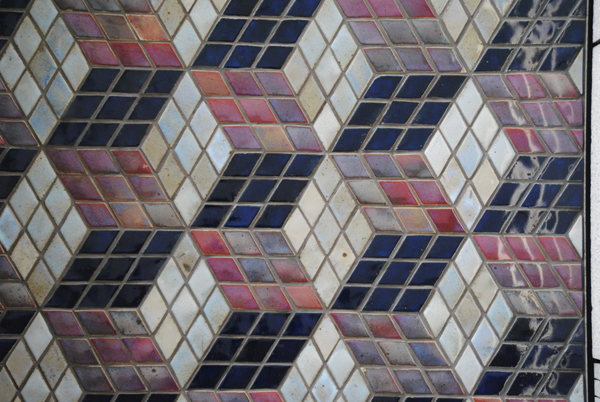
Bit of a harder one this week – these Escher-like patterns are found on a series of tiles located a wall in Waithman Street in the City of London (they are actually on the back of a building at 100 Bridge Street). According to the Tiles & Architectural Society Ceramics Society’s Gazetter, the 23 handmade stoneware tile panels were the 1992 creation of potter Rupert Spira, carried out at the behest of developers Rosehaugh Stanhope. While Spira apparently made 18,000 tiles for a garden in Paris, the tiles in Waithman Street were his only ever  British commission for tiles. Waithman Street, incidentally, is named for Robert Waithman, a draper and MP who was elected Lord Mayor of London in 1823.

Lost London: Gates Special – Newgate

Better known now as the name for the infamous former prison which whom its history is intertwined, Newgate was originally one of the seven principal gates of London and, like five others, originally dates back to Roman times.

The gate, which apparently took the name ‘new’ thanks to a rebuild in the early medieval era, possibly in the reign of King Henry I or King Stephen, was located close to where the street known as Newgate meets the Old Bailey (see picture – there’s a blue plaque marking the spot on Newgate).

It was used as a prison from the 12th century for housing debtors and felons  – in the 13th century King Henry III is recorded as having issued orders for the prison’s repair (You can see our earlier entry on the prison here.)

The gate’s prison function – this was really no more than a few ‘cells’ – was substantially added to in the 1420s when, apparently as required under the terms of former Mayor Richard Whittington’s will, the gate was rebuilt and a new prison building was constructed to the south on what is now the site of the Old Bailey (home of the Central Criminal Court).

The gate was eventually demolished in the mid 18th century apparently due to urban planning issues. The prison, meanwhile, continued to be used until 1902 and was finally pulled down two years later.

Lost London: Gates Special – Moorgate

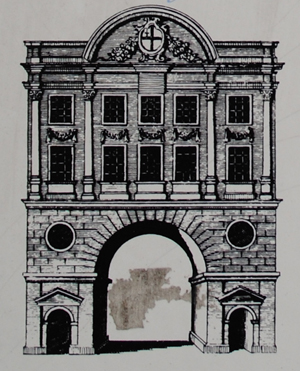
Originally a postern (small or secondary) gate built by the Romans, Moorgate came into its own as a larger gate in the 15th century and survived for more than 300 years before it was demolished in 1761.

The name comes from the area in which it stands – Moorfields, one of the last open pieces of space within the City of London – stood just to the north of the gate. It was originally a sparsely populated marshy expanse – so much so that when the gate was first built, the area around it was often flooded and some local residents used boats as a means of transport – but was later drained. Many people were evacuated here during the Great Fire of London in 1666 and some apparently then settled in the area which later also gained a reputation as a hiding place for highwaymen like Jack Sheppard – we’ll take a closer look at Moorfields in a later post.

The gate known as Moorgate, meanwhile, was first rebuilt as a full sized gate with towers in 1415 on the orders of then Mayor Thomas Falconer to provide access to the fields without. It was enlarged several times in medieval years before being damaged in the Great Fire. It was replaced with a ceremonial stone gate in 1672 to provide access to the now well-drained fields before being demolished in 1761 (some of the stone was apparently later used to support the newly widened central arch of London Bridge).

The gate’s name now lives on in the street known as Moorgate (originally formally known as Moorgate Street after it was first constructed in 1846) – worth noting is that the Romantic poet John Keats was born in the street. The area around the street also is also known by the name Moorgate and is home to some of the City’s key financial institutions.

There’s a plaque near where the site of Moorgate once stood at the corner of Moorgate and London Wall.

PICTURE: Moorgate in its final, ornate form. Taken from a London Wall Walk plaque.

10 curiously named churches of London – 9. St Michael Paternoster Royal

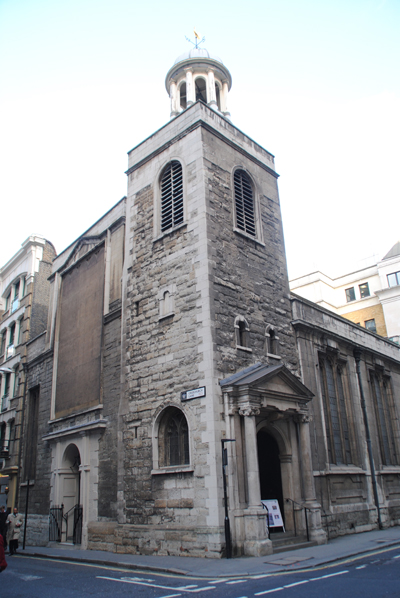
This triple-monikered church was first recorded in the 1200s. Far from unique in its dedication to the Archangel St Michael (there were apparently seven churches which were dedicated to him before the Great Fire), it was distinguished from the others by the name Paternoster Royal.

Surprisingly, the name has nothing to do with royalty or the clergy, at least not directly. The name Paternoster comes from the church’s location on what was Paternoster Lane (it’s now College Hill) – it was named for the number of paternoster or rosary seller that were based there.

The name Royal, meanwhile, is a little bit more obscure. First applied in the 1300s, it apparently comes from the close proximity of another street called Le Ryole which was itself a corruption of the French town of La Reole in the wine districts near Bordeaux. The street is believed to have been given the name thanks to the number of wine merchants who traded there.

Like other London churches, this one has been rebuilt several times – notably after the Great Fire of London (to the designs of Sir Christopher Wren) and again after World War II during which the church was all but destroyed by a V1 flying bomb. Since its reopening in 1968 it has served as the international headquarters of the Christian organisation, the Mission to Seafarers, which supports chaplains working in ports around the world.

The walls date from Wren’s time and the stone steeple, which wasn’t completed until 1717, is the work of Nicholas Hawksmoor. The interior features carved figures of Moses and Aaron which stand before the reredos – these apparently came from All-Hallows-the-Great (demolished in 1894) as did the chandelier which bears the words ‘Birmingham 1644’).

High profile parishioners over the years have included the four time Lord Mayor of London, Dick Whittington (see our earlier post on him) – he paid for a substantial extension of the church and founded a college of priests there (it’s from this college, which was dissolved in the mid-1500s and then re-established soon after, that College Hill is believed to have derived its name) as well as an almshouse next door.

Whittington and his wife were both buried inside but he was apparently exumed since several times and the location of his body is now unknown. There’s a stained glass window depicting Whittington and his famous cat inside and the gardens just outside also bear his name.

10 curiously named churches of London – 8. St Lawrence Jewry

The reason for the name of this church, founded in 1136, may seem obvious – it was associated with London’s Jewish community, thanks to its location on the edge of the area in which they lived (this area was centred on the street just to the south still known as Old Jewry).

What is perhaps more amazing may be the fact that the name stuck despite the expulsion of all Jews from London in 1291, the name was still used to distinguish it from other churches.

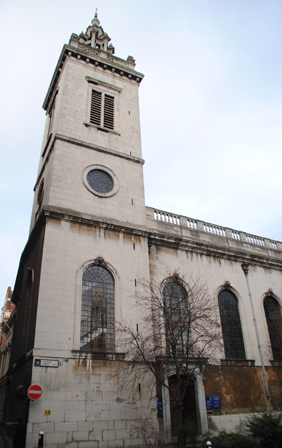
The church – named in honor of St Lawrence, a Roman era martyr who was slow grilled over a fire – was among those consumed in the Great Fire of London and rebuilt by Sir Christopher Wren afterwards. This new church had the honor of being reopened by King Charles II in 1677 – it was badly damaged in the Blitz before being rebuilt by Cecil Brown to Wren’s original design.

Located just off Guildhall Yard – home of the City’s authorities – St Lawrence Jewry is the official church of the Corporation of London and as such hosts a number of special services for the Lord Mayor and Aldermen during the year. Some 11 livery companies have links with the church – among them are those of tallow chandlers, loriners, girders, haberdashers and actuaries.

Worth noting on the inside is the painting of the martyrdom of St Lawrence – this survived the Blitz along with the tower and outer walls – and the many beautiful stained glass windows, painstakingly restored after World War II. There’s also a pond, complete with fish, outside the main entrance.

WHERE: Guildhall Yard (nearest Tube stations are St Paul’s, Bank and, a little further off, Moorgate and Mansion House). WHEN: 8am to 6pm Monday to FridayCOST: Free; WEBSITE: www.stlawrencejewry.org.uk.

10 curiously named churches of London – 7. St Margaret Pattens

It’s not often you’d come across a church named after a type of shoe, but that’s the case with the church of St Margaret Pattens.

Located in Eastcheap, a church dedicated to St Margaret – a saint who was martyred in Antioch in the Middle East – has stood on the current site for at least 900 years. The earliest reference dates from 1067 and the church was rebuilt at least once in the medieval period, with the costs of construction apparently partly funded out of gifts presented to a crucifix or rood which stood in Rood Lane close to the church.

It’s only since the 17th century, however, when the church was rebuilt to the design of Sir Christopher Wren after the Great Fire of London, that it took on the name ‘Pattens’ to distinguish itself from other churches dedicated to St Margaret.

Pattens were wooden undershoes which were trapped beneath normal footwear and raised the wearer above the street, allowing them to walk across muddy roads and still arrive at their destination cleanshod. This footwear was apparently made and sold near which the church was located.

The trade of pattenmaking, incidentially, died out as streets became paved – according to the church’s website, the last pattenmaker died in the 19th century. There’s still a sign in the church asking women to remove their pattens before entering.

It’s worth noting before we move on that there is an alternative theory as to the origins of the name – this is that it commemorates a benefactor, possibly a canon at St Paul’s named Ranulf Patin – but it’s the former interpretation which is more widely accepted.

St Margaret Pattens, which was united with that of St Gabriel Fen after the latter was destroyed in the Great Fire, was damaged by bombing in World War II but was restored in the mid 1950s.

While the church lost many of its valuables during the Reformation (with the exception of a silver gilt communion cup dating from 1545 – on loan to the Victoria & Albert Museum), notable features inside include a memorial to King Charles I (since 1890, the king has been remembered in a special service each year held on the nearest Thursday to the date of his execution – 30th January) and a Royal Stuart Coat-of-Arms believed to be those of King James II.

There’s also a reredos containing a painting by Italian Carlo Maratta (1625-1713), two unusual canopied pews reserved for churchwardens, an hourglass dating from 1750 used to time the sermons, and a bell which dates from before the Great Fire. It’s also possible to view a set of pattens.

Among those who have been associated with the church is famed medieval Lord Mayor of London, Dick Whittington, apparently at one time the church’s patron (you can see our earlier post on him here), as well as livery companies including, as one would expect, the Worshipful Company of Pattenmakers, and the Worshipful Company of Basketmakers.

WHERE: Corner of Eastcheap and Rood Lane (nearest Tube stations are Monument, Bank and Tower Hill). WHEN: Weekdays from 10.30am (check website for services)COST: Free; WEBSITE: www.stmargaretpattens.org.

10 curiously named churches of London – 6. St Katharine Cree

Contrary to what some may, St Katharine Cree is not named after a person of that name (or at least not entirely). St Katherine, certainly, but the addition of ‘Cree’ is simply a medieval corruption of ‘Christ Church’.

The name Christ Church, abbreviated to Cree, was applied to this church because it was the prior of the Augustinian Priory of the Holy Trinity in Aldgate, also known as Christ Church, who founded St Katharine Cree in 1280 for the use of the area’s parishioners (apparently their use of the priory church was causing problems).

The current building dates from 1630 (although the tower dates from 1504), making it the only surviving Jacobean church in London.

It  was consecrated by William Laud, then Bishop of London (and later beheaded for, among other things, his support of King Charles I). He is commemorated in one of the church’s chapels.

Unlike so many other of London’s churches, St Katharine Cree was not destroyed in the Great Fire of London and only suffered minor damage in the Blitz. But structural problems meant it did need substantial restoration in the 1960s.

Inside, is a mid 17th century font and stained glass dating from the same era which depicts a Catherine wheel (St Katherine/Catherine is said to have died strapped to a spiked wheel when martyred during the time of the Roman Empire.).

There is also a rose window which was modelled on that of old St Paul’s Cathedral (before it was destroyed by the Great Fire). Parts of the organ, which was restored in the early Noughties, date from the 17th century and the original was played by none other than George Frideric Handel and Henry Purcell. The six bells were restored in 2009 following an appeal.

Among those buried at St Katharine Cree are Sir Nicholas Throckmorton, a 16th century diplomat (his monument is inside), and the artist Hans Holbein the Younger (his grave is also claimed by St Andrew Undershaft).

The church today has no parish but is the Guild Church to Finance, Commerce and Industry (its rector is that of St Olave Hart Street). Among its annual events is the Lion Sermon given in October, a tradition that dates back to 1643 and owes its origins to the former Lord Mayor of London, Sir John Gayer, who decided to finance the sermon after he survived an encounter with a lion in Syria.

WHERE: Leadenhall Street, London (nearest Tube stations are Aldgate and Tower Hill); WHEN: See website for service timesCOST: Free; WEBSITE: www.sanctuaryinthecity.net/St-Katharine-Cree.html.

10 curiously named churches of London – 4. St James Garlickhythe

Situated close to London’s riverfront, there is believed to have been a church on this site since at least 1100, although it is believed to have been previously dedicated jointly to the apostles St James and St John.

The name of Garlickhythe can be explained by its location – the word ‘hythe’ is a Saxon word for a landing place or jetty and it is believed garlic, used as a preservative and medication, was unloaded nearby and even possibly traded on Garlick Hill where the church stands.

The church was rebuilt in the 1300s and again after the Great Fire (it was another of Sir Christopher Wren’s designs and thanks to the abundance of natural light inside was known as ‘Wren’s Lantern’) but it largely escaped damaged in World War II (the projecting tower clock was among the casualities but while a 500 lb bomb buried itself in the south-east corner of the church, it failed to explode).

What bombs failed to do, however, a death watch beetle did and when one was discovered in the roof timbers in the 1950s, the church was closed until 1963 while it was restored. The exterior clock was restored in 1988 and repairs to the south transept were required after a crane counterweight smashed into the church in 1991.

Inside, the church boasts the second highest ceiling  – 40 foot – of any churches in London (St Paul’s being the highest) and much of the carved woodwork inside, including the font cover, altar table and churchwardens pews, is still original.

There is also original ironwork including a mayoral swordrest as well as a Stuart and Georgian coat-of-arms (the Stuart arms are among a number of features which come from St Michael Queenhithe – it was combined with this parish in the late 1800s; St Michael’s was pulled down in 1894 ).

The magnificent Bernhard Schmidt organ was installed in 1718. The church also houses two rare chalices dating from the time of Edward VI in the mid-16th century and some other rare plate as well as the oldest parish registers in England (these date from the 16th century with the first entry being that of the baptism of Edward Butler on 18th November, 1535).

St James Garlickhythe, which sits in the parish of St James Garlickhythe with St Michael Queenhithe and Holy Trinity-the-Less (the latter being another now demolished church), boasts connections to 12 livery companies including the Vintners (the church is located in Vintry Ward) and the Joiners. Among those buried there are six former mayors.

The church is currently appealing for funds for a new ring of eight bells to mark the Diamond Jubilee of Queen Elizabeth II next year.

And we couldn’t mention the church without referring to Jimmy Garlick, the church’s mummy. An embalmed body of an older man, this was discovered in the church vaults in 1855 and, identity unknown, was subsequently put on display so that curious onlookers could, for a small fee, look upon him or apparently even touch him. Jimmy, whose identity remains unknown, is no longer on public view.

WHERE: Garlick Hill (just off Upper Thames Street) (nearest Tube station is Mansion House). WHEN: See website for service timesCOST: Free; WEBSITE: www.stjamesgarlickhythe.org.

10 curiously named churches of London – 3. St Mary-le-Bow

We’ve already touched on the history of St Mary-le-Bow in our earlier series on Sir Christopher Wren but thought it was worth revisiting in a bit more detail. 

Another of Wren’s churches (after all, remember he designed more than 50 in the city), St Mary-le-Bow, on the corner of Cheapside and Bow Lane, has a history dating back at least to the Norman Conquest (although it is thought it may stand on the site of an earlier Saxon church) when it was constructed of Caen stone on the orders of Lanfranc, the new Archbishop of Canterbury, and was perhaps seen as a symbol of Norman oppression.

The name ‘le Bow’ is said to come from the Norman arches (it was apparently initially known as St Mary de Arcubus) which stand in what is now the crypt – this would have only been partially underground when built. From 1251, it hosted one of the church’s most important courts, which, thanks to its location, was known as the Court of the Arches. There is now a cafe in the crypt.

Like many other churches in the City, St Mary-le-Bow has been repeatedly repaired and rebuilt – following damage in a tornado in the late 11th century, the collapse of its tower in 1271, and, of course, the Great Fire of London in 1666 – Wren’s subsequent rebuilding included the construction of the fine great tower (pictured here against the backdrop of more modern City buildings, it was his second tallest structure after St Paul’s and was built to accommodate the Bow bells ). The church’s most recent remodelling was in 1964 after it was almost completely destroyed during bombing in May, 1941.

One of the church’s most important claims to fame is its bells. These included the city’s principal curfew bell, rung at 9pm each day since at least as far back as 1363. It is said that ‘true Londoners’ or ‘Cockneys’ must be born within hearing of the Bow bells and it was the pealing of the Bow bells (or what may have only been one bell at the time) which, of course, caused thrice-mayor Dick Whittington to turn back when leaving London. The church (in particular, its curfew bell) is also among a number of City churches mentioned in various versions of the rhyming song, Oranges and Lemons.

Features inside include a memorial to the first British Governor of New South Wales in Australia, Admiral Arthur Phillip, who was born nearby, and a bronze relief of St George and the Dragon given by Norway in commemoration of the work of the Norwegian Resistance during World War II. The churchyard outside contains a statue of Captain John Smith, founder of Virginia, and former parishioner.

For an indepth history of the church, you can’t go past the rather comprehensive St Mary-le-Bow: A History.

WHERE: Cheapside (nearest Tube station is St Paul’s). WHEN: 7.30am to 6pm Monday to Wednesday (closes 6.30pm Thursday and 4pm Friday and not usually open on weekends or bank holidays)COST: Free; WEBSITE: www.stmarylebow.co.uk.

LondonLife Special – The Lord Mayor’s Show…

Last Saturday was the Lord Mayor’s Show, the annual three mile long procession through the streets of the City of London celebrating the arrival of the new Lord Mayor – in this case David Wootton, the City’s 684th Lord Mayor…

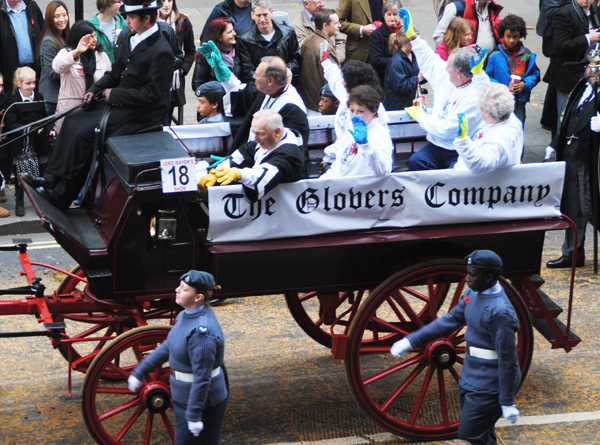
The Show always features entries by livery companies, some of which have ancient roots such as the Worshipful Company of Glovers (pictured above), first formed in 1349…

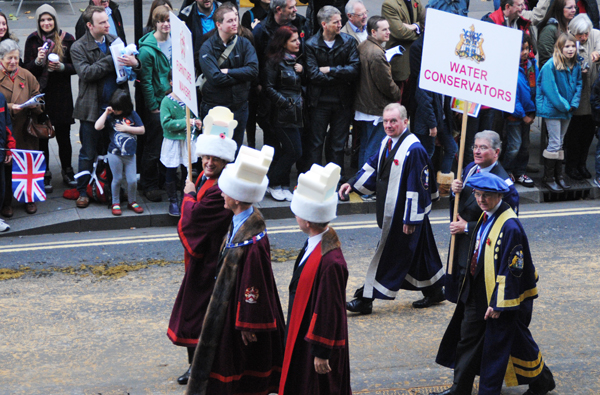
…and some which don’t, such as the Worshipful Company of Furniture Makers and the Worshipful Company of Water Conservators (representatives of which are pictured above), two of the so-called “modern livery companies”.

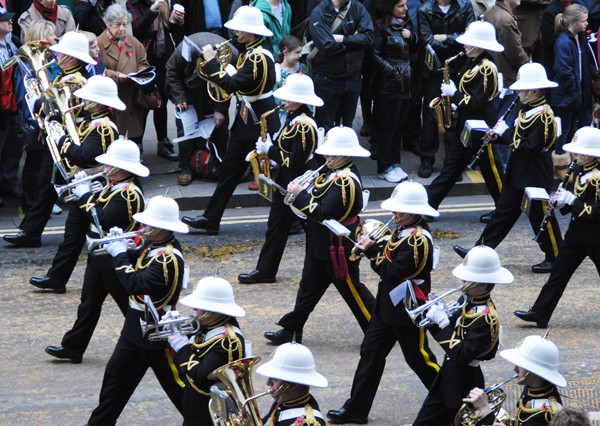
From our vantage point above Cheapside, we saw massed bands aplenty (seen above is the Royal British Legion Band & Corps of Drums from Romford)…

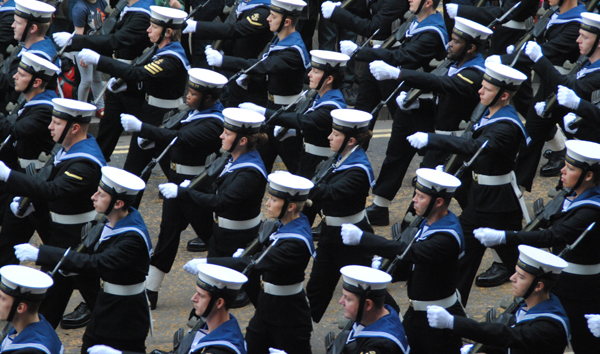
          …marching naval, army and airforce personnel…

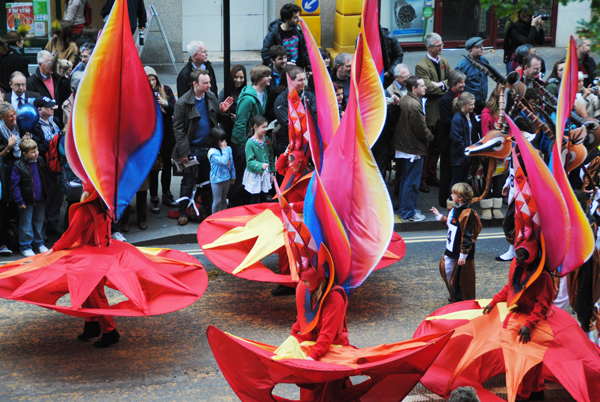
         …as well as lots of color…

…before the arrival of Lord Mayor David Wootton in the 18th century State Coach drawn by six shire horses. The Lord Mayor proceded onto St Paul’s Cathedral where he was blessed before moving onto the Royal Courts of Justice where he swore allegiance to the Sovereign (and then returning to Mansion House via Queen Victoria Street). Late in the afternoon, he presided over a stunning fireworks display on the Thames. For more information about this annual event, see www.lordmayorshow.org.