
A flight of pigeons meet outside Embankment Tube Station.
A flight of pigeons meet outside Embankment Tube Station.
 In contrast to the colourless smog which has lain over London, Scottish artist David Batchelor’s sculpture, Chromolocomotion, brings a splash of colour to the Grand Terrace at St Pancras International. Unveiled this week, the 20 by 10 metre work consists of 44 L-shaped pieces of coloured perspex suspended from the Grade I-listed roof of the Barlow Shed. It replaces Lucy and Jorge Orta’s Cloud: Meteoros and is the second installation commissioned by St Pancras International’s owners HS1 Ltd as part of the Terrace Wires initiative. The work will remain in place until late September. For more on the initiative, see www.terracewires.co.uk. PICTURE: HS1 Ltd.
 Located close to Tower Hill in the eastern part of the City, this pub – and indeed the street in which it sits (at number 64-73) – takes its name from a former nunnery that was once located here.
Known as the Minoresses, the nuns – who belonged to the Order of St Clare (also known as the Poor Clares) – lived in a nunnery here. The institution was founded by in 1293 by Edmund, the brother to King Edward I (reigned 1272-1307), and the earl of Lancaster, Leicester, and Derby, to house nuns who had been brought to England from Spain by the earl’s wife, Blanche of Artois, the widow of King Henry I of Navarre.
As with the case of the Black Friars, the name came to be used to refer to the district in which the now long-gone nunnery once stood (it was dissolved in the Great Dissolution and later used as a residence by the likes of Henry, Duke of Suffolk and father of Lady Jane Grey) and lives on in the name of the street and the pub.
The pub, which has undergone a paint job since our picture was taken, is located under a railway bridge (and may have once been part of the former Minories Railway Station which closed in 1873. For more, see www.minories-london.co.uk.
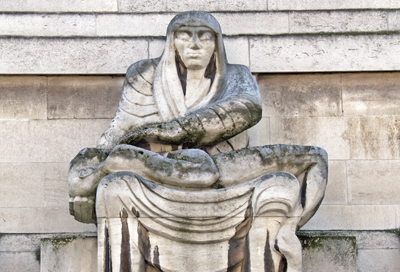
Controversial when first unveiled in the late 1920s, Jacob Epstein’s sculptures of Day and Night adorn the facade on the Grade I-listed building at 55 Broadway – home, for the present at least, to the London Underground HQ and St James’s Park Underground station.
It was the nudity and, no doubt, the stark modernist styling which provoked outrage (and newspaper campaigns) when the two sculptures – Day, depicting a seated smiling male figure with a naked boy standing in front of him and the other, Night, depicting a cowled female seated and cradling a prone, apparently resting, figure (pictured above) – were unveiled.
Such was the outcry that Frank Pick, the then head of the Underground Electric Railways Company of London (predecessor to London Underground and the organisation for whom the building was constructed), even apparently offered his resignation over it. But a compromise was reached – Epstein agreed to alter the naked figure of the boy (a rather painful snip) and the fuss soon died down. These days many people pass the building without even noticing the sculptures upon it.
Epstein’s statues aren’t the only sculptural works to adorn 55 Broadway – a series of eight smaller relief works representing the winds of each cardinal point can also be seen on the facade. All eight representations are of nude figures of different genders and were created by six different artists – Eric Gill, Alfred Gerrard, Allan Wyon, Eric Aumonier, Samuel Rabinovitch and Henry Moore (interestingly, it was Moore’s first public commission).
It’s been reported that London Underground will be vacating the building next year with the property to be converted into rather expensive flats.
PICTURE: Wikipedia
 The Brompton Road tube station, which closed in 1934 after being made redundant following the opening of other stations, sold for a reported £53 million over the weekend. The former Piccadilly Line station, located between South Kensington and Knightsbridge stations, opened in 1906 and was designed by architect Leslie Green for the Great Northern, Piccadilly and Brompton Railway. It was used as a command centre for anti-aircraft guns during World War II and the story goes was where Nazi Rudolf Hess was interrogated after being captured in 1941. Owned up until the sale by the Ministry of Defence, it was most recently used as a training centre for air cadets and naval reservists. It will reportedly be converted into residential flats.
 Way back in 2011 we ran a series looking at some of London’s most curious memorials. We’ve decided to revisit that theme in our new special series.
To kick it off, we’re taking a look at a group memorial found just outside Liverpool Street Station and dedicated to the thousands of Jewish children who arrived in the UK as refugees over nine months in 1938 and 1939, having fled the Nazis in Europe after the anti-Semitic attacks of the Kristallnacht.
Called Kindertransport – The Arrival, the group of bronze statues representing children with their luggage having just stepped off a train at the station were unveiled in 2006 in Hope Square. A short stretch of railway tracks lays behind them.
The memorial is the work of Frank Meisler – himself a child who travelled on a Kindertransport train from Danzig – and bears an inscription: “Children of the Kindertransport. In gratitude to the people of Britain for saving the lives of 10,000 unaccompanied mainly Jewish children who fled from Nazi persecution in 1938 and 1939. ‘Whosoever rescues a single soul is credited as though they had saved the whole world.’ Talmud.” It is dedicated by the Association of Jewish Refugees and the Central British Fund for Jewish World Relief.
Around the statue group are a series of blocks upon which is inscribed the names of the cities from which the children fled. They include the cities of Cologne, Hanover, Stuttgart, Frankfurt, Munich, Danzig, Breslau, Prague, Hamburg, Leipzig, Berlin and Vienna along with others.
The statue is one of four, all created by Meisler, which have been erected along the route the children took to reach safety. Others can be found at the main railway station Gdansk in Poland, Friedrichstraße railway station in Berlin, and another in Rotterdam, The Netherlands.
Hope Square also contains another plaque which dedicates the square to the children of the Kinderstransport “who found hope and safety in Britain through the gateway of Liverpool Street Station”.
In late June, an event was held in the St James’s Palace to mark the 75th anniversary of the Kindertransport.
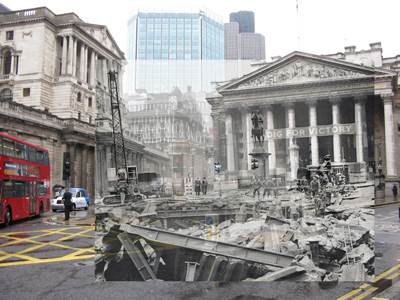
Images from the Museum of London’s Streetmuseum app give a glimpse into London’s past – in this case, its wartime history. The image above, taken by Police Constable Arthur Cross, official photographer of the City of London Police, and his assistant PC Fred Tibbs, shows bomb damage at Bank Underground Station, following a direct hit on 10th January, 1941. An estimated 111 people who had been sheltering in the Tube died, some of them thrown into the path of an incoming train. The crater that was left outside the Royal Exchange was so large the Royal Engineers had to build a bridge across it. For details on how to download the app, head to www.museumoflondon.org.uk/Resources/app/you-are-here-app/home.html. PICTURE: © Museum of London/By Kind Permission of The Commissioner of the City of London Police.
In this, the year of the 150th anniversary of the creation of what we now know as the London Underground, it’s only fitting that we take a look at the city’s oldest Tube station – Baker Street.
Opened on 10th January, 1863, by the Metropolitan Railway, the Grade II* listed property was designed by John Fowler, the company’s engineer in chief. While some stations on the initial railway – which stretched from Paddington to Farringdon – had platforms located in open cuttings, Baker Street was one of only three initial stations (the other two were at what was then named Gower Street (now Euston Square) and Great Portland Street) which was genuinely located underground, with subterranean platforms covered by brick barrel-vaults and lit by gaslights as well as natural light brought from the surface by “lunettes”.
The station was subsequently extended and further developed and, thanks to the company’s desire to make Baker Street its headquarters and “flagship” station, it underwent a major overhaul in 1911-13 with Charles Walter Clark, another Metropolitan Railway employee, designing a new grand booking hall and concourse featuring a lost property office, “ladies’ room” and a WH Smith bookstall.
Features inside include a cast-iron screen – complete with clock – installed at the entrance to the lower concourse in 1925 to help control passenger flow during the British Empire Exhibition at Wembley, a marble memorial to Metropolitan Railway employees who died in World War I, and, in a nod to the proximity of his fictitious Baker Street residence, large and small Sherlock Holmes silhouettes on tiles located at various places inside (there’s a statue of him outside the station).
For more on the 150th anniversary, see www.tfl.gov.uk/tube150.
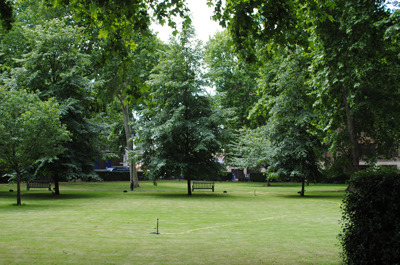 The final in our series on historic garden squares in London (for this year, anyway), we’re taking a look at Charterhouse Square.
The five sided square, located just to the east of Smithfield, takes its name from a Carthusian monastery which was established in 1371 on what is now its north side. Prior to this, what is now the square had from 1348 served as a location for a plaque burial pit (a number of skeletons from the plaque pit have been unearthed as part of the Crossrail project – for our earlier story on this, follow this link).
The monastery was dissolved in 1537 after the monk’s refused to recognise King Henry VIII’s Act of Supremacy (some were later executed at Tyburn) and it was subsequently transformed into a manor house with Thomas Howard, the 4th Duke of Norfolk, among its residents over the years (in fact he was imprisoned there around 1570 for allegedly plotting to marry Mary, Queen of Scots – he was later executed by Queen Elizabeth I for treason).
Under the will of Thomas Sutton, an almshouse and school was subsequently established on the site – the almshouse remains there while the school, whose students had included Methodism founder John Wesley and writer William Makepeace Thackeray, moved out to Godalming in Surrey in 1872. As well as the almshouse (which is open for guided tours, check this site for details), some of the buildings are now occupied by medical related institutions.
In the 1600s, the square was also home to numerous other large residences among them Rutland House, which had been the residence of the Venetian ambassador. It lost its aristocratic inhabitants in the ensuing centuries but remained mainly residential up until the late 19th century when it gradually became taken over by businesses and other organisations. Interesting to note is that the east side of the square is still home to the residential unit complex known as Florin Court, better known as Whitehaven Mansions, the home of Hercule Poirot in the TV series which bears his name.
The area of the garden square itself was variously referred to as the Charterhouse Churchyard, the Charterhouse Yard and Charterhouse Close over the years and has gone through numerous incarnations with efforts to improve and formalise its look dating back to at least the 16th century. It was at least partly enclosed by the late 1600s and the fences replaced several times, notably in 1742 when an Act of Parliament was passed allowing residents to fine those who entered without authorisation. The enclosing fences have since been modified several more times.
One of the major changes to the shape of the square occurred in 1860 when the Metropolitan Railway was extended between Farringdon and Moorgate. It was at this time that the road surface which surrounds the central garden, which has a Grade II heritage listing, was laid down.
Today the gardens in the centre of the square remain under the management of the Charterhouse (and hence aren’t open to the general public except on tours) but even without a tour it’s still a quiet place to walk around the outside of, evoking a strong sense of years gone past.
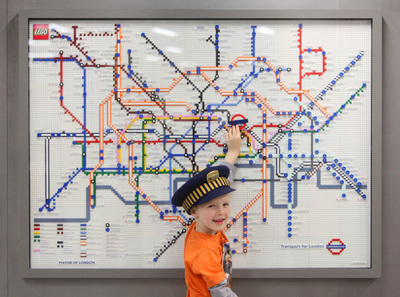
Six-year-old James Apps gets a close-up look at a map of the Tube as it will look in 2020, one of five LEGO Tube maps currently on display in London. The maps depict the evolution of the Tube network from 1927 through what it will look like in 2020, including Crossrail, and the proposed Northern Line extension and proposed Croxley Rail Link. The maps – each of which contains more than 1,000 bricks and took professional LEGO builder Duncan Titmarsh four days to build – can be found in the ticket halls of the following stations – South Kensington (1927), Piccadilly Circus (1933), Green Park (1968), Stratford (2013) and King’s Cross (2020). Visit the Transport for London website for more on the Underground’s 150th anniversary here (the website includes downloadable instructions for building your own Underground roundel out of LEGO bricks). PICTURE: Transport for London.
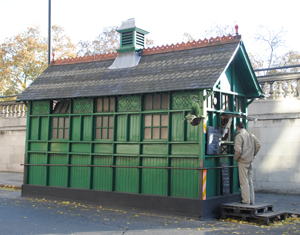 • The London Festival of Architecture has returned with a month long celebration of the city’s built form in a program of events including talks, tours and exhibitions. Among the latter is Lesser Known Architecture – A Celebration of Underappreciated London Buildings – a free exhibition at the Design Museum which runs until 22nd July and looks at 10 structures ranging from London Underground Arcades and Cabmen’s Shelters (one of which is pictured) to Nunhead Cemetery. Other events include an exhibition at Somerset House – Nicholas Hawksmoor: Methodical Imaginings – looking at churches designed by Hawksmoor in the late 17th and early 18th centuries (this runs until 1st September), and The Secret Society – A Sculptural Banquet, a large scale installation by artist and designer Kathy Dalwood at Pitzhanger Manor in Ealing, west London (ends this Sunday). For more on the festival, check out www.londonfestivalofarchitecture.org or for fringe events, http://londonarchitecturediary.com.
• A new exhibition featuring more than 100 images from space – including images of the colourful dust clouds in which new stars are formed, the aurora on the surface of Saturn and the sight of Earth from the International Space Station – opens at the National Maritime Museum in Greenwich tomorrow. Visions of the Universe takes visitors on a “visual trip through our solar system” with images of the moon, sun, plants and distant galaxies. It looks at the development of telescopy and photography and examines our understanding of our place in the cosmos. Space scientists including Astronomer Royal Sir Martin Rees and The Sky at Night‘s Chris Lintott introduce each section of the exhibition which has at its centre a 13×4 metre curved wall known as the ‘Mars Window’. It has the latest images from NASA’s Mars Curiosity Rover projected onto it. There is a programme of events accompanying the exhibition which runs until 15th September. For more, see www.rmg.co.uk.
• Tate Britain is undergoing an overhaul this year with the opening of new galleries and a rearrangement of the institution’s collection. Last month, a new chronological presentation of the institution’s British art opened across more than 2o of the institution’s galleries. BP Walk through British Art features around 500 artworks, dating from the 1500s to present day, by artists ranging from Sir Joshua Reynolds and William Hogarth to JMW Turner, John Constable, Lucien Freud and David Hockney. Meanwhile new galleries have opened dedicated to the works of sculptor Henry Moore and artist William Blake. Around 30 of Moore’s works are featured in the rooms as well as more than 40 of Blake’s works. For more see www.tate.org.uk.
• Apsley House, regency home of the Duke of Wellington, is hosting a series of events every weekend in June in the lead-up to the anniversary of the Battle of Waterloo. Interpreters will be at the house, known as Number 1 London, this weekend to discuss the dress and manners of the era while next weekend (15th and 16th June) visitors have the chance to meet some of Wellington’s soldiers and their wives. Gentry from the Napoleonic era will be celebrating the victory at Waterloo on 22nd and 23rd June while on the final weekend of the month, the focus will be on the 200th anniversary of the Battle of Vitoria in 1813, which led to eventual victory in the Peninsular War. For more, see www.english-heritage.org.uk/daysout/properties/apsley-house/.
• On Now: Coins and the Bible. This free exhibition at the British Museum looks at how money was referred to in the Old and New Testament, and the use of Christian symbols such as crosses or monograms derived from Greek letters on later coins. These include the first coin, dating from about 450 AD, to depict an image of Jesus (the coin, on loan from the Hunterian Museum in Glasgow, is included in the exhibition). There are also early Biblical fragments on papyrus and vellum lent by the British Library and an ivory panel dating from the early 400s AD which includes an image of the purse of 30 pieces of silver Judas received after his betrayal of Jesus. Held in Room 69a, the exhibition runs until 20th October. For more, see www.britishmuseum.org.
 This upmarket square in west London is named in honor of Sir Hans Sloane, the physician come botanist who bought the manor of Chelsea in 1712 and, in doing so, provided grounds for the Chelsea Physic Garden.
Sloane Square was developed by architect Henry Holland Sr and his son Henry Holland Jr in 1771 as part of a residential development they called Hans Town (also named after Sir Hans, it’s still a ward in the Royal Borough of Kensington and Chelsea). For more on Sir Hans Sloane, see our earlier post here.
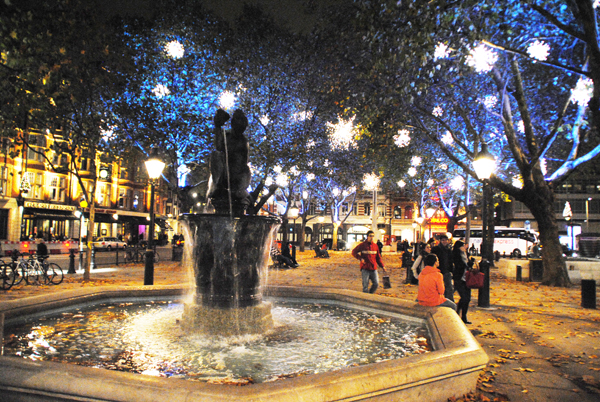
The square, pictured above as it looks decorated for Christmas, initially consisted of a village green bordered with posts and chains and the surrounding buildings were all residential. Apparently the square initially failed to attract the right sort of residents (it was a little too far from Mayfair) but despite this initial setback, it gradually became the centre of a desirable residential precinct.
Private houses began making way for other buildings in the square in the nineteenth century – in 1810, the New Chelsea Theatre opened, subsequently renamed the Royal Court Theatre (this was later moved to another site still on the square and remains there today), and in 1812, the Chelsea, Brompton and Belgrave Dispensary was established for the relief of the sick and the poor.
The Sloane Square Underground station opened in 1868 and rebuilt after it was damaged by bombs in World War II (it’s interesting to note that the River Westbourne actually runs through some iron conduit over the top of the platforms on its way to the River Thames).
Other notable buildings in the square today include the Peter Jones department store which first arrived in the square in the late nineteenth century.
The square itself was redesigned in the 1930s when the war memorial was put in its current position. The Venus Fountain (pictured above) which now stands there – the work of Gilbert Ledward – was erected in 1953.
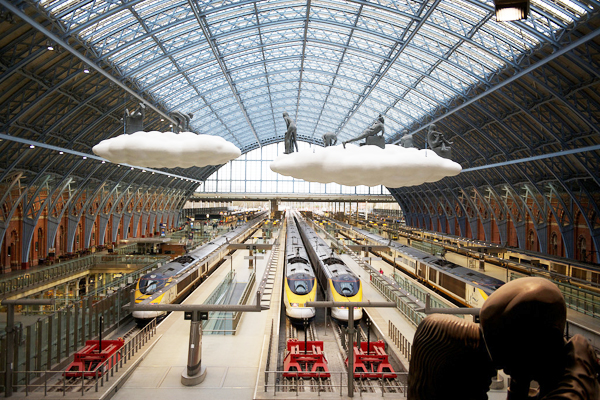
Lucy and Jorge Orta’s sculpture Cloud: Meteoros is the first sculpture to be unveiled for the ‘Terrace Wires’ project at St Pancras International. The sculpture, which hangs on wires from the station’s roof, features two clouds hovering over the station floor on which figures can be seen looking down. Says artist Lucy Orta: “Our sculpture is symbol the space in between: that of the daily routines of the millions of passengers and visitors to the station and the freedom of our imagination, daydreams – looking up to the sky.” The sculpture will remain in place for the rest of the year. For more on art at St Pancras, see http://stpancras.com/art/ and www.terracewires.com. PICTURE: Sam Lane/HS1 Ltd.
• Margaret Thatcher’s funeral will be held next Wednesday at St Paul’s Cathedral from 11am with Queen Elizabeth II among those attending (the first time she has attended the funeral of a British politician since Sir Winston Churchill’s in 1965). The funeral procession of the former Prime Minister, who died on Monday aged 87, will start at the Houses of Parliament and make its way down Whitehall to Trafalgar Square before moving down the Strand, Fleet Street and Ludgate Hill to St Paul’s Cathedral. Baroness Thatcher’s coffin will carried in a hearse for the first part of the journey and will be transferred to a gun carriage drawn by six horses of the King’s Troop Royal Horse Artillery at St Clement Danes church on the Strand for the final part of the journey. There will be a gun salute at the Tower of London. Meanwhile, a Book of Condolence has opened at St Margaret’s Church, beside Westminster Abbey, this morning and will be available for people to pay their respects until 17th April, during the church’s opening hours. St Margaret’s – which stands between Westminster Abbey and the Houses of Parliament – is commonly known as the parish church of the House of Commons.
• The story of the Jewel Tower – one of the last remaining parts of the medieval Palace of Westminster – is told in a new exhibition at the historic property. Now in the care of English Heritage, the tower – located to the south of Westminster Abbey, was built in 1365 to house King Edward III’s treasury, later used as King Henry VIII”s ‘junk room’, the record office for the House of Lords, and, from 1869, served was the “testing laboratory” for the Office of Weights and Measures. The exhibition, which opened this month, is part of the English Heritage celebrations commemorating the centenary of the 1913 Ancient Monuments Act. The Jewel Tower is open daily until November. Admission charge applies. For more, see www.english-heritage.co.uk.
• See some of the earliest underground trains, a Lego version of Baker Street station and ride the Acton Miniature Railway. The London Transport Museum’s depot in Acton is holding it’s annual spring open weekend this Saturday and Sunday and in celebration of the Underground’s 150th anniversary, attractions will include the Metropolitan Steam Locomotive No. 1 and the recently restored Metropolitan Carriage 353 along with model displays, rides on the miniature railway, film screenings, talks, and workshops. Wales’ Ffestiniog Railway team – celebrating their own 150th anniversary – will also be present with the narrow gauge train, Prince. Open from 11am to 5pm both days. Admission charge applies. For more, see www.ltmuseum.co.uk.
• Now On: Designs of the Year. The Design Museum has unveiled contenders for the sixth annual Designs of the Year competition and you can what they are in this exhibition. Consisting of more than 90 nominations spanning seven categories, the nominated designs include the Olympic Cauldron by Heatherwick Studio, The Shard – western Europe’s tallest building – by Renzo Piano, a non-stick ketchup bottle invented by the Varanasi Research Group at MIT, and Microsoft’s Windows phone 8. The exhibition runs until 7th July – the winners will be announced this month. Admission charge applies. For more, see www.designmuseum.org.
Happy Easter! We’re taking a break over the Easter weekend…Our next update will be on Tuesday, 2nd April.
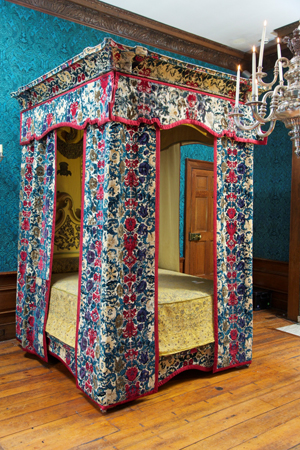 • A new exhibition exploring the secrets of the bedchambers of the Stuart and Hanoverian courts of the 17th and 18th centuries opened at Hampton Court Palace this week. At the heart of Secrets of the Royal Bedchamber are six royal beds which tell the story of why the bedchamber became the most important part of the palace and detail some of the events that took place there before an audience of courtiers, politicians and family members – from births and deaths to the consummation of marriages and the discussion of important affairs of state. It tells of why courtiers would fight for positions such as the ‘groom of the stool’ or ‘necessary woman’ and how beds which could cost the same as a London townhouse were sometimes never slept in. Among the beds on display is the ‘Warming Pan Bed’ (pictured), the State Bed of King James II’s queen, Mary of Modena, and scene of the royal birth that ultimately led to the end of the Stuart line, and the ‘Travelling Bed’ of King George II which travelled as far afield as Hanover and the battlefields of Europe. The exhibition also gives rare access into the Prince of Wales’ Apartments, designed by 17th and 18th architect Sir John Vanbrugh, and now open for the first time in 20 years. Admission charge applies. Runs until 3rd November. For more, see www.hrp.org.uk. PICTURE: HRP
• The Roman cities of Pompeii and Herculaneum are the subject of a major exhibition opening at the British Museum today. Life and death in Pompeii and Herculaneum brings together more than 250 objects from the two cities which were buried in just 24 hours during the eruption of Mount Vesuvius in 79 AD. The objects include celebrated finds and recent discoveries, many of which have never before been seen outside Italy, and help explore what daily life was like for the inhabitants. Artefacts include a beautiful wall painting from Pompeii showing baker Terentius Neo and his wife, wooden furnishings including a linen chest, inlaid stool, and even a baby’s crib from Herculaneum, and casts of victims including a family of four and a dog who died at Pompeii. Runs until 29th September. Admission charge applies. For more, see www.britishmuseum.org.
• Find out more about the history of chocolate at Kew Gardens this Easter, from the ritualistic use of cacao in ancient Mayan and Aztec cultures to the arrival of chocolate in 17th century London, where it was a luxury item for high society to indulge in at newly fashionable chocolate houses. Running from tomorrow until 14th April, there will be a range of workshops taking place at the gardens around the chocolate theme along with a traditional Easter Egg Hunt on Easter Sunday (31st March). The garden’s cocoa tree can be found in the Princess of Wales Conservatory. Admission charge applies. See www.kew.org.
• Harry Beck, designer of the innovative first diagrammatic Tube map, has been honoured by an English Heritage blue plaque – inscribed in the Underground’s new Johnston typeface – at his birthplace in Leyton in London’s east. Beck, who was born in a small terraced house at 14 Wesley Road in 1902, was working with London Transport as a draughtsman in the London Underground Serial Engineer’s Office, when, in 1931, he produced his first design for a diagrammatic map. He continued to update the map with new stations and lines even after leaving London Transport with the last version of his map published in 1960. Beck died in 1974. Meanwhile, a blue plaque commemorating railway engineer Sir Nigel Gresley (1876-1941) has been returned to King’s Cross station following the completion of building work. It can be found on platform 8. For more, see www.english-heritage.org.uk/discover/blue-plaques/.
• On Now: The Underground. A commission from Art on the Underground, this exhibition of artist Mark Wallinger’s work at the Anthony Reynolds Gallery (60 Great Marlborough Street) features some examples of 270 labyrinth designs – one representing each of the Underground stations – which are being installed at the Tube stations themselves. Among those stations represented at this showing are Westminster, St James’s Park, Oxford Circus, Victoria, Embankment, Green Park, King’s Cross St Pancras, Baker Street and Tottenham Court Road. While labyrinths are already in place at these locations, the remainder of Wallinger’s labyrinth designs will be appearing at Tube stations over the coming months. Runs until 27th April. For more, see www.anthonyreynolds.com.
Apologies for the delay in posting this piece – next week we’ll post the final in this series!
The first underground railway system in the world, the London Underground – fondly known as the ‘Tube’ – is this year celebrating the 150th anniversary of its creation.
Born out of an idea to link the inner city with the various large rail termini on the outskirts, the first section of what is now the underground system – a six kilometre stretch between Paddington and Farringdon – opened on 9th January, 1863, and was run by the Metropolitan Railway, known less formally as the ‘Met’.
 It was constructed using the ‘cut and cover’ method in which streets were dug up and tracks laid in a trench before being covered by brick-lined tunnels and the street above replaced (the method was later abandoned, apparently due to the disruption it caused to traffic). The first trains were steam-driven locomotives and drew gas-lit wooden carriages behind them (the first journey was re-enacted earlier this year – see our earlier post here. Other events commemorating the 150th included a visit to Baker Street Station by Queen Elizabeth II, Prince Philip and the Duchess of Cambridge).
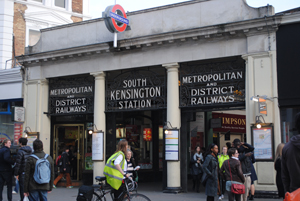
The idea proved a success – 26,000 people used the new railway every day during the first six months of its operation – and the Metropolitan District Railway opened a new line between Westminster and South Kensington (station is pictured) in December, 1868, while the first Tube tunnel under the Thames, from the Tower of London to Bermondsey, opened in 1880, and what is now the Circle Line was completed in 1884.
In December 1890, the world’s first deep-level electric railway opened, running between King William Street in the City and passing under the Thames to Stockwell. Ten years later the ‘Twopenny Tube’, more formally known as the Central London Railway, opened between Shepherd’s Bush and Bank (it was from this that the use of the word ‘Tube’ to describe the Underground system caught on).
The uniting of the system began the following year with the creation of the Underground Electric Railway Company of London and by World War I, all but the Met were within a single group organisation. The name Underground first appeared on stations in 1908, the same year electric ticket machines were introduced.
In 1933, the Underground came under the control of the London Passenger Transport Board – the same year that Harry Beck’s first diagrammatic map of the underground system appeared.
Stations in the system were used as air raid shelters during World War II – part of the Piccadilly Line was closed and used as a storage site for treasures from the British Museum. Following the war, the organisation running the system went through various name changes until the formation of London Underground in 1985.
The system has since expanded – the Victoria Line was opened in the late 1960s and the Jubilee Line a decade later – and now consists of more than 408 kilometres of railway lines and 275 stations which serve more than three million passengers a day – equating to more than a billion a year, the same as the entire national rail network.
For more on the history of the Underground, see our earlier 10 Questions with London Transport Museum curator Simon Murphy. Poster Art 150 – London Underground’s Greatest Designs runs at the London Transport Museum until October. Admission charge applies. For more (including the many events around the exhibition), see www.ltmuseum.co.uk/whats-on/events/events-calendar#posterart150.
For more, check out David Bownes’ Underground: How the Tube Shaped London

The original entrance to Euston Station, Euston Arch was not so much an arch as a colonnaded monumental gateway, formally known as a propylaeum, which resembled the entrance to a Greek temple.
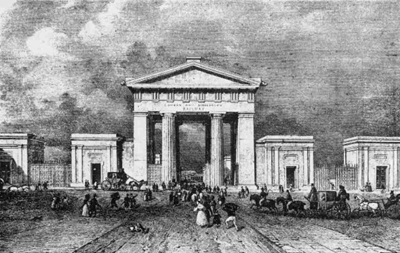 Built in 1837 (pictured here in 1851), it was designed by architect Philip Hardwick and inspired by the ancient architecture he had encountered on a trip to Europe – in particular the grand entrance to the Acropolis in Athens.
Commissioned by the London and Birmingham Railway as the grand entrance to the company’s new station then facing on to Euston Square (the site is now covered by the station structure), it was designed to complement the existing structure which had been built at the other end of the line in Curzon Street Station in Birmingham.
The building, which rose to a height of 21.5 metres and was built from Yorkshire-sourced sandstone, featured four columns behind which stood large iron gates. Rather controversial even when built, it led to an apparently unexciting courtyard lined with offices. There were lodges to either side.
While there had been a couple of proposals to relocate the arch – particularly after notice was given in 1960 that it would be demolished so the station could be rebuilt – none of the proposals came to fruition, and despite some intense last minute lobbying to preserve the arch by conservationists (among those lobbying were poet Sir John Betjeman and architectural scholar Sir Nikolaus Pevsner), demolition – viewed by some as an “architectural crime” – started in December 1961.
While sections of the arch was subsequently used as fill in the Prescott Channel in East London (numerous sections have since been recovered from the water), the main gates were saved and given to the National Railway Museum in York.
There has been talk of rebuilding the arch particularly since the formation of the Euston Arch Trust in 1994 (the patron of which is Michael Palin) with the aim of reusing some of the lost stonework. While rebuilding hasn’t yet eventuated, the proposed redevelopment of Euston Station in more recent years has given the project new impetus.
PICTURE: Wikipedia.
Located just off Liverpool Street in Old Broad Street in the City, The Lord Aberconway is named after the last chairman of the Metropolitan Railway Company, operator of the world’s first underground railway (keep an eye out for our extended piece on the history of the Underground later this week).
 Charles McLaren – Lord Aberconway – (1850-1934) was a landowner, industrialist and MP who was raised to the peerage in 1911, a year after he had left the House of Commons. He served as chairman of ‘The Met’ from 1904 to 1933.
While the current building – the interior of which features booths and an L-shaped bar – dates from the 19th century, there has been a pub on the site, close to Liverpool Street Station, for much longer and its previous names included the King and Keys and the Metropolitan Railway’s ‘Refreshment Room’ and ‘Railway Buffet’.
The pub, which stands not far from the Monument commemorating the Great Fire of London, is reputed to be haunted by victims of the fire (only four people are said to have officially died in the blaze but it’s believed the death toll would have actually been much higher). You’re more likely to see city traders there however.
The pub is now run by the Nicholson’s. For more on the Lord Aberconway, see www.nicholsonspubs.co.uk/thelordaberconwayliverpoolstreetlondon/.
London’s railway network stands out as one of the greatest achievements of the Victorian age for it was during the 19th century that much of the railway infrastructure still in use today was first established.
 The first railway line in London opened in February 1836 (six years after the UK’s first line opened) and ran between Spa Road in Bermondsey and Deptford on the south bank of the River Thames. The line was extended to London Bridge in December that same year and again to Greenwich, from cross-Channel steamers left – in April the following year.
That same year – 1837 – the station at Euston opened as the final stop for trains from Birmingham (an earlier terminus as Chalk Farm was deemed too far out). It was followed by Paddington in 1838, Fenchurch Street – the first permanent terminus in the City – in 1841, Waterloo in 1848 and King’s Cross in 1850.
Having seen a boom period during the 1840s, development of new lines took a back seat in the 1850s but resumed apace the following decade with the opening of Victoria Station, connecting the city to Brighton and Dover. Stations followed at Charing Cross, Ludgate Hill and Cannon Street and alongside the grand terminus’ around the outskirts of London where trains arriving from distant destinations arrived, numerous smaller railways began to be built, such as the West End of London and Crystal Palace Railway and the Victoria Station and Pimlico Railway, which took passengers on only short journeys across the city (these smaller railway companies all disappeared by 1923 when the 1921 Railways Act resulted in the creation of what are known as the “Big Four” British railway companies).
And, of course, the London Underground, has its first journey in 1863 but we’ll look at that in more detail next week.
Interesting to note that there were three classes of rail travel and while first and second class passengers had seats, this wasn’t always the case in third class where, writes Michael Paterson in Inside Dickens’ London, passengers, such as those on the Greenwich line, were initially forced to stand in open topped carriages known by some as ‘standipedes’.
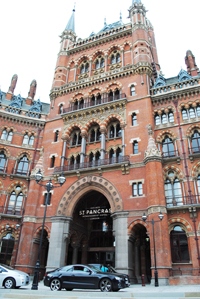
Naturally, with the building of the railways came some spectacular stations – among the most spectacular is the late Victorian building which stood at the front of St Pancras Railway Station and housed the Midland Grand Hotel (pictured above). An exemplar of the Gothic Victorian style, it was designed by Sir George Gilbert Scott and, following a massive recent refurbishment, is now home to the five star Renaissance London Hotel and apartments.
We can, of course, only touch on the history of the railways in such a brief article – but we will be looking in more detail at some more specific elements of the system in later posts.
Simon Murphy is a curator at the London Transport Museum in Covent Garden – the museum is currently celebrating the 150th birthday of the Underground with a series of events including a landmark exhibition on the art of the Tube (Poster Art 150 – London Underground’s Greatest Designs)…
 How significant was the construction of the London Underground in world terms? And how does it stack up 150 years later? “The Metropolitan Railway was a true world class pioneer, but like all pioneers it made mistakes that subsequent operators learned from. Similarly the first tube railways tested the ground for others to follow. But these pioneering lines are still part of today’s world class Tube network, and some of the original stations, like King’s Cross, are still amongst the busiest, so they must have been on the right track.”
I understand the initial stretch of line ran between Farringdon and Paddington. How quickly were other sections opened? “The Metropolitan Railway’s first extension was authorised by Parliament in 1861, two years before the original line even opened. The railway made a profit in its first year, so financial backing was relatively easy to find, and the extension east to Moorgate opened in 1865, with a westward extension to South Kensington following in 1868. The Met’s main competitor, the Metropolitan District Railway, opened its first section from South Ken to Westminster in 1868. The plan was for the two companies to work together to create an Inner Circle service, but their respective directors fell out and the Circle was not completed until 1884.”
How many miles of line is the Underground composed of today? “The first underground started with less than four miles of track and seven stations; today’s system has 250 miles of track, serving 270 stations.”
When were steam trains on the Underground replaced? “Steam trains worked in central London until 1905, but were still used on the furthest reaches of the Met until 1961.”
When did the Underground take on the name ‘Tube’? “The Central London Railway opened with a flat fare of 2d in 1900, and was promoted as the Twopenny Tube – the name caught on, although the Underground has only been referring to itself officially as the Tube since the 1990s.”
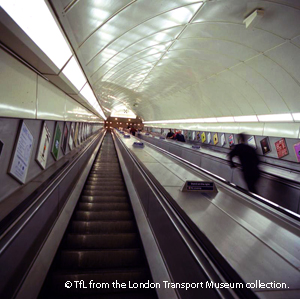 It’s fairly widely known that Underground stations and tunnels were used as air raid shelters during World War II. Do you know of any other different uses they have been put to? “The station at South Kentish Town on the Northern Line closed in 1924, but the surface building, still looking very much like a station is now occupied by a branch of Cash Converters. During the war unfinished tunnels on the Central line were occupied by a secret factory run by Plessey Components. Also during the war, paintings from the Tate Gallery were stored in a disused part of Piccadilly Circus station for safe keeping.”
Stylish design has always been an important part of the Underground’s appeal. What’s your favourite era stylistically when it comes to the Underground and why? “Most people admire the golden age of the 1920s and 30s when the Underground’s corporate identity and personality reached its peak with Charles Holden’s architecture, the roundel, Harry Beck’s diagrammatic map and the amazing posters issued in that era, but personally I find the earlier period from 1908 to 1920 more interesting. You can trace the roots of each element of today’s brand being developed at this time, under Frank Pick’s critical eye, starting with the early solid-disc station name roundels, the joint promotion of the individual tube railways under the UndergrounD brand and the introduction of Edward Johnston’s typeface. You can see the company gaining confidence and momentum, especially in relation to the increasingly sophisticated posters and promotion that Pick commissioned.”
Can you tell us a bit about how the London Transport Museum is marking the 150th anniversary? “We started the year by bringing steam back to the Circle line, after restoring an original Metropolitan Railway carriage and overhauling an original Met steam locomotive, and have just opened our fabulous overview of the 150 best Underground posters at the museum in Covent Garden, which runs until October. We are opening our Depot store, near Acton Town station in April for a steam weekend, and have a range of lectures and evening events at Covent Garden linking to the history of the Underground and its poster art heritage. There’s also our comprehensive new history of the Tube published last year and a wide range of new products and souvenirs in our amazing shop.”
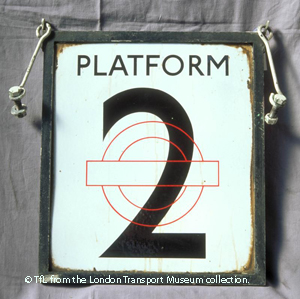 What are some of your favourite Underground-related objects on display at the museum? “The Design for Travel gallery on the ground floor is the literal and metaphorical heart of the Museum for me. Packed with close to 300 objects including signs, posters, models, leaflets and other documents, it’s hard to single out individual items, but I love the simplicity of the small ‘Platform 2’ hanging sign (pictured right) – it’s a real example of the design consistency and attention to detail that I associate with the Underground.”
And lastly, can you tell us a couple of little-known facts about the Underground? History is more than a chronological list of facts, and what one person finds fascinating sends another to sleep, so it’s quite a challenge to choose something that is little known, but genuinely interesting, but I’ll try: I grew up near Brent Cross station so I might be biased, but I reckon that if there was a top trumps for Underground lines, the Northern line would win. It has the longest escalators (at Euston), the deepest lift shaft (at Hampstead), the highest point ve sea level (on a viaduct near Mill Hill East), the longest tunnels (between East Finchley and Morden – 17 miles) and has had more names than any other line – it only became the Northern line in 1937.”
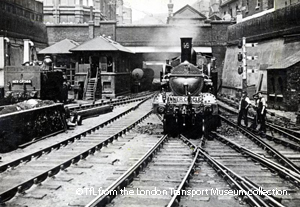
IMAGES: Top: Steam engine at Aldgate (1902); Middle: Platform 2 sign, 1930s design; and Bottom, Angel Underground Station (1990s). © TfL from the London Transport Museum collection.
Poster Art 150 – London Underground’s Greatest Designs runs at the London Transport Museum until October. Admission charge applies. For more (including the many events around the exhibition), see www.ltmuseum.co.uk/whats-on/events/events-calendar#posterart150.
 Exploring London