This rather poignant monument stands in a park above where an air raid shelter once stood in which a wedding party, 13 people in total, lost their lives in late 1940.
Subscribe for just £3 a month to access all of Exploring London’s content…
Weeks after the start of the Blitz, on 13th October, 1940, a bomb struck a residential housing block and the air raid shelter located in Stoke Newington.
Subscribe for just £3 a month to access all of our coverage and support our work.
This month, the UK and other nations marked 80 years since VE (Victory in Europe) Day. London suffered greatly during the Blitz and later rocket attacks, so we thought it appropriate to take a look at some key memorials around the city.
Subscribe for just £3 a month to support our work and access all our content…
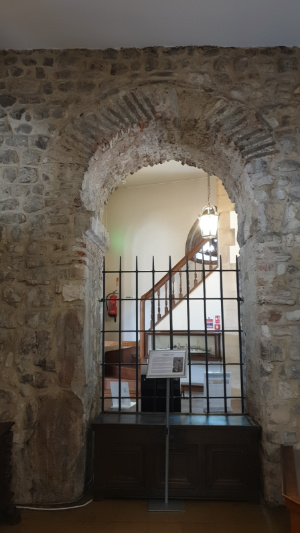
This rounded arch in the Church of All Hallows is believed to be oldest surviving arch of the Anglo-Saxon period surviving in the City of London.
The arch can be found at the west end of the nave and dates from an earlier church on the site, possibly built as early as the 7th century (the church was later rebuilt and expanded several times, survived the Great Fire in 1666, and was then largely destroyed during the Blitz before being rebuilt and reconsecrated in 1957).
Roman tiles have been reused in the arch’s construction as well as Kentish ragstone and it doesn’t include a keystone.
The arch was fully revealed after a bombing during the Blitz in 1940 brought down a medieval wall and revealed it.
The arch has given some weight to the idea that the Anglo-Saxon church was founded not long after Erkenwald founded Barking Abbey in the 7th century (he went on to become the Bishop of London in 675).
WHERE: All Hallows by the Tower, Byward Street (nearest Tube station is Tower Hill); WHEN: 8am to 5pm Monday to Friday; 10am to 5pm Saturday and Sunday; COST: Free; WEBSITE:https://www.ahbtt.org.uk/
PICTURE: Esther Dyson (licensed under CC BY-NC 2.0)
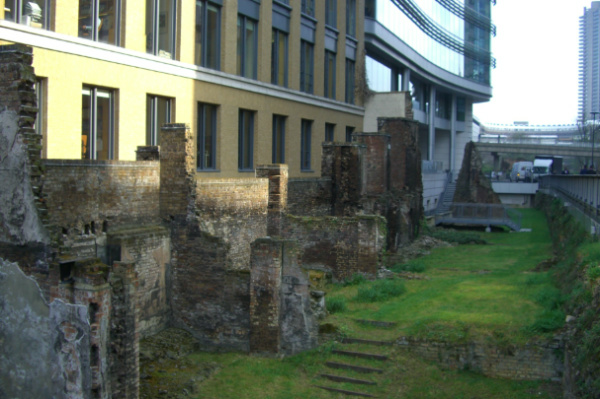
But there are several other stretches of the stone and brick wall left which evoke a sense of the structure it once was and the defensive role it played in protecting Londoners – among them is a substantial section of the wall located in Noble Street on the city’s western side.
The 80 metre long section of Roman and later medieval remains includes two internal turrets on what was the west side of the Roman Cripplegate fort (built between 120 and 150 AD) as well as a substantial bastion located at the southern end of the site.
The highest fragment of the Roman wall can be seen opposite Oat Lane, near the southern end of the site, while the highest section of the wall – which stands some 4.5 metres high and is mostly medieval – can be seen at the northern end of the site.
As well as reflecting the City’s Roman and medieval history, this section of wall also evokes a sense of the horrors of the Blitz.
Projecting eastward on the inside of the wall are party walls from World War II bomb-damaged and later demolished homes which once fronted onto Noble Street.
WHERE: Noble Street, London (nearest Tube stations are Barbican and Bank; WHEN: Anytime; COST: Free.
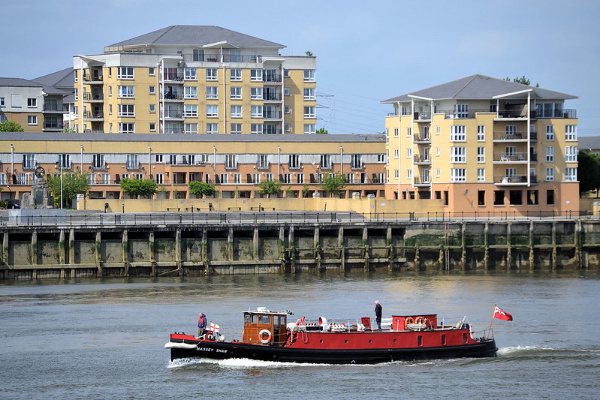
The Massey Shaw in The Thames in 2015. PICTURE: R~P~M (licensed under CC BY-NC-ND 2.0)
Moored at West India Dock, the Massey Shaw is a former London Fire Brigade fireboat.
The fireboat was constructed in 1935 for a cost of £18,000 by the J Samuel White company in Cowes on the Isle of Wight. Named for Sir Eyre Massey Shaw – the first Chief Officer of what was then named the Metropolitan Fire Brigade, the vessel was designed to London County Council specifications with a deliberately low profile so it could fit under the Thames bridges in all tides.
The vessel, which was was powered by two eight cylinder diesel engines and featured a main deck monitor as well as eight deck outlets (and a wheelhouse which was added later), soon proved its worth, playing an important role in saving what the press said was a million pounds worth of stock at a large warehouse fire on Colonial Wharf.
During World War II, the Massey Shaw took part in Operation Dynamo, forming part of the small boat flotilla which evacuated British troops from the beach at Dunkirk. She ferried more than 500 troops to a larger ship offshore and transported almost 100 back to England and it’s believed she was the last of the small boats to leave Dunkirk harbour (rescuing survivors from a French vessel which struck a mine along the way).
Back in London, Massey Shaw performed a critical role during the Blitz, pumping large quantities of Thames water to douse fires along the city’s waterfront.
It remained in service until the early 1970s, although it had operated as a reserve boat since 1960 with newer models taking over frontline duties.
Decommissioned in 1971, the Massey Shaw was found abandoned 10 years later at St Katharine Dock by a group who went on to found The Massey Shaw Fireboat Society with a view to preserving the vessel. They were granted a 50 year lease on the vessel.
In 1985, the Massey Shaw joined the Association of Dunkirk Little Ships on their return to Dunkirk for the first time since 1965 and two years later, she attended the centenary of Sir Eyre Massey Shaw’s review of 1000 firemen at Oxford.
In 1990 the Massey Shaw was sunk close to the London Fire Brigade headquarters at Lambeth but was subsequently salvaged and the following year, after restoration work, joined the 50th anniversary return trip to Dunkirk.
The society gained full ownership of Massey Shaw in 2002 and restoration work was carried out by the TV programme Salvage Squad (a second appearance on the show and more work followed two years later).
In 2008, a £500,000 Heritage Lottery Grant was used to fund the restoration of the vessel at Gloucester docks. She returned to London by road in 2013 where the restoration was completed and in 2015 was officially launched back on the River Thames with an event at the Westminster Boating Base.
Later that year she participated in another “little ships” armada to Dunkirk, this time commemorating the 75th anniversary of the evacuation. Massey Shaw has since taken part in other events including celebrations marking Queen Elizabeth II’s record as longest reigning monarch in 2015.
The vessel is now moored at the eastern end of West India Docks on the Isle of Dogs.
While Massey Shaw did appear in the 1958 film, Dunkirk, recapturing its role as one of the “little ships”, it did not appear in the 2017 film of the same name.
WHERE: Massey Shaw, West India Dock, Poplar (nearest DLR station is South Quay; nearest Tube station is Canary Wharf); WHEN: Between March and November, from 11am to 3pm daily (check website for details); WEBSITE: https://masseyshaw.org.
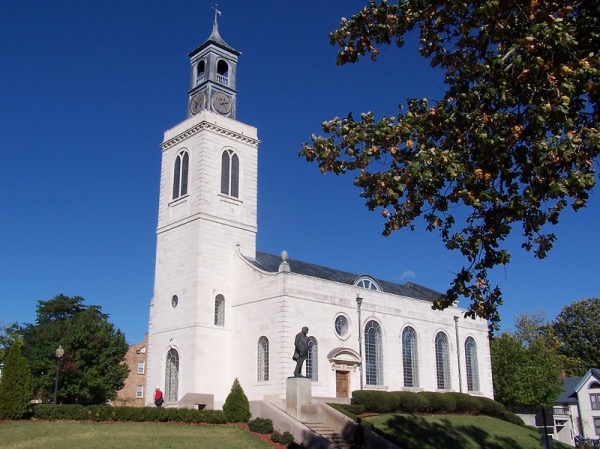
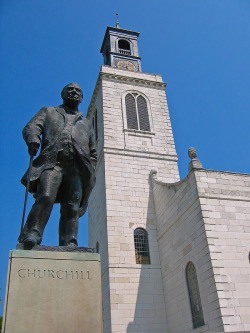
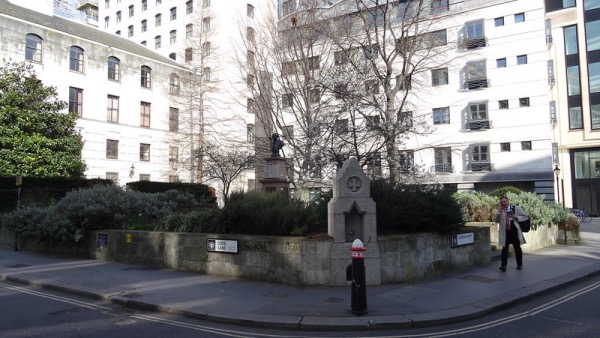
This church – not to be confused with the similarly named but still existing St Mary Aldermary – once stood at the corner of Love Lane and Aldermanbury in the City of London.
St Mary Aldermanbury, now part of the National Churchill Museum on the campus of Westminster College, Fulton, Missouri, in the US. PICTURE: J. Stephen Conn (licensed under CC BY-NC 2.0)
Founded in the 11th or early 12th century, the church – the name of which apparently relates to an endowment it received from an Alderman Bury, was destroyed in the Great Fire of London in 1666 and rebuilt by Sir Christopher Wren in a simple form with no spire.
It was gutted during the Blitz – one of 13 Wren churches hit on the night of 13th December, 1940 – and the ruins were not rebuilt. Instead, in the 1960s (and this is where we get to the relocation part) a plan was put into action to relocate the church so it could form part of a memorial to Winston Churchill in the grounds of Westminster College in Fulton, Missouri.
It was only after four years of planning and fundraising (the project apparently cost some $US1.5 million with the money raised from donors including actor Richard Burton) that the relocation process finally began in 1965.
It started with workers in London cleaning, removing and labelling each of the church’s 7,000 stones so they could be reconstructed correctly on the other side of the Atlantic.
They were shipped free-of-charge – the US Shipping Board moved them as ship’s ballast – and then taken by rail to Fulton.
By the time the stones reached Fulton they had been jumbled. And so began the painstaking process of reassembling what was described as the “biggest jigsaw puzzle in the history of architecture” (with the stones spread over an acre, it apparently took a day just to find the first two stones).
While the first shovel on the project had been turned by former US President Harry S Truman on 19th April, 1964 (his connection to the project will become clear), the foundation stone was laid in October, 1966, 300 years after the Great Fire of London.
The shell of the church was completed by May, 1967. Two more years of work saw the church’s interior recreated with English woodcarvers, working from pre-war photographs, to make the pulpit, baptismal font, and balcony (new glass was also manufactured and five new bronze bells cast for the tower). The finished church, which was rededicated in May, 1969, was almost an exact replica of the original but apparently for a new organ gallery and a tower window.
Why Fulton for a tribute to Churchill? The connection between Churchill and Westminster College went back to the post war period – it was in the college’s historic gymnasium building that, thanks to a connection the institution had with President Truman, Churchill was to give one of his most famous speeches – the 1946 speech known as ‘Sinews of Peace’ in which he first put forward the concept of an “Iron Curtain” descending between Eastern and Western Europe.
The church is now one part of the National Churchill Museum, which also includes a museum building and the ‘Breakthrough’ sculpture made from eight sections of the Berlin Wall. It was selected for the memorial – planned to mark the 20th anniversary of Churchill’s speech – thanks to its destruction in the Blitz, commemorating in particular the inspiring role Churchill had played in ensuring the British people remained stalwart despite the air raids.
Meanwhile, back in London the site of the church has been turned into a garden. It contains a memorial to John Heminges and Henry Condell, two Shakespearean actors who published the first folio of the Bard’s works and were buried in the former church. The footings upon which the church once stood can still be seen in the garden and have been Grade II-listed since 1972.
It was on 7th September, 1940, that the German bombers raided London in what was to be the first of 57 consecutive nights of bombings and the start of the air attacks on the city known as the Blitz (short for ‘Blitzkrieg’ meaning ‘lightning war’ in German).
Almost 350 German bombers, escorted by more than 600 Messerschmitt fighters, were involved in the raid on what became known as “Black Saturday”.
This first wave of bombing, which ended just after 6pm on what had been a hot day, largely targeted London’s docks in attempt to destroy the city’s infrastructure and industrial sites including the munitions factories of the Woolwich Arsenal, gasworks at Beckton, West Ham power station and oil storage tanks at Thameshaven.
A second wave, which lasted eight hours and involved another 400 bombers, arrived from 8pm striking Millwall, commercial docks at Tilbury and Thameshaven, and the heavily populated slums of the East End in localities including Silvertown, Canning Town, East Ham, Poplar, Stratford, Wapping, and Whitechapel.
Hundreds of tons of bombs were dropped in the raids during which some 448 of London’s civilians were killed and 1,600 injured. Some of the fires started in the bombing burned for five days with the flames visible for miles.
While the attack was the first day of the Blitz, it was actually the 60th day of the Battle of Britain in which the German Luftwaffe had targeted air fields, oil installations and other war-related infrastructure.
While Nazi Reichsmarschall Hermann Göring had gone on radio on the day of the raid, describing it as an “historic hour, in which for the first time the German Luftwaffe has struck at the heart of the enemy”, the strategy shift – to target London instead of the air defence-related installations – proved to be what Hugh Dowding, chief of Fighter Command described as a “mistake”, giving the defences time to rebuild.
But at the time, the attack on London was believed at the time to herald the start of a full invasion. It’s known that as the Luftwaffe attacked the East End, the military chiefs of staff were meeting in Whitehall – at 8pm that night, just as the second wave of planes was starting to bomb the city, they issued the code word ‘Cromwell’ which indicated that invasion was imminent and defending troops need to prepare.
The planned invasion – Operation Sea Lion – never eventuated but the Blitz was to continue until May the following year.
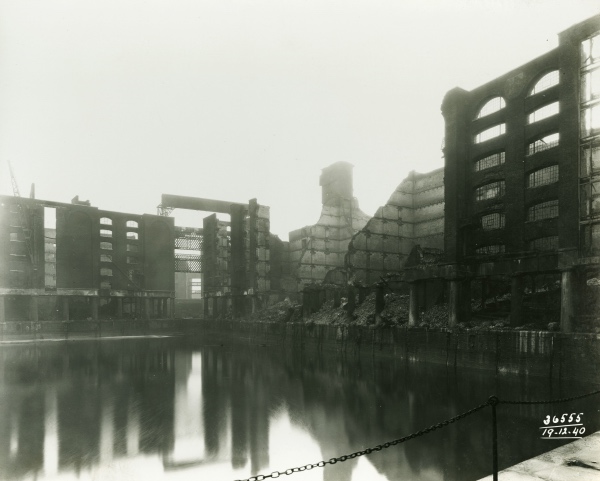
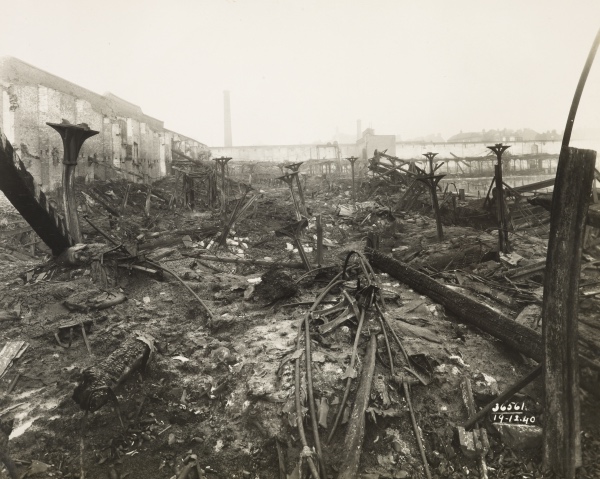
The Museum of London Docklands has released a number of images from its ‘Docklands at War’ collection – including some rarely on display – to mark the 75th anniversary of Victory in Europe. These images of the East End show the scale of the damage and destruction caused to London’s docks during World War II when more than 25,000 German bombs were dropped on it in an attempt to impact the national economy and war production, making tens of thousands of home uninhabitable, damaging businesses and destroying docks with the West India Docks and St Katherine Docks suffering the most damage. The pictures also reveal the remarkable contribution to the war effort by the people who lived and worked in the densely populated area. For more on how the museum is marking the day online, head to www.museumoflondon.org.uk/museum-london-docklands/ve-day.
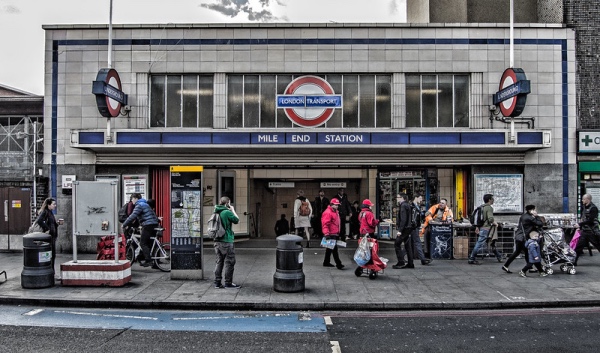
This east London district was recorded as far back as the 13th century when it was a rural area. The name comes from the obvious – it was located on the old London to Colchester Road about a mile east of Aldgate.
Its location so close to London – and the fact it was common land – meant Mile End was favoured as a recreational space by Londoners eager to escape the confines of the city.
It was here in 1381 that Jack Straw camped with the men from Essex during the Peasant’s Revolt and it was here that, even as Was Tyler and his men murdered Simon of Sudbury in the Tower of London, King Richard II famously met with the leaders of the revolt.
The area, which became known as Mile End Old Town (an unconnected area to the west was known as Mile End New Town), was gradually developed from the 16th century and attracted working class housing and, thanks to its affordability, a relatively high number of immigrants. The Mile End Tube station opened in 1902.
The area suffered in the Blitz during World War II and the first V-1 flying bomb to hit the city landed next to the Grove Road railway bridge on 13th June, 1944, killing eight civilians and injuring 30.
Famous figures connected to Mile End include explorer Captain James Cook, who lived in a now demolished house on Mile End Road between 1764-76.
Landmarks include the Trinity Almshouses (built in 1695, they’re the last survivors of several almshouses built in the area) and the Frederick Arthur Walters-designed Guardian Angels Roman Catholic Church which was built 1903 by Henry Fitzalan-Howard, 15th Duke of Norfolk, as a memorial to his youngest sister, Lady Margaret Howard.
The People’s Palace – a five acre entertainment and educational facility which included a library, swimming pool, gym and winter garden – was completed in 1892 on Mile End Road. Destroyed by fire in 1931, it was rebuilt but finally closed in 1954.
The two halves of the 79 acre linear Mile End Park, which bisected by Mile End Road, is joined by The Green Bridge over the road.
PICTURES: Top – Mile End Road featuring The Guardian Angels Catholic Church on the right and Mile End Park on the left (Matt Brown /licensed under CC BY 2.0); Below – Mile End Tube Station (Chris Jones/licensed under CC BY-NC 2.0)
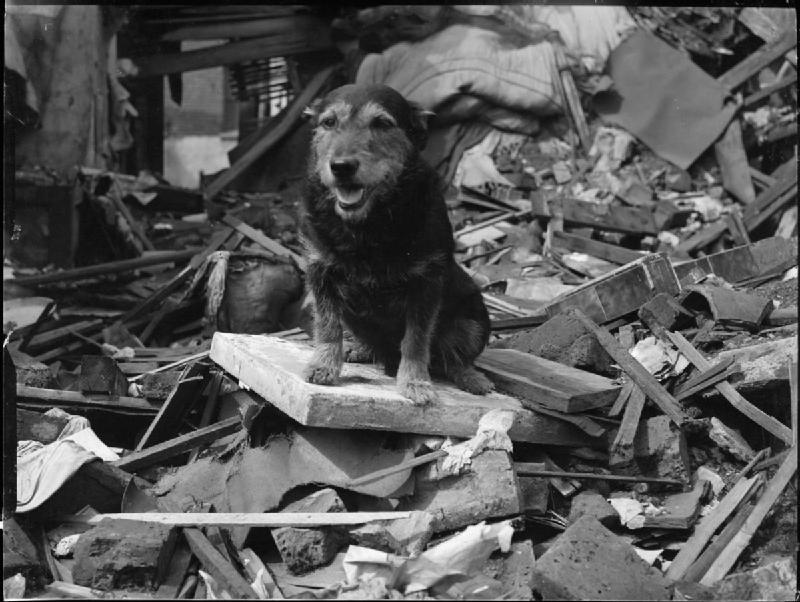
A hero of the Blitz during World War II, Rip was a stray dog who was adopted by the Southill Street Air Raid Patrol in Poplar, east London.
Found in the aftermath of a bombing by Air Raid Warden E King, he became the mascot of the air raid patrol and an unofficial rescue dog.
The mongrel terrier’s task was to help locate people and animals buried in rubble after an air raid and despite his lack of formal training, he is reported to have saved more than 100 lives as well as recovered many bodies.
In fact, such was his success that it was partially responsible for prompting authorities to start officially training dogs to find casualties in debris towards the end of the war.
Rip survived the war and was awarded a PDSA Dickin Medal in July, 1945. Created in 1943, the award is described as Victoria Cross for animals.
Rip apparently wore on his collar until his death 1946 and was buried in the PDSA cemetery in Ilford, Essex.
In 2009 his medal was sold at auction for £24,250, well above expectations of £10,000.
• The story of the St Paul’s Watch, the volunteers who worked to protect St Paul’s Cathedral during the Blitz, will be told in a digital display projected onto the cathedral’s facade this weekend.Where The Light Falls is being held in partnership with Historic England and is part of Fantastic Feats: the building of London – the City of London’s six-month cultural events season. It will see a display of poetry, visuals and photography, created by Poetry Society and Double Take Projections, projected onto the cathedral’s south side, north side and main facade in honour of those men and women who, armed with sandbags and water pumps, risked their lives to save the cathedral. The free show lasts for about 20 minutes and can be seen between 6.30pm and 10pm from tonight until Saturday night and then from 8pm to 10pm on Sunday. Meanwhile, St Paul’s is also open for a special late opening on Friday night during which poets from the Poetry Society will be bringing to life accounts of loss, bravery and sacrifice. Admission charge applies. For more on both events, head here.
• The history, teachings and contemporary relevance of Buddhism are being explored in a major new exhibition opening at the British Library on Friday. Buddhism features rare and colourful scrolls, painted wall hangings and folding books and will highlight the theory, practice and art of Buddhism, examine the enduring iconography of Buddha and consider what it means to be Buddhist today. The exhibition, which is accompanied by a program of events, runs until 23rd February. For more, see www.bl.uk.
• On Now: Elizabeth Peyton: Aire and Angels. This exhibition at the National Portrait Gallery is the first to situate the work of contemporary artist Elizabeth Peyton within the historical tradition of portraiture. In additional to the more than 40 works on display in the exhibition, Peyton has been honoured by being first artist to be given the run of the entire gallery with a series of displays within the permanent collection which juxtapose Peyton’s art with historic portraits from the Tudor period onwards. Among her portraits on show are those of Napoleon, Queen Elizabeth II, Yuzuru Hanyu, Frida Kahlo, Tyler the Creator, Isa Genzken, David Bowie, Elias Bender Rønnenfelt, David Fray, and Louis XIV. Runs until 5th January. Entry is free. For more, see www.npg.org.uk/elizabethpeyton.
Send all items for inclusion to exploringlondon@gmail.com.
Located just to the north of the City, The Wenlock Arms takes its name from the former Wenlock Brewery (the name was also given to the nearby Wenlock Basin which runs off Regent’s Canal).
Located at 26 Wenlock Road in Hoxton, the pub is said to have opened in 1836 as a tap for the nearby brewery and went on to become a rare survivor of the Blitz (for the area in which it’s located).
The pub has an interesting recent history – it was successfully saved from demolition several years ago following a campaign from locals and is now a protected building. Having undergone a bit of a spruce up since, it is highly regarded for both its ales and its live music.
It also featured as a location in the 2013 film, The World’s End, starring Simon Pegg.
Another of London’s protected views, though perhaps lesser known, is the panoramic vista from the top of Point Hill in Blackheath towards the City.
The view from a small park known as The Point (reached via Point Hill, just to the west of Blackheath) takes in modern City skyscrapers as well as Tower Bridge, St Paul’s Cathedral and even the dome of the Old Bailey.
While there is a danger the growth of plants along the brow of the hill can partially block the view (which stretches as far as Essex), it remains a splendid site from which to view the city and no doubt was a vantage point for those, such as the leaders of the Peasant’s Revolt of 1381, who historically gathered on Blackheath before marching to London.
The park, meanwhile, is host to a memorial stone erected to mark the site where an Australian-born RAF pilot, Flight Lieutenant Richard Carew Reynell, fell to his death on 7th September, 1940, after his Hurricane fighter was shot down over Blackheath on the first day of the Blitz.
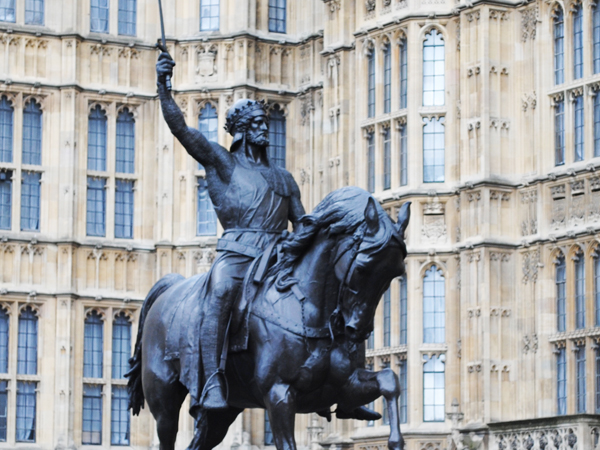
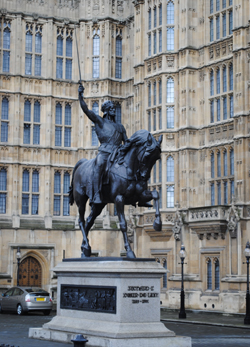
Located in Old Palace Yard outside the Palace of Westminster, this Grade II-listed equestrian statue of 12th century crusader-monarch King Richard I, known as the “Lionheart” or Coeur de Lion, is the work of 19th century sculptor Baron Carlo Marochetti.
The nine metre high statue was originally exhibited as a clay work at the Great Exhibition of 1851 – it was located outside the west entrance of the Crystal Palace – and, despite the tail falling off soon after it was display, it was well enough received by the crowds attending the exhibition (as well as the critics) that a public subscription was raised to cast the statue in bronze. Queen Victoria and Prince Albert were among those who subscribed.
It was initially proposed that the statue be placed on the site of the Crystal Palace as a memorial to the exhibition (along with a statue of Prince Albert), but this plan was put aside and, after numerous other sites were considered, the current location was settled on.
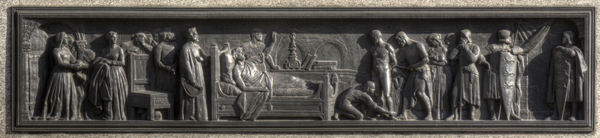
The statue was erected on the site, facing south, in 1860, although it wasn’t completed with the addition of two bronze bas relief panels until 1867. These depict Richard on his death bed pardoning Bertran de Born, the archer whose arrow caused his death, and Richard fighting Saracens at Ascalon during his crusade in the Holy Land. Two other proposed panels were never made.
The statue was peppered with shrapnel when a bomb landed only a few metres away in 1940 during the Blitz, leaving Richard’s sword bent and damaging the tail and granite pedestal. The sword was fixed soon after. Further conservation works were carried out in 2009.
Italian-born Marochetti had worked in Paris as a sculptor before following King Louis-Philippe to London after the revolution of 1848 and largely remained in the city until his death in 1867. He was created a baron by the King of Sardinia.
His statue of Richard is one of few artworks created by non-British artists in the Parliamentary estate and while Marochetti had plans to create another equestrian statue, this one of Edward, the Black Prince, to face his statue of Richard across the entrance to the House of Lords, it never eventuated. Plans to install the second statue are, however, once more being talked about.
PICTURES: Above – The statue in Old Palace Yard (David Adams); Below – Detail of the panel depicting the death of the king (Prioryman/CC BY-SA 4.0)
• The response of artists and photographers to London’s Blitz during World War II forms the subject of a new exhibition which has opened at the Museum of London.Perspectives of Destruction: Images of London, 1940-44 explores how artists and photographers responded to the devastation caused by the massive aerial bombings. Much of the artwork was commissioned by the government’s War Artists Advisory Committee and focused on damage to buildings rather than deaths and injuries to people due to the impact it may have had on public moral. At the heart of the display is nine recently acquired drawings from official war artist Graham Sutherland depicting damage in the City of London and East End between 1940 and 1941. Also on show is a 1941 oil painting of Christchurch on Newgate Street by John Piper and David Bomberg’s Evening in the City of London, dating from 1944, which depicts St Paul’s Cathedral dominating the horizon above a devastated Cheapside. There’s also a photograph of a V-1 flying bomb narrowly missing the iconic cathedral which, along with eight others, was taken by City of London police constables Arthur Cross and Fred Tibbs. Other artists with works featured include Henry Moore, Bill Brandt and Bert Hardy. Runs until 8th May. Admission is free. For more, see www.museumoflondon.org.uk.
• A series of installations commissioned from 12 artists – asked to imagine what Europe might look like 2,000 years from now and how our present might then be viewed – have gone on display in the V&A as part of the week long ‘Collecting Europe’ festival. The festival, which only runs until 7th February, includes a range of talks, discussions, live performances and workshops aimed at encouraging debate around Europe and European identity in the light of the Brexit vote. The installations, commissioned by the V&A and Goethe-Institut London, have been created by artists from across Europe. For more, see www.vam.ac.uk/collectingeurope.
• Bronze casts of black women’s movement activists’ fists go on display at the City of London’s Guildhall Art Gallery from Tuesday. A Fighters’ Archive, features the work of sculptor Wijnand de Jong and pays tribute to 15 women who were members of various activist groups. The sculpture takes the form of a boxing archive – casts of boxers’ fists collected by boxing academies to commemorate prize fighters – with the fists cast from life. Subjects include Professor Dame Elizabeth Anionwu, Emeritus Professor of Nursing at the University of West London and patron of The Sickle Cell Society, Mia Morris, creator of Black History Month, and Gerlin Bean, founder of Brixton Black Women’s Centre. The fists can be seen until 19th March. Admission if free. For more, see www.cityoflondon.gov.uk/things-to-do/visit-the-city/attractions/guildhall-galleries/Pages/guildhall-art-gallery.aspx.
Send all items for inclusion to exploringlondon@gmail.com.
This pub’s name isn’t too mysterious – it is, of course, named after Albert, Prince Consort to Queen Victoria, and given the date on which the building that now occupies the site was built – between 1862 and 1867, nor is the motivation to name it so – Prince Albert died on 14th December, 1861, leaving a bereft queen and a nation in mourning.
There had been a pub on this site at 52 Victoria Street prior to the current building – it was called The Blue Coat Boy and named after the nearby Blue Coat school – but in the mid-19th century the Artillery Brewery, which was located next door, bought the premises and renamed it.
The four storey building, which is now Grade II-listed (and dwarfed by the glass towers surrounding it), survived the Blitz and is the only building remaining from the first phase of the development of Victoria Street (and redevelopment of the area which had been a slum known as Devil’s Acre), only a stone’s throw from Westminster Abbey and the Houses of Parliament.
Inside, the Victorian features include ornate ceilings and hand-etched frosted windows and wrought iron balconies. Also of note is the Prime Minister’s gallery – including some who were patrons here – as well as memorabilia including a House of Commons Division Bell and one of Queen Victoria’s napkins.
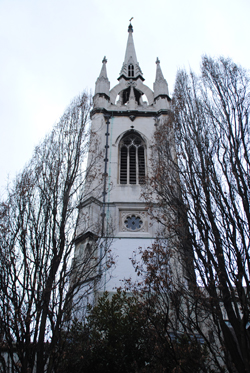
Located amid the remains of the medieval church of St Dunstan in the East, the garden was created in the late 1960s after the church was finally – and irrevocably, apparently – destroyed in the Blitz of World War II.
The church’s origins went back to around 1100 and it was subsequently extended with a new south aisle in the late 14th century and repaired in the early 17th century before being severely damaged in the Great Fire of 1666.
Patched up, with a new steeple and tower added to the building between 1695-1701 by Sir Christopher Wren, the building stood until the early 19th century when much of the church – with the exception of Wren’s additions – had to be rebuilt (for more on the history of the church, see our earlier Lost London post here).
The ‘new’ building was, however, badly damaged during bombing in 1941 and it was decided not to rebuild the church in the aftermath of the war.
The City of London opened a garden, sympathetic with the remains of the Grade I-listed building, on the site in 1971 (although Wren’s tower remains). They won a landscape award only a few years later.
Features in these atmospheric gardens – which seem to capture the essence of the Romantic idea of what ruins should look like – include a fountain which sits in the middle of the nave. In 2010 it was one of five public gardens in the City where award-winning ‘insect hotels’ were installed.
Maintenance works were carried out in 2015 and new plantings put in (the picture, above, was taken before this).
Founded in Clerkenwell in 1144, the Priory of the Order of St John of Jerusalem served as the order’s English headquarters.
The order, also known as the Knights Hospitaller, was founded in Jerusalem in 1080 to care for the sick and poor, and soon spread across Europe with the English ‘branch’ established on 10 acres just outside the City walls apparently by a knight, Jorden de Briset.
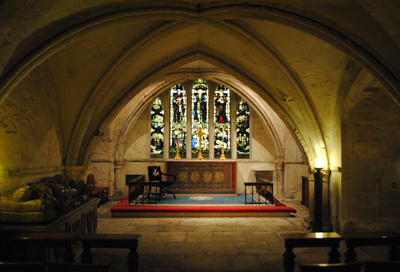
The original buildings – of which only the 12th century crypt (pictured above) survives complete with some splendid 16th century tomb effigies including that of the last prior, Sir William Weston – included a circular church, consecrated in 1185, and monastic structures including cloisters, a hospital, living quarters and a refectory or dining hall.
There are records of dignitaries staying at the priory as it grew in size and renown – among them was King John who in 1212, apparently stayed here for an entire month. There are also surviving accounts of Knights Hospitaller riding out in procession from the priory and through the City at the start of a journey to the Holy Land.
The priory and church were attacked during the Peasant’s Revolt of 1381, thanks to its connection with the hated Poll Tax (Prior Robert Hales was also the Lord High Treasurer and was beheaded during the revolt on Tower Hill).
The church was subsequently rebuilt as a rectangular-shaped building and then, in the early 16th century, enlarged when the site was significantly renovated. These renovations were still relatively new when the priory was dissolved in 1540 during the Dissolution of King Henry VIII.
The priory church, which survived the Great Fire of 1666, was later used as a parish church but was destroyed in an air raid in World War II. Subsequently rebuilt, it can be visited today along with the crypt below and the cloister garden, created in the 1950s as a memorial to St John’s Ambulance members from the London area (the original shape of the circular church is picked out in the paving here).
Perhaps the most famous building to survive is St John’s Gate which dates from the 16th century and was once the gatehouse entrance to the priory (added in the final renovations).
After the Dissolution it served various roles including as the office of the Master of Revels (where Shakespeare’s plays were licensed), the home of The Gentleman’s Magazine (Samuel Johnson was among contributors and worked on site), a coffee house (run by William Hogarth’s father) and a public house called the Old Jerusalem Tavern (yes, Charles Dickens was said to be a regular). It is now home to the recently renovated Museum of the Order of St John (you can see our earlier post on the museum here).
WHERE: Museum of the Order of St John, St John’s Gate (and nearby priory church), St John’s Lane, Clerkenwell (nearest Tube stations is Farringdon); WHEN: 10am to 5pm, Monday to Saturday (tours are held at 11am and 2.30pm on Tuesday, Friday and Saturday); COST: Free (a suggested £5 donation for guided tours); WEBSITE: www.museumstjohn.org.uk.



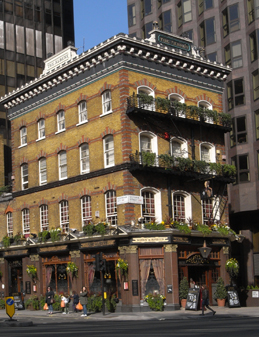 This pub’s name isn’t too mysterious – it is, of course, named after Albert, Prince Consort to Queen Victoria, and given the date on which the building that now occupies the site was built – between 1862 and 1867, nor is the motivation to name it so – Prince Albert died on 14th December, 1861, leaving a bereft queen and a nation in mourning.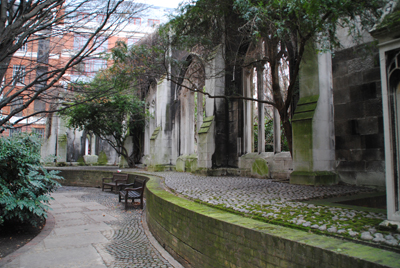
 Exploring London