What’s in a name?…Chancery Lane

This central London street, which runs between Fleet Street and High Holborn, has long been associated with the law and government, and still is so today with the Royal Courts of Justice standing close to its southern end and Lincoln’s Inn – one of the four Inns of Court – located on the lane’s western side.

Its name is a corruption of the original Chancellor Lane – a moniker which apparently dates back to at least the 14th century – and which referred to the buildings where the official documents of the Lord Chancellor’s Office, known as the Rolls of the Court of Chancellory (Chancery), were stored.

The street was apparently first known as New Street and later as Converts Lane; the latter in reference to the House of Converts (Domus Conversorum) King Henry III founded here in the 1272 for the conversion of Jews to Christianity.

When King Edward I expelled all the Jews from the kingdom in 1290, the ‘house’ continued in use as such for foreign-born Jews, albeit with very small numbers of residents until the early 17th century.

In the meantime, in 1377 King Edward III gave orders that the complex of buildings used by the Domus Conversorum also be given over to the Master of the Rolls for the storage of chancellory documents and it was this move which led to the lane gaining its new name.

The buildings – which included a chapel which had become known as the Chapel of the Master of the Rolls or the simply the Rolls Chapel which had been rebuilt several times including to the designs of 17th century architect Inigo Jones – were finally demolished around the turn of the 20th century and subsumed into the Public Records Office complex on Chancery Lane (this was formerly housed in what is now the Maughan Library of King’s College London).

The lane these days is also home to such august institutions as The Law Society and the London Silver Vaults. It also lends its name to an Underground Station located to the east of the lane entrance in High Holborn.

This Week in London – Open House London this weekend; the Ming dynasty at the British Museum; John Constable at the V&A; and Totally Thames…

The-Leadenhall-Building• Open House London is finally here with some 800 buildings across the city – some of them rarely accessible to the public – open for free this weekend, from grand historical institutions and modern skyscrapers through to ‘green’ schools, engineering projects, parks and gardens, and private homes. The weekend – which is being run this year under the theme of ‘revealing’ – also includes a programme of walks, engineering and landscape tours, cycle rides, a bus tour, childrens’ activities and expert talks as well as a moonlit ‘culture crawl’ through London on Friday night and into Saturday morning (a fundraiser for Maggie’s Centres). Among the buildings opening their doors in the festival – created by London-based architecture organisation Open-City – are the ever popular 30 St Mary Axe (aka ‘The Gherkin’), the Foreign and India Office in Whitehall, the Bank of England, Portcullis House and City Hall along with everything from The Leadenhall Building (aka ‘The Cheesegrater’ – pictured), and Temple Church in the City to the Admiral’s House in Greenwich, the Dutch Embassy in Kensington and the steam coaster, the SS Robin, in Tower Hamlets. As mentioned in a previous week, some visits required pre-booking so make sure you check the programme before heading out. For a full copy of the programme of events, see www.londonopenhouse.org. PICTURE: © R Bryant.

A major new exhibition focusing on China during the “pivotal” 50 years of Ming Dynasty rule between 1400-1450 opens at the British Museum in Bloomsbury today. Ming: 50 years that changed China features some of the finest objects ever made in China – loaned from institutions in China and elsewhere – as it explores some of the “great social and cultural changes” that saw Beijing established as the capital and the building of the Forbidden City. It includes objects from the imperial courts along with finds from three regional “princely tombs”. Four emperors ruled during the period and the display will feature the sword of Yongle Emperor, “the warrior”, the handwriting of the Hongxi emperor, “the bureaucrat”, the paintings of the Xuande emperor, “the aesthete”, and portraits of the regents who ruled while the Zhengtong emperor was a boy. The exhibition runs until 4th January. Admission charge applies. For more, see www.britishmuseum.org.

The work of 19th century artist John Constable and its debt to 17th century masters is the focus of a new exhibition opening at the V&A on Saturday. Constable: The Making of a Master – which features more than 150 works including celebrated pieces by Constable like The Hay Wain (1821), The Cornfield (1826) and Salisbury Cathedral from the Meadows (1831) as well as oil sketches, drawings, watercolours and engravings – will juxtapose his works with those of 17th century landscape masters like Ruisdael, Rubens and Claude. Among those of their works on display will be Rubens’ Moonlight Landscape (1635-1640) and Ruisdael’s Windmills near Haarlem (c.1650-62). The exhibition runs until 11th January. Admission charge applies. For more, see www.vam.ac.uk/constable.

And don’t forget, Totally Thames continues to run throughout this month which an extensive programme of river-related events. Those on during the coming week include Londonist Afloat: Terrific Tales of the Thames, a series of discussion sessions on aspects of the River Thames being held aboard the HMS President and London’s River – The City’s Ebb and Flow, a guided walk along the river (held on every Saturday and Monday during September), and Hospital and Troop Ships – Transporting the walking and wounded in the First World War, an exhibition held aboard the HQS Wellington (open Sundays and Mondays in September). For the full programme of events, see www.totallythames.org.

Send all items for inclusion to exploringlondon@gmail.com.

10 of London’s World War I memorials – 6. The Royal Fusilier’s Memorial…

Fusiliers-MonumentLocated at Holborn Bar – one of the traditional entry points to the City of London, this memorial was erected in 1922 to the memory of the almost 22,000 solider of the Royal Fusiliers (City of London Regiment) who died during the Great War.

The monument, which stands on a traffic island in the middle of busy High Holborn, was designed by sculptor Albert Toft (and hence is known affectionately as “Albert”) along with architects Cheadle and Harding at the behest of several senior officers from the regiment.

It was originally intended to be erected in one of the capital’s many parks. Hounslow Barracks was the next intended location but, after consultation with the City, the site in Holborn was eventually settled upon.

The larger-than-life bronze figure, which stands on a Portland stone pedestal holding a rifle with fixed bayonet, was apparently modelled on an actual person – a Sgt Cox, who served with the Royal Fusiliers throughout the war. The east face features a plate listing all the battalions who served in World War I; the west face features the regimental crest and dedication.

The Grade II-listed memorial, which was officially unveiled by the Lord Mayor of London (we think it was Sir Edward Cecil Moore) on 4th November, 1922, was later updated with inscriptions commemorating those who fell during World War II and in subsequent conflicts.

The original model for the monument can now be seen in the Fusilier Museum at the Tower of London. Interestingly, there is a twin monument, dedicated to the 41st Division, at Flers on the Somme, in France. It was unveiled in 1932.

PICTURE: Mike Peel (www.mikepeel.net)

Famous Londoners – Sir Edwin Lutyens…

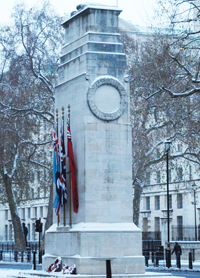
We’re looking at some of London’s World War I memorials so it’s only fitting we look at the life of acclaimed architect Sir Edwin Lutyens, the man credited with designing the Cenotaph – the UK’s national war memorial – in Whitehall (pictured below).

Lutyens was born in London at 16 Onslow Square, South Kensington, on 29th March, 1869, and – the ninth son and 10th of 13 children of soldier Captain Charles Lutyens and his wife Mary – was named for painter and sculptor Edwin Henry Landseer, a friend of his father’s. He grew up in London and Surrey and in 1885 commenced studying architecture at the South Kensington School of Art. In 1887, he left before completing the course, briefly joining the practice of Ernest George and Harold Peto before starting his own practice in 1889.
Cenotaph-in-LondonEarly commissions included country houses and it was during this period that he met with mentor and landscape gardener Gertrude Jekyll, a relationship which led him to design her home, Munstead Wood near Godalming in Surrey.

In 1897, Lutyens, known familiarly as ‘Ned’, married Emily Lytton – daughter of the late Viceroy of India and first earl of Lytton, Edward Buller-Lytton – and by 1908 the couple had five children. The family’s London addresses included 29 Bloomsbury Square (which also served as his office), 31 Bedford Square and 13 Mansfield Street, Marylebone, while his offices were located in numerous places including at 17 Queen Anne’s Gate.

Lutyens continued designing country houses – he eventually designed more than 35 major properties and altered and added many more – and among his commissions were Castle Drogo in Devon and the refurbishment of Northumberland’s spectacularly sited Lindisfarne Castle – both now National Trust properties. He was also involved in helping to plan and design Hampstead Garden Suburb in London, work which included designing two churches.

In 1912, Lutyens was invited to advise on the planning of the new Indian capital in New Delhi and his most important contribution was the design of the Viceroy’s House which combined elements of classical architecture with traditional Indian decoration. He was knighted in 1918 for his contributions in India and for his advice to the Imperial War Graves Commission.

It was his role in this latter effort which led to his becoming a national figure. He was involved in the creation of numerous monuments to commemorate the war dead, the best known of which are the Cenotaph in Whitehall – initially commissioned as a temporary structure (see our earlier post here) –  and the Memorial to the Missing of the Somme in Thiepval in northern France as well as the Australian War Memorial at Villers-Bretonneux and the Anglo-Boer War Memorial in Johannesburg.

He also designed more than 100 war cemeteries in France and Belgium and other war memorials – including overseas in places like Dublin – as well as London’s Tower Hill Memorial (see our earlier post here). Other London buildings he designed included the headquarters of Country Life magazine in Tavistock Street, Britannic House in Finsbury Square, the head office of the Midland Bank in Poultry and the Reuters and Press Association headquarters at 85 Fleet Street (now home to the Lutyens Restaurant, Bar and Private Rooms).

Lutyens was elected a fellow of the Royal Academy in 1920 (he was later president) and in 1924 was appointed a founding member of the Royal Fine Arts Commission. Even as he continued work in Delhi, he took on other commissions – such as the British Embassy in Washington, DC – and in 1924 he completed one of his most lauded – and smallest – designs: that of the one twelfth scale Queen Mary’s Dolls’ House which was shown at the 1924 British Empire Exhibition at Wembley and which can still be seen at Windsor Castle.

In 1929 Lutyens was commissioned to design a new Roman Catholic Cathedral for Liverpool but when he died on 1st January, 1944, this work was still unfinished with only the crypt completed thanks to the outbreak of World War II broke. Lutyens’ funeral was held in Westminster Abbey a few days later and his ashes were subsequently placed in the crypt of St Paul’s Cathedral.

For more information on Lutyens’ life and works, check out The Lutyens Trust, founded in 1984 to preserve and protect his legacy.
This Week in London – The Magna Carta at the new City of London Heritage Gallery; Tudor monarchs at the NPG; Mapping London; and objects with story at Pitzhanger…

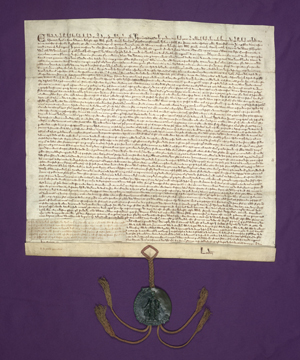
Magna-Carta-1297_Copright-London-Metropolitan-Archives---CopyThe 13th century’s finest surviving copy of the Magna Carta is taking centre stage at the new City of London Heritage Gallery which opens to the public this Friday. The 1297 document, which bears a superimposed memo reading ‘make it happen’, is being featured as part of the Corporation’s efforts to mark next year’s 800th anniversary of the signing of the landmark document. Other items on display in the new permanent, purpose-built exhibition space at the Guildhall Art Gallery include the medieval Cartae Antiquae, a volume containing transcripts of charters and statues covering laws enacted between 1327 and 1425 – a period which includes the reign of King Richard III, a poster for a World War I recruitment meeting held at the Guildhall in 1914, and a series of paintings depicting the 25 City Aldermen who were in office in the mid-1400s. The gallery, admission to which is free, will in future feature a rotating selection of rare documents from the City of London Corporation’s archives including the purchase deed William Shakespeare signed on buying a home in Blackfriars in 1613. For more, including opening times, see www.cityoflondon.gov.uk/heritagegallery. For more on events to mark the 800th anniversary of the signing of the Magna Carta next year, see www.magnacarta800th.com. PICTURE: Copyright London Metropolitan Archives.

Rare depictions of Tudor monarchs will be seen at the National Portrait Gallery in the most complete presentation of their portraiture to date. The Real Tudors: Kings and Queens Rediscovered features the gallery’s oldest portrait – that of King Henry VII – displayed alongside a Book of Hours inscribed by the king to his daughter, six portraits of King Henry VIII along with his rosary (on loan from Chatsworth), portraits of King Edward VI and a page from his diary in which he relates his father’s death, five portraits of Queen Mary I along with her prayer book (on loan from Westminster Cathedral) and several portraits of Queen Elizabeth I displayed alongside her locket ring (on loan from Chequers, the country residence of the PM). There will also be a discussion surrounding the search for a “real” portrait of the ‘nine days queen’, Lady Jane Grey, alongside a portrait of her that dates from the Elizabethan period. With many of the portraits newly examined as part of the gallery’s ‘Making Art in Tudor Britain’ project, visitors to the gallery will also be able to access a specially created app which allowing them to access the new research while looking at the portraits. The display, which will form the core of a larger exhibition in Paris next year, can be seen until 1st March. Admission to the gallery, off Trafalgar Square, is free. For more, see www.npg.org.uk.

An exhibition of rare maps from London, dating from between 1572 and last year, at gallery@oxo on South Bank, is closing on Sunday. Part of the Totally Thames festival, the Mapping London exhibition shows how the landscape along the River Thames as it passes through the capital has changed over the years. It features the first available map of London, which dates from 1572, as well as a 2013 map of underground London, monumental wall maps, and even a map of London that doubles as fan. The free exhibition at Oxo Tower Wharf is being curated by Daniel Crouch, one of the world’s leading map dealers. For more, see www.totallythames.org/events/info/mapping-london.

• A Crafts Council touring exhibition showcasing the work of 12 contemporary artisans and design studios – each of which uses objects as a means of storytelling – has opened at Pitzhanger Manor House and Gallery in Ealing – its first stop – this week. Crafting Narrative: Storytelling through objects and making explores the potential of objects to reflect on history, culture, society and technology through a combination of new and commissioned works, film text and photography. Works include Hilda Hellström’s The Materiality of a Natural Disaster which consists of food vessels made of soil from a field belonging to the last resident inside the Japanese Daiichi nuclear plant exclusion zone, Onkar Kular and Noam Toran’s archive of objects belonging to the fictional Lövy-Singh clan – an East London family of mixed Jewish and Sikh descent, and Hefin Jones’ The Welsh Space Campaign which features objects such as astronaut boots in the form of traditional Welsh clogs in an attempt to show how Wales has the capacity to explore space. The free exhibition is at the manor until 19th October. For more, see www.pitzhanger.org.uk.

Send all items for inclusion to exploringlondon@gmail.com.

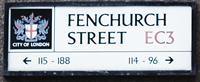
What’s in a name?…Fenchurch Street…

There’s a couple of alternate theories for the origins of this City of London street’s name.

Fenchurch-StreetRunning between Gracechurch Street to the west and Aldgate to the east, Fenchurch Street isn’t actually home to Fenchurch Street Station (one of the four Monopoly board stations!) – that’s located in adjoining Fenchurch Place. And for good measure, there’s also a nearby Fenchurch Avenue.

The name apparently relates to a church that once stood here, known as St Gabriel Fenchurch. The fen part of the name is believed to either stand for what may have been nearby ‘fens’ – that is, swampy or marshy ground – related to the now lost Langbourn River once located here or for faenum, a Latin word for hay which may have referred to a nearby haymarket.

The church, which is known to have existed from at least the 14th century and stood between Rood and Mincing Lanes, burnt down in the Great Fire of London in 1666 and was not rebuilt but merged into the parish of St Margaret Pattens (there’s a plaque marking its site in Fenchurch Street opposite Cullum Street – we’ll have a look at the church in more detail in a later Lost London entry).

Landmarks in the street include Lloyd’s Register of Shipping at number 71 (a Grade II-listed building dating from 1901) and the somewhat controversial tower at 20 Fenchurch Street, nicknamed the ‘Walkie Talkie’ building.

Lost London – The General Post Office (aka GPO East)…

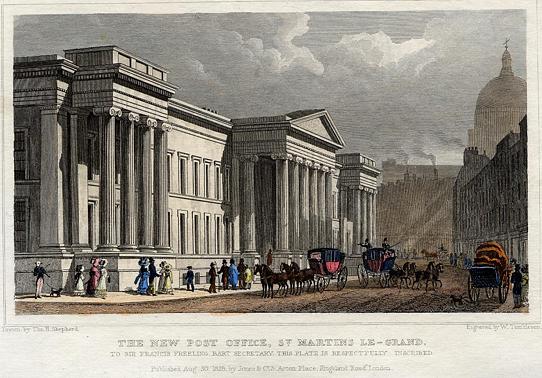
While the history of the General Post Office dates back to the reign of King Charles I, London’s first purpose-built facility for mail was constructed on the east side of St Martins-le-Grand in the 1820s.

GPOThe post office headquarters had hitherto been located in the area of Lombard Street but in 1814 it was decided that the site here couldn’t be developed any further. The site in St Martins-le-Grand was subsequently acquired and plans for the building commenced.

Designed by Sir Robert Smirke (famous for his design of the British Museum), the grand structure was built on the site of what were slums between 1825 and 1829 and featured a 400 foot long “Grecian-style” street frontage. The exterior of the building was lit with 1,000 gas burners at night.

As well as serving as the post office’s administrative headquarters, the building also contained the sorting office and the main London public post office. Along with a grand public hall and offices, it contained rooms – including an armoury – for the guards who protected mail coaches and accommodation for clerks charged with receiving foreign mail (obviously at all hours!).

A new building was added to house the telegraph department on the west side of the street in the 1870s and further buildings followed, leading Smirke’s initial building to become known as ‘GPO East’.

In 1910, the facility was bursting at the seams and so the headquarters was moved to the King Edward VII Building. Smirke’s grand building was somewhat controversially demolished in 1912. A fragment – one of the capitals which topped one of the external columns – is apparently located in Vestry Road in Walthamstow.

For more on London’s postal heritage, visit the British Postal Museum & Archive.

PICTURE: Thomas Shepherd/Wikipedia

This Week in London – St Paul’s celebrates Shakespeare; Harvest Festival time; and, Horst at the V&A…

It’s Shakespeare month at St Paul’s Cathedral as the august London institution hosts a series of special addresses and music recitals in honour of the Bard’s 450th birthday. Kicking off this weekend, the events will see preachers considering Shakespeare’s life and work – particularly in relation to faith – in a weekly address at Sunday Evensong service while a series of voice and piano recitals will present various interpretations of his work through the music of some of Britain’s greatest composers. Shakespeare, the cathedral staff say, would have known the cathedral well – many printers, including his old Stratford friend Richard Field, were located in the Churchyard, and Shakespeare would have had to regularly journey past St Paul’s to have his plays registered at St John’s Gate. See www.stpauls.co.uk for a detailed programme of events.

The Kensington Gardens Allotment is hosting a free Harvest Festival this Sunday with activities including digging up potatoes and making ‘potato people’ as well as face painting, story telling and a mobile pet farm. Complementary hot and cold drinks will be provided (while stocks last, so don’t be late!). The day runs from 11am to 4pm. Meanwhile, Regent’s Park Allotment Gardens will host its own Harvest Festival on Sunday, 21st September. Along with live folk music, a children’s treasure hunt and the ‘guess the weight of the pumpkin’ competition, the day will also feature a specially-built pizza oven in which visitors will be invited to cook their own pizza. For more, see www.royalparks.org.uk.

The works of renowned 20th century photographer Horst P Horst (1906-1999) will feature in a new exhibition opening at the V&A in South Kensington this Saturday. Horst: Photographer of Style will feature 250 photographs alongside haute couture garments, magazines, film footage and other ephemera and explores Horst’s collaborations and friendships with the likes of Coco Chanel, Marlene Dietrich, Noel Coward and Salvador Dali. Highlights include previously unpublished prints and more than 90 Vogue covers taken by Horst. Runs until 4th January. Admission charge applies. For more, see www.vam.ac.uk/horst.


LondonLife – Isaac Newton comes to life…

Isaac-Newton

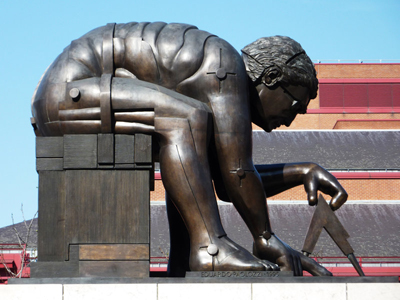
Eduardo Paolozzi’s 1995 statue of Isaac Newton which stands on the British Library’s piazza in King’s Cross has been granted a ‘voice’ as part of a new project called Talking Statues. Visitors who swipe their smartphones on a nearby tag will receive a call from the famous scientist – voiced by Simon Beale Russell – as part of the initiative which is being spear-headed by Sing London. It is one of 35 different statues across London and Manchester which will be brought to life by a range of public identities. Among the other statues in London which have been brought to life are Samuel Johnson’s cat Hodge in Gough Square (voiced by Nicholas Parsons) and Dick Whittington’s Cat in Islington (Helen Lederer), John Wilkes in Fetter Lane (Jeremy Paxman), the Unknown Soldier at Paddington Station (Patrick Stewart) and Sherlock Holmes outside Baker Street Underground (Anthony Horowitz). The British Library and Sing London are also holding a competition to give William Shakespeare a voice by writing a monologue for the statue in the library’s entrance hall which will then be read by an as yet unannounced actor. Entries close 17th October. For more, visit www.talkingstatues.co.uk

PICTURE: British Library

This Week in London – Notting Hill Carnival; St Paul’s treasures on show; Sherlock Holmes on film; and more…

Photo-by-Wayne-G-callender-(2)The August Bank Holiday is upon us which means it’s carnival time! The Notting Hill Carnival kicks off this Sunday with an extravaganza of costumes, dancing, music and food. The carnival’s origins go back to the late Fifties and early Sixties (the exact date is somewhat controversial!) when it started as a way of Afro-Caribbean communities celebrating their cultures and traditions, drawing on the tradition of carnivals in the Caribbean. The carnival is now Europe’s largest street festival and this year’s parade signifies the start of a three year celebration in the lead-up to the Golden Jubilee year of 2016. The carnival kicks off at 9am on Sunday – children’s day – and the same time on Monday – adult’s day – and organisers say the procession should be completed by 7pm. For more, see www.thelondonnottinghillcarnival.com. PICTURE: Wayne G Callender/Notting Hill Carnival.

A pop-up display of some of St Paul’s Cathedral’s treasures will appear today and tomorrow (Thursday, 21st August, and Friday 22nd August) in the cathedral’s crypt. Put together by Museum Studies students from Leicester University, the display will feature items relating to a royal event from each of the first three centuries of Wren’s church. They include images and objects from the Thanksgiving Service for the recovery of King George III in 1789 as well as items from Queen Victoria’s Diamond Jubilee in 1897 and the wedding of Prince Charles and Lady Diana in 1981. The display will be shown from 1pm to 2pm each day – entry is free via the cathedral’s north west crypt door. Meanwhile, the cathedral is offering a private, behind the scenes evening photography tour of the building for the winner of a photography competition looking for “the most surprising image” of the cathedral. The winner – and five friends – will also be treated to a meal at the Grange Hotel’s Benihama restaurant. The Surprise St Paul’s competition runs until 26th September and entrants just need to tweet or post their images to the church’s Twitter or Facebook pages with the hashtag #SurpriseStPauls. For more, see www.stpauls.co.uk.

The National Gallery has made free wi-fi available throughout the building. The Trafalgar Square-based gallery says it’s now also welcoming visitor photography and is encouraging visitors to check in on Facebook and comment on Twitter using the hashtag #MyNGPainting. For more, see www.nationalgallery.org.uk.

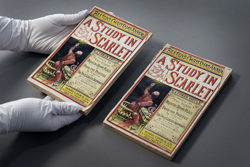
Fancy yourself a detective? The Museum of London and the BFI are asking for the public’s help in tracking down a copy of the first ever feature film starring the fictional character Sherlock Holmes.  A Study in Scarlet was released 100 years ago this autumn and was directed by George Pearson with then unknown James Bragington playing the part of Holmes. An adaption of Sir Arthur Conan Doyle’s story of the same name, it is based around Brigham Young’s trek across America with his Mormon followers and sees Holmes solve a series of murders. The film was made at Worton Hall studios and on location in Cheddar Gorge and Southport Sands in 1914. The organisations are seeking the film in the lead-up to the Museum of London’s landmark exhibition on Holmes which opens in October. If you do happen to find the film, you can write to Sherlockholmes@bfi.org.uk or make contact via social media using the hashtag #FindSherlock.

A public ballot has opened for tickets to attend the art installation Fire Garden by renowned French troupe Carabosse at Battersea Power Station this September. The event – which will be held on the nights of Friday 5th and Saturday 6th September – is one of the highlights of Totally Thames, a month-long celebration of London’s great river, and is presented as a tribute to the power station before it’s closed to the public for redevelopment. A free event, it’s expected to be so popular that organisers are holding a ballot for tickets. The ballot closes midday on 27th August. To enter via the Totally Thames website, head here.

Send all items for inclusion to exploringlondon@gmail.com.

This Week in London – Breaker’s Yard opens at Sutton House; WWI remembered; and, preparing for an Open House…

A former car breaker’s yard in Hackney has reopened as a “pocket park” of “installations and hidden spaces” following an extensive transformation project. Located next to the National Trust’s Tudor manor house, Sutton House, Breaker’s Yard incorporates elements from the site’s history including car tyres, a bus greenhouse, bespoke metal gates made out of more than 1,000 toy cars donated by celebrities, locals and artists, and a multi-storey caravan sculpture, The Grange, created by landscape designer Daniel Lobb who also designed the park in collaboration with arts-based educational charity, The House of Fairy Tales. The flower-filled park also features an ice-cream van, decorated by Rose Blake – daughter of Sir Peter Blake, which will act as a “playful shop”. The park is one of a 100 ‘pocket parks’ created under a $2 programme by the Mayor of London, Boris Johnson, in this case in collaboration with the National Trust and a host of volunteers. Entry to the park is free but admission charge applies to the house. For more on the park and Sutton House, see www.nationaltrust.org.uk/sutton-house/.

A photographic exhibition, Exploring London’s First World War Memorials, is running at City Hall near Tower Bridge in Southwark. Organised by the Mayor of London with aid from the War Memorials Trust, English Heritage and others, the exhibition is centred on new images of war memorials by London-based photographer James O Jenkins. As well as more traditional monuments, the memorials take the form of everything from fountains to paintings, buildings and landscape features. Entry is free. Runs until 12th September. For more, see www.london.gov.uk/events. Meanwhile, the Guildhall Library is showcasing images taken by photographer Simon Gregor for the Remembrance Image Project. Runs until 12th November and is part of a series of World War I commemorative events the library is running. Others include an installation by artist Rebecca Louise Law called Poppy made up of 8,000 paper poppies from the Royal British Legion. For more on World War I commemorative events at the Guildhall LIbrary follow this link.

Open House London’s programme is available for download from tomorrow (Friday, 15th August). The event, which will be held over the weekend of 20th and 21st September, will this year be conducted under the theme of ‘revealing’ and will feature more than 800 buildings, from Open House “favourites” like The Gherkin (aka 30 St Mary Axe) and the Foreign and India Office through to lesser known properties like Wandsworth’s Quaker Meeting House or the Butcher’s Hall in the City (some of which have to be booked before the weekend). There will also be a free programme of neighbourhood walks, engineering and landscape tours, cycle rides and talks by experts. To see the programme, head to www.openhouselondon.org.uk.

Send all items for inclusion to exploringlondon@gmail.com.

This Week in London – WWI at the Tower of London; remembering the Olympics; and, Roald Dahl’s portrait….

A new display commemorating the 100th anniversary of the outbreak of World War I has opened at the Tower of London, coinciding with the sea of ceramic poppies which has been ‘planted’ in its moat (see our earlier post on the poppies here). The exhibition, housed in the Flint Tower, features photographs and film from 1914 showing how the Tower was used for in the recruitment, deployment and training of the military and as a place for execution. Photographs from today have been combined with those from 1914 to create moving composite images. The display can be seen with general admission entry. For more, see www.hrp.org.uk/TowerOfLondon/.

A copper element which represented Team GB and was one of 204 – one for each country – used in the Olympic cauldron during the 2012 Games is on display at the Museum of London. It and Paralympic GB’s element will be on alternate display in a new gallery, Designing a Moment: The London 2012 Cauldron, which follows the cauldron’s journey its design and manufacture to its unveiling, ceremonial role, and legacy. The gallery features two seven metre long sections of the cauldron, which was designed by Heatherwick Studio and which featured one element for each country represented at the Games and then for the Paralympics. Until 27th August, it will also feature the Team GB’s element which will then be returned to the British Olympic Association/British Olympic Foundation and replaced with the Paralympics GB copper element, on loan from the British Paralympic Association, which will remain on show until 23rd October, after which it will be replaced by an unassigned Paralympic copper element. Admission is free. For more, see www.museumoflondon.org.uk.

A portrait of author Roald Dahl as a young RAF pilot during World War II has gone on show at the National Portrait Gallery near Trafalgar Square. Painted by Matthew Smith, the work is featured in Colour, Light, Texture: Portraits by Matthew Smith & Frank Dobson, a new display which brings together Smith’s paintings with Dobson’s sculptures. The portrait was painted in 1944 when Dahl was in his late twenties. Found in Room 33, the display can be seen until April 6th. Admission is free. For more, see www.npg.org.uk.

Send all items for inclusion to exploringlondon@gmail.com.

10 sites from Shakespearean London – 10: London in Shakespeare’s plays…

In this, the final in our series looking at Shakespeare’s London, we take a quick look at some of the plethora of London locations mentioned by the Bard in his historical plays. Some we have already covered, but here are a few more…

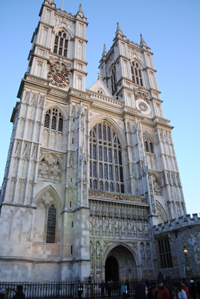
Westminster-AbbeyWestminster Abbey (pictured): We’ve already talked about Poet’s Corner but Shakespeare himself makes mention of Westminster Abbey in his plays, notably in Henry VI, Part I, when it’s the scene of Henry V’s funeral. The Jerusalem Chamber, principal room of Cheyneygates, the medieval house of abbots of Westminster is mentioned in Henry IV, Part II.

The Houses of Parliament: True, the buildings have changed somewhat since Shakespeare’s day but the former Palace of Westminster is the site of scenes in numerous plays including Richard IIHenry IV, Part II and Henry VI, Part III are set. Among rooms mentioned is Westminster Hall which survives today from the original building.

The Tower of London: As one would expect, this prominent London landmark pops up in several of Shakespeare’s plays including Henry VI, Part I and Richard III where its plays a rather central role – among the events recorded in the latter play are the infamous drowning of Richard III’s elder brother George in a butt of Malmsey wine.

Ely House: The London residence of the bishops of Ely, this long gone building is mentioned in Richard II (for more on Ely House see our earlier posts on Ye Olde Mitre Tavern here and St Etheldreda’s Church here ).

The London Stone: Now at 111 Cannon Street, the London Stone originally was located at another location in Cannon Street and its here in Henry VI, Part II, that rebel Jack Cade stops to strike his sword upon the stone (for more on the London Stone, see our earlier post here).

Other London sites mentioned in Shakespeare’s plays include generic “London Streets” (mentioned in a number of plays), “Eastcheap, near the Boar’s Head Tavern” (Henry IV, Part II), the Temple Garden (Henry VI, Part I) and Blackheath (Henry VI, Part II).

This Week in London – St Paul’s marks WWI centenary; Eid at Trafalgar Square; Suffragettes at the NPG; and, early Egypt gallery reopens at the British Museum…

An altar frontal created by more than 100 soldiers wounded in World War I will go on display at St Paul’s Cathedral this weekend. Made by 138 soldiers from the UK, Australia, Canada and South Africa, the restored altar frontal was created for the national service of thanksgiving at the end of the war and it forms the centerpiece of the cathedral’s commemoration of its centenary. The altar frontal will be used for the first time during a special service of Eucharist at 6pm this Sunday which will be attended by relatives of the men who made it. It will then be on display until 11th November, 2018, in the cathedral’s north transept. For more see www.stpauls.co.uk/WW1.

Trafalgar Square will host the annual Eid Festival this Saturday. It will feature stage entertainment including a catwalk show, arts and crafts, exhibitions, calligraphy, henna and face painting as well as a global food festival – including Turkish, Egyptian, Indonesian, Lebanese and Moroccan food – and a Malaysian food market. The free festival runs from noon to 6pm. For more, see www.london.gov.uk/eid.

A newly acquired portrait of suffragette Christabel Pankhurst has gone on display in the National Portrait Gallery for the first time in 80 years. The portrait, by Ethel Wright, was first shown at an exhibition staged in Kensington in 1909. It is part of a new display, Suffragettes: Deeds not Words, which also features photographs and archive material. It marks 100 years since the campaigners’ “final and most violent” protests which included an attack on paintings in the National Portrait Gallery. The display is on show in Room 31 of the gallery until 10th May next year. For more, see www.npg.org.uk.

The British Museum has reopened a gallery space dedicated to early Egypt as part of its refurbishment of the Ancient Egyptian galleries. The new Early Egypt gallery focuses on the development of Egypt between 8,500 BC and 3,100 BC – the beginning of the Pyramid Age – and features a redisplay of objects from the museum’s collection as well as materials only acquired recently; these include objects taken from a site in northern Sudan which were donated in 2002. Highlights of the new gallery include a series of female figurines which are among the oldest known Egyptian sculptures in human form, the Gebelein Man – the best preserved example of mummification dating to around  3,500 BC, and the Hunter’s Palette and the Battlefield Palette – two temple objects on which Egyptian rulers recorded their victories. The gallery is in Room 64. Admission is free. For more, see www.britishmuseum.org.

Send all items for inclusion to exploringlondon@gmail.com.

10 sites from Shakespearean London – 8: Memorialising Shakespeare (part 1)…

Shakespeare

This week (and next week) as part of our look at Shakespeare’s London, we’re taking a look at a few of the many memorials to William Shakespeare located around London…

• Westminster Abbey: Perhaps the most famous of London’s memorials to Shakespeare can be found in Poet’s Corner, an area of the abbey which has become noted as a burial place and memorial site for writers, playwrights and poets. Designed by William Kent, the memorial statue of Shakespeare was placed here in January, 1741 (there had apparently been some earlier talk of bringing his bones from Stratford-upon-Avon but that idea was squashed). The life-size statue in white marble, sculpted by Peter Scheemakers, was erected by Richard Boyle, the 3rd Earl of Burlington, Dr Richard Mead, Alexander Pope and Tom Martin. The memorial also features the heads of Queen Elizabeth I, King Henry V and King Richard III on the base of a pedestal and shows Shakespeare pointing to a scroll on which are painted a variation of lines taken from The Tempest. A Latin inscription records the date the memorial was created and an English translation of this was added in 1977. For more on the abbey, see www.westminster-abbey.org.

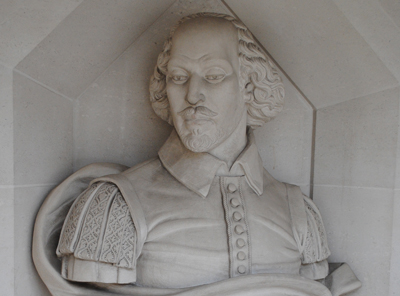
• Guildhall Art Gallery (pictured above): Facing into Guildhall Yard from niches under the loggia of the Guildhall Art Gallery are four larger-than-life busts of historical figures connected with the City of London. As well as one of Lord Protector Oliver Cromwell, architect Christopher Wren, and diarist Samuel Pepys (along with a full-length statue of Dick Whittington and his famous cat) is a bust depicting Shakespeare. Carved out of Portland stone by sculptor Tim Crawley, the busts were installed in 1999. Much attention was apparently paid to creating a bust which resembled pictures of Shakespeare. Follow this link for more on the gallery.

Former City of London School: This Thames-side building, dating from the 1880s, features a full length statue of Shakespeare who gazes out over the river. He’s not alone – poet John Milton, Sir Isaac Newton, Sir Thomas More and Sir Francis Bacon stand nearby, selected, apparently, to represent various disciplines taught at the school. The statues were the work of John Daymond who depicted Shakespeare flanked by representations of classics and poetry and drawing and music. The school vacated the building on Victoria Embankment  in the 1980s and it’s now occupied by JP Morgan.

We’ll be looking at some more works depicting Shakespeare next week…

Lost London – Baynard’s Castle (part 1)…

Baynard’s Castle actually refers to two buildings – a Norman fortification demolished in the early 13th century and a later medieval palace located to the east of the original structure. This week we’re looking at the first of those buildings – the Norman fortification.

Castle-BaynardThe first Baynard’s Castle was built in the late 11th century by Ralph Baynard (Baignard) and is believed to have replaced an earlier fortification at the site at the junction of the Thames and the Fleet rivers (the river now emerges into the Thames under Blackfriars Bridge).

Baynard (his name may be the origin of the name for Bayswater – Baynard’s Watering place – see our earlier post here), was the sheriff of Essex and a supporter of William the Conqueror.

The castle – which is said to have featured walls and parapets and which is generally said to have been on the waterfront (although some have said it was located inland) – remained in Baynard’s family until the reign of King Henry I when in 1111, his grandson William Baynard apparently forfeited his lands for supporting Henry’s eldest brother and would-be king, Robert Curthose.

It was later passed to the King’s steward Robert Fitz Richard, son of the Earl of Clare, and is known to have been inherited by his grandson, Robert Fitzwalter.

Fitzwalter, however, was a key opponent of King John and as early as 1212 he was in hot water for his part in a conspiracy against the king, although he stated it was because the king tried to seduce his daughter, Matilda the Fair. Either way, he escaped trial by heading to France and John seized the opportunity to raze the castle which he did on 14th January, 1213.

Fitzwalter was later forgiven under an amnesty and went on to play a leading role among the baronial opposition to Kong John – he was among 25 barons charged with enforcing the promises of the Magna Carta of 1215.

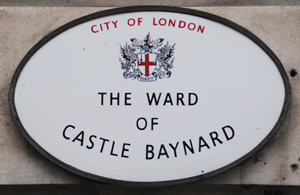
The name Baynard’s Castle is remembered in the London ward of Castle Baynard (pictured) which covers the area in which it once stood.

This Week in London – First World War galleries open at IWM; London’s WWI memorials the focus of new exhibition; and, London celebrates the Festival of Archaeology…

New galleries dedicated to exploring the history of World War I will open – along with the rest of the refurbished building – at the Imperial War Museum in Lambeth on Saturday. The First World War Galleries span 14 areas displaying everything from shell fragments and lucky charms carried by soldiers to weapons and uniforms, diaries and letters, photographs, art and film. Interactive displays include ‘Life at the Front’ featuring a recreated trench with a Sopwith Camel plane and Mark V tank, and ‘Feeding the Front’ featuring an interactive table of more than four metres long which looks how troops were kept fed. There are also reflective areas in which visitors are encouraged to reflect on some of the most difficult aspects of war. The museum – which features a dramatic new atrium – is also launching the largest exhibition and first major retrospective of British World War I art for almost 100 years. Truth and Memory includes works by some of the UK’s most important artists. Entry to both is free with Truth and Memory running until 8th March. For more, see www.iwm.org.uk.

London’s memorials to those who died in World War I are the focus of a new exhibition which opened at Wellington Arch near Hyde Park Corner yesterday. The English Heritage exhibition, which has a particular focus on the six memorials cared for by English Heritage but also looks at other memorials, will include designs, statuettes and photographs of the memorials including the Cenotaph in Whitehall. Also featured in We Will Remember Them: London’s Great War Memorials are official documents – including a note of condolence and medals certificates – received by the family of author and broadcaster Jeremy Paxman on the death of his great uncle Private Charles Dickson, who died at Gallipoli in 1915. Runs until 30th November. Admission charge applies. For more see www.english-heritage.org.uk/daysout/properties/wellington-arch/. Meanwhile, coinciding with the opening of the exhibition has been news that five of London’s key war memorials – including the Edith Cavell Memorial in St Martin’s Place and the Royal Artillery Memorial at Hyde Park Corner – have had their heritage listing upgraded.

In case you missed it, the 24th annual Festival of Archaeology kicked off last weekend and features a range of events across London. Highlights include the chance again to go ‘mudlarking’ on the Thames river bank below the Tower of London and have your finds assessed by archaeologists (this Saturday and Sunday from 11am to 4pm), guided 90 minute walks around Islington and Highbury this weekend with a particular focus on the 1940s, and a look behind the scenes at the London Metropolitan Archives (2pm to 5pm today). The festival continues until 27th July. Check the website for a full program of events – www.archaeologyfestival.org.uk.

LondonLife – Unearthing Bedlam’s buried past…


Buried-at-BedlamA team of volunteers are searching through historical records for evidence of people buried at the Bedlam burial ground in the 16th and 17th centuries. The 15 member team are carrying out the work at the London Metropolitan Archives as archaeologists prepare to excavate 3,000 skeletons from the former burial site next year in anticipation of the construction of the new Liverpool Street Crossrail Station – part of the £14.8 billion cross London Crossrail project. About 400 skeletons have already been removed during preliminary works. Located near Bethlem Hospital, the burial ground opened in the 16th century as part of the city’s response to the plague and was the first burial ground in London not associated with a parish church. Among those buried here were Robert Lockyer, a soldier executed under the orders of Oliver Cromwell for leading the Bishopsgate mutiny of 1649, and Leveller John Lilburne. Crossrail are keen to hear from members of the public who may be able to provide further details of burials at Bedlam – if you can help, email bedlamrecords@crossrail.co.uk.


A Moment in London’s History – The execution of John Austin, the last person hanged at Tyburn…

Tyburn-TreeThe site of public executions for hundreds of years, it’s generally accepted that at about 9am on 3rd November, 1783, John Austin became the last person to be hanged there (for more on the history of executions at Tyburn – and in particular the massive gallows known as the Tyburn Tree – see our previous post here).

Austin had been convicted of being a highwayman – specifically for inflicting “robbery with violence” upon labourer John Spicer, two weeks before during which Austin had attacked Spicer, beating and cutting him, “in a cruel manner”.

As he stood on the cart beneath the gallows (a mobile gallows had been in use since 1759 when the Elizabethan-era Tyburn Tree was dismantled), Austin’s last words were somewhat predictable – he requested that the crowd pray for his “departing soul”, that they would heed his example and that Jesus would have “mercy upon my poor soul”.

His death, it is said, was “hard”. As the cart was moved off, the halter around his neck apparently slipped “to the back part of his head” and instead of his neck being broken, Austin slowly choked to death.

The decision to cease executions at Tyburn (near where Marble Arch now stands) and move them to outside Newgate Prison was apparently due to complaints. These came from both City traders who felt the condemned person’s three mile procession from Newgate to Tyburn disrupted making money and the fashionable who sought to live in the city’s outlying western areas like Marylebone and who didn’t want to see the unruly mob that typically accompanied  outside their front doors. Such groups had long been lobbying for the practice to come to an end.

For more on the history of Tyburn see Robert Bard’s Tyburn: The Story of London’s Gallows.

This Week in London – Virginia Woolf celebrated at NPG; the City of London Festival; and, a new gallery at the V&A…

The life of literary icon Virginia Woolf is being celebrated in a new exhibition which opens at the National Portrait Gallery today. Virginia Woolf: Art, Life and Vision explores her life as novelist, intellectual, campaigner and public figure and features more than 100 works including portraits of Woolf by Bloomsbury Group contemporaries like her sister Vanessa Bell, Duncan Grant and Roger Fry as well as photographs by Beresford, Ray Man and Beck and McGregor who photographed the intellectual for Vogue. The display also includes works depicting her friends, family and literary peers and archival materials such as extracts from her personal diaries, books printed by Hogarth Press which she founded with husband Leonard Woolf and letters including one written to her sister shortly before her suicide in 1941. Runs until 26th October. Admission charge applies. For more, see www.npg.org.uk.

The 52nd City of London Festival enters its final week today with numerous music, dance, spoken word and theatre events – many of them free – still on offer across the City. Events this week include a concert focusing on the history of the instrument known as the recorder and that of the office of Recorder of London (as St Sepulchre with Newgate tonight; tickets required), a showcase of musical talent from the Guildhall School of Music & Drama (at St Stephen Walbrook at 1.05pm next Tuesday; free), and, the Cart Marking Ceremony, in which vehicles process into Guildhall Yard where they are marked with a red hot iron by the Master Carmen and Lord Mayor (next Wednesday at 10.30am, free). For the full program of events, see www.colf.org. This year’s festival also features the placement of “street guitars” at 12 locations across the Square Mile where you can turn up and have a strum – for locations, see www.colf.org/streetguitars.

A new gallery of items you might find in your own home has opened at the V&A. Gallery 74 now features items collected as a result of the museum’s “rapid response collecting” approach which sees them acquiring new objects relating to contemporary events and movements in architecture and design. Among the objects on display are a soft toy from IKEA, a pair of jeans from Primark (acquired soon after the Rana Plaza factory building in Dhaka, Bangladesh, in which 1129 workers were killed – the factory made clothes for a number of western brands including Primark), and the world’s first 3D printed gun, the Liberator, which was designed by Texas law student Cody Wilson. Entry is free. For more, see www.vam.ac.uk.

Send all items of interest for inclusion to exploringlondon@gmail.com.