10 Historic London Markets – 2. Smithfield Market…

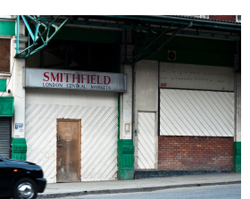
Now the largest wholesale meat market in the UK and one of the biggest in Europe, the connections between the site of Smithfield Market, officially known as the London Central Markets, and livestock go back to at least 800 years.

Since the 12th century animals were routinely traded here thanks to the site’s position on what was then the northern edge of the city. Smithfield was also known for being an area for jousting and tournaments and was the location of the (in)famous St Barthlomew Fair (this closed in 1855) as well as an execution ground – among those executed here were Wat Tyler, leader of the Peasant’s Revolt, and ‘Braveheart’, Sir William Wallace (1305).

Skip ahead several hundred years and, by the the mid-1800s, traffic congestion led to the livestock trade being relocated to a new site north of Islington. Plans were soon launched to locate a cut meat market on the Smithfield site.

Following the passing of an Act of Parliament, work on the new market began in 1866 with Sir Horace Jones (he of Tower Bridge fame), the City Architect, overseeing the design. Constructed of ornamental cast iron, stone, Welsh slate and glass, the initial market buildings were completed in 1868 with the result being two vast buildings, separated by a grand central avenue, but linked under a single roof. The new market was opened amid much pomp by the Lord Mayor of London on 24th November, 1868.

Four further buildings were soon added – only one, the Poultry Market, which opened in 1875, is still in use – and in the 1870s the market began to see the arrival of frozen meat imported from as far afield as Australia and South America.

Closed briefly during World War II – when the site was used for storage and an army butcher’s school – it reopened afterwards. The main poultry building was destroyed in a fire in 1958 and a replacement featuring a domed roof – the largest clear spanning dome roof in Europe at the time – was completed by 1963.

More recently, the market underwent a major upgrade in the 1990s. Queen Elizabeth II opened the refurbished East Market Building in June, 1997.

WHERE: London Central Markets, Charterhouse Street and West Smithfield (nearest Tube Stations are Barbican, St Paul’s and Moorgate); WHEN: From 3am Monday to Friday (visitors are told to arrive by 7am to see the market in full swing) (There are walking tours available – see www.cityoflondontouristguides.com for details); COST: Free entry; WEBSITE: www.smithfieldmarket.com.

PICTURE: Rossella De Berti/www.istockphoto.com

What’s in a name?…Cannon Street

One of the major thoroughfares of the City of London, Cannon Street’s name has nothing at all to do with artillery or religion. In fact, the street, which runs from St Paul’s Churchyard in the west to Eastcheap in the east, owes its name to the industry that once took place there.

Like many other streets in the City connected with the occupations of past residents, Cannon Street is a corruption of a street formerly known as Candelwichstrete (one of many various spellings of which the modern English version is Candlewick Street) which relates to the candlemakers and wax chandlers who lived and conducted their trade along the street in the Middle Ages (the Tallow Chandlers Company, involved in regulating candle-making, has been located in adjoining Dowgate Hill since 1476, although the current building dates from 1672).

The name was gradually corrupted into Cannon Street (apparently the corruption was at least partly due to its pronunciation in the Cockney dialect), which is what it was known as by the late 17th century when the seemingly ever-present Samuel Pepys was writing his diary.

Cannon Street – which was only extended to its current length in the mid-1800s under the supervision of architect JP Bunning, having formerly been a narrow lane which stopped at Dowgate Hill in the east – apparently later become known for the number of drapers based there and was also home to the Steelyard or Stalhof, the trading base of the German Hanseatic League in London in the 13th and 14th centuries (a plaque commemorating this was erected at Cannon Street Station in 2005).

Now lined with office buildings including some former warehouses from the Victorian era, the street is also home to a recently redeveloped above ground train station and Underground station- both of which were opened in the late 1800s (the station, which built was on the site of the Roman governor’s palace, was originally located behind the Cannon Street Hotel, birthplace of the British Communist Party). Cannon Street is also the location of the mysterious London Stone – formerly located at the now long-gone St Swithin’s Church, it can be found behind a grill at number 111 – for more on it, see our earlier post here).

London Pub Signs – The Lord Raglan…

Originally known as The Bush,  The Lord Raglan pub just to the north of St Paul’s was renamed in the mid 1800s to commemorate one of the heroes of the Battle of Waterloo – the 1st Baron Raglan (1788-1855).

Named the 1st Baron Raglan in 1852, the man previously known as Lord FitzRoy Somerset had lost his right arm at the Battle of Waterloo, fought between the Duke of Wellington and Napoleon on 18th June, 1815, in modern-day Belgium.

His name was subsequently adopted to to describe the ‘Raglan Sleeve’, a type of sleeve which extends as a single piece to the collar and a style which Lord Raglan was said to have favored after his arm was amputated.

Lord Raglan died in 1855 while Commander-in-Chief at the Crimean War. There is a blue plaque commemorating his role in this war on his former house in Stanhope Gate in Mayfair.

The site of the Lord Raglan tavern, 61 St Martin’s Le Grand, is said to be one of the oldest tavern sites in the city, originally dating from about 1779, and while the current building dates from 1855, the cellars are said to be much older and are said to incorporate parts of what was the Roman wall.

For more on the Lord Raglan, see the Taylor Walker website at www.taylor-walker.co.uk/pub/lord-raglan-st-pauls/c1779/.

Where is it?…#45


The latest in the series in which we ask you to identify where in London this picture was taken and what it’s of. If you think you can identify this picture, leave a comment below. We’ll reveal the answer early next week. Good luck!

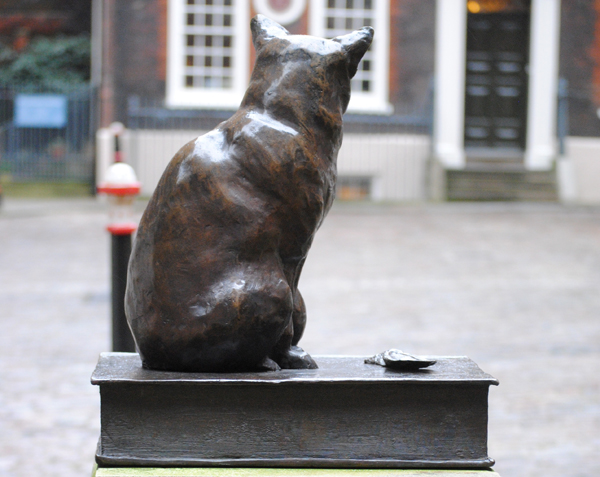
Congrats to Mike, Debbie, Janet, and Zoe (on Facebook), this is indeed the back of the statue of Hodge the cat in Gough Square in the City of London, just outside Dr Johnson’s House at No 17. One of the cats of the famed lexicographer, Dr Samuel Johnson, Hodge had his own moment of stardom in James Boswell’s Life of Johnson in which Dr Johnson is heard remarking that he’s had better cats than Hodge before, apparently in response to Hodge’s reaction, stating that he was “a very fine; a very fine cat indeed” (Johnson was apparently unusual for his love of cats; Boswell did not suffer the same love). This bronze statue of Hodge, by sculptor Jon Bickley and placed here in 1997, has Hodge sitting on a copy of Dr Johnson’s famous dictionary and beside him is some empty oyster shells, referring to Dr Johnson’s habit of buying oysters for his cats to eat. For more on Dr Johnson’s House (where Dr Johnson lived from 1747-59), see www.drjohnsonshouse.org.

Where’s London’s oldest…livery company hall?

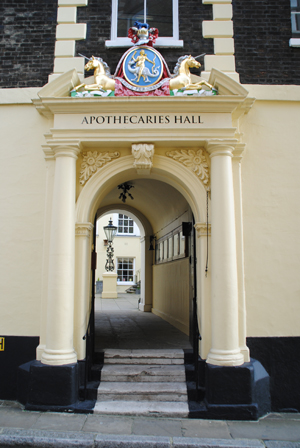
The oldest livery company building, that of the Worshipful Society of Apothecaries of London, dates from just after the Great Fire of London in 1666.

Originally built in 1672 to the designs of surveyor Edward Jerman, it replaced an earlier building which had been destroyed in the fire. It has since been refurbished several times and while the external facade appears as it did in the late 1700s, the interior layout, with Great Room – complete with original Irish Oak panelling, Court Hall and Parlour, is as it was when first built after the Great Fire.

Previously members of the Grocer’s Company (and earlier still, the Guild of Pepperers), the Apothecaries Society was incorporated as a City livery company on 1st December, 1617, when it was granted a royal charter by King James I.

They purchased a building in 1632, known then as Cobham House (previously owned by Lady Anne Howard), on land formerly part of Blackfriars Priory (see our former post on the priory here) – it was this building which was destroyed in 1666.

Among treasures inside the current hall is a portrait of Gideon de Laune, Royal Apothecary to Queen Anne of Denmark, wife of King James I, and credited as founder of the Society which was was presented to the Society  in 1641 and hangs in the Court Room. There’s also a 24-branch candelabrum in the Great Hall which was presented to the society by Sir Benjamin Rawling, Sheriff of London and Master of the Society in 1736.

Now one of the largest of the livery companies in the City and still active in regulating medical practitioners, it is 58th in order of precedence and is still active in its trade with the organisation’s constitution requiring 85 per cent of the Society’s membership belong to the medical profession. Past luminaries have included the Romantic poet, John Keats.

The society is also known for having established the Chelsea Physic Garden in 1673 – making it one of the oldest botanic gardens in the world – on land granted it by Sir Hans Sloane (see more on him in our earlier post here).

The hall is available for hire. For more information on the Society, see www.apothecaries.org. Visits to the hall are by prior arrangement only. Contact the Beadle via the above website to find out more.

Around London – Open House London; 16th century tankard at MoL Docklands; and, Spanish artists shine at the British Museum…

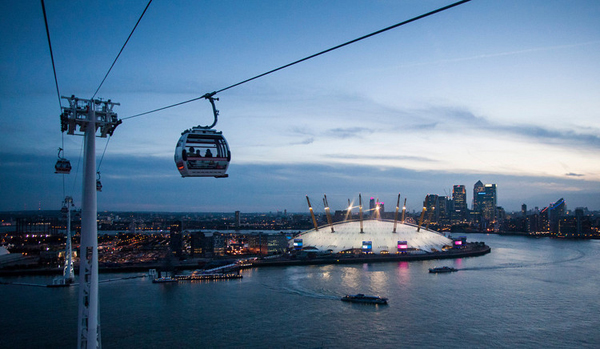
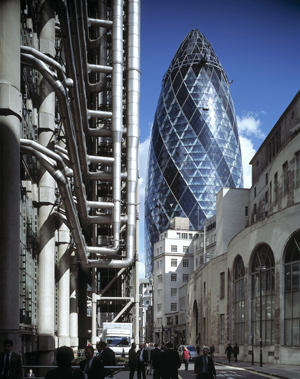
It’s Open House London weekend and that means your chance to enter scores of buildings not normally open to the public. More than 750 buildings are taking part in this, the 20th year the weekend has been held and there’s also an extensive program of free talks, walks and specialist tours. Among the buildings open this year are the iconic Gherkin building in the City (formally known as 30 St Mary Axe, pictured), Heron Tower in Bishopsgate, numerous livery company halls including that of the Apothecaries, Fishmongers and Carpenters, government buildings including Marlborough House, Westminster Hall, and the Foreign Office and numerous historic residences from the Mansion House, home of the Lord Mayor of London to Osterley Park House in west London. Among the events on offer is a moonlit hike through London tomorrow night to raise money for Maggie’s Cancer Caring Centres and rides on the new Emirates Airline cable car as well as boat tours to the Thames Barriers. If you didn’t order a guide, you can see the program online at the Open House London website – www.londonopenhouse.org. PICTURE: (c) Grant Smith/VIEW Pictures

A 16th century wooden tankard, found by a mudlark on the Thames foreshore near Ratcliff in London’s east, has briefly gone on display at the Museum of London Docklands. The large vessel, capable of holding three pints, has the initials RH inscribed on the base. It’s unknown for what purpose it was used, perhaps serving as a decanter rather than for individual use and may have been used on a ship. The vessel will be on display at the museum only until 27th September. For more, see www.museumoflondon.org.uk.

On Now: Renaissance to Goya: Prints and drawings from Spain. Opening at the British Museum today is this new exhibition featuring important prints and drawings by Spanish and other European artists working in Spain and spanning a period from the mid 16th century through to the 19th century. While all the works are drawn from the museum’s collection, many have never been on display before. The artists represented include Diego Velazquez, Alonso Cano, Bartolome Murillo, Francisco Zubaran and Jusepe de Ribera as well as Francisco de Goya. Held in room 90. Admission is free. Runs until 6th January. For more, see www.britishmuseum.org.

Famous Londoners – Grinling Gibbons…

A late 17th and early 18th century wood carver and sculptor, the curiously named Grinling Gibbons is remembered for his magnificent carvings in numerous English buildings including such London icons as St Paul’s Cathedral and Hampton Court Palace.

Not much is known about Gibbons’ early life. The son of English parents (his father was apparently a draper), he was born in Rotterdam in The Netherlands on 4th April, 1648, and, as a young man, is believed to have undertaken an apprenticeship as a sculptor in that country.

Around the age of 19, he moved to England – first to York and to Deptford in the south. It was the quality of his work which led diarist John Evelyn, having discovered Gibbons working on a limewood relief of Tintoretto’s Crucifixion in a small cottage near Deptford in early 1671, that led him to introduce him to Christopher Wren, the architect of the age, and fellow diarist Samuel Pepys and to eventually present him (and his relief) to King Charles II at Whitehall Palace on 1st March the same year.

But Gibbons’ work apparently failed to initially impress at court and it was only following his ‘discovery’ later that year by the court artist Sir Peter Lely that he began to receive major commissions.

It’s apparently not known when Gibbons married his wife Elizabeth and moved to London they were living there by 1672 and were having the first of their at least 12 children (while at least five of their daughters survived into adulthood, none of their sons did).

In 1672, they were living in an inn, called La Belle Sauvage or The Bell Savage, located on Ludgate Hill near St Paul’s, and, while Gibbons continued to maintain a workshop here into the 1680s, the family moved to Bow Street in Covent Garden around the end of the 1670s (the house here apparently collapsed in 1702 and was subsequently rebuilt in brick).

Gibbons, who was admitted to the Draper’s Company in 1672 and held various posts within it over ensuing years, reached the pinnacle of his success when he was made master sculptor and carver in wood to King William III in 1693, and was later made master carpenter to the king, then King George I, in 1719.

Having worked mostly in limewood, Gibbons, recently called the “British Bernini”, is known for his distinct and exuberant style which features cascading foliage, fruit, animals and cherubs. While he worked on numerous important buildings outside of London – including carvings in the Chapel Royal and king’s dining room at Windsor Castle, in a chapel at Trinity College in Oxford, at Blenheim Palace in Oxfordshire and a famous ‘carved room’ at Petworth House in Sussex – and beyond (he also created two presentation panels – known as the ‘Cosimo’ and ‘Modena’ panels which were sent to Italy as royal gifts), Gibbons is also noted for his work on a number of prominent buildings in London.

Among the buildings he worked on or in around London are the churches of St James’s in Piccadilly, St Mary Abchurch, St Michael Paternoster Royal and, famously, St Paul’s Cathedral (where he carved choir stalls, the bishop’s thrones and choir screen) as well as Hampton Court and Kensington Palaces.

While he is primarily remembered for his limewood carvings, Gibbons’ workshop was also responsible for sculpting statues, memorials and decorative stonework. A couple of the workshop’s statues can still be seen in London – one of King Charles II in Roman dress at the Royal Hospital in Chelsea and another of King James II outside the National Gallery in Trafalgar Square – while the magnificent Westminster Abbey memorial to Admiral Sir Clowdisley Shovell is also attributed to him.

Gibbons died at his Bow Street home on 3rd August, 1721, and was buried in St Paul’s Church in Covent Garden (his wife had been buried there several years before).

For more on Grinling Gibbons, check out David Esterly’s Grinling Gibbons and the Art of Carving.

Around London – London’s listed; Open House beckons; Blue Plaque for opthalmologist; and, Motya Charioteer at the British Museum…

• It includes everything from the iconic Lloyd’s Building in the City to the former Strand Union Workhouse in Fitzrovia which may have inspired scenes in Charles Dickens’ Oliver Twist and the red phone boxes which sit outside the British Museum in Bloomsbury. English Heritage this week released it’s London List 2011 which documents the more than 100 sites in London which have been awarded listed status by the organisation last year. They include 19 Underground stations (among them that of Oxford Circus, St James’s Park and Aldwych), four war memorials (including the grand Central Park War Memorial in East Ham) and two schools as well as various cemetery monuments (including at Highgate and Brompton Cemeteries, and Bunhill Fields Burial Ground) and parks (the status of Green Park was upgraded to Grade II*), religious and commercial premises, public libraries and homes. To download a copy, visit www.english-heritage.org.uk/publications/london-list-2011/.

It’s just one week to go until the Open House London weekend when more than 750 buildings of all sorts open their doors to you. We’ll be talking more about some of the special places open this year in next week’s update – this is, after all, one of our favorite London events of the year, and while, if you haven’t already entered, you’ve missed on the balloted openings, there’s still plenty of places where you can simply turn up on the day (and entry to all is free). If you haven’t already bought one, you can buy the Guide online – just follow the links from www.openhouselondon.org.uk. It can also be picked up free at some participating London libraries.

• Dame Ida Mann, Oxford’s first female professor and a pioneering ophthalmologist, has been honored with an English Heritage Blue Plaque at her childhood home in West Hampstead. The plaque, which was unveiled by an Australian opthalmologist who worked with Mann, Donald F. Ezekial, last week, has been placed on a house at 13 Minster Road where Mann lived from 1902-1934. Mann was born in West Hampstead and lived there for 41 years before eventually emigrating to Australia. For more on blue plaques, see www.english-heritage.org.uk.

• On Now: Motya Charioteer at the British Museum. Best be quick for this one, the charioteer, on loan from the Museo Giuseppe Whitaker on Motya, is only around until 19th September (that’s next Wednesday). The stunning statue, displayed near the sculptures from the Parthenon, dates from about 460-450 BC and is generally credited as one of the finest examples of Greek marble sculpture to have survived down the ages. It is believed to depict the winner of a chariot race and is likely to have been commissioned to commemorate a victory by a participant from one of Sicily’s Greek cities. It was found in Sicily in 1979. Admission is free. For more, see www.britishmuseum.org.

Where is it?…#42

The latest in the series in which we ask you to identify where in London this picture was taken and what it’s of. If you think you can identify this picture, leave a comment below. We’ll reveal the answer early next week. Good luck!

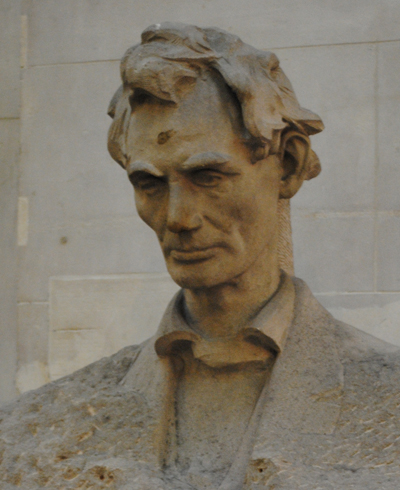
Well done to Carol, this bust – yes, of Abraham Lincoln, 16th President of the United States – is located just inside the ‘rear’ entrance of the Royal Exchange in the heart of the City. The work of Irish-American sculptor Andrew O’Connor, it was carved from a block of limestone apparently quarried near the President’s birthplace in central Kentucky. The bust, which shows Lincoln is his prime, was presented to The Gresham Committee by the Lincoln Committee in 1930.

(And sorry about the previous #42 post – a technical glitch meant we had to shelve it!)


Lost London – Queenhithe…

Not, strictly speaking, lost, Queenhithe – a dock on the north bank of the Thames – is nonetheless these days merely a shadow of its former self.

There has been a dock here since Saxon times when it is recorded that King Alfred (he of ‘The Great’ fame), established a harbour here in 883. It was then known as Ethelred’s Hythe (the Ethelred being that of his brother-in-law and ‘hythe’ being a Saxon word for a trading shore where goods could be traded directly out of boats).

Queenhithe took its name from Queen Matilda, the wife of King Henry I, who was granted dues from goods being traded at the dock in the early 1100’s – a right which was later inherited by future English queens.

The dock reached the peak of its popularity in the 13th century when it became the principal site for the landing of grain and other food supplies to feed London but in the 15th century, the dock’s importance waned as other docks downstream, better suited to larger watercraft, took over much of its trade.

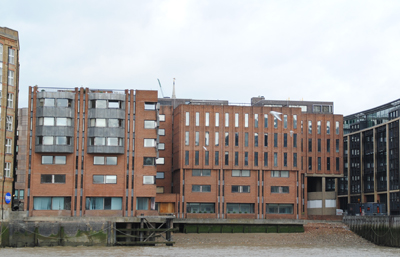
Remains of the wooden timbers which in medieval times lined the Thames waterfront have been found here. The inlet for Queenhithe’s harbour (pictured above) is one of few left on The Thames.

The name these days gives itself to Queenhithe street (which leads to the inlet) and the Queenhithe Ward, one of 25 wards in the City of London. There was also a former church known as St Michael Queenhithe – it was destroyed in the Great Fire of 1666, rebuilt to the designs of Sir Christopher Wren and then demolished in the late 19th century.

Around London – Cecil Beaton at the IWM; a night of bicycles at the Design Museum; and, Dickens and the Foundling…

A major new exhibition featuring stunning images captured by the late renowned society and fashion photographer Cecil Beaton during World War II opens at the Imperial War Museum in Lambeth today. Cecil Beaton: Theatre of War features some of the 7,000 photographs the photographer took between 1940 and 1945 with many of them exhibited for the first time. The photographs were taken in an array of locations – from Britain and Europe to the Middle East and Africa, India, Burma, China and the US – and depict everything from “ordinary” people in civilian life through to some of the era’s most famous military leaders. The exhibition will also look at how the war affected Beaton personally including his own brushes with death including in a major air crash and suffering from the likes of dengue fever and dysentery. Admission charge applies. Runs until 1st January. For more, see www.iwm.org.uk.

• A celebration of all things bicycle will be held at the Design Museum tomorrow (Friday, 7th September) night. Bike V Design, which kicks off at 6.30pm, will feature talks exploring the design of bikes, a mini cinema and live performances including BMX stunts and circus trick cycling as well as a demonstration of saddle manufacturing. Visitors are encouraged to bring their own bikes or enjoy the selection of bespoke bicycles on display. The night is being held to coincide with Designed to Win, the museum’s current exhibition exploring the tension between sport and design. An admission charge applies. For more, see www.designmuseum.org.

• On Now: Dickens and the Foundling. In case you’ve missed it, this exhibition at the Foundling Museum in Bloombury explores the relationship between the writer and the Foundling Hospital through a series of objects selected for display by six people with an interest in Dickens including actress Gillian Anderson, Dickens’ descendent Mark Dickens, comedian Armando Iannucci, Camden councillor Tulip Siddiq, poet Lemn Sissay and journalist Jon Snow. Among the objects on show are a letter from Dickens to the editor of The Times in which he objects to public hangings, the writing desk at which Dickens wrote what we have of the unfinished The Mystery of Edwin Drood, and a manuscript page from Oliver Twist, written when Dickens lived in a house at nearby Doughty Street. The exhibition runs until the end of October. Free with museum admission. For more, see www.foundlingmuseum.org.uk.

LondonLife – John Donne at St Paul’s Cathedral…

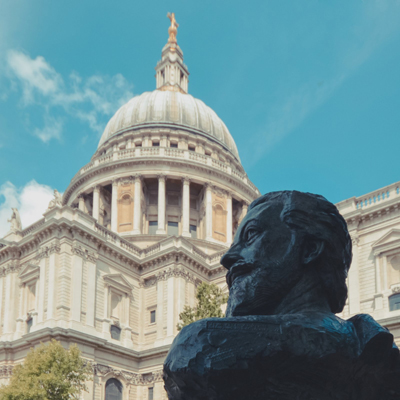
A new bust of priest and poet John Donne was unveiled outside St Paul’s Cathedral earlier this year. Donne was made  Dean of St Paul’s in 1621, a position he held until his death 10 years later. He was subsequently buried in Old St Paul’s Cathedral and a memorial to him – a likeness apparently based on a drawing of him in his shroud – was the only monument to survive the Great Fire of London in 1666. It’s still inside the cathedral. The new bronze bust, located in the garden to the south of the cathedral, was the work of artist Nigel Boonham and has Donne looking east towards his birth place in nearby Bread Street. The text “Hence is’t, that I am carried towards the West/This day, when my Soul’s form bends to the East” – taken from the poem Good-Friday, 1613, Riding Westward – is inscribed underneath the bust. Commissioned by the City of London, the sculpture was unveiled in June by the artist and Professor Peter McCullough, one of the cathedral’s Lay Canons. For more on St Paul’s, see www.stpauls.co.ukPICTURE: Graham Lacdao / The Chapter of St Paul’s Cathedral. 

Where is it? #41….

The latest in the series in which we ask you to identify where in London this picture was taken and what it’s of. If you think you can identify this picture (and try and be as precise as possible), leave a comment below. We’ll reveal the answer early next week. Good luck!

Yes, you guessed it, these are indeed the 3.7 metre high statues which sit above the south transept of St Paul’s Cathedral. The statues include those of St Andrew and St Thomas, both of which are attributed to Caius Gabriel Cibber (1630-1700) and Grinling Gibbons (1648-1721). We had originally said they were the work of Francis Bird (1667-1731), who also completed the famous panel depicting the Conversion of St Paul on the cathedral’s west front and the original version of the statue of Queen Anne outside the main entrance (more on that another time), but while he was responsible for other statues on the cathedral, turns out he wasn’t for these two. The image was taken from the viewing deck of One New Change on Cheapside.

Treasures of London – King Lud and his sons…

A mythical figure from early Britain, King Lud is said to have been a pre-Roman king of Britain who rebuilt London (which according to legend had been originally founded by the exiled Trojan Brutus) and from whom London derives its name.

Lud is said by some to have given his name to the gateway known as Ludgate (although others say it comes from an Old English term meaning swing or postern gate – see our earlier post here for more on Ludgate).

This series of badly weathered statues – depicting King Lud and his two sons, apparently named Androgeus and Theomantius – was originally located on the gate. In fact, the legend goes, the king was buried under it.

Following the gate’s demolition, the statues – said to date from 1586 with the name of the sculptor now lost to time – were moved here at some point to the vestry porch of St Dunstan-in-the West in Fleet Street.

Olympics Special – London bridges aglow…

Seven of London’s bridges are being lit up at night until 10th September in an initiative called “Dazzle”. Being run under the Mayor of London Presents program, it celebrates the 50 evenings of the Olympic and Paralympic Games. Here’s just a sample of what you can see…

The most iconic of London’s bridges, Tower Bridge has been a focal point for Olympic celebrations. One of the great structures of Victorian London, it was opened in 1894 and at the time was largest bascule bridge ever built (for more on Tower Bridge, see our earlier post here).

The most recent version of London Bridge, this links Borough High Street in Southwark (you can see Southwark Cathedral in the background) and King William Street in the City and was built in the late 1960s/early 1970s and opened by Queen Elizabeth II in 1973. There have been bridges in this vicinity since as far back as Roman times (for more on the history of London Bridge, see our earlier post here).

The current Southwark Bridge – which links the City of London with the heart of Southwark – dates from 1921 and replaced an earlier bridge designed by John Rennie.

Initially plaqued by the wobbles, the steel suspension walk bridge known as Millennium Bridge is the newest of the bridges that cross the Thames in central London, linking St Paul’s Cathedral on the north bank with the Tate Modern on the south (the looming bulk of which is pictured here). First opened in July 2000, it was closed after concerns over its movement and then reopened to the public in 2002.

Other bridges taking part in Dazzle but not shown here include the Golden Jubilee footbridges, Waterloo Bridge and Blackfriars Bridge.

For more on the program, see www.molpresents.com/dazzle.

PICTURES: All images courtesy of the City of London Corporation.

Around London – Celebrating the Olympics; Camden Lock’s night market; and, images of London at the Tate…

We’ll kick off this week with just a few more of the plethora of Olympic-related events which are happening around town:

Tower Bridge, site of some spectacular fireworks last Friday night, is currently hosting an exhibition celebrating the 26 cities which have hosted the modern Olympics. Cities of the Modern Games, located on the bridge’s walkways, runs alongside an interactive exhibition looking at the bridge’s construction. Follow the link for details.

The Guildhall Art Gallery is showcasing sculpture and art inspired by sport and the “Olympic values”. The art works are all winning entries from a contest organised by the International Olympic Committee. The chosen works were selected from among 68 submissions made by an international jury. Follow the link for details.

The Design Museum is hosting a new exhibition celebrating the nexus between sport and design. Designed to Win looks at everything from the design of F1 cars to running shoes, bats and bicycles and explores the way in which design has shaped the sporting world. Runs until 9th September. Admission charge applies. See www.designmuseum.org.

• The London Metropolitan Archives is holding an exhibition of playing cards featuring an Olympic theme. Sporting Aces – Playing Cards and the Olympic Games features cards drawn from the collection of the Worshipful Company of Makers of Playing Cards which have an Olympic theme. Admission is free. Runs until 13th September. See www.cityoflondon.gov.uk/lma.

And in other news…

A night market has been launched at Camden Lock over the summer period. Street food stalls and vintage fashion, arts and crafts and book shops will be open until 10pm every Thursday with extras including live music and film screenings. For more, see www.camdenlockmarket.com.

• On Now: Another London: International Photographers and City Life 1930-1980. This exhibition at Tate Britain in Millbank features more than 150 classic photographs of the city and its communities by foreign photographers including such luminaries as Henri Cartier-Bresson. The exhibition features iconic works such as Robert Frank’s London (Stock Exchange) 1951, Cartier-Bresson’s images of King George VI’s coronation, Elliot Erwitt’s depiction of a rain-washed London bus stop, and Bruce Davidson’s image of a child with pigeons in Trafalgar Square alongside works such as Wolfgang Suschitzky’s images of working class families in the East End, from the 1940s, and Karen Knorr’s images of punks in the 1970s. The photographs all come from the Eric and Louise Franck London Collection, which includes more than 1,200 images of London and has been promised as a gift to the Tate. Runs until 16th September. Admission charge applies. See www.tate.org.uk. 

Have we missed something we should be telling others about? Send details in an email to exploringlondon@gmail.com.

Around London – Bells…and more bells; Olympic memorabilia; free wifi in the West End; The Arch returns to Kensington Gardens; and, Impressionists at the RA…

• It’s all about the Olympics in London this week and many of the events – like the Opening Ceremony and Torch Relay (see last week’s post) – are well covered elsewhere, but we thought we’d mention a couple of things in relation to the Games: 

The first is the ‘All the Bells’ project which will see bells across London being rung at 8:12am on Friday to “ring in” the first day of the Olympic and Paralympic Games. Work No. 1197: All the bells in a country rung as quickly and as loudly as possible for three minutes, commissioned as part of the London 2012 Festival, is the brainchild of Turner Prize-winning artist and musician Martin Creed and will involve thousands of bells across the nation. Speaking of bells, the City of London has announced that some of the City’s churches will be ringing continuously during the three Olympic marathon events – the men’s, women’s, and Paralympic events. As many as 57 of the country’s most experienced bell ringers, co-ordinated by the Ancient Society of College Youths (a ringing society created in London in 1637) will be working for three to four hours continuously at churches including St Paul’s Cathedral, St Mary le Bow, St Lawrence Jewry, St Magnus the Martyr, St Vedast and St Katharine Cree. During the women’s marathon, an all-female band will be attempting a peal at St Paul’s, the first all-woman attempt on the bells. (Apologies, this article had originally had the time for the bell ringing at 8.12pm – it is in the morning, not the evening!)

A new exhibition exploring London’s Olympic history has opened at the British Library. Olympex 2012: Collecting the Olympic Games features a range of memorabilia including a swimming costume and the finishing tape broken by – later disqualified – marathon runner Dorando Pietri  from the 1908 London Games (see our earlier post for more on him) as well as posters and artworks, stamps, letters and postcards. The exhibition also features audio interviews with Olympians including William (Bill) Roberts, a relay runner in the 1936 Berlin Olympics, and Dorothy Tyler, a medal-winning high jumper who competed in the 1936 and 1948 Olympics. Presented by the British Library and International Olympic Committee, the exhibition runs until 9th September at the library in St Pancras. Entry is free. For more, see www.bl.uk. PICTURE: Rare 1948 postcard by an unknown artist (c) Private collection/IOC

• A new free wifi network has been launched in London’s West End. Westminster City Council and telco O2 launched the network this week. It will initially cover Oxford and Regent Streets, Trafalgar Square, Leicester Square, Piccadilly Circus and Parliament Square with further areas in Westminster and Covent Garden the next to be included in the network. A once-only registration process is required to join.

• Henry Moore’s famous sculpture, The Arch, has been returned to its original home in Kensington Gardens. The six metre high work was presented to the nation by Moore in 1980 and was positioned on the north bank of the Long Water until 1996 when the structure became unstable and was placed in storage. In late 2010, the Royal Parks began a project with The Henry Moore Foundation to see if the work could be returned to the gardens. Work began to restore the piece – which consists of seven stones weighing 37 tonnes – to its original location earlier this year. For more on Kensington Gardens, see www.royalparks.org.uk/parks/kensington-gardens.

• On Now: From Paris: A Taste for Impressionism. This Royal Academy of Arts exhibition at Burlington House features 70 works from the Sterling and Francine Clark Art Institute in Williamstown, Massachusetts, and includes works by Manet, Monet, Pissarro, Degas, Sisley, Morisot and Renoir as well as those of post-Impressionist artists Corot, Théodore Rousseau and J-F. Millet, and ‘academic’ paintings by Gérôme, Alma-Tadema and Bouguereau. Runs until 23rd September. Admission charge applies. See www.royalacademy.org.uk for more.

Around London: Olympic Torch Relay hits London; mascots pop-up all over the city; and Shakespeare at the British Museum…

• The Olympic Torch Relay arrives in London tomorrow night before working its way around all of the city’s 33 boroughs and reaching the Olympic Stadium for the Opening Ceremony next Friday.  The torch will arrive in the city by helicopter from Guildford tomorrow night and then be abseiled into the Tower of London where it will spend the night ensconced with the Olympic medals. The relay will travel 200 miles over the next week, carried by more than 980 torchbearers. The route is as follows:

  • Saturday, 21st July – Greenwich via Newham, Tower Hamlets and Hackney to Waltham Forest (highlights include a visit to the Cutty Sark);
  • Sunday, 22nd July – Redbridge via Barking & Dagenham and Havering to Bexley (highlights include a ride on the London Eye and a crossing of the Thames);
  • Monday, 23rd July – Lewisham via Bromley, Croydon, Sutton and Merton to Wandsworth (highlights include a visit to a live filming of Eastenders);
  • Tuesday, 24th July – Kingston via Richmond, Hounslow, Hillingdon and Denham to Ealing (highlights include a visit to Kew Gardens);
  • Wednesday, 25th July – Harrow via Brent, Barnet and Enfield to Haringey (highlights include a visit to Wembley Arena);
  • Thursday, 26th July – Camden via Islington, the City of London, Southwark, Lambeth, Wandsworth, Kensington & Chelsea and Hammersmith & Fulham  to Westminster (the many landmarks to be visited include St Paul’s Cathedral, Shakespeare’s Globe, Trafalgar Square, Buckingham Palace and Hyde Park);
  • Friday, 27th July – From Hampton Court Palace (where it will be taken into the maze) on board Gloriana via the Thames to Olympic Park for the Opening Ceremony.

The 70 day torch relay, which kicked off on 19th May, will have travelled a total distance of about 8,000 miles and have involved 8,000 torchbearers by the time it reaches its end. LOCOG and Transport for London have advised people to see the relay at a location closest to their home given the expected crowds. For more detailed route information, see www.london2012.com/torch-relay/route/. PICTURE: LOCOG

Still talking all things Olympics and London’s largest ever ‘pop up’ shop – where you can buy Olympic merchandise – was officially opened by multiple gold medalist Sir Steve Redgrave in Hyde Park last week. The shop, located on Rotten Row, will be the site of special athlete visits during the Games and visitors can have their photo taken with the Olympic Torch.

• Meanwhile, life-sized versions of the Olympic mascot Wenlock and Paralympic mascot Mandeville are popping up at some of London’s key tourist locations. The 83 two metre tall sculptures capture various elements of life in London with incarnations including a Beefeater, a giant red phone box and a replica of Big Ben. The figures can be found on the routes of Stroll, six new discovery trails designed to help both tourists and Londoners get more out of the city. A QR code on the bottom of each of the sculptures directs smartphone users to further information about the discovery trails. The discovery trails are part of the Mayor of London Presents, a city-wide programme featuring free events, shows and activities. For more on what’s happening in your area, see www.molpresents.com. Some of these events are also being run as part of the Festival of London 2012. For more on this, see http://festival.london2012.com.

• On Now: Shakespeare: staging the world. Part of the World Shakespeare Festival taking place in London, this exhibition at the British Museum looks at the then emerging role of London as a “world city” as interpreted through Shakespeare’s plays and examines the role the playhouse performed in this. The museum has collaborated with the Royal Shakespeare Company to produce the exhibition which features more than 190 objects including paintings, jewels and rare manuscripts. These include the Ides of March coin, a Roman gold aureus commemorating the assassination of Julius Caesar (Julius Caesar), the Lyte Jewel, presented to Thomas Lyte in 1610 in thanks for his work in tracing King James I’s lineage back through Banquo (Macbeth), and a 1610 bird’s-eye view of Venice (Othello and The Merchant of Venice). Runs until 25th November. Admission charge applies. For more, see www.britishmuseum.org.

Around London – Richmond’s upsized Olympic rings; cart marking; ‘Sam’ Mussabini honored; and, Tudor twins at the NPG…

• The largest official Olympic Rings were unveiled at Richmond Park National Nature Reserve in London’s south-west this week, having been mown into the grass by the Royal Parks’ shire horses. The rings, which lie on Heathrow’s flight path and are 300 metres wide and more than 135 metres tall, will welcome athletes as they fly in to compete in the Games which kick off later this month. It took six shire horses to create the giant rings – which represent five continents – but they’ll be maintained by just two – Jim and Murdoch. Horses have worked in Richmond Park since as far back 1637 when King Charles I had the park enclosed as a royal hunting ground. Eleven Olympic events will be held on Royal Parks during the Games including road race cycling in Richmond Park. For more on Richmond Park, see www.royalparks.org.uk/parks/richmond-park. PICTURE: LOCOG.

• Almost 50 vehicles, ranging from handcarts to horse drawn carriages, steam powered vehicles to a new London bus, took part in the Worshipful Company of Carmen’s traditional ‘Cart Marking’ procession through the City of London yesterday. The ‘trade’ of carmen dates back to the 13th century when City authorities passed a bye-law controlling carters. At the ceremony, the carmen bring a variety of vehicles which are branded by placing a red hot iron on a wooden plate, with the year letter and the car number, in the continuation of an ancient tradition. The Worshipful Company of Carmen is said to be the oldest transportation organisation in the world. For more on the livery company, see www.thecarmen.co.uk.

• The late athletics coach Scipio Africanus “Sam” Mussabini (1867-1927) was honored this week with the unveiling of an English Heritage Blue Plaque at his former home in Herne Hill in London’s south. Mussabini, whose role in helping 100 metre sprinter Harold Abrahams win gold at the 1924 Olympics was depicted in the film Chariots of Fire (he was played by Ian Holm),  lived at the house at 84 Burbage Road from 1911 to about 1916. It backs onto the Herne Hill Stadium where he worked as a cycling and athletics coach from the 1890s, a period during which he trained several medal-winning Olympic athletes. All up, Mussabini’s runners won a total of 11 Olympic medals including five golds, between 1908 and 1928. For more, see www.english-heritage.org.uk.

On Now: Double Take: Versions and Copies of Tudor Portraits. This display at the National Portrait Gallery features five pairs of nearly identical Tudor portraits and explores how and why they were made. Among the portraits from the gallery’s collection on display are those of King Henry VIII, his wife Anne Boleyn, Archbishop William Warham, the merchant Thomas Gresham and Lord Treasurer Thomas Sackville – all of which are paired with paintings on loan from other collections. Admission is free. Runs until 9th September. For more information on the Making Art in Tudor Britain research project – of which this is a part – see www.npg.org.uk/research/programmes/making-art-in-tudor-britain.

Around London – The Shard celebrates; Crossrail archaeology; new sheriffs named; and, Blackpool at Wellington Arch…

• Europe’s tallest building marks the completion of its exterior structure today with a spectacular light show. The Shard, a £450 million development located over London Bridge Station in Southwark, stands 310 metres tall and was designed by Italian architect Renzo Piano. The controversial glass clad structure, work on which commenced in 2009, features a jagged top with the design reportedly referencing the city’s many church spires. While the exterior of the building is now complete, work is expected to continue on the building’s interior – which will contain offices, luxury shops and restaurants, a five star hotel and 10 top-end apartments (the highest in the UK) – until next year. It is expected that the building’s viewing decks – which offer panoramic 360 degree views over the city – will become a major new tourist attraction in the city. The Shard will be formally opened today by Qatari Prime Minister Hamad bin Jassem al-Thani and Prince Andrew, Duke of York. The hour long light show, which features lasers and searchlights, kicks off at 10pm and those who can’t see it in person can watch it streamed live at the-shard.com.

• A skeleton from the St Bethlehem Burial Ground and 55 million-year-old fragments of amber are among the artefacts which will go on display this Saturday at a special public exhibition of archaeological discoveries made during the construction of Crossrail. Almost 100 objects found at 10 different sites will be in the Bison to Bedlam – Crossrail’s archaeology story so far exhibition which marks the halfway point of the Crossrail archaeology program, first launched in 2009. Finds have dated from prehistoric times through to the Industrial Revolution and, as well as those aforementioned, also include some medieval ceramic wig curlers, 17th century gravestone markers and stakes made out of animal bone. All the items will be eventually donated to the Museum of London or Natural History Museum. The exhibition will be held from 10am to 5pm this Saturday at the Music Room, Grays Antiques, 26 South Molton Street (nearest Tube station is Bond Street). For more, see www.crossrail.co.uk.

• Alderman Jeffrey Evans (Ward of Cheap) and Nigel Pullman have been elected the new sheriffs of the City of London in a poll held late last month. The office of the sheriffs dates back to the Middle Ages – current duties include assisting the Lord Mayor of London in his official duties and attending sessions of the Central Criminal Court at the Old Bailey. The two new sheriffs take up their post in late September.

• On Now: Blackpool: Wonderland of the World. A new exhibition held in the Quadriga Gallery at the Wellington Arch, Hyde Park Corner, this looks at how Blackpool transformed in the 19th century from a small village to become became the first resort in the world to cater for the working classes. Focusing on two of the town’s key attractions – the Winter Gardens and the Blackpool Tower – the exhibition’s highlights include a silver model of Blackpool Tower dating from 1893, rare Victorian and vintage posters advertising performances by some of the stars who shone there, and early 20th century photographs of the interiors of the Winter Gardens. In addition, two crowns will illuminate the top of Wellington Arch in a taste of Blackpool’s famous light show. Organised by English Heritage in partnership with Blackpool Council, it runs until 27th August. Admission fee applies. See www.english-heritage.org.uk/daysout/properties/wellington-arch/exhibitions-at-the-arch/current-exhibition/ for more.