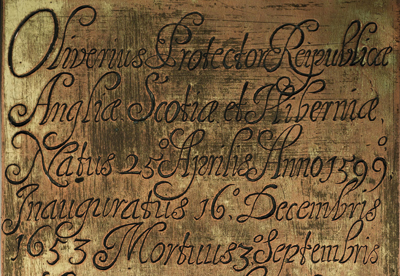
 The copper gilt plate found on former Lord Protector Oliver Cromwell’s breast when his body was exhumed will be put up to auction in London later today. Sotheby’s says that according to contemporary reports, the plate was found in a leaden canister lying on Cromwell’s chest when the coffin – interred in
 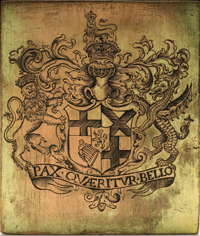 the Henry VII Chapel in Westminster Abbey – was opened by James Norfolke, Serjeant of the House of Commons, on the orders of parliament on 26th January, 1661 – just two years from Cromwell was buried. Norfolke apparently took the plate which was subsequently handed down through his family. It was not the only relic associated with Cromwell to survive – while Cromwell’s body, along with that of regicides Henry Ireton and John Bradshaw, was hanged at Tyburn and then apparently buried in an unmarked grave pit, his head was placed on a spike above Westminster Hall and remained there for more than 20 years until it blew down in a gale and was taken by a guard. It apparently subsequently passed through numerous private hands before, in 1960, it was interred in a secret location in the chapel of Sidney Sussex College in Cambridge. Meanwhile, the plate – which bears the arms of the Protectorate on one side and an inscription in Latin with the dates of Cromwell’s birth, inauguration as Lord Protector and death on the other – is listed with an estimated price of between £8,000 and £12,000. For more on the item, see www.sothebys.com/en/auctions/ecatalogue/2014/english-literature-history-childrens-books-illustrations-l14408/lot.3.html.
Churches
Famous Londoners – Dr Richard Mead…
Eighteenth century physician Dr Richard Mead is noted not only for his attendance on the rich and famous of his time – including royalty – but also for his philanthropy, his expansive collections and, importantly, his contributions in the field of medicine.
Born in Stepney, London, on the 11th August, 1673, as the 11th of 13 children of nonconforming minister Matthew Mead, Mead studied both Utrecht and Leiden before receiving his MD in Italy. Returning to England in 1696, he founded his own medical practice in Stepney.
He married Ruth Marsh in 1699 and together the couple had at least eight children, several of whom died young, before her death in 1720 (he subsequently married again, this time to Anne, daughter of a Bedfordshire knight, Sir Rowland Alston).
Having published the then seminal text – A Mechanical Account of Poisons – in 1702, the following year Mead was admitted to the Royal Society. He also took up a post as a physician at St Thomas’ Hospital, a job which saw him move to a property in Crutched Friars in the City – his home until 1711, when he relocated to Austin Friars.
It was after this that he become friends with eminent physician John Radcliffe who chose Mead as his successor and, on his death in 1714, bequeathed him his practice and his Bloomsbury home (not to mention his gold-topped cane, now on display at the Foundling Museum – see note below).
Following Radcliffe’s death, in August of that year Dr Mead attended Queen Anne on her deathbed. Other distinguished patients over his career included King George I, his son Prince George and daughter-in-law Princess Caroline – in fact he was appointed as official physician to the former prince when elevated to the throne as King George II – as well as Sir Isaac Newton, lexicographer Dr Samuel Johnson, Alexander Pope, Sir Robert Walpole and painter Antoine Watteau.
Mead, who had been named a governor of St Thomas’ in 1715 and elected a fellow of the Royal College of Physicians in 1716, was over the years recognised as an expert in a range of medical fields – including, as well as poisons, smallpox, scurvy and even the transmission of the plague.
Among the many more curious stories about Dr Mead is one concerning a ‘duel’ (or fistfight) he apparently fought with rival Dr John Woodward outside Gresham College in 1719 over their differences in tackling smallpox and others which concern experiments he conducted with venomous snakes to further his knowledge of venom before writing his text on poisons.
Dr Mead was also known for his philanthropy and became one of the founding governors of the Foundling Hospital (as well as being its medical advisor) – a portrait of him by artist Allan Ramsay (for whom he was a patron), currently hangs at the museum.
Dr Mead, who by this stage lived in Great Ormond Street in Bloomsbury (the property, which backed onto the grounds of the Foundling Museum and which Mead had moved into after his first wife’s death, later formed the basis of the Great Ormond Street Hospital for Children), is also noted for the large collection he gathered of paintings – including works by Dürer, Holbein, Rembrandt, and Canaletto, a library of more than 10,000 books, antiquities and classical sculpture as well as coins and jewels, all of which scholars and artists could access at his home (it took some 56 days to sell it all after his death).
While Dr Mead – who died on 16th February, 1754 – was buried in the Temple Church, there is a monument to him – including a bust by Peter Scheemakers – in the north aisle of Westminster Abbey.
Dr Mead is currently being honoured in an exhibition at the Foundling Museum – The Generous Georgian: Dr Richard Mead – which runs until 4th January. There’s an accompanying blog here which provides more information on his life and legacy.
This Week in London – Christmas celebrations; photographic history on show; and, architects as artists…
• Events celebrating Christmas continue to make our post this week. Sunday will see the annual ‘Blessing of the Crib’ – featuring a torch-lit procession on the steps of St Martin-in-the-Fields before the crib is blessed in Trafalgar Square – while on Monday carol singers will kick off their annual program of carolling in the square. More than 50 carol groups are taking part in the singing this year, which takes place from 4pm to 8pm on weeknights and 2pm to 6pm on weekends and runs until 23rd December. For more on the blessing, see www.stmartin-in-the-fields.org and for more on the carolling in Trafalgar Square and other Christmas events in the city, see www.london.gov.uk/events.
• A showcase of works from the Royal Photographic Society Collection has gone on show at the Science Museum’s Media Space. The images include some of the earliest known photographic pictures – dating from the 1820s, they are the work of pioneers like Roger Fenton, William Henry Fox Talbot and Julia Margaret Cameron – alongside contemporary works by the likes of influential modern figures such as Don McMullin, Terry O’Neill and Martin Parr. The exhibition also features artefacts from the history of the craft, such as Niepce’s heliographs, Fox Talbot’s experimental cameras and The Pencil of Nature – the first commercially published book to be illustrated by photographs. Masters of Light: Treasures from the Royal Photographic Society Collection, presented in collaboration with the Reiss-Engelhorn Museen in Mannheim, Germany, runs at the South Kensington institution until 1st March. Admission charge applies. For more, see www.sciencemuseum.org.uk/mastersoflight.
• On Now: Architects as Artists. This exhibition, marking the 10th anniversary of the partnership between the V&A and RIBA, examines the relationship between architecture and art and features about 50 works from the collections of the V&A and RIBA. They include everything from a drawing by Raphael of the Pantheon in Rome to a lithograph by Cyril Power depicting staircase in Russell Square tube station and a volume of architectural fantasies by the Russian architect Iakov Chernikhov. Held in the V&A + RIBA Architecture Gallery Room at the V&A in South Kensington, it runs until 15th March. Admission is free. For more, see www.vam.ac.uk/architecture.
Send items to inclusion to exploringlondon@gmail.com.
What’s in a name?…Holborn…

The origins of the name of this part of central London, to the west of the City, lie in the fact that the Fleet River runs through the area (albeit, since the 18th century, underground).
Mentioned as far back as the 950s, the name Holborn comes from the Old English “hol” or “holh” (“hollow”) and “burne” or “bourne” (“stream”) and means the “stream in the hollow” with the hollow in this case being the valley over which the Holborn Viaduct was built in the 1860s.
The term ‘Holburne’ was either used to refer to a tributary of the Fleet or part of the river itself. There was a bridge which apparently bore the same name and spanned either the Fleet or its tributary up until the river was covered.
The street now known as High Holborn – the main street in the area – was originally a Roman road and by the 19th century had become a centre for the entertainment industry featuring theatres, restaurants and pubs (including one of our favorites, the Cittee of Yorke).
The street is also home to the Holborn Bar, which marked the boundary of the City of London and was once site of a toll gate – it’s now the site of the Royal Fusilier’s War Memorial.
Other famous monuments in the area include an equestrian statue of Prince Albert – the City of London’s official statue of him – which was removed from its position in the centre of Holborn Circus in the east of the area to a new position on the western side of the intersection during a renovation last year.
Now dominated by offices and some shopping precincts (these include a street market in Leather Lane), among other notable buildings are pre-Great Fire of London survivor Staple Inn (see our earlier post here), churches including St Andrew Holborn, and St Alban the Martyr, Holborn, and, to the east, St Etheldreda’s Church (see our earlier post here) and Ye Olde Mitre pub (see our earlier post here).
The area is also home to the Inns of Court Lincoln’s Inn and Gray’s Inn and the Grade II*-listed Prudential Assurance Building (pictured above), constructed on the former site of Furnival’s Inn in the late 19th century/early 20th century, as well as Hatton Garden, famous for being the centre of London’s jewellery trade.
8 structures from the London that never was – 2. Watkin’s Tower…
Designed as London’s response to the Eiffel Tower, Watkin’s Tower was the brainchild of railway entrepreneur and MP Sir Edward Watkin.
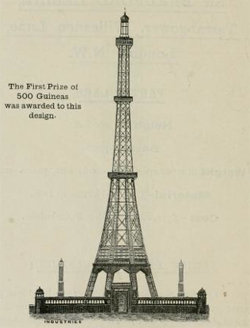 Following the opening of the Eiffel Tower in 1889, Watkin wanted to go one better in London and build a tower than surpassed its 1,063 feet (324 metres) height.
He apparently first approached Gustave Eiffel himself to design the tower which was to be located as the centrepiece for a pleasure park development at Wembley Park in London’s north (which, incidentally, would be reached by one of Sir Edward’s railway lines – he opened Wembley Park station to service it). But Eiffel declined the offer and Watkin subsequently launched an architectural design competition.
Among the 68 designs received from as far afield as the US and Australia were a cone-shaped tower with a railway spiralling up its exterior, a Gothic-style tower (also with a railway), a tower topped with a 1/12 scale replica of the Great Pyramid, one modelled on the spire of Bow Church in Cheapside and one topped by a giant globe (you can see the catalogue of all entries here).
The winning entry was submitted by Stewart, MacLaren and Dunn who proposed a steel eight legged tower soaring 1,200 feet (366 metres) into the sky. To be lit with electric lighting at night, it came with two observation decks with restaurants, theatres and exhibition space as well as winter gardens, Turkish baths, shops, promenades and a 90 room hotel as well as an astronomical observatory. The top of the tower would be reached by a series of elevators.
The first stage of the project – formally known as London Tower or the Wembley Park Tower – had still not been completed when Wembley Park opened in May, 1894 – standing 154 feet (47 metres tall), it was finally finished in September the following year.
It was to never rise higher. The project become mired in problems – Watkin retired through ill health (and died in 1901), the structure started to subside and the construction company went into liquidation. Dubbed Watkin’s Folly and the London Stump, what there was of the tower was eventually demolished between 1904-1907.
While the dream of the tower never came to be, the site nonetheless became a popular vehicle for recreation and the site was later used for the 1924 British Empire Exhibition with Wembley Stadium built over the spot where the tower had once stood.
LondonLife – Rotherhithe from the Thames…
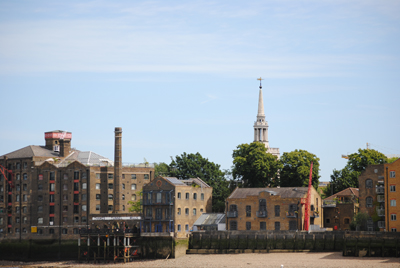
Pictured is the south bank of the Thames showing the buildings of the former Thames Tunnel Mills (now converted to residences). The tower of the Church of St Mary the Virgin is in the background – the church dates from 1716 and was designed by John James, an associate of Sir Christopher Wren.
What’s in a name?…Fulham…
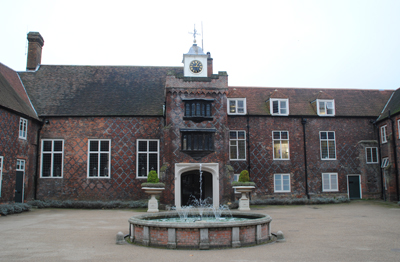 This Thameside area in London’s west has a long and storied history and its name is a reflection of it.
Long home to the ‘country’ manor of the bishops of London (Fulham Palace, pictured above), the name Fulanham is recorded as early as the late 7th century.
While there’s been speculation in the past that the name Fulham (also recorded among other variations as Fullam) was a corruption of ‘fowl-ham’ – relating to the wild fowl that were to be found here – or of ‘foul-ham’, relating to the muddied waters, that’s now apparently generally deemed not to be the case.
Instead, its name most likely owes its origins to an Anglo-Saxon named Fulla and the Old English word ‘hamm’ – a term for a water meadow or piece of land enclosed in a bend in a river (in contrast to the more common ‘ham’ which refers to an estate or homestead) – and referred to the manor he owned here, its boundaries set by a bend in the Thames. (It should be noted there is evidence of earlier occupation of the site by the Romans and as far back as the Neolithic era).
In about 700, the manor of Fulham – which includes the area we now think of as Fulham as well as land stretching as far afield as Acton, Ealing and Finchley – was acquired by Bishop Waldhere of London from Bishop Tyrhtilus of Hereford. Since Tudor times, Fulham Palace was used as the country home of the bishops of London and in the 20th century became their principal residence. It was used as such until 1975 and now houses a museum and reception rooms.
As well as now being used for the area which once contained what became the village of Fulham itself, since 1979 the name has also been used in that of the Borough of Hammersmith and Fulham. Interestingly, Fulham Broadway tube station was known as Walham Green when it first opened in 1880 and was only given its current name in 1952.
The bishop’s palace (and the nearby riverside Bishop’s Park) aside, other landmarks in the area include the Grade I-listed All Saints Church, which is largely late Victorian and which hosts the grave of abolitionist Granville Sharp, and the nearby Powell Almhouses which date from 1869.
It’s also linked by Putney Bridge with Putney on the other side of the Thames; the current bridge is the work of Sir Joseph Bazalgette and was built in 1882 – it replaced an earlier wooden bridge built in 1729 and overlooks where the annual Oxford-Cambridge Boat Race begins (other bridges spanning the river from Fulham include the rather ugly Wandsworth Bridge).
Known during the 18th century as something of a mecca for gambling, prostitution and other debauched leisure activities, these days Fulham is known for its football club, Fulham FC headquartered at Craven Cottage stadium (named for a cottage owned by Baron Craven which once stood here), shopping and is a sought-after residential location.
Lost London – The Devil Tavern…
Famous as the home of the Apollo Club, the Devil – more completely the Devil and St Dunstan or The Devil and the Saint, thanks to its sign which showed the saint tweaking the Devil’s nose with pincers – was a Fleet Street institution.
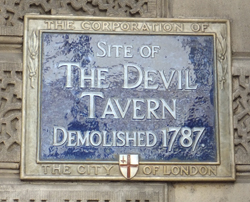 Located at number 2, Fleet Street close to the Temple Bar, the tavern’s origins date back to at least 16th century but it was Elizabethan playwright Ben Jonson who made it home to the literary dining club known as the Apollo Club (the moniker comes from the name of the room in the tavern in which the club was located).
As well as Jonson, members of the club are said to have included William Shakespeare, Jonathan Swift, Alexander Pope and Dr Samuel Johnson. Samuel Pepys is also said to have frequented the tavern.
A bust of Apollo was mounted over the door to the room and a verse of welcome on the wall – they apparently still exist inside the bank of Child & Co (now part of the Royal Bank of Scotland) which now occupies the site on which the tavern once stood. The ‘rules’ of the club – which have been penned by Jonson – also apparently hung over the fireplace (and the name of the club lives on in Apollo Court over the road).
The tavern is also noted for its associations with ‘Mull Sack’ (aka chimney sweep turned 17th century highwayman John Cottington) and hosted concerts and other important gatherings including that of the Royal Society which held its annual dinner here in 1746.
It was demolished in the 1787 when the site was annexed by the neighbouring bank. A plaque can now be seen on the bank’s wall in Fleet Street.
PICTURE: Open Plaques
10 of London’s World War I memorials – 10. Grave of the Unknown Warrior, Westminster Abbey…
In this, the final in our series looking at London’s World War I memorials, we’re taking a look at one of the city’s most visited monuments – the grave of the Unknown Warrior in Westminster Abbey.
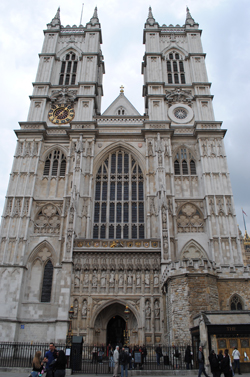
Located at the west end of the minster nave (pictured is the west front of the abbey inside of which lies the grave), the grave is that of a British soldier whose body was brought back from France and buried on the site on 11th November, 1920. The grave, which also contains soil brought from France, is covered by a slab of black marble from Belgium.
 The slab bears an inscription written by Herbert Ryle, then dean of the abbey, which commemorates the “many multitudes” who died during World War I. “They buried him among the kings because he had done good toward God and toward his house”.
It is believed the idea for the memorial was that of a chaplain at the front during the war – Rev David Railton – who in 1916 saw a grave in northern France which featured a cross upon which was written, “An Unknown British Soldier”. He wrote to Ryle about what he’d seen and the idea for the new memorial slowly took shape – albeit with the initial misgivings of some including King George V.
Representing servicemen from the army, navy or air force from anywhere within Britain and its dominions who died in the war and have no other memorial or known grave, the unidentified body which lies in the grave is believed to have been selected at random from among a number bodies of soldiers who died early in the war – accounts suggest they numbered either four or six – and which were exhumed from battle areas at the Aisne, the Somme, Arras and Ypres.
Covered with Union flags, the bodies were taken to a chapel at St Pol on 7th November, 1920, and one selected by Brigadier General LJ Wyatt, commander of troops in France and Flanders.
The three remaining bodies were reburied while the selected remains were placed in two coffins, the outer one made of oak harvested from a tree which had grown at Hampton Court Palace. A 16th century crusader’s sword taken from the Tower of London’s collection was placed in the wrought iron bands of the coffin and it was then covered with a flag which Rev Railton had used as an altar cloth during the war (known as the Ypres or Padre’s Flag, it now hangs nearby in St George’s Chapel at the abbey).
The coffin was then transported on the destroyer HMS Verdun to Dover and then taken by train to Victoria Station before, on the morning of 11th November, it was placed on a gun carriage drawn by six black horses and transported through massive but silent crowds which lined the streets.
Pausing at the Cenotaph in Whitehall, King George V unveiled the monument which represent an empty tomb (see our earlier post here) and placed a wreath on the coffin and then, followed by the king, other royal family members and dignitaries, it was taken to the abbey minster and lowered into the grave at a special service attended by the king, Queen Alexandra, the queens of Spain and Norway, and Prime Minister David Lloyd George and former Prime Minister HH (later Lord) Asquith (a recording made of some of the service – apparently conducted simultaneously with one at the Arc de Triomphe in Paris – became the first ever electrical recording to be sold to the public).
Thousands of mourners paid their respects at the open grave before the grave was filled in and covered with temporary stone on 18th November. The marble stone which now stands there was unveiled at a special service on 11th November the following year. A framed US Congressional Medal of Honor, conferred by General John J Pershing on the unknown warrior on 17th October, 1921, hangs from a pillar nearby.
WHERE: Westminster Abbey, Westminster (nearest Tube station is Westminster or St James’s Park); WHEN: Generally open to tourists everyday except Sunday (times vary so check the website); COST: £18 an adult/£15 concessions/£8 schoolchildren (11-18 years), free for children aged under 11/£44 for a family (two adults, two children); WEBSITE: www.westminster-abbey.org.
Famous Londoners – Sir Robert Geffrye…
He lends his name to one of London’s best small museums but who was the person behind the name the Geffrye Museum?
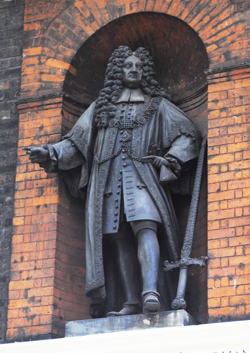 Details about his life are somewhat scant but it is generally believed Sir Robert Geffrye (among a number of variants of the spelling of his name) was born around 1613 in the village of Landrake near Saltash in Cornwall.
Moving to London while still just in his teens, he is believed to have undertaken a seven year apprenticeship, eventually admitted as a member of the Worshipful Company of Ironmongers and freeman of the City of London.
It’s been suggested he was an ironmonger in name only but it seems to be the case that his new status gave him the opportunity to launch his career as a merchant and he apparently made a fortune from investing in African and East Indian trade.
Geffrye – who married Priscilla Cropley, a lawyer’s daughter, at the chapel in the Mercer’s Hall in Cheapside in 1651 and lived in Lime Street – was twice Master of the Worshipful Company of Ironmongers (first in 1667 and then again in 1685).
He was knighted by King Charles II in 1673 (his coat-of-arms can still be seen in the Ironmonger’s Hall) and in 1674, he was appointed a sheriff of London before being elected Lord Mayor in 1685 (his wife Priscilla had died in 1676).
In 1688, Geffrye became president of Bridewell and Bethlehem Hospitals – a role which he held for two years and which apparently saw him attending Bridewell every Friday to judge and sentence prisoners.
He died in February 1704 and was buried in the now long-gone St Dionis Backchurch, where his wife had been buried earlier. Their remains were transferred to the almshouses grounds after the church was demolished in 1878.
Geffrye left behind a substantial fortune and, along with bequests to family, friends and charities, he made a sizeable bequest which funded the building of 14 almshouses in Shoreditch (now home to the Geffrye Museum which this year celebrates its tercentenary) (for more on the museum and alms houses, see our earlier posts here and here).
A replica of an original 1723 statue of Sir Robert still adorns the almshouses which bear his name (pictured above).
For more on the people that made London, see Boris Johnson’s Johnson’s Life of London: The People Who Made the City That Made the World
LondonLife – Admiral Arthur Phillip honoured in Westminster Abbey…
 A memorial to Admiral Arthur Phillip, described as the “father of modern Australia”, was unveiled in Westminster Abbey back in July. Admiral Phillip (1738-1814) commanded the ‘First Fleet’ which left the UK in 1787, transporting convicts and military to the new colony Phillip founded as New South Wales. Prince Phillip, the Duke of Edinburgh, attended the memorial’s dedication service on 9th July which was conducted by the Dean of Westminster, Dr John Hall, who credited Admiral Phillip – a “modest, yet world-class seaman, linguist and patriot”- with laying the foundations “on which was developed the Commonwealth of Australia”. Among other dignitaries who attended was Dame Marie Bashir, the Governor of the Australian state of New South Wales, who described Admiral Phillip as “enlightened, far-sighted and indeed humane” and paid tribute to his attempts to actively foster harmonious relations with the Aboriginal people. Carved from Sydney sandstone, the memorial is set in the floor of the nave of the minster close to memorials of David Livingstone, Thomas Cochrane and Isaac Newton. The memorial stone is among a number of projects around Britain instigated by the Britain-Australia Society to mark the bicentenary year of Admiral Phillip’s death. For more on the abbey, see www.westminster-abbey.org. PICTURE: Andrew Dunsmore/Westminster Abbey.
10 of London’s World War I memorials – 6. The Royal Fusilier’s Memorial…
 Located at Holborn Bar – one of the traditional entry points to the City of London, this memorial was erected in 1922 to the memory of the almost 22,000 solider of the Royal Fusiliers (City of London Regiment) who died during the Great War.
The monument, which stands on a traffic island in the middle of busy High Holborn, was designed by sculptor Albert Toft (and hence is known affectionately as “Albert”) along with architects Cheadle and Harding at the behest of several senior officers from the regiment.
It was originally intended to be erected in one of the capital’s many parks. Hounslow Barracks was the next intended location but, after consultation with the City, the site in Holborn was eventually settled upon.
The larger-than-life bronze figure, which stands on a Portland stone pedestal holding a rifle with fixed bayonet, was apparently modelled on an actual person – a Sgt Cox, who served with the Royal Fusiliers throughout the war. The east face features a plate listing all the battalions who served in World War I; the west face features the regimental crest and dedication.
The Grade II-listed memorial, which was officially unveiled by the Lord Mayor of London (we think it was Sir Edward Cecil Moore) on 4th November, 1922, was later updated with inscriptions commemorating those who fell during World War II and in subsequent conflicts.
The original model for the monument can now be seen in the Fusilier Museum at the Tower of London. Interestingly, there is a twin monument, dedicated to the 41st Division, at Flers on the Somme, in France. It was unveiled in 1932.
PICTURE: Mike Peel (www.mikepeel.net)
What’s in a name?…Fenchurch Street…
There’s a couple of alternate theories for the origins of this City of London street’s name.
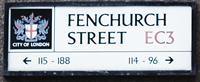 Running between Gracechurch Street to the west and Aldgate to the east, Fenchurch Street isn’t actually home to Fenchurch Street Station (one of the four Monopoly board stations!) – that’s located in adjoining Fenchurch Place. And for good measure, there’s also a nearby Fenchurch Avenue.
The name apparently relates to a church that once stood here, known as St Gabriel Fenchurch. The fen part of the name is believed to either stand for what may have been nearby ‘fens’ – that is, swampy or marshy ground – related to the now lost Langbourn River once located here or for faenum, a Latin word for hay which may have referred to a nearby haymarket.
The church, which is known to have existed from at least the 14th century and stood between Rood and Mincing Lanes, burnt down in the Great Fire of London in 1666 and was not rebuilt but merged into the parish of St Margaret Pattens (there’s a plaque marking its site in Fenchurch Street opposite Cullum Street – we’ll have a look at the church in more detail in a later Lost London entry).
Landmarks in the street include Lloyd’s Register of Shipping at number 71 (a Grade II-listed building dating from 1901) and the somewhat controversial tower at 20 Fenchurch Street, nicknamed the ‘Walkie Talkie’ building.
This Week in London – St Paul’s celebrates Shakespeare; Harvest Festival time; and, Horst at the V&A…
• It’s Shakespeare month at St Paul’s Cathedral as the august London institution hosts a series of special addresses and music recitals in honour of the Bard’s 450th birthday. Kicking off this weekend, the events will see preachers considering Shakespeare’s life and work – particularly in relation to faith – in a weekly address at Sunday Evensong service while a series of voice and piano recitals will present various interpretations of his work through the music of some of Britain’s greatest composers. Shakespeare, the cathedral staff say, would have known the cathedral well – many printers, including his old Stratford friend Richard Field, were located in the Churchyard, and Shakespeare would have had to regularly journey past St Paul’s to have his plays registered at St John’s Gate. See www.stpauls.co.uk for a detailed programme of events.
• The Kensington Gardens Allotment is hosting a free Harvest Festival this Sunday with activities including digging up potatoes and making ‘potato people’ as well as face painting, story telling and a mobile pet farm. Complementary hot and cold drinks will be provided (while stocks last, so don’t be late!). The day runs from 11am to 4pm. Meanwhile, Regent’s Park Allotment Gardens will host its own Harvest Festival on Sunday, 21st September. Along with live folk music, a children’s treasure hunt and the ‘guess the weight of the pumpkin’ competition, the day will also feature a specially-built pizza oven in which visitors will be invited to cook their own pizza. For more, see www.royalparks.org.uk.
• The works of renowned 20th century photographer Horst P Horst (1906-1999) will feature in a new exhibition opening at the V&A in South Kensington this Saturday. Horst: Photographer of Style will feature 250 photographs alongside haute couture garments, magazines, film footage and other ephemera and explores Horst’s collaborations and friendships with the likes of Coco Chanel, Marlene Dietrich, Noel Coward and Salvador Dali. Highlights include previously unpublished prints and more than 90 Vogue covers taken by Horst. Runs until 4th January. Admission charge applies. For more, see www.vam.ac.uk/horst.
Treasures of London – The Wolsey Angels…
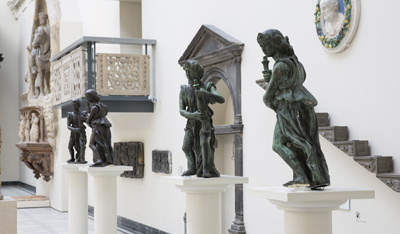
Four bronze angels, designed for the tomb of Cardinal Thomas Wolsey, have been temporarily reunited in the V&A’s Medieval & Renaissance galleries as the museum looks for funding to acquire them.
Once thought lost, the Wolsey Angels were commissioned in 1524 from Florentine sculptor Benedetto de Rovezzano for the tomb of Wolsey, chief advisor to King Henry VIII and one of the most powerful men in the kingdom. Each of the angels, which measure around a metre in height, was created between 1524 and 1529 – the period in which Wolsey was trying to have the pope annul Henry VIII’s marriage to Catherine of Aragon.
As is well-known, Wolsey failed to do so and died in 1530 in disgrace. Henry appropriated Wolsey’s assets including the tomb which the king apparently intended to use for himself. The work was slow, however, and when Henry died in 1547, it remained unfinished. His children – King Edward VI, Queen Mary I and Queen Elizabeth I – each said they would complete the tomb as a memorial to their father but didn’t and in 1565, Elizabeth moved parts of the tomb to Windsor.
During the English Civil War elements of the tomb were sold off to raise funds and only the black stone chest – now used to house the remains of Admiral Lord Nelson in the St Paul’s Cathedral crypt – were believed to have survived along with four large gilt-bronze candlesticks which were installed at St Bavo Cathedral in Ghent.
The angels passed out of sight until, in 1994, two of them appeared in a Sotheby’s sale. Acquired by a Parisian art dealer, they were later attributed to Benedetto. The remaining two angels were discovered at Harrowden Hall in Northamptonshire in 2008 – the hall is now owned by the Wellingborough Golf Club – and it was subsequently revealed that the other two had been stolen from the same site 20 years previously.
The V&A has embarked on a campaign – backed by Hilary Mantel, the Booker Prize winning author of Wolf Hall – to acquire the four angels, priced at £5 million. It has already been granted £2 from the National Heritage Memorial Fund and the Art Fund has pledged a further £500,000.
Mantel described the recovery of the angels as “one of those miracles that historians pray for; something that seems irrevocably lost has been there all the time”. “To claim the angels for the nation would connect us to one of the liveliest eras of our history and one of its most remarkable men.”
Donations can be made via the V&A’s website at www.vam.ac.uk/wolseyangels.
PICTURE: Wolsey Angels on display at the V&A/© Victoria and Albert Museum, London
This Week in London – Notting Hill Carnival; St Paul’s treasures on show; Sherlock Holmes on film; and more…
 • The August Bank Holiday is upon us which means it’s carnival time! The Notting Hill Carnival kicks off this Sunday with an extravaganza of costumes, dancing, music and food. The carnival’s origins go back to the late Fifties and early Sixties (the exact date is somewhat controversial!) when it started as a way of Afro-Caribbean communities celebrating their cultures and traditions, drawing on the tradition of carnivals in the Caribbean. The carnival is now Europe’s largest street festival and this year’s parade signifies the start of a three year celebration in the lead-up to the Golden Jubilee year of 2016. The carnival kicks off at 9am on Sunday – children’s day – and the same time on Monday – adult’s day – and organisers say the procession should be completed by 7pm. For more, see www.thelondonnottinghillcarnival.com. PICTURE: Wayne G Callender/Notting Hill Carnival.
• A pop-up display of some of St Paul’s Cathedral’s treasures will appear today and tomorrow (Thursday, 21st August, and Friday 22nd August) in the cathedral’s crypt. Put together by Museum Studies students from Leicester University, the display will feature items relating to a royal event from each of the first three centuries of Wren’s church. They include images and objects from the Thanksgiving Service for the recovery of King George III in 1789 as well as items from Queen Victoria’s Diamond Jubilee in 1897 and the wedding of Prince Charles and Lady Diana in 1981. The display will be shown from 1pm to 2pm each day – entry is free via the cathedral’s north west crypt door. Meanwhile, the cathedral is offering a private, behind the scenes evening photography tour of the building for the winner of a photography competition looking for “the most surprising image” of the cathedral. The winner – and five friends – will also be treated to a meal at the Grange Hotel’s Benihama restaurant. The Surprise St Paul’s competition runs until 26th September and entrants just need to tweet or post their images to the church’s Twitter or Facebook pages with the hashtag #SurpriseStPauls. For more, see www.stpauls.co.uk.
• The National Gallery has made free wi-fi available throughout the building. The Trafalgar Square-based gallery says it’s now also welcoming visitor photography and is encouraging visitors to check in on Facebook and comment on Twitter using the hashtag #MyNGPainting. For more, see www.nationalgallery.org.uk.
• Fancy yourself a detective? The Museum of London and the BFI are asking for the public’s help in tracking down a copy of the first ever feature film starring the fictional character Sherlock Holmes. A Study in Scarlet was released 100 years ago this autumn and was directed by George Pearson with then unknown James Bragington playing the part of Holmes. An adaption of Sir Arthur Conan Doyle’s story of the same name, it is based around Brigham Young’s trek across America with his Mormon followers and sees Holmes solve a series of murders. The film was made at Worton Hall studios and on location in Cheddar Gorge and Southport Sands in 1914. The organisations are seeking the film in the lead-up to the Museum of London’s landmark exhibition on Holmes which opens in October. If you do happen to find the film, you can write to Sherlockholmes@bfi.org.uk or make contact via social media using the hashtag #FindSherlock.
• A public ballot has opened for tickets to attend the art installation Fire Garden by renowned French troupe Carabosse at Battersea Power Station this September. The event – which will be held on the nights of Friday 5th and Saturday 6th September – is one of the highlights of Totally Thames, a month-long celebration of London’s great river, and is presented as a tribute to the power station before it’s closed to the public for redevelopment. A free event, it’s expected to be so popular that organisers are holding a ballot for tickets. The ballot closes midday on 27th August. To enter via the Totally Thames website, head here.
Send all items for inclusion to exploringlondon@gmail.com.
LondonLife – A walk across Blackheath…
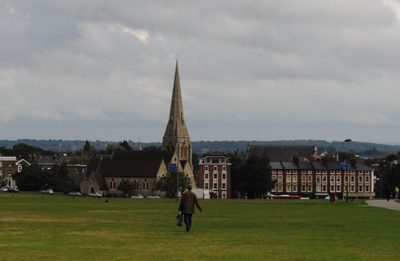
An overcast day on Blackheath, in the south-east of the city. All Saint’s Church is located in the centre of the picture. The Grade II-listed church, the parish church of Blackheath, was built between 1857-67 to the designs of architect Benjamin Ferrey.
10 sites from Shakespearean London – 3. Shakespeare’s houses…
The playwright is believed to have lived in several different locations in London and is also known to have invested in a property. Here we take a look at a couple of different locations associated with him…
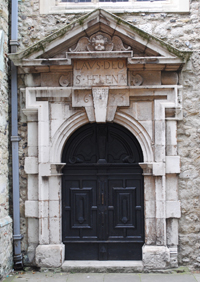 • Bishopsgate: Shakespeare is believed to have lived here in the 1590s – in 1596 tax records show he was living in the parish of St Helen’s. The twin-nave church of St Helen’s Bishopsgate (pictured), which would have been his parish church, still stands. In fact, there is a window to Shakespeare’s memory dating from the late 19th century.
• Bankside: In the late 1590s, Shakespeare apparently moved across the Thames to Bankside where he lived at a property on lands in the Liberty of the Clink which belonged to the Bishop of Winchester. The exact address remains unknown.
• Silver Street, Cripplegate: It’s known that in 1604, Shakespeare moved from Bankside back to the City – it’s been speculated outbreaks of plaque may have led him to do so. Back in the City, he rented lodgings at the house of Christopher and Mary Mountjoy in on the corner of Monkwell and Silver Streets in Cripplegate, not far from St Paul’s Cathedral. Mountjoy was a refugee, a French Huguenot, and a tire-maker (manufacturer of ladies’ ornamental headresses). The house, which apparently stood opposite the churchyard of the now removed St Olave Silver Street, was consumed in the Great Fire of London in 1666 (the church was also lost in the Great Fire). The former church site is now located on the south side of London Wall. Silver Street itself was wiped out in the Blitz and is now lost under the Barbican redevelopment but the house lives on in a representation found on a late 16th century map created by Ralph Agas.
• Ireland Yard, Blackfriars: In 1613, Shakespeare purchased the former gatehouse of the Blackfriars Priory located here, close to the where the Blackfriars Theatre was located. It is believed the property was purchased as an investment – there’s no evidence he ever lived there but it was passed to his daughter Susanna after his death. Incidentally, there is some speculation that Shakespeare may have lived in Blackfriars when he first came to London – a man believed to have been a boyhood friend from Stratford, Richard Field, who was known to have lived there.
For a more in-depth look at Shakespeare’s time in Silver Street, see Charles Nicholl’s The Lodger: Shakespeare on Silver Street
Famous Londoners – Christopher Marlowe…
Born the same year as Shakespeare, Christopher Marlowe was, like him, one of the foremost dramatists of the Elizabethan era.
 Born in Canterbury the son of shoemaker John Marlowe and his wife Catherine in 1564 (he was baptised on 26th February and likely to have been born a few days before), Marlowe attended the King’s School in the city and went on to study at Corpus College in Cambridge, receiving a Bachelor of Arts in 1584 and a Master of Arts in 1587. It is believed that at around this time, he was also working secretly for the government of Queen Elizabeth I, although what the nature of that work was remains unknown.
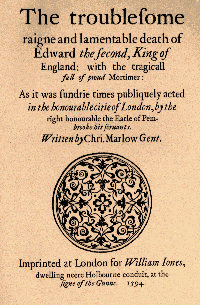
While Marlowe’s first play was Dido, Queen of Carthage, he first found theatrical success in 1587 with Tamburlaine the Great, later followed with a second part. His other four plays included The Jew of Malta, Edward the Second, The Massacre at Paris about the St Bartholomew’s Day Massacre in 1572, and Doctor Faustus.
The plays served as key works for the Admiral’s Men, the company of Edward Alleyn who performed many of the key roles in the plays, and who is strongly associated with the Rose Theatre – indeed it was here that Tamburlaine the Great, The Jew of Malta, and Doctor Faustus premiered (you can see our earlier post on the theatre here).
Marlowe, who is known to have lived in Shoreditch, also completed other works included poetry and translations and while there is little evidence about his personal life, there is much speculation including that he was, as aforementioned, a spy as well as a carouser (he is known to have frequented taverns in London including Ye Olde Cock in Fleet Street), a homosexual and/or a heretic. It has also been suggested he was a tutor to noblewoman Arabella Stuart.
It is known that he was arrested in 1592 in Flushing in The Netherlands for counterfeiting coins and was sent back to England but no further action was taken.
His death is one of the big mysteries of his life. A warrant was issued for Marlowe’s arrest over some heretical tracts which were found in the lodgings of his colleague Thomas Kyd (who when questioned apparently implicated him) and he appeared to answer to the Privy Council on 20th May, 1593. They weren’t sitting and he was apparently instructed to appear daily until further notice. He was dead 10 days later.
The exact circumstances of his death remain a matter of speculation. It is often said he died in a drunken brawl with one early source suggesting this was over a homosexual love affair and another, more recent, theory suggesting he even faked his own death to avoid being executed for heresy (an extrapolation of this theory goes that after his fake death he continued writing plays under the name of William Shakespeare but this is generally deemed fairly far-fetched). The official account recorded at the time was that he was stabbed to death in a brawl over payment of a bill with men at a house in Deptford.
He was buried in an unmarked grave at St Nicholas’ Church in Deptford. There is a memorial window to him in Poet’s Corner in Westminster Abbey. A gift of the Marlowe Society, it was unveiled in 2002 and controversially included a question mark after the generally accepted date of his death. There is a portrait, dated 1585, generally believed to be of Marlowe at Cambridge.
PICTURE: Title page of the earliest known edition of Edward II (1594)/Wikipedia
10 sites from Shakespearean London – 2. Southwark Cathedral…
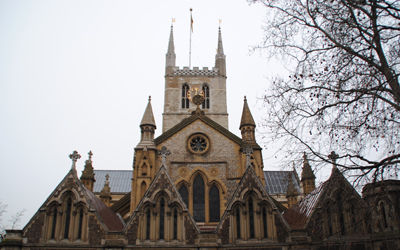
Located close to the Bankside theatres where William Shakespeare’s plays would have been performed, Southwark Cathedral – known then as St Saviour’s Church – has plenty of connections to the Elizabethan theatre world.
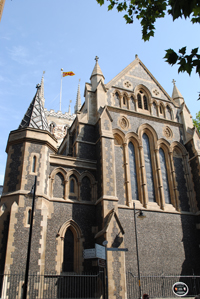 Not only was the Bard’s youngest brother, the actor Edmund, buried here in 1607 (the grave is unmarked but there’s a commemorative stone in the floor of the choir), the playwrights John Fletcher and Philip Massinger and theatre owner Phillip Henslowe were also buried here. And like them, another theatre owner (and Henslowe’s son-in-law), Edward Alleyne, also held positions at the church.
The cathedral has several memorials to Shakespeare. These include a memorial window in the south aisle – unveiled in April 1954 on the anniversary of Shakespeare’s death, it depicts characters from some of his works and was designed by Christopher Webb to replace an earlier window which had been destroyed during World War II. Below it is an alabaster reclining figure of the playwright set against a relief of Southwark as it appeared during the 17th century. Carved by Henry McCarthy, it was unveiled in 1912.
The history of the church is believed to go back to at least Saxon times. Between 1106 and 1538, it served as the church of the Augustinian Southwark Priory and was dedicated to St Mary Overie. Following the Dissolution in the mid 16th century was re-dedicated as the parish church of St Saviour’s. It only became a cathedral in 1905 with the creation of the Diocese of Southwark. While some scant parts of the building date back to the 12th century (the church was rebuilt after a fire in the 13th century), much of it has been altered.
For more on Elizabethan England, check out Ian Mortimer’s recent book The Time Traveller’s Guide to Elizabethan England
 Exploring London