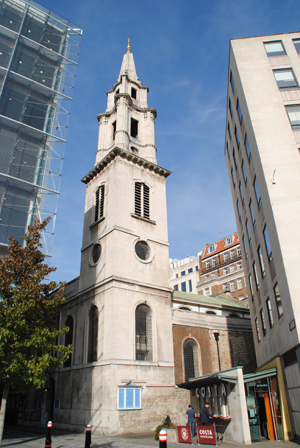
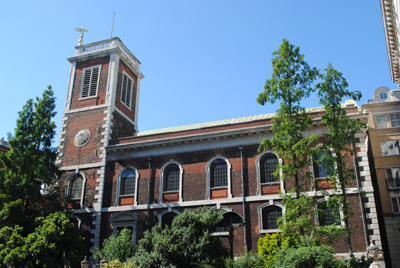
10 curiously named churches of London – 2. St Vedast-alias-Foster

This strangely named church has its origins at least as far back as the 12th century when it was under the jurisdiction of the Prior and Convent of Canterbury. 

The name St Vedast is in itself unusual – St Vedast (known as St Vaast elsewhere) is said to have been the Bishop of Arras in northern France during the late fifth and early sixth centuries. How his name came to be associated with a church in London remains a matter of speculation but one plausible explanation is that the church was founded in the twelfth century by a small group of French merchants who had emigrated from Arras.

The ‘alias Foster’ part of the name is perhaps easier to explain although it has led to considerable confusion over the years. While some have in the past suggested the name refers to a different obscure saint – that is, the church is dedicated to St Vedast and St Foster – Foster is actually just an corrupted Anglicised version of Vedast.

But back to the church’s history. The medieval building was apparently replaced at the beginning of the sixteenth century and in the early 1600s this was enlarged and “beautified”. It escaped total destruction during the Great Fire of London but was badly enough damaged to require restoration and this was carried out, albeit not very well, so that in the late 1600s, Sir Christopher Wren was asked to rebuild it.

Given the demands of Wren’s time elsewhere, it’s not known if he personally designed the resulting church (the spire is possibly the work of Nicholas Hawksmoor), but the church was rebuilt and stood until 194o when the body of the building was ruined in the Blitz. The spire, however, survived and the restoration of the remainder of the church was completed in 1962.

It was also after World War II that the city parishes were reorganised and St Vedast-alias-Foster was united with three other former parishes – St Alban Wood Street, St Anne & St Agnes, St Lawrence Jewry, St Mary Aldermanbury, St Michael-le-Querne, St Matthew Friday Street, St Peter Chepe, St Olave Silver Street, St Michael Wood Street, St Mary Staining, St Mary Magdalene Milk Street, St John Zachary, and St Michael Bassishaw, of which only the buildings of St Lawrence Jewry and St Anne and St Agnes remain along with the tower of St Alban Wood Street).

Although the bulk of the building of St Vedast-alias-Foster is modern, the church does retain its seventeenth century Great West Doors and the font also comes from that century, having been designed by Wren and carved by Grinling Gibbons for the church of St Anne and St Agnes. The reredos which stands behind the altar, meanwhile, is inscribed with the Ten Commandments, the Lord’s Prayer and The Creed, and originally stood in St Christopher-le-Stock Parish Church in Threadneedle Street. Other features to come from other churches include the seventeenth century pulpit (All Hallows, Bread Street) and swordrest (St Anne and St Agnes).

The church’s Fountain Courtyard features part of a Roman floor found under St Matthew Friday Street and a stone (actually baked brick) upon which is inscribed cuneiform writing. The latter, which comes from a Zigurrat in modern Iraq built in the 9th century BC, was presented to Canon Mortlock, rector of the church, marking his work with novelist Agatha Christie and her husband, archaeologist Sir Max Mallowan and was found during his 1950-65 dig on the site. The lump of stone bears the name of Shalmaneser who reigned from 858 to 834 BC.

Famous figures associated with the church include John Browne, sergeant painter to King Henry VIII, Sir Thomas More, Lord Chancellor of King Henry VIII who was born in nearby Milk Street, and Thomas Rotherham, rector of the church from from 1463-48 and later Archbishop of York and Lord Chancellor of King Edward IV.

WHERE: 4 Foster Lane (nearest Tube station is St Paul’s). WHEN: 8am to 5.30pm weekdays/11am to 4pm Saturday (Mass is held between 12.15 and 12.45 weekdays and a sung Eucharist at 11am on Sundays) COST: Free but a donation of at least £1 per head is asked; WEBSITE: www.vedast.org.uk.

Where is it? #12

The latest in the series in which we ask you to identify where in London this picture was taken and what it’s of. If you reckon you know the answer, leave a comment below. We’ll reveal the answer early next week. Good luck!

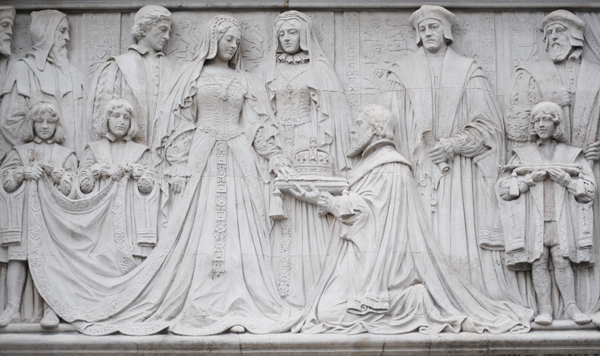
And the answer is…this is part of the decorative facade of the Middlesex Guildhall which stands opposite the Houses of Parliament in Parliament Square. The building, which dates from 1912-13 and stands on the former site of the Westminster Abbey Sanctuary Tower and Old Belfry (where fugitives from the law could seek sanctuary), is now home to the Supreme Court and the Judicial Committee of the Privy Council.

Designed by architect James Gibson, it is the latest in a series of buildings which stood on the site which have served as courthouses and the headquarters of the Middlesex County Council (the first Middlesex Guildhall was built here in 1889). Described by Nikolaus Pevsner as “art nouveau Gothic”, it features a series of medieval-looking decorative friezes and sculptures by Henry Charles Fehr.

The image pictured above shows one of the friezes – this one of the Duke of Northumberland offering the ill-fated Lady Jane Grey the Crown (known as the “Nine Days Queen”, she was later imprisoned and eventually executed on 12th February, 1554). Others show King John handing the Magna Carta to the English barons and the granting of the charter of Westminster Abbey.

It was refurbished for use of the Supreme Court in 2007 and the court has occupied it since its creation in 2009.

Interestingly, according to Ed Glinert of The London Compendium, it was here that courts martial were held of those suspected of giving aid to the enemy during World War I.

10 curiously named churches of London – 1. St Andrew-by-the-Wardrobe

Look a little deeper and you’ll find there’s often a fascinating story behind many of London’s seemingly odd place names. Churches are no exception and in this new series we’re looking at some of the stories behind the name. First up, it’s the church of St Andrew-by-the-Wardrobe, a rather austere-looking church which looms up over Queen Victoria Street.

While the present church largely dates from after World War II – it was bombed during the Blitz and only the outer walls remain of what was there before (the previous church was itself a rebuild to the designs of Sir Christopher Wren after an earlier version was burnt down in the Great Fire of 1666) – there has apparently been a church on the site since at least the 12th century. Indeed, in the 13th century it was associated with the then royal residence known as Baynard’s Castle.

The church’s rather unusual name owes its origins to King Edward III’s decision in 1361 to move the Royal Wardrobe – which included his state robes and other valuables – from the Tower of London to a new building which lay near to the church (there’s a plaque in nearby Wardrobe Place marking the former location of the King’s Wardrobe which also burnt down in the Great Fire and was subsequently relocated). Hence St Andrew-by-the Wardrobe.

While the interior of the church is a complete reconstruction of Wren’s original, it does still boast some early treasures including  an original pulpit as well as a font and cover of Wren’s period (these come from the now long gone church of St Matthew Friday Street), a figure of St Andrew dating from about 1600 and another of St Ann (mother of Mary), who is holding her daughter who is in turn holding Jesus, dating from about a century earlier. There’s also a royal coat of arms – dating from the Stuart period – which originally came from St Olave’s Old Jewry.

Among the most prominent residents in the church’s parish was the playwright William Shakespeare (there’s a rather odd oak and limewood memorial to him and a contemporary composer, singer and musician, John Dowland – who was  buried in the churchyard, inside). Another Shakespearian contemporary, Ben Jonson, also apparently lived in the parish. The church also has links with with the Mercers, Apothecaries and Blacksmiths livery companies.

Earlier this year St Andrew-by-the-Wardrobe, which is a sister church to St James Garlickhythe (another unusually named church), celebrated 50 years since its post war reopening in 1961.

WHERE: Access is via St Andrew’s Hill or Queen Victoria Street (nearest Tube stations are St Paul’s and Mansion House). WHEN: The church building and the Chapel of St Ann are normally open for visitors between 10am and 4pm weekdays while the nave is open on Fridays from 11am to 3pm (check with the church before going); COST: Free; WEBSITE: www.standrewbythewardrobe.net.

What’s in a name?…Strand

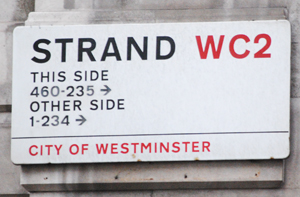
Now one of the major thoroughfares of the West End, the origins of the roadway known as the Strand go back to the Roman times leading west out of the city.

Later part of Saxon Lundenwic which occupied what is now the West End, it ran right along the northern shore of the Thames and so became known as the Strand (the word comes from the Saxon word for the foreshore of a river). During the following centuries the river was pushed back as buildings were constructed between the road and the river, leaving it now, excuse the pun, ‘stranded’ some distance from where the Thames flows.

Sitting on the route between the City of London and Westminster, seat of the government, the street proved a popular with the wealthy and influential and during the Middle Ages, a succession of grand homes or palaces was built along its length, in particular along the southern side.

All are now gone but for Somerset House – originally the home of the Dukes of Somerset, it was built in the 16th century but rebuilt in the 18th century after which it served a variety of roles including housing the Navy Office, before taking on its current role as an arts centre. Others now recalled in the names of streets coming off the Strand include the Savoy Palace, former residence of John of Gaunt which was destroyed in the Peasant’s Revolt, and York House, once home of the Bishops of Norwich and later that of George Villiers, favorite of King James I (see our earlier Lost London entry on York Watergate for more).

After the aristocracy decamped further west during the 17th and 18th centuries, the road and surrounding area fell into decline but was resurrected with a concerted building effort in the early 19th century (this included the creation of the Victoria Embankment which pushed the Thames even further away) which saw it become a favorite of the those who patronised the arts, including the opening of numerous theatres. Among those which still stand on the Strand today are the Adelphi and Savoy Theatres (this was apparently the first in London to be fitted with electric lights and sits on a site once occupied by the Savoy Palace).

Among the other landmarks along the Strand are the churches of St Mary-le-Strand (the present building which sits on what amounts to a traffic island) dates from 1717 and was designed by James Gibbs, and St Clement Danes, designed by Sir Christopher Wren and completed in 1682 (it is now the Central Church of the Royal Air Force). The Strand is also home to the Victorian-era Royal Courts of Justice (it boasts more than 1,000 rooms), Australia House (home of the oldest Australian diplomatic mission), the Strand Palace Hotel (opened in 1907) and Charing Cross Railway Station.

10 Questions – Martin Stancliffe, Surveyor to the Fabric, St Paul’s Cathedral…

In the first of a new series in which we ask 10 questions of someone involved with one of London’s historic sites, we speak to Martin Stancliffe, Surveyor of the Fabric at St Paul’s Cathedral, about the £40 million, 15 year cleaning and restoration project at the iconic London structure which came to an end last month…

1. What does your job at the cathedral involve? “Advising on all aspects of the care and repair of the fabric of the cathedral, and its setting. This involves devising and leading all fabric projects, major or minor.”

 2. What prompted the 15 year repair and cleaning project? “The perception that the cathedral could reach out more to all its visitors both as a great centre for worship and as a great tourist attraction if it were in better condition and had improved facilities.”

3. How much of a difference has the cleaning and repair project made to the look of the cathedral, both inside and out? “I think it is not too much to say that the cleaning has transformed the appearance of both the exterior and the interior. In particular, the interior now speaks much more clearly of its primary purpose as a great church and a setting for great national services of memorial or celebration. In addition, the programme of repair works in almost all parts of the cathedral has put it into good condition in ways that can be sensed, but cannot  – I hope – be seen.”

4. How many people have been involved? “It is hard to make a count, but the number must run into several hundred.”

5. What trades did the task require and was it easy to source the sort of expertise required? “The various different tasks required a great range of skills, from masons to electricians and scaffolders,  and from expert painters and gilders to conservators. There is a wonderful supply of skilled craftsmen and professionals in this country; but younger people need to be encouraged to understand how creative and rewarding such work is, and to learn the expert skills required to continue to care for buildings like this.”

6. What was the most challenging aspect of the project? “The most challenging aspect was the organisation of the internal cleaning project, which required special techniques and special scaffolding to enable the cathedral to continue its day to day work uninterruptedly throughout the 15 year programme – including having to remove all scaffolding from the interior for the Queen’s Golden Jubilee right in the middle of the project!”

7. Is the cathedral we now see as (original architect) Sir Christopher Wren envisaged it? “No, the interior had already been substantially altered in the 19th century by the removal of the original choir screen, the stripping of paint from all the internal stonework, and the installation of mosaic decorations. However, the atmosphere in the cathedral is certainly closer to how Wren envisaged it than in its gloomy state 15 years ago; and he would certainly have recognised – and welcomed – the radiant quality of light which has been restored to the interior.”

8. Did you make any interesting discoveries about the building during the restoration project? “A building like this is always revealing new things. We discovered much more about how the lower parts of the dome were constructed, and we have understood much better why and how the building moved and settled as a structure over the last 300 years. We also discovered many fragments of the great cathedral which stood on this site for some 600 years before the destruction of the Great Fire, built into the structure of  Wren’s cathedral.”

 9. What’s your favorite part of the cathedral?  “I love all parts of the dome, from the top of the lantern down to its complex foundations on the top of the arches of the nave.”

10. Can you tell us something about St Paul’s that many visitors may be unaware of? “Many people are unaware of the reason why the dome seems so all embracing when you are in the interior. This is because the dome spans right across the whole width of the church,  allowing the aisles to pass through it, unlike St Peter’s in Rome, for instance.”

WHERE: St Paul’s Cathedral, St Paul’s Churchyard (nearest tube station is St Paul’s); WHEN: St Paul’s is open from 8.30am to 4pm (galleries from 9.30am to 4.15pm), Monday to Saturday. Open for worship only on Sundays;  COST: £14.50 an adult/£13.50 concessions/£5.50 a child (6-18 years)/£34.50 a family of four; WEBSITE: www.stpauls.co.uk

10 small (and fascinating) museums in London…1. Museum of the Order of St John

This is the first in our new special series looking at 10 of the best of London’s small museums. We’re not including houses once lived in by famous people (that will be the subject of a later series), but rather those museums which contain some of the city’s most eclectic collections yet still tend to fly a little under the radar when it comes to the crowds…

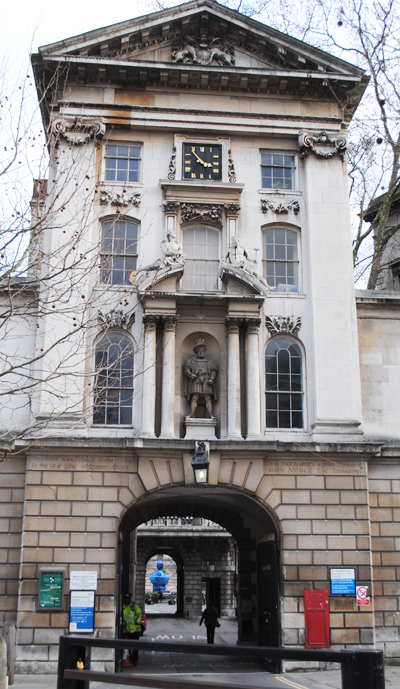
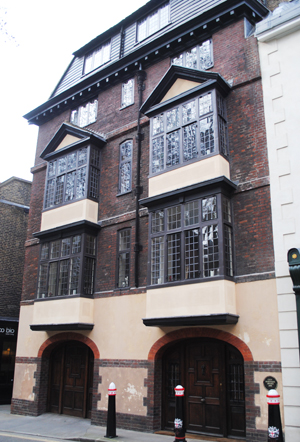
First up, we take a look at the Museum of the Order of St John. The museum – which was reopened in late 2010 following a £3.7 million redevelopment – is located in St John’s Gate in Clerkenwell (pictured), the Tudor era gatehouse of the order’s once substantial London priory.

Told inside is the story of the order, from its founding in the 12th century as the Order of the Hospital of St John of Jerusalem with the aim of caring for sick pilgrims who had travelled to the Holy Land through to its later role as a military order and its Middle Ages moves – following the capture of Palestine by Muslim forces in 1291 – to Cyprus, then Rhodes, and eventually Malta, along with its current work through the charitable foundation of St John Ambulance.

Exhibits include weapons and armour, paintings and illuminated manuscripts (such as the Rhodes Missal of 1504), coins, furnishings, ceramics, silverware and textiles. There is also a 16th or 17th century bust of Jean de la Valette, Grand Master of the Knights Hospitaller from 1557 to 1568 and famed for leading the order to victory in the Great Siege of Malta in 1565 (he is remembered still in the name of the island nation’s capital, Valletta).

As well as the gatehouse (which, following the Dissolution, was used for various purposes including being the childhood home of 18th century artist William Hogarth and, at another time, housing a printing press used by famed lexicographer Dr Samuel Johnson), the museum’s assets also encompass the 12th century crypt under what was once the priory church (it’s located just to the north across Clerkenwell Road). It’s well worth a visit for the stunning 16th century tomb effigies alone.

WHERE: The Museum of the Order of St John, St John’s Gate, St John’s Lane, Clerkenwell (nearest Tube stations is Farringdon); WHEN: 10am to 5pm, Monday to Saturday (tours are held at 11am and 2.30pm on Tuesday, Friday and Saturday); COST: Free (a small donation for guided tours); WEBSITE: www.museumstjohn.org.uk.

Famous Londoners – Sir Hans Sloane

An Ulster-Scots born physician, scientist and avid collector, Sir Hans Sloane served as doctor to no less than three British monarchs during the 17th and 18th centuries and during his life amassed a vast collection of natural specimens and curiosities which after his death were used to form the core of the British Museum’s collection.
Born on 16th April, 1660, at Killyleagh in County Down, Ireland, Sir Hans was the son of Alexander Sloane, a “receiver-general of taxes” who originally hailed from Scotland.

Even as a young man, he developed a keen interest in the natural sciences. Having suffered from some ill-health which, at the age of 16 is said to have kept him confined to a room for a year, in 1679, at the age of 19, he moved to London where he studied chemistry at the Apothecaries Hall and botany at the Chelsea Physic Garden – a period during which he befriended the botanist John Ray and chemist Robert Boyle.

Four years later, he travelled through France where he received his Doctorate of Physics. On his subsequent return to London in 1685, he was made a Fellow of the Royal Society and in 1687 a Fellow of the Royal College of Physicians.

Given the chance to travel to Jamaica as physician to the new Governor, Christopher, the 2nd Duke of Albemarle, he only spent 15 months there (the Governor died soon after arrival). But it was an important period during which not only did he document and collect a vast amount of flora and fauna (bringing some 800 specimens back to London), he also came up with the idea of drinking chocolate with milk after witnessing locals drinking the dark chocolate with water but finding the mix made him “nauseous” (back in England, his concoction was first sold as a medicine and was later manufactured as a drink by Cadburys).

Having returned to London in 1689, he published the information he had gathered in Jamaica, and in 1693 he become secretary to the Royal Society.

In 1695 he married a Jamaican sugar planter’s widow, Elizabeth Langley Rose (with whom he had several children but of whom only two daughters, Sarah and Elizabeth, survived) and, thanks in part to an ongoing association with the duke’s widow, was able to set up a fashionable medical practice at 3 Bloomsbury Place on the northern end of Bloomsbury Square.

The house, not far from where the British Museum now stands, become something of an attraction in its own right, filled with objects and specimens he had collected on his travels as well as those – in some cases complete collections – given to him by others including friends and patients (in fact, he had to purchase the property next door, number four, to find room for them all – this property is now marked with a Blue Plaque).

The composer Handel is said to have been among those who visited the property and there is a delightful tale that says Sir Hans was outraged when Handel placed a buttered scone on one of his rare books.

With his services as a physician highly prized, in 1696, he was appointed physician to Queen Anne, the first of the three monarchs he would serve. In 1712-13, with his collection still growing, he purchased the Manor of Chelsea to help house it (four acres of which were leased to the Chelsea Physic Garden, which had been founded in 1673 with the idea of providing a training ground for apprentice apothecaries, in perpetuity).

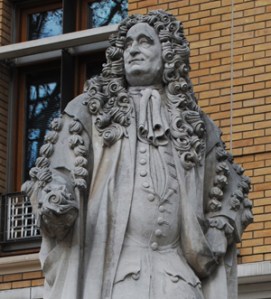
He subsequently moved his collection out to this property and his connection with Chelsea is still celebrated in place names such as name Sloane Square (not to mention Sloane Street, Sloane Gardens, Hans Street, Hans Crescent, Hans Road and Hans Place). There is also a statue of the bewigged man in Duke of York Square (pictured), not far from Sloane Square – this is a 2007 copy of 1737 original by John Rysbrack, another (older) copy of which can be found in the Chelsea Physic Garden.

Following Queen Anne’s death in 1714, in 1716 Sir Hans was appointed physician to her successor, King George I (he was also created a baronet the same year, becoming the first medical practitioner to receive a hereditary title).

Three years later, in 1719, he become president of the Royal College of Physicians, an office he held for 16 years, and in 1727, he was appointed physician to King George II. The same year he succeeded Isaac Newton as president of the Royal Society, an office which he held until 1741.

In 1742, Sir Hans retired to his property in Chelsea.

By the time of his death on 11th January, 1753 at the ripe old age of 93, Sir Hans had collected more than 71,000 objects including books, manuscripts, drawings, coins and medals and plant specimens which he bequeathed to King George II in exchange for a payment of £20,000 to his executors.

Parliament agreed, following a lottery to raise the money, his collection went on to form the basis of the British Museum, first opened to the public in 1759 in Bloomsbury. It was also to form the basis of the museum’s later offshoot, the Natural History Museum at South Kensington.

Sir Hans was buried at Chelsea Old Church with his wife Elizabeth who died in 1724.
King James I’s London – 10. Westminster Abbey’s Lady Chapel

And so we come to the final instalment in our series on King James I’s London. This week we’re looking at Westminster Abbey’s Lady Chapel where King James I – who was crowned in Westminster Abbey in 1603 – was laid to rest after his death in 1625.

But before we turn to James himself, it’s worth noting that several members of his immediate family are also buried in the abbey’s Lady Chapel (pictured). These include his eldest son, Henry Fredrick, Prince of Wales, who died in 1612 at the age of 18 (and thus opened the way for his younger brother Charles to become King Charles I). He is buried in the south aisle of the magnificent Lady Chapel which had been added at the behest of King Henry VII between 1503 and 1519 and replaced a 13th century chapel.

Three of James’ daughters are also buried in the Lady Chapel – Mary, who died in 1607, aged two, and Sophia, who died in 1606, aged just three days old. Both of them have monuments in the north aisle while their sister Elizabeth, wife of King Fredrick V of Bohemia, who died much later in 1662, is buried near her brother Henry Fitzpatrick.

As we’ve previously mentioned, King James I also outlived his wife, Queen Anne of Denmark, who died of dropsy at Hampton Court Palace on 2nd March, 1619, at the age of 43. She lay in state at Somerset House until her funeral on 13th May and was then buried in the south-eastern area of the Lady Chapel where her gravesite is marked by a modern stone bearing her name. Her wooden funeral effigy is one of a collection which can still be seen in the Abbey’s Museum.

After James himself died on 27th March, 1625, he was laid in the vault beneath King Henry VII’s monument beside Elizabeth of York, Henry’s wife. No monument was erected to mark his passing save for a modern inscription placed nearby (in fact Queen Elizabeth I was the last monarch to be buried with a monument above the site – see below).

It’s also worth noting that in 1612 – nine years into his reign – James arranged for the body of his mother – Mary, Queen of Scots, who was executed in 1587 on the orders of Queen Elizabeth I – to be transferred from its resting place in Peterborough Cathedral to the south aisle of the Lady Chapel where he had an elaborate tomb erected featuring an elegant white marble effigy showing her wearing a coif, ruff and long mantle.

In the north aisle, James had previously erected a marble monument to his predecessor, Queen Elizabeth I and had her body moved from where it had lain in the vault of her grandfather, King Henry VIII, to a place beneath the new monument. Her half-sister, Queen Mary I, is also buried beneath the monument.

That’s the final in our series on King James I’s London – it’s by no means a comprehensive look at significant sites in the early Stuart period and we shall be looking at more from the period down the track, but it’s a good start. Our new special series starts next week. 

WHERE: Westminster Abbey, Westminster (nearest Tube station is Westminster or St James’s Park); WHEN: Open to tourists everyday except Sunday  (times vary so check the website); COST: £16 an adult/£13 concessions/£6 schoolchildren (11-18 years), free for children aged under 11/£38 for a family (two adults, two children); WEBSITE: www.westminster-abbey.org

Around London – 250,000 British Library titles to be available online; summer in Bunhill Fields Burial Ground; funding for church and synagogue repairs; and, the British Museum takes a closer look at relics and reliquaries…

The British Library is to digitise 250,000 books and make them available on the internet under a deal with tech giant Google. The works, which are all out of copyright, date from between 1700 and 1870 and include printed books, pamphlets and periodicals. Among them are feminist pamphlets about the ill-fated French Queen Marie Antionette dating from 1791, blueprints of the first combustion engine-driven submarine dating from 1858, and a 1775 account which tells of a stuffed hippopotamus owned by the Prince of Orange. The works will all be available online via Google Books which has partnered with more than 40 libraries around the world. The project will include material published in a range of European languages and will focus on works not already freely available in digital form online. For more see www.bl.uk.

A series of events running under the banner of ‘Green Garden Lunchtimes’ will be held at the Bunhill Fields Burial Group (off City Road) in the City of London from next Monday until 1st July. The events include free yoga and tai chi classes, a bike repair workshop, a history tour from City Guides and a wildlife talk courtesy of the Natural History Museum. The Wren Clinic will also be providing free advice and treatments. Bunhill Fields is famous for its connections to the Nonconformists and contains the graves of writers William Blake, Daniel Defoe and John Bunyan. For dates and times, follow this link.

• Six churches and a synagogue in London have been granted £582,000 to carry out repair works under the Repair Grants for Places of Worship scheme. The grants, which are administered by English Heritage and funded by the Heritage Lottery Fund, include £199,000 for the Church of St Augustine in Honor Oak Park – an early example of the Gothic Revival in the Early English style, £122,000 for Christ Church in Christchurch Park, Sutton, and £111,000 for the Golders Green Synagogue in Barnet. The grants were part of £8 million worth of funding given to 67 of England’s most important Grade II listed churches, chapels and synagogues. For more, see www.hlf.org.uk.

On Now: Treasures of Heaven: saints, relics and devotion at the British Museum. The museum’s major summer exhibition looks at the spiritual and artistic significance of Christian relics and reliquaries in medieval Europe. Among the highlights are: an arm reliquary of St George, which was housed in the treasury of St Mark’s in Venice following its capture in the sack of Constantinople in 1204; the British Museum’s bejewelled Holy Thorn reliquary, dating from 1390-97 and said to contain a relic from the Crown of Thorns; and, a 12th century bust of St Baudime from France, which once contained a vial of the saint’s blood and is being seen for the first time in Britain. Other exhibits come from the Cleveland Museum of Art in Ohio and the Walters Art Museum in Baltimore as well as from the Vatican. Runs until 9th October. There is an admission charge. For more, see www.britishmuseum.org.

LondonLife – St Paul’s celebrates 300 years since its completion…

Queen Elizabeth II attends the tercentenary service at St Paul’s. PICTURE: Graham
Lacdao/St Paul’s Cathedral

A service was held at St Paul’s today in celebration of the 300 year anniversary of the cathedral’s completion.

The tercentenary service also marks the end of a massive 15 year, £40 million repair and cleaning project, meaning the cathedral is now clear of scaffolding for the first time in 15 years.

Designed by the indomitable Sir Christopher Wren, work on St Paul’s Cathedral began in 1677 and was formally completed in 1710 (although it had been holding services since 1697). (For more on the history of St Paul’s, see our earlier post, part of our series on Wren’s London, here).

Said to have the largest dome after St Peter’s in Vatican City, St Paul’s has been at the centre of London’s (and the United Kingdom’s) religious and political life for centuries, hosting state funerals (Lord Nelson, the Duke of Wellington and Winston Churchill’s were all held here) as well as the royal wedding of Prince Charles and Lady Diana and many celebration services.

Sights include the crypt – containing the tombs of both Nelson and Wellington – and the Whispering Gallery (see our earlier post on the Whispering Gallery here) as well as the exterior viewing galleries.

To celebrate the cathedral’s liberation from scaffolding, St Paul’s is holding a 300th Anniversary Photography Competition in which photographers are invited to submit their best exterior shots of the building. The 10 winning images will then be displayed in the cathedral crypt. The competition runs until 16th July.

To enter, upload pictures to St Paul’s 300th anniversary competition group at Flickr – www.flickr.com/groups/stpaulslondon/. For more information, see www.stpauls.co.uk/photocomp.

King James I’s London – 8. The New World

It was during the reign of King James I that the first permanent English settlement was made in what was then called the New World (and is now better known as the United States of America).

Named Jamestown (after the King) and located on Jamestown Island, it was the capital of the new Virginia Colony and was founded by the London Company.

The ‘discovery’ and settlement of the New World impacted London itself in various ways – here we look at a couple of related sites in London…

First up is Blackwall in East London, from where three small merchant ships of the Virginia Company of London sailed in 1606 under orders from King James I to bring back gold from the New World. The site is now marked by the First Settlers Monument, first unveiled in 1928 and then restored in 1999.

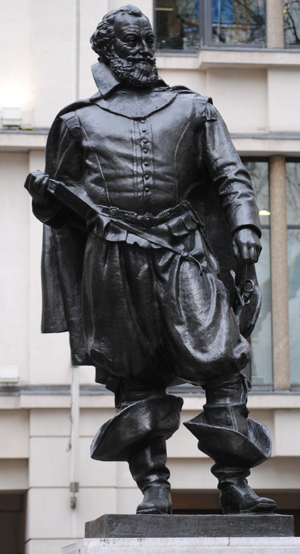
Among those who was on board the ships is Captain John Smith (he of Pocahontas fame) – a statue of him can be found in Bow Churchyard in the City (pictured right, it’s a replica of an original in Richmond, Virginia). Captain Smith was buried in St Sepulchre-without-Newgate, where there is a window commemorating him.

Next we turn to the former, now non-existent, property of John Tradescant and his son, also John Tradescant. Gardeners to the rich and famous and avid collectors of all sorts of artefacts, they are noted for having founded “The Ark” – a house in Lambeth, in they showed off a collection of curiosities that they had gathered on his trips (both were were widely travelled).

These included objects presented to by American colonists including John the Elder’s friend Captain John Smith and those collected by personally by John the Younger (he made several trips to the New World). Among them was the mantle of Powhattan, the father of Pocahontas.

The pair’s name lives on in Tradescant Road in Lambeth (it marks one side of the Tradescant estate). They are both buried at St Mary-at-Lambeth which now houses the Garden Museum.

LondonLife – Knollys Rose Ceremony

A London tradition which has its origins in the fourteenth century, the Knollys Rose Ceremony surrounds the presentation of a single red rose to the Lord Mayor of London at Mansion House.

The ceremony, which was held in the City yesterday, relates to a judgement of 1381 in which the fine was the annual payment of a single red rose.

The fine was levied after Lady Constance Knollys, the wife of prominent citizen Sir Robert Knollys, bought a property opposite her own in Seething Lane and then added a footbridge linking the two without first gaining planning permission (it’s suggested that she bought the property which had previously been used as a threshing ground because she was annoyed with the constant chaff in the air).

Following discovery of her breach, it was agreed that she would pay the annual ‘peppercorn rent’ of a single red rose from the new property’s garden to the Lord Mayor.

Lady Constance’s footbridge is long gone but the tradition of paying the annual rent was revived last century and is now presided over by the Company of Watermen and Lightermen of the River Thames.

The ceremony starts at the church of All Hallows by the Tower and then involves a procession to Seething Lane Gardens (a modern garden close to where the original may have been; the gardens were once the site of the Navy Office) where the Master of the Company of Watermen and Lightermen snips off a rose before heading on to Mansion House where it is presented to the Lord Mayor on a velvet altar cushion from All Hallows.

The ceremony usually takes place on the second Monday in June.

What’s in a name?…King’s Cross

The location now known as King’s Cross, north-west of the City, takes its name from a monument adorned with an 11 foot high statue of King George IV which once stood on a site now occupied by King’s Cross Railway Station.

The area had been previously known as Broadford Bridge or Battlebridge – the latter a name many associated with the apparently erroneous belief that it was here, at a bridge which once crossed the River Fleet, the Iceni Queen Boudicca (also known as Boadicea) ill-fatedly confronted the Roman Army under the command of Gaius Suetonius Paulinus.

From the 1830’s (King George IV ruled from 1820 to 1830), however, the area took on the name of King’s Cross thanks to the erection of what Walter Thornbury described in his 1878 text, Old and New London, as a “ridiculus octagonal structure crowned by an absurd statue of George IV”.

The structure, said to be 60 feet high, was erected at the intersection of Gray’s Inn Road, Pentonville Road and what we now know as Euston Road, and during its relatively short lifespan, was employed at different times as a police station and as a pub (complete, apparently, with a camera obscura in the upper level).

It was completely removed by 1845 (King’s Cross Railway Station officially opened in 1852).

The area of King’s Cross has been settled back as far as Roman times – St Pancras Old Church is one of the oldest sites of Christian worship in England although the current church is Victorian – but it wasn’t until the 1700s and 1800s that it was transformed in to an urban area with the arrival of canals – including The Regent’s Canal – and the railways.

Traditionally one of London’s poorest areas, it survived World War II bombings but subsequently suffered as the railways declined in the post-war period. By the 1980s, it had become notorious as a red light district.

It has since gone through – and is still going through – a gradual gentrification process, however, with the 67 acre development King’s Cross Central among the projects currently under construction.

Key attractions of the area include The British Library, The London Canal Museum, arts centre King’s Place, and the recently refurbished St Pancras Renaissance London Hotel.

It’s also now home to St Pancras International – London’s Eurostar terminus (having been moved here from Waterloo) – as well as King’s Cross Railway Station which is believed by many, despite the lack of any evidence, to be the burial site of Queen Boadicea (it’s said she still lies beneath platform 9 or 10) and which is the home of the fictitious platform 9 and 3/4 from which Harry Potter catches the train to Hogwarts.

LondonLife – Beating the Bounds at All Hallows

Thursday is Ascension Day and, at All Hallows by the Tower in the City, that means conducting the ancient ceremony of Beating the Bounds.

The origins of the custom go back to medieval times when parishes annually reaffirmed their boundaries by undertaking a procession during which each parish boundary marker was beaten with wands while praying for protection and blessings.

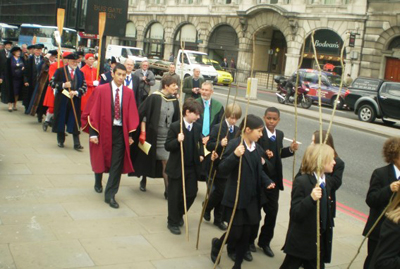
At All Hallows, the beating party consists of students from Dunstan College in Catford (these students have an association with the church of St Dunstan-in-the-East which is now part of the parish of All Hallows) along with parish clergy and the masters of livery companies associated with the parish and Thames waterboatmen. (Pictured right is last year’s procession).

Highlights of the procession at All Hallows include the beating of the parish’s southern marker – this is located in the middle of the Thames and must be reached by boat – and the mock ‘confrontation’ which occurs between the beating party and the Governor and Yeoman Warders of the Tower of London.

The ‘confrontation’ relates to the fact that the parish and the tower share a boundary – this was apparently a common cause of dispute in the Middle Ages and led, in 1698, to a ‘battle’ between the people of the parish and those of the tower. The ceremony is followed by attendance at a festal evensong at the church.

For more, see www.ahbtt.org.uk/history/beating-the-bounds/

PICTURE: Courtesy of All Hallows by the Tower.

Where’s London’s oldest…hospital?

London’s oldest hospital – St Bartholomew’s Hospital in what is known now as Smithfield – was founded in the 12th century.

The hospital owes its foundations – like the neighbouring Priory of St Bartholomew (London’s oldest church – see our previous story on this here) – to Rahere, a courtier (possibly a minstrel or jester) at the court of King Henry I who, tired with triviality, may have become a priest.

In any event, after the death of Henry’s son William – he is believed to have drowned when the White Ship foundered in November 1120 – and that of his wife Queen Matilda, Rahere went on pilgrimage to Rome. He did so but contracted malaria while there and, while under the care of  monks, he vowed to found a hospital for poor men if he recovered.

He did recover and on his return journey had a vision of St Bartholomew who informed him that it was he who had helped him to recover and now desired him to found a church in Smithfield (then known as Smedfield).

Back in London, Rahere as he’d promised and, after petitioning the king, was granted a royal charter in 1122 to found the priory of Augustinian canons and the hospital.Work began in March 1123 and it was completed by 1145 when Rahere died (his tomb can still be seen in the church).

The hospital – one of a number in London at the time – was probably little more than a single hall with a chapel at one end. Other buildings and some cloisters were added later as was the Church of St Bartholomew the Less.

Under a charter of 1147, it was open to the needy, orphans, outcasts and the poor as well as sick people and homeless wanderers. In the 14th century, the definition was honed to include the sick until they recovered, pregnant women (until delivery) and for the maintenance of children born there until they were seven-years-old.

As well as the master (Rahere was the first), other ‘staff’ at the hospital initially included eight Augustinian brothers and four sisters but the hospital gradually became independent of the priory and by 1300, the hospital has its own dedicated master. By 1420, the two institutions had apparently become completely separate.

Following the Dissolution in 1539, the hospital was refounded in the 1540s thanks to a deal brokered between King Henry VIII and the Corporation of the City of London. Along with Bethlem, Bridewell and St Thomas’, St Bartholomews was one of four Royal Hospitals administered by the City.

The first regular physician – a Portuguese man by the name of Roderigo Lopez – was appointed around 1567 (he was later hung, drawn and quartered for an allegedly plotting against Queen Elizabeth I). Among the most famous physicians to serve at St Barts in later years was William Harvey, renowned for having ‘discovered’ the circulatory system.

The hospital survived the Great Fire in 1666 but in the 1700s most of the medieval buildings, with the exception of the tower in the Church of St Bartholomew the Less, were demolished as the hospital was rebuilt to the design of James Gibbs. The new design featured a central courtyard with a Great Hall contained in the north wing, reached by a ‘Grand Staircase’ decorated with images of the Good Samaritan and Christ at the Pool of Bethesda by celebrated artist William Hogarth.

The famous Henry VIII gate (pictured above) dates from 1702, slightly before Gibb’s rebuilding project. Other buildings have been added in more recent times.

In more recent times, the hospital was amalgamated with The Royal London and the London Chest Hospitals in 1994 with the establishment of The Royal Hospitals NHS Trust (now known as the Barts and The London NHS Trust). St Barts is now a specialist cancer and cardiac hospital.

There is a museum at the hospital which houses exhibits including a facsimile of Rahere’s grant of 1137 (now in the hospital’s archives), amputation instruments dating from the early 1800s once used by surgeon John Abernathy and a display on William Harvey. Hogarth’s paintings are visible from the museum.  There are also guided tours of the hospital.

WHERE: Museum at St Barts Hospital (nearest tube station is Barbican); WHEN: 10am to 4pm Tuesday to Friday ; COST: Free (donations welcomed); WEBSITE:  www.bartsandthelondon.nhs.uk/about-us/museums-and-archives/st-bartholomew-s-museum/

Curious London Memorials – 10. The Bard or not The Bard?

For the last in our series of curious London memorials, we’re looking at one which isn’t quite what it seems.

At first glance, the granite plinth topped by a bronze bust of William Shakespeare which stands in gardens at the junction of Love Lane and Aldermanbury in the City, looks like yet another tribute to the Bard.

But take a closer look and you’ll read that the inscriptions in fact refer to John Heminge and Henry Condell, two actors and friends of the Bard, who were responsible for collecting his works and giving them “to the world”.

The two men were partners with Shakespeare at the Globe and it was they who were behind the publication of his First Folio in 1623. They were both buried here in what was formerly the churchyard of St Mary Aldermanbury (first destroyed in the Great Fire of 1666 and then again in the Blitz although the surviving walls were later rebuilt in the US – more on that another time), Heminge on 12th October, 1630, and Condell on 29th December, 1627.

It’s worth quoting the inscription on the memorial – and there is a lot of it – at greater length. “The fame of Shakespeare,” it reads, “rests on his incomparable dramas. There is no evidence that he ever intended to publish them and his premature death in 1616 made this the interest of no-one else. Heminge and Condell had been co-partners with him in the Globe Theatre Southwark and from the accumulated plays there of thirty-five years with great labour selected them. No men living were so competent having acted with him in them for many years and well knowing his manuscripts. They were published in 1623 in folio, thus giving away their private rights therein. What they did was priceless, for the whole of his manuscripts with almost all those of the dramas of the period have perished.”

The memorial was erected by Charles Clement Walker, of Shropshire, in 1896. Walker, who has his own memorial in Northampton Square in Clerkenwell, was a Justice of the Peace for the counties of Salop and Stafford and a native of the parish of Clerkenwell.

The bronze bust of Shakespeare was by Charles Allen.

What’s in a name?…Clerkenwell

Located just to the north of the City, the area of Clerkenwell takes its name from the Clerk’s Well which stands in Farringdon Lane.

The well was mentioned as far back as 1174 and was the scene of medieval mystery plays which were performed by the parish clerks of London. It was formerly located inside the wall of the 12th century St Mary’s Nunnery (located on the site of St James Parish Church) but is now found in the basement of a building named Well Court.

Islington Council record that a pump was installed at pavement level in 1800 to enable the public to use the well to draw water but this was closed by the mid 1800s and the exact site of the well lost to public knowledge. It was only in 1924 that the well was rediscovered during building work.

Alongside the nunnery, Clerkenwell was also home to the Priory of St John of Jerusalem, English headquarters of the crusader order known as the Knights Hospitallers. The Order of St John is still headquartered on the site of the former priory – the remains of the original priory include the Norman crypt under the rebuilt church and the priory’s main entrance, St John’s Gate, now home to a museum on the order. Also found in Clerkenwell is the Charterhouse, founded by Carthusian monks in 1370 and later a school (it’s these days home to a school of medicine and dentistry).

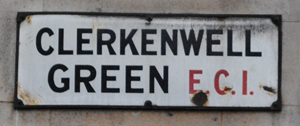
The area, centred on Clerkenwell Green (although apparently there hasn’t been a green here for several hundred years), become famous for its leisure-related institutions in the 1600s – these included spas, tea gardens and theatres (Sadler’s Wells Theatre still remains, albeit in a modern, dance-related form) – and gradually evolved into a more built-up residential area.

It was initially favored by the fashionable until the Industrial Revolution saw printing houses, breweries and distilleries, and clock and watchmakers move in. A survivor from the 18th century is the Middlesex Sessions House, built on Clerkenwell Green as a court around 1782 and now used by the Freemasons.

Industry declined in the area after World War II and Clerkenwell, which had also become a noted location for communists in the early 1900s (Lenin edited a paper here at one stage), was gradually transformed back into a residential area. Since the Eighties, Clerkenwell has again been going through a process of transformation – this time one of gentrification.

The well, located at 14-16 Farringdon Lane, can be visited – to arrange a visit, contact the Islington Local History Centre on 020 7527 7988 or email local.history@islington.gov.uk. For walks in Clerkenwell, see the Clerkenwell & Islington Guides Association  at www.clerkenwellwalks.org.uk.

Treasures of London – The Whispering Gallery, St Paul’s Cathedral

Found 98 feet (30 metres) above the cathedral’s floor, the Whispering Gallery at London’s iconic St Paul’s Cathedral is an architectural marvel.

As with other “whispering galleries” found around the world, its construction is such that something whispered into the wall on one side of the gallery, which runs around the interior of the cathedral’s inner dome (part of the first ever ‘triple dome’), can be heard on the other side of the gallery, around 100 feet (30 metres) away.

The dome (pictured right), the design of which draws inspiration from that of St Peter’s Basilica in Vatican City, was constructed to the designs of Sir Christopher Wren. The cathedral, including the dome, was essentially completed in 1708.

As well as giving views down into the cathedral, the Whispering Gallery – a relatively easy climb of only 257 steps – also provides a close-up view of murals painted on the dome’s inner surface by Sir James Thornhill. Painted between 1715 and 1719, these depict images from St Paul’s life.

Two further galleries on the dome are also publicly accessible – the Stone Gallery, which stands 173 feet (53.4 metres) above the cathedral floor, and the Golden Gallery, which stands 280 feet (85.4 metres) above the cathedral floor and offers stunning views of the city as well as southward over the Thames. But be prepared for a long climb – 528 steps – up what are in places narrow, winding staircases.

The current ball and cross on top of the dome date from 1821 (these replaced those which had first topped the cathedral). Together they stand 23 feet (seven metres) high and weigh seven tonnes.

WHERE: St Paul’s Cathedral, St Paul’s Churchyard (nearest tube station is St Paul’s); WHEN: The galleries are open from 9.30am to 4.15pm, Monday to Saturday (small children must be accompanied by an adult)/Cathedral is open from 8.30am;  COST: £14.50 an adult/£13.50 concessions and students/£5.50 a child (6-18 years)/£34.50 a family of four; WEBSITE: www.stpauls.co.uk

Where’s London’s oldest…lived in house?

Like many in our series on London’s oldest, this one is a little subjective. But based on our survey of the data out there, we’re opting for 41-42 Cloth Fair, right beside St Bartholowmew the Great, in the City.

The only house to have survived the Great Fire of London in 1666, this five bedroom property – which we can confirm is still up for sale with a guide price of more than £5.9 million following a major restoration – was apparently completed around 1614.

It was originally constructed as part of a development initiated by Robert, Baron Rich, which featured 11 houses around a courtyard and was known as Launders Green (being located on what was the former laundry ground of the monastery at St Barts).

The red brick house, which was awarded a City Heritage award in 2000 for the sensitive restoration work, retains many of its original features.

Interestingly, windows on the second floor contain autographs of some of the famous people who have been to the property over the years including Queen Elizabeth, the Queen Mother, former PM Winston Churchill and Poet Laureate John Betjeman.

Happy St David’s Day!

It’s St David’s Day, Wales’ national day of celebration, so you may have noticed the Welsh flag flying in a few places you wouldn’t normally see it – including at 10 Downing Street. In keeping with the theme of all things Welsh, we’re taking a look at a couple of Welsh-related sites in London…

St Benet, Paul’s Wharf – Known as London’s “Welsh church”, the current St Benet’s was rebuilt to the designs of Christopher Wren after the Great Fire of 1666 although a church has stood on this site for 900 years. Services have been held at the church (pictured right) in Welsh since 1879 after Queen Victoria granted Welsh Anglicans the right to worship in their own language there. Known formally at St Benet’s Metropolitan Welsh Church, the premises, located just off Queen Victoria Street in the City, has also been the church of the College of Arms since 1555. Among other historic titbits is the suggestion that both Anne Boleyn and Lady Jane Grey – the “nine day Queen” – may have received the last rites here before going on to their executions at the Tower of London, that 17th century architect Inigo Jones was buried here, and that King Charles II had a special door built for himself in the side of the building and a private room where he could take part in services. See www.stbenetwelshchurch.org.uk

The London Welsh Centre – Located in Gray’s Inn Road, the centre’s origins go back to the founding of the Young Wales Association in 1920, created to provide a focus for young Welsh people in London. The organisation, which initially didn’t have a permanent home, held meetings in several locations before moving to the current premises in the 1930s. Today the premises is used by the London Welsh Centre and is the base for three choirs – the London Welsh Chorale, The London Welsh Gwalia Male Choir and The London Welsh Male Voice Choir. It also provides Welsh language classes and hosts concerts and other cultural events. See www.londonwelsh.org.

Memorial to Welsh poet Iolo Morganwg – A memorial plaque to this Welsh poet and antiquarian stands on Primrose Hill on the site where the first meeting of the Gorsedd of Bards of the Isle of Britain, convened by Morganwg, was held in 1792. The plaque was unveiled in 2009. Follow this link for more information.

Do you know of any other Welsh-related sites in London? Let us know…