This Week in London – Garden art from the Royal Collection; A Royal Welcome at Buckingham Palace; photographic history; and, Joshua Reynolds reconsidered…

GardensKing Henry VIII’s well-thumbed gardening manual, a late 15th century copy of the Ruralia Commoda, and a 16th century portrait of Jacopo Cennini, factor and estate manager to the House of Medici – believed to be the earliest surviving portrait of a gardener – are among more than 150 objects on display at a new exhibition celebrating the art of gardens. Opening at The Queen’s Gallery in Buckingham Palace tomorrow, Painting Paradise: The Art of the Gardens features some of the earliest surviving records of gardens and plants in the Royal Collection including Jan Brueghel the Elder’s Adam and Eve in the Garden of Eden (1615), The Family of Henry VIII (c. 1545) featuring King Henry VIII’s Great Garden at Whitehall Palace – the first real garden recorded in British art, and A View of Hampton Court by Leonard Knyff (c. 1702-14) – described as the “greatest surviving Baroque painting of an English garden”. There are also works by Frenchman Jean-Baptiste Martin, Swiss artist Johan Jacob Schalch and Sir Edwin Landseer. The exhibition runs until 11th October. Admission charge applies. For more, see www.royalcollection.org.uk. PICTURE: Illustration from Henry VIII’s copy of the gardening manual, c. 1490-95. Royal Collection Trust/© Her Majesty Queen Elizabeth II 2015. 

Buckingham Palace, meanwhile, has announced its summer opening under the theme of A Royal Welcome. From 25th July to 27th September, displays in the State Rooms will recreate the settings for some of the many occasions in which the palace welcomes guests – from State Visits and garden parties to investitures and private audiences. The displays will show the behind-the-scenes preparations that go into a state visit and show the ballroom set up for a State Banquet. There will also be a display featuring the knighting stool and a knighting sword and, for the first time ever, visitors will enter the State Rooms through the Grand Entrance, used by those who come to the palace at the invitation of the Queen, including heads of state and prime ministers. The Australian State Coach, most recently used to carry the Duke of Edinburgh and the wife of the Mexican President, Señora Rivera, in March this year, will be displayed in the Grand Entrance portico. Admission charge applies. For more, see www.royalcollection.org.uk.

About 100 of the “most stunning photographs ever created” go on show in the Science Museum’s Media Space in South Kensington from tomorrow. Revelations explores the role of early scientific photography in inspiring later art photographers and will feature rare shots from the National Photography Collection including an original negative of X-Ray, 19th century photographs capturing electrical charge and William Henry Fox Talbot’s experiments with photomicrography. Displayed alongside are images by some of the 20th century’s pre-eminent art photographers such as Trevor Paglen, Idris Khan and Clare Strand. Runs until 13th September. Admission charge applies. For more, see www.sciencemuseum.org.uk/revelations.

On Now: Joshua Reynolds: Experiments in Paint. This exhibition at the Wallace Collection in Marylebone provides a new perspective on the portraits of Reynolds, one of the greatest artists of his day. Works on show including Nelly O’Brien, Mrs Abington as Miss Prue and Self Portrait Shading the Eyes as well as lesser known pictures and a rare history painting. The exhibition reveals discoveries made recently during a four year research project into the works of Reynolds now in the care of the collection. Runs until 7th June. Admission is free. For more, see www.wallacecollection.org.

Send items for inclusion to exploringlondon@gmail.com.

This Week in London – Rarely seen Goya at the Courtauld; Wolsey Angels saved; and, A Victorian Obsession…

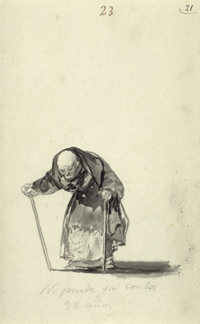
He-can-no-longer-at-theA “ground-breaking” exhibition of works of 18th and 19th century Spanish painter and printmaker Francisco Goya opens to the Courtauld Gallery at Somerset House today. Goya: The Witches and Old Women Album brings together the previously widely scattered pages of one of the artist’s most celebrated private albums in the first exhibition to ever recompile one of them. The album – which features themes of witchcraft, dreams and nightmares and has been reconstructed into its original sequence – is thought to have been made between 1819-23, a period during which Goya completed the murals known as the Black Paintings. Runs until 25th May. Admission charges applies. For more, see www.courtauld.ac.uk/goya. PICTURE: © The Courtauld Gallery (He can no longer at the age of 98, c. 1819-23, J. Paul Getty Museum).

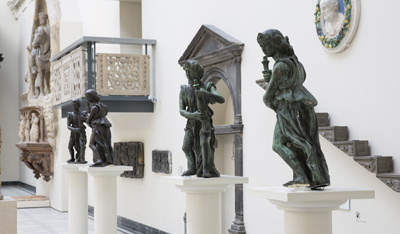
The ‘Wolsey Angels’ have been “saved for the nation” after a campaign to acquire them by the V&A. The museum has reported that more than £87,000 was raised in a national public appeal – around £33,000 of which was raised via donations and through the purchase of badges at the South Kensington premises – which, along with grants including a £2 million National Heritage Memorial Fund grant and a £500,000 Art Fund grant, will be used to acquire the four bronze angels which were originally designed for the tomb of Cardinal Thomas Wolsey, chief advisor to King Henry VIII. The four bronze angels, which have been in display at the V&A, will now undergo conservation treatment before going back on display. For more on the history of the angels, see our earlier post here. For more information on the V&A, see www.vam.ac.uk.

Closing Soon – A Victorian Obsession: The Pérez Simón collection at Leighton House Museum. This exhibition at the former Holland Park of Lord Leighton presents more than 50 rarely exhibited paintings by leading Victorian artists including Albert Moore, Dante Gabriel Rossetti, Edward Burne-Jones, John Everett Millais, John William Waterhouse, Edward Pointer, John Strudwick and John William Godward as well as six pictures by Leighton himself and the highlight, Lawrence Alma-Tadema’s The Roses of Heliogabalus. Runs until 29th March. Admission charge applies. See www.rbkc.gov.uk/subsites/museums/leightonhousemuseum/avictorianobsession.aspx for more.

Lost London – Baynard’s Castle (part 2)…

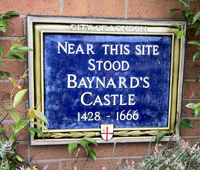
Having previously looked at the Norman fortification (razed by King John in 1213 – see our earlier post here), this time we’re taking a look at the later (medieval) fortification known as Baynard’s Castle.

Baynard's-CastleIn the 1300s, a mansion was constructed about 100 metres east of where the castle had originally stood on a riverfront site which had been reclaimed from the Thames. This was apparently destroyed by fire before being rebuilt in the 1420s and it became the seat of the House of York during the Wars of the Roses. King Edward IV was proclaimed king here in 1461 and King Richard III was offered the crown here in 1483 (a moment famously captured by William Shakespeare).

King Henry VII transformed the fortified mansion into a royal palace at the start of the 16th century – adding a series of towers – and his son, King Henry VIII, gave it to the ill-fated Catherine of Aragon when they married. The Queen subsequently took up residence (Anne Boleyn and Anne of Cleves also resided here when queen – the latter was the last member of the royal family to use it as a permanent home).

After King Henry VIII’s death, the palace passed into the hands of the Earl of Pembroke (brother-in-law of Queen Catherine Parr, Henry’s surviving Queen) who substantially extended it, adding ranges around a second courtyard. In 1553, both Lady Jane Grey and Queen Mary I were proclaimed queen here. Queen Elizabeth I was another royal visitor to the palace, entertained with a fireworks display when she did.

It was left untouched during the Civil War (the Pembrokes were Parliamentarians) but following the Restoration, it was occupied by the Royalist Earl of Shrewsbury (among his visitors was King Charles II). It wasn’t to be for long however – the palace was largely destroyed in the Great Fire of 1666, although remnants of the building, including one or two of the towers, continued to be used for various purposes until the site was finally cleared in the 1800s to make way for warehouses.

The site in Queen Victoria Street in Blackfriars (the area is named for the monastery built on the site of the Norman castle) is now occupied by the Brutalist building named Baynard House. The castle is also commemorated in Castle Baynard Street and Castle Baynard Ward.

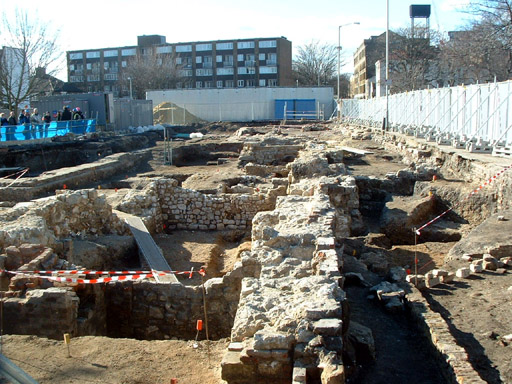
It was discovered in archaeological excavations in the 197os that the castle’s waterfront wall had been built on top of the Roman riverside city wall.

PICTURE: © Copyright Andrew Abbott

This Week in London – Hampton Court Palace turns 500; celebrating the influence of Rubens; and, remembering the liberation of Auschwitz…

Hampton-Court-Palace Hampton Court Palace turns 500 this year and the palace is conducting a programme of events in celebration of the landmark anniversary. Sadly, the first in a series of events – a night in which Historic Royal Palace’s chief curator Lucy Worsley, inspired by the recent BBC Two programme Britain’s Tudor Treasure: A Night at Hampton Court, will explore one of the greatest nights in Hampton Court’s history, the christening of King Henry VIII’s longed for son, Edward (later King Edward VI) – is already sold out but there are a range of further events planned (we’ll try and keep you informed as they come up through the year). In the meantime, HRP have announced that a rare 16th century hat which is rumoured to have once belonged to King Henry VIII is to return to the palace later this year after undergoing restoration. The story goes that the hat, which will become the oldest item of dress in the palace’s collection by almost a century, was caught by Nicholas Bristowe, the king’s Clerk of the Wardrobe, when Henry threw it in the air on hearing of the French surrender of Boulogne in 1544. Treasured by the Bristowe’s descendants, it has now been acquired by HRP and is expected to go on show in a future exhibition. We’ll be looking at the hat in more detail in a future post. For more on the palace, see www.hrp.org.uk/HamptonCourtPalace/. PICTURE: HRP/Newsteam

The first major exhibition in the UK to examine the influence of Peter Paul Rubens on the history of art opens at the Royal Academy of Arts on Piccadilly on Saturday. Rubens and His Legacy: Van Dyck to Cezanne brings together more than 160 works by Rubens and artists who were inspired by him both during his lifetime and later including everyone from Van Dyck, Watteau, Turner and Delacroix to Manet, Cezanne, Renoir, Klimt and Picasso. The exhibition is organised around six themes: poetry, elegance, power, lust, compassion and violence. Runs until 10th April in the Main Galleries. For more, see www.royalacademy.co.uk.

The 70th anniversary of the liberation of Auschwitz will be marked at Westminster Abbey with a special service at 6.30pm on 1st February. At least 1.1 million prisoners died at the camp, located in south-west Poland, around 90 per cent of them Jewish. It was liberated on 27th January, 1945 by the Red Army. Tickets are free but need to be booked. Follow this link to book. Meanwhile, the Imperial War Museum London in Lambeth has invited people to mark Holocaust Memorial Day – 27th January – with a visit to the free Holocaust Exhibition which has a 13 metre long model depicting the arrival of a deportation train from Hungary at the Auschwitz-Birkenau camp in 1944, accompanied by testimonies from 18 survivors. Recommended for children aged 14 and above. For more, see www.iwm.org.uk/visits/iwm-london.

Lost London – Alsatia…

A Thames-side slum area located between Temple and Whitefriars Street (and south of Fleet Street), an area previously occupied by the Whitefriars Monastery, Alsatia was known as something of a lawless district where residents resisted any intervention by City officials.

The district came into existence following the dissolution of the monastery by King Henry VIII (he apparently gave the buildings and land to his physician Dr William Butts) and the area, despite some initial efforts to build substantial houses there, eventually degenerated into an overcrowded slum (apparently even when the priory was still existent, some of the surrounding areas had been somewhat disreputable).

The right of sanctuary apparently existed in the area which meant that debtors and criminals who entered gained immunity from arrest while they remained here.

Authorities were certainly loathe to enter the district given the strength which residents showed in resisting any attempts to grab hold of wanted persons and the maze-like narrow thoroughfares of the area and it became mockingly referred to as Alsatia in a reference to Alsace, a much disputed region on the French-German border which was historically outside normal legal jurisdiction.

Among those who took refuge here was Daniel Defoe – he is said to escaped here in 1692 after he was wanted by authorities for writing seditious material.

There were several attempts to clean up the slum but these had little effect (although the Great Fire of London did burn through here in 1666) and in 1608, King James I confirmed the area’s liberties in a formal charter. The rights remained in place until 1697 when they were abolished by an Act of Parliament (along with those of other liberties), although the area maintained its disreputable character for some time after.

Alsatia was mentioned in several books including in Thomas Shadwell’s 1688 play The Square of Alsatia and Sir Walter Scott’s 1822 novel, The Fortunes of Nigel, and the term continued to be used to refer to run-down neighbourhoods until late in the 19th century.

8 structures from the London that never was – 4. Whitehall Palace (remodelled)…

Banqueting-House

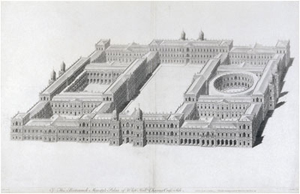
Still on designs for royal palaces and today we’re looking at two designs for the same palace. Both Inigo Jones (1573-1652) and Sir Christopher Wren (1632-1723) drew up designs for the remodelling and expansion of Whitehall Palace.

Inigo-Jones-proposalFirst up was the neo-classical architect Jones who drew up plans for a vast complex of buildings (pictured left) which would replace the Tudor palace King Henry VIII had created when he transformed the grand house formerly known as York Place into a residence suitable for a king (York Place had previously been a residence of Cardinal Thomas Wolsey and prior to that, the London residence of the Archbishops of York).

Jones’ complex – which apparently featured seven internal courts – covered much of what is now known as Whitehall as well as neighbouring St James’s Park with a magnificent River Thames frontage.

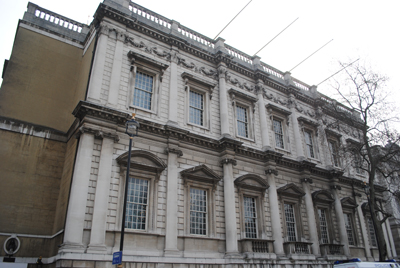
The first part of Jones’ grand scheme – the Banqueting House (see our earlier post here) – opened in 1622. It still survives today – pictured above – and gives a taste of the grandeur of his overall scheme.

Yet, despite the eagerness of King James I for the project, it failed to materialise. English Heritage chief executive Simon Thurley told the BBC in 2012 that the hall represented only five per cent of what Jones had planned.

King James I died in 1625 and his son King Charles I was apparently keen to continue the project – so much so that Jones submitted new plans in 1638 – but he didn’t find the funds the project needed (and, of course, as we know, then became consumed by the events of the Civil War before being beheaded outside the Banqueting House in 1649).

Following the Restoration, in the 1660s King Charles II apparently had Sir Christopher Wren quietly draw up plans to redevelop the palace but these weren’t follow through on although during the reign of King James II he did work on several projects at the palace including a new range of royal riverside apartments, terrace (remains of which can still be seen) and a chapel.

In 1698, much of the bloated Whitehall Palace – then the largest palace in Europe with more than 1,500 rooms – burnt down although the Banqueting House, though damaged, survived basically intact (in fact there’s an interesting anecdote, its veracity questionable, which has it that on hearing of the fire Wren rushed to the site and had an adjacent building blown up to create a firebreak and ensure the Banqueting House was saved).

The then king, King William III, approached Wren and he again submitted plans for its rebuilding (prior to the fire, he had already worked on several aspects of the palace including a new range of royal apartments and a chapel for King James II).

But Wren’s plans – images show a grand domed building – were largely never realised (although he did convert the Banqueting House into a chapel) and the destroyed palace never rebuilt (no doubt in large part due to the fact that King William III preferred a more rural and less damp location – such as that of Kensington Palace – thanks to his asthma).

For more on the history of the Palace of Whitehall, see Simon Thurley’s Whitehall Palace: The Official Illustrated History.

LondonLife – Long unseen ‘map room’ to be opened at Eltham Palace…

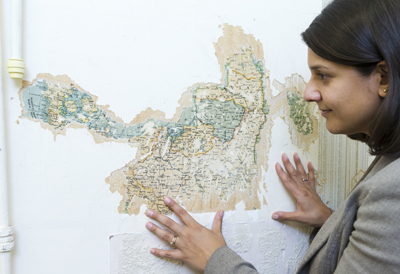
Eltham-PalaceAnnie Kemkaran-Smith, curator at Greenwich’s art deco masterpiece Eltham Palace, examines the 1930s ‘map room’, one of five new rooms to be opened at the palace this spring following a major renovation by English Heritage. Alongside the map room – to be opened for the first time in a decade following a renovation for which English Heritage has launched a £25,000 appeal – other rooms include the luxury wartime bunker, a basement billiards room, a walk-in wardrobe and two new bedrooms. The project, work on which started earlier this month, also includes restoration of the gardens, the creation of a new visitor centre, shop and cafe in former glasshouses. The former childhood home of King Henry VIII, Eltham Palace was transformed in the 1930s by art collectors and philanthropists Stephen and Virginia Courtauld and features an interior now boasting a mix of art deco, ocean-liner styles and Swedish design with then cutting-edge features such as under-floor heating, multi-room sound systems and a centralised vacuum system. The palace will remain open to the public on Sundays over winter with the new rooms to be opened in April. For more, see www.english-heritage.org.uk/daysout/properties/eltham-palace-and-gardens/.

This Week in London – The Magna Carta at the new City of London Heritage Gallery; Tudor monarchs at the NPG; Mapping London; and objects with story at Pitzhanger…

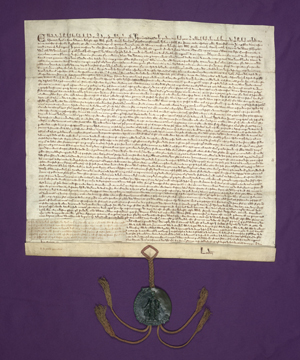
Magna-Carta-1297_Copright-London-Metropolitan-Archives---CopyThe 13th century’s finest surviving copy of the Magna Carta is taking centre stage at the new City of London Heritage Gallery which opens to the public this Friday. The 1297 document, which bears a superimposed memo reading ‘make it happen’, is being featured as part of the Corporation’s efforts to mark next year’s 800th anniversary of the signing of the landmark document. Other items on display in the new permanent, purpose-built exhibition space at the Guildhall Art Gallery include the medieval Cartae Antiquae, a volume containing transcripts of charters and statues covering laws enacted between 1327 and 1425 – a period which includes the reign of King Richard III, a poster for a World War I recruitment meeting held at the Guildhall in 1914, and a series of paintings depicting the 25 City Aldermen who were in office in the mid-1400s. The gallery, admission to which is free, will in future feature a rotating selection of rare documents from the City of London Corporation’s archives including the purchase deed William Shakespeare signed on buying a home in Blackfriars in 1613. For more, including opening times, see www.cityoflondon.gov.uk/heritagegallery. For more on events to mark the 800th anniversary of the signing of the Magna Carta next year, see www.magnacarta800th.com. PICTURE: Copyright London Metropolitan Archives.

Rare depictions of Tudor monarchs will be seen at the National Portrait Gallery in the most complete presentation of their portraiture to date. The Real Tudors: Kings and Queens Rediscovered features the gallery’s oldest portrait – that of King Henry VII – displayed alongside a Book of Hours inscribed by the king to his daughter, six portraits of King Henry VIII along with his rosary (on loan from Chatsworth), portraits of King Edward VI and a page from his diary in which he relates his father’s death, five portraits of Queen Mary I along with her prayer book (on loan from Westminster Cathedral) and several portraits of Queen Elizabeth I displayed alongside her locket ring (on loan from Chequers, the country residence of the PM). There will also be a discussion surrounding the search for a “real” portrait of the ‘nine days queen’, Lady Jane Grey, alongside a portrait of her that dates from the Elizabethan period. With many of the portraits newly examined as part of the gallery’s ‘Making Art in Tudor Britain’ project, visitors to the gallery will also be able to access a specially created app which allowing them to access the new research while looking at the portraits. The display, which will form the core of a larger exhibition in Paris next year, can be seen until 1st March. Admission to the gallery, off Trafalgar Square, is free. For more, see www.npg.org.uk.

An exhibition of rare maps from London, dating from between 1572 and last year, at gallery@oxo on South Bank, is closing on Sunday. Part of the Totally Thames festival, the Mapping London exhibition shows how the landscape along the River Thames as it passes through the capital has changed over the years. It features the first available map of London, which dates from 1572, as well as a 2013 map of underground London, monumental wall maps, and even a map of London that doubles as fan. The free exhibition at Oxo Tower Wharf is being curated by Daniel Crouch, one of the world’s leading map dealers. For more, see www.totallythames.org/events/info/mapping-london.

• A Crafts Council touring exhibition showcasing the work of 12 contemporary artisans and design studios – each of which uses objects as a means of storytelling – has opened at Pitzhanger Manor House and Gallery in Ealing – its first stop – this week. Crafting Narrative: Storytelling through objects and making explores the potential of objects to reflect on history, culture, society and technology through a combination of new and commissioned works, film text and photography. Works include Hilda Hellström’s The Materiality of a Natural Disaster which consists of food vessels made of soil from a field belonging to the last resident inside the Japanese Daiichi nuclear plant exclusion zone, Onkar Kular and Noam Toran’s archive of objects belonging to the fictional Lövy-Singh clan – an East London family of mixed Jewish and Sikh descent, and Hefin Jones’ The Welsh Space Campaign which features objects such as astronaut boots in the form of traditional Welsh clogs in an attempt to show how Wales has the capacity to explore space. The free exhibition is at the manor until 19th October. For more, see www.pitzhanger.org.uk.

Send all items for inclusion to exploringlondon@gmail.com.

Treasures of London – The Wolsey Angels…

Wolsey-Angels


Four bronze angels, designed for the tomb of Cardinal Thomas Wolsey, have been temporarily reunited in the V&A’s Medieval & Renaissance galleries as the museum looks for funding to acquire them.

Once thought lost, the Wolsey Angels were commissioned in 1524 from Florentine sculptor Benedetto de Rovezzano for the tomb of Wolsey, chief advisor to King Henry VIII and one of the most powerful men in the kingdom. Each of the angels, which measure around a metre in height, was created between 1524 and 1529 – the period in which Wolsey was trying to have the pope annul Henry VIII’s marriage to Catherine of Aragon.

As is well-known, Wolsey failed to do so and died in 1530 in disgrace. Henry appropriated Wolsey’s assets including the tomb which the king apparently intended to use for himself. The work was slow, however, and when Henry died in 1547, it remained unfinished. His children – King Edward VI, Queen Mary I and Queen Elizabeth I – each said they would complete the tomb as a memorial to their father but didn’t and in 1565, Elizabeth moved parts of the tomb to Windsor.

During the English Civil War elements of the tomb were sold off to raise funds and only the black stone chest – now used to house the remains of Admiral Lord Nelson in the St Paul’s Cathedral crypt – were believed to have survived along with four large gilt-bronze candlesticks which were installed at St Bavo Cathedral in Ghent.

The angels passed out of sight until, in 1994, two of them appeared in a Sotheby’s sale. Acquired by a Parisian art dealer, they were later attributed to Benedetto. The remaining two angels were discovered at Harrowden Hall in Northamptonshire in 2008 – the hall is now owned by the Wellingborough Golf Club – and it was subsequently revealed that the other two had been stolen from the same site 20 years previously.

The V&A has embarked on a campaign – backed by Hilary Mantel, the Booker Prize winning author of Wolf Hall – to acquire the four angels, priced at £5 million. It has already been granted £2 from the National Heritage Memorial Fund and the Art Fund has pledged a further £500,000.

Mantel described the recovery of the angels as “one of those miracles that historians pray for; something that seems irrevocably lost has been there all the time”. “To claim the angels for the nation would connect us to one of the liveliest eras of our history and one of its most remarkable men.”

Donations can be made via the V&A’s website at www.vam.ac.uk/wolseyangels.

PICTURE: Wolsey Angels on display at the V&A/© Victoria and Albert Museum, London

LondonLife – Hampton Court Palace’s royal ‘edible’ gardens…

Gardens1

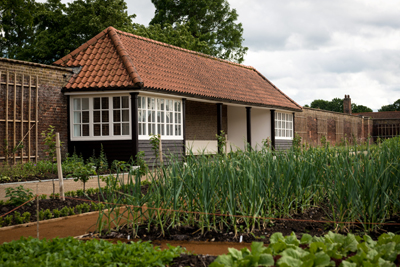
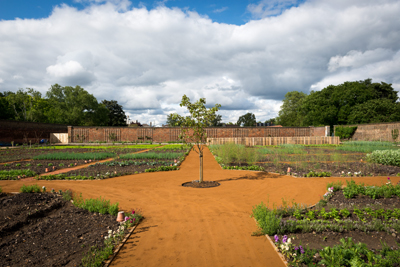
Historic Royal Palaces has reopened Hampton Court Palace’s royal kitchen garden, having recreated it according to a plan dating from 1736. The  six acre garden – constructed on the site of King Henry VIII’s tiltyard on the orders of Queen Anne in 1702 – was used to supply the table of monarchs from the early 1700s through to the 1840s. The recreated version showcases rare and heritage varieties of fruit and vegetables including Italian celery, borrage, skirret and swelling parsnips as well as apricots, nectarine and peaches while on site displays showcase some of the techniques used by the royal gardeners. The gardens are open to the public free-of-charge and it’s hoped that as they mature, vegetable growing classes will be held there. The gardens have been opened as part of celebrations marking the 300th anniversary of the Hanoverian accession. For more on Hampton Court Palace, see www.hrp.org.uk/HamptonCourtPalace/. PICTURES: Courtesy Historic Royal Palaces.

Gardens2

Gardens3

London Pub Signs – The Hung, Drawn and Quartered…

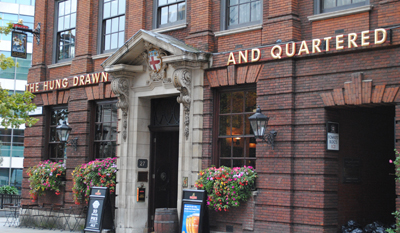
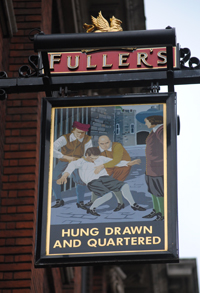
Hung-longThe rather grisly name of this pub (and there’s some debate over whether hanged or hung is grammatically correct) relates to its location close by the former public execution ground of Tower Hill.

While for many Tower Green inside the Tower of London is synonymous with beheadings, only seven people, including Anne Boleyn, were ever actually executed there. Far more people were executed outside the Tower’s walls at nearby Tower Hill, just to the north.

HungSome of the names of those executed here are recorded on a memorial at the site – everyone from Simon Sudbury, the Archbishop of Canterbury who was beheaded here by an angry mob in 1381, through to Sir Thomas More in 1535 (gracious King Henry VIII commuted his sentence from being hung, drawn and quartered to mere beheading), and Simon Fraser, the 11th Lord Lovat, a Jacobite arrested after the Battle of Culloden and the last man to be executed here when his head was lopped off in 1747.

While, as you can see above, many of those executed at Tower Hill were beheaded (and most were of the nobility), there were some executions there which did involve the guilty party being hung, drawn and quartered – a punishment reserved for those being convicted of high treason and also enforced at other sites in London including at Tyburn and Smithfield. Among them was William Collingbourne in 1484 for supporting the cause of Henry Tudor against that of King Richard III.

A plaque on the external wall of the nearby pub quotes a passage from the famous diarist Samuel Pepys after he witnessed an execution in Charing Cross on 13th October, 1660: “I went to see Major General Harrison. Hung drawn and quartered. He was looking as cheerful as any man could in that condition”.

Thomas Harrison fought with Parliament during the Civil War and was among those who signed the death warrant of King Charles I. Found guilty of regicide after the Restoration, he was hung, drawn and quartered (though as Pepys tells us, not here).

The pub, located at 26-27 Great Tower Street, is part of the Fuller’s chain. For more, see www.hung-drawn-and-quartered.co.uk.

10 sites from Shakespearean London – 1. The Globe…

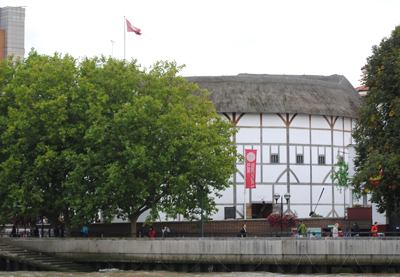
The-GlobeMention William Shakespeare and London in the same breath and everyone immediately thinks of one building – the reconstructed Globe on Bankside. So we thought that to kick off our new series – being run in honour of the 450th anniversary of the playwright’s birth – we’d take a look at history of the iconic structure.

The-Globe2The original Globe Theatre, located a few hundred metres to the south, opened in 1599 as a home for the actors’ company known as the Lord Chamberlain’s Men (later renamed the King’s Men on the accession of King James I in 1603), of which Shakespeare was a member. Founded by James Burbage, this merry band was originally was housed at London’s first purpose-built playhouse Shoreditch before lease disputes led them to establish a new theatre in Southwark, close to the then existing theatre, The Rose.

Up and running by 1599 (Shakespeare was among four actors who bought a share in the property to help fund the new building which used timbers from the former Shoreditch theatre), the new theatre was used for 14 years until, during a performance of Henry VIII in 1613, wadding from a stage cannon ignited and the theatre burned to the ground. Rebuilt with a tiled roof, it remained the home of the company until it was closed down by the Puritan government in 1642 and demolished two years later.

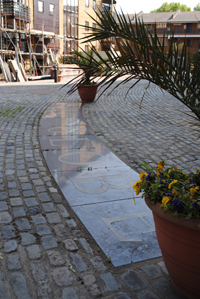
You can see the original site of The Globe just in nearby Park Street. The shape of the structure is marked by a dark line embedded in the pavement (pictured).

The reconstructed building which stands proudly by the water today was the vision of the late American actor, director and producer, Sam Wanamaker. He founded the Shakespeare Globe Trust which, with the on-site assistance of Queen Elizabeth II, opened the theatre at its current site in 1997 (sadly, Wanamaker had died three-and-a-half-years previously).

The building’s design was drawn from sifting through what little historical evidence could be found including the findings of an archaeological dig at the original site, descriptions contained in Shakespeare’s plays (including the line from Henry V – “Or may we cram within this wooden ‘O’), and printed panoramas from the time, although it should be noted that much – particularly the design of the stage – is speculative.

Meanwhile the techniques used in the construction of the theatre were the subject of years of research and were in accord with those of the early 17th century  and included using oak laths and staves to support lime plaster and then covering the walls in white lime wash while the roof was made of water reed thatch.

One of the best ways to see the theatre and make the most of the atmosphere is to see a play from a standing position in the pit!

WHERE: Globe Theatre Exhibition & Tour, Shakespeare’s Globe, 21 New Globe Walk (nearest Tube stations are Southwark and London Bridge); WHEN: Exhibition is open 9am to 5.30pm daily – tours run at various times, see website for details; COST: Exhibition and tour cost is £13.50 adults/£12 seniors/£11 students/£8 children (5-15 with children under five free)/£36 family of four; WEBSITE: www.shakespearesglobe.com.

Daytripper – Walmer Castle…

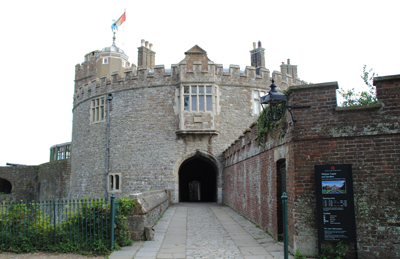
Walmer-CastleA coastal artillery fort built on the orders of King Henry VIII in light of a threatened Catholic invasion, Walmer Castle on the Kentish coast is officially the residence of the Lord Warden of the Cinque Ports.

What was a rather functional artillery platform has been embellished significantly in the years since it became the official residence of the Lord Warden in 1708, creating a comfortable home for holders of the title who have included Queen Elizabeth, the Queen Mother, the Duke of Wellington and bookseller WH Smith.

The ‘castle’, located about a two hour, 10 minute train journey from London (and then a mile walk from Walmer Station), was constructed in 1539 as one of a string of forts – others include nearby Deal Castle and the long gone Sandown Castle – designed to protect the watery stretch between Goodwin Sands and the coast known as the Downs.

Its low circular design, featuring a central ‘keep’ reached by a drawbridge and surrounded by a curtain wall with four projecting, semi-circular bastions, was influenced by the need to defend against heavy artillery and provide a platform for guns.

Initially garrisoned with ten gunners, four soldiers and two porters under the command of a captain and a lieutenant, Walmer saw little action during Tudor times but was the site of a siege during the Civil War.

Obsolete by the end of the 17th century, it was the Duke of Dorset who was the first Lord Warden (an office created in the thirteenth century to oversee the affairs of the Cinque Ports Confederation, a grouping of five ports including Hastings, Romney, Hythe, Dover and Sandwich) to use Walmer Castle as a residence, embarking on a renovation and extension of the existing structure.

Further alterations was carried out by successive Lords Warden, the most extensive being those made by  the 2nd Earl Granville, Lord Warden between 1865 and 1891, who commissioned architect George Devey to oversee the additions.

The gardens, meanwhile, which are well worth visiting in their own right, were also Granville’s work as well as that of an earlier Lord Warden, Prime Minister William Pitt the Younger, who was Lord Warden between 1792 and 1806.

The Duke of Wellington (Lord Warden between 1829 and 1852) reputedly enjoyed his time staying at the castle – he was even visited by the young Princess Victoria here in 1835 (she later stayed for a month with her family when Queen) and died here on 14th September 1852. His room can still be seen inside – the contents include the armchair he was sitting in when he died (the rooms also include a small museum dedicated to Wellington and another dedicated to William Pitt).

Not all Lords Warden enjoyed the property. Sir Winston Churchill, Lord Warden  between 1941 and 1965, never stayed here but Sir Robert Menzies, Prime Minister of Australia and Lord Warden between 1966 and 1978, did and the Queen Mother, Lord Warden between 1978 and 2002, was a regular visitor.

The castle was opened to the public soon after responsibility for it was transferred from the War Office to the Ministry of Works in 1905. It is now under the care of English Heritage and the rooms inside are decorated as they were in the 1930s (it was WH Smith who ensured historic furnishings at Walmer could not be removed). There are even a couple of holiday cottages on site which can now be rented.

WHERE: Walmer Castle, Kingsdown Road, Deal, Kent; WHEN: 10am to 6pm daily (until 6th July); COST: Adults £7.90/Children (5-15 years) £4.70/Concession £7.10; WEBSITE: www.english-heritage.org.uk/daysout/properties/walmer-castle-and-gardens/.

10 significant sites from Georgian London – 5. Horse Guards…

Horse-Guards1

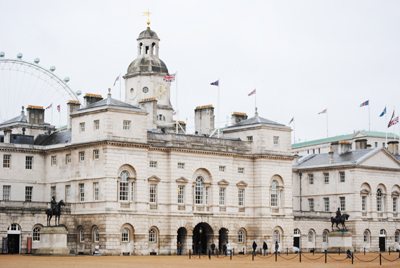
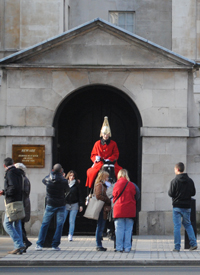
Known around the world for the stoic mounted troopers which stand guard here, this rather fanciful building straddling a site between Whitehall and St James’s Park was built in the early 1750s on land which had previously served as a tiltyard for King Henry VIII.

In the 1660s King Charles II had a barracks built here for the guards manning the entrance to what was then the Palace of Whitehall, but in 1749 it was demolished and the present building constructed.

William Kent had apparently drawn up designs but it was architect John Vardy who oversaw construction of the neo-Palladian building after Kent’s death in 1748. The windows on the St James’s Park side of the building are said to have been based on a drawing by Lord Burlington (he of Chiswick House fame – see our earlier post here).

While the site previously marked the entrance to the Palace of Whitehall, it is now considered the formal entrance to St James’s Palace (although the palace is located some distance away) and, as a result, only the monarch can drive through the central archway without displaying a pass.

Horse-GuardsUntil 1904, the Grade I-listed building housed the office of the Commander-in-Chief of the Forces but the title was then abolished and replaced with Chief of the General Staff, who relocated to the War Office Building. Horse Guards subsequently became the home of the army commands of London District and the Household Division, a role it still fulfils.

As well as being the site of the daily Changing of the Queen’s Life Guard (this free event takes place at 11am every day; 10am on Sundays), Horse Guards is also now home to the Household Cavalry Museum.

Among treasures in the museum are two silver kettledrums presented to the regiment in 1831 by King William IV, a cork leg used by the first Marquess of Anglesey after his real leg was amputated following the Battle of Waterloo (and subsequently became a tourist attraction in its own right) and silverware by Faberge. Visitors to the museum can also see into the working stables via a glazed petition.

The parade ground behind the building is the site of the annual Trooping the Colour ceremony which officially celebrates the Sovereign’s birthday. Although the ceremony has only been held since 1748, it’s interesting to note that some of the birthday celebrations of Queen Elizabeth I were held in the same place.

WHERE: The Household Cavalry Museum, Horse Guards, Whitehall (nearest Tube stations are Westminster, Embankment, St James’s Park and Charing Cross); WHEN: Open 10am to 5pm (November to March)/10am to 6pm (April to October); COST: £6 adults/£4 children (aged 5-16) and concessions/£15 family ticket; WEBSITE: www.householdcavalrymuseum.co.uk.

10 significant sites from Georgian London – 4. St Martin-in-the-Fields…

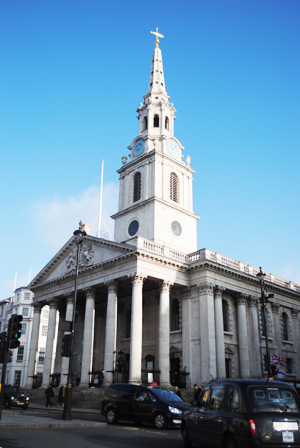
This iconic church on the edge of Trafalgar Square, known for its musical associations, is another of the works of architect James Gibbs and, as with St Mary le Strand, the current building was constructed in the first half of the 18th century to replace an earlier building.

St-Martin-in-the-fieldsThe first references to a church on the site of the present building date back to the 13th century when, constructed upon a Roman burial site, it was apparently used by monks from Westminster. It was replaced by King Henry VIII around 1542 and enlarged in 1602 before finally being demolished in 1721.

Gibbs’ apparently first suggested the design feature a round nave with a dome over the top but the proposal was rejected as too expensive and a simpler, rectangle-shaped church was subsequently agreed upon and eventually completed in 1726. Part of the design inspiration comes from Sir Christopher Wren, although Gibbs’ integration of the tower into the church was a departure from Wren’s designs (the church spire rises 192 foot into the air).

Among the features of the interior are ceiling panels in the nave which feature cherubs and shells and are the work of ceiling experts Giuseppe Artari and Giovanni Bagutti. Other items of interest include Chaim Stephenson‘s sculpture, Victims of Injustice and Violence, remembering all victims during apartheid in South Africa (it was dedicated by Desmond Tutu in 1994), a statue of St Martin and the Beggar by James Butler, and, on the porch, Mike Chapman‘s sculpture marking the millennium, Christ Child. Paintings include one of James Gibbs himself by Andrea Soldi and dating from 1800.

Among those buried in the church are furniture-maker Thomas Chippendale, sculptor Louis-François Roubiliac and notorious robber Jack Sheppard (he’s buried in the churchyard). The crypt also contains a life-sized marble statue of Henry Croft, London’s first pearly king, which was moved there from St Pancras Cemetery in 2002.

As well as being the location of the first religious broadcast, its musical heritage includes performances by Handel and Mozart and being the location of the first performance of its namesake chamber orchestra, the Academy of St Martin in the Fields.

Since the early 20th century, the church has been noted for its work with the homeless (thanks in particular to the work of Vicar Dick Sheppard). Meanwhile, its connections with music – which date back to its rebuilding – continue in the concerts held in the crypt cafe. The crypt also hosts art exhibitions.

The church underwent a £36 million renewal project in the Noughties. Additions included the new east window by Shirazeh Houshiary.

WHERE: St Martin-in-the-Fields on the north-east corner of Trafalgar Square (nearest tube stations are Charing Cross, Leicester Square and Embankment); WHEN: Open weekdays and weekends – times vary, see website for details; COST: free; WEBSITE: www.stmartin-in-the-fields.org.

London Pub Signs – The Sutton Arms…

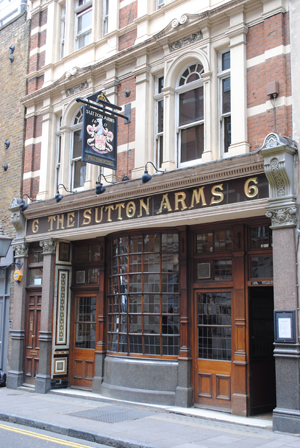
This pub, located just off Charterhouse Square near Barbican, has a distinctive barrel-shaped front window and a name that evokes a sense of the rich history of the area in which it stands.

The-Sutton-ArmsThe name of this pub at 6 Carthusian Street comes directly from Sir Thomas Sutton, a late 16th century/early 17th century businessman and moneylender who owned nearby land on which a Carthusian monastery once stood and who founded the Charterhouse School based at the site.

The monastery, which had been founded in 1371, was dissolved by King Henry VIII in the Dissolution of the Monasteries which took place in the first half of the 16th century – it was a nasty business with some of the monks executed at Tyburn.

The land was subsequently granted to Sir Edward North who built a mansion on the site which was subsequently sold to the fourth Duke of Norfolk. It was his son, Thomas Howard – the first Earl of Suffolk, who, in 1611, sold the property to Sir Thomas (and subsequently built the magnificent Audley End House in Essex with the funds).

Said to have been the “wealthiest commoner in England”, Sutton, who died that same year, used his wealth to endow a charitable foundation to both educate boys and care for elderly men.

The Charterhouse school later moved out to Surrey while elderly “brothers” are still housed at the original location today (for more on the Charterhouse, see our previous posts on King James I’s London and on 10 Historic London Squares).

Some of the glass in the  pub’s great barrel-shaped window was apparently replaced after a bomb knocked some of the original out during the Blitz.

Incidentally, there’s another pub of the same name only a few streets away in Great Sutton Street.

Around London – The ‘Line of Kings’ has a makeover; London captured from St Paul’s; and, cycles at the Museum of London…

Line-of-Kings

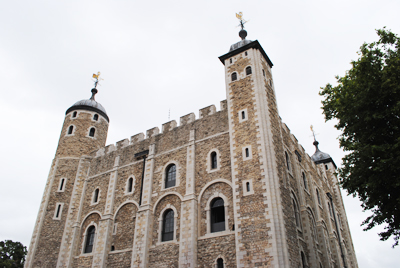
The Tower of London’s iconic exhibition, the Line of Kings, has had a makeover. Described as the “world’s longest running visitor attraction”, the Line of Kings features more than 500 objects including historic suits of armour – such as those worn by King Henry VIII, King Charles I and King James II – as well as life-sized wooden horses and individually carved king’s heads, many of which were made between 1685 and 1690. The exhibition was originally created following the Restoration in 1660 and was used as propaganda to promote the king’s rule (interestingly omitting queens and featuring only those deemed “good kings”). Rearranged and dispersed over the centuries, it’s been brought back together in the White Tower and reopened last month. Entry to the exhibition – a collaboration between Historic Royal Palaces and the Royal Armouries – is free as part of general admission to the Tower. For more, check out www.royalarmouries.org/line-of-kings. PICTURE: HRP/Newsteam

Four cameras mounted on top of St Paul’s Cathedral’s Golden Gallery have captured a 360 degree time lapse video of the capital. The video, which was shot in early July, captured 36 hours in the life of London and is the work of specialist photographer Henry Stuart who previously completed two projects from the Golden Gallery – a GigaPixel image of London and a Day Meets Night image. The latest project captured some 8,000 panoramic images. The time lapse video, which is set to Kyrie from Wolfgang Amadeus Mozart’s Missa in C major ‘Missa solemnis’ K337 being sung by the St Paul’s Cathedral Choir, can be found at http://visualise.com/videos/london-360-time-lapse-from-st-pauls-cathedral.

• On Now: London Cycles. This free exhibition at the Museum of London looks at cycling in the capital with highlights including 10 large scale portraits by Ugo Gattoni, bikes including an 1880s “boneshaker”, a penny farthing, an 1930s Enfield cycle and a ‘Boris’ bike as well as head cam footage from riders including from the annual Tweed Run bike. The free display runs until 22nd September. For more, see www.museumoflondon.org.uk.

Special – 10 facts about royal births of years past…

Buckingham-Palace

As we all know by now, Prince William and Kate, Duchess of Cambridge, are proud parents of a new born son with news of the new arrival provoking celebrations across Britain and, indeed, the world.

To celebrate the royal birth, here are 10 interesting facts about some previous royal births in London…

• The last time a Home Secretary attended a royal birth was in 1936 for the birth of Princess Alexandria, cousin of the Queen. The practice was officially stopped before the birth of Prince Charles in 1948.

• Such was the doubt over whether Mary of Modena, wife of King James II, was really pregnant that more than 40 eminent people were invited to witness the birth of their son Prince James in 1688 (and even then the rumours of that the stillborn baby had been swapped for another were rife).

• Queen Anne, who ruled from 1702-1714, went through 17 pregnancies but, tragically, outlived all of her children, her last surviving child – the Duke of Gloucester – dying in 1700.

• The tradition of firing a 41 gun salute on the news of the birth of a future monarch dates from the birth of the future King Edward VII. Twenty-one shots are fired in honour of the birth with an additional 21 fired because the guns are located in Green Park, a Royal Park.

• Queen Elizabeth II was born by caesarean section at 2.40am on April 21, 1926, at the home of her mother’s parents – 17 Bruton Street in Mayfair. (See our previous post on this here).

• Such was the animosity between Frederick, Prince of Wales, and his father, King George II, that when Frederick’s wife Augusta went into labour at the king’s home of Hampton Court Palace, he bundled her into a coach and had her taken to his home of St James’s Palace. With no preparations made there, his newly born daughter had to be wrapped in a tablecloth (the story is retold in detail in Lucy Worsley’s terrific book, Courtiers: The Secret History of the Georgian Court)

• Queen Victoria, who had nine children, used chloroform for pain relief during later births, despite the concept being frowned upon by some officials.

• Buckingham Palace (pictured above) has been the birthplace of numerous Royal Family members. Of course, Prince Charles was born here in 1948 as was his brother Prince Andrew (1960) and Prince Edward (1964) but so too – somewhat earlier – were 14 of King George III and Queen Charlotte’s 15 children when the property was known as Buckingham House and, later, the Queen’s House. King Edward VII was the only monarch who both was born and died in the building.

• Such was the desperation of King Henry VIII for a son, that a document announcing the birth were drawn up to that effect prior to Anne Boleyn giving birth to a daughter, the future Queen Elizabeth I. The document was still issued – the only concession being an ‘s’ added to the end of the word prince.

• The oldest English king to father a child was King Edward I – he was 66-years-old when his last child, Princess Eleanor, was born in 1306. Queen Eleanor of Aquitaine, wife of King Henry II, was the oldest queen to father a child when she gave birth to the future King John at 44-years-of-age in 1166.

10 Historic London Garden Squares…10. Charterhouse Square…

Charterhouse-Square-GardensThe final in our series on historic garden squares in London (for this year, anyway), we’re taking a look at Charterhouse Square.

The five sided square, located just to the east of Smithfield, takes its name from a Carthusian monastery which was established in 1371 on what is now its north side. Prior to this, what is now the square had from 1348 served as a location for a plaque burial pit (a number of skeletons from the plaque pit have been unearthed as part of the Crossrail project – for our earlier story on this, follow this link).

The monastery was dissolved in 1537 after the monk’s refused to recognise King Henry VIII’s Act of Supremacy (some were later executed at Tyburn) and it was subsequently transformed into a manor house with Thomas Howard, the 4th Duke of Norfolk, among its residents over the years (in fact he was imprisoned there around 1570 for allegedly plotting to marry Mary, Queen of Scots – he was later executed by Queen Elizabeth I for treason).

Under the will of Thomas Sutton, an almshouse and school was subsequently established on the site – the almshouse remains there while the school, whose students had included Methodism founder John Wesley and writer William Makepeace Thackeray, moved out to Godalming in Surrey in 1872. As well as the almshouse (which is open for guided tours, check this site for details), some of the buildings are now occupied by medical related institutions.

In the 1600s, the square was also home to numerous other large residences among them Rutland House, which had been the residence of the Venetian ambassador. It lost its aristocratic inhabitants in the ensuing centuries but remained mainly residential up until the late 19th century when it gradually became taken over by businesses and other organisations. Interesting to note is that the east side of the square is still home to the residential unit complex known as Florin Court, better known as Whitehaven Mansions, the home of Hercule Poirot in the TV series which bears his name.

The area of the garden square itself was variously referred to as the Charterhouse Churchyard, the Charterhouse Yard and Charterhouse Close over the years and has gone through numerous incarnations with efforts to improve and formalise its look dating back to at least the 16th century. It was at least partly enclosed by the late 1600s and the fences replaced several times, notably in 1742 when an Act of Parliament was passed allowing residents to fine those who entered without authorisation. The enclosing fences have since been modified several more times.

One of the major changes to the shape of the square occurred in 1860 when the Metropolitan Railway was extended between Farringdon and Moorgate. It was at this time that the road surface which surrounds the central garden, which has a Grade II heritage listing, was laid down.

Today the gardens in the centre of the square remain under the management of the Charterhouse (and hence aren’t open to the general public except on tours) but even without a tour it’s still a quiet place to walk around the outside of, evoking a strong sense of years gone past.

London Pub Signs – The White Cross…

The-White-Cross

This pub situated on the bank of the River Thames in Richmond, in London’s west, owes its name to a former monastery which once stood on the site.

A pub has been on the site since at least 1748 when it was known as the Waterman’s Arms. But the current building dates from 1838 and it was renamed the White Cross shortly after.

There’s a couple of competing theories behind its name – one is that the landlord at the time of the name changed was one Samuel Cross. The other is that it was named after the friary which once stood on the site and was dissolved, no surprises here, by King Henry VIII, in 1534. The friary had been established by Observant Franciscans, who took the white cross as their symbol, around 1500.

Apparently some remains of the friary may be incorporated into the cellars of the pub. Other features to note are the lovely open fireplaces including one oddly placed under a window (delightful on colder days), and the sign pointing to the door on the side of the pub which states that this is the entrance in times of high tide (these usually occur during spring and see access to the front entrance blocked by the rising river water).

Located off Water Lane in Richmond. For more on the pub, check out http://thewhitecrossrichmond.com.