Around London: Nelson and the Navy; Whistler at Dulwich; Eric Coates’ Blue Plaque; childrens’ books at BL…

A new permanent gallery looking at how the Royal Navy shaped individual lives and the course of British history over the 18th century opens at the National Maritime Museum in Greenwich on Monday 21st October, Trafalgar Day. Nelson, Navy, Nation charts a course from the Glorious Revolution of 1688 through to the defeat of Napoleon in 1815 and provides a setting for the museum’s many artefacts related to Vice-Admiral Lord Nelson. Among the 250 objects on display in the gallery are the uniform (with bullet hole) Nelson wore at the Battle of Trafalgar, artworks likes William Hogarth’s Captain Lord George Graham in his Cabin, a seven barreled volley gun and grim items like a surgeon’s tools including an amputation knife, bone saw and bullet forceps. There is also the last letter Nelson wrote to his daughter Horatia and mourning rings worn by close friends and family at his funeral. Entry to the new gallery is free. For more, see www.rmg.co.uk.

The first major exhibition dedicated to the American-born artist James Abbott McNeill Whistler’s time in London between 1859 and his death in 1903 opened at the Dulwich Picture Gallery this week. An American in London: Whistler and the Thames features paintings, etchings and drawings produced by the artist and more than 70 objects related to Whistler’s depiction of the Thames and Victorian London. Highlights include Nocturne: Blue and Gold – Old Battersea Bridge (1872/1873) and Brown and Silver: Old Battersea Bridge (1859-1863), the oil painting Wapping (1860-64) and the etching Rotherhithe (1860). There are also a series of portraits of Whistler and his patrons. Runs until 12th January. Admission charge applies. For more, see www.dulwichpicturegallery.org.uk.

Composer Eric Coates has been honoured with the unveiling of an English Heritage blue plaque outside his former home at Chiltern Court in Baker Street. Coates, who created “some of the best known and loved pieces of English light orchestral music”, lived in a flat at the property between 1930-39. For more, see www.english-heritage.org.uk/discover/blue-plaques/.

On Now: Picture This: Children’s Illustrated Classics. This exhibition in the Folio Society Gallery at the British Library takes a look at 10 of the most iconic children’s books of the 20th century – from Charlie and the Chocolate Factory to The Wind in the Willows, Paddington Bear, Peter Pan and Wendy, and The Iron Man as well as Just So Stories, The Hobbit, The Borrowers, The Secret Garden and The Railway Children. On display is at least four illustrated editions or artworks of each title with Quentin Blake, Michael Foreman, Peggy Fortnum and Lauren Child among the artists whose works are being shown. The exhibition also features five specially filmed interviews with four illustrators and Paddington Bear author Michael Bond. Runs until 26th January. Entry is free. For more, see www.bl.uk.
Around London – The Cheapside Hoard revealed; Queen Elizabeth I at the NPG; 3D printing at the Science Museum; and, Viennese portraits…

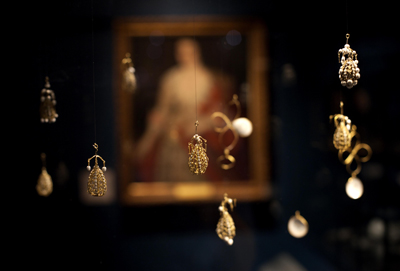
Cheapside-Hoard-1The ‘secrets’ of the Cheapside Hoard – the world’s finest and largest collection of 16th and 17th century jewels – are revealed in a new exhibition opening tomorrow at the Museum of London. The
Cheapside-Hoard-2Cheapside Hoard: London’s Lost Jewels
 publicly displays the hoard of Elizabethan and early Stuart jewellery and gemstones in its entirety for the first time since its discovery more than 100 years ago. The hoard, consisting of as many as 500 pieces including rings, necklaces, cameos, scent bottles and a unique Colombian emerald watch, was discovered buried in a cellar on Cheapside in the City of London in 1912. The exhibition uses new research and state-of-the-art technology to showcase the hoard as it explores the questions of who owned the hoard, when and why was it hidden, and why was it never reclaimed. New information revealed by the research shows that the hoard was buried between 1640 and 1666 (the critical clue was a previously overlooked intaglio – a gemstone engraved with the heraldic badge of William Howard, Viscount Stafford, who lived between 1612-1680). It also reveals Thomas Sympson was the “dodgy” jeweller responsible for two counterfeit rubies contained within the hoard (he apparently had a trade in selling counterfeit gems for as much as £8,000 each). Entry charge applies. Runs until 27th April. For more, see www.museumoflondon.org.uk.  PICTURED: Above: gold and pearl cage pendants from the Cheapside Hoard; and right: a bejewelled scent bottle.

A previously unknown painting of Queen Elizabeth I is on display as part of a new exhibition, Elizabeth I and Her People, opening at the National Portrait Gallery today. The small painting, which has been attributed to miniaturist Isaac Oliver and which is a reworking of the classical story of the Judgement of Paris, was recently acquired by the gallery. It will sit among a selection of other portraits of the “Virgin Queen” in a display which endeavours to show how during her 50 year reign she portrayed the image of a strong monarch. The portraits are just some of the 100 items featured in the exhibition which also includes costumes, coins, jewellery and crafts and examines the rise of new social classes in Elizabethan society. Other portraits in the exhibition feature images of courtiers such as William Cecil and Christopher Hatton along with images of merchants, lawyers, goldsmiths, butchers, calligraphers, playwrights and artists. There is also a little known painting of three Elizabethan children and what may be the first portrait of a guinea pig. The exhibition, supported by the Weiss Gallery, runs until 5th January. Admission charge applies. For more, see www.npg.org.uk.

Printed objects including replacement body organs, aeroplane parts and a music box have gone on display at the Science Museum in South Kensington as part of a new exhibition, 3D: printing the future. The exhibition looks at the rapidly evolving field of 3D printing and its growing impact on society through stories such as the use of 3D printing by engineers to create lighter aeroplane parts and the ways in which the medical industry is researching the use of the technology to create replacement body parts. The display will also include miniature 3D printed figures created from scans of visitors who took part in workshops during the summer holidays. This free exhibition runs in the Antenna gallery for nine months. For more, see www.sciencemuseum.org.uk.

On Now: Facing the Modern: The Portrait in Vienna 1900. On at the National Gallery, the first major UK exhibition devoted to the portrait in Vienna features iconic works by Gustav Klimt, Egon Schiele, Richard Gerstl, Oskar Kokoschka and Arnold Schonberg alongside those of lesser known artists such as Bronica Koller and Isidor Kaufmann. Highlights include Klimt’s Portrait of Hermine Gallia (1904) and Portrait of a Lady in Black (about 1894), Schiele’s The Family (Self Portrait) (1918) and Nude Self Portrait by Gerstl (1908). Runs until 12th January. Admission charge applies. For more, see www.nationalgallery.org.uk.

Around London – The Bard is back; Foundling Museum displays; and, exhibitions on iconoclasm and explicit Japanese art…

The Bard is back in Leicester Square with the announcement last week that restoration work on the square’s 19th century Grade II listed statue of William Shakespeare – the only full-length statue the playwright in central London – has been completed. The 11 month restoration was carried out as part of £17 million revamp of the square which has seen the installation of a new fountain. The statue, which was the work of James Knowles, has been in the square since it was completed in its current configuration in 1874. Meanwhile, in other sculpture-related news, Sorry, Sorry Sarajevo – a life-size statue of a man holding  a dead or badly injured man in his arms has been placed in St Paul’s Cathedral where it will remain for the rest of the year. The work by Nicola Hicks dates from 1993 – when the Bosnian war was at its height – and has been placed opposite Henry Moore’s 1983 sculpture, Mother and Child: Hood as part of the cathedral’s approach to next year’s World War I centenary.

Two new displays opened at the Foundling Museum in Bloomsbury last month. Hogarth and Copyright, which runs until 5th January, looks at the role the artist William Hogarth played in the passing of the 1735 Engravers’ Copyright Act (also known as Hogarth’s Act – it was the first law to protect artist’s rights over their work) while Handel and Lucretia, presented in conjunction with The Sir Denis Mahon Charitable Trust and running until 26th January, shows Guercino’s painting Lucretia alongside two early manuscripts of Handel’s cantata La Lucretia. Entry is part of admission price. For more, see www.foundlingmuseum.org.uk.

A new exhibition tracing the history of attacks on artworks in Britain from the 16th century to today opened at Tate Britain in Millbank this week. Art under Attack: Histories of British Iconoclasm looks at why and how monuments have been damaged over the past 500 years. The display includes the remarkable pre-Reformation sculpture, the Statue of the Dead Christ (about 1500-1520), which was discovered in 1954 beneath the chapel floor at the Mercer’s Hall. Already damaged – most likely at the hands of Protestant iconoclasts – it may have been buried there to protect it. Also displayed are fragments of monuments destroyed in Ireland last century, paintings including Edward Burne-Jones’ 1898 painting Sibylla Delphica which was attacked by suffragettes in 1913-14, and Allen Jones’ 1969 work Chair – damaged in a feminist attack in 1986. Runs until 5th January. Admission charge applies. For more, see www.tate.org.uk.

A controversial exhibition of sexually explicit Japanese works of art created between 1600-1900 opened at the British Museum this week. Shunga: sex and pleasure in Japanese Art – which carries a warning of “parental guidance for visitors under 16 years – features 170 works including paintings, prints and illustrated books. Drawn from collections in the UK, Japan, Europe and the US, the exhibition of explores the phenomena of what are known as shunga (‘spring pictures’), looking at why it was produced and to whom it was circulated. Admission charge applies. Runs until 5th January. For more, see www.britishmuseum.org.

Around London: Historic pearls at the V&A; ‘Big Brother’ house opening; aircraft pioneers honoured; and Jonathan Yeo at the NPG…

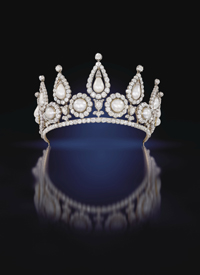
The_Rosebery_Tiara_QMA_Collection._Photo_c_SothebysA pearl-drop earring worn by King Charles I at his execution in 1649, pearl tiaras worn by European nobles and a pearl necklace given to Marilyn Monroe by Joe DiMaggio in 1954 are among the items on display as part of a new exhibition which opened at the V&A last Saturday. The V&A and Qatar Museums Authority exhibition traces the history of pearls from the early Roman Empire to now and features more than 200 pieces of jewellery and works of art. Other items on display include ‘Queen Mary II’ pearls dating from 1662-1664, a miniature portrait of Queen Charlotte wearing pearl jewellery and a set of buttons, finely enamelled and framed with pearls, worn by George III in 1780. There’s also the Dagmar necklace given to Princess Alexandra when she married the future King Edward VII in 1863. The exhibition is part of the Qatar UK 2013 Year of Culture. Admission charge applies. Runs until 19th January. For more, see www.vam.ac.uk. PICTURE: Lady Rosebery’s pearl and diamond tiara (1878) © Christie’s Images.

The Big Brother house – located in Elstree Studios in north London – opens to the public tomorrow and on Saturday as part of a partnership between Initial – an Endemol Company, Channel 5 and the National Trust. Some two million people tuned in to watch the final night of the show this summer leading one TV critic to describe the property as “the most important house in Britain”. The opening is being preceded by an Opening Gala featuring housemates past and present as well as celebrities – but that’s an invitation only event. Sadly, tickets for the opening are already sold out – for returns and your last chance of getting in, follow this link.

The UK’s first aircraft manufacturers – Horace, Eustace and Oswald Short – have been commemorated with an English Heritage blue plaque placed on their former workshop in Battersea. Unveiled this week by Jenny Body – the first female president of the Royal Aeronautical Society, the plaque can be found at the railway arches near Queen’s Circus where the brothers, who lived nearby in the Prince of Wales Mansions, worked on ballooning and first made the transition to aircraft construction. Among their firsts was the construction of the first British powered aircraft to complete a circular mile of flight and the creation of Britain’s first ever purpose-built aircraft factory (it was located on the Isle of Sheppey in Kent). For more, see www.english-heritage.org.uk/discover/blue-plaques/.

On Now: Jonathan Yeo Portraits. New and previously unseen works including a six foot high portrait of controversial artist Damien Hirst and a portrait of Kevin Spacey as King Richard III feature in this exhibition running at the National Portrait Gallery. Other subjects featured in the painted works include media mogul Rupert Murdoch, model Erin O’Connor, artist Grayson Perry and actor Sierra Miller. Runs until 5th January. Admission is free. For more, see www.npg.org.uk.

Around London – Open House London; Yinka Shonibare at Greenwich; Bankside transformed; and Michael Peto at the NPG…

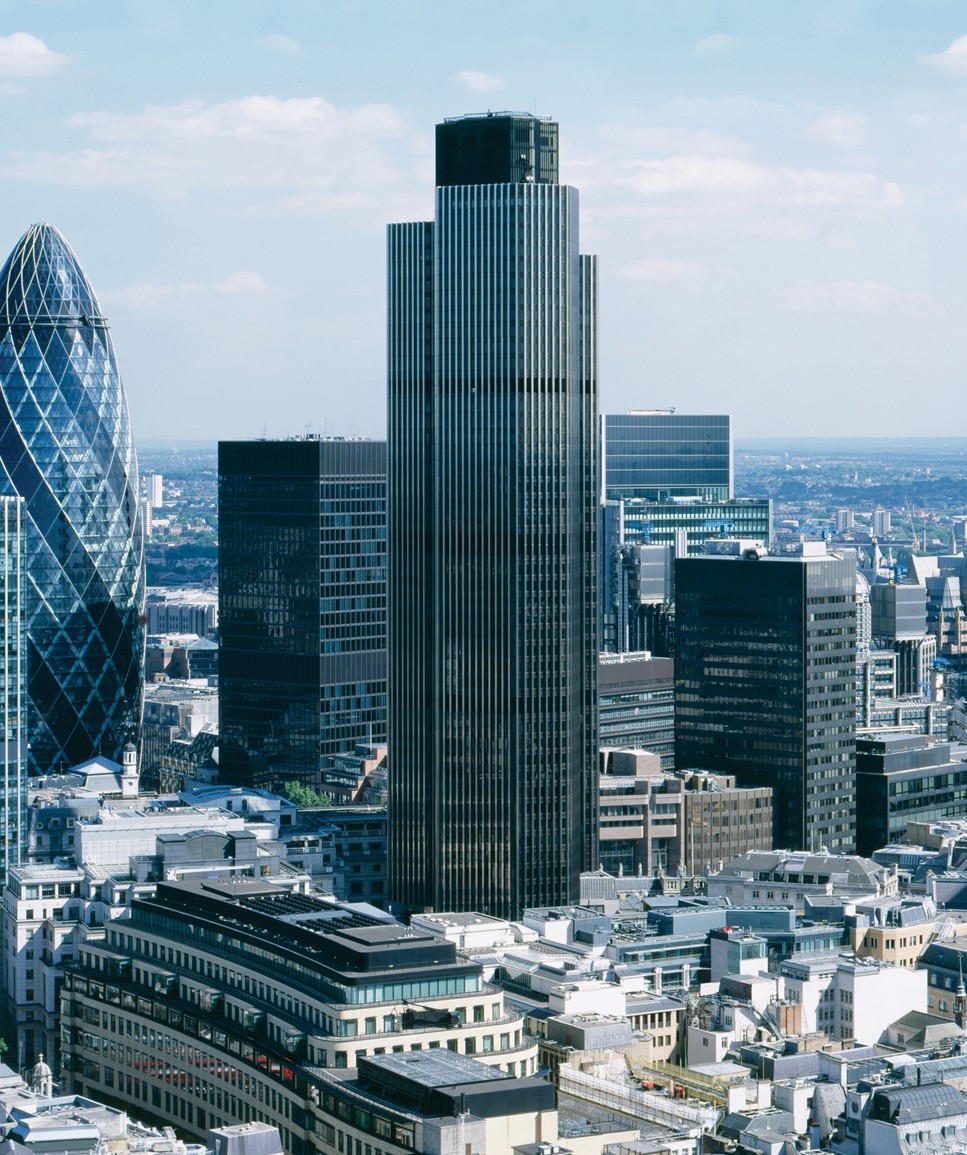
Tower 42_external It’s finally here. Open House London kicks off on Friday and with more than 800 buildings opening their doors, the only difficulty you’ll have this weekend will be choosing what you end up doing! This year’s theme is ‘celebrating architecture, people and place’ and among the highlights will be the opening of landmark structures like Battersea Power Station, Tower 42 (pictured), and the Gherkin (30 St Mary Axe) as well as 100 private homes, architects’ homes and “ground-breaking” housing developments and everything from the Shri Swaminarayan Temple in Brent to Horse Guards in Whitehall (certain buildings, like 10 Downing Street and The View from the Shard, are only open to people who won tickets in an earlier ballot). This year’s festivities also include a moonlit “culture crawl” through London on Friday night. If you haven’t ordered a hardcopy programme, you can check the listings online at www.openhouselondon.org. There’s also an Open House iPhone app available from the appstore.

A series of works by Yinka Shonibare – including some never before seen in the UK – went on display at Greenwich yesterday, thanks to Royal Museums Greenwich. The works, which explore notions of “Britishness, trade and empire, commemoration and national identity”, can be found inside and around buildings including the Queen’s House, National Maritime Museum and Royal Observatory and include Fake Death Pictures – a series of five vision of the death of naval hero Vice-Admiral Lord Nelson, Wind Sculpture – a gravity-defying object located on the Queen’s House lawn, Cheeky Little Astronomer – a specially commissioned sculpture located in the Flamsteed House at the Royal Observatory, and Nelson’s Ship in a Bottle – last seen on Trafalgar Square’s Fourth Plinth. Yinka Shonibare MBE at Greenwich, which is supported by a range of talks, debates and tours, runs until 23rd February. For more, see www.rmg.co.uk.

Bankside will be transformed this weekend as artists will be transforming disused hoardings and derelict buildings with original artworks as part of the Merge Festival. The work’s include Candy Chang’s Before I Die, Alex Chinnick’s Miner on the Moon, and Marcus Lyall and Mark Logue’s House of Pain. Until 20th October. For more on the festival celebrating Bankside, see www.mergefestival.co.uk.

On Now: Michael Peto Photographs: Mandela to McCartney. This new exhibition at the National Portrait Gallery just off Trafalgar Square features a previously unexhibited photo of Elizabeth Taylor and Richard Burton, taken at the beginning of their love affair. It’s one of 10 portraits taken by the late Hungarian-born photographer Michael Peto in London during the 1950s and 1960s – others feature Samuel Beckett, Jennie Lee, Paul McCartney and Ian McKellen. Admission is free. For more, see www.npg.org.uk.

LondonLife – Steps to nowhere…

Endless-Stair

Inspired by Escher’s staircase, the London Design Festival’s landmark project Endless Stair has taken up residence outside the Tate Modern overlooking the River Thames. Designed by Alex de Rijke of dRMM and Dean of Architecture at the Royal College of Art (in collaboration with AHEC, ARUP, Nüssli, Imola Legno, SEAM and Lumenpulse), the 187 step stairway is constructed from a series of giant interlocking staircases shaped from American tulipwood. The stairway will be in place until 10th October. The London Design Festival, meanwhile, kicked off on Saturday and runs until 22nd September. It features more than 300 events with the V&A once again the festival’s central hub. For more – including a full programme of events –  see www.londondesignfestival.comPICTURE: Cityscape


Around London: Heritage Open Days; Afghanistan supply lines; and Leslie Howard’s Blue Plaque…

It’s a good weekend for a day trip with heritage sites all around the fringes of greater London throwing their doors open this weekend as part of the annual Heritage Open Days event. Among places taking part in this year’s event – which will be followed by Open House London next weekend – are Cleaves Almshouses – established in 1669 and located in Kingston upon Thames, Watford’s oldest building – St Mary’s Church, Lopping Hall in Loughton (so named for the fact it was given to the townspeople in exchange for lopping rights in Epping Forest), and St George’s RAF Chapel of Remembrance at Biggin Hill Airfield in Kent. There are more than 4,500 properties taking part over the weekend, which kicks off today and runs until Sunday, across England. For more information – including full listings of all premises taking part, check out www.heritageopendays.org.uk.

A new display taking at in-depth look at the complexities of supplying soldiers in Afghanistan’s Helmand Province opened at the Imperial War Museum this week. War Story: Supplying Frontline Afghanistan follows the journey from RAF Brize Norton in the UK to Camp Bastion in Afghanistan and then to forward operating bases and patrol bases on the frontline and features photographs, interviews and time lapse footage collected by IWM staff on trips to Afghanistan undertaken last year and this year – the first time IWM teams have visited an active theatre of conflict since World War I. Runs until 27th April. For more, see www.iwm.org.uk.

A blue plaque honouring actor and film director Leslie Howard was unveiled by English Heritage at his former childhood home in Upper Norwood in south London last week. Born in the London suburb of Forest Hill, his family moved to Vienna when was only three-years-old but returned to London five years later and lived at 45 Farquhar Road in Upper Norwood for the next four years before moving to another address nearby. Howard made his West End debut in 1917 – adopting the stage name Leslie Howard in favor of his birth name Leslie Howard Steiner – subsequently appeared on stage and in films including Pygmalion (1938) and Gone with the Wind (1939). He died in 1943 when the plane he was in was shot down by enemy fire over the English Channel. For more, see www.english-heritage.org.uk/discover/blue-plaques/.

Treasures of London – Freud’s collection of antiquities…

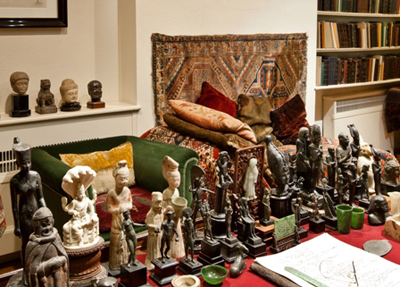
Freud's-DeskThis group of antiquities sits upon the desk of Sigmund Freud – the “founding father” of psychoanalysis –  at what was his home in Hampstead.

It’s part of an extensive collection of around 2,000 items which is on display at house – now the Freud Museum – located at 20 Maresfield Gardens.

The antiquities – which include Egyptian, Greek, Roman, and Oriental artefacts fill a series of cabinets and sit on almost every available surface in Freud’s study including the desk upon which Freud typically wrote until the early hours of the morning.

Collected by Freud from the 1890s onward, they include everything from a bronze statuette of the Greek goddess Athena (dating from the 1st or 2nd century AD – it’s mentioned in one of his manuscripts and, one of Freud’s favorite objects, was one of only three items he chose to have smuggled out of Vienna when his entire collection was threatened in 1938), a small bronze head of the Egyptian God Osiris believed to date from between 1075-716 BC, and a silver Roman ring featuring a blue glass intaglio depicting a pastoral scene which dates from between the 1st century BC and the 1st century AD (it was given as a gift from Freud to German psychoanalyst Ernst Simmel in 1928).

The museum has launched a conservation fund to repair and conserve the most fragile of the items and is aiming to raise £40,000 for the work. It follows a successful campaign earlier this year to raise funds for the conservation of Freud’s famous couch, brought from his former home in Vienna (seen in the background of this image).

Freud and his family lived at the home after escaping from Austria following the country’s annexation by Nazi Germany in 1938. It remained the family home until the death of Freud’s daughter, Anna, in 1982. The museum opened to the public in 1986.

PICTURE: Courtesy of the Freud Museum.

WHERE: Freud Museum, 20 Maresfield Gardens, Hampstead (nearest Tube stations are Finchley Road and Swiss Cottage);  WHEN: Noon to 5pm, Wednesday to Sunday; COST: £6 adults; £4.50 seniors; £3 concessions (including children 12-16); children under 12 free; WEBSITE: www.freud.org.uk.

Around London – 1863 FA Minute Book at BL; marking International Slave Remembrance Day at the NMM; Kenwood House concerts; and Dylan at the NPG…

FA-Cup-Minute-BookThe 1863 FA Minute Book forms the centrepiece of a new display at the British Library marking the 150th anniversary of The Football Association. Handwritten by Ebenezer Cobb Morley, the minute book contained the 13 original rules of football and is valued at £2.5 million. It is being displayed along with other football related artefacts – such as a Guide for Referees from the 1930s – in the Sir John Ritblat Treasures Gallery alongside the Magna Carta, Shakespeare’s First Folio and Captain Scott’s diary and is the first time the library has had a football-themed display. The Football Association was formed on 26th October, 1863, at the Freemason’s Tavern in London with the meeting documented in the minute book which also records the establishment of The FA Cup and the first international football match. Football Rules, entry to which is free, runs at the British Library in King’s Cross until 17th December. For more, see www.bl.uk. For more on the FA’s 150th anniversary, check out www.thefa.com.
As mentioned last week, Hidden London kicks off today and runs over this August bank holiday weekend. The second year it’s been held, the initiative is your chance to see some of the country’s finest museum collections and archives.  To see what’s on, head to www.hiddentreasures.org.uk/?page_id=118.

The National Maritime Museum tomorrow marks International Slavery Remembrance Day tomorrow with a series of free family-oriented events. The programme, which takes place at the museum and around Greenwich, involves music, workshops, talks and walking tours and will culminate in a commemorative ceremony by the River Thames. The day falls on the date of the first successful slave uprising in the western hemisphere which took place in Haiti on 23rd August, 1791, and led to the island’s independence. For more, see www.rmg.co.uk/national-maritime-museum/.

English Heritage’s season of concerts at Kenwood House beside Hampstead Heath kicks off this weekend. Live by the Lake features artists including Suede and Keane, an outdoor live screening of Singin’ in the Rain featuring the Royal Philharmonic Concert Orchestra, Opera Alfresco and An Evening of Gershwin. Events run until 1st September. For more, see www.english-heritage.org.uk/daysout/properties/kenwood-house/.

Pastel portraits by Bob Dylan go on show at the National Portrait Gallery in the West End from Saturday. Bob Dylan: Face Value features 12 new works by singer/songwriter and the portraits represent characters, some of which are real and some fictitious. Dylan, who has 110 million record sales to his name, has been sketching and drawing since childhood but only starting exhibiting his portraits six years ago. The exhibition, in Room 40, is free and runs until 5th January. For more, check www.npg.org.uk.

Around London – ‘Hidden Treasures’; Open House programme; and the Isabella Plantation celebrates 60 years…

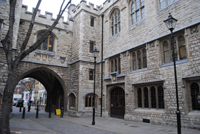
St-John's-GateHidden Treasures – the national initiative to celebrate the UK’s museum and archive collections – kicks off for its second year next Thursday, 22nd August, and runs over the bank holiday weekend until 27th August. Among the London institutions taking part this year are the British Library, the British Postal Museum and Archive in Houghton, the Museum of the Order of St John in Clerkenwell (pictured) and Orleans House Gallery in Twickenham. Hidden Treasures is an initiative of the Collections Trust and the Independent newspaper. All events are free but some have to be pre-booked and have limited spaces so make sure you check out the details at www.hiddentreasures.org.uk/?page_id=118.

The programme for Open House London – held over the weekend of 21st and 22nd September – will be made available online from today (or alternatively you can order a hard copy via the Open House London website). It’s important to note that a few of the buildings involved can only be entered by those successful in a ballot – they include 10 Downing Street, The View from The Shard, EDF Energy London Eye and Gray’s Inn. Head to the website – www.londonopenhouse.org – to enter the ballots which close on 13th September.

The Isabella Plantation – a 40 acre ornamental woodland garden located in the south west area of Richmond Park – is celebrating 60 years since its creation and they’ve kicked off a fortnight’s programme of free events community to mark the occasion. The events, which will be focused around the yurt by Peg’s Pond in the plantation,  include guided walks, a showcase of art for young people and a Teddy Bears picnic on the bank holiday weekend. One of the most visited parts of Richmond Park, the plantation is home to the Wilson 50 National Collection of Evergreen Azaleas, more than 150 hardy hybrid Rhododendrons, 50 species of Rhododendron and a large collection of camellias and magnolia as well as many rare and unusual trees and shrubs. While the plantation can be dated as far back as 1771 (then named Isabella Slade), it was planted for timber in 1831, and in 1953 the present garden was established and the old name Isabella adopted for it. For more on the events, see www.royalparks.org.uk.

As Muslims mark the end of Ramadan this weekend, the festival of Eid-ul-Fitr will be celebrated in Trafalgar Square on Saturday. As well as the chance to sample foods from across the Islamic world, there will also be entertainment on stage, exhibitions and children’s activities. The festival, put on by the Mayor of London Boris Johnson, runs between 1.30pm and 6pm. For more, see www.london.gov.uk/eid.

On Now: Take One Picture – Discover, Imagine, Explore: Children Inspired by Willem Kalf. This display at the National Gallery focuses on Willem Kalf’s Still Life with Drinking-Horn (about 1653) and features alongside it responsive works created by children from 25 schools across the UK and as far afield as Turkey with works from other schools captured in a slide-show. Located at the Annenberg Court (Getty Entrance), admission is free. Runs until 12th September. For more, see www.nationalgallery.org.uk.

Around London – The ‘Line of Kings’ has a makeover; London captured from St Paul’s; and, cycles at the Museum of London…

Line-of-Kings

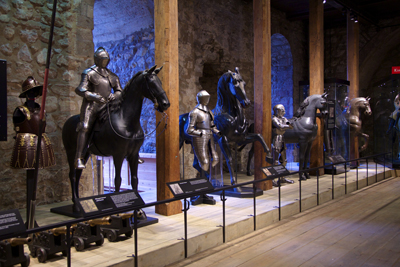
The Tower of London’s iconic exhibition, the Line of Kings, has had a makeover. Described as the “world’s longest running visitor attraction”, the Line of Kings features more than 500 objects including historic suits of armour – such as those worn by King Henry VIII, King Charles I and King James II – as well as life-sized wooden horses and individually carved king’s heads, many of which were made between 1685 and 1690. The exhibition was originally created following the Restoration in 1660 and was used as propaganda to promote the king’s rule (interestingly omitting queens and featuring only those deemed “good kings”). Rearranged and dispersed over the centuries, it’s been brought back together in the White Tower and reopened last month. Entry to the exhibition – a collaboration between Historic Royal Palaces and the Royal Armouries – is free as part of general admission to the Tower. For more, check out www.royalarmouries.org/line-of-kings. PICTURE: HRP/Newsteam

Four cameras mounted on top of St Paul’s Cathedral’s Golden Gallery have captured a 360 degree time lapse video of the capital. The video, which was shot in early July, captured 36 hours in the life of London and is the work of specialist photographer Henry Stuart who previously completed two projects from the Golden Gallery – a GigaPixel image of London and a Day Meets Night image. The latest project captured some 8,000 panoramic images. The time lapse video, which is set to Kyrie from Wolfgang Amadeus Mozart’s Missa in C major ‘Missa solemnis’ K337 being sung by the St Paul’s Cathedral Choir, can be found at http://visualise.com/videos/london-360-time-lapse-from-st-pauls-cathedral.

• On Now: London Cycles. This free exhibition at the Museum of London looks at cycling in the capital with highlights including 10 large scale portraits by Ugo Gattoni, bikes including an 1880s “boneshaker”, a penny farthing, an 1930s Enfield cycle and a ‘Boris’ bike as well as head cam footage from riders including from the annual Tweed Run bike. The free display runs until 22nd September. For more, see www.museumoflondon.org.uk.

Around London – Radio Times celebrated at MoL; IWM reopens; and Lowry at the Tate…

A new exhibition marking the 90th anniversary of the iconic publication, Radio Times, opens at the Museum of London tomorrow (Friday). Cover Story: Radio Times at 90 features some of the magazines most famous covers depicting the likes of Tony Hancock, The Goon Show, Only Fools and Horses and Coronation Street, and charts the history of radio from the BBC’s first transmission to today’s multiple channels. As well as original artwork and photographs used in Radio Times, the display includes a special focus on Doctor Who with the chance for visitors to create their own Radio Times cover as they stand alongside a life-size Dalek. Other highlights include an original 1941 illuminated map used by the Luftwaffe which shows Radio Times‘ Waterlows printing plant in Park Royal alongside other targets. Radio Times was first published by the BBC in London on 29th September, 1923, and since 2011 has been owned by Immediate Media Co. The free exhibition runs until 3rd November. For more, check out www.museumoflondon.org.uk.

The Imperial War Museum has partially reopened this week. As well as the re-opening of its permanent galleries and exhibitions, the museum has launched a major new family-oriented exhibition Horrible Histories: Spies, a new art exhibition entitled Architecture of War and ‘IWM Contemporary’, a new programme showcasing significant works by leading artists in response to war and conflict. The museum will fully reopen in summer next year with the opening of new First World War Galleries. Horrible Histories: Spies, which runs until 4th January (admission charge applies), immerses visitors in the world of World War II spycraft with families able to uncover the techniques used by the most cunning spies. More on Architecture of War and IWM contemporary in upcoming posts. For more, see www.iwm.org.uk.

On Now: Lowry and the Painting of Modern Life. This exhibition at the Tate Britain represents the first to be held by a public London institution featuring  the works of LS Lowry since his death in 1976 and is the first to explore his connections with French art. Among works on display is a little known, untitled painting depicting a busy town square set against the backdrop of industrial Salford which was found on the back of the wooden panel on which Lowry painted his 1937 work The Mission Room. Others among the 90 works on display include Coming Out Of School (1927), The Pond (1950), Industrial Landscape (1955) and Hillside in Wales (1962) as well as Ancoats Hospital Outpatients Hall (1952), The Cripples (1949), Piccadilly Circus, London (1960) and Excavating Manchester (1932). Runs until 20th October. For more, see www.tate.org.uk.

Treasures of London – Shakespeare’s Blackfriars deed…

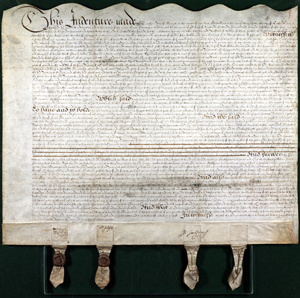
Shakespeare's-DeedIn 1613, the playwright William Shakespeare – now widely regarded as the greatest writer of the English language – purchased a property in Blackfriars.

The only real estate he was to buy in London, the purchase of the gatehouse – which may have stood on the junction of St Andrew’s Hill and Ireland Yard – was apparently made as an investment (Shakespeare never lived there).

The deed which recorded the sale (dated 10th March, 1613) – only one of six documents in the entire world which bears Shakespeare’s authenticated signature – is in the care of the London Metropolitan Archives.

According to the deed, he bought the property from Henry Walker, a minstrel, paying £140 for the property (he mortgaged £60 of it the next day – the document for this is located in the British Library).

Other parties mentioned on the document are William Johnson, a London-based vintner and possibly landlord of the Mermaid tavern in Cheapside, and two ‘gentlemen’ John Jackson and John Heminges, an actor, manager and editor of Shakespeare’s first folio.

They were appointed as trustees in Shakespeare’s interest and handled the sale of the property after Shakespeare’s death in 1616. The copy of the deed held by the LMA was that of Henry Walker (Shakespeare’s copy is in the Folger Shakespeare Library in Washington).

The deed is currently on display as part of an exhibition surrounding the 400th anniversary of its signing. ‘Shakespeare and London’, a free exhibition, also features other documents from the period as well as maps, prints and models and runs at the LMA (40 Northampton Road) until 26th September. Due to the age and importance of the deed, the deed itself will only be displayed at specific times – check the LMA website for details.

Around London – Celebrating the coronation at Buckingham Palace; Royal births at the MoL; the Fourth Plinth unveiled; Menon remembered; and, manufacturing at the Design Museum…

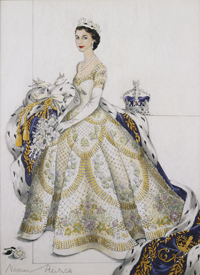
Norman-Hartnell-sketchThe Queen’s Coronation in 1953 is the subject of a special exhibition opening at Buckingham Palace as part of the palace’s summer opening. Celebrating the 60th anniversary of the coronation, the display features an array of outfits including uniforms and robes worn on the historic event on 2nd June, 1953, as well as a series of paintings recording the event, works of art and objects used on the day and film footage and sound recordings. Among the highlights of the exhibition will be sketches made by Norman Hartnell, the principal designer of the outfits worn at the coronation by the Queen, principal ladies of the immediate Royal Family and the Maids of Honour. The State Rooms of Buckingham Palace open on Saturday and remain open until 29th September. An admission charge applies. For more, see www.royalcollection.org.uk. PICTURE: Her Majesty The Queen in her Coronation Dress, 1953, Norman Hartnell. Royal Collection Trust/All Rights Reserved.

Meanwhile in this, the week of the birth of Prince George, it’s only fitting that we mention a small display at the Museum of London showcasing memorabilia relating to royal babies of years past. A Royal Arrival features baby clothes and other items worn by future monarchs. They include a embroidered skullcap worn by the future King Charles I, a tiny linen vest and mitten which once was worn by the future King George III and a dress emblazoned with the three feather insignia which belonged to the future King Edward VII, eldest son of Queen Victoria. The free display will be on show until October. For more, see www.museumoflondon.org.uk.

The new commission for Trafalgar Square’s Fourth Plinth will be unveiled today. The 4.7 metre high sculpture, Hahn/Cock, is the work of contemporary artist Katharina Fritsch. It will sit on the plinth for the next 18 months.  For more details, see www.fourthplinth.co.uk.

Indian statesman VK Krishna Menon has been commemorated by English Heritage with a blue plaque on his former residence in Highgate. A key campaigner for Indian independence, Menon lived at 30 Langdon Road from 1929 to 1931, having moved to England from Madras in 1924. In 1947, Menon was appointed India’s First High Commissioner in London and among his greatest achievements was his work in keeping the country in the British Commonwealth after independence. Having been a local councillor in St Pancras, he later returned to India and embarked upon a political career there. For more, see www.english-heritage.org.uk/discover/blueplaques/.

The-Future-Was-HereOn Now: The Future is Here. A major new exhibition examining the changes taking place in manufacturing around the world, opened this week at the Design Museum. The Future is Here looks at how everything from “cars to shoes” is manufactured, funded, distributed and bought. Among highlights is a ‘Factory’ where visitors can discover how 3D printing works and see production in process. There will also be the chance to make your own ‘action doll’ and see a sofa designed through a crowd-sourcing process which involved members of the public. Runs until 3rd November. Admission charge applies. For more, see www.designmuseum.org.

Special – London unearthed…

ForeshoreThis month the Festival of Archaeology is being celebrated all across the UK, including in London where about 30 different events are being held. This year they include the chance to visit the remains of the Elizabethan Rose Theatre in Bankside and see for yourself preparations for an excavation to start next year, the opportunity to walk through the London offices of the Egypt Exploration Society, a series of hands-on archaeology-related activities at Eltham Palace in south London, behind the scenes tours of the Museum of London, and the chance (next weekend – 27th/28th July) to go mud-larking along the foreshore of the River Thames outside the Tower of London and then present your findings to archaeologists for identification (pictured above from a previous year). Get in there and have some fun! For more details of events, check out www.archaeologyfestival.org.uk.

Around London: Masques of the Stuart Court; saving London’s heritage; IEDs at the NAM; and, Eighties fashion at the V&A…

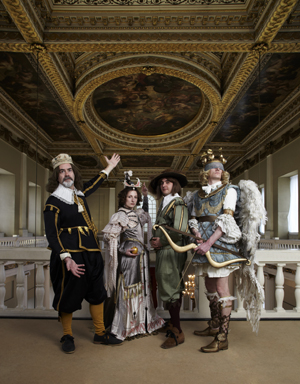
Stuart-masque-at-Banqueting-HouseThe sights and sounds of the elaborate masques of the early Stuart Court – described as a cross between a ball, an amateur theatrical, and a fancy dress party – are being recreated at the Banqueting House in Whitehall. Historic Royal Palaces have joined with JB3 Creative to create an “immersive theatrical experience” for visitors to the building – one of the last surviving parts of the Palace of Whitehall – with the chance to try on costumes, learn a masque dance and witness performance rehearsals for Tempe Restored, last performed in the building in 1632. Inigo Jones will be ‘present’ as masque designer to talk about his vision for the performance. Weekends will also see musicians performing period music and on 27th July there will be a one-off evening event at the Banqueting House based on Tempe Restored. Admission charge applies. Performing for the King opens tomorrow and runs until 1st September. For more, see www.hrp.org.uk/BanquetingHouse/. PICTURE: HPR/newsteam.

A new exhibition looking at how some of London’s great Georgian and Victorian buildings were lost to bombs and developers before, after and during World War II – and how people such as poet John Betjeman campaigned to save them – opened in the Quadriga Gallery at Wellington Arch near Hyde Park Corner yesterday. Pride and Prejudice: The Battle for Betjeman’s Britain features surviving fragments and rare photographs of some of the “worst heritage losses” of the mid-20th century. They include Robert Adam’s Adelphi Terrace (1768-72) near the Strand, the Pantheon entertainment rooms (1772) on Oxford Street, and Euston Arch (1837). The English Heritage exhibition runs until 15th September. Admission charge applies. For more, see www.english-heritage.org.uk/daysout/properties/wellington-arch/.

IEDs (Improvised Explosive Devices) will be ‘uncovered’ in a new exhibition opening tomorrow at the National Army Museum. Unseen Enemy will tell the stories of the men and women in Afghanistan who search for, make safe and deal with the impact of the IEDs through personal interviews, images and mementoes. The exhibition has been developed with “unprecedented access” from the British Army, Royal Air Force and Royal Navy and will include a range of equipment used in detecting and disarming the devices, such as bombsuits and robots as well as medical equipment used to help those injured in explosions. The exhibition is free. For more, see www.nam.ac.uk.

On Now: Club to Catwalk – London Fashion in the 1980s. This exhibition at the V&A explores the “creative explosion” of London fashion during the decade and features more than 85 outfits by designers including John Galliano, Vivienne Westwood and Katherine Hamnett as well as accessories by designers such as Stephen Jones and Patrick Cox. While the ground floor gallery focuses on young fashion designers who found themselves on the world stage, the upper floor focuses on club wear, grouping garments worn by ‘tribes’ such as Fetish, Goth, High Camp and the New Romantics and featuring clothes such as those worn by the likes of Boy George, Adam Ant and Leigh Bowery. The exhibition also includes a display of magazines of the time. Entry charge applies. Runs until 16th February, 2014. For more, see www.vam.ac.uk. Meanwhile, tomorrow (Friday) night the V&A will celebrate the 25th anniversary of designer Jenny Packham with a series of four free catwalk shows in its Raphael Gallery. Booking is essential. Head to the V&A website for details.

LondonLife – A look into London’s wartime past…

StreetMuseum

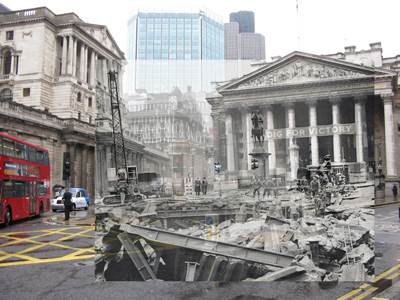
Images from the Museum of London’s Streetmuseum app give a glimpse into London’s past – in this case, its wartime history. The image above, taken by Police Constable Arthur Cross, official photographer of the City of London Police, and his assistant PC Fred Tibbs, shows bomb damage at Bank Underground Station, following a direct hit on 10th January, 1941. An estimated 111 people who had been sheltering in the Tube died, some of them thrown into the path of an incoming train. The crater that was left outside the Royal Exchange was so large the Royal Engineers had to build a bridge across it. For details on how to download the app, head to www.museumoflondon.org.uk/Resources/app/you-are-here-app/home.htmlPICTURE: © Museum of London/By Kind Permission of The Commissioner of the City of London Police.

Around London – The City of London Festival; last chance to see the Temperate House; and, Vermeer and music at the National Gallery…

City-of-London-FestivalThe City of London Festival kicked off last Sunday and runs for the next month in what is being billed as an “extravaganza of music, dance, art, film, poetry, family and participation events” in the Square Mile. Among the highlights of this year’s festival – the 51st – is a series of musical performances at St Paul’s Cathedral and a range of other locations including livery halls, churches and Mansion House – home of the Lord Mayor of London – as well as walks and talks including a two-day conference this Friday and Saturday, Worlds in Collision, which will explore questions surrounding the healing power of music in the treatment of post-traumatic stress disorders resulting from conflict. There’s also a range of free events such as a family day on Hampstead Heath celebrating Northern Irish culture and heritage and artistic installations such as that by artist Konstantin Dimopoulos which this week saw the trees of Festival Gardens near St Paul’s turn bright blue. Trees around Devonshire Square are also expected to be ‘coloured’ and both sites will form part of a ‘Tree Trail’ in the square mile which is aimed at revealing the ‘secret stories’ of some of the city’s trees and the locations they inhabit. The festival, which runs until 26th July, will be reflecting on a number of significant historical landmark anniversaries taking place this year, including the 400-year relationship between the City of London and the Northern Irish community of Derry-Londonderry, the 300th anniversary of the Treaty of Utrecht and the 100th anniversary of the birth of composer Benjamin Britten. For more information and a full programme of events, see www.colf.org. PICTURE: London Symphony Orchestra at St Paul’s Cathedral, © City of London Festival/Robert Piwko

The next month represents the last chance to visit Kew Gardens’ historic Temperate House – the world’s largest surviving Victorian glasshouse – for five years. The Grade I-listed building is about to undergo a five year restoration project, funded by a £14.7 million grant from the Heritage Lottery Fund. It is home to Kew’s rarest plant, the South African cycad Encephalartos woodii while other rarities include the St Helena ebony (Trochetiopsis ebenus). The Temperate House will close on 4th August and won’t reopen until May 2018. For more, see www.kew.org.

On Now: Vermeer and Music: The Art of Love and Leisure. Opened yesterday, this landmark exhibition at the National Gallery explores the motif of music in Dutch painting, in particular in the works of Johannes Vermeer and his contemporaries. Displayed alongside actual examples of 17th century virginals, guitars, lutes and other instruments, visitors will be able to see for themselves how accurate the painters were and discover why they may have taken artistic liberties. At the centre of the exhibition are three works by Vermeer – A Young Woman Standing at a Virginal and A Young Woman seated at a Virginal (both of which form part of the gallery’s collection) and The Guitar Player (on loan from Kenwood House). A fourth Vermeer, The Music Lesson, has been loaned from the Queen. Other artists featured in the exhibition include Gerard ter Borch, Gabriel Metsu, Jan Steen, Pieter de Hooch and Godfried Schalcken. Live musicians from the Academy of Ancient Music will be playing at the gallery three days each week. Runs until 8th September. Admission charge applies. For more, see www.nationalgallery.org.uk.

Around London – Sculpture in the City; Taste of London; Paddington’s 1st Festival; and, Gauguin at the Courtauld…

LoveA free outdoor exhibition of nine artworks by world famous artists can be seen in the City of London from today. Works featured in this year’s Sculpture in the City exhibition – the third year the event has run – include Robert Indiana’s iconic LOVE sculpture (found at 99 Bishopsgate), Shirazeh Houshiary’s five spiralling stainless steel ribbons String Quintet (St Helen’s Square), and three giant steel dinosaurs, The Good, The Bad and The Ugly, made by the Jake & Dinos Chapman (30 St Mary Axe). Other artists whose work is featured include Antony Gormley, Keith Coventry, Richard Wentworth, Jim Lambie and Ryan Gander. The works will be on display in the Square Mile for the next 12 months. For more – including the locations of all nine installations – see www.cityoflondon.gov.uk/sculptureinthecity. PICTURE: Robert Indiana ‘LOVE’ (1966)  ∏ Morgan Art Foundation, Artists Right Socienty (ARS), New York – DACS, London. Photograph – A et cetera

The 10th Taste of London festival – London’s biggest outdoor food festival – kicks off in Regent’s Park today and runs over the weekend. This year sees amateur BBQ enthusiasts going head-to-head in a “battle of the BBQs” on Saturday while professionals will hit the grills on Sunday with the winners crowned champions of the Weber BBQ Challenge. Meantime, visitors can experience the food of 40 of the city’s top restaurants, shop at 200 food and drink stalls, enjoy fine wine tasting and watch demonstrations by some of the world’s top chefs including three generations of the Roux dynasty – Albert Roux, Michel Roux Jr and Emily Roux – as well as Rene Redzepi, Raymond Blanc, Ben Tish, Pascal Aussignac and Bruno Loubet. For more, see www.tastefestivals.com/london.

The first ever Paddington Festival – an 11 week showcase of art and culture supported by the City of Westminster – kicks off this weekend. Events include a “puppet theatre barge” at Little Venice and a launch event featuring an appearance by Chucky Venn (Eastenders) and steelpan and performances from local dance group, The Phoenix Dancers, at the Maida Hill Market. For more on the festival and for the full programme, see www.paddingtonfestival.co.uk. Other festivals kicking off this weekend include Shubbak 2013 – an international festival of Arab culture (www.shubbak.co.uk).

On Now: Collecting Gauguin: Samuel Courtauld in the 20s. Opening today, this exhibition at the Courtauld Gallery at Somerset House features the gallery’s collection of works by the Post-Impressionist master Paul Gauguin. The most important collection of Gauguin’s works in the UK, it was assembled by Samuel Courtauld between 1923 and 1929 and includes major paintings and works on paper by  along with one of only two marble sculptures the artist ever created. The exhibition, the gallery’s “summer showcase”, also features two important works formerly in the Courtauld’s collection and now on loan – Martinique Landscape and Bathers at Tahiti. Runs until 8th September. Admission charges apply. Meanwhile, The Courtauld Institute of Art’s MA Curating the Art Museum programme is also launching its annual exhibition, Imagining Islands: Artists and Escape, in response to the gallery’s summer showcase. A “trans-historical” exhibition displayed in two rooms, it explores artists’ fascination with other worlds and the search for utopia. Works include a 1799 engraving of Jan Brueghel the Elder’s Adam and Eve in Paradise, Barbara Hepworth’s 1957 work Icon and John Everett Millais’ 1862 painting, The Parting of Ulysses. For more, see www.courtauld.ac.uk.

Hampton Court Palace Festival; good deeds at the Foundling Museum; Harold Wilson’s memorial; and, the RA’s summer exhibition…

The 2013 Hampton Court Palace Festival kicks off tonight. Highlights include a performance by the Royal Philharmonic Concert Orchestra and fireworks on Saturday night while other artists featured include Jools Holland, Lisa Stansfield, Frank Valli and the Four Seasons, Imeda May, Bjorn Again, Russell Watson, Cliff Richard and Joe Bonamassa and Beth Hart. For the full programme of events over the next couple of weeks, check out www.hamptoncourtpalacefestival.com.

It’s all about good deeds at the Foundling Museum. Opening at the museum in Bloomsbury tomorrow, a ceramic artist Clare Twomey’s exhibition – Exchange: 1,000 Good Deeds at the Foundling Museum – features more than 1,000 cups and saucers with each cup hiding instructions for a good deed underneath. The instructions are only revealed when a visitor selects a cup – they either agree to do the good deed, leaving it exposed and taking home the cup, or, if they’re not able to, can return the cup to its saucer. There is a limit of 10 cups available for exchange each day – ring or check the website for times when the exchanges may take place. Entry is free with museum admission. Runs until 15th September. For more, see www.foundlingmuseum.org.uk.

A memorial ledger stone to former Labour PM, Harold Wilson (later Lord Wilson of Rievaulx), was dedicated in Westminster Abbey this week. Lord Wilson (1916-1995) was PM from 1964 to 1970 and 1974 to 1976. The stone is placed near where Earl Attlee’s ashes were interred at a memorial service attended by Lord Wilson when Prime Minister in 1967. For more, see www.westminster-abbey.org.

On Now: Royal Academy of Arts Summer Exhibition 2013. Coordinated by Royal Academicians printmaker Norman Ackroyd and Eva Jiricna, this year’s exhibition at the Royal Academy in Piccadilly features more than 1,000 artworks with many going on display for the first time. Among the works on display will be Grayson Perry’s series of six tapestries entitled The Vanity of Small Differences – inspired by Hogarth’s A Rake’s Progress, it tells the story of Tom Rakewell. Other highlights include a room dedicated to portraiture – including photographs and works on paper – and a new large scale sculpture by Anthony Caro. Runs until 18th August. Admission charge applies. For more, see www.royalacademy.org.uk.