Around London – Tens of thousands expected for weekend’s Sky Ride; IWM marks 10th anniversary of September 11; Liberty festival hits South Bank; British Library launches new 19th century app; and, a new slavery exhibition at Museum of London…

• Tens of thousands of people are expected to join London Mayor Boris Johnson for the annual Sky Ride this Sunday. The event, organised by the Mayor of London, Sky and British Cycling in partnership with Transport for London, allows people to cycle a 11.6 kilometre route through the city centre minus the usual car traffic. The circular route, which takes in Westminster Bridge, the Mall and Buckingham Palace, Trafalgar Square and Whitehall, will be vehicle-free between 9.30am and 4.30pm. Last year more than 85,000 took part. For more information, seewww.goskyride.com/london.

• The Imperial War Museum is marking the 10th anniversary of the 9/11 attacks in the US with a new photographic exhibition showing artefacts recovered after the destruction of the World Trade Center in New York. Memory Remains, which opened on 26th August and runs until 26th February, is a photographic exploration of Hangar 17 – a previously empty hanger at John F. Kennedy Airport in New York where debris and material retrieved from the 16 acre World Trade Center site were stored. It features images taken by Spanish-American artist Francesc Torres, who was commissioned by the National September 11 Memorial & Museum to capture what was happening inside the hangar and granted special access to do so. The exhibition is being accompanied by another at Imperial War Museum North in Manchester. In the Spotlight: Remembering 9/11, which runs from 10th September until September next year, features artefacts from the World Trade Center including a British flag which was laid on the altar in St Paul’s Cathedral on the first anniversary of the attacks. Admission to both exhibitions is free. For more information, see www.iwm.org.uk.

South Bank hosts the Liberty festival, an annual showcase by deaf and disabled artists, this Saturday. The festival, which will take place at two sites – the Southbank Centre and the National Theatre, will feature a mix of music, dance, street theatre, comedy, circus performances and aerial displays. Highlights include Mark Smith’s Deaf Men Dancing, performance artist Bobby Baker, Jean-Marie Akkerman’s Cirque Nova featuring four disabled aerial artists, and Kazzum, who produce theatrical work for children up to 16-years-old. The event is free. For more information, see www.london.gov.uk/liberty.

The British Library and BiblioLabs have launched a new 19th century historical collection app for iPad users. The app (which costs £1.99 a month or $US2.99 for those outside the UK and is available through Apple’s App Store) allows users to explore historical and antiquarian books including classic novels, original accounts by Victorian travellers, books on science and poetry, memoirs and military histories. Around 45,000 titles are initially available with a further 15,000 to be added by the end of the year.

On Now: Freedom from: modern slavery in the capital. A new exhibition looking at the reality of trafficking and forced labour has opened at the Museum of London and the Museum of London Docklands – the museum first cross-site exhibition. Created in partnership with Anti-Slavery International and coinciding with the launch of its Slavery-Free London campaign, the exhibition looks at the personal impact of human trafficking and slavery in 21st century London and includes personal testimonies such as that of ‘Gheeta’ who was trafficked from India and forced into work. It also features a series of large scale photographs by Chris Steele-Perkins of Magnum Photos. Runs until 20th November. Admission is free. For more information, see www.museumoflondon.org.uk.

Around London – Story of London Festival; a new filmlovers’ walk; ‘pocket histories’ of London; and, Your 2012…

The third Story of London Festival kicked off at the start of the month with a programme of events aimed at celebrating the 60th anniversary of the 1951 Festival of Britain. This year’s festival is being coordinated by the Museum of London in partnership with the Southbank Centre. It also involves five London borough museums – that of Brent, Dagenham, Haringey, Redbridge and Wandsworth – which are hosting free displays and events around the theme of how they celebrated in 1951. The festival runs until the end of the month, so there’s still plenty of time to get involved. Among the highlights still to come is the Floral Bicycle Parade around the Southbank Centre on 28th August (‘decorating stations’ will be set up at the centre prior to the parade). For a full listing of what’s happening, see www.london.gov.uk/priorities/art-culture/storyoflondon.

The City of London has released a new filmlovers’ walking tour of London which takes in locations featured in films and TV shows. Lights, camera, action starts on Millennium Bridge (destroyed in the opening sequence of Harry Potter and the Half-Blood Prince) and takes in 23 other locations including St Paul’s Cathedral (The Madness of King George and Great Expectations), Bank Junction (28 Days Later, National Treasure II), St Bart’s Hospital (Bridget Jones: The Edge of Reason), Moorgate (Ocean’s 13 and The Bourne Ultimatum) and Tower Bridge (BranniganThe Mummy ReturnsThunderbirdsTomb RaiderSherlock Holmes) before finishing at Postman’s Park (Closer). The walk has been mapped out by the City’s film team which works with location managers and film directors when they’re working in the Square Mile. The leaflet can be picked up free-of-charge from the City of London Information Centre (opposite St Paul’s) or downloaded here.

• Interested in a snapshot of what London was like during a particular historical era? The Museum of London has launched a series of 16 “pocket histories”, each of which, in up to 1,000 words, tackles a particular aspect of the city’s history based around five objects or images. The subjects covered range from a look at the River Thames in prehistory to life in medieval London, from an examination of the history of Jack the Ripper and the East End, to a detailed look at the London’s plagues. While designed for a general audience, the histories are expected to be particularly useful to school students. They can be looked at online or downloaded as a PDF. Further subjects are expected to be added in the future. See www.museumoflondon.org.uk/pockethistories. The museum has also launched Picturebank, a collection of images which can be accessed online and viewed, printed or copied for educational use.

• On Now: Your 2012. The Museum of London Docklands is hosting a free exhibition featuring images capturing the construction work at the Olympic site in East London and the impact on the surrounding boroughs and the environment as well as archival images which show the history of the site. The free exhibition runs until 5th February. For more, see www.museumoflondon.org.uk/docklands/.

Around London – In the aftermath of the riots…

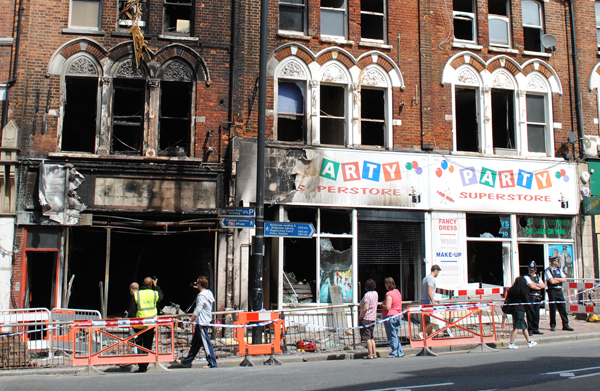
Damage in Clapham Junction, south London, following Monday night’s riots. PICTURE: David Adams

It’s been a tough few days to be a resident of London – the city we at Exploring London love for its vibrant culture and deep, rich history. Calm seems to have descended for the moment, but we couldn’t let the week pass without paying tribute to all those of the “broom army” who have turned up to help out with the clean-up of the damaged high streets, those who are donating clothes and goods for people who lost their homes, and the emergency workers – police, paradmedics and firefighters – who have worked so tirelessly to restore order to the streets since Saturday night. Here’s a couple of places to turn to if you want to get involved: www.riotcleanup.co.uk, a website showing where clean-up operations are underway (the Guardian newspaper is also running a riot clean-up page at http://ukriotcleanup.crowdmap.com/main), while the Londonist blog has a terrific page showing where you can donate and what items are most in need (http://londonist.com/2011/08/london-riots-how-you-can-donate-to-the-victims.php). And, of course, you can check out @riotcleanup on Twitter.

Around London – 16 Underground stations listed; life in a gun turret at HMS Belfast; and that dress on display at Buckingham Palace

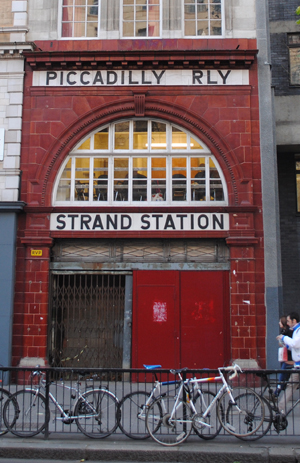
Sixteen London Underground stations were this week listed as Grade II heritage buildings. The Tube stations – several of which were designed by Leslie Green, known for his pioneering use of ‘ox-blood’ red tiles on the exterior of stations to create a consistent brand for the stations – include the now-closed Aldwych (pictured) along with Oxford Circus (originally two stations), Covent Garden and Russell Square as well as Belsize Park, Brent Cross, Caledonian Road, Chalk Farm, Chesham, Perivale, Redbridge, St John’s Wood, West Acton and Wood Green. Three other stations – Arnos Grove, Oakwood and Sudbury Town – have had their status upgraded from Grade II to Grade II*. These three were all designed by modernist architect Charles Holden for the extension of the Piccadilly Line in the 1930s. The new listings were made by Tourism and Heritage Minister John Penrose on the advice of English Heritage.

A new permanent exhibition showing would-be sailors what it is like to fight at sea opens at the HMS Belfast this weekend. Gun Turret Experience: A Sailor’s Story, 1943, is an immersive experience using lights, imagery, sound, smoke effects, movement and smell to recreate the atmosphere and conditions of a gun turret tower when a crew was at battle stations. Visitors are encouraged to follow the story of a young sailor on Boxing Day, 1943 when the German battle cruiser Scharnhorst is sighted leading to the Battle of the North Cape. The Gun Turret Experience, housed within the original triple gun turrets overlooking the quarterdeck, was developed with the help of Royal Navy veterans and eye-witness accounts from the Imperial War Museum (of which the HMS Belfast is part). Entry is included in normal admission price. For more information, see www.hmsbelfast.iwm.org.uk.

• Now On: See the dress the Duchess of Cambridge wore when she was married to Prince William in April at this year’s summer opening at Buckingham Palace. The gown, which features a nine foot long train, will be displayed along with the Halo Tiara until 3rd October in the palace ballroom (the same room used for the newly married couple’s reception). The exhibition features video footage of designer Sarah Burton, explaining how the dress was made. This year’s summer opening also features a display of the work of Carl Faberge – including his magnificent jewel-encrusted Imperial Easter Eggs as well as bejewelled boxes and miniature carvings of favorite pets of the royal family. More than half a million people are expected to visit the exhibition. For more information, see www.royalcollection.org.uk/default.asp?action=article&ID=30

LondonLife – SS Robin returns to East London…

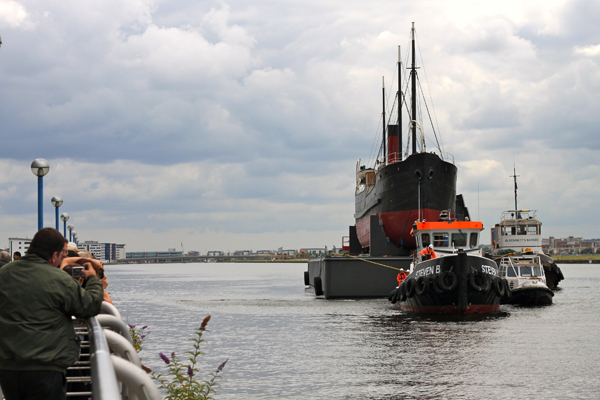
The SS Robin being towed to its new mooring in East London on a floating pontoon. PICTURE: James Spellane/SS Robin Trust.

The world’s oldest complete steamship, the SS Robin, made a dramatic return to the Royal Docks in East London earlier this month. Built in 1890 at the Thames Ironworks shipyard on the River Lea, the coastal cargo steamer was operational for more than 80 years, initially around the coast of Britain and the English Channel and later in Spain where it bore the name Maria. The 300 tonne vessel has just been through a three year restoration project spearheaded by the SS Robin Trust. It has now taken up a temporary mooring on a new floating pontoon while final conservation work is completed. It is anticipated that the steamship – which is listed on the ‘Core Collection’ of the UK National Historic Ships Register meaning it’s seen as historically significant as London’s two other maritime landmarks, the Cutty Sark and HMS Belfast – will be opened to the public. For more information, see www.ssrobin.com.

Around London – Yuri Gagarin honored; Londinium by iPhone; celebrating a year to the Olympics; and, British Museum hopes to buy Europe’s oldest book…

Earlier this month it was former US President Ronald Reagan’s turn to be honored with statue in Grosvenor Square. Last week it was the turn of former Soviet Cosmonaut Yuri Gagarin – the first man in space – to be so honored with a new statue located outside the British Council’s offices in the Mall (opposite another explorer, Captain James Cook). The statue, a gift of the Russian Space Agency Roscosmos, was unveiled to mark the 50th anniversary of Gagarin’s celebratory visit to London on 14th July, 1961, just three months after he completed his orbit of the earth on 12th April that year. The 3.5 metre high zinc alloy figure stands close to Admiralty Arch which was where Gagarin met then Prime Minister Harold MacMillan after he was invited to the UK by the National Union of Foundrymen. Among those present for the unveiling of the statue – which is a replica of one in the town of Lubertsy where Gagarin worked as a foundryman as a teenager – was Gagarin’s daughter Elena Gagarina, now director of the Kremlin Museums, and Vladimir Popovkin, head of the Russian Federal Space Agency. The British Council is running an exhibition, Gagarin in Britain, which looks at the life of Gagarin and the early Soviet space programme, until 14th September – among the objects on display is the first space suit and an ejector seat similar to that Gargarin used when he ejected out of Vostok 1. Entry is by registration only and space is limited – email gargarin@britishcouncil.org is you’d like to register for a place. For more information, see www.britishcouncil.orgPICTURE: Frank Noon/British Council

A new iPhone app which directs people to key sites in what was Roman London (Londinium) will go live on Monday. Developed by the Museum of London and the History Channel, Streetmuseum Londonium will bring to life some of the city’s most significant Roman sites, such as the amphitheatre at Guildhall, using “augmented reality video” which will overlay scenes of Roman London over the modern city while soundscapes will allow users to listen to a ritual at the Temple of Mithras or traders at the forum. In addition, users will be able to ‘digitally excavate’ Roman artifacts including leather bikini briefs and an ancient manicure set. Navigation to these “immersive experiences” will be via a specially created new map of Roman London which will be superimposed on a modern map of the capital, allowing users to see how the city has changed. The launch follows the earlier creation of the Streetmuseum app which guides people to more than 200 sites across the city. More than 200,000 people from across the world have so far downloaded this. Streetmuseum Londinium will be available free to download from 25th July. See www.museumoflondon.org.uk/apps for more.

London will mark one year to go until the Olympic Games next Wednesday with a ceremony in Trafalgar Square which will be broadcast live on BBC1. Among those present with be the International Olympic Committee (IOC) President Jacques Rogge, London Organising Committee of the Olympic and Paralympic Games (LOCOG) chairman Sebastian Coe and Mayor of London Boris Johnson. The event will also feature a live cross to the Aquatics Centre in Olympic Park where Olympic hopeful Tom Daley will make the first dive into the pool.

• The British Library hopes to raise £2.75 million to acquire the world’s earliest surviving intact European book, the 7th century St Cuthbert Gospel. A copy of the Gospel of St John, the book was buried with St Cuthbert on the isle of Lindisfarne in 698 and later found in the saint’s coffin in Durham Cathedral in 1104. The National Heritage Fund Memorial has already awarded £4.5 million to obtain the St Cuthbert Gospel and the Art Fund and The Garfield Weston Foundation have donated £250,000 each. The book has been on long-term loan to the library since 1979 and is regularly on view in the Sir John Ritblat Treasures Gallery. The library was approached last year and given first option to acquire the text after the Society of Jesus (British Province) decided to sell it. A price of £9 million has been agreed, of which £2.75 million remains outstanding. For more, see www.bl.uk.

Around London – National Maritime Museum expands; new galleries proposed for British Museum; Festival of British Archaeology in London; and, the London Street Photography Festival…

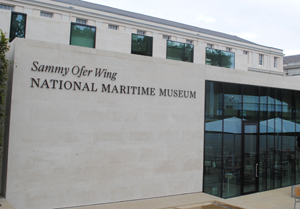
The National Maritime Museum in Greenwich opened the doors of its new £36.5 million Sammy Ofer Wing today. The new, architecturally slick extension – which is being touted as bringing with it a change of direction in the way the museum operates – features a new permanent gallery known as Voyages as well as a temporary exhibition space, library and archive. There’s also a lounge, cafe and brasserie – the latter boasting views out over Greenwich Park. The Voyages gallery has been designed as an introduction to the museum and features a 30 metre long thematic ‘object wall’ hosting more than 200 objects – everything from a letter written by Horatio Nelson to his mistress Emma Hamilton while he was on board the Victory in 1803 through to a watch belonging to Robert Douglas Norman – among those who perished on the Titanic, and a somewhat battered Punch puppet. The special exhibition space initially hosts High Arctic which uses technology to create an “immersive environment” exploring the Arctic world from the perspective of the future. The museum is also introducing the Compass Card scheme, a new initiative which will eventually be rolled out across the museum. Visitors are presented with a unique card with which, by inserting it into special units placed in galleries, they can flag their interest in receiving further information on a specified subject. The card can then be used to call up related archival information in the museum’s Compass Lounge or using the visitor’s home computer. For more information, see www.nmm.ac.uk.

The British Museum has announced funding has been secured for two new gallery spaces. These will include a new gallery looking at the history of world money from 2000 BC to present day. Known as the Citi Money Gallery, it will be opened in 2012. A donation from Paul and Jill Ruddock, meanwhile, means the museum will also be working on a major redisplay of Room 41 which covers the Mediterranean and Europe from 300 to 1,100 AD. The artefacts in the room include treasures taken from Sutton Hoo and the Vale of York Viking Hoard. The gallery will open in 2013/14. For more, see www.britishmuseum.org.

Now On: Festival of British Archaeology. Coordinated by the Council for British Archaeology, the 21st festival (formerly known as National Archaeology Week) kicks off this weekend and runs until the end of July. It boasts more than 800 events across Britain including in London where they include guided tours of the Rose Theatre, a range of Roman themed events and activities – including a gladiator show – at the Museum of London, gallery talks at the Bank of England Museum and British Museum, the chance to visit the Billingsgate Roman House and Baths, and a guided walk of Londinium (Roman London) organised by All Hallows by the Tower. For a complete events listing, see http://festival.britarch.ac.uk/.

Now OnThe London Street Photography Festival is running until the end of the month with a series of exhibitions, talks, walks and workshops, the majority of which are taking place in and around King’s Cross. Key events include Street Markets of London in the 1940s – Walter Joseph featuring never before seen images at the British Library, Vivien Maier: A Life Uncovered at the German Gymnasium, and Seen/Unseen – George Georgiou and Mimi Mollica at the Collective Gallery. For more information, see www.londonstreetphotographyfestival.org.

LondonLife – Remembering the 2004 Indian Ocean tsunami…

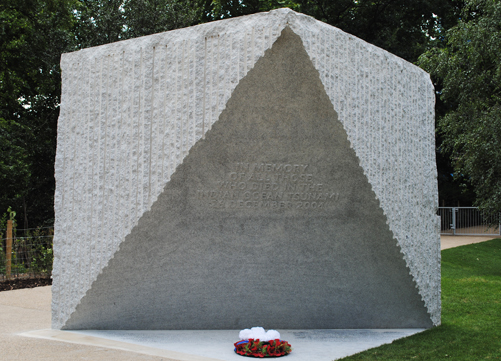
Prince Charles and the Duchess of Cornwall were among those to pay their respects at a new memorial remembering those 155 Britons who were among the 225,000 people died in the 2004 Indian Ocean tsunami last week. The 115 tonne memorial, located in gardens at the Natural History Museum in South Kensington, was designed by architecture studio Carmody Groarke. It is sculpted from granite quarried from France and was funded by a £550,000 grant from the Department for Culture, Media and Sport. Carmody Groarke was also involved in the design of the 7 July Memorial which, located in Hyde Park, commemorates the 52 people killed in the suicide bombings which took place in London in 2005. It was unveiled by Prince Charles in 2009.

Around London – Ronald Reagan unveiled, two ways in Pall Mall, Hungarian photography at the RA, and a celebration of the Arab world…

A new statue of former US President Ronald Reagan was unveiled in Grosvenor Square near the US embassy on Monday, 4th July. The 10 foot tall bronze statue of the president, who died in 2004, was unveiled at a private ceremony by the Foreign Secretary William Hague – former US Secretary of State Condoleezza Rice were also among the more than 2,000 people who attended along with current US ambassador Louis Susman (a frail Margaret Thatcher was reportedly too frail to attend). Commissioned by the Ronald Reagan Presidential Foundation, the statue is the work of sculptor Chas Fagan. Its unveiling is one of a series of events marking the centenary of the birth of the former actor turned politician.

Pall Mall and St James Street in the West End were opened to two-way traffic this week for the first time in 50 years. The changeover came into effect last Sunday morning. The roads were made one-way in 1963 under a scheme to deal with increasing traffic in the area. But it has been reopened in the first stage of a £14 million overhaul of traffic around Piccadilly Circus – home to world-famous neon billboards and the Eros Statue. The area is visited by 200,000 every day.

Time to get your togs on. Scores of swimmers will be taking the plunge at the Hampstead Heath Lido tomorrow and Saturday to raise funds for the Lord Mayor’s Appeal, Bear Necessities. A 4,000 metre swim, the City Dip, will be swum by teams and individuals with every swimmer receiving a commemorative certificate and medal. The current Lord Mayor of London is Michael Bear. To sign up or for more information, see  www.lordmayorsappeal.org.uk/dip

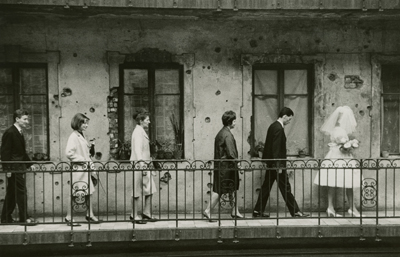
On Now: Eyewitness: Hungarian Photography in the 20th Century – Brassaï, Capa, Kertész, Moholy-Nagy, MunkácsiThis new exhibition at the Royal Academy of the Arts at Burlington House in Piccadilly, organised to mark the Hungarian Presidency of the EU, is dedicated to the birth of modern photography and features the work of Brassaï, Robert Capa, André Kertész, László Moholy-Nagy and Martin Munkácsi. It comprises more than 200 photographs, dating from 1914 to 1989, which usually form part of the collection of the Hungarian National Museum of Photography as well as the National Museum in Budapest and other public and private collections in both Hungary and the UK. Runs until 2nd October. For more information, see www.royalacademy.org.ukPICTURE: Laszlo Fejes, Wedding, Budapest, 1965, Copyright Hungarian Museum of Photography.

On Now: Shubbak: A Window on Contemporary Arab Culture. London’s first ever celebration of contemporary culture from across the Arab world will feature more than 100 artists involved in 70 events at some 30 venues over the weeks until 24th July. The program includes visual arts, film, music, theatre, dance, literature, architecture, lectures and discussions with many events boasting free admission. Highlights include A Girl in her Room, an exhibition of photo works by highly acclaimed Lebanese/American artist, Rania Matar, at the Mosaic Rooms, one of London’s leading centres for Arab contemporary arts (runs until 23rd July), Shopopolis, a series of collaborations with shoppers at Westfield Shopping Centre (runs until 24th July) and this weekend’s Interference, a series of free films, talks and workshops at the ICA curated by Mathaf: Arab Museum of Modern Art in Doha. For full details of all events, see www.london.gov.uk/shubbak.

Around London – Website to showcase UK’s oil paintings; Arctic explorer John Rae gets Blue Plaque; sharing experiences of kindness; and Toulouse-Lautrec and Jane Avril hit the Courtauld…

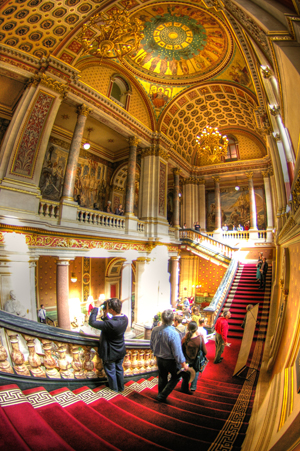
• A new website has been launched to showcase the UK’s vast national collection of oil paintings. While the website, which is a partnership between the BBC, the Public Catalogue Foundation, and participating collections and museums, currently hosts around 60,000 works, it is envisaged that by the end of 2012 it will carry digitised images of all 200,000 oil paintings in the UK (in an indicator of how many there are, the National Gallery currently has around 2,300 oil paintings, about one hundredth of all those in the nation). The works on the site will eventually include almost 40,000 by British artists. The 850 galleries and organisations participating so far include 11 in London – among them the National Gallery, the Tate Gallery, the Victoria and Albert Museum, the Bank of England, the Imperial War Museum and Dr Johnson’s House. For more, see www.bbc.co.uk/arts/yourpaintings/

• Arctic explorer John Rae has had a Blue Plaque unveiled in his honor at his former home in Holland Park. Although his feats were relatively unsung in his lifetime, the explorer’s expeditions in the Canadian Arctic saw him travel 13,000 miles by boat and foot and survey more than 1,700 miles of coastline. He is also credited with having “signposted” the only north-west passage around America that is navigable without icebreakers. Rae, who died in 1893, lived at the property at 4 Lower Addison Gardens in Holland Park for the last 24 years of his life.

Transport For London is calling on Londoners to share experiences of “kindness” that they have witnessed or participated in while travelling on the Underground. Artist Michael Landy has created a series of posters which are calling on people to submit their stories. Some of the stories will then be shown at Central Line stations (the first four posters go up on 23rd July at stations including Hollard Park, Holborn and Liverpool Street). For more, go to www.tfl.gov.uk/art.

On the Olympic front, the City of London Corporation has announced Tower Bridge will be bedecked with a set of giant Olympic Rings and the Paralympic Agitos during the 45 days of next year’s Games. Meanwhile, the Corporation has also unveiled it will host next week the launch of a London-wide campaign to get people involved in sport and activity in the lead-up to the Games. More to come on that.

On Now: Toulouse-Lautrec and Jane Avril Beyond the Moulin Rouge. The Courtauld Gallery, based at Somerset House, is running an exhibition celebrating the “remarkable creative partnership” between Jane Avril, a star of the Moulin Rouge in Paris during the 1890s, and artist Henri de Toulouse-Lautrec. Lautrec created a series of posters featuring Avril which ensured she became a symbol of Lautrec’s world of “dancers, cabaret singers, musicians and prostitutes”. Runs until 18th September. See www.courtauld.ac.uk for more.


Around London – 250,000 British Library titles to be available online; summer in Bunhill Fields Burial Ground; funding for church and synagogue repairs; and, the British Museum takes a closer look at relics and reliquaries…

The British Library is to digitise 250,000 books and make them available on the internet under a deal with tech giant Google. The works, which are all out of copyright, date from between 1700 and 1870 and include printed books, pamphlets and periodicals. Among them are feminist pamphlets about the ill-fated French Queen Marie Antionette dating from 1791, blueprints of the first combustion engine-driven submarine dating from 1858, and a 1775 account which tells of a stuffed hippopotamus owned by the Prince of Orange. The works will all be available online via Google Books which has partnered with more than 40 libraries around the world. The project will include material published in a range of European languages and will focus on works not already freely available in digital form online. For more see www.bl.uk.

A series of events running under the banner of ‘Green Garden Lunchtimes’ will be held at the Bunhill Fields Burial Group (off City Road) in the City of London from next Monday until 1st July. The events include free yoga and tai chi classes, a bike repair workshop, a history tour from City Guides and a wildlife talk courtesy of the Natural History Museum. The Wren Clinic will also be providing free advice and treatments. Bunhill Fields is famous for its connections to the Nonconformists and contains the graves of writers William Blake, Daniel Defoe and John Bunyan. For dates and times, follow this link.

• Six churches and a synagogue in London have been granted £582,000 to carry out repair works under the Repair Grants for Places of Worship scheme. The grants, which are administered by English Heritage and funded by the Heritage Lottery Fund, include £199,000 for the Church of St Augustine in Honor Oak Park – an early example of the Gothic Revival in the Early English style, £122,000 for Christ Church in Christchurch Park, Sutton, and £111,000 for the Golders Green Synagogue in Barnet. The grants were part of £8 million worth of funding given to 67 of England’s most important Grade II listed churches, chapels and synagogues. For more, see www.hlf.org.uk.

On Now: Treasures of Heaven: saints, relics and devotion at the British Museum. The museum’s major summer exhibition looks at the spiritual and artistic significance of Christian relics and reliquaries in medieval Europe. Among the highlights are: an arm reliquary of St George, which was housed in the treasury of St Mark’s in Venice following its capture in the sack of Constantinople in 1204; the British Museum’s bejewelled Holy Thorn reliquary, dating from 1390-97 and said to contain a relic from the Crown of Thorns; and, a 12th century bust of St Baudime from France, which once contained a vial of the saint’s blood and is being seen for the first time in Britain. Other exhibits come from the Cleveland Museum of Art in Ohio and the Walters Art Museum in Baltimore as well as from the Vatican. Runs until 9th October. There is an admission charge. For more, see www.britishmuseum.org.

Around London – The Tower hosts Royal Beasts; take a ride on a 1938 tube train; Lambeth Palace Library celebrates the King James Bible; and, see model cathedrals at Sir John Soane’s house…

• The history of the Royal Menagerie is the focus of a new exhibition on now at the Tower of London. Royal Beasts explores the history of the Tower menagerie which, founded during the reign of King John in the early 1200s, remained there for more than 600 years. Among the animals were lions (the first record of which dates from 1210), a grizzly bear (a gift from the Hudson Bay Company to King George III), elephants, tigers, ostriches and kangaroos. Highlights of the exhibition include modern animal sculptures by artist Kendra Haste and interactive sensory displays. The recently restored north wall walk and the never before opened Brick Tower will host some of the displays, including sights, sounds and smells of some of the animals. See www.hrp.org.uk/TowerofLondon.

A 1938 tube train will run along the western end of the Piccadilly Line this Sunday (that’s Father’s Day in case you’ve forgotten) as part of the London Transport Museum’s Heritage Vehicles on the Move 2011 programme. Leaving Northfields, the train will travel to High Street Kensington via Earl’s Court (crossing from the Piccadilly to the District Line in a move not normally experienced by the general public) before heading back down the District Line to Acton Town where it will change back onto the Piccadilly Line. The train will then undertake the “fishhook move”, visiting Heathrow Terminal 4 before going to Terminals 1,2,3 and 5. The entire journey is expected to last about two hours. Tickets, which can be purchased at the museum ticket desk or by calling 020 7565 7298, will need to be collected at Northfields Station. For more, see www.ltmuseum.co.uk/whats-on/events/vehicles-on-the-move.

• Lambeth Palace Library is celebrating the 400th anniversary of the King James Bible with a new exhibition. The exhibits include a 1611 edition of the Bible as well as Medieval Bible translations, landmark editions of the Bible which drew on the textual scholarship of the Renaissance and Reformation and early printed vernacular versions. Runs until 29th July. Admission is by pre-booking only. For information on buying tickets and more, see www.lambethpalacelibrary.org/content/2011exhibition.

On Now: Time is running out to see Sir Herbert Oakley’s collection of 27 models of European and English cathedrals at the Sir John Soane Museum. The models were made in the 1850s by William Gorringe, who was a modelmaker by appointment to Queen Victoria. Runs until 25th June. For more, see www.soane.org/exhibitions/

Around London – Celebrating visits to the Royal Parks; pregnant cows at the British Library; and, lost tube art found…

Royal Parks are celebrating the 160th anniversary of the opening of London’s Royal Parks to the public with a season of events including Trooping the Color (St James’s Park, this weekend), BBC Proms in the Park (Hyde Park) and various sporting events being held in the lead-up to the London Olympics next year. Last month also saw the unveiled of a new permanent art project in Hyde Park commemorating the Great Exhibition of 1851. Organised by the Royal Commission for the Exhibition of 1851 in conjunction with Royal Parks, it marks the site where the exhibition was held. London’s Royal Parks were opened to the public in 1851 after the passing of the Crown Lands Act which transferred management of the parks to the government. For more, see www.royalparks.org.uk.

Who could pass up a chance to feel whether a cow is pregnant? The British Library will be hosting staff from The Royal Veterinary College on 28th June for a day of hands-on demonstrations including the chance to use haptic technology and “feel” whether a cow is pregnant as well as opportunity to create a virtual, touchable 3D model using interactive software. The demonstrations are part of the library’s Growing Knowledge Exhibition showcasing innovative research tools. Spaces are limited so get in quick. To book your place, visit http://cowlooseinthelibrary.eventbrite.com/%3C/a%3E

On Now – The Lost Collection. In conjunction with Transport for London’s Lost Property Office, KK Outlet in Hackney is running an exhibition of unclaimed art that was left on London’s tube, buses, overground trains and black cabs. The work by nameless artists includes drawings, painting and photographs and, in some cases, whole portfolios. Runs until 30th June (42 Hoxton Square). For more information, see www.kkoutlet.com

LondonLife – Beating Retreat…

This week Horse Guards in London hosts the annual ceremony of Beating Retreat with massed bands playing and marching in formation. But where does the tradition come from?

The origins of the ceremony date back several hundred years to at least the 16th century when the beating of drums signalled the end of a day’s fighting, the closure of camp gates and the lowering of flags. Among the English kings credited with having ordered troops to “beat retreat” are old enemies King James II and King William III.

The ceremony was standard practice by the early 1700s with flutes or fifes added to the drum beating before, following the Napoleonic Wars, these were both replaced with bugles, to help ensure the sound reached greater distances.

The ceremony has been held annually at Horse Guards Parade since 1966 and this year involves the Massed Bands and Corps of Drums of the army’s Household Division along with The King’s Troop Royal Horse Artillery as well as The United States Army Europe Band and Chorus.

The event is a prelude to the Trooping the Colour on Saturday when more than 1,300 troops will parade in honor of the Queen’s Official Birthday.

Beating Retreat will be held at Horse Guards Parade on 8th and 9th of June (Wednesday and Thursday night), from 9pm. For more information and tickets, see www.guardsbeatingretreat.com

Around London – Apsley House history goes online; Australian landscapes at the British Museum; Dame Judy Dench awarded Freedom of the City of London; and, Out of this World on at British Library

A detailed history of Apsley House, the former home of Arthur Wellesley, 1st Duke of Wellington, has gone live online as part of a pilot project aimed at “deepening the public’s understanding of English history”. The property, known as Number 1, London, is one of 12 initially being profiled in depth in a pilot project on the new English Heritage online resource, Portico. Others include Down House, the former home of Charles Darwin, located in Kent, as well as Beeston Castle, Brough Castle, Byland Abbey, Carlisle Castle, Dunstanburgh Castle, Easby Abbey, Kenilworth Castle, Lullingstone Roman Villa, Rievaulx Abbey and Wroxeter Roman City near Shrewsbury. Brief historical details are also provided for an additional 220 lesser known free sites including Dunster Yarn Market in Somerset. For more see www.english-heritage.org.uk/professional/archives-and-collections/portico/.

The West Lawn of the British Museum Forecourt has been turned into an image of the Australian continent as part of a five year partnership programme between the museum and the Royal Botanic Gardens, Kew. The landscape moves from the vegetation of the eastern Australia’s coast through to the red centre and onto a rocky Western Australian outcrop. It showcases some of the continent’s unique and highly threatened flora. The  construction of the landscape, which follows one showcasing that of South Africa last year, is part of the museum’s ‘Australian season’. Runs until October. Admission is free. See www.britishmuseum.org.

• Dame Judy Dench was awarded the Freedom of the City of London for services to acting at a ceremony at the Guildhall last week. The winner of an Academy Award, nine BAFTAs and three Laurence Olivier Awards, Dame Judy is an icon of stage and screen. She is reportedly looking forward to driving her sheep over London Bridge and occasionally wearing a sword in public – both privileges of those awarded the Freedom of the City of London. The Freedom of the City’s origins are believed to date back to 1237 and enabled recipients to carry out their trade. Today people are nominated for or apply for the Freedom for the link with the City or are awarded it for a significant contribution to London life. Many of the traditional privileges – such as driving your sheep over London Bridge or being hanged with a silken rope – no longer exist.

Now On: Out of this World: Science Fiction but not as you know it. The British Library’s first exhibition which explores science fiction through literature, film, illustrations and sound. Guest curated by Andy Sawyer, director of science fiction studies MA at the University of Liverpool, the exhibition traces the evolution of the genre from Lucian of Samosata’s True History, written in the 2nd century AD, through to the recent writings of Cory Doctorow and China Mieville. Highlights include a 1516 edition of Sir Thomas More’s Utopia, a 1647 edition of Lucian’s True History, and a 1906 edition of HG Wells text, The War of the Worlds. Runs until 25th September. For more see, www.bl.uk/sciencefiction.

LondonLife – Chelsea Flower Show

The Queen visits the Chelsea Flower Show. PICTURE: Courtesy Royal Horticultural Society.

More correctly known as the Royal Horticultural Society Great Spring Show, the history of the Chelsea Flower Show traces its origins back to the 1820s when the society, then known as the The Horticultural Society in London, held a series of “floral fetes” at the Duke of Devonshire’s estate in Chiswick.

The fortunes of the society were on the wane when, thanks in part to its then president, Prince Albert, it was reborn with a new charter and name – the Royal Horticultural Society – and a new garden in Kensington.

The first Great Spring Show was held there in 1862 and continued to be so for the next 26 years until, in 1888, the site of the show was moved to Temple Gardens near Embankment in central London.

It was subsequently held there until 1912. During this year, the show was cancelled and the Royal International Horticultural Exhibition held instead in the grounds of the Royal Hospital, Chelsea. So popular did this prove that the Great Spring Show was subsequently moved there. It’s been held almost every since with cancellations during World Wars I and II.

Today, the show – claimed to be “the world’s most famous gardening event” – attracts 157,000 visitors from around the world who view the exhibits of 600 companies including nurseries, florists and floral arranges. This year’s show, which has sold out, features 17 show gardens, 15 smaller gardens and 100 of nurseries and growers. It runs from today until Saturday.

For more information on the show, see www.rhs.org.uk/chelsea.

Around London – Captain Kidd at Docklands; London’s Olympic Torch Relay path; St Giles’ seedy past; speech therapist Lionel Logue honored; and, The Seven Seas at Selfridges…

The true story of Captain Kidd and an exploration of London’s links with piracy is the focus of a new major exhibition at the Museum of London Docklands. Pirates: The Captain Kidd Story features original artefacts dating from 300 years ago when London was a site of pirate executions and tells the story of the infamous Captain Kidd’s life until his execution at Wapping’s Execution Dock. Among the artefacts is the original costume worn by actor Johnny Depp as he played Captain Jack Sparrow in the film Pirates of the Caribbean. The exhibition, which opens tomorrow and runs until 30th October, is being held in conjunction with a series of pirate related events including an adults-only pirate night on 27th May where you have the chance to sample some genuine “pirate drink” and take part in pirate speech lessons. Admission charges apply. For more information, visit the Museum of London Docklands website www.museumoflondon.org.uk/Docklands/Whats-on/Exhibitions-Displays/Pirates.htm.

The path of London’s Olympic Torch Relay has been announced and will finish with a week long jaunt through London. The torch will arrive in Waltham Forest on 21st July next year and then pass through Bexley, Wandsworth, Ealing, Haringey and Westminster before its arrival at the Olympic Stadium on 27th July. To find out how to nominate someone to carry the torch or for more information on the relay, visit www.london2012.com/olympic-torch-relay.

• On Now: London’s Underworld Unearthed: the Secret Life of the Rookery. The seedy side of the St Giles Rookery, a once infamous quarter of the capital, is laid bare in this new exhibition at the Coningsby Gallery. Back in 1751, the area was known as “a pit of degradation, poverty and crime” known for its free-flowing gin. Artist Jane Palm-Gold has displayed 18th and 19th century artifacts found during the Museum of London Archaeology’s recent excavation of old St Giles (conducted prior to the construction of the recent Central St Giles development which now covers the site) alongside her paintings, building what has been described as a “multi-layered psycho-geography that both mesmerises and disturbs”. Runs until 3rd June at the Coninsby Gallery at 30 Tottenham Street (nearest tube station is Goodge Street). Admission is free. For more information, see www.coningsbygallery.com

Australian speech therapist Lionel Logue – known for having helped cure King George VI of his stammer, the story of which is told in the recent Oscar-winning film, The King’s Speech – has been honored with a green plaque by Westminster Council. The plaque was expected to be unveiled today at 146 Harley Street, where Logue, who is known to have used fees from wealthier client to subsidise free treatments for those who could not afford them, lived from 1926 until 1952. The plaque is one of 94 which Westminster Council has placed to mark buildings of particular significance for their association with people who have made lasting contributions to society.

• On Now: The Seven Seas at Selfridges in Oxford Street. Conceptual artist Beth Derbyshire’s seven minute video installation features seven films of seven different seas around the globe. On show as part of Project Ocean – an initiative by Selfridges and 20 environmental and conservation groups aimed at celebrating the ocean’s beauty and highlighting the issue of overfishing. Runs until 8th June. For more information, see www.selfridges.com.

Around London – See museums after hours; the White Tower is white again; and, foundation stone for Bomber Command is laid…

• The annual Museums at Night event returns to London (and Britain) this weekend with hundreds of museums and galleries across the country opening their doors for special after hours events. Among those places in London taking part is the Churchill War Rooms, which is hosting a 1940s evening on Friday night, the London Canal Museum which is hosting”candle-lit tours, atmospheric lighting, and exhibits of art and film in dark places”, and the Petrie Museum of Egyptian Archaeology which is hosting a double hill of Hammer films and a “Gothic Egypt” trail. Other institutions taking part include the Sir John Soane Museum, the National Gallery, the Bank of England Museum, and Orleans House Gallery in Twickenham.  For more information about what’s on see www.museumsatnight.org.uk

King William the Conqueror celebrated at the Tower of London this week following the completion of a £2 million, three year project to clean the White Tower. First built shortly after the Norman Conquest of 1066, the tower had become blackened by pollution but has now been restored to its original color. For more information on visiting the Tower, see www.hrp.org.uk/toweroflondon/.

A foundation stone has reportedly been laid for a Bomber Command Memorial in Green Park. The memorial, which is due to be completed for the Queen’s Jubilee celebrations in 2012, will be constructed of Portland stone and will feature a nine foot tall statue of a bomber command aircrew. Bomber Command lost more than 55,000 airmen during World War II. The foundation stone was laid by the Duke of Gloucester. Supporters of the monument’s construction have included former Bee Gee Robin Gibb, Sir Michael Beetham, Marshal of the RAF, and  The Daily Telegraph newspaper which is running an appeal to help raise funds for the memorial.

Around London – Brixton Windmill reopens; offload your Royal Wedding bunting; and, Women War Artists…

The Brixton Windmill, the only surviving windmill in inner London, was reopened to the public amid much celebration on 1st May. The windmill, located at Windmill Gardens, was built in 1816 and leased the following year by John Ashby. The Ashby family – including the sons and grandsons of John – operated the mill until the 1860s when the Ashby’s milling business was transferred to what was then a more rural location at Mitcham. Two years later the sails were removed and the mill was subsequently used for storage. A steam and later a gas engine were fitted to the mill in the early 20th century but it was finally closed down in 1934. In the 1970s, the mill passed into the ownership of Lambeth Council. A £400,000 Heritage Lottery grant obtained by Friends of Windmill Gardens and Lambeth Council has enabled a complete restoration of the Grade II* listed building. For more details on the mill, including opening hours and events, see www.brixtonwindmill.org.

• Wanting to offload some Royal Wedding tat? The Museum of London is looking for objects which help tell the story of how London celebrated the marriage of Prince William and Kate Middleton. They are particularly interested in acquiring materials people used in street parties or private celebrations – everything from paper plates and napkins to bunting and “funny hats”. Donations are unable to be returned even if not used. For details on where to send items, see www.museumoflondon.org.uk/Corporate/Press-media/Remembering+the+Royal+Wedding.htm

Now On: Women War Artists at the Imperial War Museum. Covering the period from World War I to the Kosovo conflict of the 1990s, the exhibition features the work of artists including Anna Airy, one of the first women officially commissioned during the First World War, Dame Laura Knight, Linda Kitson and Frauke Eigen. Admission is free. Runs until 8th January, 2012. For more information, see www.iwm.org.uk.

Around London – South Bank marks 60 years since the Festival of Britain; Royal wedding cakes; and, a new cable car for London…

• South Bank is celebrating the 60th anniversary of the 1951 Festival of Britain with a four month series of events. The official celebrations kicked off yesterday and will run until early September. Highlights of the celebrations include the Museum of 1951 – a temporary museum located in Royal Festival Hall featuring exhibits relating to the 1951 festival, themed weekends including next weekend’s ‘London in Love’, featuring performances by Billy Bragg, and a Festival of Britain-inspired ‘Meltdown’ curated by Ray Davies of The Kinks (runs from 10th to 19th June). The original Festival of Britain was opened on 3rd May, 1951, with the intention of developing a sense of “recovery and progress” among the British in the aftermath of World War II and marked the centenary of the 1851 Great Exhibition. The South Bank Exhibition was at the heart of what were national celebrations and was attended by more than eight million people. For more information on what’s happening, see www.southbankcentre.co.uk.

• Historic royal wedding cakes have been recreated this Easter weekend  in an exhibition celebrating the lead-up to this Friday’s Royal Wedding. The English Heritage-event Let Them Eat Cake, which is being held at Wellington Arch near Hyde Park Corner, features a “four-and-20 blackbirds pie” of the sort King Henry VIII gave to his new wife Anne Boleyn as well as recreations of Prince Charles and Lady Diana’s wedding cake and that of Queen Elizabeth II. The event, which is sponsored by Tate & Lyle Sugars, involves some of Britain’s leading bakers. For more, see www.english-heritage.org.uk/daysout/events/765107/. See Exploring London this week for more on the upcoming Royal Wedding.

• The Mayor of London, Boris Johnson, confirmed this week that work will begin on a new cable car to cross the Thames River in East London this summer. The 34 gondola cable car will stretch for 1.1 kilometres, connecting Greenwich Peninsula and the O2 on the river’s south bank with Royal Victoria Docks and the ExCel centre on the north and carrying up to 2,500 people every hour. Construction will be carried out by a consortium of firms led by Mace – the company currently building the Shard Tower – and it is hoped it will be completed before next year’s Olympics.