This Week in London – Notting Hill Carnival; St Paul’s treasures on show; Sherlock Holmes on film; and more…

Photo-by-Wayne-G-callender-(2)The August Bank Holiday is upon us which means it’s carnival time! The Notting Hill Carnival kicks off this Sunday with an extravaganza of costumes, dancing, music and food. The carnival’s origins go back to the late Fifties and early Sixties (the exact date is somewhat controversial!) when it started as a way of Afro-Caribbean communities celebrating their cultures and traditions, drawing on the tradition of carnivals in the Caribbean. The carnival is now Europe’s largest street festival and this year’s parade signifies the start of a three year celebration in the lead-up to the Golden Jubilee year of 2016. The carnival kicks off at 9am on Sunday – children’s day – and the same time on Monday – adult’s day – and organisers say the procession should be completed by 7pm. For more, see www.thelondonnottinghillcarnival.com. PICTURE: Wayne G Callender/Notting Hill Carnival.

A pop-up display of some of St Paul’s Cathedral’s treasures will appear today and tomorrow (Thursday, 21st August, and Friday 22nd August) in the cathedral’s crypt. Put together by Museum Studies students from Leicester University, the display will feature items relating to a royal event from each of the first three centuries of Wren’s church. They include images and objects from the Thanksgiving Service for the recovery of King George III in 1789 as well as items from Queen Victoria’s Diamond Jubilee in 1897 and the wedding of Prince Charles and Lady Diana in 1981. The display will be shown from 1pm to 2pm each day – entry is free via the cathedral’s north west crypt door. Meanwhile, the cathedral is offering a private, behind the scenes evening photography tour of the building for the winner of a photography competition looking for “the most surprising image” of the cathedral. The winner – and five friends – will also be treated to a meal at the Grange Hotel’s Benihama restaurant. The Surprise St Paul’s competition runs until 26th September and entrants just need to tweet or post their images to the church’s Twitter or Facebook pages with the hashtag #SurpriseStPauls. For more, see www.stpauls.co.uk.

The National Gallery has made free wi-fi available throughout the building. The Trafalgar Square-based gallery says it’s now also welcoming visitor photography and is encouraging visitors to check in on Facebook and comment on Twitter using the hashtag #MyNGPainting. For more, see www.nationalgallery.org.uk.

Fancy yourself a detective? The Museum of London and the BFI are asking for the public’s help in tracking down a copy of the first ever feature film starring the fictional character Sherlock Holmes.  A Study in Scarlet was released 100 years ago this autumn and was directed by George Pearson with then unknown James Bragington playing the part of Holmes. An adaption of Sir Arthur Conan Doyle’s story of the same name, it is based around Brigham Young’s trek across America with his Mormon followers and sees Holmes solve a series of murders. The film was made at Worton Hall studios and on location in Cheddar Gorge and Southport Sands in 1914. The organisations are seeking the film in the lead-up to the Museum of London’s landmark exhibition on Holmes which opens in October. If you do happen to find the film, you can write to Sherlockholmes@bfi.org.uk or make contact via social media using the hashtag #FindSherlock.

A public ballot has opened for tickets to attend the art installation Fire Garden by renowned French troupe Carabosse at Battersea Power Station this September. The event – which will be held on the nights of Friday 5th and Saturday 6th September – is one of the highlights of Totally Thames, a month-long celebration of London’s great river, and is presented as a tribute to the power station before it’s closed to the public for redevelopment. A free event, it’s expected to be so popular that organisers are holding a ballot for tickets. The ballot closes midday on 27th August. To enter via the Totally Thames website, head here.

Send all items for inclusion to exploringlondon@gmail.com.

10 sites from Shakespearean London – 10: London in Shakespeare’s plays…

In this, the final in our series looking at Shakespeare’s London, we take a quick look at some of the plethora of London locations mentioned by the Bard in his historical plays. Some we have already covered, but here are a few more…

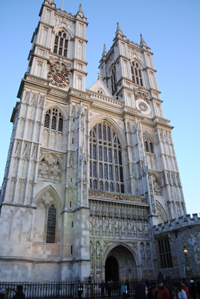
Westminster-AbbeyWestminster Abbey (pictured): We’ve already talked about Poet’s Corner but Shakespeare himself makes mention of Westminster Abbey in his plays, notably in Henry VI, Part I, when it’s the scene of Henry V’s funeral. The Jerusalem Chamber, principal room of Cheyneygates, the medieval house of abbots of Westminster is mentioned in Henry IV, Part II.

The Houses of Parliament: True, the buildings have changed somewhat since Shakespeare’s day but the former Palace of Westminster is the site of scenes in numerous plays including Richard IIHenry IV, Part II and Henry VI, Part III are set. Among rooms mentioned is Westminster Hall which survives today from the original building.

The Tower of London: As one would expect, this prominent London landmark pops up in several of Shakespeare’s plays including Henry VI, Part I and Richard III where its plays a rather central role – among the events recorded in the latter play are the infamous drowning of Richard III’s elder brother George in a butt of Malmsey wine.

Ely House: The London residence of the bishops of Ely, this long gone building is mentioned in Richard II (for more on Ely House see our earlier posts on Ye Olde Mitre Tavern here and St Etheldreda’s Church here ).

The London Stone: Now at 111 Cannon Street, the London Stone originally was located at another location in Cannon Street and its here in Henry VI, Part II, that rebel Jack Cade stops to strike his sword upon the stone (for more on the London Stone, see our earlier post here).

Other London sites mentioned in Shakespeare’s plays include generic “London Streets” (mentioned in a number of plays), “Eastcheap, near the Boar’s Head Tavern” (Henry IV, Part II), the Temple Garden (Henry VI, Part I) and Blackheath (Henry VI, Part II).

Famous Londoners – Madame Tussaud…

Famed around the world for her London-based wax museum (and the chain of waxworks which now bears her name), French-born Madame Tussaud is a towering figure of the early 19th century.

Born Anna Maria Grosholtz in Strasbourg on 1st December, 1761, Marie Tussaud’s association with waxworks came early when, her father Joseph having apparently died from wounds sustained in the Seven Years War just before her birth, she accompanied her mother Anna Maria Walder to Berne in Switzerland where her mother took up a position as a housekeeper for a physician and anatomical wax sculptor and portraitist Dr Philippe Curtius.

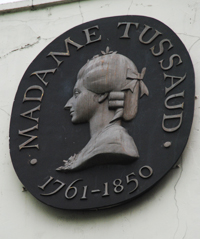
Madame-TussaudIn 1765, Dr Curtius moved to pre-Revolutionary Paris where he was soon to open a couple of establishments – at the Palais-Royal and the Boulevard du Temple (later consolidated at the latter site) – displaying his works in wax. Marie, whom Dr Curtius brought to Paris with her mother in 1768, started working with him on wax models and in 1777, at the age of just 16, produced her first wax figure, that of philosopher Voltaire. Other early works of Madame Tussaud’s depicted Rousseau and Benjamin Franklin.

The story goes that such was the renown of Tussaud and her “uncle” Dr Curtius, that their social circle came to include members of the Royal Family. Tussaud is widely believed to have been an art tutor to King Louis XVI’s sister Elizabeth and may have even taken up residence at Versailles.

Tussaud recounts that she was arrested during the French Revolution – the story goes that she was imprisoned and eventually released thanks to the intervention of family friend and revolutionary Jean-Marie Collot d’Herbois but whether this is true remains a matter of debate.

Tussaud claims she was then forced make death masks of those who ended their life on the scaffold including Louis XVI, Marie Antoinette, Marat and Robespierre. When Curtius died in 1794, she inherited his wax works and the following year married an engineer Francois Tussaud with whom she had two sons, Joseph and Francois (later known as Francis).

In 1802, Madame Tussaud accepted an invitation to go to London to exhibit her work at the Lyceum Theatre but thanks to the outbreak of the Napoleonic Wars, she and her four-year-old son Joseph were unable to return to France. Separated from her husband, she subsequently spent the next three decades travelling with her exhibition – which included relics from the Revolution and, like those of Curtius, was being constantly updated to reflect current affairs – around Britain and Ireland.

Her son Francois joined her in 1822 and Tussaud continued travelling until 1835 when she first established a permanent exhibition in Baker Street, London. Known as the Baker Street Bazaar, it apparently contained more than 400 wax figures. In 1846, Punch Magazine is credited with having invented the term ‘Chamber of Horrors’ for the room where the relics of the French Revolution were displayed.

Tussaud wrote her memoirs in 1838, and, in 1842, completed a wax model of herself. She died in her sleep on 16th April, 1850, in London. Her son Francois became chief artist for the exhibition after her retirement – he was succeeded by his son and then grandson. The exhibition moved to its current site in Marylebone Road in 1884.

Now owned by the Merlin Entertainments Group, Madame Tussauds has branches in cities in some 10 countries as well as its London base. Many of her original models still exist and are on display in the London museum along with the exhibition’s oldest attraction – known as ‘Sleeping Beauty’, it dates from 1863 – a breathing likeness of Louis XV’s sleeping mistress Madame du Barry.

For more on Madame Tussauds today, see www.madametussauds.com.

For more on the life of Madame Tussaud, see Kate Berridge’s book, Waxing Mythical: The Life and Legend of Madame Tussaud.

10 sites from Shakespearean London – 9: Memorialising Shakespeare (part 2)…

Following on from last week’s post, we look at a couple more London memorials to The Bard,  playwright William Shakespeare…

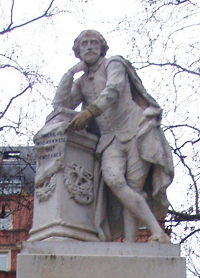
Shakespeare-Leicester-SquareLeicester Square: Returned to the West End square last year following its restoration (and the square’s redevelopment), this statue of Shakespeare – claimed to be the only outdoor one in London – was designed by architect John Knowles in 1874 when the square was constructed. Now Grade II-listed, it depicts Shakespeare leaning on a pedestal, pointing to a scroll which reads “There is no darkness but ignorance”, a quote from Twelfth Night. An inscription on the plinth upon which Shakespeare stands, refers to the laying out of the square by Albert Grant and doesn’t mention the playwright at all. The statue stands in the middle of a fountain, upgraded  as part of the recent overhaul of the site. PICTURE: Carcharoth/Wikipedia.

Primrose Hill: Shakespeare’s Tree on Primrose Hill was originally planted in April, 1864, to mark the 300th anniversary of his birth. An estimated 100,000 people marched to the site to watch the tree planting by poet Eliza Cooke and actor Samuel Phelps which was organised by the Workingmen’s Shakespeare Committee – apparently in response to the lacklustre efforts of a government-backed committee to mark the anniversary. The tree stood for 100 years before it died and was replaced with an oak sapling planted in 1964 actress Dame Edith Evans. A plaque which was attached to the tree detailing when it was planted has long since gone but there is talk of some sort of a permanent new memorial on the site.

There are other numerous places in London where Shakespeare – and his works – are remembered in London. One of our favourites is based in Love Lane and recalls the work of John Heminge and Henry Condell is getting Shakespeare’s works out to the world (for more on this, see our previous post here).

In our final post in this series next week, we take a look at some of the key London locations mentioned in Shakespeare’s plays.

What’s in a name?…Bond Street…

Bond-Street

No, the name of the famous Bond Street in Mayfair has nothing to do with James Bond. Rather, the street – in fact, two streets named Old and New Bond Street – takes its name from a 17th century courtier, Sir Thomas Bond.

Bond was the comptroller of the household of Queen Henrietta Maria, then the Queen Mother thanks to being the widow of King Charles I and the mother of King Charles II. He was also something of a land developer – the head of a consortium that purchased Albermarle House from Christopher Monck, the 2nd Duke of Albermarle, in 1683.

The house was promptly demolished and the area redeveloped with what is now Old Bond Street – which runs from Piccadilly to Burlington Gardens – laid out in 1686 and given Sir Thomas’ surname (he’d died the previous year).

AlliesThe northern extension of Old Bond Street (which runs from Burlington Gardens to Oxford Street) – named New Bond Street – was developed in the 1720s. Caroline Taggart, in The Book of London Place Names, says it was residents of Old Bond Street who insisted on the use of ‘new’ in the name, no doubt to differentiate between themselves and the newcomers or, as Taggart suggests, ‘upstarts’.
Traditionally known as a location for art dealers (Sotheby’s auction house – identified by an ancient Egyptian bust of the goddess Sekhmet which sits on the facade – has stood there for more than a century), the street has become increasingly known for its luxury fashion and accessories retailers such as Asprey’s, Chanel, Cartier, Dolce & Gabbana, Bulgari and Tiffany & Co (see the Bond Street Association for more). Other landmark buildings in the street include the home of the Fine Art Society and the Royal Arcade.

Bond Street is also home to US sculptor’s Lawrence Holofcener’s work, Allies (pictured above), depicting former British PM Winston Churchill and US President Franklin D Roosevelt, and at the northern end stands the Bond Street Underground Station which opened in 1900.

Famous residents have included Admiral Horatio Nelson – who stayed at number 147 in 1797-98 while he recovered after losing his arm at Tenerife, eighteenth century satirist Jonathan Swift and politician William Pitt the Elder, as well as twentieth century spy Guy Burgess, who lived at Clifford Chambers before his defection to USSR.

Around Christmas, the street plays host to a rather special display of lights (pictured top).

Books – ‘The Devil in the Marshalsea’…

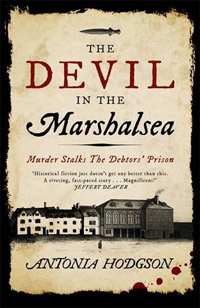
The Devil in the MarshalseaAntonia Hodgson, Hodder & Staughton, 2014

The-Devil-in-the-MarshalseaA murder-mystery set among the desperate and dangerous denizens of London’s Marshalsea Prison in 1727, The Devil in Marshalsea tells the story of lad-about-town Tom Hawkins who is tossed into the notorious prison for debt.

Hawkins’ only chance of escape is to find the killer of one Captain Roberts, who died in the jail before his arrival, and it’s a task that brings him into conflict with, and under the suspicion of, many within the prison walls.

There’s plenty of historical detail and the book delivers an insightful look into what life in Marshalsea would have been like – although as Hodgson points out in an historical note at the start, this is not the Marshalsea of Charles Dickens’ Little Dorrit – that wasn’t opened until 1800 on a different site while this one was located between Mermaid Court and what is now Newcomen Street in Southwark.

The characters are largely based on actual people – Hodgson goes to the trouble to describe the background to each in some explanatory endnotes – and their stories criss-cross the main narrative.

There’s plenty of twists along the way and the story plunges on at a cracking pace as Hawkins has to confront his worst fears and struggles to discern who is friend and who is foe in a world where everyone appears to be driven by their most base desires.

An enlightening read and, as is the case with a good murder-mystery, hard to put down. A terrific debut.

To buy this book, follow this link The Devil in the Marshalsea.

10 sites from Shakespearean London – 8: Memorialising Shakespeare (part 1)…

Shakespeare

This week (and next week) as part of our look at Shakespeare’s London, we’re taking a look at a few of the many memorials to William Shakespeare located around London…

• Westminster Abbey: Perhaps the most famous of London’s memorials to Shakespeare can be found in Poet’s Corner, an area of the abbey which has become noted as a burial place and memorial site for writers, playwrights and poets. Designed by William Kent, the memorial statue of Shakespeare was placed here in January, 1741 (there had apparently been some earlier talk of bringing his bones from Stratford-upon-Avon but that idea was squashed). The life-size statue in white marble, sculpted by Peter Scheemakers, was erected by Richard Boyle, the 3rd Earl of Burlington, Dr Richard Mead, Alexander Pope and Tom Martin. The memorial also features the heads of Queen Elizabeth I, King Henry V and King Richard III on the base of a pedestal and shows Shakespeare pointing to a scroll on which are painted a variation of lines taken from The Tempest. A Latin inscription records the date the memorial was created and an English translation of this was added in 1977. For more on the abbey, see www.westminster-abbey.org.

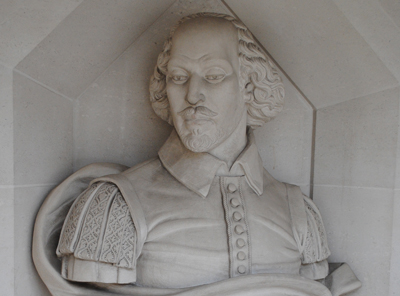
• Guildhall Art Gallery (pictured above): Facing into Guildhall Yard from niches under the loggia of the Guildhall Art Gallery are four larger-than-life busts of historical figures connected with the City of London. As well as one of Lord Protector Oliver Cromwell, architect Christopher Wren, and diarist Samuel Pepys (along with a full-length statue of Dick Whittington and his famous cat) is a bust depicting Shakespeare. Carved out of Portland stone by sculptor Tim Crawley, the busts were installed in 1999. Much attention was apparently paid to creating a bust which resembled pictures of Shakespeare. Follow this link for more on the gallery.

Former City of London School: This Thames-side building, dating from the 1880s, features a full length statue of Shakespeare who gazes out over the river. He’s not alone – poet John Milton, Sir Isaac Newton, Sir Thomas More and Sir Francis Bacon stand nearby, selected, apparently, to represent various disciplines taught at the school. The statues were the work of John Daymond who depicted Shakespeare flanked by representations of classics and poetry and drawing and music. The school vacated the building on Victoria Embankment  in the 1980s and it’s now occupied by JP Morgan.

We’ll be looking at some more works depicting Shakespeare next week…

London Pub Signs – The Hung, Drawn and Quartered…

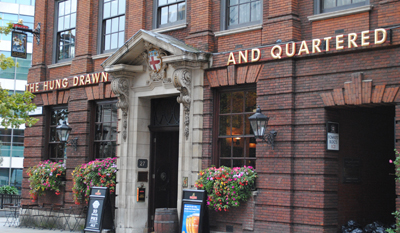
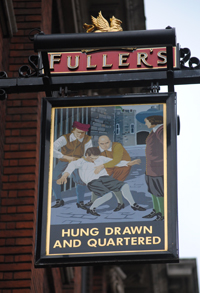
Hung-longThe rather grisly name of this pub (and there’s some debate over whether hanged or hung is grammatically correct) relates to its location close by the former public execution ground of Tower Hill.

While for many Tower Green inside the Tower of London is synonymous with beheadings, only seven people, including Anne Boleyn, were ever actually executed there. Far more people were executed outside the Tower’s walls at nearby Tower Hill, just to the north.

HungSome of the names of those executed here are recorded on a memorial at the site – everyone from Simon Sudbury, the Archbishop of Canterbury who was beheaded here by an angry mob in 1381, through to Sir Thomas More in 1535 (gracious King Henry VIII commuted his sentence from being hung, drawn and quartered to mere beheading), and Simon Fraser, the 11th Lord Lovat, a Jacobite arrested after the Battle of Culloden and the last man to be executed here when his head was lopped off in 1747.

While, as you can see above, many of those executed at Tower Hill were beheaded (and most were of the nobility), there were some executions there which did involve the guilty party being hung, drawn and quartered – a punishment reserved for those being convicted of high treason and also enforced at other sites in London including at Tyburn and Smithfield. Among them was William Collingbourne in 1484 for supporting the cause of Henry Tudor against that of King Richard III.

A plaque on the external wall of the nearby pub quotes a passage from the famous diarist Samuel Pepys after he witnessed an execution in Charing Cross on 13th October, 1660: “I went to see Major General Harrison. Hung drawn and quartered. He was looking as cheerful as any man could in that condition”.

Thomas Harrison fought with Parliament during the Civil War and was among those who signed the death warrant of King Charles I. Found guilty of regicide after the Restoration, he was hung, drawn and quartered (though as Pepys tells us, not here).

The pub, located at 26-27 Great Tower Street, is part of the Fuller’s chain. For more, see www.hung-drawn-and-quartered.co.uk.

10 sites from Shakespearean London – 7. Shakespearean connections in the Elizabethan world – St John’s Gate and Staple Inn…

Following on from our post last week, we take a look at a couple more of London’s buildings that had some sort of association with William Shakespeare…

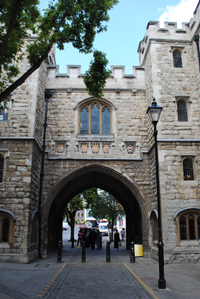
St-John's-Gate St John’s Gate, Clerkenwell (pictured): This former gatehouse into Clerkenwell Priory was at the time of Shakespeare home to the Master of the Revels and where the playwright would have had to have brought his plays for official government approval. Thirty of the Bard’s plays were licensed here and the Master of Revels during all but the final few years of Shakespeare’s career was Edmund Tilney (or Tylney), who served in the post under both Queen Elizabeth I and King James I. The gatehouse was later used as a coffee house and pub among other things and is associated with everyone from artist William Hogarth (his father Richard ran the coffee house), Dr Samuel Johnson and Charles Dickens. These days, the gatehouse is part of the Museum of the Order of St John (for more on that, see our earlier post here).

Staple Inn, Holborn: OK, there’s no direct link at all between Shakespeare and this building on High Holborn but it was built during his lifetime – in 1585 – and as such is one of very few surviving examples of buildings of his era. Its name comes from the fact the site where it stands was originally a covered market where wool was weighed and taxed (the word ‘staple’ apparently relates to the duty on wool introduced in 1275). It later became an Inn of Chancery – a medieval school for lawyers which fed students through to the Inns of Court (in this case mostly Gray’s Inn), and it was members of the Society of Staple Inn who built the new building here in the 1580s. The building – which still boasts a grand hall – survived the Great Fire of London in 1666 and, albeit with considerable damage, the Blitz. Since the late 1800s, it has been home to what’s now known as the Institute and Faculty of Actuaries. The building, which was restored in the 1990s, is a great example of an Elizabethan-era structure and gives some sense of what Shakespeare’s London was like.

LondonLife – Unearthing Bedlam’s buried past…


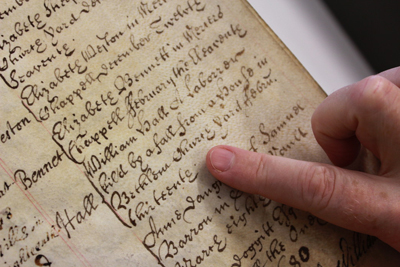
Buried-at-BedlamA team of volunteers are searching through historical records for evidence of people buried at the Bedlam burial ground in the 16th and 17th centuries. The 15 member team are carrying out the work at the London Metropolitan Archives as archaeologists prepare to excavate 3,000 skeletons from the former burial site next year in anticipation of the construction of the new Liverpool Street Crossrail Station – part of the £14.8 billion cross London Crossrail project. About 400 skeletons have already been removed during preliminary works. Located near Bethlem Hospital, the burial ground opened in the 16th century as part of the city’s response to the plague and was the first burial ground in London not associated with a parish church. Among those buried here were Robert Lockyer, a soldier executed under the orders of Oliver Cromwell for leading the Bishopsgate mutiny of 1649, and Leveller John Lilburne. Crossrail are keen to hear from members of the public who may be able to provide further details of burials at Bedlam – if you can help, email bedlamrecords@crossrail.co.uk.


10 sites from Shakespearean London – 6. Shakespearean connections in the Elizabethan world: The George Inn and Middle Temple Hall…

Today we’re taking a look at a couple of still extant London buildings which have strong associations with playwright William Shakespeare…

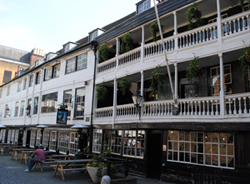
George-InnThe George Inn, Southwark. Located at 75-77 Borough High Street, the George Inn is London’s last remaining galleried inn. The current building has its origins in the late 17th century after the original inn, which can be traced back to at least the mid-1500s – was destroyed in a fire in 1676. Now owned by the National Trust, it is leased out and remains open as a public house – part of the Greene King chain. While its known for its connections with 19th century writer Charles Dickens – he was a patron of this establishment and mentions it in Little Dorrit (a fact we mentioned in our series on Dickens back in 2012), the inn (or at least the previous version of it) also has Shakespearean connections with its prime Southwark location meaning it’s quite possible Shakespeare himself may have visited. Whether that’s the case or not, it is known that the premises served at time as a theatre of sorts in his day with acting troops performing in the courtyard while audience members could stand in the courtyard and watch or pay extra for a seat in the gallery. For more on the inn, see www.gkpubs.co.uk/pubs-in-london/the-george-inn-pub/.

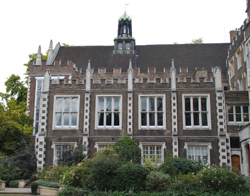
Middle-Temple-HallMiddle Temple Hall. Built between 1562 and 1573 by Edmund Plowden (memorialised with monuments in both the hall and nearby Temple Church), this magnificent Tudor hall has survived both the Great Fire of London and the Blitz and continues to serve the legal profession today. It too was used as a theatre/concert hall in Elizabethan times and later as a site for Inigo Jones’ masques but in terms of the Shakespearean connection, it is known for being where the first recorded performance of Twelfth Night took place – on the night of Candlemas (2nd February) 1602. The Lord Chamberlain’s Men performed the play and it is thought that Shakespeare himself was among the players. For more on the hall, which is only rarely opened to the public, you can visit our earlier posts here and (on ‘Drake’s Cupboard) here or the official website at www.middletemple.org.uk/home/.

For more on the George Inn, check out Pete Brown’s social history Shakespeare’s Local: Six Centuries of History Seen Through One Extraordinary Pub.


Famous Londoners – Philip Henslowe…

A contemporary of William Shakespeare (and hence, given our current focus on Shakespeare, the reason why we’re featuring him), Philip Henslowe was a theatre owner and impresario who, along with John Chomley, built the Rose Theatre in Bankside.

Henslowe is believed to have been born in about 1550 and was the son of Edmund Henslowe, master of the game at Ashdown Forest in Sussex. He is known to have moved to London in the 1570s and there became an apprentice to dyer Henry Woodward. Marrying Woodward’s widow Agnes, from 1577 Henslowe lived in Southwark – in the Liberty of the Clink – where, along with other business interests including bringing in timber from Sussex, he is known to have been a prominent landlord.

He and Chomley built The Rose Theatre – the first theatre in Bankside – in 1587 on land Henslowe had purchased several years earlier and from 1591 onwards, he partnered with the acting company known as the Admiral’s Men (they had parted ways with theatre owner James Burbage after a dispute about money). In fact it was the company’s leading actor, the renowned Edward Alleyn, who married Henslowe’s step-daughter Joan.

Following the arrival of the rival Globe Theatre in Bankside in the late 1590s, Henslowe decided to make a move and built the Fortune Theatre in the north-west corner of the City which subsequently became home to the Admiral’s Men. He is also believed to have had interests in several other theatres – Newington Butts, the Swan and more latterly, the Hope in Paris Garden, a versatile facility which could be used as both animal-baiting ring and theatre.

His prominence in business matters led to many rewards including serving as a Groom of the Chamber during the reign of Queen Elizabeth I and the delightfully named Gentleman Sewer of the Chamber during the reign of King James I.

He died in 1616, leaving behind a diary which spans the period 1592 to 1609 – it includes mention of performances of many of Shakespeare’s plays and although the Bard himself doesn’t get a mention, many of his contemporaries – Christopher Marlowe and Ben Jonson included – do. The diary – which had been written in an old account book and provides great detail of Henslowe’s theatre-related business – passed into the care of Dulwich College which his son-in-law had founded.

Click here to buy Henslowe’s Diary.

10 sites from Shakespearean London – 5. Other Elizabethan theatres…

Last week we had a look at two former theatres in Shoreditch which had strong associations to William Shakespeare and in previous weeks we’ve talked about both The Globe and Blackfriars Playhouse. So this week we thought we’d wrap up our look at Elizabethan theatres with a brief glance at a couple of other theatrical establishments which may have had some association with The Bard…

The Rose. Built by Philip Henslowe in 1587, the theatre is located close to where The Globe later stood in Bankside. Many companies performed here – including Lord Strange’s Men in 1592 when, according to some, Shakespeare may have been the actors in the company. The theatre’s remains are open to the public. For more on The Rose, you can see our earlier Lost London entry.

The Swan. Built by Francis Langley in the mid 1590s in the Paris Gardens area in the west of Bankside, The Swan was the most impressive of London’s theatres when first constructed due to both its size – it’s believed to have held an audience as big as 3,000 people – and the manner of its construction. It’s a matter of debate whether the Lord Chamberlain’s Men – the acting troupe Shakespeare was a part of – ever performed here while waiting for the Globe to be built. By the early 1630s, the theatre had apparently fallen into disrepair.

Newington Butts. In use from 1580, this theatre was located in Surrey (the name is now preserved in that of the street still known as Newington Butts just to the south of the Elephant & Castle roundabout). Little is known about the theatre but it’s believed the Lord Chamberlain’s Men played here in the mid 1590s and apparently gave their earliest known performances of a number of Shakespeare’s plays including Titus Andronicus and The Taming of the Shrew took place. Butts were typically used in the national sport of archery but that may not apparently be the explanation behind the name here which may instead refer to an odd-shaped area of land.

For more on Elizabethan theatre, check out Elizabethan-Jacobean Drama: The Theatre in its Time.

What’s in a name?…Bayswater

The origins of the name of this inner west London location on the northern side of Hyde Park and Kensington Gardens go back to at least the 14th century when it was recorded as Bayard’s or perhaps Baynard’s watering place.

Bayard was the word for a bay-coloured horse but it is thought that instead the name here comes from a local landowner – it’s been suggested he may be the same Baynard whose name is was remembered in the long gone Norman fortification Baynard’s Castle in the City.

The name probably referred to a site where people on their way out of or headed to London stopped for a rest and some water; the water aspect may relate to springs or to the Westbourne Stream which ran through the area.

It’s now known for its culturally diverse population and high concentration of hotels. It’s also known for Georgian terraces – many of which have been converted into flats, mansion blocks and garden squares.

Notable residents have included Peter Pan author JM Barrie and former PM’s Tony Blair and Winston Churchill while landmarks include Whiteleys, a department store which first opened in the mid 19th century (and was later rebuilt after burning down).

10 sites from Shakespearean London – 4. Shakespeare’s Shoreditch theatres…

While the association between the Bard and Bankside’s Globe Theatre is well known (see our earlier post here for more), the Bard and his plays were also performed in various other theatres around London. Here we take a quick look at a couple in Shoreditch, then a more rural suburb of London known for its associations with the (somewhat seedy) entertainment industry…

The-Theatre The Theatre, Shoreditch. Built in 1576 by James Burbage on property that had once been part of Holywell Priory, the Theatre was the home of a number of acting companies including The Lord Chamberlain’s Men of which Shakespeare was a member. The polygon-shaped theatre served as the home of the company between 1594 and 1598 when a dispute with a landlord over the lease led them to leave, temporarily settling at The Curtain Theatre, before rebuilding their theatre, now renamed The Globe, in Southwark. Between 2008 and 2010, archaeologists from Museum of London Archaeology (MOLA) carried out an investigation beneath a disused warehouse in New Inn Broadway, near the intersection of Curtain Road and Great Eastern Street, and found the remains of a 14 sided theatre about 22 metres across. Plans have been mooted to build a new theatre on the site. To find out more about The Theatre and see a terrific animated recreation by Cloak & Dagger Studios and MOLA (pictured), head to www.explorethetheatre.co.uk. PICTURE: Courtesy of MOLA (Museum of London Archaeology) and Cloak and Dagger Studios.

The Curtain Theatre, Shoreditch. The Lord Chamberlain’s Men only performed here temporarily, between 1598-1599, before relocating to Southwark. Henry V (the reference to “this wooden O” in the prologue of the play is taken to refer to this theatre) and Romeo and Juliet are believed to be among Shakespeare’s plays which premiered here. Located just a couple of hundred yards south of The Theatre and built the year after it, it also hosted Ben Jonson’s Every Man in his Humour, a play in which Shakespeare is known to have performed. The polygonal theatre’s name comes from the road on which it stood – Curtain Road, which, it has been suggested, was named after the Holywell Priory’s ‘curtain wall’. It continued as a theatre until the 1620s and was later converted into tenements. The remains of what is believed to have been the Curtain Theatre were found by MOLA archaeologists in 2012 and further excavations are expected with the hope that one day the site will be open to the public with plays performed here. There is a plaque commemorating the site at 18 Hewett Street which is only a short distance from where the excavations were carried out. For more on the Curtain Theatre, check out www.shakespearesshoreditch.com.

For more on Elizabethan theatres, see Julian Bowsher’s Shakespeare’s London Theatreland: Archaeology, History and Drama.

London Pub Signs – The Globe…

GlobeNo, this pub on Moorgate is not related to William Shakespeare. Its name actually comes from the globe which was used as the emblem of Portugal and advertised the fact that fine Portuguese wines were on sale at the premises.

According the pub’s website, there were eight pubs with the sign of the Globe in London during the reign of King Charles I (when this pub was apparently founded). By the middle of the 19th century, the number had risen to more than 30.

There are still a few other Globe pubs in London – as well as this one, others include the Globe in Marylebone Road and The Globe Bow Street (although we’re not sure whether their names were derived in the same way).

The pub, which is located at 83 Moorgate – close to where Moorgate once punctured London’s city wall and gave access to the fens known as Moorfields. In 2008, the pub merged with the neighbouring pub, the John Keats, now commemorated in the name of the bar (that pub was named for the Romantic poet John Keats, who it has been speculated was born in a pub on the site in 1795).

The pub is now part of the Nicholson’s group. For more, check out its website at www.nicholsonspubs.co.uk/theglobemoorgatelondon/.

This Week in London – Celebrating the Year of the Bus; the British Library looks at WWI; medieval jousting and The Duke of Wellington; and, Blue Plaque nominations resumed…

BusesAlmost 50 buses, from a horse-drawn model of the 1820s to the New Routemasters of today, will come to Regent Street on Sunday in celebration of the Year of the Bus. The ‘Regent Street Bus Cavalcade’ – which will stretch from Piccadilly Circus to Oxford Circus and will see the iconic West End street closed to traffic – will also feature a variety of free family events including Lego workshops (there will be a bus shelter and bus stop made entirely out of Lego outside Hamley’s toy shop), children’s theatre performances, a pop-up London Transport canteen and the chance to have a personal message recorded by the voice of London’s buses, Emma Hignett. There will also be an exhibition – Battle Bus – which provides information about the B-type bus (a newly restored version of which will be on display) which was used during World War I to carry soldiers to the frontline as well as ambulances and mobile pigeon lofts while jewellery company Tatty Devine will feature a special range of bus-inspired jewellery and hold jewellery-making workshops on board a London bus. The cavalcade, supported by the Regent Street Association and The Crown Estate, is part of Transport for London’s celebrations marking the Year of the Bus, organised in partnership with the London Transport Museum and the capital’s bus operators. The free event runs from 11.30am to 6pm. For more information, see www.tfl.gov.uk/yearofthebus and www.ltmuseum.co.uk.

A new exhibition of materials showing how people coped at home and on the front during World War I opens at the British Library in King’s Cross today as part of efforts to mark the war’s centenary. Enduring War: Grief, Grit and Humour features personal objects such as letters, a handkerchief bearing the lyrics of It’s A Long, Long Way to Tipperary, Christmas cards, school essays about airship raids over London sit and recruitment posters, humorous magazines and even a knitting pattern for balaclavas. Highlights include a letter in which Sir Arthur Conan Doyle expresses his concern over his son serving at the front, manuscripts by war poets such as Rupert Brooke as well as Wilfred Owen’s manuscript for Anthem for Doomed Youth, Vaughan Williams’ A Pastoral Symphony and Laurence Binyon’s For the Fallen. A specially commissioned video and ‘soundscape’, Writing Home, features personal messages contained on postcards written to and from the front. A range of events accompanies the free exhibition. Runs until 12th October. For more on the exhibition, see www.bl.uk.

Armoured knights on horseback can be seen jousting at Eltham Palace in south London this weekend. The former childhood home of King Henry VIII will host a Grand Medieval Joust which will also include displays of foot combat, the antics of a court jester, medieval music performances and a series of children’s events including a knight’s school. Runs from 10am to 5pm on both Saturday and Sunday. Admission charge applies. For more, see www.english-heritage.org.uk/events. Meanwhile, the Battle of Waterloo is being remembered at the Duke of Wellington’s home of Apsley House near Hyde Park Corner. Visitors will come face-to-face with Wellington’s troops and their wives, having the chance to take a look inside a soldier’s knapsack, see the equipment he used and the drills he performed as well as see the Battle of Waterloo recreated in vegetables. The Waterloo Festival – this year marks 200 years since Napoleon’s abdication and exile to Elba – runs from 11am to 5pm on Saturday and Sunday. Admission charge applies. For more, see www.english-heritage.org.uk/apsley/.

Nominations have reopened for English Heritage’s Blue Plaques scheme in London. In 2012 nominations were temporarily suspended while new funding for the scheme was found and thanks to one individual’s donation and the creation of a new Blue Plaques Club to support the scheme on an ongoing basis, they have now reopened. There are 880 official Blue Plaques on London’s streets – remembering everyone from Florence Nightingale to Fred Perry and Charles Darwin. For more and details on nominations, see www.english-heritage.org.uk/discover/blue-plaques/.

Send all items of interest for inclusion to exploringlondon@gmail.com.

10 sites from Shakespearean London – 3. Shakespeare’s houses…

The playwright is believed to have lived in several different locations in London and is also known to have invested in a property. Here we take a look at a couple of different locations associated with him…

St-Helen'sBishopsgate: Shakespeare is believed to have lived here in the 1590s – in 1596 tax records show he was living in the parish of St Helen’s. The twin-nave church of St Helen’s Bishopsgate (pictured), which would have been his parish church, still stands. In fact, there is a window to Shakespeare’s memory dating from the late 19th century.

•  Bankside: In the late 1590s, Shakespeare apparently moved across the Thames to Bankside where he lived at a property on lands in the Liberty of the Clink which belonged to the Bishop of Winchester. The exact address remains unknown.

Silver Street, Cripplegate: It’s known that in 1604, Shakespeare moved from Bankside back to the City – it’s been speculated outbreaks of plaque may have led him to do so. Back in the City, he rented lodgings at the house of Christopher and Mary Mountjoy in on the corner of Monkwell and Silver Streets in Cripplegate, not far from St Paul’s Cathedral. Mountjoy was a refugee, a French Huguenot, and a tire-maker (manufacturer of ladies’ ornamental headresses). The house, which apparently stood opposite the churchyard of the now removed St Olave Silver Street, was consumed in the Great Fire of London in 1666 (the church was also lost in the Great Fire). The former church site is now located on the south side of London Wall. Silver Street itself was wiped out in the Blitz and is now lost under the Barbican redevelopment but the house lives on in a representation found on a late 16th century map created by Ralph Agas.

Ireland Yard, Blackfriars: In 1613, Shakespeare purchased the former gatehouse of the Blackfriars Priory located here, close to the where the Blackfriars Theatre was located. It is believed the property was purchased as an investment – there’s no evidence he ever lived there but it was passed to his daughter Susanna after his death. Incidentally, there is some speculation that Shakespeare may have lived in Blackfriars when he first came to London – a man believed to have been a boyhood friend from Stratford, Richard Field, who was known to have lived there.

For a more in-depth look at Shakespeare’s time in Silver Street, see Charles Nicholl’s The Lodger: Shakespeare on Silver Street.

A Moment in London’s History – The day the Globe Theatre burnt down…

FireSince we’re talking about all things Shakespearean at the moment, we though we’d take a look again at the day on which The Globe Theatre burnt down.

The theatre was only about 14-years-old when on  29th June, 1613 – the 400th anniversary of which passed last year – a “special effects” cannon was fired during a performance of King Henry VIII (also known as All is True) – specifically as the king made his entrance on the stage. While cannons had apparently been used for years with no ill effect – that was not to be the case this time.

It is said sparks from the cannon landed on either directly on the theatre’s thatched roofing or a roof beam near the thatch and caught fire – there are also suggestions the fire was in fact caused when one of the stoppers used to block up the cannon came into contact with the thatch.

Theatre patrons apparently initially thought the smoke was simply from the cannon blast but can’t have been confused for long – the fire was said to have moved very quickly; in fact one contemporary letter writer – author, diplomat and politician Sir Henry Wotton – says the entire theatre was burnt to the ground in less than an hour.

The audience – the theatre is thought to have housed some 1,000 people seated and a further 2,000 standing – is thought to have escaped unharmed. There are no reports, at least, of any deaths as a result of the fire.

The theatre was quickly rebuilt – apparently more opulently – and reopened the following year. Traces of the burnt theatre was found during an excavation of the Globe site in 1989.

For more on The Globe, see our earlier post here.

PICTURE: Ashley Nummerdor/www.freeimages.com

Famous Londoners – Christopher Marlowe…

Born the same year as Shakespeare, Christopher Marlowe was, like him, one of the foremost dramatists of the Elizabethan era.

EdwardiiquartoBorn in Canterbury the son of shoemaker John Marlowe and his wife Catherine in 1564 (he was baptised on 26th February and likely to have been born a few days before), Marlowe attended the King’s School in the city and went on to study at Corpus College in Cambridge, receiving a Bachelor of Arts in 1584 and a Master of Arts in 1587. It is believed that at around this time, he was also working secretly for the government of Queen Elizabeth I, although what the nature of that work was remains unknown.

While Marlowe’s first play was Dido, Queen of Carthage, he first found theatrical success in 1587 with Tamburlaine the Great, later followed with a second part. His other four plays included The Jew of Malta, Edward the Second, The Massacre at Paris about the St Bartholomew’s Day Massacre in 1572, and Doctor Faustus.

The plays served as key works for the Admiral’s Men, the company of Edward Alleyn who performed many of the key roles in the plays, and who is strongly associated with the Rose Theatre  – indeed it was here that Tamburlaine the Great, The Jew of Malta, and Doctor Faustus premiered (you can see our earlier post on the theatre here).

Marlowe, who is known to have lived in Shoreditch, also completed other works included poetry and translations and while there is little evidence about his personal life, there is much speculation including that he was, as aforementioned, a spy as well as a carouser (he is known to have frequented taverns in London including Ye Olde Cock in Fleet Street), a homosexual and/or a heretic. It has also been suggested he was a tutor to noblewoman Arabella Stuart.

It is known that he was arrested in 1592 in Flushing in The Netherlands for counterfeiting coins and was sent back to England but no further action was taken.

His death is one of the big mysteries of his life. A warrant was issued for Marlowe’s arrest over some heretical tracts which were found in the lodgings of his colleague Thomas Kyd (who when questioned apparently implicated him) and he appeared to answer to the Privy Council on 20th May, 1593. They weren’t sitting and he was apparently instructed to appear daily until further notice. He was dead 10 days later.

The exact circumstances of his death remain a matter of speculation. It is often said he died in a drunken brawl with one early source suggesting this was over a homosexual love affair and another, more recent, theory suggesting he even faked his own death to avoid being executed for heresy (an extrapolation of this theory goes that after his fake death he continued writing plays under the name of William Shakespeare but this is generally deemed fairly far-fetched). The official account recorded at the time was that he was stabbed to death in a brawl over payment of a bill with men at a house in Deptford.

He was buried in an unmarked grave at St Nicholas’ Church in Deptford. There is a memorial window to him in Poet’s Corner in Westminster Abbey. A gift of the Marlowe Society, it was unveiled in 2002 and controversially included a question mark after the generally accepted date of his death. There is a portrait, dated 1585,  generally believed to be of Marlowe at Cambridge.

PICTURE: Title page of the earliest known edition of Edward II (1594)/Wikipedia