Around London: Masques of the Stuart Court; saving London’s heritage; IEDs at the NAM; and, Eighties fashion at the V&A…

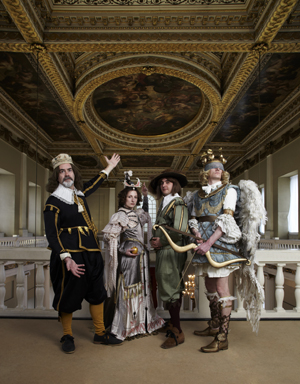
Stuart-masque-at-Banqueting-HouseThe sights and sounds of the elaborate masques of the early Stuart Court – described as a cross between a ball, an amateur theatrical, and a fancy dress party – are being recreated at the Banqueting House in Whitehall. Historic Royal Palaces have joined with JB3 Creative to create an “immersive theatrical experience” for visitors to the building – one of the last surviving parts of the Palace of Whitehall – with the chance to try on costumes, learn a masque dance and witness performance rehearsals for Tempe Restored, last performed in the building in 1632. Inigo Jones will be ‘present’ as masque designer to talk about his vision for the performance. Weekends will also see musicians performing period music and on 27th July there will be a one-off evening event at the Banqueting House based on Tempe Restored. Admission charge applies. Performing for the King opens tomorrow and runs until 1st September. For more, see www.hrp.org.uk/BanquetingHouse/. PICTURE: HPR/newsteam.

A new exhibition looking at how some of London’s great Georgian and Victorian buildings were lost to bombs and developers before, after and during World War II – and how people such as poet John Betjeman campaigned to save them – opened in the Quadriga Gallery at Wellington Arch near Hyde Park Corner yesterday. Pride and Prejudice: The Battle for Betjeman’s Britain features surviving fragments and rare photographs of some of the “worst heritage losses” of the mid-20th century. They include Robert Adam’s Adelphi Terrace (1768-72) near the Strand, the Pantheon entertainment rooms (1772) on Oxford Street, and Euston Arch (1837). The English Heritage exhibition runs until 15th September. Admission charge applies. For more, see www.english-heritage.org.uk/daysout/properties/wellington-arch/.

IEDs (Improvised Explosive Devices) will be ‘uncovered’ in a new exhibition opening tomorrow at the National Army Museum. Unseen Enemy will tell the stories of the men and women in Afghanistan who search for, make safe and deal with the impact of the IEDs through personal interviews, images and mementoes. The exhibition has been developed with “unprecedented access” from the British Army, Royal Air Force and Royal Navy and will include a range of equipment used in detecting and disarming the devices, such as bombsuits and robots as well as medical equipment used to help those injured in explosions. The exhibition is free. For more, see www.nam.ac.uk.

On Now: Club to Catwalk – London Fashion in the 1980s. This exhibition at the V&A explores the “creative explosion” of London fashion during the decade and features more than 85 outfits by designers including John Galliano, Vivienne Westwood and Katherine Hamnett as well as accessories by designers such as Stephen Jones and Patrick Cox. While the ground floor gallery focuses on young fashion designers who found themselves on the world stage, the upper floor focuses on club wear, grouping garments worn by ‘tribes’ such as Fetish, Goth, High Camp and the New Romantics and featuring clothes such as those worn by the likes of Boy George, Adam Ant and Leigh Bowery. The exhibition also includes a display of magazines of the time. Entry charge applies. Runs until 16th February, 2014. For more, see www.vam.ac.uk. Meanwhile, tomorrow (Friday) night the V&A will celebrate the 25th anniversary of designer Jenny Packham with a series of four free catwalk shows in its Raphael Gallery. Booking is essential. Head to the V&A website for details.

10 Historic London Garden Squares…10. Charterhouse Square…

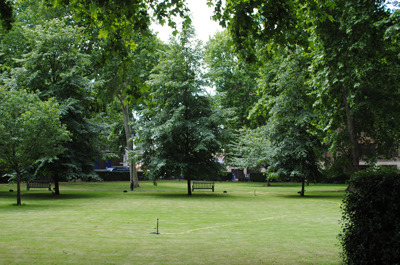
Charterhouse-Square-GardensThe final in our series on historic garden squares in London (for this year, anyway), we’re taking a look at Charterhouse Square.

The five sided square, located just to the east of Smithfield, takes its name from a Carthusian monastery which was established in 1371 on what is now its north side. Prior to this, what is now the square had from 1348 served as a location for a plaque burial pit (a number of skeletons from the plaque pit have been unearthed as part of the Crossrail project – for our earlier story on this, follow this link).

The monastery was dissolved in 1537 after the monk’s refused to recognise King Henry VIII’s Act of Supremacy (some were later executed at Tyburn) and it was subsequently transformed into a manor house with Thomas Howard, the 4th Duke of Norfolk, among its residents over the years (in fact he was imprisoned there around 1570 for allegedly plotting to marry Mary, Queen of Scots – he was later executed by Queen Elizabeth I for treason).

Under the will of Thomas Sutton, an almshouse and school was subsequently established on the site – the almshouse remains there while the school, whose students had included Methodism founder John Wesley and writer William Makepeace Thackeray, moved out to Godalming in Surrey in 1872. As well as the almshouse (which is open for guided tours, check this site for details), some of the buildings are now occupied by medical related institutions.

In the 1600s, the square was also home to numerous other large residences among them Rutland House, which had been the residence of the Venetian ambassador. It lost its aristocratic inhabitants in the ensuing centuries but remained mainly residential up until the late 19th century when it gradually became taken over by businesses and other organisations. Interesting to note is that the east side of the square is still home to the residential unit complex known as Florin Court, better known as Whitehaven Mansions, the home of Hercule Poirot in the TV series which bears his name.

The area of the garden square itself was variously referred to as the Charterhouse Churchyard, the Charterhouse Yard and Charterhouse Close over the years and has gone through numerous incarnations with efforts to improve and formalise its look dating back to at least the 16th century. It was at least partly enclosed by the late 1600s and the fences replaced several times, notably in 1742 when an Act of Parliament was passed allowing residents to fine those who entered without authorisation. The enclosing fences have since been modified several more times.

One of the major changes to the shape of the square occurred in 1860 when the Metropolitan Railway was extended between Farringdon and Moorgate. It was at this time that the road surface which surrounds the central garden, which has a Grade II heritage listing, was laid down.

Today the gardens in the centre of the square remain under the management of the Charterhouse (and hence aren’t open to the general public except on tours) but even without a tour it’s still a quiet place to walk around the outside of, evoking a strong sense of years gone past.

Famous Londoners – William Blake…

Poet. Painter. Visionary? William Blake failed to find great success in his lifetime and died in relative obscurity but is now known internationally for his controversial and innovative works in the written word and visual arts.

Blake was born on 28th November, 1757, at 28 Broad Street in Soho, the third son of hosier James Blake and his wife Catherine (he was christened at St James’s Piccadilly). Little is known of his early life although accounts suggest he had some spiritual experiences – including a vision of a tree full of angels – as a young boy and also showed an interest in the visual arts at an early age.

William-BlakeAbout the age of 10, he started attending Henry Par’s drawing school before, at the age of 14, becoming an apprentice to James Basire, engraver to the Royal Society and Society of Antiquaries. Among his early assignments was to make drawings of the monuments and paintings at Westminster Abbey – interestingly, Blake’s earliest extant drawings are of the opening of King Edward I’s coffin on 2nd May, 1774.

In 1779, his apprenticeship completed, Blake enrolled as a student at the Royal Academy of Arts and at the same time, made his living as a copy engraver. His clients included the radical bookseller Joseph Johnson through whom he became introduced to people like Joseph Priestley. He also began producing original works on historical themes apparently with the aim of forging a career in the painting of history.

In 1782, Blake married Catherine Sophia Boucher and they took up life together at a property near Leicester Square, later moving to Lambeth. They were to have no children.

Experimenting with new methods of engraving, in 1788, he published the first of what he was to call his “illuminated books” – All Religions are One, and There is no Natural Religion – with his first illuminated book of poetry, Songs of Innocence, coming a year later (its sequel Songs of Experience was published in 1794). In 1789, he published The Book of Thel, combining his new method of engraving with “prophetic” verse.

Later works in prose and poetry – created while Blake was still working as an engraver – continued to explore his increasingly radical views on religion and politics. They included The Marriage of Heaven and Hell published in 1790, The French Revolution in 1791, America: A Prophecy in 1793 and Visions of the Daughters of Albion the same year.

In 1800, Blake moved to Felpham, West Sussex, thanks to his friendship with one William Hayley who engaged his skills on several projects. It was while living here that Blake began work on his epic poems Milton (printed in 1810-11) and Jerusalem (completed in 1820).

Following an incident in 1803 in which Blake removed a drunk soldier from his garden, Blake was charged with high treason but acquitted after a trial at Chichester.

Having meanwhile moved back to London, in 1809 Blake made a last effort to gain the public’s attention with his work and held an exhibition of his paintings and watercolours at his family home in Broad Street (now home of his eldest brother James). But the exhibition did not elevate his profile as he may have hoped and during his last years, Blake increasingly sank into obscurity amid tightening finances and, although he continued to produce poetry, paintings and engravings, he found it hard to find work.

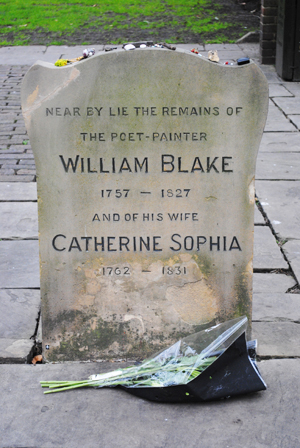
Blake died on 12th August, 1827, at his home at 3 Fountain Court on the Strand and was buried in an unmarked grave at Bunhill Fields. The stone which now stands there (pictured above) was added later.

It was during the Victorian-era that Blake’s work made its way into the hands of a larger audience than it ever had while he was alive, thanks to Blake enthusiasts like his first biographer Alexander Gilchrist and people associated with the Romantic movement.

His work continued to gain attention into the 20th century (in particular around the centenary of his death in 1927) and by mid-century had become what Robert N Essick says in Blake’s entry in the Oxford Dictionary of National Biography, “one of the cultural icons of the English-speaking world”. Interest in Blake and his works has continued both in the UK and around the world.

A new room dedicated to showing Blake’s works opened at Tate Britain in May.

Treasures of London – Henry Moore altar at St Stephen Walbrook…

Henry-Moore-altar

A beautiful church in the round, St Stephen Walbrook has a rich history with one of its stand-out features is an altar designed by world renowned sculptor Henry Moore. 

The centrally located circular altar, carved between 1972 and 1983 of polished travertine marble (the marble was taken from the same quarry as that used in Michelangelo’s work), is eight foot across and weighs several tons.

It was commissioned  by property developer and churchwarden, Lord Palumbo, as part of a £1.3 million restoration of the church – built under the supervision of Sir Christopher Wren in the 1670s, replacing an earlier church which burnt down in the Great Fire – which took place between 1978 and 1987.

It was deliberately designed to be placed at the centre of the church and didn’t take up its new position without controversy with objectors to it taking the matter to the Court of Ecclesiastical Cases Reserved (they ruled the altar was acceptable for use in a Church of England church).

WHERE: St Stephen Walbrook, 39 Walbrook (nearest tube stations are Bank and Cannon Street); WHEN: 10am to 4pm weekdays (check website for changes); COST: Free; WEBSITE: www.ststephenwalbrook.net.  

Hampton Court Palace Festival; good deeds at the Foundling Museum; Harold Wilson’s memorial; and, the RA’s summer exhibition…

The 2013 Hampton Court Palace Festival kicks off tonight. Highlights include a performance by the Royal Philharmonic Concert Orchestra and fireworks on Saturday night while other artists featured include Jools Holland, Lisa Stansfield, Frank Valli and the Four Seasons, Imeda May, Bjorn Again, Russell Watson, Cliff Richard and Joe Bonamassa and Beth Hart. For the full programme of events over the next couple of weeks, check out www.hamptoncourtpalacefestival.com.

It’s all about good deeds at the Foundling Museum. Opening at the museum in Bloomsbury tomorrow, a ceramic artist Clare Twomey’s exhibition – Exchange: 1,000 Good Deeds at the Foundling Museum – features more than 1,000 cups and saucers with each cup hiding instructions for a good deed underneath. The instructions are only revealed when a visitor selects a cup – they either agree to do the good deed, leaving it exposed and taking home the cup, or, if they’re not able to, can return the cup to its saucer. There is a limit of 10 cups available for exchange each day – ring or check the website for times when the exchanges may take place. Entry is free with museum admission. Runs until 15th September. For more, see www.foundlingmuseum.org.uk.

A memorial ledger stone to former Labour PM, Harold Wilson (later Lord Wilson of Rievaulx), was dedicated in Westminster Abbey this week. Lord Wilson (1916-1995) was PM from 1964 to 1970 and 1974 to 1976. The stone is placed near where Earl Attlee’s ashes were interred at a memorial service attended by Lord Wilson when Prime Minister in 1967. For more, see www.westminster-abbey.org.

On Now: Royal Academy of Arts Summer Exhibition 2013. Coordinated by Royal Academicians printmaker Norman Ackroyd and Eva Jiricna, this year’s exhibition at the Royal Academy in Piccadilly features more than 1,000 artworks with many going on display for the first time. Among the works on display will be Grayson Perry’s series of six tapestries entitled The Vanity of Small Differences – inspired by Hogarth’s A Rake’s Progress, it tells the story of Tom Rakewell. Other highlights include a room dedicated to portraiture – including photographs and works on paper – and a new large scale sculpture by Anthony Caro. Runs until 18th August. Admission charge applies. For more, see www.royalacademy.org.uk.

Famous Londoners – Edward Lloyd…

The founder of Lloyd’s Coffee House, Edward Lloyd – who died 300 years ago this year – is perhaps not so much famous in his own right as for the fact his name lives on in the Lloyd’s insurance business today.

Lloyd's_Coffee_House_plaqueLloyd is believed to have been born around 1648 but little is known of his early day (it’s thought he may have come from Canterbury). By 1688, he was the proprietor of a licensed coffee house in the now long gone Tower Street and was living nearby with his wife Abigail (the first reference to the coffee house dates from 1688).

In 1691, the coffee house moved to a premises at 16 Lombard Street – not far from the Royal Exchange – and it’s here that the coffee house gained a reputation as the centre of the ship-broking and marine insurance business (a blue plaque marks the site today).

Lloyd, meanwhile, was building up a network of correspondents at major ports around the world, and according to Sarah Palmer, writing in the Oxford Dictionary of National Biography, was also involved in the publication of a weekly news sheet featuring shipping-related news – initially published on a Saturday, it became a Friday publication in 1699 and continued until at least 1704 – and the rather shorter-lived single sheet newspaper Lloyd’s News, founded in 1696. (Lloyd’s List wasn’t founded until well after Lloyd’s death in 1734).

Lloyd and his first wife had at least nine children, with four daughters surviving into adulthood – it was the youngest, Handy, who with her first husband William Newton (he was head waiter at the coffee house and married her just prior to her father’s death) and, following his death, her second husband Samuel Sheppard, continued the family business after her father’s death in 1713.

Following Abigail’s death in 1698, he married Elizabeth Mashbourne and after her death in 1712, married again – this time to Martha Denham.

Lloyd died the following year on – 15th February 1713 – and was buried at St Mary Woolnoth – a church at which he’d held positions when alive.

The business which grew to become the Lloyd’s of London insurance business we know today, meanwhile, took its next step forward in 1769 when a group of professional underwriters established New Lloyd’s Coffee House in nearby Pope’s Head Alley. The group, formalised into a committee, later moved to the Royal Exchange and dropped the word new. Lloyd’s was incorporated in 1871 by an Act of Parliament and has gone on to become one of the world’s most famous insurers. It now operates in more than 300 countries and territories worldwide.

What was to become Lloyd’s Register, meanwhile, was founded in 1760 as the Society for the Registry of Shipping.

Around London – Celebrating London’s architecture; space at the NMM; Tate Britain redux; remembering Waterloo at Apsley House; and, ‘Coins and the Bible’ at the British Museum…

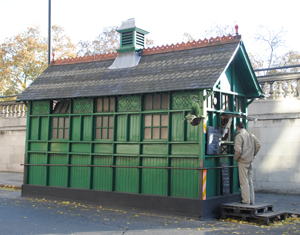
Cabmen's-ShelterThe London Festival of Architecture has returned with a month long celebration of the city’s built form in a program of events including talks, tours and exhibitions. Among the latter is Lesser Known Architecture – A Celebration of Underappreciated London Buildings – a free exhibition at the Design Museum which runs until 22nd July and looks at 10 structures ranging from London Underground Arcades and Cabmen’s Shelters (one of which is pictured) to Nunhead Cemetery. Other events include an exhibition at Somerset House – Nicholas Hawksmoor: Methodical Imaginings – looking at churches designed by Hawksmoor in the late 17th and early 18th centuries (this runs until 1st September), and The Secret Society – A Sculptural Banquet, a large scale installation by artist and designer Kathy Dalwood at Pitzhanger Manor in Ealing, west London (ends this Sunday). For more on the festival, check out www.londonfestivalofarchitecture.org or for fringe events, http://londonarchitecturediary.com.

A new exhibition featuring more than 100 images from space – including images of the colourful dust clouds in which new stars are formed, the aurora on the surface of Saturn and the sight of Earth from the International Space Station – opens at the National Maritime Museum in Greenwich tomorrow. Visions of the Universe takes visitors on a “visual trip through our solar system” with images of the moon, sun, plants and distant galaxies. It looks at the development of telescopy and photography and examines our understanding of our place in the cosmos. Space scientists including Astronomer Royal Sir Martin Rees and The Sky at Night‘s Chris Lintott introduce each section of the exhibition which has at its centre a 13×4 metre curved wall known as the ‘Mars Window’. It has the latest images from NASA’s Mars Curiosity Rover projected onto it. There is a programme of events accompanying the exhibition which runs until 15th September. For more, see www.rmg.co.uk.

Tate Britain is undergoing an overhaul this year with the opening of new galleries and a rearrangement of the institution’s collection. Last month, a new chronological presentation of the institution’s British art opened across more than 2o of the institution’s galleries. BP Walk through British Art features around 500 artworks, dating from the 1500s to present day, by artists ranging from Sir Joshua Reynolds and William Hogarth to JMW Turner, John Constable, Lucien Freud and David Hockney. Meanwhile new galleries have opened dedicated to the works of sculptor Henry Moore and artist William Blake. Around 30 of Moore’s works are featured in the rooms as well as more than 40 of Blake’s works. For more see www.tate.org.uk.

Apsley House, regency home of the Duke of Wellington, is hosting a series of events every weekend in June in the lead-up to the anniversary of the Battle of Waterloo. Interpreters will be at the house, known as Number 1 London, this weekend to discuss the dress and manners of the era while next weekend (15th and 16th June) visitors have the chance to meet some of Wellington’s soldiers and their wives. Gentry from the Napoleonic era will be celebrating the victory at Waterloo on 22nd and 23rd June while on the final weekend of the month, the focus will be on the 200th anniversary of the Battle of Vitoria in 1813, which led to eventual victory in the Peninsular War. For more, see www.english-heritage.org.uk/daysout/properties/apsley-house/.

On Now: Coins and the Bible. This free exhibition at the British Museum looks at how money was referred to in the Old and New Testament, and the use of Christian symbols such as crosses or monograms derived from Greek letters on later coins. These include the first coin, dating from about 450 AD, to depict an image of Jesus (the coin, on loan from the Hunterian Museum in Glasgow, is included in the exhibition). There are also early Biblical fragments on papyrus and vellum lent by the British Library and an ivory panel dating from the early 400s AD which includes an image of the purse of 30 pieces of silver Judas received after his betrayal of Jesus. Held in Room 69a, the exhibition runs until 20th October. For more, see www.britishmuseum.org.

10 Historic London Garden Squares…6. Grosvenor Square

Grosvenor-Square-1

The largest square in Mayfair, Grosvenor Square was laid out in the 1720s on the orders of  Sir Richard Grosvenor of Cheshire.

Sir Richard owned the Grosvenor Estate, a considerable tract of land in London’s west which includes in its northern part the land upon which the square was created (the estate is now owned by Gerald Cavendish Grosvenor, the 6th Duke of Westminster).

It’s proximity to Hyde Park and Whitehall quickly made it, like many other historic squares, a fashionable place for politicians to live – among those who lived here in the late 18th century were three prime ministers.

The oval-shaped gardens in the middle of the square – which was only opened to the public in 1948 – were once home to a statue of King George I but this was removed at some point. Originally thought to have been laid out by gardener John Alston, they took on their current form in 1948 when they were redesigned by architect BWL Gallannaugh (interestingly, Grosvenor Square is also said to have been the last part of London to exchange gas lighting for electric lighting).

There’s almost no residential buildings on the square these days but among the most prominent buildings (in fact it dominates the west end of the square) is the US Embassy. Designed by Eero Saarinen, the building was completed in 1960 with US President John F Kennedy one of the first visitors.

Grosvenor-Square-2The hulking embassy is only one of the many American connections to the square, connections which at one point led to it being known as “Little America”. Dwight Eisenhower, commander of the US armed forces in World War II, based his headquarters at number 20 in 1944, while number nine – one of the few residences to survive – was home to John Adams, first American ambassador to the Court of St James and later the country’s second president.

The American theme, which has meant the square has been the focus of demonstrations such as those protesting the Vietnam War as well as outpourings of support such as in the wake of the September 11 attacks, is also evident in the statutory in the square’s gardens with grand, full size statues of  President Franklin D. Roosevelt (a bronze by William Reid Dick unveiled by Eleanor Roosevelt on the third anniversary of the president’s death – 12th April, 1948 – it is pictured above), President Eisenhower (a bronze by Robert Dean dating from 1989), and President Ronald Reagan (unveiled on 4th July, 2011, pictured right).

On the eastern side of the garden square is the September 11 Memorial Garden opened in 2003 while on the south side is the Monument to the Eagle Squadrons, the three RAF squadrons in World War II mostly composed of American volunteers before the US entered the war. There’s also a set of memorial “Diplomatic Gates”, installed in 1984 to commemorate the bicentennial of the Treaty of Paris and honour US and UK politician who have worked in the service of peace.

Other notable buildings include number one, the Canadian High Commission (previously the US embassy); and number four, one of  square’s oldest houses. Now demolished, number 44 was the home of the Earl of Harrowby and where the British Cabinet were dining when word arrived of Wellington’s victory at Waterloo.

Around London – Celebrating the Coronation’s 60th anniversary; Benjamin Britten; Keat’s House Festival; and, silver service in Roman Britain…

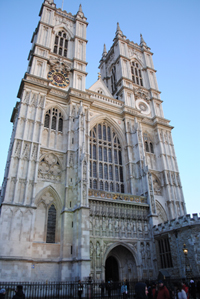
Westminster-Abbey3Sunday marks 60 years since Queen Elizabeth II’s coronation and Westminster Abbey – site of that event – is celebrating with a series of events. These include a special 60th Anniversary of the Coronation Service on Tuesday (4th June) to be attended by the Queen, Duke of Edinburgh and members of the royal family as well as a public lecture to be given by the Bishop of London Richard Chartres on Friday night (7th June – booking is essential), a concert performed by the abbey choir (13th June), and a new exhibition in the chapter house featuring archive images of the 1953 coronation ceremony and of preparations which took place at the abbey. Meanwhile the Coronation Chair, used in most coronations since the 14th century and having just undergone conservation work, is the subject of a new display in St George’s Chapel, and two new commemorative stained glass windows have been installed in King Henry VII’s Lady Chapel – the first commissioned by the abbey for more than a decade, they have been designed by artist Hughie O’Donoghue. For more on the abbey’s celebrations, see www.westminster-abbey.org.

Composer Benjamin Britten is the subject of a new exhibition opening at the British Library tomorrow. Poetry in Sound: The Music of Benjamin Britten (1913-1976) looks at the poetic and literary influences on the work of the man often described as the greatest English composer since Purcell. In particular it examines his collaboration with WH Auden and the interplay of his work with authors such as William Blake, Wilfred Owen, Alfred Lord Tennyson and William Shakespeare. As well as composition manuscripts, the exhibition features photographs, concert programmes and unpublished recordings of his music. There are a range of events accompanying the exhibition which runs until 15th September. An admission charge applies. For more, see www.bl.uk.

The Keats House 2013 Festival is underway this week with activities ranging from poetry readings to felt-making demonstrations, free family workshops and musical performances. The programme of events runs until 2nd June, all under this year’s theme of ‘Health is My Expected Heaven’: The Body and The Imagination. Poet John Keats lived at the house in Hampstead, not far from Hampstead Heath, from 1818 to 1820 and it is the setting for some of his most acclaimed poetry including Ode to a Nightingale. It was this house that he left to travel to Rome where he died of tuberculosis at the age of 25. For more on the festival programme, follow this link.

On Now: Silver Service – Fine dining in Roman Britain. This free exhibition at the British Museum recreates the experience of dining late in the Roman era and uses the Mildenhall Great Dish, Britain’s finest late Roman silver dining service, as an example of the type of large platter on which food for sharing would have been presented. The exhibition, which runs until 4th August, is free (keep an eye out for our upcoming Treasures of London on the Mildenhall Great Dish). For more information, see www.britishmuseum.org.

10 Historic London Garden Squares…5. Berkeley Square…

Berkeley-Square

Located in the south-west of Mayfair in London’s West End, Berkeley Square was originally laid out by architect William Kent in the mid 1700s.

It takes its name from the Berkeley family of Gloucestershire (the first Lord Berkeley of Stratton was a Royalist commander in the Civil War) whose London residence, Berkeley House, stood on what is now the south side of the square until it was destroyed in a fire in 1733 (Devonshire House, whose residents included the 5th Earl of Devonshire and his somewhat notorious wife Georgiana, was subsequently built on the site and remained there until it was demolished in the 1920s).

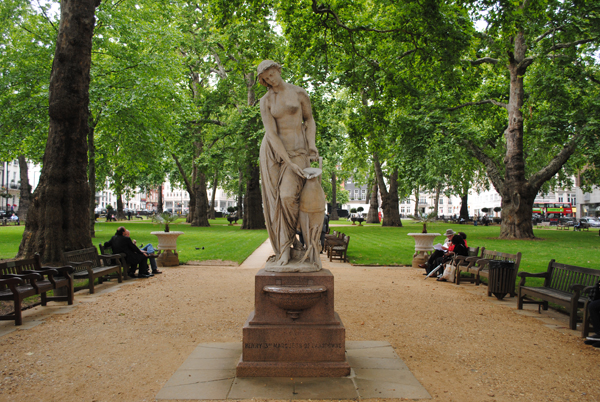
The gardens, which feature some of the city’s oldest London Plane trees (dating from 1789), have a pump house at the centre which was built in 1800 and is now Grade II listed (it stands on the site of an earlier equestrian statue of King George III). Other features including the statue Lady of Sumaria (Water Carrier) – pictured above – which was made by Pre-Raphaelite sculptor Alexander Munro in 1858 and stands at the garden’s southern end.

Among notable buildings which face onto the square are Lansdowne House – located on the south-west corner of the square, it was designed by Robert Adam and now home of the Lansdowne Club – and number 50 Berkeley Square, home of short-lived early 19th century PM George Canning (and said to be the most haunted house in London). The square was also the home of society favorite, Gunter’s Tea Shop, which dated from the mid-1700s.

Famous residents have included wartime PM Sir Winston Church (he lived at number 48 as a child); Horace Walpole, some of the first Prime Minister Robert Walpole (he lived at number 11 during the 1700s), Robert Clive (more famously known as Clive of India, he committed suicide in number 45 in 1774), and the fictional Bertie Wooster and his valet Jeeves (creations of author PG Wodehouse). The square also featured in the famous wartime song, A Nightingale Sang in Berkeley Square.

The square is open from 8am daily with closing times varying based on the season.

10 Historic London Garden Squares…4. St James’s Square…

A quiet square at the heart of the area known as St James, the square’s origins go back to the 1660s when King Charles II granted what was initially a lease (and later the freehold) over a section of St James’s Field to Henry Jermyn, a favourite of King Charles I’s queen Henrietta Maria who was created the 1st Earl of St Alban.

William-IIIThe earl began developing the residential square (the original design had houses on the south-side fronting onto Pall Mall) and, thanks to its proximity to Whitehall and St James’s Palace, quickly attracted some of the who’s who of London to live there.

Indeed it’s said that by the 1720s, seven dukes and seven earls were in residence in the square – other residents included PMs William Pitt the Elder and William Gladstone (both lived in Chatham House, at numbers 9 and 10, albeit at different times) as well as two of James II’s mistresses, Arabella Churchill and Catherine Sedley, who apparently lived at number 21 in the late 1600s.

Among the architects who designed houses around the square were Robert Adam, Sir John Soane, and, in more recent times, Edwin Lutyens.

The square – which reached its final layout, designed by John Nash, around 1854 – remained a desirable place to live even as in the 19th century, some of the houses gave way to financial institutions, private clubs, offices and even lodging houses. These days it’s dominated by business and other institutional organisations.

Organisations located in the square today include the Naval and Military Club (number four – former home of Nancy Astor), the East India Club (number 16) and the London Library (located at number 14, it was founded by Thomas Carlyle in 1841) as well as the international headquarters of BP.

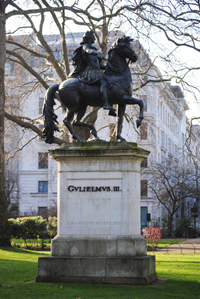
The gardens feature an equestrian statue of King William III at their centre (the work of John Bacon Sr and Jr, it was installed in 1808 and is pictured above). Other monuments include The Stag (located in the south-west corner, it is the work of Marcus Cornish and was installed in 2001) and, just outside the garden railings in the north-east corner, a memorial to WPC Yvonne Fletcher who was killed when a gun was fired from the Libyan Embassy (known as the Libyan People’s Bureau, it was located at number 5) during a demonstration on 17th April, 1984. The pavilion on the south side was designed by John Nash.

The gardens are private – managed by the St James’s Square Trust – but open to the public on weekdays from 10am to 4.30pm.

Where is it?…#64…And the answer is…

Where-is-it--#64

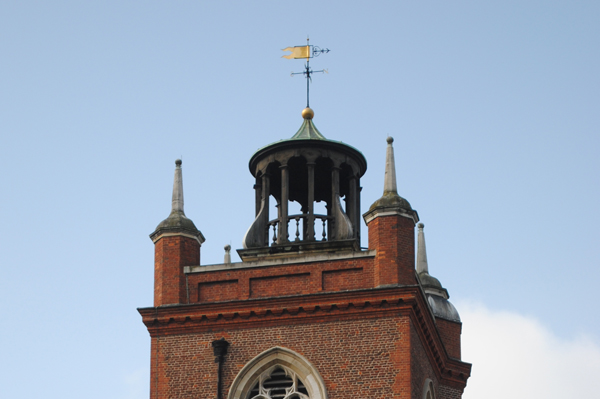
Can you identify where in London this picture was taken? If you think you can, leave a comment below. We’ll reveal the answer early next week. Good luck!

Well done to Jamie, this is indeed the tower of St Giles Cripplegate, located  just off Fore Street in the Barbican Estate. The church – the oldest building in the area – dates from about 1090 and was rebuilt in 1545 after it was destroyed by a fire. The new building survived the Great Fire of 1666 but didn’t fare so well in a fire of 1897 or in the Blitz when all but the outer shell was destroyed. Oliver Cromwell was married here in 1620 and the poet John Milton was buried here in 1674 (he had written much of Paradise Lost locally) (interestingly, his body was apparently exhumed about 100 years later, workman took some souvenirs including teeth and a rib). Others buried here include explorer Sir Martin Frobisher, John Foxe, author of The Book of Martyrs, and Bible translator Lancelot Andrews. For more on the church, see www.stgilescripplegate.com.

Treasures of London: The Americus Backers grand piano…

Americus-Backers-piano

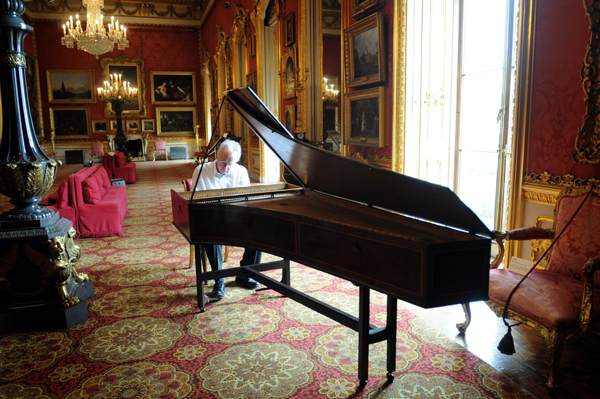
The oldest surviving English grand piano, built in London in 1772 by Americus Backers, has gone on display at Apsley House in London, home of the 1st Duke of Wellington, Arthur Wellesley.

Known to have been played by the Iron Duke’s wife Kitty (nee Pakenham), it has been suggested (although remains unconfirmed) that the piano belonged to the Iron Duke’s father, Lord Mornington, who was politician and a composer.

The piano, which has been loaned to English Heritage by Lord and Lady Douro and is expected to remain at the house for the foreseeable future, is the earliest example of a piano with loud and soft pedals and is illustrative of the impact Backers, described by some as “the father of the English grand pianoforte style”, had on the development of piano design.

While much of the detail of Backers’ life  remains obscured, he was apprenticed to a piano builder in Saxony before coming to England in the 1750s and taking up residence in Jermyn Street in 1763 where he apparently lived until his death in 1778. He is known to have built both pianofortes and harpsicords.

The piano, the only known pianoforte by Backers still existing, was previously on loan to the Russell Collection in Edinburgh.

In celebration of the return of the piano to Apsley House, the residence is hosting a special concert this Tuesday (21st May), between 7pm-9pm – the first time the piano will have been heard for at least 5o years (albeit for a short period only with most of the concert performed on a 1781 Ganer. ‘The Duke of Wellington’s Music of the French Wars’ will be held in the Waterloo Gallery. Tickets are £45 each and limited seats are available. Call English Heritage Customer Services on 0870 333 1183 for bookings or see www.english-heritage.org.uk. PICTURE:  Professor David Owen Norris, who has researched and devised the programme has been devised the programme for the evening, playing the piano.He will be joined by the soprano Amanda Pitt. Image courtesy of English Heritage.

Where’s London’s oldest…higher education institution?

While higher education may something we generally associate with more recent historical eras, London’s oldest higher educational institution in fact was founded in the dying years of the 16th century.

Thomas-GreshamGresham College was founded in 1597 by Sir Thomas Gresham (pictured, right) – son of Lord Mayor Sir Richard Gresham and the man behind the construction of the Royal Exchange (see our earlier post on Sir Thomas Gresham here) – according to instructions in his will (Sir Thomas died in 1579).

Under the terms of the will, part of his estate was left to the City of London Corporation and the Mercer’s Company and it is these who founded the organisation according to his request and still operate via the Joint Grand Gresham Committee.

According to the will’s terms, the corporation were to appoint professors in divinity, astronomy, geometry and music while the Mercer’s Company were given the responsibility of appointing professors in law, physic and rhetoric (a chair in commerce was added in 1985). There are also currently a number of visiting professorships.

The college – which was founded to provide free public lectures on subjects of scientific interest – is  governed by a council with the Lord Mayor of London as its president.

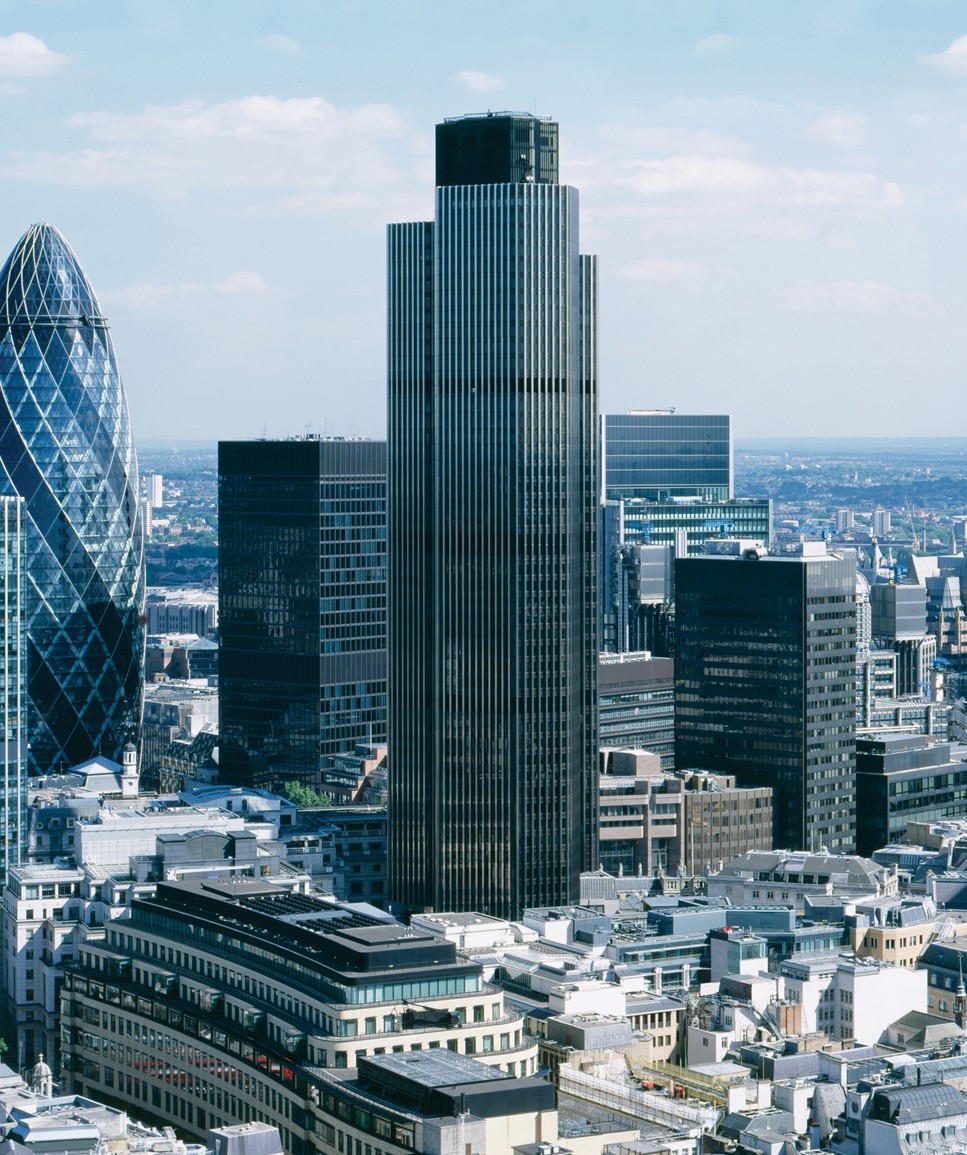
Sir Thomas’ mansion in Bishopsgate (now the site of what was formerly known as the NatWest Tower) was the college’s first home. Professors, whose salaries were met by rental income from the Royal Exchange, continued giving lectures there until 1768.

Various locations around the city were later used for the college before the opening of a new college building in Gresham Street in 1842. It moved again in 1991 and is now based at Barnard’s Inn Hall in Holborn.

Among the professors who have held chairs at the college are architects Sir Christopher Wren (astronomy) and Robert Hooke (geometry) as well as Richard Chartres, current Bishop of London (divinity).

The college, which doesn’t enrol students as such and doesn’t award degrees, continues to provide more than 100 free public lectures every year and is also involved in running seminars and conferences and other initiatives.

For a detailed history of Gresham College, check out Richard Chartres’ and David Vermont’s book on the college’s history – www.gresham.ac.uk/greshamftp/historygreshm_bk2.pdf. For more on the college and its programme of events, see www.gresham.ac.uk. Lectures are available online.

10 Historic London Garden Squares…2. Parliament Square

Located in one of the most prominent sites in London, Parliament Square is these days perhaps best known as a protest site for those wanting to attract Parliament’s eye. And while, unlike say, Trafalgar Square, many visitors to London may not know its name, its proximity to the Houses of Parliament, Whitehall, Westminster Bridge and Westminster Abbey means it’s rarely off anyone’s tourist agenda.

David-Lloyd-GeorgeThe history of the square goes back to 1868 when architect Sir Charles Barry (responsible for the design of the Houses of Parliament) designed a square to improve traffic flow in the area (and demolished many buildings – apparently the area was a slum – in the process).

The roads around the square featured London’s first traffic signals (it used semaphore arms rather than lights and was installed at the meeting of Great George and Bridge Streets) and in addition the square was originally the location for the Buxton Memorial Fountain which moved to its present position in Victoria Tower Gardens in 1940 (see our earlier post on the fountain here). In 1950, the entire square was redesigned by architect George Grey Wornum.

The square is home to a plethora of statues including former PMs Sir Winston Churchill, a relatively recent statue of David Lloyd George (pictured), Sir Robert Peel (also the founder of the Metropolitan Police Force – see our earlier post here), Benjamin Disraeli, the Earl of Derby and Lord Palmerston as well as South African PM Jan Christian Smuts and, (if you count the space in front of Middlesex Guildhall), US President Abraham Lincoln (a replica of a statue in Lincoln Park, Chicago) and former Foreign Secretary and PM George Canning. Among the last statues added was a nine foot high bronze figure of Nelson Mandela which was placed in the square in 2007 after an unsuccessful push to have it located in Trafalgar Square.

Among the most high profile of protests to have been held there is that of the late peace campaigner Brian Haw who camped on the square for 10 years until 2010. Among the most recent protests this year has been a colourful demonstration by beekeepers, calling for a ban on pesticides.

For more on London’s statues, see Peter Matthews’ London’s Statues and Monuments.

10 Historic London Garden Squares…1. Leicester Square…

In the first of a new Wednesday series looking at historic London garden squares, we take a look at what next to Trafalgar Square, is the most famous square in the entire city – Leicester Square.

Located in the heart of the West End, Leicester Square’s history finds its origins back in the 17th history when Robert Sidney, the 2nd Earl of Leicester acquired property on the site where the square now stands. Then known as St Martin’s Field and located within the parish of St Martin’s, Sidney purchased four acres in 1630 and constructed Leicester House on land now located at the square’s northern end.

Leicester-SquareThe earl raised the ire of locals, however, when – having subsequently fenced off the land to prevent people from wandering on to his property – he enclosed what had previously been common land.

The people appealed to King Charles I who appointed three members of the Privy Council to look at the issue. Their decision? That the earl keep a section of his land open for the use of the parishioners of St Martin’s.

First known as Leicester Field, it was this land which later became known as Leicester Square. Fine homes were built around the square (its proximity to the Royal Court and centre of government made it a desirable place to live for the well-to-do and those seeking influence) with the centre enclosed with rails (it’s pictured here in 1750).

The square’s reputation also had a royal boost when, in 1717/1718, Leicester House became home to Prince George (later King George II) and his wife Princess Caroline along with their court after the prince fell out with his father King George I and was banished from St James’ Palace (this story is recounted in marvellous detail in Lucy Worsley’s terrific book, Courtiers: The Secret History of the Georgian Court).

The prince remained at the house for 10 years and was proclaimed King George II after his father’s death at its gate. Interestingly, King George II’s eldest son, Prince Frederick, also lived here for a time after he too fell out with his father (King George II). Apparently their relationship was even worse than the previous generation’s had been.

Despite its royal attractions, even at this stage the square apparently had it’s darker side with some less than savoury characters attending the hotels and livery stables that were built there. But things were to get worse as the wealthy moved out – a situation not helped when Leicester House was demolished in the 1790s.

Leicester Square became known as an entertainment venue in the 19th century (among attractions was the short-lived Royal Panopticon of Science and Art which showcased the best in science and art and Wyld’s Great Globe which contained a gigantic model of the earth) and received a new injection of life when theatres and music halls moved in, bringing the crowds back with them.

Shakespeare-StatueMeanwhile, the status of the square – and whether it could be built upon – remained a matter of debate well into the 19th century. That ended in 1874 when businessman Albert Grant bought the freehold of the land, had the garden created upon it and then donated it to the Metropolitan Board of Works as a gift to the city.

Responsibility for the management of the square now rests with the City of Westminster. The square area – which is now known for hosting film premieres as well as the tourists who inevitably gather there – was pedestrianised in the 1980s and has just undergone a redevelopment and modernisation which was unveiled last year.

Meanwhile, work to restore the 19th century Shakespeare statue and fountain in the square’s centre is about to be completed (pictured). The square also contains a statue of actor Charlie Chaplin in the square as well as busts of scientist Sir Isaac Newton, painter and first president of the royal Academy Sir Joshua Reynolds, 18th century pioneer surgeon John Hunter, and painter William Hogarth.

The tradition of the entertainment continues in the modern era through the cinemas which now stand in the square and regularly host film premieres (an interesting, if oft-repeated, film-related anecdote connected to the square is that it was in a phone booth located at the square that during the 1960s a young actor Maurice Micklewhite saw a poster for The Caine Mutiny and decided to change his name to Michael Caine).

PICTURES (top) Wikipedia and (below) City of Westminster.

Lost London – Mrs Salmon’s Waxworks…

Before Madame Tussaud arrived in London, there was Mrs Salmon and her famous waxworks, one of several such establishments in London.

Prince-Henry's-RoomsFirst sited at the Sign of the Golden Ball in St Martin’s Le Grand – where it filled six rooms – in 1711, the display was relocated to the north side of Fleet Street where it remained until 1795 when it moved across the road to number 17 Fleet Street, now housing Prince Henry’s Room (pictured, room takes its name from Prince Henry, eldest son of the king, who died at the age of 18 and was apparently the inspiration for an inn which previously occupied the building called The Prince’s Arms).

The waxworks were apparently originally run by Mr Salmon – there are references to him being a “famous waxwork man” – but his wife, Mrs Salmon, continued it alone after his death in 1718 until her own death, variously said to have been in 1760 or as late as 1812. At some point after his death, Mrs Salmon is said to have remarried, to a Mr Steers.

Described in a handbill published soon after its initial move to Fleet Street, the exhibitions were said to include a scene of King Charles I upon the scaffold, another of the ill-fated Queen Boudicea, and more exotic tableaux including one showing Canaannite ladies offering their children in sacrifice to the god Moloch, another of a Turkish seraglio, and another of Margaret, Countess of Heningbergh with the 365 children she is said to have given birth to (all at once!). There was also a mechanised figure of the “famous English prophetess” Old Mother Shipton, who is said to have given a boot to visitors as they left.

While some accounts say the waxworks – which, according to the City of London website remained at the site until 1816 – were taken over by a Chancery Lane surgeon named Clarke after Mrs Salmon’s death (and by his wife after his death), it is also suggested that at some point they moved to Water Lane in east London where they were ruined by thieves.

Whatever its fate, it’s generally accepted that the famous waxworks were visited by the likes of James Boswell and artist William Hogarth. They were also mentioned by author Charles Dickens in David Copperfield. 

For more of London’s past, see Philip Davies’ Lost London 1870-1945.

Special – Five famous London funerals…

With former PM Margaret Thatcher’s funeral held in London today, we take a look at five prominent funerals in the city’s past…

Queen Eleanor of Castile: King Edward I was lavish in his funeral for Queen Eleanor (perhaps in an effort to restore her reputation given suggestions she had been unpopular among the common people although it may well have simply been because of the king’s level of grief) and when she died at Harby, a village near Lincoln, on 28th November, 1290, he ordered her body to be transported from Lincoln Cathedral to Westminster Abbey where the funeral was held, with a series of elaborate memorial crosses to be built close to where-ever her body rested for the night. Twelve of these were built including at Westcheap in the City of London and Charing (hence Charing Cross, see our earlier post here), the latter thanks to her body “resting” overnight at the Dominican Friary at Blackfriars. Her funeral took place on 17th December, 1290, with her body placed in a grave near the high altar until her marble tomb was ready. The tomb (one of three built for the queen – the others were located at Lincoln – for her viscera – and Blackfriars – for her heart) still survives in the abbey.

St-Paul's-CathedralVice Admiral Lord Nelson: Heroic in life and perhaps seen as even more so after his death, Nelson’s demise at the Battle of Trafalgar was a national tragedy. His body, preserved in brandy, was taken off the HMS Victory and transported to Greenwich where he lay in state for three days in the Painted Hall. Thousands visited before the body was again moved, taken in a barge upriver to the Admiralty where it lay for a night before the state funeral on 9th January, 1806, more than two months after his death. An escort said to comprise 10,000 soldiers, more than 100 sea captains and 32 admirals accompanied the body through the streets of the city along with seamen from the Victory to St Paul’s Cathedral (pictured)  where he was interred in a marble sarcophagus originally made for Cardinal Wolsey located directly beneath the dome. The tomb can still be seen in the crypt of St Paul’s.

Arthur Wellesley, the Duke of Wellington: Given the last heraldic state funeral ever held in Britain, the Iron Duke’s funeral was held on 18th November, 1852, following his death on 14th September. His body, which had been brought to London from Walmer where it had laid in state by rail, lay in state a second time at Chelsea Hospital. On the morning of the funeral, the cortege set out from Horse Guards, travelling via Constitution Hill to St Paul’s. The body was conveyed in the same funeral car used to convey Nelson’s and accompanied by a guard of honour which included soldiers from every regiment in the army. Masses – reportedly more than a million-and-a-half people – lined the streets to watch funeral procession pass through the city before a service was held in St Paul’s Cathedral under the great dome and he was interred in a monumental sarcophagus alongside that Vice Admiral Lord Nelson. Like Nelson’s, it can still be seen there today.

Sir Winston Churchill: Widely regarded as one of the great wartime leaders of the 20th century, the former British Prime Minister died in his London home on 24th January, 1965, having suffered a stroke nine days earlier. His funeral (plans for which had apparently been code-named ‘Hope-Not’), was the largest state funeral in the world at the time of his death with representatives of 112 nations attending and watched on television by 25 million people in Britain alone. His body lay in state for three days (during which more than 320,000 people came to pay their respects) before on 30th January, it was taken from Westminster Hall and through the streets of London to a funeral service at St Paul’s Cathedral. After the service, a 19 gun salute was fired and the RAF staged a flyby of 16 fighter planes as the body was taken to Tower Hill and then by barge to Waterloo Station. From there it was taken by a special funeral train (named Winston Churchill) to Bladon near Churchill’s home at Blenheim Palace.

Diana, Princess of Wales: Having died in a car crash in Paris on 31st August, 1997, her body was flown back to London and taken to St James’s Palace where it remained for five days before being transported to her former home of Kensington Palace. More than a million people crowded London’s streets on 6th September, 1997, to watch the funeral procession as it made its way from the palace to Westminster Abbey. Among those present at the funeral (which was not a state funeral) were members of the royal family as well as then Prime Minister Tony Blair, former PMs including Margaret Thatcher and foreign dignitaries and celebrities, the latter including Elton John who sang a rewritten version of Candle in the Wind. After the service, Diana’s body was taken to her family’s estate of Althorp in Northamptonshire where the “People’s Princess” was laid to rest.

Our new series will be launched next week due to this week’s events…

London Pub Signs – The Trafalgar Tavern…

This Greenwich institution, housed in a Grade II-listed building in Park Row, has been noted for its whitebait dinners since it first opened its doors in 1837 (among those said to enjoy them was the author Charles Dickens – indeed the premises features in Our Mutual Friend). 

Trafalgar-TavernThe tavern, which takes its name from the famous 1805 battle of the Napoleonic War which cost Vice-Admiral Lord Horatio Nelson his life, was built by Joseph Kay, a founding member of the Royal Institute of British Architects and the man responsible for the layout of Greenwich town centre.

Built on the site of an earlier tavern named the Old George Inn, the new late Regency pub featured at its heart the Lord Nelson Room which still looks out over the Thames and the, albeit much lessened, shipping that travels upon it. It was a favoured location for gatherings of liberal politicians.

In 1915, the pub transformed into the Royal Alfred Aged Merchant Seamen’s Institute – a role which it continued to fulfil until the 1960s when it reverted to being the Trafalgar Tavern.

For more on the tavern, see www.trafalgartavern.co.uk.

Around London – Margaret Thatcher’s funeral; telling the Jewel Tower’s story; depot open weekend; and, Designs of the Year…

Margaret Thatcher’s funeral will be held next Wednesday at St Paul’s Cathedral from 11am with Queen Elizabeth II among those attending (the first time she has attended the funeral of a British politician since Sir Winston Churchill’s in 1965). The funeral procession of the former Prime Minister, who died on Monday aged 87, will start at the Houses of Parliament and make its way down Whitehall to Trafalgar Square before moving down the Strand, Fleet Street and Ludgate Hill to St Paul’s Cathedral. Baroness Thatcher’s coffin will carried in a hearse for the first part of the journey and will be transferred to a gun carriage drawn by six horses of the King’s Troop Royal Horse Artillery at St Clement Danes church on the Strand for the final part of the journey. There will be a gun salute at the Tower of London. Meanwhile, a Book of Condolence has opened at St Margaret’s Church, beside Westminster Abbey, this morning and will be available for people to pay their respects until 17th April, during the church’s opening hours. St Margaret’s – which stands between Westminster Abbey and the Houses of Parliament – is commonly known as the parish church of the House of Commons.

The story of the Jewel Tower – one of the last remaining parts of the medieval Palace of Westminster – is told in a new exhibition at the historic property. Now in the care of English Heritage, the tower – located to the south of Westminster Abbey, was built in 1365 to house King Edward III’s treasury, later used as King Henry VIII”s ‘junk room’, the record office for the House of Lords, and, from 1869, served was the “testing laboratory” for the Office of Weights and Measures. The exhibition, which opened this month, is part of the English Heritage celebrations commemorating the centenary of the 1913 Ancient Monuments Act. The Jewel Tower is open daily until November. Admission charge applies. For more, see www.english-heritage.co.uk.

See some of the earliest underground trains, a Lego version of Baker Street station and ride the Acton Miniature Railway. The London Transport Museum’s depot in Acton is holding it’s annual spring open weekend this Saturday and Sunday and in celebration of the Underground’s 150th anniversary, attractions will include the Metropolitan Steam Locomotive No. 1 and the recently restored Metropolitan Carriage 353 along with model displays, rides on the miniature railway, film screenings, talks, and workshops. Wales’ Ffestiniog Railway team – celebrating their own 150th anniversary – will also be present with the narrow gauge train, Prince. Open from 11am to 5pm both days. Admission charge applies. For more, see www.ltmuseum.co.uk.

Now On: Designs of the Year. The Design Museum has unveiled contenders for the sixth annual Designs of the Year competition and you can what they are in this exhibition. Consisting of more than 90 nominations spanning seven categories, the nominated designs include the Olympic Cauldron by Heatherwick Studio, The Shard – western Europe’s tallest building – by Renzo Piano, a non-stick ketchup bottle invented by the Varanasi Research Group at MIT, and Microsoft’s Windows phone 8. The exhibition runs until 7th July – the winners will be announced this month. Admission charge applies. For more, see www.designmuseum.org.