Around London: Charles Dickens Museum reopens; ‘The History Man’s’ blue plaque; and, a Dandy exhibition at the Cartoon Museum…

The only surviving London house lived in by author Charles Dickens – now occupied by the Charles Dickens Museum – reopens on Monday after a £3.1 million restoration and refurbishment. The redevelopment of the Georgian, Grade I listed townhouse at 48 Doughty Street in Bloomsbury – a project named Great Expectations – has seen the museum expand into a neighbouring property at 49 Doughty Street which now houses a visitor and learning centre and cafe. Inside the house itself, the rooms have been returned to their appearance during Victorian times and on display will be some of Dickens’ personal items which haven’t been seen before. They include a set of photographic prints from 1865 which depict a train crash in Staplehurst, Kent, in which Dickens was involved. The museum, which is where Dickens wrote Oliver Twist, Nicholas Nickleby and finished The Pickwick Papers while living here between 1837-1839, was first opened in 1925. This year marks the bicentenary of Dickens’ birth (he was born on 7th February, 1812, in Portsmouth). For more on the museum and upcoming events there (including Christmas performances of A Christmas Carol and a series of special Dickensian Christmas walks), see www.dickensmuseum.com. For more on Dickens, see our earlier special – 10 London sites to celebrate Charles Dickens.

Historian and broadcaster AJP Taylor, known as ‘The History Man’, has been honoured by English Heritage with a blue plaque placed on his former home at 13 St Mark’s Crescent in Primrose Hill.  Taylor lived at the mid-nineteenth century semi-detached villa between 1955 and 1978 during the height of his fame. First appearing on television as early as 1942, Taylor was a regular on television discussion programmes between the 1950s and 1980s, and is described as one of the first ‘media dons’. He also wrote weekly columns in the press and books including the controversial The Origins of the Second World War. Married three times, he had six children and died of Parkinson’s disease in 1990. For more, see www.english-heritage.org.uk/about/news/?topic=Blue%20Plaques.

On Now: A Dandy 75th Birthday Exhibition. This exhibition at the Cartoon Museum in Bloomsbury focuses on The Dandy, Britain’s longest running comic (officially recognised by the Guinness Book of Records), and follows its development from its birth with the release of the first issue on 4th December, 1937 (which, incidentally, was so popular it sold 481,895) through to this year’s issues including the final print issue released on 4th December this year (after which The Dandy goes digital). Runs until 24th December. Admission charge applies. For more see www.cartoonmuseum.org.

What’s in a name?…Barbican

Though it’s these days associated with a Brutalist housing estate and performing arts centre based in the north of the City of London, the name Barbican has been associated with the area on which the estate stands for centuries.

BarbicanThe word barbican (from the Latin barbecana) refers to an outer fortification designed to protect the entrance to a city or castle. In this case it apparently referred to watchtower which may have had its origins in Roman or Saxon times (or maybe both). The City of London website suggests it was located “somewhere between the northern side of the Church of St Giles Cripplegate and the YMCA hostel on Fann Street”.

When-ever it was built, the watchtower was apparently demolished on the orders of King Henry III in 1267, possibly as a response to Londoners who had supported England’s barons when they had rebelled against him. One source suggests the tower was rebuilt during the reign of King Edward III but, if so, the date of its subsequent demolition remains unknown.

Later residents of the area – which become known as a place to trade new and used clothes – included John Milton and William Shakespeare.

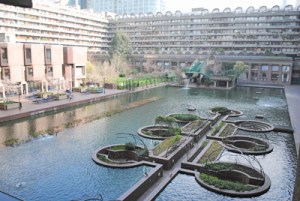
The area known as Barbican was devastated by bombing raids in World War II. Discussions on the future of the site started in 1952 and for more than 10 years plans for redeveloping the area were debated until finally, in the early 1960s, work began on what is now the Barbican Estate including three tall residential towers (part of the residential estate is pictured above). Completed in the mid 1970s, the Brutalist design of the complex, which features buildings named after historical figures associated with the area, means it meets with strong reactions from those who encounter it whether love – or hate.

Construction of the arts centre – known as the Barbican Centre – the largest performing arts centre in Europe and home to the London Symphony Orchestra – was started in the early 1970s. The £156 million centre was eventually opened by Queen Elizabeth II in 1982.

Other buildings within the Grade II listed complex include the Guildhall School of Music and Drama, the City of London School for Girls and a YMCA.

Around London – Christmas at the Geffrye; a Kensington Palace advent calendar; new furniture gallery at the V&A; and, last chance to see Bronze…

Christmas is looming and at the Geffrye Museum in Hoxton that means the museum’s many period rooms have been transformed for the Christmas festivities. The rooms span 400 years of history, from 1600 until today, and show how the middle class have lived over that time. The Christmas display will also provide insights into such Christmas traditions as kissing under the mistletoe, hanging up stockings, sending Christmas cards and decorating trees. The Christmas theme carries through to the restaurant and gift shop. Entry to the exhibition is free. Runs until 6th January. For an online gallery showing some of the rooms, click here. For more on the museum, see www.geffrye-museum.org.uk.

• Meanwhile Kensington Palace is to be transformed into giant advent calendar in the lead-up to Christmas with a daily ‘reveal’ inspired by Princess Victoria’s Christmas diary entries and letters. The halls of the palace will be decorated with 24 specially designed mirrored baubles, Christmas music will be played throughout and a sparkling 25 foot high Christmas tree will be placed in the gardens. As part of the Christmas festivities, an evening of carol singing will be held on 5th December in the King’s Gallery with carols sung by the Hampton Court Palace Royal Chapel Choir. Other events include a Midwinter Masquerade Ball on 13th December and an Eerie Evening Tour on 20th December. For more, see www.hrp.org.uk/KensingtonPalace/.

• A new permanent furniture gallery opens at the V&A this Saturday. The Dr Susan Weber Gallery – the first at the museum dedicated to furniture – will display more than 200 pieces of British and European furniture, spanning a period stretching from the Middle Ages through to present day, as well as examples of American and Asian furniture. Each piece is examined in detail with information provided about the materials and techniques used in creating it. Among the designers represented will be Thomas Chippendale, Grinling Gibbons, Robert Adam, Ron Arad and Tom Dixon. Highlights include a 20th century Frank Lloyd Wright-designed dining chair, a gilded cassone made for the Duke of Urbino in about 1509, and a scagliola decorated table which was formerly at Warwick Castle and dates from 1675. Twenty-five ‘key’ pieces have been selected for a central chronological display including a storage unit by Charles and Ray Eames dating from 1949-50, a Gothic revival cradle dating from 1861 and designed by Richard Norman Shaw and one of the museum’s newest acquisitions, the 2011 ‘Branca’ chair, designed by Industrial Facility. The display includes the use of touch screen interfaces, films and audio recordings. Entry is free. For more, see www.vam.ac.uk.

• On Now: Bronze. Last chance to see this exhibition at the Royal Academy of Arts which closes on 9th December. The exhibition brings together more than 150 of the finest bronzes in the world, spanning 5000 years of history, with many of the pieces on display never seen before in the UK. Among the earliest works are the 14th century BC bronze and gold Chariot of the Sun from Denmark, ancient Chinese ritual vessels including an elephant-shaped vessel dating from the Shang Dynasty (1100-1050 BC) and an Etruscan masterpiece – Chimera of Arezzo, dating from about 400 BC. Other highlights include a Roman cavalry helmet found in Cumbria in 2010 and the Portrait of King Seuthes III, dating from the early Hellenistic period, and found in Bulgaria in 2004 as well as a series of Renaissance bronzes and more recent works like Rodin’s The Age of Bronze (c 1876). Admission charge applies. For more, see www.royalacademy.org.uk.

Lost London – Bridewell Palace…

Built in the 16th century for King Henry VIII, Bridewell Palace only had a short-lived life as a royal residence before it was handed over to the City of London and used as a poorhouse and prison.

Located on the western bank of the Fleet River (the site is now occupied by Unilever House and remembered in the place names of Bridewell Place and Bridewell Court), the palace – named for a holy well located nearby which was dedicated to St Bride  (St Brigid) – was built on the direction of the king’s key advisor Cardinal Thomas Wolsey between 1510-15 on land which had previously been the site of St Bride’s Inn.

In 1515 Cardinal Wolsey gave it to King Henry VIII after taking up residence at Hampton Court and York Place  – Henry was looking for a royal residence in London after the Palace of Westminister was largely destroyed in a fire in 1512. Work continued on the palace until its completion in 1523.

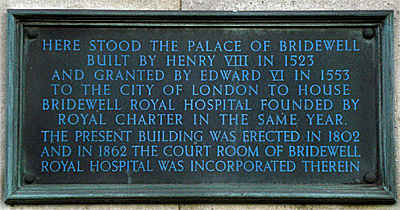
The palace, the site of which is now marked with a plaque on the approach to Blackfriars Bridge, consisted of two courtyards surrounded by brick buildings with the three storey royal lodgings (separate quarters for the king and queen) located around the inner courtyard and entered by a grand staircase from the outer courtyard. It also featured a watergate was located on the Thames and, interestingly, Bridewell was the first royal palace not to have its own great hall.

Among historic events hosted here was the visit of the Holy Roman Emperor Charles V in 1522 (the emperor did not stay here but his entourage did). In 1528 meetings of the papal delegation took place at Blackfriars (located next door and joined by a specially built gallery) to discuss the king’s divorce from Queen Katherine of Aragon – it’s here that the Queen made her most famous speech declaring her fidelity to the king – and for its duration the king and queen lodged at Bridewell. It’s also said that it was at Bridewell Palace that artist Hans Holbein the Younger painted his famous work – The Ambassadors (see our earlier post on this here).

Following Cardinal Wolsey’s fall from favor in 1529, King Henry VIII no longer used the property (he took over the Palace of Whitehall, then known as York Place, as his main residence in 1530 – for more on this see our earlier post here). It was leased for much of the following decade to the French ambassador in London before, following petitioning for a new hospital for the poor from Nicholas Ridley, the Bishop of London, King Edward VI gave it to the City of London in 1553. They took over fully in 1556 and converted the palace into a prison, hospital and workrooms (we’ll deal in detail with the prison in an upcoming post).

LondonLife – Dick Whittington visits St Paul’s for the Lord Mayor’s Show…

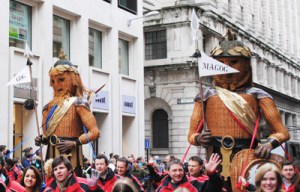
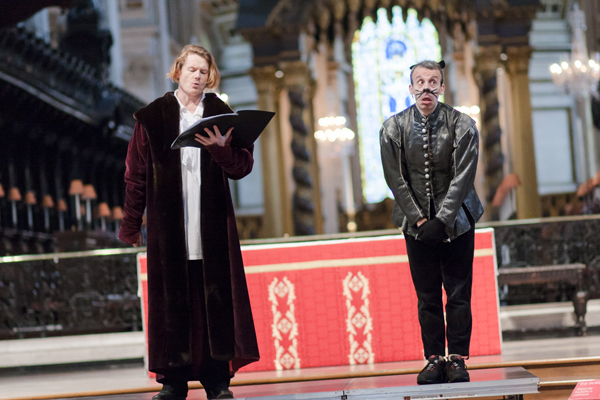
Actors Julian Rhind-Tutt (The Madness of King George, Notting Hill) and David Schneider (Horrid Henry the Movie, I’m Alan Partridge) star as thrice Lord Mayor of London, Dick Whittington, and his cat in one of a series of free performances held in St Paul’s Cathedral last Saturday as part of the festivities surrounding the annual Lord Mayor’s Show. The Lord Mayor, Roger Gifford, visited St Paul’s to receive a blessing before heading on to the Royal Courts of Justice to swear an oath of allegiance (and then, eventually returning to Mansion House where his journey had also begun). Interestingly, the Lord Mayor was unable to complete his entire journey to and from Mansion House in the State Coach this year (see our earlier post here) when what was reported as a fault with the coach’s wheels meant he had to complete the journey in an open top Land Rover. For more on events at St Paul’s Cathedral, see www.stpauls.co.uk.

PICTURE: © Graham Lacdao/The Chapter of St Paul’s Cathedral

Famous Londoners – Sir Peter Lely…

One of the most famous painters of his age, Dutchman Sir Peter Lely – currently the subject of an exhibition at London’s Courtauld Gallery – rose to become the foremost portrait painter at the English Court during the latter half of the 17th century.

Born to Dutch parents on 14th September, 1618, in Westphalia (now part of Germany) where his father was serving as an infantry captain, Peter – originally named Pieter van der Faes – studied art as an apprentice in Haarlem in what is now The Netherlands. While there he is believed to have changed his name to Lely based on a heraldic lily which appeared on the gable of the house where his father was born in The Hague.

Lely appeared in London in the early 1640s and, while he initially devoted himself to the sort of narrative-style paintings inspired by classical mythology, the Bible and literature he had been working on in Haarlem but having found no great success there, soon turned his hand to portraiture.

The death of court portraitist Anthony van Dyck in 1641 had left a vacuum he stepped into the gap, soon becoming the most in-demand portrait painter at the Royal Court, his sitters including none other than King Charles I himself.

However, Lely, who was made a freeman of the Painter-Stainers Company in London in 1647, managed to straddle the political divide and after the beheading of King Charles I and the end of the English Civil War in 1651, was able to continue painting portraits of the most powerful people in the land including Oliver Cromwell – whom he painted “warts and all” as per the Lord Protector’s request – and his Cromwell’s brother Richard.

Already renowned as the best artist in the country, following the Restoration in 1660, Lely became Principal Painter of King Charles II, placed on an annual stipend as van Dyck had been before him during the reign of King Charles I.

Lely’s workshop was large and its output prolific, with his students and employees – who at one stage apparently included scientist and architect Robert Hooke – often completing his paintings after he sketched out some details, only painting the sitter’s face in any great detail.

Among his most famous works are a series of 10 portraits known as the Windsor Beauties (currently at Hampton Court Palace), a series of portraits of senior naval officers who served in the Second Anglo-Dutch War, known as the Flagmen of Lowestoft (most of the works at are the National Maritime Museum in Greenwich) and Susannah and the Elders (currently at Burghley House in Cambridgeshire) as well as some of the paintings in the current Courtauld exhibition including Nymphs by a Fountain (usually found at the Dulwich Picture Gallery) and Boy as a Shepherd (also the Dulwich Picture Gallery).

Lely was also known as an avid collector of art and is credited as being the first artist in England to do so in any serious manner – among his purchases were works which formerly formed part of King Charles I’s collection. At the time of his death, he is said to have owned more than 500 paintings, although more than half of these were works of his or his studio.

Sir Peter, who never married but had two children who survived him with a common-law wife Ursula, lived at a house in the north-east corner of Covent Garden from about 1650 until his death in 1680 (some sources have him knighted in this year, others in 1679) but also had a house at Kew and owned property outside of London including in Lincolnshire and The Hague.

He was apparently working at his easel in the studio of his Covent Garden house when he died on 30th November, 1680. He was buried at St Paul’s Church, Covent Garden. The monument to him, the work of Grinling Gibbons, was destroyed by fire in 1795.

Peter Lely: A Lyrical Vision – which focuses on some of his early non-portrait works – runs at The Courtauld Gallery until 13th January. For more on the exhibition, visit www.courtauld.ac.uk/gallery/exhibitions/2012/peter-lely/index.shtml. Running alongside the exhibition is a display of some of the drawings from Sir Peter’s own collection, Peter Lely: The Draughtsman and His Collection.

LondonLife Special – It’s Bonfire Night!…

Today marks what was traditionally known as Guy Fawkes Day or, as it’s known more popularly today, Bonfire Night, when, along with people throughout the UK, Londoners celebrate the capture of would be regicide Guy Fawkes and his conspirators, who in 1605 plotted to blow up the House of Lords and with it, King James I, during the State Opening of Parliament.

We’ve previously run a couple of pieces on the conspiracy and some of the key people and places involved – check out our earlier entries here and here.

Meantime, if you’re wanting to attend a celebration in London, Time Out has a terrific guide to all the events taking place – simply head to their page here. Enjoy the night!

Where is it?…#48

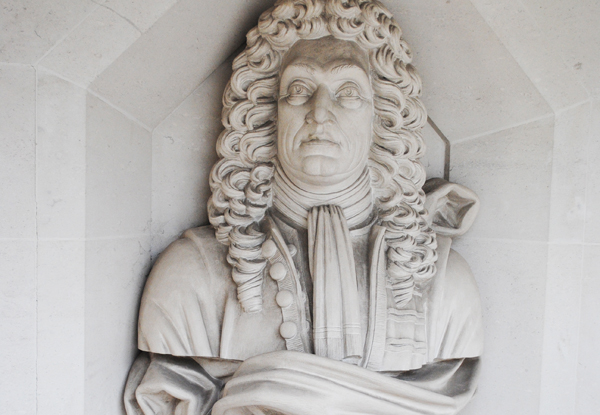
The latest in the series in which we ask you to identify where in London this picture was taken and who it’s of. If you think you can identify this picture, leave a comment below. We’ll reveal the answer early next week. Good luck!

Well done to Angelo (and, I suspect the correct location for Mike), this is indeed a bust of Sir Christopher Wren and is located in a loggia outside the Guildhall Art Gallery facing into Guildhall Yard. It and three other larger than life busts of notable Londoners – playwright William Shakespeare, statesman Oliver Cromwell and diarist Samuel Pepys – are all the work of Tim Crawley and were installed when the gallery was completed in 1999. Along with them is a full length statue of Dick Whittington and his famous cat – these are the work of Laurence Tindall.

Around London – Henry Stuart at the NPG; the Lord Mayor’s Show; prehistoric Japanese pots; and, photography at the National Gallery…

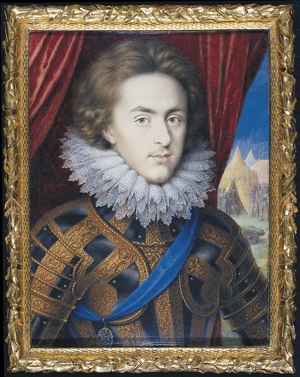
• The first ever exhibition focusing on Henry Stuart, older brother of King Charles I, has opened at the National Portrait Gallery. The Lost Prince: The Life and Death of Henry Stuart features more than 80 exhibits including paintings, miniatures, manuscripts, books and armour gathered from museums and personal collections around the UK and abroad – with some of the objects being displayed in public for the first time. Opened on 18th October – the 400th anniversary of the Prince’s death, among the paintings displayed in the exhibition are works by Holbein, Nicholas Hilliard and Isaac Oliver as well as Robert Peake as well as masque designs by Inigo Jones and poetry  by Ben Jonson. Henry, Prince of Wales, was the eldest son of King James I and Queen Anne of Denmark, and died at the age of 18 of typhoid fever. As well as looking at his short life, the exhibition covers the extraordinary reaction to his premature death (and the end of hope that King Henry IX would sit next upon the throne). The exhibition runs until 13th January. An admission fee applies. For more, see www.npg.org.uk. PICTURE:  Henry, Prince of Wales by Isaac Oliver, c. 1610-12; Copyright: The Royal Collection Photo: Supplied by Royal Collection Trust / © HM Queen Elizabeth II 2012

The Lord Mayor’s Show – the largest unrehearsed procession in the world – will be held on 10th November. This year’s procession – celebrating the election of the 685th Lord Mayor of London, Alderman Roger Gifford – will feature more than 6,500 people winding their way through the City of London in a three-and-a-half mile-long display including 22 marching bands, 125 horses, 18 vintage cars, 21 carriages, an original American stagecoach, a Sherman tank, a steamroller and a Japanese Taiko drum band. While there will be no fireworks after this year’s parade, following the success of last year’s trial there will be an early morning flotilla with the Lord Mayor conveyed in the barge QRB Gloriana from Vauxhall up the Thames to HMS President, just below St Katharine Docks, from where he will make his way to the Mansion House to join the procession as it heads first to St Paul’s and then on to the Royal Courts of Justice before returning (via a different route). There are no grand stand seats left but plenty of places you can watch it for free (for a chance to win free Grandstand tickets, head to the Lord Mayor’s Show Facebook page and ‘like’ it). We’ll be talking about this more next week, but in the meantime, for maps and details of a new smart phone app, head to www.lordmayorsshow.org.

Two prehistoric Japanese pots have gone on display at the British Museum. Loaned from the Nagaoka Municipal Science Museum, the pots date from the Middle Jomon period (3,500-2,500 BCE) and consist of a ‘flame’ and a ‘crown’ pot which were excavated in Nagaoka city. The pots form part of the Asahi Shimbun Displays in room 3 and will be there until 20th January. Meanwhile, continuing the Asian theme, an exhibition of more than 100 contemporary carved Chinese seals by artist Li Lanqing is on display in room 33 until 15th January. Admission to both is free. For more, see www.britishmuseum.org.

• On Now: Seduced by Art: Photography Past and Present. The National Gallery’s first major exhibition of photography, the display looks at the relationship between historical paintings and photography, both its early days in the mid-19th century and the work of contemporary photographers – in particular how photographers have used the traditions of fine art to “explore and justify” their own works. Almost 90 photographs are displayed alongside a select group of paintings for the show. Admission is free. Runs until 20th January in the Sainsbury Wing. For more, see www.nationalgallery.org.uk.

10 Historic London Markets – 5. Covent Garden Market…

We’ve had a quick look at the origins of Covent Garden before (as part of our What’s in a name? series) but it’s worth a recap.

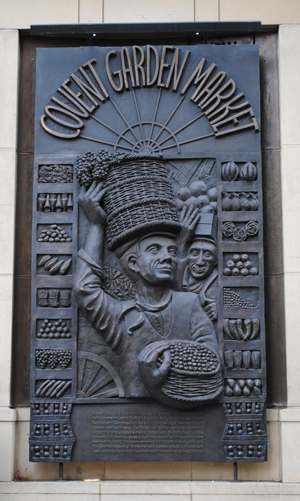
Now a favorite of tourists visiting London, Covent Garden is these days largely known as a specialty shopping and entertainment precinct in the West End. But its beginnings as a market go back at least to the 1600s when a licence was formally granted to hold a market in the piazza.

The land had been formerly owned by the Abbey (or Convent) of St Peter in Westminster which had established 40 acre kitchen garden here (hence ‘Convent Garden’) and had passed into the hands of the Crown at the Dissolution. Later owned by the Earls of Bedford, it was the 4th earl, Francis Russell, who commissioned Inigo Jones to design a great residential square- including St Paul’s Church, known as the Actor’s Church – on the site.

By 1650, fruit and vegetable markets were regularly been held on the site and, interestingly, around this time the market adopted the pineapple, a symbol of wealth, as its emblem (it was also around this time that Punch and Judy shows were introduced to the area (see our earlier post on Mr Punch here)). Covent Garden’s rise to prominence as a market came when the Great Fire of London destroyed many of London’s other markets leaving it as the foremost fruit, vegetable and flower market. In May 1670, the 5th Earl of Bedford, William Russell (later 1st Duke of Bedford), obtained the formal right to hold a market on the site from King Charles II.

The growth of the market and the development of fashionable residential developments further west in Soho and Mayfair saw many of the affluent people who had lived around the market move out and the character of the square changed (in an indication of this, a list of Covent Garden prostitutes was published in 1740).

In 1813, the 6th Duke of Bedford, John Russell, secured an Act of Parliament regulating the market and in the late 1820s began to redevelop the site, commissioning architect Charles Fowler to design new buildings (up until then the market was housed in makeshift stalls and sheds). These include the grand main market building which still stands on the site today.

The market continued to grow – there is said to have been 1,000 porters employed at the market’s peak – and in 1860 a new flower market was built on the south piazza (where the London Transport Museum now stands), while in the 1870s, a glass roof was added to the market building. A “foreign” flower market opened in what is now Jubilee Hall in 1904.

In 1918, the Bedford family sold the market to the Covent Garden Estate Company. The next major installment in the market’s life came in 1974 when the market, which had outgrown the West End site, moved out to a new site in Nine Elms at Vauxhall in London’s inner south.

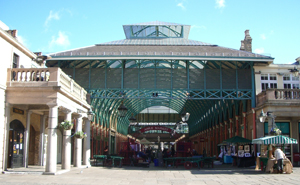
The Covent Garden site was left to fall into disrepair but, saved from demolition and redevelopment largely through the efforts of Geoffrey Rippon, then Secretary of State for the Environment, it subsequently underwent restoration, reopening as a speciality shopping centre in 1980 with areas including the Apple Market (pictured above), the East Colonnade Market and the Jubilee Market. Now owned by Capital & Counties who purchased it in 2006, the market – along with the larger 97 acre Covent Garden area – remain under the care of the Covent Garden Area Trust.

Meanwhile, the New Covent Garden Market at Nine Elms is these days the largest fruit, vegetable and flower market in the UK and boasts more than 200 businesses. There are currently plans to redevelop the 57 acre market site which will include providing more space for market tenants as well as new homes, shops and community facilities like parks.
.
Covent Garden
WHERE: King Street, Covent Garden (nearest Tube stations are Covent Garden, Leicester Square and Embankment); WHEN: Public areas are open 24 hours; check with individual shops for opening times; COST: Free; WEBSITE: www.coventgardenlondonuk.com
.
New Covent Garden Market
WHERE: New Covent Garden Market, Nine Elms, Vauxhall (nearest Tube station is Vauxhall); WHEN: The fruit and vegetable market’s core trading hours are between midnight and 6am, Monday to Saturday, while the flower market’s core trading hours are between 2am and 8am, Monday to Saturday (times may vary for individual businesses); COST: Free (charge for cars); WEBSITE: www.newcoventgardenmarket.com.
.
PICTURE: Apple Market Picture courtesy of www.coventgardenlondonuk.com.

Lost London – Greyfriars…

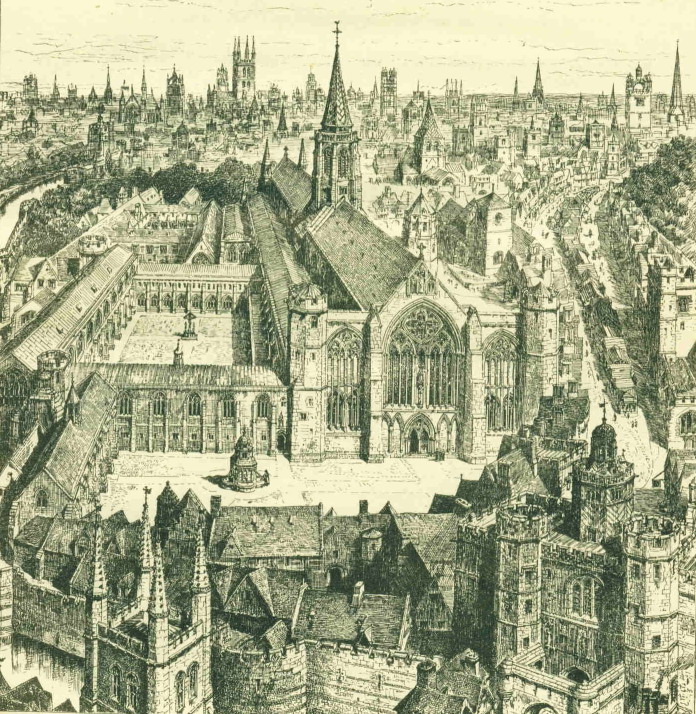
A now long gone Franciscan friary located in the north-west of the City of London near Newgate (just to the north of St Paul’s Cathedral), Greyfriars, so known for the color of the friars’ clothing, was the second Franciscan religious house to have been founded in England.

The foundations of the friary date from the early part of the 13th century – the Franciscans, as members of the Order of Friars Minor were known, had arrived in 1224 and are recorded as settling on land granted to them by a rich mercer, John Iwyn, just inside the City wall, in 1225, in the butcher’s quarter of the city.
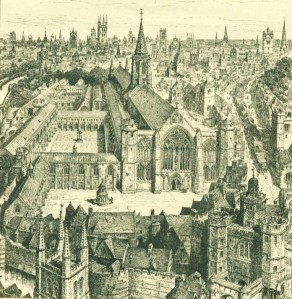
King Henry III apparently gave them some oak to build their own friary in 1229 and by the mid 1200s, there were more than 80 friars living on the site which was gradually extended over the ensuing years to the north and the west.

Using funds given them by Sir William Joyner, Lord Mayor of London in 1239, they built a chapel which was later extensively enlarged and improved in the late 13th and early 14th centuries – the new church was said to be 300 feet long – with much of the work funded by Queen Margaret, second wife of King Edward I, and later in the 14th century, Queen Isabella, wife of Edward III. It apparently suffered some damage in a storm in 1343 but was restored by King Edward III.

When it was finally completed in 1348, the church is said to have been the second largest in London. A library was later added to the buildings, founded by the famous Lord Mayor of London, Richard “Dick” Whittington.

Such was the fame of the church that, the heart of Queen Eleanor, wife of King Henry III, was buried here after her death in 1291 while, despite dying at her castle in Marlborough, Queen Margaret was also buried here in 1318 (apparently wearing a Franciscan habit).

But perhaps the most notorious person to be buried here was Queen Isabella, wife of King Edward II and known by many as the “She-Wolf of France”, after her death in 1358. In fact, it’s said that the ghost of Isabella still haunts the former location of Greyfriars, driven forth from the grave for her role in deposing her husband.

Other non royal luminaries said to have been buried here include the 15th century writer Sir Thomas Mallory, author of Le Morte d’Arthur and 16th century Catholic nun Elizabeth Barton, the so-called ‘mad maid of Kent’ who was executed for her rather unwise prophecies predicting King Henry VIII’s death if he married Anne Boleyn.

The end of the friary, pictured above in the sixteenth century, came in 1538 when it fell victim to King Henry VIII’s policy of dissolving monasteries and was surrendered to his representatives.

Some of the houses were subsequently converted for private use and the church, which was somewhat damaged during this period with many of the elaborate tombs destroyed, was briefly closed before it and other buildings were given to the City of London Corporation who reopened it again in 1547 as Christ Church Greyfriars, a parish church serving the now joined parishes of St Nicholas Shambles and St Ewen.

Only a few year’s later King Edward IV founded a school for poor orphans in some of the old friary buildings known as Christ’s Hospital or informally as The Bluecoat School thanks to the uniforms students wore. Some of the school buildings, along with part of the church which was also used by the school, was destroyed by the Great Fire of London in 1666, but the school was rebuilt and remained in use until the late 1800s when the last of the students were relocated to a new facility in Sussex (where the school still exists today).
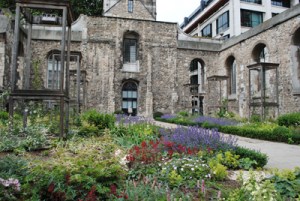
The church (also known as Christ Church Newgate Street), meanwhile, was also rebuilt after the Great Fire – it was one of Sir Christopher Wren’s designs and was completed in 1704. The church remained in use until World War II when a firebomb struck it during a German raid on 29th December, 1940, all but destroying it.

The church was not rebuilt and the parish merged with the nearby St Sepulchre-without-Newgate – the largest parish church in London – and eventually what’s left of the church – the tower with rebuilt steeple and the west and north walls – were converted into a public garden (rose beds were planted where the pews once stood and there are wooden towers representing the church’s pillars). Pictured right, it’s now a terrific place to sit and have lunch pondering the past which the bustle of the city goes on about you.

PICTURE: (top) Wikipedia

For a great biography of Isabella, the She-Wolf of France, see Alison Weir’s Isabella: She-Wolf of France, Queen of England. For more on Sir Christopher Wren’s churches in London, see John Christopher’s Wren’s City of London Churches.

10 Historic London Markets – 4. Leadenhall Market…

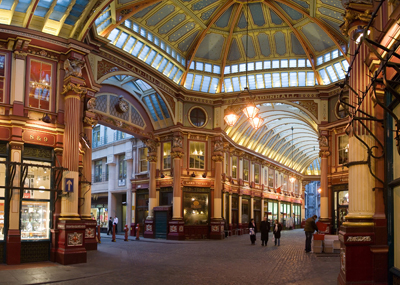
A covered – and splendidly decorated – Victorian-era market located just off Gracechurch Street in the heart of the City of London, Leadenhall Market might go un-noticed by many but visit at lunchtime on a weekday and you’ll to fight for space among the besuited City workers looking for sustenance there.

The history of a market on this site goes back to Roman times for it was under the current market that the remains of Londinium’s basilica and forum – the Roman marketplace – can be found (there’s apparently a part of the basilica wall in the basement of one of the Leadenhall shops).

This fell into disuse following the Roman period, however, and the origins of the current market are generally agreed upon as emerging in the 14th century when it occupied the site of a lead-roofed manor (hence “leaden hall) which was at one stage leased by the famous Lord Mayor Richard “Dick” Whittington before it burnt down in the late 1400s. The subsequent market was initially associated with poultry and then with cheese and other foodstuffs (it remained known for game and poultry) and separate areas were later developed for trade in wool, leather and cutlery.

In 1666, a small section of the market was destroyed in the Great Fire of London but it was rebuilt shortly after – for the first time under cover – and was divided into three sections: the Beef Market, the Green Yard and the Herb Market.

In 1881, after the existing building was demolished, a new structure boasting wrought iron and glass was designed by Sir Horace Jones (architect for the Corporation of the City of London, he also designed Billingsgate and Smithfield Markets – see our earlier entries here and here). The market is now one of the City’s five principal shopping centres and, as well as fresh food and flowers, hosts a variety of specialty shops, restaurants, cafes and pubs.

The Grade II* listed building was extensively restored in 1991. It has since starred in Harry Potter and the Philosopher’s Stone as well as other films including The Imaginarium of Doctor Parnassus and the recent Tinker, Tailor, Soldier, Spy.

Before we finish, we would be remiss not to mention Old Tom. A celebrated gander, he managed to avoid the axe for years and became a favorite of traders and customers (even being fed by local innkeepers) – so much so, that when he died at the age of 38 in 1835, his body lay in state before he was buried on site. There’s a bar in the market named for him.

WHERE: Gracechurch Street, City of London (nearest Tube stations are Monument, Bank and Cannon Street); WHEN: Public areas are generally open 24 hours a day with core trading hours between 10am and 5pm weekdays (check with individual shops for opening hours); COST: Free; WEBSITE: www.leadenhallmarket.co.uk

PICTURE: DAVID ILIFF. Licence CC-BY-SA 3.0. Via Wikipedia.

Treasures of London – Temple Church knight effigies…

A relic of the early medieval age, the late 12th century Temple Church in the City of London is a marvel in its own right, its circular nave modelled on the Church of the Holy Sepulchre in Jerusalem (for more on its history, see our earlier entry here). But it’s inside the round church – once based inside property that formed the London headquarters of the Templar Knights – that we are concerned with in this piece – for there can be found are series of remarkable effigies of knights which date from the 13th century.

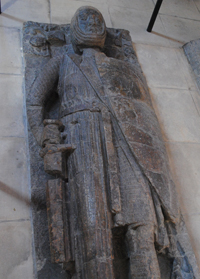
There are nine effigies in all (and one grave cover) and, having survived the Great Fire of 1666, most of them were damaged during World War II when, in a bombing raid on 10th May, 1941, the roof was set alight and came crashing down on top of them. They have since been repaired, using as much of the original material as possible, and still make an imposing sight redolent with the history they depict.

Pre-eminent (at least in his lifetime) among those depicted is William Marshal, the 1st Earl of Pembroke (1146 -1219) and an advisor of kings including King Henry II, King Richard ‘the Lionheart’ and King John who was named Regent during the infancy of King Henry III.

One of the most influential men of his age (described by early thirteenth century Archbishop of Canterbury, Stephen Langton, as the “greatest knight who ever lived”), he lies in the southern group of effigies near his sons William, 2nd Earl of Pembroke (1190-1231) and Gilbert, the 4th Earl of Pembroke (1194-1241). (The 3rd Earl of Pembroke, Richard, was the second son of William – he died after being captured during fighting in Ireland and was buried in Kilkenny). Another of this group is believed t0 depict Robert, Lord de Ros, one of the 25 barons to guarantee the observance of the Magna Carta, signed by King John in 1215.

The only identified effigy in the northern group is that of Geoffrey de Mandeville, the 1st Earl of Essex and a man known for the cruelties he inflicted during the troubled reign of King Stephen (he shifted his allegiances between King Stephen and his rival, the Empress Matilda several times), particularly in the eastern counties where he seized Ramsey Abbey near Peterborough to use as his base.

Interestingly, none of the men named was a Templar but are believed to have been benefactors of the Templar Knights. Some of those shown are cross-legged but whether this denotes a crusader or not remains a matter of debate.

WHERE: Off Fleet Street and down Inner Temple Lane (nearest tube station is Temple); WHEN: Check website for times; COST: £4 (free to under 18s, seniors); WEBSITE: www.templechurch.com.

Famous Londoners – John Wesley…

Credited as the founder, along with his brother, of Methodism, it was in London that John Wesley experienced the spiritual awakening that would change his life and lead to the establishment of a new religious movement.

Born on 17th June, 1720, in Epworth, not far from Lincoln, Wesley was the 15th of 19 children born to Samuel Wesley – the rector there – and his wife Susanna. Rescued from a fire in the family rectory at a young age, the event was to have a lasting impression on him leading to his later view that he was set apart for a special purpose – “a brand plucked from the burning”.

Wesley was educated at London’s Charterhouse School and then at Christchurch College in Oxford. Ordained a priest in the Church of England in 1728, he spent two years serving as his father’s curate before returning to Oxford in 1729.

It was there he formed the ‘Holy Club’ with his brother Charles and fellow students including George Whitfield. It’s here that the name ‘Methodist’ was first used as a pejorative term to describe members of the group thanks to their ‘methodical’ way of living – which included religious practises like fasting as well as caring for the ill and prisoners – and which was later adopted by Wesley himself.

Following a largely unsuccessful sojourn in the newly founded American Province of Georgia with his brother Charles (they had been invited by the colony’s first governor, James Oglethorpe, to minister to the new settlers) during which Wesley was involved in a courtship that ended badly, the clergyman fled back to England.

It was in London, on 24th May, 1738, that the clergyman then had his “Aldersgate experience” in which he felt his heart “strangely warmed” while at a religious meeting in Aldersgate Street (there’s a monument – the Aldersgate Flame – to this next to the Museum of London).

Initially influenced by the Moravians (Wesley even visited one of their communities in Germany), he later developed some concerns about some aspects of their teachings and so began forming his own followers into what would become the Methodist Society. Despite considerable opposite from the Church of England (Wesley was still an ordained Anglican minister), the new Methodists continued to work among the poor of London and elsewhere in England.

Barred from many Church of England pulpits thanks to his views on everything from salvation to the role ordinary people could play in the church, Wesley began preaching to large masses in the open air – ‘field preaching’ – as he travelled extensively about the country. He is said to have preached as many as 40,000 sermons and travelled some 250,000 miles during his ministry and campaigned on many social issues – including prison reform and the abolition of slavery – while his brother Charles is credited with writing thousands of hymns.

The first Methodist chapels in the UK were opened in the late 1770s – while the first was in Bristol, the second was opened in City Road, London, in 1778. It is still in use today – you can visit it, the Museum of Methodism (housed in the chapel crypt), and the house where Wesley lived the last 12 years of his life – follow this link for more details. The statue pictured above stands outside.

While he did not ordain ministers in England and throughout his lifetime continued to consider himself an Anglican, in an act which helped lead to the creation of an independent Methodist Church (formally created after his death), in 1784 Wesley ordained ministers to head to the newly independent United States of America after the Anglican Church failed to do so.

John Wesley died on 2nd March, 1791, at the age of 87, in his house. He was entombed at the London chapel.

While at the time of his death, it’s estimated that there were 135,000 members and more than 500 itinerant preachers working under the name  of “Methodist”, Wesley’s legacy was to become far greater as his ideas spread across the globe. It’s now estimated that there are around 70 million Methodists around the world.

Other monuments commemorating Wesley in London include Methodist Central Hall in Westminster – located opposite Westminster Abbey – which was built in the early Twentieth century to mark the centenary of Wesley’s death and a statue of Wesley on St Paul’s Churchyard, erected in 1988.

There’s a terrific walking guide published by the Methodist Church which links sites of relevance to Wesley’s life in London. You can download it here.

What’s in a name?…Cannon Street

One of the major thoroughfares of the City of London, Cannon Street’s name has nothing at all to do with artillery or religion. In fact, the street, which runs from St Paul’s Churchyard in the west to Eastcheap in the east, owes its name to the industry that once took place there.

Like many other streets in the City connected with the occupations of past residents, Cannon Street is a corruption of a street formerly known as Candelwichstrete (one of many various spellings of which the modern English version is Candlewick Street) which relates to the candlemakers and wax chandlers who lived and conducted their trade along the street in the Middle Ages (the Tallow Chandlers Company, involved in regulating candle-making, has been located in adjoining Dowgate Hill since 1476, although the current building dates from 1672).

The name was gradually corrupted into Cannon Street (apparently the corruption was at least partly due to its pronunciation in the Cockney dialect), which is what it was known as by the late 17th century when the seemingly ever-present Samuel Pepys was writing his diary.

Cannon Street – which was only extended to its current length in the mid-1800s under the supervision of architect JP Bunning, having formerly been a narrow lane which stopped at Dowgate Hill in the east – apparently later become known for the number of drapers based there and was also home to the Steelyard or Stalhof, the trading base of the German Hanseatic League in London in the 13th and 14th centuries (a plaque commemorating this was erected at Cannon Street Station in 2005).

Now lined with office buildings including some former warehouses from the Victorian era, the street is also home to a recently redeveloped above ground train station and Underground station- both of which were opened in the late 1800s (the station, which built was on the site of the Roman governor’s palace, was originally located behind the Cannon Street Hotel, birthplace of the British Communist Party). Cannon Street is also the location of the mysterious London Stone – formerly located at the now long-gone St Swithin’s Church, it can be found behind a grill at number 111 – for more on it, see our earlier post here).

London Pub Signs – The Lord Raglan…

Originally known as The Bush,  The Lord Raglan pub just to the north of St Paul’s was renamed in the mid 1800s to commemorate one of the heroes of the Battle of Waterloo – the 1st Baron Raglan (1788-1855).

Named the 1st Baron Raglan in 1852, the man previously known as Lord FitzRoy Somerset had lost his right arm at the Battle of Waterloo, fought between the Duke of Wellington and Napoleon on 18th June, 1815, in modern-day Belgium.

His name was subsequently adopted to to describe the ‘Raglan Sleeve’, a type of sleeve which extends as a single piece to the collar and a style which Lord Raglan was said to have favored after his arm was amputated.

Lord Raglan died in 1855 while Commander-in-Chief at the Crimean War. There is a blue plaque commemorating his role in this war on his former house in Stanhope Gate in Mayfair.

The site of the Lord Raglan tavern, 61 St Martin’s Le Grand, is said to be one of the oldest tavern sites in the city, originally dating from about 1779, and while the current building dates from 1855, the cellars are said to be much older and are said to incorporate parts of what was the Roman wall.

For more on the Lord Raglan, see the Taylor Walker website at www.taylor-walker.co.uk/pub/lord-raglan-st-pauls/c1779/.

Where is it?…#45


The latest in the series in which we ask you to identify where in London this picture was taken and what it’s of. If you think you can identify this picture, leave a comment below. We’ll reveal the answer early next week. Good luck!

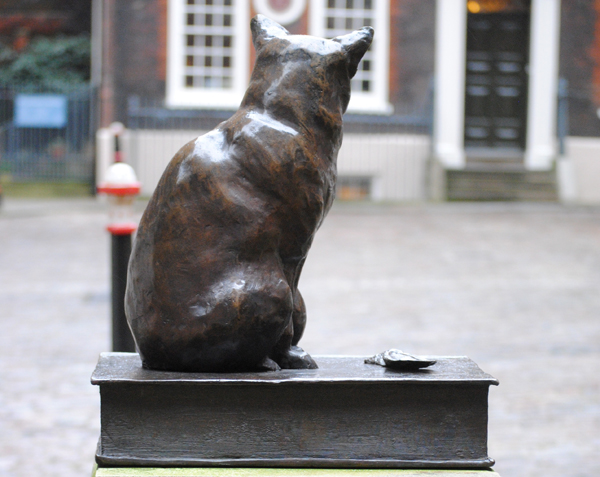
Congrats to Mike, Debbie, Janet, and Zoe (on Facebook), this is indeed the back of the statue of Hodge the cat in Gough Square in the City of London, just outside Dr Johnson’s House at No 17. One of the cats of the famed lexicographer, Dr Samuel Johnson, Hodge had his own moment of stardom in James Boswell’s Life of Johnson in which Dr Johnson is heard remarking that he’s had better cats than Hodge before, apparently in response to Hodge’s reaction, stating that he was “a very fine; a very fine cat indeed” (Johnson was apparently unusual for his love of cats; Boswell did not suffer the same love). This bronze statue of Hodge, by sculptor Jon Bickley and placed here in 1997, has Hodge sitting on a copy of Dr Johnson’s famous dictionary and beside him is some empty oyster shells, referring to Dr Johnson’s habit of buying oysters for his cats to eat. For more on Dr Johnson’s House (where Dr Johnson lived from 1747-59), see www.drjohnsonshouse.org.

Around London – Dickens and the foundlings; astronomy photographs at the Royal Observatory; Royal Parks allotments; and, Asian drinking vessels at the British Museum…

• A new exhibition exploring the relationship between author Charles Dickens, the Foundling Hospital and its secretary and former foundling, John Brownlow, opened at the Foundling Museum today. Received, a Blank Child: Dickens, Brownlow and the Foundling Hospital looks at how Dickens supported the institution in various ways including helping a young mother petition for a place for her child and publicising the work of the hospital through his writing – in particular the 1853 article Received, A Blank Child (the phrase comes from the wording used on the hospital’s entry forms). Among the items on display are never before displayed letters from Dickens relating to the hospital. The exhibition, which runs until 16th December, is free with the museum admission. And if you haven’t yet had a chance to see it, there’s still time to catch Dickens and the Foundling, in which six contributors including actor Gillian Anderson and journalist Jon Snow, have chosen objects to be displayed. This ends on 28th October. For more, see www.foundlingmuseum.org.uk.

Images from the Astronomy Photographer of the Year competition have gone on display at the Royal Observatory in Greenwich (which runs the competition in conjunction with Sky at Night Magazine). Among the winning images were The Whirlpool Galaxy taken by Martin Pugh of the UK/Australia, Star Icefall by Masahiro Miyasaka of Japan, and Venus-Jupiter Close Conjunction, by Laurent Laveder of France. The exhibition is free of charge and runs until February next year. For more (including an online gallery), see www.rmg.co.uk/visit/exhibitions/astronomy-photographer-of-the-year/2012-winners/.

It’s Harvest Festival time at London’s Royal Parks and this Sunday, between 11am and 4pm, people are invited to attend the Kensington Gardens’ allotment to see the fruits of the gardeners’ labour including the “big dig” of the potato crop as well as seasonal vegetables. There’s also the chance for families to see the allotment chickens being fed and children’s activities run by Ginger Cat. This week’s event follows one last weekend at Regent’s Park. For more, see www.royalparks.org.uk.

• On Now: Ritual and revelry: the art of drinking in Asia. This new free exhibition in room 91 of the British Museum features a display of objects which have been used in the consumption of liquids in various Asian contexts and the manner in which their use is intertwined with ritual, religious and otherwise. Among the vessels on display is a Tibetan skull-cap known as a kapala which is made from a human skull and used in religious rituals as well as a silver tea set from western India which features handles shaped like bamboo stems and a lacquered wooden sake bottle which was used as an altar piece. Runs until 6th January. For more, see www.britishmuseum.org.

Famous Londoners – Grinling Gibbons…

A late 17th and early 18th century wood carver and sculptor, the curiously named Grinling Gibbons is remembered for his magnificent carvings in numerous English buildings including such London icons as St Paul’s Cathedral and Hampton Court Palace.

Not much is known about Gibbons’ early life. The son of English parents (his father was apparently a draper), he was born in Rotterdam in The Netherlands on 4th April, 1648, and, as a young man, is believed to have undertaken an apprenticeship as a sculptor in that country.

Around the age of 19, he moved to England – first to York and to Deptford in the south. It was the quality of his work which led diarist John Evelyn, having discovered Gibbons working on a limewood relief of Tintoretto’s Crucifixion in a small cottage near Deptford in early 1671, that led him to introduce him to Christopher Wren, the architect of the age, and fellow diarist Samuel Pepys and to eventually present him (and his relief) to King Charles II at Whitehall Palace on 1st March the same year.

But Gibbons’ work apparently failed to initially impress at court and it was only following his ‘discovery’ later that year by the court artist Sir Peter Lely that he began to receive major commissions.

It’s apparently not known when Gibbons married his wife Elizabeth and moved to London they were living there by 1672 and were having the first of their at least 12 children (while at least five of their daughters survived into adulthood, none of their sons did).

In 1672, they were living in an inn, called La Belle Sauvage or The Bell Savage, located on Ludgate Hill near St Paul’s, and, while Gibbons continued to maintain a workshop here into the 1680s, the family moved to Bow Street in Covent Garden around the end of the 1670s (the house here apparently collapsed in 1702 and was subsequently rebuilt in brick).

Gibbons, who was admitted to the Draper’s Company in 1672 and held various posts within it over ensuing years, reached the pinnacle of his success when he was made master sculptor and carver in wood to King William III in 1693, and was later made master carpenter to the king, then King George I, in 1719.

Having worked mostly in limewood, Gibbons, recently called the “British Bernini”, is known for his distinct and exuberant style which features cascading foliage, fruit, animals and cherubs. While he worked on numerous important buildings outside of London – including carvings in the Chapel Royal and king’s dining room at Windsor Castle, in a chapel at Trinity College in Oxford, at Blenheim Palace in Oxfordshire and a famous ‘carved room’ at Petworth House in Sussex – and beyond (he also created two presentation panels – known as the ‘Cosimo’ and ‘Modena’ panels which were sent to Italy as royal gifts), Gibbons is also noted for his work on a number of prominent buildings in London.

Among the buildings he worked on or in around London are the churches of St James’s in Piccadilly, St Mary Abchurch, St Michael Paternoster Royal and, famously, St Paul’s Cathedral (where he carved choir stalls, the bishop’s thrones and choir screen) as well as Hampton Court and Kensington Palaces.

While he is primarily remembered for his limewood carvings, Gibbons’ workshop was also responsible for sculpting statues, memorials and decorative stonework. A couple of the workshop’s statues can still be seen in London – one of King Charles II in Roman dress at the Royal Hospital in Chelsea and another of King James II outside the National Gallery in Trafalgar Square – while the magnificent Westminster Abbey memorial to Admiral Sir Clowdisley Shovell is also attributed to him.

Gibbons died at his Bow Street home on 3rd August, 1721, and was buried in St Paul’s Church in Covent Garden (his wife had been buried there several years before).

For more on Grinling Gibbons, check out David Esterly’s Grinling Gibbons and the Art of Carving.

Where is it?…#43

The latest in the series in which we ask you to identify where in London this picture was taken and what it’s of. If you think you can identify this picture, leave a comment below. We’ll reveal the answer early next week. Good luck!

This image is one of many found in a subterranean tunnel surrounding Hyde Park Corner Underground Station and depicts, of course, the 1st Duke of Wellington, Arthur Wellesley, enjoying his latter years. The ‘Iron Duke’ has strong connections to Hyde Park Corner – his former home, Apsley House, No 1. London, is located there as is the Wellington Arch, the Decimus Burton memorial to him. For more on the Duke, see our earlier post here and for more on Wellington Arch, see our earlier ‘Where is it?’ post here.