10 sites from Shakespearean London – 10: London in Shakespeare’s plays…

In this, the final in our series looking at Shakespeare’s London, we take a quick look at some of the plethora of London locations mentioned by the Bard in his historical plays. Some we have already covered, but here are a few more…

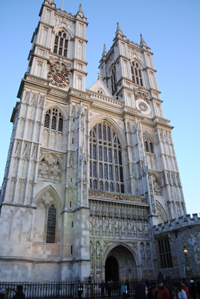
Westminster-AbbeyWestminster Abbey (pictured): We’ve already talked about Poet’s Corner but Shakespeare himself makes mention of Westminster Abbey in his plays, notably in Henry VI, Part I, when it’s the scene of Henry V’s funeral. The Jerusalem Chamber, principal room of Cheyneygates, the medieval house of abbots of Westminster is mentioned in Henry IV, Part II.

The Houses of Parliament: True, the buildings have changed somewhat since Shakespeare’s day but the former Palace of Westminster is the site of scenes in numerous plays including Richard IIHenry IV, Part II and Henry VI, Part III are set. Among rooms mentioned is Westminster Hall which survives today from the original building.

The Tower of London: As one would expect, this prominent London landmark pops up in several of Shakespeare’s plays including Henry VI, Part I and Richard III where its plays a rather central role – among the events recorded in the latter play are the infamous drowning of Richard III’s elder brother George in a butt of Malmsey wine.

Ely House: The London residence of the bishops of Ely, this long gone building is mentioned in Richard II (for more on Ely House see our earlier posts on Ye Olde Mitre Tavern here and St Etheldreda’s Church here ).

The London Stone: Now at 111 Cannon Street, the London Stone originally was located at another location in Cannon Street and its here in Henry VI, Part II, that rebel Jack Cade stops to strike his sword upon the stone (for more on the London Stone, see our earlier post here).

Other London sites mentioned in Shakespeare’s plays include generic “London Streets” (mentioned in a number of plays), “Eastcheap, near the Boar’s Head Tavern” (Henry IV, Part II), the Temple Garden (Henry VI, Part I) and Blackheath (Henry VI, Part II).

10 sites from Shakespearean London – 9: Memorialising Shakespeare (part 2)…

Following on from last week’s post, we look at a couple more London memorials to The Bard,  playwright William Shakespeare…

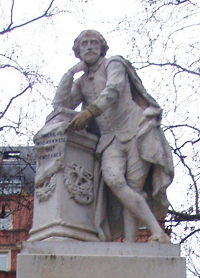
Shakespeare-Leicester-SquareLeicester Square: Returned to the West End square last year following its restoration (and the square’s redevelopment), this statue of Shakespeare – claimed to be the only outdoor one in London – was designed by architect John Knowles in 1874 when the square was constructed. Now Grade II-listed, it depicts Shakespeare leaning on a pedestal, pointing to a scroll which reads “There is no darkness but ignorance”, a quote from Twelfth Night. An inscription on the plinth upon which Shakespeare stands, refers to the laying out of the square by Albert Grant and doesn’t mention the playwright at all. The statue stands in the middle of a fountain, upgraded  as part of the recent overhaul of the site. PICTURE: Carcharoth/Wikipedia.

Primrose Hill: Shakespeare’s Tree on Primrose Hill was originally planted in April, 1864, to mark the 300th anniversary of his birth. An estimated 100,000 people marched to the site to watch the tree planting by poet Eliza Cooke and actor Samuel Phelps which was organised by the Workingmen’s Shakespeare Committee – apparently in response to the lacklustre efforts of a government-backed committee to mark the anniversary. The tree stood for 100 years before it died and was replaced with an oak sapling planted in 1964 actress Dame Edith Evans. A plaque which was attached to the tree detailing when it was planted has long since gone but there is talk of some sort of a permanent new memorial on the site.

There are other numerous places in London where Shakespeare – and his works – are remembered in London. One of our favourites is based in Love Lane and recalls the work of John Heminge and Henry Condell is getting Shakespeare’s works out to the world (for more on this, see our previous post here).

In our final post in this series next week, we take a look at some of the key London locations mentioned in Shakespeare’s plays.

10 sites from Shakespearean London – 8: Memorialising Shakespeare (part 1)…

Shakespeare

This week (and next week) as part of our look at Shakespeare’s London, we’re taking a look at a few of the many memorials to William Shakespeare located around London…

• Westminster Abbey: Perhaps the most famous of London’s memorials to Shakespeare can be found in Poet’s Corner, an area of the abbey which has become noted as a burial place and memorial site for writers, playwrights and poets. Designed by William Kent, the memorial statue of Shakespeare was placed here in January, 1741 (there had apparently been some earlier talk of bringing his bones from Stratford-upon-Avon but that idea was squashed). The life-size statue in white marble, sculpted by Peter Scheemakers, was erected by Richard Boyle, the 3rd Earl of Burlington, Dr Richard Mead, Alexander Pope and Tom Martin. The memorial also features the heads of Queen Elizabeth I, King Henry V and King Richard III on the base of a pedestal and shows Shakespeare pointing to a scroll on which are painted a variation of lines taken from The Tempest. A Latin inscription records the date the memorial was created and an English translation of this was added in 1977. For more on the abbey, see www.westminster-abbey.org.

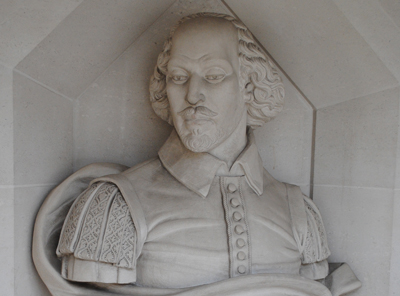
• Guildhall Art Gallery (pictured above): Facing into Guildhall Yard from niches under the loggia of the Guildhall Art Gallery are four larger-than-life busts of historical figures connected with the City of London. As well as one of Lord Protector Oliver Cromwell, architect Christopher Wren, and diarist Samuel Pepys (along with a full-length statue of Dick Whittington and his famous cat) is a bust depicting Shakespeare. Carved out of Portland stone by sculptor Tim Crawley, the busts were installed in 1999. Much attention was apparently paid to creating a bust which resembled pictures of Shakespeare. Follow this link for more on the gallery.

Former City of London School: This Thames-side building, dating from the 1880s, features a full length statue of Shakespeare who gazes out over the river. He’s not alone – poet John Milton, Sir Isaac Newton, Sir Thomas More and Sir Francis Bacon stand nearby, selected, apparently, to represent various disciplines taught at the school. The statues were the work of John Daymond who depicted Shakespeare flanked by representations of classics and poetry and drawing and music. The school vacated the building on Victoria Embankment  in the 1980s and it’s now occupied by JP Morgan.

We’ll be looking at some more works depicting Shakespeare next week…

10 sites from Shakespearean London – 7. Shakespearean connections in the Elizabethan world – St John’s Gate and Staple Inn…

Following on from our post last week, we take a look at a couple more of London’s buildings that had some sort of association with William Shakespeare…

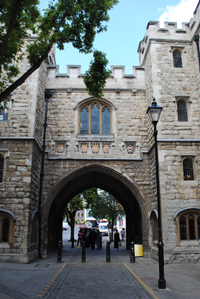
St-John's-Gate St John’s Gate, Clerkenwell (pictured): This former gatehouse into Clerkenwell Priory was at the time of Shakespeare home to the Master of the Revels and where the playwright would have had to have brought his plays for official government approval. Thirty of the Bard’s plays were licensed here and the Master of Revels during all but the final few years of Shakespeare’s career was Edmund Tilney (or Tylney), who served in the post under both Queen Elizabeth I and King James I. The gatehouse was later used as a coffee house and pub among other things and is associated with everyone from artist William Hogarth (his father Richard ran the coffee house), Dr Samuel Johnson and Charles Dickens. These days, the gatehouse is part of the Museum of the Order of St John (for more on that, see our earlier post here).

Staple Inn, Holborn: OK, there’s no direct link at all between Shakespeare and this building on High Holborn but it was built during his lifetime – in 1585 – and as such is one of very few surviving examples of buildings of his era. Its name comes from the fact the site where it stands was originally a covered market where wool was weighed and taxed (the word ‘staple’ apparently relates to the duty on wool introduced in 1275). It later became an Inn of Chancery – a medieval school for lawyers which fed students through to the Inns of Court (in this case mostly Gray’s Inn), and it was members of the Society of Staple Inn who built the new building here in the 1580s. The building – which still boasts a grand hall – survived the Great Fire of London in 1666 and, albeit with considerable damage, the Blitz. Since the late 1800s, it has been home to what’s now known as the Institute and Faculty of Actuaries. The building, which was restored in the 1990s, is a great example of an Elizabethan-era structure and gives some sense of what Shakespeare’s London was like.

10 sites from Shakespearean London – 6. Shakespearean connections in the Elizabethan world: The George Inn and Middle Temple Hall…

Today we’re taking a look at a couple of still extant London buildings which have strong associations with playwright William Shakespeare…

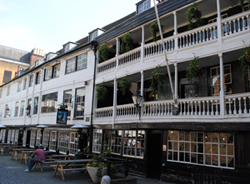
George-InnThe George Inn, Southwark. Located at 75-77 Borough High Street, the George Inn is London’s last remaining galleried inn. The current building has its origins in the late 17th century after the original inn, which can be traced back to at least the mid-1500s – was destroyed in a fire in 1676. Now owned by the National Trust, it is leased out and remains open as a public house – part of the Greene King chain. While its known for its connections with 19th century writer Charles Dickens – he was a patron of this establishment and mentions it in Little Dorrit (a fact we mentioned in our series on Dickens back in 2012), the inn (or at least the previous version of it) also has Shakespearean connections with its prime Southwark location meaning it’s quite possible Shakespeare himself may have visited. Whether that’s the case or not, it is known that the premises served at time as a theatre of sorts in his day with acting troops performing in the courtyard while audience members could stand in the courtyard and watch or pay extra for a seat in the gallery. For more on the inn, see www.gkpubs.co.uk/pubs-in-london/the-george-inn-pub/.

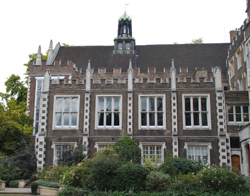
Middle-Temple-HallMiddle Temple Hall. Built between 1562 and 1573 by Edmund Plowden (memorialised with monuments in both the hall and nearby Temple Church), this magnificent Tudor hall has survived both the Great Fire of London and the Blitz and continues to serve the legal profession today. It too was used as a theatre/concert hall in Elizabethan times and later as a site for Inigo Jones’ masques but in terms of the Shakespearean connection, it is known for being where the first recorded performance of Twelfth Night took place – on the night of Candlemas (2nd February) 1602. The Lord Chamberlain’s Men performed the play and it is thought that Shakespeare himself was among the players. For more on the hall, which is only rarely opened to the public, you can visit our earlier posts here and (on ‘Drake’s Cupboard) here or the official website at www.middletemple.org.uk/home/.

For more on the George Inn, check out Pete Brown’s social history Shakespeare’s Local: Six Centuries of History Seen Through One Extraordinary Pub.


Famous Londoners – Philip Henslowe…

A contemporary of William Shakespeare (and hence, given our current focus on Shakespeare, the reason why we’re featuring him), Philip Henslowe was a theatre owner and impresario who, along with John Chomley, built the Rose Theatre in Bankside.

Henslowe is believed to have been born in about 1550 and was the son of Edmund Henslowe, master of the game at Ashdown Forest in Sussex. He is known to have moved to London in the 1570s and there became an apprentice to dyer Henry Woodward. Marrying Woodward’s widow Agnes, from 1577 Henslowe lived in Southwark – in the Liberty of the Clink – where, along with other business interests including bringing in timber from Sussex, he is known to have been a prominent landlord.

He and Chomley built The Rose Theatre – the first theatre in Bankside – in 1587 on land Henslowe had purchased several years earlier and from 1591 onwards, he partnered with the acting company known as the Admiral’s Men (they had parted ways with theatre owner James Burbage after a dispute about money). In fact it was the company’s leading actor, the renowned Edward Alleyn, who married Henslowe’s step-daughter Joan.

Following the arrival of the rival Globe Theatre in Bankside in the late 1590s, Henslowe decided to make a move and built the Fortune Theatre in the north-west corner of the City which subsequently became home to the Admiral’s Men. He is also believed to have had interests in several other theatres – Newington Butts, the Swan and more latterly, the Hope in Paris Garden, a versatile facility which could be used as both animal-baiting ring and theatre.

His prominence in business matters led to many rewards including serving as a Groom of the Chamber during the reign of Queen Elizabeth I and the delightfully named Gentleman Sewer of the Chamber during the reign of King James I.

He died in 1616, leaving behind a diary which spans the period 1592 to 1609 – it includes mention of performances of many of Shakespeare’s plays and although the Bard himself doesn’t get a mention, many of his contemporaries – Christopher Marlowe and Ben Jonson included – do. The diary – which had been written in an old account book and provides great detail of Henslowe’s theatre-related business – passed into the care of Dulwich College which his son-in-law had founded.

Click here to buy Henslowe’s Diary.

10 sites from Shakespearean London – 5. Other Elizabethan theatres…

Last week we had a look at two former theatres in Shoreditch which had strong associations to William Shakespeare and in previous weeks we’ve talked about both The Globe and Blackfriars Playhouse. So this week we thought we’d wrap up our look at Elizabethan theatres with a brief glance at a couple of other theatrical establishments which may have had some association with The Bard…

The Rose. Built by Philip Henslowe in 1587, the theatre is located close to where The Globe later stood in Bankside. Many companies performed here – including Lord Strange’s Men in 1592 when, according to some, Shakespeare may have been the actors in the company. The theatre’s remains are open to the public. For more on The Rose, you can see our earlier Lost London entry.

The Swan. Built by Francis Langley in the mid 1590s in the Paris Gardens area in the west of Bankside, The Swan was the most impressive of London’s theatres when first constructed due to both its size – it’s believed to have held an audience as big as 3,000 people – and the manner of its construction. It’s a matter of debate whether the Lord Chamberlain’s Men – the acting troupe Shakespeare was a part of – ever performed here while waiting for the Globe to be built. By the early 1630s, the theatre had apparently fallen into disrepair.

Newington Butts. In use from 1580, this theatre was located in Surrey (the name is now preserved in that of the street still known as Newington Butts just to the south of the Elephant & Castle roundabout). Little is known about the theatre but it’s believed the Lord Chamberlain’s Men played here in the mid 1590s and apparently gave their earliest known performances of a number of Shakespeare’s plays including Titus Andronicus and The Taming of the Shrew took place. Butts were typically used in the national sport of archery but that may not apparently be the explanation behind the name here which may instead refer to an odd-shaped area of land.

For more on Elizabethan theatre, check out Elizabethan-Jacobean Drama: The Theatre in its Time.

10 sites from Shakespearean London – 4. Shakespeare’s Shoreditch theatres…

While the association between the Bard and Bankside’s Globe Theatre is well known (see our earlier post here for more), the Bard and his plays were also performed in various other theatres around London. Here we take a quick look at a couple in Shoreditch, then a more rural suburb of London known for its associations with the (somewhat seedy) entertainment industry…

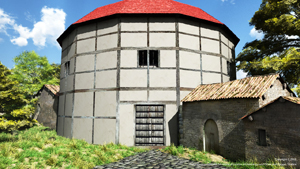
The-Theatre The Theatre, Shoreditch. Built in 1576 by James Burbage on property that had once been part of Holywell Priory, the Theatre was the home of a number of acting companies including The Lord Chamberlain’s Men of which Shakespeare was a member. The polygon-shaped theatre served as the home of the company between 1594 and 1598 when a dispute with a landlord over the lease led them to leave, temporarily settling at The Curtain Theatre, before rebuilding their theatre, now renamed The Globe, in Southwark. Between 2008 and 2010, archaeologists from Museum of London Archaeology (MOLA) carried out an investigation beneath a disused warehouse in New Inn Broadway, near the intersection of Curtain Road and Great Eastern Street, and found the remains of a 14 sided theatre about 22 metres across. Plans have been mooted to build a new theatre on the site. To find out more about The Theatre and see a terrific animated recreation by Cloak & Dagger Studios and MOLA (pictured), head to www.explorethetheatre.co.uk. PICTURE: Courtesy of MOLA (Museum of London Archaeology) and Cloak and Dagger Studios.

The Curtain Theatre, Shoreditch. The Lord Chamberlain’s Men only performed here temporarily, between 1598-1599, before relocating to Southwark. Henry V (the reference to “this wooden O” in the prologue of the play is taken to refer to this theatre) and Romeo and Juliet are believed to be among Shakespeare’s plays which premiered here. Located just a couple of hundred yards south of The Theatre and built the year after it, it also hosted Ben Jonson’s Every Man in his Humour, a play in which Shakespeare is known to have performed. The polygonal theatre’s name comes from the road on which it stood – Curtain Road, which, it has been suggested, was named after the Holywell Priory’s ‘curtain wall’. It continued as a theatre until the 1620s and was later converted into tenements. The remains of what is believed to have been the Curtain Theatre were found by MOLA archaeologists in 2012 and further excavations are expected with the hope that one day the site will be open to the public with plays performed here. There is a plaque commemorating the site at 18 Hewett Street which is only a short distance from where the excavations were carried out. For more on the Curtain Theatre, check out www.shakespearesshoreditch.com.

For more on Elizabethan theatres, see Julian Bowsher’s Shakespeare’s London Theatreland: Archaeology, History and Drama.

10 sites from Shakespearean London – 3. Shakespeare’s houses…

The playwright is believed to have lived in several different locations in London and is also known to have invested in a property. Here we take a look at a couple of different locations associated with him…

St-Helen'sBishopsgate: Shakespeare is believed to have lived here in the 1590s – in 1596 tax records show he was living in the parish of St Helen’s. The twin-nave church of St Helen’s Bishopsgate (pictured), which would have been his parish church, still stands. In fact, there is a window to Shakespeare’s memory dating from the late 19th century.

•  Bankside: In the late 1590s, Shakespeare apparently moved across the Thames to Bankside where he lived at a property on lands in the Liberty of the Clink which belonged to the Bishop of Winchester. The exact address remains unknown.

Silver Street, Cripplegate: It’s known that in 1604, Shakespeare moved from Bankside back to the City – it’s been speculated outbreaks of plaque may have led him to do so. Back in the City, he rented lodgings at the house of Christopher and Mary Mountjoy in on the corner of Monkwell and Silver Streets in Cripplegate, not far from St Paul’s Cathedral. Mountjoy was a refugee, a French Huguenot, and a tire-maker (manufacturer of ladies’ ornamental headresses). The house, which apparently stood opposite the churchyard of the now removed St Olave Silver Street, was consumed in the Great Fire of London in 1666 (the church was also lost in the Great Fire). The former church site is now located on the south side of London Wall. Silver Street itself was wiped out in the Blitz and is now lost under the Barbican redevelopment but the house lives on in a representation found on a late 16th century map created by Ralph Agas.

Ireland Yard, Blackfriars: In 1613, Shakespeare purchased the former gatehouse of the Blackfriars Priory located here, close to the where the Blackfriars Theatre was located. It is believed the property was purchased as an investment – there’s no evidence he ever lived there but it was passed to his daughter Susanna after his death. Incidentally, there is some speculation that Shakespeare may have lived in Blackfriars when he first came to London – a man believed to have been a boyhood friend from Stratford, Richard Field, who was known to have lived there.

For a more in-depth look at Shakespeare’s time in Silver Street, see Charles Nicholl’s The Lodger: Shakespeare on Silver Street.

A Moment in London’s History – The day the Globe Theatre burnt down…

FireSince we’re talking about all things Shakespearean at the moment, we though we’d take a look again at the day on which The Globe Theatre burnt down.

The theatre was only about 14-years-old when on  29th June, 1613 – the 400th anniversary of which passed last year – a “special effects” cannon was fired during a performance of King Henry VIII (also known as All is True) – specifically as the king made his entrance on the stage. While cannons had apparently been used for years with no ill effect – that was not to be the case this time.

It is said sparks from the cannon landed on either directly on the theatre’s thatched roofing or a roof beam near the thatch and caught fire – there are also suggestions the fire was in fact caused when one of the stoppers used to block up the cannon came into contact with the thatch.

Theatre patrons apparently initially thought the smoke was simply from the cannon blast but can’t have been confused for long – the fire was said to have moved very quickly; in fact one contemporary letter writer – author, diplomat and politician Sir Henry Wotton – says the entire theatre was burnt to the ground in less than an hour.

The audience – the theatre is thought to have housed some 1,000 people seated and a further 2,000 standing – is thought to have escaped unharmed. There are no reports, at least, of any deaths as a result of the fire.

The theatre was quickly rebuilt – apparently more opulently – and reopened the following year. Traces of the burnt theatre was found during an excavation of the Globe site in 1989.

For more on The Globe, see our earlier post here.

PICTURE: Ashley Nummerdor/www.freeimages.com

Famous Londoners – Christopher Marlowe…

Born the same year as Shakespeare, Christopher Marlowe was, like him, one of the foremost dramatists of the Elizabethan era.

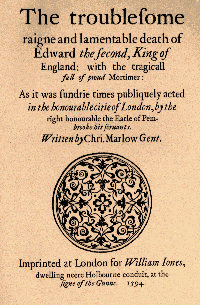
EdwardiiquartoBorn in Canterbury the son of shoemaker John Marlowe and his wife Catherine in 1564 (he was baptised on 26th February and likely to have been born a few days before), Marlowe attended the King’s School in the city and went on to study at Corpus College in Cambridge, receiving a Bachelor of Arts in 1584 and a Master of Arts in 1587. It is believed that at around this time, he was also working secretly for the government of Queen Elizabeth I, although what the nature of that work was remains unknown.

While Marlowe’s first play was Dido, Queen of Carthage, he first found theatrical success in 1587 with Tamburlaine the Great, later followed with a second part. His other four plays included The Jew of Malta, Edward the Second, The Massacre at Paris about the St Bartholomew’s Day Massacre in 1572, and Doctor Faustus.

The plays served as key works for the Admiral’s Men, the company of Edward Alleyn who performed many of the key roles in the plays, and who is strongly associated with the Rose Theatre  – indeed it was here that Tamburlaine the Great, The Jew of Malta, and Doctor Faustus premiered (you can see our earlier post on the theatre here).

Marlowe, who is known to have lived in Shoreditch, also completed other works included poetry and translations and while there is little evidence about his personal life, there is much speculation including that he was, as aforementioned, a spy as well as a carouser (he is known to have frequented taverns in London including Ye Olde Cock in Fleet Street), a homosexual and/or a heretic. It has also been suggested he was a tutor to noblewoman Arabella Stuart.

It is known that he was arrested in 1592 in Flushing in The Netherlands for counterfeiting coins and was sent back to England but no further action was taken.

His death is one of the big mysteries of his life. A warrant was issued for Marlowe’s arrest over some heretical tracts which were found in the lodgings of his colleague Thomas Kyd (who when questioned apparently implicated him) and he appeared to answer to the Privy Council on 20th May, 1593. They weren’t sitting and he was apparently instructed to appear daily until further notice. He was dead 10 days later.

The exact circumstances of his death remain a matter of speculation. It is often said he died in a drunken brawl with one early source suggesting this was over a homosexual love affair and another, more recent, theory suggesting he even faked his own death to avoid being executed for heresy (an extrapolation of this theory goes that after his fake death he continued writing plays under the name of William Shakespeare but this is generally deemed fairly far-fetched). The official account recorded at the time was that he was stabbed to death in a brawl over payment of a bill with men at a house in Deptford.

He was buried in an unmarked grave at St Nicholas’ Church in Deptford. There is a memorial window to him in Poet’s Corner in Westminster Abbey. A gift of the Marlowe Society, it was unveiled in 2002 and controversially included a question mark after the generally accepted date of his death. There is a portrait, dated 1585,  generally believed to be of Marlowe at Cambridge.

PICTURE: Title page of the earliest known edition of Edward II (1594)/Wikipedia

Lost London – The Blackfriars Playhouse…

Located on the site of the former Blackfriars Monastery which has closed during the Dissolution (see our earlier post here), the origins of the Blackfriars Playhouse or Theatre go back to the mid-1570s when children connected with the Queen’s Chapel Choir performed plays in part of the former monastery.

While those plays were performed in order to practice for those performed before Queen Elizabeth I, the organisers did also apparently use the theatre for paying audiences. This first theatre ceased operation in 1584.

In 1596, part of the priory and an adjoining building were bought by James Burbage in 1596 who created a playhouse within them. It was used by the Children of the Chapel, a group of choristers and other boys, until 1608 when the King’s Men took over – with Burbage’s son Richard and Shakespeare among those who had a share in the theatre – and used it as their winter playhouse.

The theatre – where Shakespeare himself is believed to have performed – was apparently the first commercial premises of its type to used artificial lighting and, usually for the time, featured music between acts.

The wife of King Charles I, Queen Henrietta Maria, is known to have attended the theatre later in its life in 1634 and again a couple of years later.

The theatre closed with the commencement of the English Civil War and the theatre was demolished in 1655.

The candle-lit Sam Wanamaker Playhouse, which opened in January at the Globe Theatre on Bankside, was designed based on drawings of indoor theatres of the era (there’s also a recreation of the Blackfriars Playhouse in the US which is home to the acting troupe of the American Shakespeare Center).

While nothing remains of the playhouse today, it lives on in the name Playhouse Yard.

10 sites from Shakespearean London – 2. Southwark Cathedral…

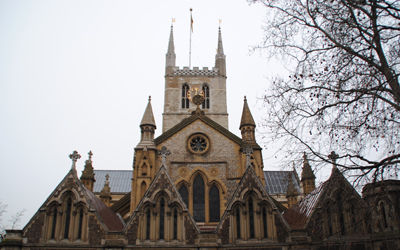
Southwark-Cathedral1

Located close to the Bankside theatres where William Shakespeare’s plays would have been performed, Southwark Cathedral – known then as St Saviour’s Church – has plenty of connections to the Elizabethan theatre world.

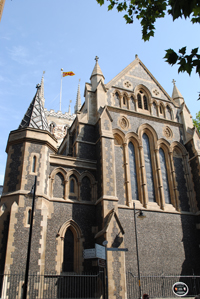
Southwark-Cathedral2Not only was the Bard’s youngest brother, the actor Edmund, buried here in 1607 (the grave is unmarked but there’s a commemorative stone in the floor of the choir), the playwrights John Fletcher and Philip Massinger and theatre owner Phillip Henslowe were also buried here. And like them, another theatre owner (and Henslowe’s son-in-law), Edward Alleyne, also held positions at the church.

The cathedral has several memorials to Shakespeare. These include a memorial window in the south aisle – unveiled in April 1954 on the anniversary of Shakespeare’s death, it depicts characters from some of his works and was designed by Christopher Webb to replace an earlier window which had been destroyed during World War II. Below it is an alabaster reclining figure of the playwright set against a relief of Southwark as it appeared during the 17th century. Carved by Henry McCarthy, it was unveiled in 1912.

The history of the church is believed to go back to at least Saxon times. Between 1106 and 1538, it served as the church of the Augustinian Southwark Priory and was dedicated to St Mary Overie. Following the Dissolution in the mid 16th century was re-dedicated as the parish church of St Saviour’s. It only became a cathedral in 1905 with the creation of the Diocese of Southwark. While some scant parts of the building date back to the 12th century  (the church was rebuilt after a fire in the 13th century), much of it has been altered.

 For more on Elizabethan England, check out Ian Mortimer’s recent book The Time Traveller’s Guide to Elizabethan England.

10 sites from Shakespearean London – 1. The Globe…

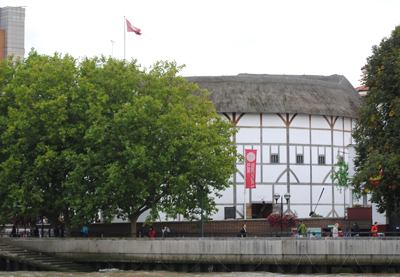
The-GlobeMention William Shakespeare and London in the same breath and everyone immediately thinks of one building – the reconstructed Globe on Bankside. So we thought that to kick off our new series – being run in honour of the 450th anniversary of the playwright’s birth – we’d take a look at history of the iconic structure.

The-Globe2The original Globe Theatre, located a few hundred metres to the south, opened in 1599 as a home for the actors’ company known as the Lord Chamberlain’s Men (later renamed the King’s Men on the accession of King James I in 1603), of which Shakespeare was a member. Founded by James Burbage, this merry band was originally was housed at London’s first purpose-built playhouse Shoreditch before lease disputes led them to establish a new theatre in Southwark, close to the then existing theatre, The Rose.

Up and running by 1599 (Shakespeare was among four actors who bought a share in the property to help fund the new building which used timbers from the former Shoreditch theatre), the new theatre was used for 14 years until, during a performance of Henry VIII in 1613, wadding from a stage cannon ignited and the theatre burned to the ground. Rebuilt with a tiled roof, it remained the home of the company until it was closed down by the Puritan government in 1642 and demolished two years later.

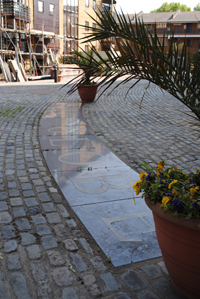
You can see the original site of The Globe just in nearby Park Street. The shape of the structure is marked by a dark line embedded in the pavement (pictured).

The reconstructed building which stands proudly by the water today was the vision of the late American actor, director and producer, Sam Wanamaker. He founded the Shakespeare Globe Trust which, with the on-site assistance of Queen Elizabeth II, opened the theatre at its current site in 1997 (sadly, Wanamaker had died three-and-a-half-years previously).

The building’s design was drawn from sifting through what little historical evidence could be found including the findings of an archaeological dig at the original site, descriptions contained in Shakespeare’s plays (including the line from Henry V – “Or may we cram within this wooden ‘O’), and printed panoramas from the time, although it should be noted that much – particularly the design of the stage – is speculative.

Meanwhile the techniques used in the construction of the theatre were the subject of years of research and were in accord with those of the early 17th century  and included using oak laths and staves to support lime plaster and then covering the walls in white lime wash while the roof was made of water reed thatch.

One of the best ways to see the theatre and make the most of the atmosphere is to see a play from a standing position in the pit!

WHERE: Globe Theatre Exhibition & Tour, Shakespeare’s Globe, 21 New Globe Walk (nearest Tube stations are Southwark and London Bridge); WHEN: Exhibition is open 9am to 5.30pm daily – tours run at various times, see website for details; COST: Exhibition and tour cost is £13.50 adults/£12 seniors/£11 students/£8 children (5-15 with children under five free)/£36 family of four; WEBSITE: www.shakespearesglobe.com.

London Pub Signs – The Anchor…

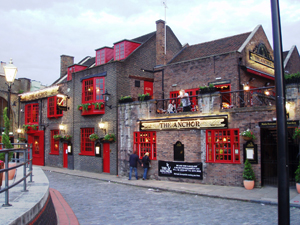
While the first official records of this Bankside pub only date from 1822, the pub’s history goes back much further. Like many pubs in London, nailing down its exact origins is tough but the story goes that it was named The Anchor by seventeenth century merchant Josiah Child.

The-AnchorChild owned the brewhouse which had been established in 1616 by James Monger at a site known as Dead Man’s Place (close to where the original Globe Theatre had stood before burning down in 1613) and was also a merchant who supplied the navy with everything from masts and spars to stores and beer. Hence the name The Anchor.

It’s speculated that William Shakespeare himself might have had a drink here and it’s believed to be from this pub – “a little alehouse on Bankside” – that diarist Samuel Pepys witnessed the destructive power of the Great Fire of London in 1666.

Dr Samuel Johnson – apparently a close friend of later brewery owners, Henry and Hester Thrale – was among regular drinkers. Other patrons, according to the pub’s website, included the artist Joshua Reynolds, Irish poet Oliver Goldsmith, actor David Garrick and Irish statesmen Edmund Burke.

The pub was apparently rebuilt a couple of times after being destroyed by fire. The brewery, meanwhile, rose to become one of the largest in the world before it was finally demolished in 1981 leaving the pub, the brewery tap, still standing.

Refurbished in recent years, the pub today contains a room dedicated to The Clink prison, the Bishop of Winchester’s lock-up which was located in nearby Clink Street.

The waterside pub at 34 Park Street is now part of the Taylor Walker chain. You can find out more about it here.

PICTURE: Ewan Munro/Flickr

LondonLife – Celebrate Shakespeare with a cake…

Jane-Asher

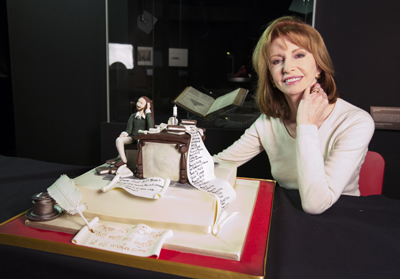
Time is running out for your entry into Cakespeare – the V&A’s competition to find the best Shakespeare-themed cake as part of the institution’s celebration of the 450th anniversary of William Shakespeare’s birth. The competition, which closes on 4th May, was launched earlier this month with an almost 15 kilogram cake created by Jane Asher Party Cakes (actress Jane Asher and the cake are pictured). A fruitcake, it features the playwright at work with a writing table and feature quill made from icing while a scroll lists the 36 plays in Shakespeare’s First Folio (which is on show in the V&A’s Theatre and Performance Galleries). To enter the competition, design, bake and decorate your cake celebrating Shakespeare and then upload an image of it to social media, tagged #Cakespeare. Oh, and the winner – selected by Asher and Geoff Marsh, director or the V&A’s department of theatre and performance – will receive a weekend for two in Stratford-upon-Avon complete with tickets to see the Royal Shakespeare Company. The V&A’s Shakespeare Festival runs until 4th May. For more, see www.vam.ac.uk. So enjoy your Shakespeare – and your cake…might be a way to take your mind off London’s transport woes! PICTURE: Victoria and Albert Museum, London.

This Week in London – William Shakespeare’s influence; new Fourth Plinth commissions; the car and landscape; and London Stories…

First up, apologies that we were unable to launch our new Wednesday series yesterday due to some technical difficulties (stayed tuned for next week). And now, on with the news…

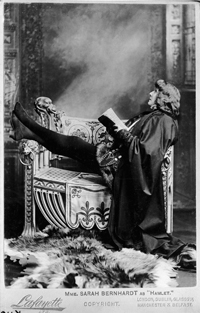
Sarah_Bernhardt_by_Lafayette_Ltd_1899_c__Victoria_and_Albert_Museum_London__William Shakespeare’s influence on successive generations of theatrical performance is the subject of a new exhibition at the V&A to mark the 450th anniversary of his birth on 23rd April. Shakespeare: Greatest Living Playwright centres on the Bard’s First Folio which, published in 1623, contains 36 plays including 18 works – Macbeth, The Tempest and Twelfth Night among them – which would be unknown without it. The display includes interviews, archive footage and photography and objects from the V&A collections as well as an audio-visual presentation by Fifty Nine Productions featuring interviews with contemporary theatre practitioners such as actors, directors and designers. Objects on display include a skull used by Sarah Bernhardt when playing Hamlet in 1899, an embroidered handkerchief used by Ellen Terry when playing Desdemona in 1881 at the Lyceum Theatre, and a pair of red boots worn by actor-manager Henry Irving in an 1887 production of Richard III. Runs in the V&A’s Theatre and Performance Galleries until 21st September. Admission is free. For more, see www.vam.ac.uk. PICTURE: Sarah Bernhardt as Hamlet, 1899, © Victoria and Albert Museum, London.

A skeletal horse and a giant hand giving a thumbs up will adorn the Fourth Plinth in Trafalgar Square during 2015-16. Hans Haacke’s Gift Horse is derived from an etching by painter George Stubbs and, while being a comment on the equestrian statue of King William IV which was intended for the plinth, also features an electronic ribbon displaying a live ticker of the London Stock Exchange on its front leg. Meanwhile David Shrigley’s Really Good is a 10 metre high hand giving a thumbs up – sending a positive message to those who see it. For more, see www.london.gov.uk/priorities/arts-culture/fourth-plinth.

The impact of the car on England’s landscape and the listed buildings of motoring history are the focus of a new exhibition in Wellington Arch. Carscapes: How the Motor Car Reshaped England features archive photographs, historic advertising, cartoons and motoring magazines as well as a 1930s traffic light, a petrol pump and other accessories and memorabilia. Wellington Arch, which is managed by English Heritage, is a fitting location for the exhibition – it was moved to its current position due to increasing traffic back in 1883. Admission charge apply. For more, see www.english-heritage.co.uk.

A new exhibition exploring some of the true and not-so-true stories inspired by and produced in London opens at the London Transport Museum in Covent Garden tomorrow. London Stories features the best entries from The Serco Prize for Illustration 2014 with more than 50 works of art on display depicting a well-known or obscure London narrative. The short-listed illustrations tackle everything from ghost buses to Buffalo Bill’s Wild West Show of 1887, a Pearly King and Queen, Lenin’s ‘Love letter to London’ and an escaped monkey jazz band. There’s also a host of musical and literary references – everything from Mary Poppins to Sweeney Todd and Oranges and Lemons. Tomorrow there will be a late opening of the exhibition complete with cash bar, DJ and story-telling for adults as well as the chance to create your own London story with illustration workshops and a photo-booth. Organised by London Transport Museum in partnership with the Association of Illustrators, it runs until 6th April. Admission charge applies. For more, see www.ltmuseum.co.uk.

Send all items of interest for inclusion to exploringlondon@gmail.com.

Famous Londoners – Ben Jonson…

Often noted as the second greatest English dramatist of his generation (after that Shakespeare guy), the playwright Ben Jonson stands tall in his own right as one of the leading literary figures of the late 16th and early 17th century.

Born in 1572, Jonson was educated at Westminster School in London and possibly went on to Cambridge before he started work as a bricklayer with his stepfather and later served as a soldier, fighting with English troops in The Netherlands.

It was on his return to London that he ventured into acting – among his early roles was Hieronimo in Thomas Kyd’s The Spanish Tragedie – and by 1597 he was employed as a playwright.

While one of his early play-writing efforts (The Isle of Dogs, co-written with Thomas Nashe) led to a term of imprisonment in Marshalsea Prison in 1597 (he was also briefly imprison about this time for killing another actor in a duel, escaping a death sentence by pleading “benefit of the clergy”), the following year – 1598 – the production of his play Every Man In His Humour  established his reputation as a dramatist. Shakespeare, whom some suggest was a key rival of Jonson’s during his career – is said to have been among the actors who performed in it.

Further plays followed including Every Man Out Of His Humour (1599), his only tragedy Sejanus (1603), the popular Volpone (1606) and The Alchemist (1610), and Bartholomew Fair (1614) and it was during these years, particularly following the accession of King James I in 1603, that he became an important figure at the royal court).

His political views continued to cause trouble at times – he was again imprisoned in the early 1600s for his writings and was questioned over the Gunpowder Plot after apparently attending an event attended by most of those later found to be co-conspirators – but his move into writing masques for the royal court – saw his star continue to rise.

All up he wrote more than 20 masques for King James and Queen Anne of Denmark including Oberon, The Faery Prince which featured the young Prince Henry, eldest son of King James, in the title role. Many of these masques saw him working with architect Inigo Jones, who designed extravagant sets for the masques,  but their relationship was tense at times.

In 1616 – his reputation well established – Jonson was given a sizeable yearly pension  (some have concluded that as a result he was informally the country’s first Poet Laureate) and published his first collection of works the following year. Noted for his wit, he was also known to have presided over a gathering of his friends and admirers at The Mermaid Tavern and later at the Devil’s Tavern at 2 Fleet Street (Shakespeare was among those he verbally jousted with).

Jonson spent more than a year in his ancestral home of Scotland around 1618 but on his return to London, while still famous, he no longer saw the same level of success as he had earlier – particularly following the death of King James and accession of his son, King Charles I, in 1625.

Jonson married Anne Lewis – there is a record of such a couple marrying at St Magnus-the-Martyr church near London Bridge in 1594 – but their relationship certainly wasn’t always smooth sailing for they spent at least five years of their marriage living separately. It’s believed he had several children, two of whom died while yet young.

Jonson, meanwhile, continued to write up until his death on 6th August, 1637, and is buried in Westminster Abbey (he’s the only person buried upright in the abbey – apparently due to his poverty at the time of his death).

For an indepth look at the life of Ben Jonson, check out Ian Donaldson’s Ben Jonson: A Life.

Around London – The Bard is back; Foundling Museum displays; and, exhibitions on iconoclasm and explicit Japanese art…

The Bard is back in Leicester Square with the announcement last week that restoration work on the square’s 19th century Grade II listed statue of William Shakespeare – the only full-length statue the playwright in central London – has been completed. The 11 month restoration was carried out as part of £17 million revamp of the square which has seen the installation of a new fountain. The statue, which was the work of James Knowles, has been in the square since it was completed in its current configuration in 1874. Meanwhile, in other sculpture-related news, Sorry, Sorry Sarajevo – a life-size statue of a man holding  a dead or badly injured man in his arms has been placed in St Paul’s Cathedral where it will remain for the rest of the year. The work by Nicola Hicks dates from 1993 – when the Bosnian war was at its height – and has been placed opposite Henry Moore’s 1983 sculpture, Mother and Child: Hood as part of the cathedral’s approach to next year’s World War I centenary.

Two new displays opened at the Foundling Museum in Bloomsbury last month. Hogarth and Copyright, which runs until 5th January, looks at the role the artist William Hogarth played in the passing of the 1735 Engravers’ Copyright Act (also known as Hogarth’s Act – it was the first law to protect artist’s rights over their work) while Handel and Lucretia, presented in conjunction with The Sir Denis Mahon Charitable Trust and running until 26th January, shows Guercino’s painting Lucretia alongside two early manuscripts of Handel’s cantata La Lucretia. Entry is part of admission price. For more, see www.foundlingmuseum.org.uk.

A new exhibition tracing the history of attacks on artworks in Britain from the 16th century to today opened at Tate Britain in Millbank this week. Art under Attack: Histories of British Iconoclasm looks at why and how monuments have been damaged over the past 500 years. The display includes the remarkable pre-Reformation sculpture, the Statue of the Dead Christ (about 1500-1520), which was discovered in 1954 beneath the chapel floor at the Mercer’s Hall. Already damaged – most likely at the hands of Protestant iconoclasts – it may have been buried there to protect it. Also displayed are fragments of monuments destroyed in Ireland last century, paintings including Edward Burne-Jones’ 1898 painting Sibylla Delphica which was attacked by suffragettes in 1913-14, and Allen Jones’ 1969 work Chair – damaged in a feminist attack in 1986. Runs until 5th January. Admission charge applies. For more, see www.tate.org.uk.

A controversial exhibition of sexually explicit Japanese works of art created between 1600-1900 opened at the British Museum this week. Shunga: sex and pleasure in Japanese Art – which carries a warning of “parental guidance for visitors under 16 years – features 170 works including paintings, prints and illustrated books. Drawn from collections in the UK, Japan, Europe and the US, the exhibition of explores the phenomena of what are known as shunga (‘spring pictures’), looking at why it was produced and to whom it was circulated. Admission charge applies. Runs until 5th January. For more, see www.britishmuseum.org.

Famous Londoners – David Garrick…

Playwright. Actor. Theatre manager. David Garrick stands out as a towering figure of the theatrical world in the 18th century and is remembered, at least in part, for his friendship with the irrepressible lexicographer Samuel Johnson.

Born on 19th February, 1717, in Hereford to an army officer (with French Huguenot roots) as the third of five children, Garrick attended school in Lichfield, north of Birmingham, including, at the short-lived Edial Hall School where Dr Johnson himself taught Latin and Greek. It was during his youth that he first took an interest in the stage, appearing in George Farquhar’s The Recruiting Officer.

When the school closed due to lack of funds, Garrick accompanied Dr Johnson to London (they had become friends) and there he and his younger brother Peter established a wine business (Peter eventually went back to Lichfield to run part of the business from there). While the business wasn’t a great success, Garrick took to acting in amateur theatricals and eventually – according to Peter Thomson, writing in the Oxford Dictionary of National Biography – made his professional debut acting incognito in a pantomime in London in March, 1741, although Garrick apparently said placed his debut in Ipswich that summer when he was acting in Thomas Southerne’s Oroonoko, or the Royal Slave (meanwhile the first performance of one of his dramatic works – Lethe, or Aesop in the Shades – had taken place at Drury Lane the previous year).

His breakthrough role came later that year – in October – when he appeared in London on the stage of the unlicensed Goodman’s Fields Theatre in the title role of Richard III. Soon acclaimed by the likes of Alexander Pope and William Pitt as the greatest actor of his time, further roles followed at Goodman’s Fields and at the famous Drury Lane Theatre as well as in Dublin (where he started an ultimately ill-fated love affair with Irish actress Peg Woffington who returned with him to London where he continued acting at Drury Lane).

Having also performed for a season, at the rival Covent Garden Theatre, in April 1747, Garrick entered into a partnership with James Lacy for the ownership of the Drury Lane Theatre. The first performance was apparently by Garrick himself, reading Ode to Drury Lane Theatre, on dedicating a Building and erecting a Statue, to Shakespeare – a piece written by Dr Johnson.

It was two years later – on 22nd June, 1749 – that he married a German dancer Eva Marie Veigel. They lived at a house at 27 Southampton Street and Garrick’s increasing wealth led him to buy a country property in Hampton, today in south west London, in 1754 which became known as “Garrick’s Villa”. Considerably altered, the Grade I-listed property still stands there today (albeit having suffered extensive damage in a 2008 fire) along with the summerhouse he built to house his collection of Shakespearian memorabilia – known as Garrick’s Temple to Shakespeare, it’s open to the public over from April to October.

Meanwhile, as well as managing the theatre, Garrick continued acting and writing plays. In September, 1769, he staged the Shakespeare Jubilee in Stratford-upon-Avon, celebrating 200 years since the playwright’s birth – even though it was five years too late and was ultimately a bit of a disaster, he took his celebration of Shakespeare back to Drury Lane and there it was a huge success.

Garrick, who moved from Southampton Street into the newly built Adelphi Terrace in 1772, remained manager of Drury Lane until his retirement in 1776 during which time it became widely acknowledged as the country’s leading theatre. He died at home on 20th January, 1779. His wife outlived him by 43 years. The couple had no children. Garrick was subsequently interred in Poet’s Corner, Westminster Abbey – the first actor to receive the honour.

Garrick’s legacy was enormous – not only is he famed for bringing a new ‘realistic’ style to the profession he so loved, he set new standards in the arts of public relations and was also an instrumental figure in having Shakespeare recognised as England’s national icon. Legend goes that he was also the actor responsible for the phrase “Break a leg!” – apparently so engrossed in a performance of Richard III that he overlooked the fact he’d fractured his bone.

Garrick’s name lives on in the Garrick Theatre (still operating in Charing Cross Road) and the Garrick Club, and there’s memorial to him on his former home in Adelphi Terrace.