10 fictional character addresses in London – 8. The Darling’s House…

Peter-Pan2In JM Barrie’s 1911 novel, Peter and Wendy (based on the stage play Peter Pan; or, the Boy Who Wouldn’t Grow Up), the adventure begins when Peter Pan visits the home of the Darling family.

He secretly listens in – via an open window – while Mrs Darling tells bedtime stories to her children – Wendy, John and Michael – but during one visit loses his shadow and it’s on returning to claim it that he meets Wendy and, well, you know the rest…

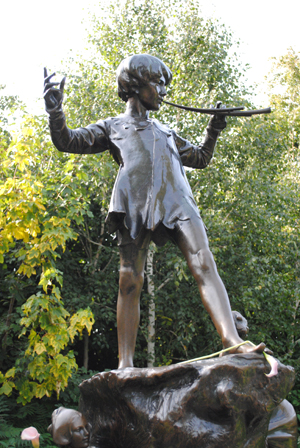
Peter Pan is most famously associated with Kensington Gardens – it’s here that we are first introduced to the character of Peter in the book Peter Pan in Kensington Gardens (in fact there’s a rather famous statue of him there to this day, pictured above) – it’s most often assumed that the Darling’s house must be nearby.

But, in fact, the book Peter and Wendy never states where the Darlings’ house is located exactly  – just that it is at number 14 in the street in which they live – while in the 1904 play the address is given as “a rather depressed street” in Bloomsbury. Barrie explains that he placed the Darlings’ house in Bloomsbury because Mr Roget (of Thesaurus fame) once lived there and “we whom he has helped to wend our way through life have always wanted to pay him a little compliment”.

Worth noting, however, is a property at 31 Kensington Park Gardens. Once the home of the Llewellyn Davies family, family friend Barrie was a frequent visitor here and in fact went on to adopt the five Llewellyn Davies children following the death of their parents in the early 1900s. The property, which is divided into a series of flats, is, as a result, said to have been something of a model for the Darling’s house.

Barrie, himself, meanwhile, owned a house at 100 Bayswater Road – not far from Kensington Gardens where he first meet the Llewellyn Davies family – but, interestingly, had previously lived in Bloomsbury. The house is marked with a blue plaque.

Another Peter Pan-related address we have to mention is that of the Great Ormond Street Hospital for Children to which Barrie gave the rights to receive royalties from Peter Pan in perpetuity. You can arrange for a tour of the hospital’s Peter Pan-related memorabilia.

For more on the story behind the writing of Peter Pan, see Andrew Birkin’s book, J.M.Barrie and the Lost Boys.

10 fictional character addresses in London – 7. Saffron Hill…

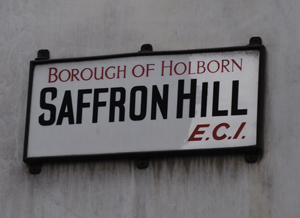
Saffron-Hill2Once at the heart of one of London’s most infamous rookeries or slums, Saffron Hill – located between Holborn and Clerkenwell – is forever associated with Charles Dickens’ 1838 novel, Oliver Twist, and in particular with the arch criminal Fagin.

In the text, Fagin’s den is located “near Field Lane” (the southern extension of Saffron Hill beyond Greville Street) and it is here that Fagin’s young associate, Jack Dawkins (better known as the Artful Dodger), takes Oliver after first encountering him.

As Oliver is led down Saffron Hill, Dickens records his thoughts and it’s worth quoting to get a flavour of the place as he saw it: “A dirtier of more wretched place he had never seen. The street was very narrow and muddy, and the air was impregnated with filthy odours. There were a good many small shops; but the only stock in trade appeared to be heaps of children, who, even at that time of night, were crawling in and out at the doors, or screaming from the inside. The sole places that seemed to prosper amid the general blight of the place, were the public-houses; and in them, the lowest orders of Irish were wrangling with might and main. Covered ways and yards, which here and there diverged from the main street, disclosed little knots of houses, where drunken men and women were positively wallowing in filth; and from several of the door-ways, great ill-looking fellows were cautiously emerging, bound, to all appearance, on no very well-disposed or harmless errands.” (Oliver Twist, p. 55, Vintage, 2007)

Saffron-Hill3Saffron Hill, known as London’s Italian quarter in the 19th century, takes its name from the saffron which was once grown here but which was not to be seen by the time Dickens’ wrote his book. As well as Fagin’s lair, the street is also home to salubrious pub The Three Cripples, Bill Sikes’ favoured watering-hole (The Three Cripples was apparently the name of a lodging house in Saffron Hill during Dickens’ time – it was located next to a pub called The One Tun) .

It’s worth noting that this is only one of many addresses in London associated with Dickens’ characters but the ill-fated Fagin does stand out as one of his most memorable.

PICTURE: Saffron Hill as it is now.

For more on Dickens’ London, check out Alex Werner’s  Dickens’s Victorian London: The Museum of London.

10 fictional character addresses in London – 6. Wimbledon Common…

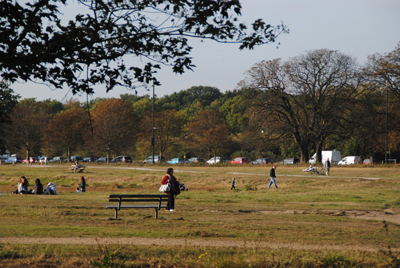
Wimbledon-CommonA vast expanse of forested parkland in south-west London, Wimbledon Common is also home to the burrow of those pointy-nosed furry (and extremely environmentally-friendly) creatures known as The Wombles.

Created by the late author Elisabeth Beresford, the Wombles apparently have their origin in a walk Ms Beresford took with her children on the Common during which one of them referred to their location as Wombledon Common.

The Wombles of Wimbledon Common – who include Bungo, Orinoco, Tobermory, Miss Adelaide, Madame Cholet, and Great Uncle Bulgaria – appeared in more than 20 books written by Beresford with the first, The Wombles, published in 1968. They’ve also starred in a couple of TV series, made a number of other TV appearances, released some albums and even had their own stage show and a movie, Wombling Free, released in 1977.

Much of the action in the books takes place on Wimbledon Common (which along with the adjoining Putney Common covers some 460 hectares) where they all live in a burrow, recycling rubbish they find discarded by humans.

Features of Wimbledon Common include the Wimbledon Windmill Museum (see our earlier post on it here) and a number of ponds including Rushmere Pond which lies close to Wimbledon Village and probably has a medieval origin.

For more on Wimbledon Common, check out www.wpcc.org.uk.

For more on London’s parks and gardens, see David Hampshire’s London’s Secrets: Parks & Gardens.

10 fictional character addresses in London – 5. 17 Cherry Tree Lane…

This is one property for which there is no ‘real’ address – 17 Cherry Tree Lane doesn’t exist except in the pages of PL Travers’ books about Mary Poppins (and the many subsequent adaptions including the famous 1964 musical film starring Julie Andrews and Dick Van Dyke).

Bank-of-EnglandBut we do know that the home of Mr and Mrs Banks – the couple who hired Ms Poppins as a nanny for their children Jane, Michael and baby twins John and Barbara – is believed to have been located somewhere in London – possibly somewhere to the north-west of the city close to The Regent’s Park and within an easy commute of the Bank of England (pictured) where Mr Banks worked.

While some of the locations featured in the book and the film – such as the Bank  and, of course, St Paul’s Cathedral (remember the lady who fed the birds?) – do exist – there is also at least one residential property related to Mary Poppins which does as well.

According to Ed Glinert, author of Literary London, the model for Admiral Boom’s house a little further along Cherry Tree Lane  – you may recall him firing his cannon on the 1964 film – can be found in Admiral’s Walk in Hampstead. The property was apparently once home to the nineteenth century architect George Gilbert Scott.

10 fictional character addresses in London – 4. 186 Fleet Street…

OK, so the debate may continue over whether Sweeney Todd was an actual person (according to author Peter Haining, the real Todd, born in Brick Lane, is supposed to have been hanged in 1802) or a fictional character, but, suspending that debate for the moment, we’re including the infamous Fleet Street barber in this list.

186-Fleet-StreetKnown as the “demon barber of Fleet Street”, Todd first appeared in literature as a murderer in the Victorian serial, The String of Pearls: A Romance, published in a weekly periodical, and soon became a staple of the Victorian theatre, later appearing in numerous plays and films including the 2007 Johnny Depp vehicle, Sweeney Todd.

His MO usually involved cutting his unsuspecting victim’s throat and then, using a specially constructed barber’s chair, dropping the body into the cellar. There, he and his associate, Mrs Lovett, would rob them (alternatively, other versions have him dropping the customers into the cellar first and then, if needed, finishing them off).

Mrs Lovett would then dispose of the remains by baking them into pies and selling them via her pie shop located nearby in Bell Yard. The story goes that the cellar was linked to nearby Bell Yard via tunnels.

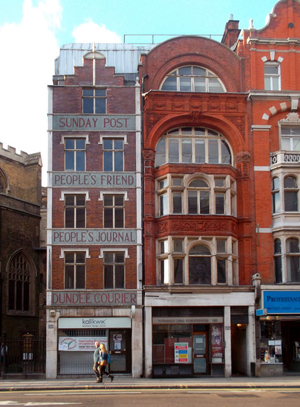
Sweeney Todd was supposed to have terrorised London in the late 18th century and his barber shop was apparently located at 186 Fleet Street in London – right next to St Dunstan-in-the-West. The site is now occupied by a former newspaper office – that of the Dundee Courier (pictured above, left).

For Peter Haining’s book on Sweeney Todd, see Sweeney Todd: The Real Story of the Demon Barber of Fleet Street.

PICTURE: 186 Fleet Street, Sweeney Todd’s (Des Blenkinsopp) / CC BY-SA 2.0

10 fictional character addresses in London – 3. 32 Windsor Gardens…

The address might not immediately ring a bell but it will when we tell you this was the home of London’s most famous bear, Paddington.

Paddington-BearFirst appearing in A Bear Called Paddington published on 13th October, 1958, Paddington Bear was the brainchild of Michael Bond, who was apparently inspired a couple of years earlier when he spotted a lonely teddy bear sitting on a shop shelf in a store near Paddington Station (a bear which he subsequently bought and gave to his wife as a Christmas present).

In the books, Paddington – who is typically depicted wearing a blue duffel coat, old hat and Wellington boots – was found at Paddington Railway Station by the Brown family with a note asking that he be looked after (he had been a stowaway on board a ship from Peru, put their by his Aunt Lucy who had gone to a retirement home in Lima).

Naming him Paddington after being unable to say his Peruvian name (it turns out later to be Pastuso), the family take the bear back to their large semi-detacted home at 32 Windsor Gardens, just around the corner from the station (his room ends up being located at the top of the house).

A Windsor Gardens does actually exist but it apparently has no connection with the Browns’ address which is said to have been wholly imaginary. The real Windsor Gardens is a tiny and rather unappealing cul-de-sac off Harrow Road, between Notting Hill and Maida Vale, and doesn’t even have a number 32.

Paddington, known for his love of marmalade, went on to appear in 13 books by Bond – selling more than 30 million copies around the world – and has been the subject of numerous other versions and spin-offs and even a couple of TV series. There’s also a movie in the works with a projected release date of Christmas 2014 and he’s also depicted in a statue by Marcus Cornish at Paddington Station.

For more on Paddington, see www.paddingtonbear.com.

PICTURE:  Lonpicman/Wikimedia Commons

10 fictional character addresses in London – 2. ‘Whitehaven Mansions’…

Florin-Court

Since we’re talking about the homes of detectives, we’ll continue on that trend with a look at the home of Agatha Christie’s creation Hercule Poirot as it appears in the TV series of the same name (now in its 13th and final season).

The Belgian-born detective, who featured in some 33 novels and 65 short stories, rose to the rank of the police chief of the city Brussels before the outbreak of World War I forced him to leave his home for England. There he met up with his friend Captain Arthur Hastings – they had apparently previously met – and undertakes some government work before eventually embarking upon his new career as a private detective.

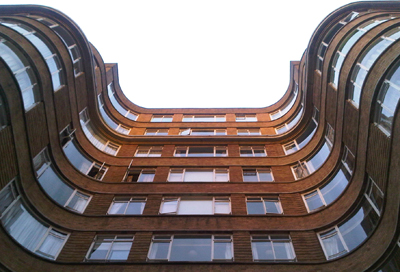
He subsequently moves into an art deco flat which becomes his workplace and home at 56B Whitehavens Mansions (he apparently chose the building based on its symmetry).  In the TV show, the art deco block chosen to represent this building is the Grade II-listed Florin Court, located on the eastern side of Charterhouse Square in Smithfield.

Actually built in 1936 – well after Poirot apparently moved in – the nine floor building has a curvaceous facade and boasts some 120 flats along with a basement swimming pool and rooftop garden. Interestingly, last July there was a fire in a first floor flat causing the entire building to be evacuated.

Poirot apparently lived in a couple of different apartments in the building and was also known at times to reside in The Savoy Hotel and The Park Lane Hotel.

PICTURE: Goodwillgames/Wikimedia Commons

10 fictional character addresses in London – 1. 221b Baker Street…

221b-Baker-Street

Today we kick off our new Wednesday series with a look at some of the most famous addresses in London where fictional characters once lived. Most, if not all, of the addresses we’ll look at are not fictional in themselves – they do actually exist – but the characters said to have lived there owe their lives solely to the imaginations of their creators and the readers and audiences who have loved and admired them.

To kick it off, we take a quick look at what is certainly the most visited address of a fictional character in London – 221b Baker Street, the home of Sherlock Holmes and his associate Dr John Watson.

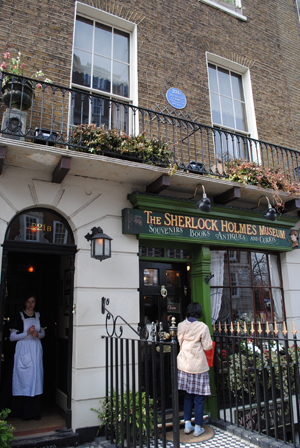
The-Sherlock-Holmes-MuseumWe’ve looked mentioned this Baker Street address in a couple of earlier posts – including a look at the origins of the naming of Baker Street and a piece on Sherlock Holmes himself.

So, to somewhat recap, the writer Sir Arthur Conan Doyle has Holmes and Watson living at this address from 1881 (it becomes their address in the first book featuring them – A Study in Scarlet, published in 1887) to 1904 when Holmes retired (Watson was not a continual presence here, moving in and out a couple of times).

What’s interesting is that the address now belongs to the Sherlock Holmes Museum, although in terms of the other numbers in the street, this is actually located between numbers 237 and 241 (in a street which was, prior to the 1930s, known as Upper Baker Street).

What is now number 221 is a 1930s art deco building formerly known as Abbey House (but this would have been 41 Upper Baker Street in 1887). It was the headquarters of Abbey National which had a long-running dispute with the museum over the right receive mail at the address 221b (since the closure of Abbey House in the early Noughties, the museum has received the mail).

It should be noted that there are also numerous other theories over the ‘real’ location of 221b Baker Street – in particular one which suggests the real address is opposite the former location of Camden House in Baker Street, thanks to a reference in The Empty House.

The museum, which is located in a house built in 1815, is set up as it was in Holmes’ day and contains his first floor study, filled with artefacts relating to the many cases he solved – including his famous pipe as well as his deerstalker hat, magnifying glass, violin, and the wicker chair which was used in Sidney Paget’s famous illustrations.

Other rooms include Dr Watson’s small second floor bedroom and the housekeeper Mrs Hudson’s room.

Worth noting is that there is also reconstruction of Holmes’ study at The Sherlock Holmes pub, located at 10-11 Northumberland Street in Westminster. This had been created for the Festival of Britain in 1951 by the Marylebone Borough Library and Abbey National and was located at Abbey House. For on this, check out the Westminister Libraries & Archives site.

WHERE: The Sherlock Holmes Museum, 221b Baker Street (nearest Tube station is Baker Street);  WHEN: 9.30am to 6pm daily; COST: £8 adults; £5 children (under 16); WEBSITE: www.sherlock-holmes.co.uk.

10 curious London memorials recapped (and vote for the one that most moves you)…

We’re kicking off a new special series next Wednesday but in the meantime we thought we’d recap our latest series – 10 (more) curious London memorials, and the previous series, 10 curious London memorials…

So, first for the 10 (more) curious London memorials list…

10. Memorial to 16th century navigators…

9. The Speke Monument…

8. The SOE Memorial…

7. D’Oyly Carte Memorial…

6. 7 July Memorial…

5. National Police Memorial…

4. ‘People of London’ Memorial…

3. William Wallace Memorial…

2. Animals in War Memorial…

1. Kindertransport memorial…

And, for the first curious London memorials list, which we ran way back in 2011…

10. The Bard or not The Bard?

9. The Golden Boy of Pye Corner

8. Edith Cavell Memorial

7. Tower Hill scaffold memorial

6. The Buxton Memorial Fountain

5. Eros (or the Shaftesbury Memorial Fountain)

4. The Suffragette Memorial

3. Charing Cross

2. The Albert Memorial

1. Watt’s Memorial in Postman’s Park

Hope you’ve enjoyed them. We look forward to bringing you our next series from next Wednesday…

10 (more) curious London memorials…10. Memorial to 16th century navigators…

16th-century-navigators

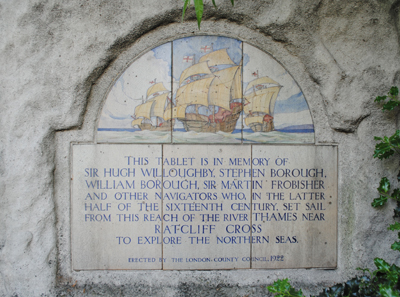
In the final of our series looking at London memorial, we head out to Shadwell in the city’s east where on the bank of the Thames, we find a memorial tablet dedicated to a group of 16th century navigators who set sail from near this point.

Located in Edward VII Memorial Park, the tablet can be found – rather oddly – on the landward side of the Wapping cupola, built to disguise a ventilation shaft and spiral staircase for the Rotherhithe road tunnel which opened in 1908 (the road is the A101). The cupola has a twin on the other side of the river in Rotherhithe.

Erected in 1922, the memorial specifically names arctic explorers Sir Hugh Willoughby, Stephen Borough, William Borough, and Sir Martin Frobisher but then goes on to state that it is also dedicated to the “other navigators who, in the latter half of the sixteenth century, set sail from this reach of the River Thames near Ratcliff Cross to explore the Northern Seas.”

Sir Hugh and his crew died while on an expedition in 1553 after becoming separated from the other ships on the expedition (Stephen Borough, master of one of the other ships, survived that expedition) while Sir Martin Frobisher made several unsuccessful attempts to find the North West passage in the late 1500s.

Ratcliffe Cross was a point on the northern bank of the river located just to the east of the park at the top of Ratcliffe Stairs and was an important navigation point for Thames watermen.

10 (more) curious London memorials…9. The Speke Monument…

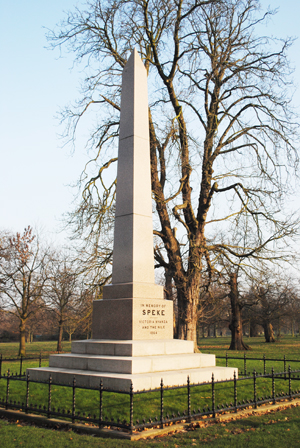
Speke-MonumentWhile thousands walk past this obelisk in Kensington Gardens each day, few probably realise it commemorates the life of John Hanning Speke, a Victorian-era explorer who discovered Lake Victoria in East Africa and named its northern outflow as the source of the Nile.

The red granite monument, designed by Philip Hardwicke and made from stone quarried in Scotland, was paid for by public donations and sponsored by Sir Roderick Murchison, president of the Royal Geographic Society which had paid for two of Speke’s expeditions. It was installed in 1866 and is located near the junction of Lancaster Walk and Budges Walk.

Speke, who had been on several expeditions in Africa, had only died at the age of 37 two years before in relatively controversial circumstances. He was shot by his own gun only the day before he was to participate in a debate with another explorer, Sir Richard Burton, about the source of the River Nile (Speke claimed the source of the Nile was Rippon Falls which flowed out of Lake Victoria; Sir Richard disputed this claim – it was later proven correct). Some have claimed Speke’s death to be suicide; others that it was an accident.

The monument itself was circumspect with regard to Speke’s success – it didn’t directly credit him as being the discoverer of the river’s source. This was rectified in 1995 when a plaque giving credit where it was due was placed on the ground in front of the monument by the Friends of Hyde Park and Kensington Gardens.

10 (more) curious London memorials…8. The SOE Memorial…

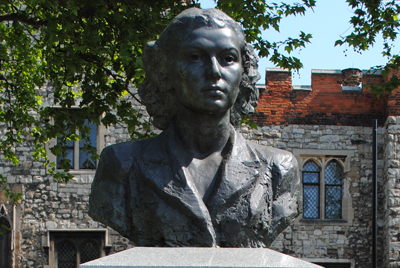
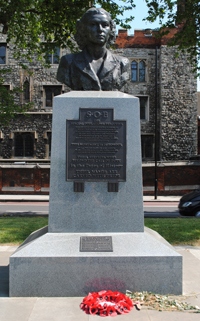
SOE-bigTucked away on Albert Embankment just to the north of Lambeth Bridge, this moving memorial was only unveiled in 2009 and formally honours the under-cover agents who worked for the Allies behind enemy lines during World War II.

The plinth is topped with a larger-than-life bust of Londoner Violette Szabo, sculpted by London artist Karen Newman. Szabo, who here gazes out across the Thames, was tortured and executed after being captured by the Germans while on a mission behind enemy lines following the D-Day landings.

SOEThe daughter of a French mother and English father, Szabo grew up in South London and, when World War II broke out in 1939, volunteered to work as an undercover operative in France as member of the British Special Operations Executive (SOE).

She had successfully completed one mission and had returned to France for a second when she was discovered and sent to a prison camp where she was unsuccessfully tortured for information.

Posthumously awarded the George Cross and the Croix de Guerre, a plaque on the memorial says she was among the 117 SOE agents who did not survive their missions to France. As many as 407 SOE agents were sent on “sabotage missions” to occupied France to fight with the French resistance.

Surprisingly, this SOE Memorial was apparently the first public memorial to honour the work of the unit. Formed on the orders of PM Sir Winston Churchill, it consisted of agents from various countries who were devoted to the Allied cause. Its feats included a raid which destroyed a factory in the Telemark region of Norway where the Germans were trying to produce heavy water which is used in the creation of atomic bombs – an operation which receives a special mention on the memorial.

The memorial was officially unveiled by the Duke of Wellington on 4th October, 2009. One of the plaques on it states that the monument “is in honour of all the courageous S.O.E. Agents: those who did survive and those who did not survive their perilous missions”. “Their services were beyond the call of duty. In the pages of history their names are carved with pride.” Enough said.

For more on the history of women serving in the SOE, see Squadron Leader Beryl E Escott’s book The Heroines of SOE: F Section: Britain’s Secret Women in France.

10 (more) curious London memorials…7. D’Oyly Carte Memorial…

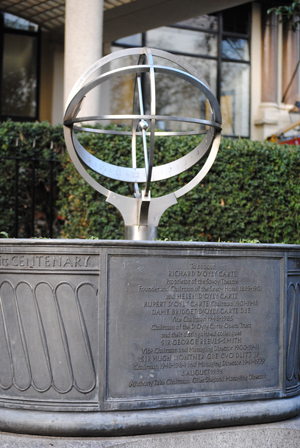
DOyly-CarteThis strange looking globe standing in Victoria Embankment Gardens just off Savoy Place may appear just another random piece of street art but in fact it’s a memorial to a man and his family who established the hotel now housed nearby.

Theatre impresario Richard D’Oyly Carte is known for having formed his own opera company – the D’Oyly Carte Opera Company, it was known for staging Gilbert and Sullivan’s ‘Savoy operas’ –  and for having founded the Savoy Hotel, which stands across the road from the memorial’s location.

The memorial, which was placed here in 1989 to mark the hotel’s centenary, takes the form of an armillary sphere – a model of objects circling the earth – standing in the middle of a cistern.

The inscription accompanying the memorial states that it honors not only Richard D’Oyly Carte but also others – including members of his family – who have since been involved in the hotel’s management. There’s also a note on the rim of the cistern, stating that the garden was “given to London by the Savoy in celebration of its centenary” while inscribed on the armillary sphere’s rings are the words “Savoy Centenary 1989, ‘For excellence we strive.'” and a line from dramatist WS Gilbert (of Gilbert and Sullivan fame) – “Every season has its cheer, life is lovely all the year”.

10 (more) curious London memorials…6. 7 July Memorial…

77-Memorial

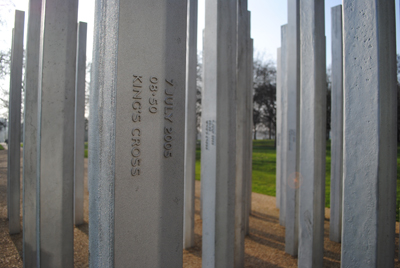
It’s not immediately obvious what this series of upright stainless steel pillars standing on the eastern edge of Hyde Park has been placed there for.

But look a little closer and you’ll see inscribed upon a date which any long-term Londoner immediately recognises – 7th July, 2005: the day when a series of bombs claimed 52 lives on three trains and a bus at various locations around central London.

The memorial, designed by architects Carmody Groarke and engineering team Arup working in consultation with victims’ representatives, Royal Parks and the Department for Culture, Media & Sport, consists of 52 pillars – one for each victim of the bombings.

The 3.5 metre high, 850 kilogram pillars are clustered together in four groups representing the four locations of the bomb attacks – Tavistock Square, Edgware Road, King’s Cross and Aldgate. They are marked with the times, dates and locations of the bombings and there’s also a 1.4 tonne stainless steel plaque upon which are written the names of the victims located nearby.

The RIBA award-winning memorial, which is located just to the north of the colossal statue Achilles and Hyde Park Corner, was unveiled by Prince Charles and Lady Camilla on the fourth anniversary of the attack in 2009.

For more, see the Royal Parks website www.royalparks.org.uk/parks/hyde-park/hyde-park-attractions/7-july-memorial.

10 (more) curious London memorials…5. National Police Memorial…

National-Police-Memorial

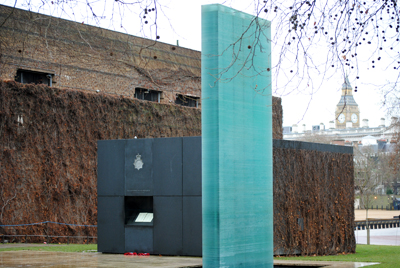
The unobtrusive box-like structure and adjacent glass pillar located on the corner of The Mall and Horse Guards Road in Whitehall is another memorial that is easy to overlook.

Unveiled by Queen Elizabeth II in 2005, it commemorates the 4,000 police officers who have been killed in the course of their duty in the UK and was commissioned by the Police Memorial Trust.

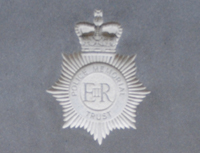
Police-Memorial-TrustThe trust was formed in the mid-1980s by the late film director Michael Winner following the shooting death of WPC Yvonne Fletcher, who was killed while policing a protest outside the Libyan Embassy in St James’s Square on 17th April, 1984.

The Trust ensured an individual memorial to WPC Fletcher now marked the spot of her death and was followed by further memorials to individual police officers before the trust began a campaign for a larger, national memorial in the mid-1990s.

As much as £2.3 million was raised from the public for the memorial which was designed by architectural firm Foster + Partners.

The memorial, which won a RIBA award, consists of a black granite clad wall with a glass chamber set into its face, inside which is a Book of Remembrance listing the names of all UK police officers killed in the course of duty (the pages of the book are apparently turned every two weeks). Above the chamber is carved the Metropolitan Police Crest.

The tall glass pillar which stands nearby in a reflecting pool was designed to pay homage to the blue lamps that once burned outside police stations.

For more on other police memorials in the UK, see www.policememorial.org.uk.

10 (more) curious London memorials…4. ‘People of London’ Memorial…

People-of-London

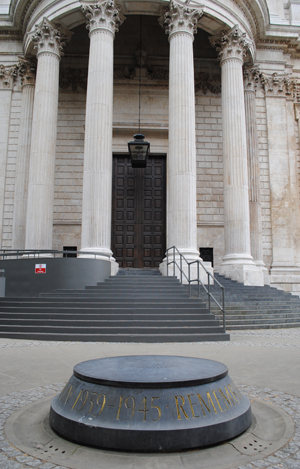
Amid all the grand war-related memorials of London, this rather humble memorial sitting outside the north transept of St Paul’s Cathedral in St Paul’s Churchyard can easily be overlooked. 

Known as the Memorial to the Londoners killed in World War II Bombardments or simply as the ‘People of London’ memorial as it’s called on the sculptor’s website, it commemorates the 30,000 Londoners who were killed during the Blitz  (not to be confused with the National Firefighters’ Memorial, known informally to many as the Blitz Memorial, which sits opposite the cathedral’s south transept and commemorates firefighters who died during the Blitz).

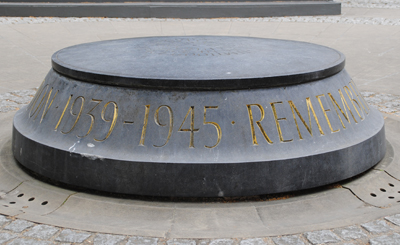
People-of-London---smallThe round memorial was carved from a three tonne block of Irish limestone and is set into paving (it was initially very shiny).

The gilded inscription which runs around the outside reads “Remember before God the people of London 1939-1945” while on top, written in a spiral, is an inscription written by Sir Edward Marsh – “In war resolution, in defeat defiance, in victory magnanimity, in peace goodwill”, the text of which was used by Sir Winston Churchill in the frontispiece to his history, The Second World War.

Unveiled by the Queen Mother on 11th May, 1999, the memorial is the work of Richard Kindersley, whose other memorials include the Commonwealth Memorial on Constitution Hill.

Kindersley writes on his website, that the “position of the memorial adjacent to St Paul’s is most appropriate, as most people will remember the dramatic photograph of the Cathedral dome of the taken during a devastating attack in 1941.”

It was paid for by public funds raised following an appeal in the Evening Standard newspaper, launched in connection with the 50th anniversary of VE Day.

10 (more) curious London memorials…3. William Wallace Memorial…

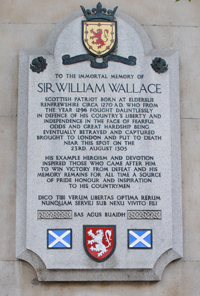
William-Wallace-memorialHe was captured in Scotland but it was actually at Smithfield in London that the Scottish leader, Sir William Wallace, was put to death on 23rd August, 1305.

Erected in 1956 by “Scots and friends at home and abroad”, a plaque located on the wall of St Bartholomew’s Hospital overlooking the former execution ground commemorates the “Scottish patriot” Wallace, saying that from the year 1296 “fought dauntlessly in defence of his country’s liberty and independence in the face of fearful odds and great hardship”. It goes on to note that he was “eventually betrayed”, captured and executed “near this spot”.

Elsewhere the memorial reads: “His example, heroism and devotion inspired those who came after him to win victory from defeat and his memory remains for all time a source of pride, honour and inspiration to his countrymen”.

Having co-led the Scottish to victory against the army of King Edward I at the Battle of Stirling Bridge in 1297, Wallace was later knighted for his efforts and subsequently served as a Guardian of the Kingdom of Scotland.

Following his defeat at English hands in the Battle of Falkirk in 1298, he escaped and continued to evade capture until he was apprehended near Glasgow in August 1305. Brought to London where he was put on trial in Westminster Hall. Summarily found guilty of treason, he was stripped naked and dragged to Smithfield and it was there that he suffered the horrible death of being hung, drawn and quartered.

And while the 1995 movie, Braveheart, had Wallace crying out “Freedom” as he died, his last words are actually not recorded. His tarred head was subsequently displayed on a pike atop London Bridge while his limbs were sent to towns including Stirling in Scotland.

10 (more) curious London memorials…2. Animals in War Memorial…

Animals-in-War

This week we take a look at another of London’s war-related memorials but unlike the vast majority, this one, as its name says, commemorates animals, not humans.

Located in the middle of Park Lane near the intersection with Upper Brook Street on the eastern side of Hyde Park, the memorial is dedicated “to all the animals that served and died alongside British and Allied Forces in wars and campaigns throughout time”. Another inscription on the memorial reads “They had no choice”.

A further dedication at the memorial pays tribute to the “millions” of animals who have died in wars. “From the pigeon to the elephant, they all played a vital role in every region of the world in the cause of human freedom,” it says. “Their contribution must never be forgotten.” It’s been said that as many as eight million horses were killed in World War I alone.

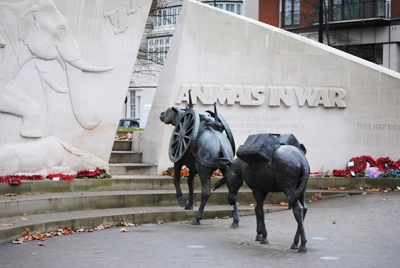
It features a couple of bronze pack mules making their way through a gap in a curved, 58 foot wide Portland stone wall – themselves carrying reliefs of various animals including an elephant, horses, camels and pigeons – while on the other side is a bronze horse and a dog, looking ahead.

The memorial is the work of Somerset-based sculptor David Backhouse and was unveiled by Princess Anne in November 2004, the 90th anniversary of the outbreak of World War I. It was apparently inspired by Jilly Cooper’s book, Animals in War, and commissioned by the Imperial War Museum. It was paid for by £2 million in public donations.

For more, check out www.animalsinwar.org.uk.

10 (more) curious London memorials…1. Kindertransport memorial

KindertransportWay back in 2011 we ran a series looking at some of London’s most curious memorials. We’ve decided to revisit that theme in our new special series.

To kick it off, we’re taking a look at a group memorial found just outside Liverpool Street Station and dedicated to the thousands of Jewish children who arrived in the UK as refugees over nine months in 1938 and 1939, having fled the Nazis in Europe after the anti-Semitic attacks of the Kristallnacht.

Called Kindertransport – The Arrival, the group of bronze statues representing children with their luggage having just stepped off a train at the station were unveiled in 2006 in Hope Square. A short stretch of railway tracks lays behind them.

The memorial is the work of Frank Meisler – himself a child who travelled on a Kindertransport train from Danzig – and bears an inscription: “Children of the Kindertransport. In gratitude to the people of Britain for saving the lives of 10,000 unaccompanied mainly Jewish children who fled from Nazi persecution in 1938 and 1939. ‘Whosoever rescues a single soul is credited as though they had saved the whole world.’ Talmud.”  It is dedicated by the Association of Jewish Refugees and the Central British Fund for Jewish World Relief.

Around the statue group are a series of blocks upon which is inscribed the names of the cities from which the children fled. They include the cities of Cologne, Hanover, Stuttgart, Frankfurt, Munich, Danzig, Breslau, Prague, Hamburg, Leipzig, Berlin and Vienna along with others.

The statue is one of four, all created by Meisler, which have been erected along the route the children took to reach safety. Others can be found at the main railway station Gdansk in Poland, Friedrichstraße railway station in Berlin, and another in Rotterdam, The Netherlands.

Hope Square also contains another plaque which dedicates the square to the children of the Kinderstransport “who found hope and safety in Britain through the gateway of Liverpool Street Station”.

In late June, an event was held in the St James’s Palace to mark the 75th anniversary of the Kindertransport.

10 Historic London Garden Squares…10. Charterhouse Square…

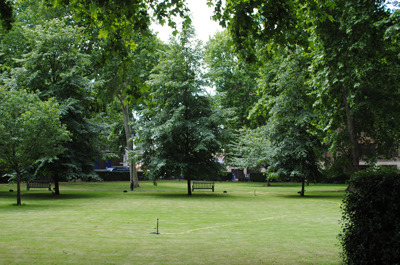
Charterhouse-Square-GardensThe final in our series on historic garden squares in London (for this year, anyway), we’re taking a look at Charterhouse Square.

The five sided square, located just to the east of Smithfield, takes its name from a Carthusian monastery which was established in 1371 on what is now its north side. Prior to this, what is now the square had from 1348 served as a location for a plaque burial pit (a number of skeletons from the plaque pit have been unearthed as part of the Crossrail project – for our earlier story on this, follow this link).

The monastery was dissolved in 1537 after the monk’s refused to recognise King Henry VIII’s Act of Supremacy (some were later executed at Tyburn) and it was subsequently transformed into a manor house with Thomas Howard, the 4th Duke of Norfolk, among its residents over the years (in fact he was imprisoned there around 1570 for allegedly plotting to marry Mary, Queen of Scots – he was later executed by Queen Elizabeth I for treason).

Under the will of Thomas Sutton, an almshouse and school was subsequently established on the site – the almshouse remains there while the school, whose students had included Methodism founder John Wesley and writer William Makepeace Thackeray, moved out to Godalming in Surrey in 1872. As well as the almshouse (which is open for guided tours, check this site for details), some of the buildings are now occupied by medical related institutions.

In the 1600s, the square was also home to numerous other large residences among them Rutland House, which had been the residence of the Venetian ambassador. It lost its aristocratic inhabitants in the ensuing centuries but remained mainly residential up until the late 19th century when it gradually became taken over by businesses and other organisations. Interesting to note is that the east side of the square is still home to the residential unit complex known as Florin Court, better known as Whitehaven Mansions, the home of Hercule Poirot in the TV series which bears his name.

The area of the garden square itself was variously referred to as the Charterhouse Churchyard, the Charterhouse Yard and Charterhouse Close over the years and has gone through numerous incarnations with efforts to improve and formalise its look dating back to at least the 16th century. It was at least partly enclosed by the late 1600s and the fences replaced several times, notably in 1742 when an Act of Parliament was passed allowing residents to fine those who entered without authorisation. The enclosing fences have since been modified several more times.

One of the major changes to the shape of the square occurred in 1860 when the Metropolitan Railway was extended between Farringdon and Moorgate. It was at this time that the road surface which surrounds the central garden, which has a Grade II heritage listing, was laid down.

Today the gardens in the centre of the square remain under the management of the Charterhouse (and hence aren’t open to the general public except on tours) but even without a tour it’s still a quiet place to walk around the outside of, evoking a strong sense of years gone past.