10 (more) curious London memorials…3. William Wallace Memorial…

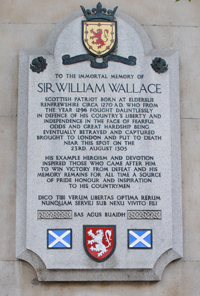
William-Wallace-memorialHe was captured in Scotland but it was actually at Smithfield in London that the Scottish leader, Sir William Wallace, was put to death on 23rd August, 1305.

Erected in 1956 by “Scots and friends at home and abroad”, a plaque located on the wall of St Bartholomew’s Hospital overlooking the former execution ground commemorates the “Scottish patriot” Wallace, saying that from the year 1296 “fought dauntlessly in defence of his country’s liberty and independence in the face of fearful odds and great hardship”. It goes on to note that he was “eventually betrayed”, captured and executed “near this spot”.

Elsewhere the memorial reads: “His example, heroism and devotion inspired those who came after him to win victory from defeat and his memory remains for all time a source of pride, honour and inspiration to his countrymen”.

Having co-led the Scottish to victory against the army of King Edward I at the Battle of Stirling Bridge in 1297, Wallace was later knighted for his efforts and subsequently served as a Guardian of the Kingdom of Scotland.

Following his defeat at English hands in the Battle of Falkirk in 1298, he escaped and continued to evade capture until he was apprehended near Glasgow in August 1305. Brought to London where he was put on trial in Westminster Hall. Summarily found guilty of treason, he was stripped naked and dragged to Smithfield and it was there that he suffered the horrible death of being hung, drawn and quartered.

And while the 1995 movie, Braveheart, had Wallace crying out “Freedom” as he died, his last words are actually not recorded. His tarred head was subsequently displayed on a pike atop London Bridge while his limbs were sent to towns including Stirling in Scotland.

10 (more) curious London memorials…2. Animals in War Memorial…

Animals-in-War

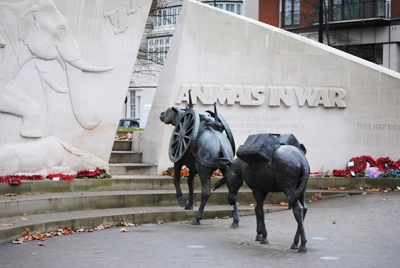
This week we take a look at another of London’s war-related memorials but unlike the vast majority, this one, as its name says, commemorates animals, not humans.

Located in the middle of Park Lane near the intersection with Upper Brook Street on the eastern side of Hyde Park, the memorial is dedicated “to all the animals that served and died alongside British and Allied Forces in wars and campaigns throughout time”. Another inscription on the memorial reads “They had no choice”.

A further dedication at the memorial pays tribute to the “millions” of animals who have died in wars. “From the pigeon to the elephant, they all played a vital role in every region of the world in the cause of human freedom,” it says. “Their contribution must never be forgotten.” It’s been said that as many as eight million horses were killed in World War I alone.

It features a couple of bronze pack mules making their way through a gap in a curved, 58 foot wide Portland stone wall – themselves carrying reliefs of various animals including an elephant, horses, camels and pigeons – while on the other side is a bronze horse and a dog, looking ahead.

The memorial is the work of Somerset-based sculptor David Backhouse and was unveiled by Princess Anne in November 2004, the 90th anniversary of the outbreak of World War I. It was apparently inspired by Jilly Cooper’s book, Animals in War, and commissioned by the Imperial War Museum. It was paid for by £2 million in public donations.

For more, check out www.animalsinwar.org.uk.

10 (more) curious London memorials…1. Kindertransport memorial

KindertransportWay back in 2011 we ran a series looking at some of London’s most curious memorials. We’ve decided to revisit that theme in our new special series.

To kick it off, we’re taking a look at a group memorial found just outside Liverpool Street Station and dedicated to the thousands of Jewish children who arrived in the UK as refugees over nine months in 1938 and 1939, having fled the Nazis in Europe after the anti-Semitic attacks of the Kristallnacht.

Called Kindertransport – The Arrival, the group of bronze statues representing children with their luggage having just stepped off a train at the station were unveiled in 2006 in Hope Square. A short stretch of railway tracks lays behind them.

The memorial is the work of Frank Meisler – himself a child who travelled on a Kindertransport train from Danzig – and bears an inscription: “Children of the Kindertransport. In gratitude to the people of Britain for saving the lives of 10,000 unaccompanied mainly Jewish children who fled from Nazi persecution in 1938 and 1939. ‘Whosoever rescues a single soul is credited as though they had saved the whole world.’ Talmud.”  It is dedicated by the Association of Jewish Refugees and the Central British Fund for Jewish World Relief.

Around the statue group are a series of blocks upon which is inscribed the names of the cities from which the children fled. They include the cities of Cologne, Hanover, Stuttgart, Frankfurt, Munich, Danzig, Breslau, Prague, Hamburg, Leipzig, Berlin and Vienna along with others.

The statue is one of four, all created by Meisler, which have been erected along the route the children took to reach safety. Others can be found at the main railway station Gdansk in Poland, Friedrichstraße railway station in Berlin, and another in Rotterdam, The Netherlands.

Hope Square also contains another plaque which dedicates the square to the children of the Kinderstransport “who found hope and safety in Britain through the gateway of Liverpool Street Station”.

In late June, an event was held in the St James’s Palace to mark the 75th anniversary of the Kindertransport.

10 Historic London Garden Squares…10. Charterhouse Square…

Charterhouse-Square-GardensThe final in our series on historic garden squares in London (for this year, anyway), we’re taking a look at Charterhouse Square.

The five sided square, located just to the east of Smithfield, takes its name from a Carthusian monastery which was established in 1371 on what is now its north side. Prior to this, what is now the square had from 1348 served as a location for a plaque burial pit (a number of skeletons from the plaque pit have been unearthed as part of the Crossrail project – for our earlier story on this, follow this link).

The monastery was dissolved in 1537 after the monk’s refused to recognise King Henry VIII’s Act of Supremacy (some were later executed at Tyburn) and it was subsequently transformed into a manor house with Thomas Howard, the 4th Duke of Norfolk, among its residents over the years (in fact he was imprisoned there around 1570 for allegedly plotting to marry Mary, Queen of Scots – he was later executed by Queen Elizabeth I for treason).

Under the will of Thomas Sutton, an almshouse and school was subsequently established on the site – the almshouse remains there while the school, whose students had included Methodism founder John Wesley and writer William Makepeace Thackeray, moved out to Godalming in Surrey in 1872. As well as the almshouse (which is open for guided tours, check this site for details), some of the buildings are now occupied by medical related institutions.

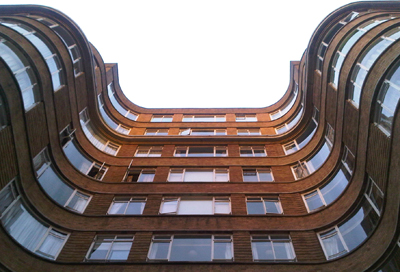
In the 1600s, the square was also home to numerous other large residences among them Rutland House, which had been the residence of the Venetian ambassador. It lost its aristocratic inhabitants in the ensuing centuries but remained mainly residential up until the late 19th century when it gradually became taken over by businesses and other organisations. Interesting to note is that the east side of the square is still home to the residential unit complex known as Florin Court, better known as Whitehaven Mansions, the home of Hercule Poirot in the TV series which bears his name.

The area of the garden square itself was variously referred to as the Charterhouse Churchyard, the Charterhouse Yard and Charterhouse Close over the years and has gone through numerous incarnations with efforts to improve and formalise its look dating back to at least the 16th century. It was at least partly enclosed by the late 1600s and the fences replaced several times, notably in 1742 when an Act of Parliament was passed allowing residents to fine those who entered without authorisation. The enclosing fences have since been modified several more times.

One of the major changes to the shape of the square occurred in 1860 when the Metropolitan Railway was extended between Farringdon and Moorgate. It was at this time that the road surface which surrounds the central garden, which has a Grade II heritage listing, was laid down.

Today the gardens in the centre of the square remain under the management of the Charterhouse (and hence aren’t open to the general public except on tours) but even without a tour it’s still a quiet place to walk around the outside of, evoking a strong sense of years gone past.

10 Historic London Garden Squares…9. Queen Square…

Queen-Charlotte

This rectangular-shaped square in Bloomsbury, known for its association with the medical profession, was first laid out in the early 1700s and was named for Queen Anne.

Originally known as Devonshire Square, the space was largely laid out between 1716 and 1725 on land owned by Sir Nathaniel Curzon of Kedlestone and, as with so many of London’s squares, attracted it’s fair share of the well-to-do. Among early residents were several bishops and members of the aristocracy.

Queen-SquareOne of the most interesting early associations with Queen Square is that of King George III and his consort Queen Charlotte. The king – better known to many as ‘Mad King George’ – was treated for mental illness in a house on the square and there’s a tradition that Queen Charlotte, stored some of the food to be consumed by the king during his treatment in the base of what is now the pub known as the Queen’s Larder (see our previous entry on the pub here).

There’s a statue of a queen in the central gardens which was thought to be of Queen Charlotte. Since it was erected in 1775, there has been some confusion over the statue’s identity – it has been thought at different stages to be of Queen Anne, Queen Mary (co-ruler with King William III), and Queen Caroline (consort of King George II) – a fact which has led to some confusion as to which queen the square was named after (although general consensus now seems to be that it was indeed Queen Anne whom the square was named after).

The houses in Queen Square – which was later associated with artists and literary types – were gradually replaced by institutional buildings relating to, among other things, education and the practice of medicine and today it remains a hub for the medical establishment – the National Hospital for Neurology and Neurosurgery and the Royal London Hospital for Integrated Medicine (formerly known as the Royal London Homoeopathic Hospital) are both located on the east side of the square and there are several other medical-related buildings located around it including the former Italian Hospital (Ospedale Italiano) which was founded by Italian businessman Giovanni Battista Ortelli in 1884 for poor Italian immigrants and since about 1990 has been part of the Great Ormond Street Hospital.

SamOther prominent buildings located on the square include the Church of St George the Martyr Holborn (number 44) which, built in 1706, predates the square’s formation. The church is known as the ‘sweep’s church’ due to the practice of a parishioner who provided Christmas dinners for 100 chimney sweep apprentices each year.

The gardens themselves are protected by an Act of Parliament passed in the 1830s and the gardens are to this day maintained by trustees appointed under that act. Aside from the statue of the queen, monuments in the gardens include a small plaque commemorating the bomb which landed in the square during a Zeppelin raid in World War I (no one was killed), benches commemorating 16 doctors from the homeopathic hospital who died in the Trident air disaster of 1972, and some lines of poetry on a flower bowl and surrounds by Philip Larkin and Ted Hughes in honor of the Queen’s Silver Jubilee of 1977. Statues include a 2001 bronze of Mother and Child and, (this one we love), a sculpture of Sam the cat, apparently a local resident (pictured)!

10 Historic London Garden Squares…8. Russell Square

The largest garden square in Bloomsbury (and one of the largest in London), Russell Square was first laid out by Humphry Repton in 1806 and was located on what were the gardens of the home of the Dukes of Bedford, Bedford House.

Duke-of-BedfordIts name is that family name of the 5th Duke of Bedford, Francis Russell, who initially ordered the creation of the square and owned the land upon which it stands. The Russell family still hold the title today – the current duke, the 15th, is Andrew Russell – and still run the Bedford Estates upon which the square still stands.

The square was originally lined with grand terraced homes aimed at the upper middle class – the survivors, which can be found largely on the southern and western side of the square, are these days occupied by offices and the University of London. The eastern side of the square is these days dominated by the French Gothic Hotel Russell – designed by Charles Fitzroy Doll, it was built in 1898.

Famous residents and inhabitants have included TS Eliot, who worked at a building in the square’s north-west corner when he was poetry editor at Faber & Faber, 19th century painter Sir Thomas Lawrence who had a studio at number 67, poet William Cowper, who lived at number 62 in the 1830s as a schoolboy, and George Williams, founder of the YMCA, who lived at number 13 in the late 19th and early 20th centuries. It also appears in William Thackeray’s novel, Vanity Fair, and Virginia Woolf’s Night and Day.

The gardens were overhauled in 2002 in view of Repton’s original design and a new ornamental fountain installed in the middle. A cafe was also added.

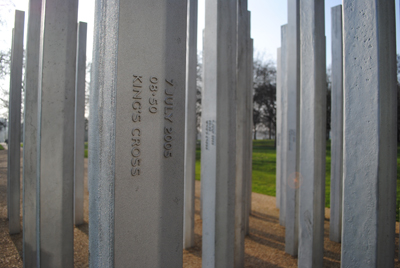
Russell Square still houses one of London’s 13 extant Cabmen’s Shelters while monuments within the gardens include a small memorial to the 7th July, 2005, bombings – two of which occurred nearby – and a statue of the 5th Duke of Bedford, another which is the work of Sir Richard Westmacott and which was erected in 1807-08 (pictured).

10 Historic London Garden Squares…7. Bloomsbury Square

Initially known as Southampton Square, Bloomsbury Square – located just to the east of the British Museum – was first developed in the mid-1660s, making it London’s oldest formal square.

Bloomsbury-SquareIt was the fourth Earl of Southampton, Thomas Wriothesley, who developed the square – his rather grand house, Southampton House, was located on the northern side of the square which initially featured gardens at the centre laid out in a cruciform pattern.

In 1723 – via the marriage of Southampton’s daughter, Lady Rachel Vaughan, to the ill-fated William, son of the 5th Earl of Bedford (he was implicated in the Rye House Plot and beheaded) – it passed to the Dukes of Bedford, becoming part of the Bedford Estates (and with it the earl’s house, later renamed Bedford House). The square took on its new name of Bloomsbury Square around this time.

Initially popular among the well-to-do, it had fallen somewhat from favour by the 19th century and with the 5th Duke preferring to live in the West End, in 1800 Bedford House was auctioned off and demolished. Terraced houses were later built along the now vacant north side of the square.

About 1806, the 5th Duke commissioned Humphry Repton to redesign the square and by the 1820s a garden including trees in the centre and a perimeter shrubbery. The gardens have gone through several makeovers since, including in the 1960s when an underground carpark was built underneath.

Most recently refurbished in 2006-2007 so they once again reflect Repton’s design, the gardens – which have been open to the public since 1950 – also contain a bronze statue of Whig politician (and friend of the Dukes of Bedford) Charles James Fox, which was designed by Sir Richard Westmacott and erected in 1816 (pictured, it was restored in 2006 to mark the bicentenary of Fox’s death).

It remained popular among middle class professionals, however, and among its most notable residents were the writer Isaac D’Israeli, father of the future Prime Minister Benjamin Disraeli, who lived at number six in the early 19th century (his son with him) while architect Sir Edwin Lutyens lived and worked at number 29 for more than 15 years after his marriage in 1897. Literary and artistic figures like Leonard and Virginia Woolf and Lytton Strachey, who became part of what was known as the ‘Bloomsbury Group’, were also famously known to have lived in the area around the square.

Most of the houses in the square are now used as offices but among the notable buildings there are the former home of the Royal Pharmaceutical Society of Great Britain (based in a building partly credited to architect John Nash) and, dating from 1930, Victoria House.

One of the more famous events to have taken place in the square occurred in 1780 during the anti-Catholic Gordon Riots when rioters burned down the house of the Lord Chief Justice. Almost 100 years earlier, in 1694, the square was site of a deadly fencing duel between Scottish financier John Law and Edward Wilson. Law killed Wilson, was subsequently convicted of his murder and sentenced to death but escaped by fleeing to the continent. He later become the founder of the Mississippi Company.

10 Historic London Garden Squares…6. Grosvenor Square

Grosvenor-Square-1

The largest square in Mayfair, Grosvenor Square was laid out in the 1720s on the orders of  Sir Richard Grosvenor of Cheshire.

Sir Richard owned the Grosvenor Estate, a considerable tract of land in London’s west which includes in its northern part the land upon which the square was created (the estate is now owned by Gerald Cavendish Grosvenor, the 6th Duke of Westminster).

It’s proximity to Hyde Park and Whitehall quickly made it, like many other historic squares, a fashionable place for politicians to live – among those who lived here in the late 18th century were three prime ministers.

The oval-shaped gardens in the middle of the square – which was only opened to the public in 1948 – were once home to a statue of King George I but this was removed at some point. Originally thought to have been laid out by gardener John Alston, they took on their current form in 1948 when they were redesigned by architect BWL Gallannaugh (interestingly, Grosvenor Square is also said to have been the last part of London to exchange gas lighting for electric lighting).

There’s almost no residential buildings on the square these days but among the most prominent buildings (in fact it dominates the west end of the square) is the US Embassy. Designed by Eero Saarinen, the building was completed in 1960 with US President John F Kennedy one of the first visitors.

Grosvenor-Square-2The hulking embassy is only one of the many American connections to the square, connections which at one point led to it being known as “Little America”. Dwight Eisenhower, commander of the US armed forces in World War II, based his headquarters at number 20 in 1944, while number nine – one of the few residences to survive – was home to John Adams, first American ambassador to the Court of St James and later the country’s second president.

The American theme, which has meant the square has been the focus of demonstrations such as those protesting the Vietnam War as well as outpourings of support such as in the wake of the September 11 attacks, is also evident in the statutory in the square’s gardens with grand, full size statues of  President Franklin D. Roosevelt (a bronze by William Reid Dick unveiled by Eleanor Roosevelt on the third anniversary of the president’s death – 12th April, 1948 – it is pictured above), President Eisenhower (a bronze by Robert Dean dating from 1989), and President Ronald Reagan (unveiled on 4th July, 2011, pictured right).

On the eastern side of the garden square is the September 11 Memorial Garden opened in 2003 while on the south side is the Monument to the Eagle Squadrons, the three RAF squadrons in World War II mostly composed of American volunteers before the US entered the war. There’s also a set of memorial “Diplomatic Gates”, installed in 1984 to commemorate the bicentennial of the Treaty of Paris and honour US and UK politician who have worked in the service of peace.

Other notable buildings include number one, the Canadian High Commission (previously the US embassy); and number four, one of  square’s oldest houses. Now demolished, number 44 was the home of the Earl of Harrowby and where the British Cabinet were dining when word arrived of Wellington’s victory at Waterloo.

10 Historic London Garden Squares…5. Berkeley Square…

Berkeley-Square

Located in the south-west of Mayfair in London’s West End, Berkeley Square was originally laid out by architect William Kent in the mid 1700s.

It takes its name from the Berkeley family of Gloucestershire (the first Lord Berkeley of Stratton was a Royalist commander in the Civil War) whose London residence, Berkeley House, stood on what is now the south side of the square until it was destroyed in a fire in 1733 (Devonshire House, whose residents included the 5th Earl of Devonshire and his somewhat notorious wife Georgiana, was subsequently built on the site and remained there until it was demolished in the 1920s).

The gardens, which feature some of the city’s oldest London Plane trees (dating from 1789), have a pump house at the centre which was built in 1800 and is now Grade II listed (it stands on the site of an earlier equestrian statue of King George III). Other features including the statue Lady of Sumaria (Water Carrier) – pictured above – which was made by Pre-Raphaelite sculptor Alexander Munro in 1858 and stands at the garden’s southern end.

Among notable buildings which face onto the square are Lansdowne House – located on the south-west corner of the square, it was designed by Robert Adam and now home of the Lansdowne Club – and number 50 Berkeley Square, home of short-lived early 19th century PM George Canning (and said to be the most haunted house in London). The square was also the home of society favorite, Gunter’s Tea Shop, which dated from the mid-1700s.

Famous residents have included wartime PM Sir Winston Church (he lived at number 48 as a child); Horace Walpole, some of the first Prime Minister Robert Walpole (he lived at number 11 during the 1700s), Robert Clive (more famously known as Clive of India, he committed suicide in number 45 in 1774), and the fictional Bertie Wooster and his valet Jeeves (creations of author PG Wodehouse). The square also featured in the famous wartime song, A Nightingale Sang in Berkeley Square.

The square is open from 8am daily with closing times varying based on the season.

10 Historic London Garden Squares…4. St James’s Square…

A quiet square at the heart of the area known as St James, the square’s origins go back to the 1660s when King Charles II granted what was initially a lease (and later the freehold) over a section of St James’s Field to Henry Jermyn, a favourite of King Charles I’s queen Henrietta Maria who was created the 1st Earl of St Alban.

William-IIIThe earl began developing the residential square (the original design had houses on the south-side fronting onto Pall Mall) and, thanks to its proximity to Whitehall and St James’s Palace, quickly attracted some of the who’s who of London to live there.

Indeed it’s said that by the 1720s, seven dukes and seven earls were in residence in the square – other residents included PMs William Pitt the Elder and William Gladstone (both lived in Chatham House, at numbers 9 and 10, albeit at different times) as well as two of James II’s mistresses, Arabella Churchill and Catherine Sedley, who apparently lived at number 21 in the late 1600s.

Among the architects who designed houses around the square were Robert Adam, Sir John Soane, and, in more recent times, Edwin Lutyens.

The square – which reached its final layout, designed by John Nash, around 1854 – remained a desirable place to live even as in the 19th century, some of the houses gave way to financial institutions, private clubs, offices and even lodging houses. These days it’s dominated by business and other institutional organisations.

Organisations located in the square today include the Naval and Military Club (number four – former home of Nancy Astor), the East India Club (number 16) and the London Library (located at number 14, it was founded by Thomas Carlyle in 1841) as well as the international headquarters of BP.

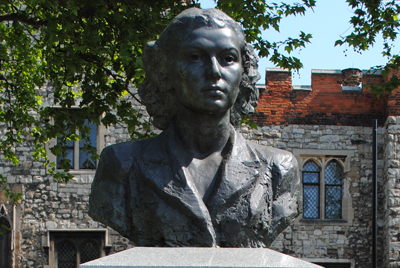
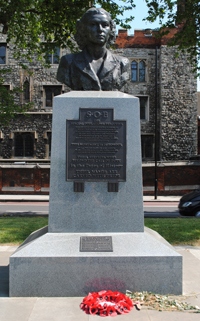
The gardens feature an equestrian statue of King William III at their centre (the work of John Bacon Sr and Jr, it was installed in 1808 and is pictured above). Other monuments include The Stag (located in the south-west corner, it is the work of Marcus Cornish and was installed in 2001) and, just outside the garden railings in the north-east corner, a memorial to WPC Yvonne Fletcher who was killed when a gun was fired from the Libyan Embassy (known as the Libyan People’s Bureau, it was located at number 5) during a demonstration on 17th April, 1984. The pavilion on the south side was designed by John Nash.

The gardens are private – managed by the St James’s Square Trust – but open to the public on weekdays from 10am to 4.30pm.

10 Historic London Garden Squares…3. Soho Square…

Soho-Square

Originally named King’s Square in honour of King Charles II, Soho Square was laid out on what had been known as Soho Fields as a residential square with a garden at its centre in the late 1670s – part of the general demand for homes that came about after the Great Fire of London in 1666.

A fashionable place to live when built, among the early mansions was Monmouth House, a grand mansion originally built for James Scott, the Duke of Monmouth (and illegitimate son of King Charles II who lost his head after leading a rebellion against King James II) and later used by the French ambassador before it was demolished in the 1770s. Two of the square’s original homes are located at numbers 10 and 15.

A number of trees and shrubs were recorded as being planted here including cherry, peach and almond trees as well as lilacs, jessamine and honeysuckle – it’s suggested these may have been chosen by botanist Sir Joseph Banks who lived at number 32 from 1777 until his death in 1820.

King-Charles-IIThe square, which was opened to the public in 1954, is today at the heart of the West-End district of Soho, once synonymous with late night entertainment including the sex industry but also home to a growing number of film and media-related organisations (for a look at the derivation of the name Soho, see our earlier post).

Indeed, a number of media companies are based in the square itself – British Movietone, which was produced the Movietone news, was located here at number 22 for years while current inhabitants include Twentieth Century Fox (located in a building at number 31-32 where the botanically minded Linnean Society once met).

Other buildings of note in the square include the French Protestant Church, built in 1891-93 and located at numbers eight and nine and St Patrick’s Church, located at on the corner of Soho Square and Sutton Row. While a chapel was first consecrated here in 1792, the current building dates from the 1890s (reopened in 2011 after a £3.5 million restoration) and has catacombs which spread a considerable distance under the square. In a nod to less savoury aspects of the square’s past, the White House Brothel was also located here – at number 21 – in the late 18th century (the building is now known as Manor House).

The oldest statue in the square is that of Caius Gabriel Cibber’s King Charles II which dates from 1681 (pictured right) – a reminder of the square’s past name.  Originally part of a larger monument containing a fountain, it was removed in 1875 to make way for the distinctive half-timbered Tudor-style hut (pictured above) used by gardeners which, having been rebuilt in the 1930s, currently sits at the square’s centre and only returned to the gardens in 1938. There’s also a bench in the square which commemorates the late singer Kirsty MacColl, writer of the song Soho Square.

For more on London’s squares, see Gary Powell’s Square London.

10 Historic London Garden Squares…2. Parliament Square

Located in one of the most prominent sites in London, Parliament Square is these days perhaps best known as a protest site for those wanting to attract Parliament’s eye. And while, unlike say, Trafalgar Square, many visitors to London may not know its name, its proximity to the Houses of Parliament, Whitehall, Westminster Bridge and Westminster Abbey means it’s rarely off anyone’s tourist agenda.

David-Lloyd-GeorgeThe history of the square goes back to 1868 when architect Sir Charles Barry (responsible for the design of the Houses of Parliament) designed a square to improve traffic flow in the area (and demolished many buildings – apparently the area was a slum – in the process).

The roads around the square featured London’s first traffic signals (it used semaphore arms rather than lights and was installed at the meeting of Great George and Bridge Streets) and in addition the square was originally the location for the Buxton Memorial Fountain which moved to its present position in Victoria Tower Gardens in 1940 (see our earlier post on the fountain here). In 1950, the entire square was redesigned by architect George Grey Wornum.

The square is home to a plethora of statues including former PMs Sir Winston Churchill, a relatively recent statue of David Lloyd George (pictured), Sir Robert Peel (also the founder of the Metropolitan Police Force – see our earlier post here), Benjamin Disraeli, the Earl of Derby and Lord Palmerston as well as South African PM Jan Christian Smuts and, (if you count the space in front of Middlesex Guildhall), US President Abraham Lincoln (a replica of a statue in Lincoln Park, Chicago) and former Foreign Secretary and PM George Canning. Among the last statues added was a nine foot high bronze figure of Nelson Mandela which was placed in the square in 2007 after an unsuccessful push to have it located in Trafalgar Square.

Among the most high profile of protests to have been held there is that of the late peace campaigner Brian Haw who camped on the square for 10 years until 2010. Among the most recent protests this year has been a colourful demonstration by beekeepers, calling for a ban on pesticides.

For more on London’s statues, see Peter Matthews’ London’s Statues and Monuments.

10 Historic London Garden Squares…1. Leicester Square…

In the first of a new Wednesday series looking at historic London garden squares, we take a look at what next to Trafalgar Square, is the most famous square in the entire city – Leicester Square.

Located in the heart of the West End, Leicester Square’s history finds its origins back in the 17th history when Robert Sidney, the 2nd Earl of Leicester acquired property on the site where the square now stands. Then known as St Martin’s Field and located within the parish of St Martin’s, Sidney purchased four acres in 1630 and constructed Leicester House on land now located at the square’s northern end.

Leicester-SquareThe earl raised the ire of locals, however, when – having subsequently fenced off the land to prevent people from wandering on to his property – he enclosed what had previously been common land.

The people appealed to King Charles I who appointed three members of the Privy Council to look at the issue. Their decision? That the earl keep a section of his land open for the use of the parishioners of St Martin’s.

First known as Leicester Field, it was this land which later became known as Leicester Square. Fine homes were built around the square (its proximity to the Royal Court and centre of government made it a desirable place to live for the well-to-do and those seeking influence) with the centre enclosed with rails (it’s pictured here in 1750).

The square’s reputation also had a royal boost when, in 1717/1718, Leicester House became home to Prince George (later King George II) and his wife Princess Caroline along with their court after the prince fell out with his father King George I and was banished from St James’ Palace (this story is recounted in marvellous detail in Lucy Worsley’s terrific book, Courtiers: The Secret History of the Georgian Court).

The prince remained at the house for 10 years and was proclaimed King George II after his father’s death at its gate. Interestingly, King George II’s eldest son, Prince Frederick, also lived here for a time after he too fell out with his father (King George II). Apparently their relationship was even worse than the previous generation’s had been.

Despite its royal attractions, even at this stage the square apparently had it’s darker side with some less than savoury characters attending the hotels and livery stables that were built there. But things were to get worse as the wealthy moved out – a situation not helped when Leicester House was demolished in the 1790s.

Leicester Square became known as an entertainment venue in the 19th century (among attractions was the short-lived Royal Panopticon of Science and Art which showcased the best in science and art and Wyld’s Great Globe which contained a gigantic model of the earth) and received a new injection of life when theatres and music halls moved in, bringing the crowds back with them.

Shakespeare-StatueMeanwhile, the status of the square – and whether it could be built upon – remained a matter of debate well into the 19th century. That ended in 1874 when businessman Albert Grant bought the freehold of the land, had the garden created upon it and then donated it to the Metropolitan Board of Works as a gift to the city.

Responsibility for the management of the square now rests with the City of Westminster. The square area – which is now known for hosting film premieres as well as the tourists who inevitably gather there – was pedestrianised in the 1980s and has just undergone a redevelopment and modernisation which was unveiled last year.

Meanwhile, work to restore the 19th century Shakespeare statue and fountain in the square’s centre is about to be completed (pictured). The square also contains a statue of actor Charlie Chaplin in the square as well as busts of scientist Sir Isaac Newton, painter and first president of the royal Academy Sir Joshua Reynolds, 18th century pioneer surgeon John Hunter, and painter William Hogarth.

The tradition of the entertainment continues in the modern era through the cinemas which now stand in the square and regularly host film premieres (an interesting, if oft-repeated, film-related anecdote connected to the square is that it was in a phone booth located at the square that during the 1960s a young actor Maurice Micklewhite saw a poster for The Caine Mutiny and decided to change his name to Michael Caine).

PICTURES (top) Wikipedia and (below) City of Westminster.

10 most viewed posts of 2013 (so far)..

Stay tuned – we’re launching our new Wednesday series next week. In the meantime, here’s a link to our 10 most viewed posts on Exploring London for the first quarter of this year (counting backwards from 10)…

10. LondonLife – The city illuminated…

9. Treasures of London – Admiral Lord Nelson’s coat

8. Where is it?…#58

7. LondonLife – A new crown for King Henry VIII…

6. Where is it?…#60…

5. Where’s London’s oldest…church?

4. Where’s London’s oldest…Thames tunnel?

3. Lost London – The ‘Tyburn Tree’

2. Treasures of London – The Cheapside Hoard

1. Where’s London’s oldest…department store?

10 of London’s greatest Victorian projects – 10. The final wrap-up…

For the final in our series on 10 of London’s greatest Victorian projects, we’re taking a quick look at some of the great Victorian projects that we’ve previously examined on Exploring London…

Tower Bridge – An eight year project which opened in 1894. For more, see our earlier post, Treasures of London – Tower Bridge.

Albert Memorial – Completed in 1876, the memorial to the Prince Consort is a masterpiece of the Gothic Revival style. For more, see Curious London memorials – 2. The Albert Memorial.

Trafalgar Square – While plans were drawn up by John Nash, it was Sir Charles Barry who designed the basic layout we see today. See our earlier post – What’s in a Name?…Trafalgar Square for more.

You can see all the previous entries in this series here.

What do you think is the most iconic Victorian building in London?

10 of London’s greatest Victorian projects – 9. The Underground…

Apologies for the delay in posting this piece – next week we’ll post the final in this series!

The first underground railway system in the world, the London Underground – fondly known as the ‘Tube’ –  is this year celebrating the 150th anniversary of its creation. 

Born out of an idea to link the inner city with the various large rail termini on the outskirts, the first section of what is now the underground system – a six kilometre stretch between Paddington and Farringdon – opened on 9th January, 1863, and was run by the Metropolitan Railway, known less formally as the ‘Met’.

South-Kensington-stationIt was constructed using the ‘cut and cover’ method in which streets were dug up and tracks laid in a trench before being covered by brick-lined tunnels and the street above replaced (the method was later abandoned, apparently due to the disruption it caused to traffic). The first trains were steam-driven locomotives and drew gas-lit wooden carriages behind them (the first journey was re-enacted earlier this year – see our earlier post here. Other events commemorating the 150th included a visit to Baker Street Station by Queen Elizabeth II, Prince Philip and the Duchess of Cambridge).

The idea proved a success – 26,000 people used the new railway every day during the first six months of its operation – and the Metropolitan District Railway opened a new line between Westminster and South Kensington (station is pictured) in December, 1868, while the first Tube tunnel under the Thames, from the Tower of London to Bermondsey, opened in 1880, and what is now the Circle Line was completed in 1884.

In December 1890, the world’s first deep-level electric railway opened, running between King William Street in the City and passing under the Thames to Stockwell. Ten years later the ‘Twopenny Tube’, more formally known as the Central London Railway, opened between Shepherd’s Bush and Bank (it was from this that the use of the word ‘Tube’ to describe the Underground system caught on).

The uniting of the system began the following year with the creation of the Underground Electric Railway Company of London and by World War I, all but the Met were within a single group organisation. The name Underground first appeared on stations in 1908, the same year electric ticket machines were introduced.

In 1933, the Underground came under the control of the London Passenger Transport Board – the same year that Harry Beck’s first diagrammatic map of the underground system appeared.

Stations in the system were used as air raid shelters during World War II – part of the Piccadilly Line was closed and used as a storage site for treasures from the British Museum. Following the war, the organisation running the system went through various name changes until the formation of London Underground in 1985.

The system has since expanded – the Victoria Line was opened in the late 1960s and the Jubilee Line a decade later – and now consists of more than 408 kilometres of railway lines and 275 stations which serve more than three million passengers a day – equating to more than a billion a year, the same as the entire national rail network.

For more on the history of the Underground, see our earlier 10 Questions with London Transport Museum curator Simon MurphyPoster Art 150 – London Underground’s Greatest Designs runs at the London Transport Museum until October. Admission charge applies. For more (including the many events around the exhibition), see www.ltmuseum.co.uk/whats-on/events/events-calendar#posterart150.

For more, check out David Bownes’ Underground: How the Tube Shaped London or Andrew Martin’s Underground, Overground: A Passenger’s History of the Tube.

10 of London’s greatest Victorian projects – 8. London’s railways…

London’s railway network stands out as one of the greatest achievements of the Victorian age for it was during the 19th century that much of the railway infrastructure still in use today was first established.

St-PancrasThe first railway line in London opened in February 1836 (six years after the UK’s first line opened) and ran between Spa Road in Bermondsey and Deptford on the south bank of the River Thames. The line was extended to London Bridge in December that same year and again to Greenwich, from cross-Channel steamers left – in April the following year.

That same year – 1837 – the station at Euston opened as the final stop for trains from Birmingham (an earlier terminus as Chalk Farm was deemed too far out). It was followed by Paddington in 1838, Fenchurch Street – the first permanent terminus in the City – in 1841, Waterloo in 1848 and King’s Cross in 1850.

Having seen a boom period during the 1840s, development of new lines took a back seat in the 1850s but resumed apace the following decade with the opening of Victoria Station, connecting the city to Brighton and Dover. Stations followed at Charing Cross, Ludgate Hill and Cannon Street and alongside the grand terminus’ around the outskirts of London where trains arriving from distant destinations arrived, numerous smaller railways began to be built, such as the West End of London and Crystal Palace Railway and the Victoria Station and Pimlico Railway, which took passengers on only short journeys across the city (these smaller railway companies all disappeared by 1923 when the 1921 Railways Act resulted in the creation of what are known as the “Big Four” British railway companies).

And, of course, the London Underground, has its first journey in 1863 but we’ll look at that in more detail next week.

Interesting to note that there were three classes of rail travel and while first and second class passengers had seats, this wasn’t always the case in third class where, writes Michael Paterson in Inside Dickens’ London, passengers, such as those on the Greenwich line, were initially forced to stand in open topped carriages known by some as ‘standipedes’.

Naturally, with the building of the railways came some spectacular stations – among the most spectacular is the late Victorian building which stood at the front of St Pancras Railway Station and housed the Midland Grand Hotel (pictured above). An exemplar of the Gothic Victorian style, it was designed by Sir George Gilbert Scott and, following a massive recent refurbishment, is now home to the five star Renaissance London Hotel and apartments.

We can, of course, only touch on the history of the railways in such a brief article – but we will be looking in more detail at some more specific elements of the system in later posts.

10 of London’s greatest Victorian projects – 7. Foreign and Commonwealth Office, Whitehall…

We’ve previously mentioned the home of the British Government – the Houses of Parliament – in this series but this week we’re looking at another government building – a gem of 19th century architecture.

FCOIn existence since 1782, the Foreign Office had originally been housed in two houses in St James and then, as the department grew, to properties in Whitehall – first in The Cockpit (this building has an interesting history we’ll look at in a later post) and then in Downing Street. Initially lodged in what had been Lord Sheffield’s house in Downing Street, the department soon spilled over into neighbouring properties.

The deteriorating quality of these abodes, however, was such that there were fears for their collapse and plans to build a new Foreign Office were mooted. But it wasn’t until the 1850s that it was decided the government announced plans for a competition to design new Foreign and War Offices on Downing Street. There was something of a heated debate over the style of the building between those favouring classical and those favouring gothic architecture but in 1858 George Gilbert Scott (knighted in 1872) was finally appointed as architect.

While Scott apparently originally favoured a building in the gothic style, this was opposed by then Prime Minister Lord Palmerston whose preferences for a classical building eventually won the day.

Work on the new building began in the early 1860s and it eventually opened in July, 1868. While the War Office was never constructed, other departments were located in adjoining premises within the same block. These included the India Office – while Scott oversaw the exterior design, the interior was designed by Matthew Digby Wyatt, surveyor of the former East India Company and subsequently Architect to the Council of India. It opened in November 1867 but was taken over by the Foreign Office in 1947 following India’s independence – and the Colonial and Home offices – designed by Scott, these were completed by 1875.

Plans to build a new Foreign Office were mooted in the mid-20th century and there was talk of demolishing the existing building but after a public debate, Scott’s building was protected after being given Grade I listed building status.

In 1968, the Foreign and Commonwealth Office merged (the latter had only been created two years before) and the Home Office moved out of its premises, meaning that the Foreign and Commonwealth Office now occupied all four original departmental premises. A modernisation program subsequently took place and there was also a significant restoration program which was completed by January 1997.

Stand out rooms in the complex include the grand Locarno Suite – three interlinked rooms designed by Scott to host dinners, receptions and conferences which gained its current moniker in 1925 when  the Locarno Treaties were signed here; as well as the India Office Council Chamber – designed by Wyatt, it features a great marble chimney taken from the former Director’s Court Room in East India House located in Leadenhall Street in the City; and, Wyatt’s spectacular Durbar Court which features a glazed cast-iron roof added in 1868 (the name dates from 1902 when some of coronation celebrations of King Edward VII were held here). The many grand staircases in the building – including the beautiful Muses Stair with its octagonal lantern – are also worth noting.

While the buildings, which are officially entered off King Charles Street, are not usually open to the public, they have been opened for the past few years during London’s Open House weekend. There is an audio tour available which details much of the fine artwork in the building.

10 of London’s greatest Victorian projects – 6. Victoria and Albert Embankments…

We’ve already mentioned these two riverside embankments as part of our previous piece on Sir Joseph Bazalgette’s revolutionary sewer system. But so important are they to the shape of central London today – not to mention a great place to take a stroll – that we thought they’re also worth a mention in their own right.

Albert-EmbankmentAs mentioned, the Victoria and Albert Embankments (the latter is pictured right) – named, of course, for Queen Victoria and her by then late consort, Prince Albert, who had died in 1861 (see our previous post What’s in a name?…Victoria Embankment) – were located on opposite sides of the River Thames and involved reclaiming a considerable amount of the river so new sewers could be laid.

Construction of Victoria Embankment – which was also seen as a way to relieve traffic congestion in the central London area – started in the mid 1860s and was complete by 1870. Running along the north and western banks of the Thames between Westminster and Blackfriars bridges, its creation involved the demolition of many riverside buildings as a new walk and roadway were constructed behind a wall.

Numerous monuments have since been located along this promenade – they include the Battle of Britain Monument, RAF Memorial and the mis-named Cleopatra’s Needle (see our earlier post to find out why) – as well as a number of permanently berthed ships including the HQS Wellington – the base of the Honorable Company of Master Mariners – and the HMS President.

The walkway also features original decorative lamps – interestingly, Victoria Embankment was the first roadway in London to be permanently lit  by electric-powered lighting (from 1878).

The parks, collectively known as Victoria Embankment Gardens, contain numerous statues and monuments (including one to Bazalgette himself – it’s located close to the intersection with Northumberland Avenue) as well as a bandstand. They also contain the remains of York Watergate – once fronting on to the river, it shows how much land was reclaimed for the project (you can also visit the riverside entrance to Somerset House to gain a feel for where the river once was – look through the glass floor and you’ll see the old riverbank below).

Albert Embankment, meanwhile, runs between Vauxhall and Westminster Bridges on the eastern side of the river. Constructed around the same time as Victoria Embankment, it was designed to prevent flooding of the low-lying areas of Vauxhall and Kennington and to help in Bazalgette’s sewage system plan (although it apparently doesn’t have the same large sewers as can be found on the other side of the river).

Sadly, the demolition did see the centre of what was once the village of Lambeth removed to make way for the new promenade and roadway. But like Victoria Embankment, Albert Embankment features delightfully decorative lamps along the riverfront promenade and is a great place for a walk in any weather.

10 of London’s greatest Victorian projects – 5. Sir Joseph Bazalgette’s sewer system…

Precipitated at last by the so-called ‘Great Stink’ of 1858, Sir Joseph Bazalgette’s subterranean sewer system was a remarkable feat of engineering and made radical new inroads in improving the health on Londoners during the Victorian age.

Joseph-BazalgetteThe state of the River Thames – basically an open sewer – and the city’s water supplies had become a growing cause for concern as the population of the city – and the amount of waste they produced – increased.

Not surprisingly in the mid-1800s this led to outbreaks of cholera which killed tens of thousands (the outbreaks were generally attributed to a miasma in the air until the work of Dr John Snow eventually proved otherwise – see our earlier entry on the Dr John Snow pub here for more). But it wasn’t until the hot summer of 1858 that – unable to escape the stink of the river under their noses at Westminster – politicians decided something had to be done.

Bazalgette (depicted right in a monument at Victoria Embankment) was chief engineer at the newly formed Metropolitan Board of Works (he was appointed in 1856) when legislation was passed which paved the way for the board to create a sewer system underneath London’s streets to serve the growing metropolis. He designed an ingenious system in which the flow from existing sewers and underground rivers was intercepted before it could reach the river and diverted along new low level sewers to treatment works.

All up, the £4.2 million project involved the construction of 1,100 miles of street sewers and five major brick-walled sewer tunnels which ran for some 82 miles along the banks of the Thames and were large enough to cope with the rising demand as the city grew. It also meant the creation of several massive embankments along the river, narrowing the Thames as land was reclaimed from the river.

The work proceeded apace and much of the system was completed by 1866 (it was officially declared open by Edward, the Prince of Wales in 1865). The Victoria and Albert Embankments – located on the northern and southern banks of the Thames respectively – were both open by 1870 and the Chelsea Embankment further upriver was completed in the mid-1870s. Bazalgette was knighted for his efforts in 1875.

The system, which also featured a series of ornately decorated pumping houses, has since been considerably extended and upgraded but at its heart is still that which was created by Sir Joseph and his team.

For more on the creation of Bazalgette’s sewer system, try Stephen Halliday’s The Great Stink of London: Sir Joseph Bazalgette and the Cleansing of the Victorian Metropolis. For a mystery set against the backdrop of London in the mid-1800s, check out Clare Clark’s novel The Great Stink.