What’s in a name?…Canary Wharf

No, Canary Wharf is not so named because it was the centre of London’s lucrative trade in canaries.

Canary-WharfRather it received its name from the fact that it was at a quay here that ships from the Spanish Canary Islands and the Mediterranean landed laden with cargos of fruit.

The wharf, part of the West India Docks on the Isle of Dogs, was built in 1936 by Fruit Lines Limited and a warehouse the following year.

The area where the wharf was once located was redeveloped under a massive regeneration project starting in the late 1980s and is now one of London’s key financial districts, filled with modern, multi-storey office towers and home to the second-tallest tower in the UK, One Canada Square (seen above with the pyramid-shaped roof).

Lost London – Euston Arch…

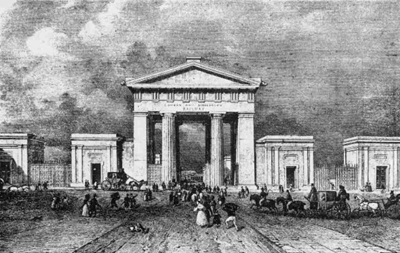
The original entrance to Euston Station, Euston Arch was not so much an arch as a colonnaded monumental gateway, formally known as a propylaeum, which resembled the entrance to a Greek temple.

Euston-ArchBuilt in 1837 (pictured here in 1851), it was designed by architect Philip Hardwick and inspired by the ancient architecture he had encountered on a trip to Europe – in particular the grand entrance to the Acropolis in Athens.

Commissioned by the London and Birmingham Railway as the grand entrance to the company’s new station then facing on to Euston Square (the site is now covered by the station structure), it was designed to complement the existing structure which had been built at the other end of the line in Curzon Street Station in Birmingham.

The building, which rose to a height of 21.5 metres and was built from Yorkshire-sourced sandstone, featured four columns behind which stood large iron gates. Rather controversial even when built, it led to an apparently unexciting courtyard lined with offices. There were lodges to either side.

While there had been a couple of proposals to relocate the arch – particularly after notice was given in 1960 that it would be demolished so the station could be rebuilt – none of the proposals came to fruition, and despite some intense last minute lobbying to preserve the arch by conservationists (among those lobbying were poet Sir John Betjeman and architectural scholar Sir Nikolaus Pevsner), demolition – viewed by some as an “architectural crime” – started in December 1961.

While sections of the arch was subsequently used as fill in the Prescott Channel in East London (numerous sections have since been recovered from the water), the main gates were saved and given to the National Railway Museum in York.

There has been talk of rebuilding the arch particularly since the formation of the Euston Arch Trust in 1994 (the patron of which is Michael Palin) with the aim of reusing some of the lost stonework. While rebuilding hasn’t yet eventuated, the proposed redevelopment of Euston Station in more recent years has given the project new impetus.

PICTURE: Wikipedia.

Dr Livingstone honoured; David Bowie at the V&A; Damian Lewis receives Freedom; pocket parks; and, try a new sport…

The President of Malawi, Joyce Banda, attending a wreath-laying ceremony at Westminster Abbey on Tuesday night to mark the bicentenary of the birth of Scottish missionary and explorer Dr David Livingstone. The ceremony took place at the grave of Dr Livingstone – his body was repatriated to London following his death in Zambia in 1873 from malaria and dysentery. The Very Reverand Dr John Hall, the Dean of Westminster, said the ceremony honored a “Scot of humble origins, but clear determination and courage”. “140 years after his death, he remains respected throughout these islands, and especially in Africa, where, for 30 years, he laboured to spread the Gospel, to explore the land’s secrets, and to map what he discovered,” he said. “Treating all people as his equals, he worked to abolish the slave trade in Africa.” Livingstone conducted several expeditions into the interior of Africa – while they included a failed attempt to find the source of the Nile, he is credited with documenting numerous geographical features including Victoria Falls (he named it after Queen Victoria) and Lake Malawi. Celebrated as a hero of the Victorian age, his meeting with Henry Stanley in October 1871 – Stanley had been sent to find him after he had lost contact with the outside world – gave rise to the expression “Dr Livingstone, I presume?” (though whether he actually said the phrase remains a matter of debate).

A landmark exhibition on the career of David Bowie opens at the V&A on Saturday. David Bowie is features more than 300 objects including handwritten lyrics, costumes, photographs, films, Bowie’s instruments and album artwork selected by the V&A’s theatre and performance curators, Victoria Broackes and Geoffrey Marsh. The exhibition takes an in-depth look at Bowie’s music and how it and his “radical individualism” has influenced and been influenced by wider movements in art, design and contemporary culture. Among the more than 60 costumes on display will be a Ziggy Stardust bodysuit (1972) and costumes made for the 1973 Aladdin Sane tour as well as some of Bowie’s own sketches, musical scores and diary entries. This exhibition, which is sponsored by Gucci and Sennheiser,  runs until 11th August. Admission charge applies. For more, see www.vam.ac.uk/davidbowieis.

Homeland star Damian Lewis has received the Freedom of the City of London in a ceremony at Guildhall on Tuesday in recognition of his “outstanding achievements in acting”. Lewis, who graduated from the City of London’s Guildhall School of Music & Drama in 1993, has appeared in The Forsyte Saga, US mini-series Band of Brothers and, of course, in Homeland. Interestingly, his maternal grandfather, Sir Ian Bowater, was Lord Mayor of the City of London from 1938 to 1939. For more, see www.cityoflondon.gov.au.

Work is underway on the first of the Mayor of London, Boris Johnson’s, “pocket parks”. The size of a tennis court, the pocket parks are set to “reinvent some of London’s forgotten nooks and crannies”. Among the first will be an edible park featuring vegetable, herbs, fruit trees and hops located on ‘dead space’ behind a Stockwell bus stop (the hops will be sold to the Brixton Beer Cooperative). All 100 of the pocket parks will be finished by March 2015 at a cost of £2 million. For more, see www.london.gov.uk/priorities/environment/greening-london/parks-green-spaces/pocket-parks.

It’s the chance to try a new sport for the first time in a day of free games and activities which will be held at the Queen Mother Sports Centre in Vauxhall Bridge Road on Saturday. From 10am to 3pm, visitors will be able to try a range of different sporting activities including football, basketball and swimming with athletes and coaches on hand to offer advice. For more, see www.westminster.gov.uk.

LondonLife – 14th century burial ground unearthed underneath Charterhouse Square…

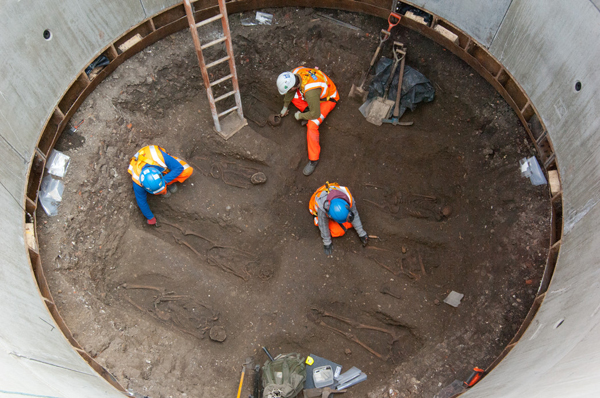
Crossrail---FarringdonA lost London burial ground has been unearthed in Farringdon by archaeologists working on the £14.8 million Crossrail project.

Thirteen adult skeletons, believed to be up to 660 years old, have been discovered lying in two rows 2.5 metres below the ground on the edge of Charterhouse Square.

It is likely based on the depth at which the bodies were buried and other evidence (including pottery found at the site and a similarity between the layout of the bones and those of 14th century plaque victims unearthed at the East Smithfield Burial Ground in the 1980s), that the skeletons were buried here in 1349 during the Black Death.

Historical records suggest that as many as 50,000 people may have been buried here in the three years from the burial ground’s opening in 1348. The burial ground remained in use until the 1500s but has never been located in modern times.

The skeletons are being excavated and taken to the Museum of London Archaeology for laboratory testing.

Crossrail Lead Archaeologist Jay Carver described the discovery as “highly significant”.

“We will be undertaking scientific tests on the skeletons over the coming months to establish their cause of death, whether they were Plague victims from the 14th Century or later London residents, how old they were and perhaps evidence of who they were,” he said.

“However, at this early stage, the depth of burials, the pottery found with the skeletons and the way the skeletons have been set out, all point towards this being part of the  14th century emergency burial ground.”

It is likely more remains will be found according to experts.

Archaeologists working on the Crossrail project have previously uncovered more than 300 burials at the New Cemetery near the site of the Bedlam Hospital at Liverpool Street from the 1500s to 1700s.

For more on Crossrail, see www.crossrail.co.uk.

London Pub Signs – The Lord Aberconway…

Located just off Liverpool Street in Old Broad Street in the City, The Lord Aberconway is named after the last chairman of the Metropolitan Railway Company, operator of the world’s first underground railway (keep an eye out for our extended piece on the history of the Underground later this week).

Lord-AberconwayCharles McLaren – Lord Aberconway – (1850-1934) was a landowner, industrialist and MP who was raised to the peerage in 1911, a year after he had left the House of Commons. He served as chairman of ‘The Met’ from 1904 to 1933.

While the current building – the interior of which features booths and an L-shaped bar – dates from the 19th century, there has been a pub on the site, close to Liverpool Street Station, for much longer and its previous names included the King and Keys and the Metropolitan Railway’s ‘Refreshment Room’ and ‘Railway Buffet’.

The pub, which stands not far from the Monument commemorating the Great Fire of London, is reputed to be haunted by victims of the fire (only four people are said to have officially died in the blaze but it’s believed the death toll would have actually been much higher). You’re more likely to see city traders there however.

The pub is now run by the Nicholson’s. For more on the Lord Aberconway, see www.nicholsonspubs.co.uk/thelordaberconwayliverpoolstreetlondon/.

Where is it?…#60…

Where-is-it--#60
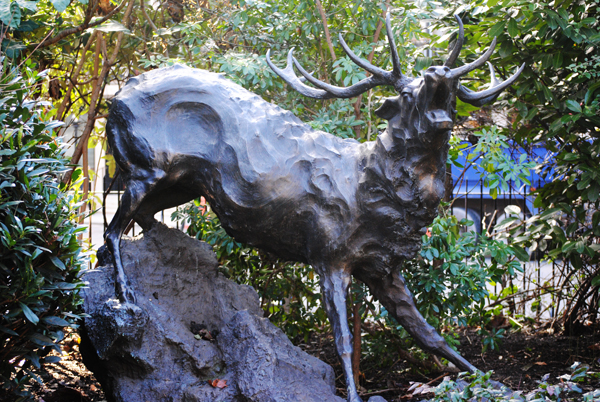
Can you identify where in London this picture was taken and what it’s of? If you think you can, leave a comment below. We’ll reveal the answer early next week. Good luck!

Well done to Jameson, this is indeed located in St James’s Square. Called – rather aptly – Stag, the sculpture dates from 2001 and is the work of Marcus Cornish. The larger-than-life bronze sculpture is located in the south-west corner of the West End square. For more on the work of Mr Cornish, see www.marcuscornish.com. Other statues in the square include an equestrian statue of King William III, the work of John Bacon Senior and Junior, which was installed in 1808.

Treasures of London – Siborne’s Large Model…

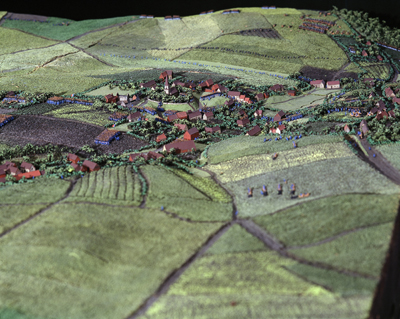
An amazing feat of model-making, Siborne’s Large Model is a painstakingly detailed model reconstruction of the Battle of Waterloo on display at the National Army Museum. Controversial even to this day, the story behind the model’s creation is an incredible tale of one man’s perseverance.

Siborne's-modelA career soldier, Captain William Siborne was commissioned in 1830 by Lord Rowland Hill, then Commander-in-Chief of the British Army, to construct a model of the Battle of Waterloo, fought between British and allied forces under the command of the Duke of Wellington and Prussian field marshal Gebhard von Blücher and French forces under the command of the Emperor Napoleon on 18th June, 1815.

Siborne, who hadn’t been present at the battle but had previously been involved in the construction of a model of the Battle of Borodino, extensively researched it before beginning work including spending eight months surveying the entire field where the battle took place and corresponding with hundreds of those who had fought there.

The model wasn’t completed until 1838, partly due to the fact that Siborne still had military duties to perform and also due to the fact that he ran out of funds and, when the authorities refused to pay up, ended up financing the project out of his own pocket (and then spent much time trying to recover the funds).

In his fascinating book, Wellington’s Smallest Victory: The Duke, the Model Maker and the Secret of Waterloo (well worth a read if you’re interested in learning more about the history of this amazing model), Peter Hofschroer writes in detail about the acrimonious relationship the Duke of Wellington developed with Siborne, thanks to a clash over the model’s depiction of the battle which shows the crisis point in the battle at 7pm – when the French Imperial Guard attacked Wellington’s centre – and has the Prussians helping to win the day.
The model was placed on public display in October 1838 at the Egyptian Hall in Piccadilly after which it went on tour around the UK. He went on to write up his research in a book on the battle, published in 1844, and it was while preparing this – in 1841 – that he announced he had changed his mind and would revise the model, eventually removing figures representing some 40,000 Prussians from the model and thus reducing the role they played at the decisive moment of the battle – a move which could only be seen as a win for Wellington.

It’s also worth mentioning that Siborne created a second, larger scale model of just part of the battlefield, exhibited in 1844 in London and later in Berlin (it’s now on display at the Royal Armouries Museum in Leeds). Siborne’s subsequent efforts to sell either model didn’t bear fruit before he died, said to have been a “broken man”, on 13th January, 1849.

After his death the large model was subsequently purchased by the United Service Museum and can now be found at the National Army Museum in Chelsea.

WHERE: National Army Museum, Royal Hospital Road, Chelsea (nearest Tube station is Sloane Square); WHEN: 10am to 5.30pm daily; COST: Free; WEBSITE: www.nam.ac.uk.

Around London – John Snow’s legacy; a spotlight on the music hall; Alice Kettle at the Queen’s House; and, Sydney Lee at the RA…

A new exhibition on the work and legacy of John Snow – who traced the source of a deadly cholera outbreak in the 1850s to a Soho water pump – opened at the London School of Hygiene and Tropical Medicine this week. Cartographies of Life & Death – John Snow and Disease Mapping – part of a series of events planned for the bicentenary of Snow’s birth – features both historical treasures, such as disease maps from the school’s archives, and new artworks inspired by science with the entire display presented as a disease mapping ‘detective trail’. There will be a pop-up water bar and street lectures and performances. Snow (1813-1858) is considered the founder of modern epidemiology, the study of patterns and causes of health and disease in populations. His work remain influential even today. Admission is free. The exhibition runs until 17th April at the school in Keppel Street. For more, see www.johnsnow.org.uk.

A new installation at the V&A opening on Saturday will explore the rise – and fall – of the music hall. Music Hall: Sickert and the Three Graces picks up on artist Walter Sickert’s obsession with the New Bedford Music Hall in Camden Town and features film, music and objects presented in a ‘theatrical narrative’ which focuses on the world of the Edwardian Music Hall. Highlights include filmed extracts of Tanika Gupta’s specially produced play The Boy I Love (directed by Katie Mitchell) which takes its name from George Ware’s celebrated music hall song The Boy I Love is Up in the Gallery. Admission is free. The exhibition, which is in the Theatre and Performance Galleries of the V&A, runs until 5th January next year. For more see www.vam.ac.uk.

Three specially commissioned artworks by British textile artist Alice Kettle will be unveiled today at the Queen’s House in Greenwich. The Garden of England – Royal Museums Greenwich’s first contemporary arts program – features Flower Helix (hanging in the Tulip Stairs), Flower Bed (a “textile garden” found in the North West Parlour), and Queen Henrietta Maria (a stitched portrait of the wife of King Charles I also found in the North West Parlour). The display is accompanied by a program of events – for more on them, see www.rmg.co.uk. Entry is free – the exhibition is on show until 18th August.

On Now – From the Shadows: The Prints of Sydney Lee RA. This exhibition at the Royal Academy represents a reappraisal of the work of painter-printmaker Sydney Lee (1866-1949) and features more than 50 prints and two major paintings. Lee studied in Manchester and Paris before coming to London where he lived in a house and studio in Holland Park Road in Kensington. He was elected a Royal Academician in 1930 and served as Treasurer from 1932-1940. The first exhibition devoted to his art since 1945, the event coincides with the publication of the first book on Lee written by its curator Professor Robert Meyrick, head of the School of Art at Aberystwyth University. Runs until 26th May. Admission charge applies. For more, see www.royalacademy.org.uk.

10 of London’s greatest Victorian projects – 8. London’s railways…

London’s railway network stands out as one of the greatest achievements of the Victorian age for it was during the 19th century that much of the railway infrastructure still in use today was first established.

St-PancrasThe first railway line in London opened in February 1836 (six years after the UK’s first line opened) and ran between Spa Road in Bermondsey and Deptford on the south bank of the River Thames. The line was extended to London Bridge in December that same year and again to Greenwich, from cross-Channel steamers left – in April the following year.

That same year – 1837 – the station at Euston opened as the final stop for trains from Birmingham (an earlier terminus as Chalk Farm was deemed too far out). It was followed by Paddington in 1838, Fenchurch Street – the first permanent terminus in the City – in 1841, Waterloo in 1848 and King’s Cross in 1850.

Having seen a boom period during the 1840s, development of new lines took a back seat in the 1850s but resumed apace the following decade with the opening of Victoria Station, connecting the city to Brighton and Dover. Stations followed at Charing Cross, Ludgate Hill and Cannon Street and alongside the grand terminus’ around the outskirts of London where trains arriving from distant destinations arrived, numerous smaller railways began to be built, such as the West End of London and Crystal Palace Railway and the Victoria Station and Pimlico Railway, which took passengers on only short journeys across the city (these smaller railway companies all disappeared by 1923 when the 1921 Railways Act resulted in the creation of what are known as the “Big Four” British railway companies).

And, of course, the London Underground, has its first journey in 1863 but we’ll look at that in more detail next week.

Interesting to note that there were three classes of rail travel and while first and second class passengers had seats, this wasn’t always the case in third class where, writes Michael Paterson in Inside Dickens’ London, passengers, such as those on the Greenwich line, were initially forced to stand in open topped carriages known by some as ‘standipedes’.

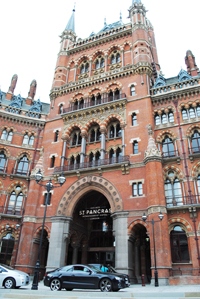
Naturally, with the building of the railways came some spectacular stations – among the most spectacular is the late Victorian building which stood at the front of St Pancras Railway Station and housed the Midland Grand Hotel (pictured above). An exemplar of the Gothic Victorian style, it was designed by Sir George Gilbert Scott and, following a massive recent refurbishment, is now home to the five star Renaissance London Hotel and apartments.

We can, of course, only touch on the history of the railways in such a brief article – but we will be looking in more detail at some more specific elements of the system in later posts.

LondonLife – Yuri Gagarin relocates to Greenwich…

Elena-Gagarina-and-Dr-Kevin-Fewster

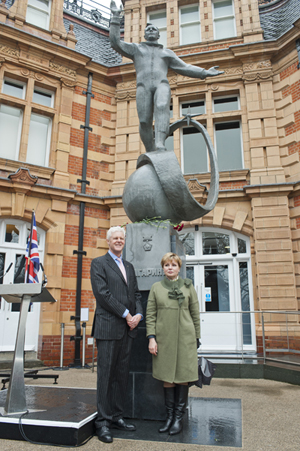
A statue of Russian cosmonaut and first man in space Yuri Gagarin has been relocated to the newly named Yuri Gagarin Terrace outside the Royal Observatory in Greenwich. First unveiled in The Mall, not far from Admiralty Arch, on 14th July 2011, the statue was a gift from the Russian federal space agency, Roscosmos, to mark the 50th anniversary of manned space flight (you can read more at our earlier post here). But it was only granted permission to remain on the site for 15 months and so has now been relocated to Greenwich where it as officially unveiled last Thursday in the week of Gagarin’s birthday by his daughter Elena Gagarina (pictured here with Royal Museums Greenwich director Dr Kevin Fewster). The statue – a 3.5 metre high zinc alloy figure – shows Gagarin dressed in a spacesuit and standing on a globe. It stands just outside the observatory’s Astronomy Centre. For more on the Royal Observatory Greenwich – the “home” of Greenwich Mean Time, see www.rmg.co.uk.

Where’s London’s Oldest…wine bar?

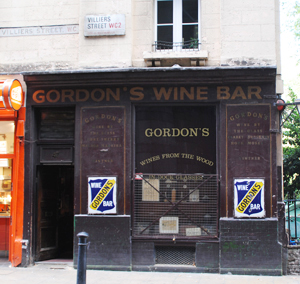
The honour of being London’s oldest winebar goes to Gordon’s Wine Bar at 47 Villiers Street in the West End (just up from Embankment Tube Station or down from Charing Cross Station, whichever you prefer).

Gordon's-Wine-BarThe venerable establishment – still a favoured place to stop for a drink for many Londoners – opened its doors in the 1890s and still conveys a powerful sense of old world charm with the decor pretty much unchanged (there’s been no fancy makeover here) and the wine still served from wooden casks behind the bar.

The site on which the bar is located was once occupied by York House (home to, among others during its centuries of life, Robert Devereaux – 2nd Earl of Essex and favourite of Queen Elizabeth I and Sir Francis Bacon – Lord Chancellor during the reign of King James I) and then, later on, by a large house lived in by diarist Samuel Pepys in the late 1600s before, thanks to its position close to the river, a building was built upon it in the 1790s which served as a warehouse.

The usefulness of the warehouse came to an end when Victoria Embankment was built and the river pushed back and the building was subsequently used for accommodation. Writer Rudyard Kipling was among tenants who lived here (from 1889-1891 during which wrote The Light that Failed – in fact, the building was renamed after him, Kipling House, in 1950.

It was Angus Gordon, a “free vintner” meaning he didn’t have to apply for a licence thanks to the largesse of King Edward III in 1364, who established the premises in the vaults here in the 1890s (interestingly the current owners are also Gordons, but not related). Among the other uses of the building, of which Gordon’s only occupies a part, was apparently as a brothel in the 1920s.

For more on Gordon’s head to www.gordonswinebar.com.

Lost London – The Cockpit at Whitehall…

Once part of the Palace of Whitehall, the Cockpit (also referred to as Cockpit-in-Court or the Royal Cockpit) was initially built as a pit in which to watch cockfighting as part of renovations carried out by King Henry VIII after he “acquired” Cardinal Wolsey’s former property of York Place and before transforming it into a royal palace.

It was one of a number of entertainment related buildings constructed by the king in the new palace precinct – others included a real tennis court, bowling alley and a tiltyard.

By Jacobean times, the use of the octagonal-shaped cockpit – located between today’s Downing Street and Horse Guards Parade – had changed into that of a private royal theatre and in 1629 Inigo Jones was given the task of redesigning it to accommodate King Charles I’s elaborate court masques (Jones had previously redesigned the Cockpit Theatre in Drury Lane).

Following the Restoration in 1660, the Cockpit again returned to its use as a theatre and King Charles II had new dressing rooms added and the decor given an overhaul (the ever-present diarist Samuel Pepys was among those who attended theatrical presentations during this period and Ben Jonson among those whose work was presented here).

The theatre building is believed to have been demolished around 1675 and the site subsequently used to house government officials including those of the Foreign Office (see our earlier post here) and Privy Council.

In the 1730s, William Kent designed the building (which although since expanded and modified) now stands on the site and is currently the home of the Cabinet Office.

While the Cockpit is long gone, its name lives on in ‘Cockpit Passage’ – a gallery inside the Cabinet Office from where one could once watch tennis being played.

Around London – Royal Court treasures at V&A; Sir Michael Caine celebrated; a tunic with a past; and, George Catlin’s American Indian portraits…

Water_potA new exhibition opens at the V&A in South Kensington this Saturday which charts the development of cultural trade and diplomacy between Britain and Russia from the founding of the Muscovy Company in 1555 until the end of King Charles II’s reign in 1685. Treasures of the Royal Courts: Tudors, Stuarts and the Russian Tsars reveals the “majesty and pageantry” of the royal courts of both countries – from that of King Henry VIII to King Charles II in Britain and from that of Ivan the Terrible (Ivan IV) to the early Romanovs in Russia. The display features more than 150 objects including heraldry and processional armour,  furnishings, clothing, jewellery and portraiture including paintings and miniatures painted by court artists. Highlights include a rarely viewed portrait of Queen Elizabeth I, the Barbor Jewel – a pendant set with an onyx cameo of the queen; a hand-colored map of ‘Muscovy’ dating from 1570, and literature including Shakespeare’s First Folio as well as a showcase of British and French silver given to the Tsars by British merchants and kept in the Kremlin. The 20 pieces include the Dolphin Basin, made by Christiaen van Vianen – said to be a favoured silversmith of King Charles I and II – in 1635. The exhibition marks the 400th anniversary of the Romanov dynasty. Admission charge applies. Runs from Saturday, 9th March, until 14th July. For more, see www.vam.ac.uk. PICTURE: Water pot (1604-05), Historic collectino of the Armoury, © The Moscow Kremlin Museums.

The life and work of Sir Michael Caine – who turns 80 this month – is the focus of a new free exhibition at the Museum of London. Michael Caine, which opens tomorrow, features photographs including some never exhibited before as well as iconic portraits by the likes of David Bailey and Terry O’Neill as well as a selection of audio and film clips from movies such as Alfie, The Italian Job, Get Carter, Hannah and Her Sisters and Educating Rita. The exhibition follows Sir Michael’s life from “Cockney rebel, through to Hollywood legend and inspirational Londoner” and looks at how the city influenced his life and career. Runs until 14th July. To coincide with the exhibition, the Museum of London Docklands is running Caine on Screen, a selection of free films which can been voted for by the public (see our earlier post here). The schedule of films will be announced after 14th March. For voting details and more information, see www.museumoflondon.org.uk.

A bullet-pierced military tunic worn during the Indian Mutiny in the mid 19th century has been donated to the National Army Museum in Chelsea. The tunic, worn by Lieutenant Campbell Clark, of the 2nd Bengal European Fusiliers, at Cawnpore in 1857. The lieutenant was ambushed by rebels Indian infantry and shot at point-blank range. Despite being grievously wounded (the musket ball had passed through his stomach and remained in the wound), he survived the injury and the military hospital he was taken to and went on to have a long career, rising to the rank of colonel. He died in 1896 in Sussex. The tunic was donated to the museum by Clark’s great-great-nephew, John Gordon Clark. For more, see www.nam.ac.uk.

On Now: George Catlin: American Indian Portraits. Opening today, this exhibition at the National Portrait Gallery is the first major exhibition of the American artist’s works to be held in Europe since the 1840s and has been designed to demonstrate to the viewer how Catlin constructed a particular view of Native Americans in the minds of his audiences. Catlin made five trips into the western United States in the 1830s before the Native American peoples had been subsumed into the United States and, inspired by those trips, went on to create an Indian Gallery which featured 500 portraits, pictures and indigenous artefacts. He subsequently toured with the gallery in both the US and Europe. The exhibition is organised in collaboration with the Smithsonian American Art Museum in Washington. Runs until 23rd June. Admission charge applies. For more, see www.npg.org.uk.

10 of London’s greatest Victorian projects – 7. Foreign and Commonwealth Office, Whitehall…

We’ve previously mentioned the home of the British Government – the Houses of Parliament – in this series but this week we’re looking at another government building – a gem of 19th century architecture.

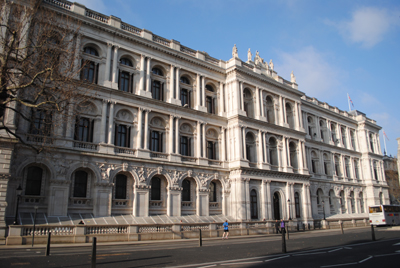
FCOIn existence since 1782, the Foreign Office had originally been housed in two houses in St James and then, as the department grew, to properties in Whitehall – first in The Cockpit (this building has an interesting history we’ll look at in a later post) and then in Downing Street. Initially lodged in what had been Lord Sheffield’s house in Downing Street, the department soon spilled over into neighbouring properties.

The deteriorating quality of these abodes, however, was such that there were fears for their collapse and plans to build a new Foreign Office were mooted. But it wasn’t until the 1850s that it was decided the government announced plans for a competition to design new Foreign and War Offices on Downing Street. There was something of a heated debate over the style of the building between those favouring classical and those favouring gothic architecture but in 1858 George Gilbert Scott (knighted in 1872) was finally appointed as architect.

While Scott apparently originally favoured a building in the gothic style, this was opposed by then Prime Minister Lord Palmerston whose preferences for a classical building eventually won the day.

Work on the new building began in the early 1860s and it eventually opened in July, 1868. While the War Office was never constructed, other departments were located in adjoining premises within the same block. These included the India Office – while Scott oversaw the exterior design, the interior was designed by Matthew Digby Wyatt, surveyor of the former East India Company and subsequently Architect to the Council of India. It opened in November 1867 but was taken over by the Foreign Office in 1947 following India’s independence – and the Colonial and Home offices – designed by Scott, these were completed by 1875.

Plans to build a new Foreign Office were mooted in the mid-20th century and there was talk of demolishing the existing building but after a public debate, Scott’s building was protected after being given Grade I listed building status.

In 1968, the Foreign and Commonwealth Office merged (the latter had only been created two years before) and the Home Office moved out of its premises, meaning that the Foreign and Commonwealth Office now occupied all four original departmental premises. A modernisation program subsequently took place and there was also a significant restoration program which was completed by January 1997.

Stand out rooms in the complex include the grand Locarno Suite – three interlinked rooms designed by Scott to host dinners, receptions and conferences which gained its current moniker in 1925 when  the Locarno Treaties were signed here; as well as the India Office Council Chamber – designed by Wyatt, it features a great marble chimney taken from the former Director’s Court Room in East India House located in Leadenhall Street in the City; and, Wyatt’s spectacular Durbar Court which features a glazed cast-iron roof added in 1868 (the name dates from 1902 when some of coronation celebrations of King Edward VII were held here). The many grand staircases in the building – including the beautiful Muses Stair with its octagonal lantern – are also worth noting.

While the buildings, which are officially entered off King Charles Street, are not usually open to the public, they have been opened for the past few years during London’s Open House weekend. There is an audio tour available which details much of the fine artwork in the building.

LondonLife – Paper protestors fill Parliament Square…

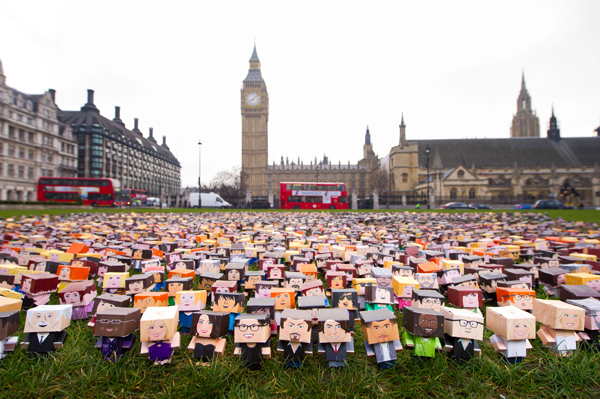
mc_fairtrade_004Jonathan Ross, Eddie Izzard, Amanda Holden, Tulisa and Gok Wan were among the thousands of people represented by paper protestors in Parliament Square, outside the Houses of Parliament, on Monday. The Fairtrade-backed protest marked the second week of ‘Fairtrade Fortnight’ and was aimed at sending a message to Prime Minister David Cameron to “do more to protect smallholder farmers from trade injustice”. More than 8,000 people have signed the online petition so far, creating a personalised “mini marcher” via Fairtrade’s partnership with Foldable.me. The final petition will be delivered to the PM on World Fair Trade Day in May ahead of the June meeting of the G8. For more on the Fairtrade Foundation, see www.fairtrade.org.uk.

Famous Londoners – Jane Austen…

It’s probably a bit of a stretch to call Jane Austen a ‘famous Londoner’ (although the city does make a fairly regular appearance in her books) but she did have some strong associations. Given the 200th anniversary of Pride and Prejudice earlier this year, we thought it was only fitting to take a quick look at a five places associated with the author in London…

10 Henrietta Street, Covent Garden: Austen stayed in a flat here during the summer of 1813 and during March 1814. The premises was the home of her older brother Henry, then a banker, who moved here after the death of his wife Eliza. While here, Austen visited theatres including The Lyceum and The Theatre Royal, Drury Lane. The building is now occupied by offices.

23 Hans Place, Belgravia: The home of her brother Henry (after he moved from Covent Garden), Austen lived for two years in a house here in 1814-15 and is said to have particularly enjoyed the garden. The current building on the site apparently dates from later in the 19th century. There’s a blue plaque located on the house.

50 Albemarle Street, Mayfair: The former office of publishers John Murray who counted Austen among their first clients were located here.

Westminster Abbey: Austen is not buried here but in Winchester Cathedral. However, you will find a small memorial to her in Poet’s Corner, put here in 1967. It simply reads ‘Jane Austen 1775-1817’.

The British Library, St PancrasAusten’s rather tiny writing desk can be found here, usually on display in the Sir John Ritblat Gallery. It was donated to the library in 1999 by her Canadian descendents.

Where is it?…#59

Where-is-it--#59

Can you identify where in London this picture was taken and what it’s of? If you think you can, leave a comment below. We’ll reveal the answer early next week. Good luck!

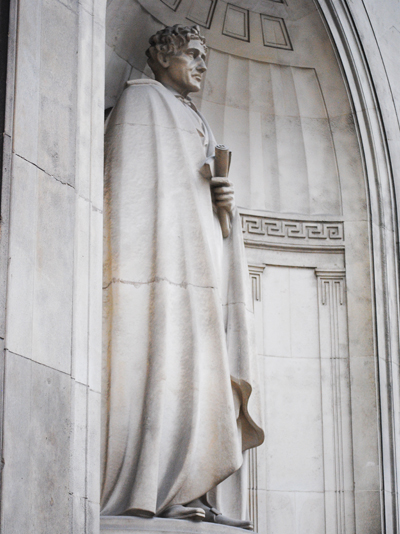
Well done to Carol and Jameson, this statue is indeed located on the north-western corner of the Bank of England (the corner of Lothbury and Prince’s Street) and is indeed a depiction of architect Sir John Soane (1753-1837), noted for his work on the Bank of England (the bank’s design was substantially later reworked by Sir Herbert Baker in the 1920s-1930s (for more on Soane and his work, see our earlier posts here and here). The statue, by William Dick Reid, was unveiled in 1937.

Treasures of London – K2 telephone kiosk at the Design Museum…

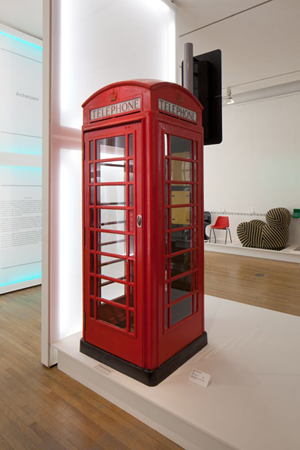
This version of the iconic British ‘institution’ – the red phone box – was designed by architect Sir Giles Gilbert Scott in 1924 (you may know him as the designer of the Battersea Power Station).

K2-KioskFormally known as the K2 telephone kiosk, Scott’s design was selected after a competition organised by the Royal Fine Art Commission (there’s a wooden prototype of Scott’s K2 located under the entrance to the Royal Academy of Arts in Piccadilly – the location where it was originally positioned).

The design featured a classical-looking dome (said to have been influenced by the work of architect Sir John Soane) which featured the royal crest of King George V (done in perforation, so it also provided ventilation). The phone box was made in cast iron and painted red (Scott had apparently suggested silver). From 1926 onwards, around 1,700 of the K2s – which weighed more than a ton – were deployed around London (very few were ever erected outside the city).

The surviving K2s – there are said to be slightly more than 200 – are now listed buildings.

The telephone box is a part of the Design Museum’s permanent collection which is currently held in two locations but from 2015 will be housed in a new purpose-built museum in High Street Kensington.

The box, which will be displayed on the museum’s top floor which will be dedicated to the display of 20th century artefacts, is currently featured in a special exhibition, Design Museum Collection: Extraordinary Stories About Ordinary Things, which runs at the museum’s current premises until January, 2015.

To further explore the Design Museum’s collection, you can download a free Design Museum Collection App for iPad app via iTunes.

WHERE: Design Museum, 28 Shad Thames (nearest Tube stations are London Bridge and Tower Bridge); WHEN: 10am to 5.45pm daily (last admission 5.15pm); COST: £11.85 adults/£10.70 concessions/£7.50 students (children under 12 are free); WEBSITE: www.designmuseum.org

Around London – Aliens at the Royal Observatory; celebrating spring at the British Library; Blue Plaques for Heal and Mendelssohn; and, Barocci at the National Gallery…

It’s alien season at the Royal Observatory in Greenwich and to kick off a series of special events around all things extra-terrestrial, a new exhibition looking the history with things not of this earth opens tomorrow. Alien Revolution, which looks at man’s obsession with intelligent alien life – a trend which began in the century following Copernicus’ discovery that the earth was a planet and the sun a star, will be held in the observatory’s Astronomy Centre until August. Runs until 8th September. Admission is free. Other events include shorts courses looking at science fiction and astronomy, family events and special planetarium shows such as We Are Aliens which runs in April. For more on the events, see www.rmg.co.uk.

The British Library’s Spring Festival kicks off tomorrow with five days of film, design and fashion including the unveiling of a new artwork by fashion illustrator and artist Julie Verhoeven. Verhoeven – who has worked for fashion houses Louis Vuitton, Versace and Mulberry – will be joined by Dylan Jones, editor-in-chief of GQ, to talk about what inspires them while others among fashion’s leading names will be contributing postcards in a one night only pop-up exhibition – Late at the Library: Fashion Flashback – which will also feature talks involving Jones and illustrator Tanya Ling. The event also features a spring market held in the library’s piazza at which designers will be selling wares inspired by the library’s collection. Other events include the showing of a series of short films.  For more about the Spring Festival events, head to www.bl.uk/whatson/exhibitions/spring-festival-2013/index.html.

Furniture designer Sir Ambrose Heal was honoured with the unveiling of an English Heritage Blue Plaque at his former home in Pinner yesterday – the date marking 120 years since he joined the family firm, Heal’s. The house – at Fives Court, Moss Lane in Pinner – was Sir Ambrose’s home from 1901-1917 during the period when he began exerting his influence over the business, having won a silver medal at the 1900 Paris Exhibition for a bedroom suite. Heal was knighted in 1933 and appointed a royal designer for industry in 1939. Meanwhile, a Blue Plaque for 19th century composer Felix Mendelssohn was unveiled at 4 Hobart Place earlier this month, commemorating the house he stayed in at the height of his career during his numerous visits to London. The house was the home of the Hanoverian embassy secretary, Karl Klingemann, at the time. For more on Blue Plaques, see www.english-heritage.org.uk.

On Now: Barocci – Brilliance and Grace. This landmark exhibition at the National Gallery is the first major monographic exhibition dedicated to the art of 16th and 17th century Italian artist Frederico Barocci – pioneer of the Baroque style. Highlights include his spectacular altarpiece, The Entombment of Christ, from the coastal town of Senigallia, the Last Supper – painted for Urbino Cathedral, as well as two altar pieces from Rome – Visitation from the Chiesa Nuova and Institution of the Eucharist from Santa Maria sopra Minerva. Also included are portraits, smaller devotional paintings, Aeneas’ Flight From Troy – his only secular narrative, and more than 65 preparatory drawings, pastel studies and oil sketches. Runs until 19th May. Admission charge applies. For more, see www.nationalgallery.org.

10 of London’s greatest Victorian projects – 6. Victoria and Albert Embankments…

We’ve already mentioned these two riverside embankments as part of our previous piece on Sir Joseph Bazalgette’s revolutionary sewer system. But so important are they to the shape of central London today – not to mention a great place to take a stroll – that we thought they’re also worth a mention in their own right.

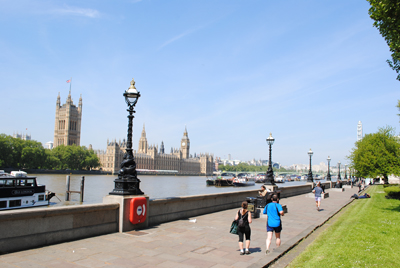
Albert-EmbankmentAs mentioned, the Victoria and Albert Embankments (the latter is pictured right) – named, of course, for Queen Victoria and her by then late consort, Prince Albert, who had died in 1861 (see our previous post What’s in a name?…Victoria Embankment) – were located on opposite sides of the River Thames and involved reclaiming a considerable amount of the river so new sewers could be laid.

Construction of Victoria Embankment – which was also seen as a way to relieve traffic congestion in the central London area – started in the mid 1860s and was complete by 1870. Running along the north and western banks of the Thames between Westminster and Blackfriars bridges, its creation involved the demolition of many riverside buildings as a new walk and roadway were constructed behind a wall.

Numerous monuments have since been located along this promenade – they include the Battle of Britain Monument, RAF Memorial and the mis-named Cleopatra’s Needle (see our earlier post to find out why) – as well as a number of permanently berthed ships including the HQS Wellington – the base of the Honorable Company of Master Mariners – and the HMS President.

The walkway also features original decorative lamps – interestingly, Victoria Embankment was the first roadway in London to be permanently lit  by electric-powered lighting (from 1878).

The parks, collectively known as Victoria Embankment Gardens, contain numerous statues and monuments (including one to Bazalgette himself – it’s located close to the intersection with Northumberland Avenue) as well as a bandstand. They also contain the remains of York Watergate – once fronting on to the river, it shows how much land was reclaimed for the project (you can also visit the riverside entrance to Somerset House to gain a feel for where the river once was – look through the glass floor and you’ll see the old riverbank below).

Albert Embankment, meanwhile, runs between Vauxhall and Westminster Bridges on the eastern side of the river. Constructed around the same time as Victoria Embankment, it was designed to prevent flooding of the low-lying areas of Vauxhall and Kennington and to help in Bazalgette’s sewage system plan (although it apparently doesn’t have the same large sewers as can be found on the other side of the river).

Sadly, the demolition did see the centre of what was once the village of Lambeth removed to make way for the new promenade and roadway. But like Victoria Embankment, Albert Embankment features delightfully decorative lamps along the riverfront promenade and is a great place for a walk in any weather.