The next two entries in Exploring London’s 100 most popular posts countdown…
58. Celebrating the Diamond Jubilee with 10 royal London locations – 5. Buckingham Palace…
57. Treasures of London – Peter Pan statue, Kensington Gardens
The next two entries in Exploring London’s 100 most popular posts countdown…
58. Celebrating the Diamond Jubilee with 10 royal London locations – 5. Buckingham Palace…
57. Treasures of London – Peter Pan statue, Kensington Gardens
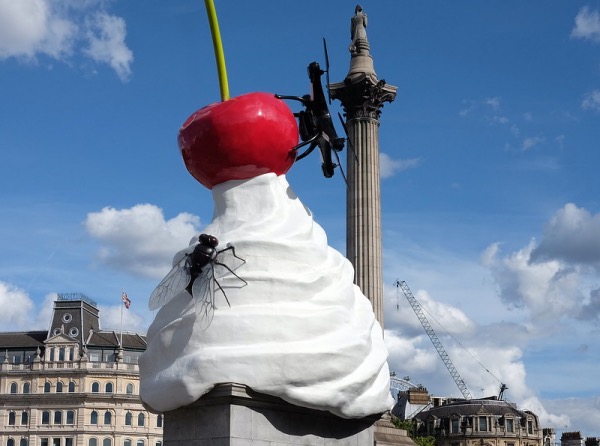
The 13th sculpture to occupy Trafalgar Square’s famous Fourth Plinth is a nine tonne, 9.4 metre high swirl of cream topped with a cherry. Unveiled in late July, THE END is the work of Heather Phillipson and also features a giant fly as well as a drone that transmits a live feed of Trafalgar Square to a specially created website, www.theend.today. The sculpture, which plays on the idea of the square as a site of celebration and protest, replaced Michael Rakowitz’s The Invisible Enemy Should Not Exist and both Phillipson and Rakowitz were selected by the Fourth Plinth Commission Group in 2017 following an exhibition at the National Gallery where 10,000 people voted for their favourite shortlisted artwork. PICTURE: astonishme (licensed under CC BY 2.0)
OK, so we’re not absolutely certain which street is the oldest in London to have introduced a number system. But one contender – according to The Postal Museum at least – is Prescot Street in Whitechapel.
That comes from a mention, in 1708, when topographer Edward Hatton made a special note of the street’s use of numbers instead of signs in his New View of London, in a rather clear indication that the use of numbers was still at that stage rather unusual.
The following century saw the numbering of properties become more common. Some suggest that the banning of hanging signboards (under an 1762 Act of Parliament) and the subsequent requirement that names to be fixed to all thoroughfares (under the Postage Act of 1765) both played a significant role in encouraging the use of house numbers.
Interestingly, not all numbering schemes are the same. The first schemes introduced in London involved numbering houses consecutively along one side of the street – this can still be seen in streets like Pall Mall and Downing Street, where Number 10 – official residence of the Prime Minister, is located next to number 11 – official residence of the Chancellor of the Exchequer.
The system used in more modern times, typically, involves numbering one side of the road with odd numbers (usually the left with the lowest number closest to the city or town centre) and the other with even.
But it’s fair to say that the numbering of houses was, initially at least, rather haphazard and it wasn’t until the passing of the Metropolitan Management Act that the numbering of properties become more standardised with the then new Board of Works given the power to regulate street numbers.
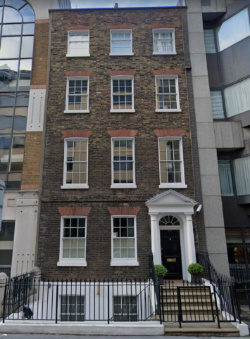
PICTURED: Number 23 Prescot Street, said to be the street’s single 18th century survivor.
The next two entries in Exploring London’s 100 most popular posts countdown…
60. 10 (more) curious London memorials…3. William Wallace Memorial…
Newly awarded upgraded heritage status, Ropers Garden in Cheyne Walk, Chelsea, was created in the wake of World War II.
The buildings which had formerly stood here were destroyed on 17th April, 1941, thanks to a parachute mine.
 The first gardens were planted on the site by the Chelsea Society but these were then redesigned by Peter Shepheard in 1960.
Shepheard used the basements of the terraced housing previously on the site to create a sunken garden, maintaining a link with the history of the site and reducing the noise of traffic from nearby Chelsea Embankment.
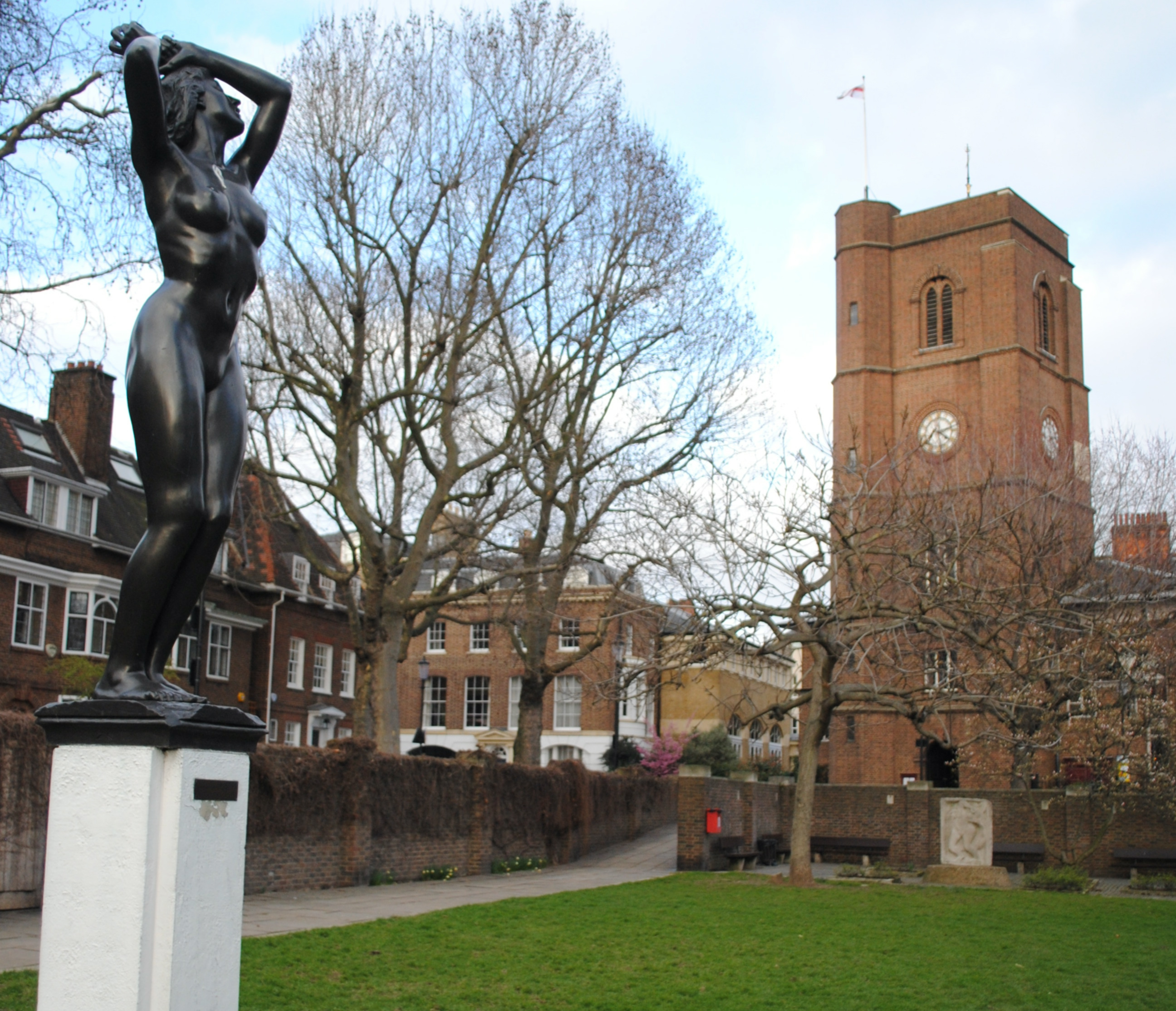
The centrepiece of the now Grade II-listed gardens – which were recently added to the Register of Parks and Gardens – is a sculpture called “The Awakening”. The work of Gilbert Ledward, who lived and worked in the area, it depicts a bronze standing nude figure of a woman (apparently modelled on the artist’s wife and cast in the 1920s).
The sculpture (pictured at the top with Chelsea Old Church in the background) was recently added to the garden’s Grade II listing.
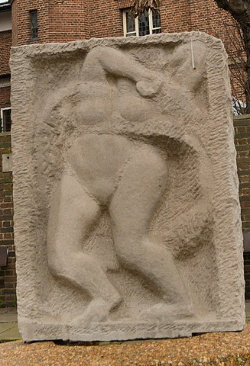
Other features of the garden include an unfinished stone relief by Jacob Epstein (pictured, right) who had a studio nearby in the early 20th century (the sculpture was unveiled in 1970) and a cherry tree which commemorates Gunji Koizumi the father of British Judo (1885-1965).
And the garden’s name? That comes from the history of the land on which it lies – once an orchard and part of the marriage gift of Sir Thomas More to his daughter Margaret and son-in-law William Roper in 1521.
PICTURES: Top – David Adams; Right – Andy Scott (licensed under CC BY-SA 4.0)
• The National Maritime Museum in Greenwich opens its doors this Monday, 7th September. Those who visit in the first week will be able to see all the winning images in the ‘Insight Investment Astronomy Photographer of the Year’ competition.Entry is free but tickets must be booked in advance. For more, see www.rmg.co.uk/national-maritime-museum.
• Other reopenings include the London Transport Museum in Covent Garden which also throws back its doors on Monday. Along with displays including historic vehicles and iconic posters, the reopening includes the ‘Hidden London’ exhibition revealing London’s ‘abandoned’ Underground stations. Tickets must be booked in advance. Admission charges apply. For more, see www.ltmuseum.co.uk.
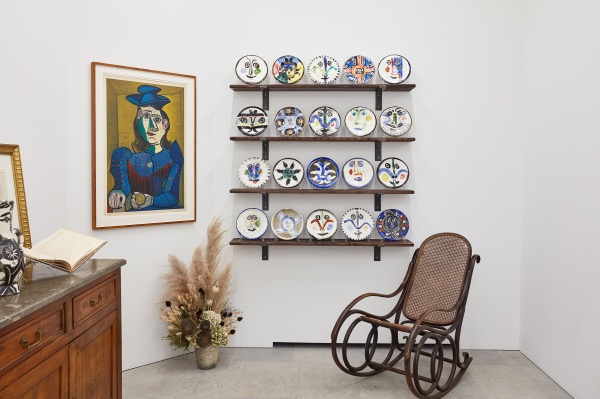
• Picasso’s Cannes’ studio has been recreated in an immersive experience at the BASTIAN gallery in Mayfair. Atelier Picasso is an installation-style exhibition and features furniture, sculptures, ceramics, drawings and prints. Highlights include portraits of the artist taken by his friend André Villers, ceramic works such as Wood Owl (1969) and Carreau Visage d’Homme (1965), lithograph and linocut posters and books including Gallieri Jorgen Expose Le Lithographies de L’atelier Mourlot (1984), and the masterpiece Minotaure caressing une dormeuse from the artist’s Vollard Suite. Admission is free. For more, see www.bastian-gallery.com. PICTURE: Courtesy of Luke Andrew Walker.
Send all items for inclusion to exploringlondon@gmail.com.
We’ve reached the end of our series on disease-related memorials in London. But, before we jump into the next Wednesday series, here’s a recap…
2. Commemorating the monks who died in the Black Death…
3. The Lambeth cholera epidemic memorial…
8. Former site of the Hospital for Tropical Diseases…

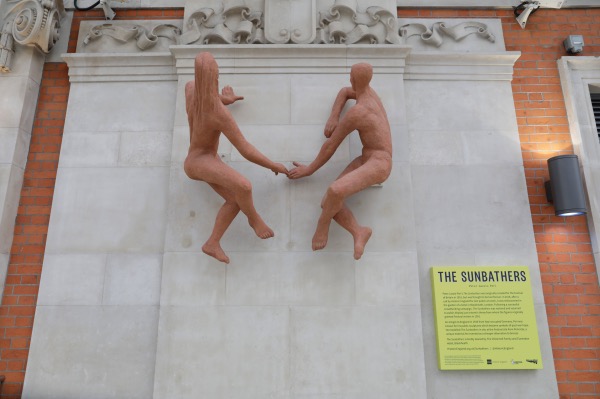
A sculpture created for the 1951 Festival of Britain has returned to Waterloo Station where it was first displayed almost 70 years ago. The work of Hungarian-born artist Peter Laszlo Peri, The Sunbathers features two figures – made from ‘Pericrete’, a special kind of concrete created by the artist as a cheaper alternative to casting in bronze – and was mounted on the wall close to the station’s entrance. It was presumed lost until it was rediscovered in 2016 at the Clarendon Hotel in Blackheath and, following restoration, was put on show in 2017 in the Southbank Centre’s Royal Festival Hall. Now, thanks to the efforts of Historic England and Network Rail, the sculptures have returned to the station, close to its original site, and will stay there for five years. PICTURES: Courtesy of Network Rail
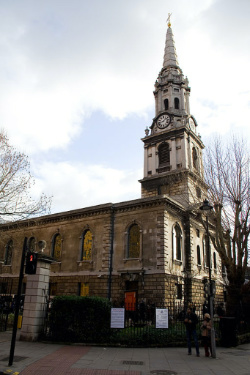
Partly located on a site now occupied by the church of St Giles-in-the-Fields in central London was a leprosy hospital founded by Queen Matilda, wife of King Henry I, in 1101.
The site was located outside the City walls making it ideal for such an establishment (given lepers had to isolate from the rest of the population) and the hospital, one of the first such establishments in England, was dedicated to St Giles, the patron saint of outcasts.
 As well as an oratory or chapel, the hospital, initially founded on eight acres of farmland, is believed to have included houses for lepers, a master’s house, and quarters for a chaplain, clerk and servant. A chapter house was added in the early 14th century.
The hospital was under the care of the crown and in 1299, King Edward I ordered that the hospital be run by and its revenues given to the military Order of St Lazarus of Jerusalem (also known as the Leper Brothers of Jerusalem or Lazarists).
By the 15th century leprosy (now known as Hansen’s disease) was on the decline in England but this hospital continued to be used for lepers until at least 1500 after which it is recorded that it had opened it doors to the poor who needed care.
In 1539, the hospital was closed under King Henry VIII’s Dissolution of the monasteries. While the chapel remained in use as a parish church (it was at this time that “in-the-fields” was added to the church’s name), the hospital’s other buildings were given by King Henry VIII to John Dudley, Lord Lisle (and later Duke of Northumberland and Protector of Edward VI, the king’s eventual heir).
The church, meanwhile, had fallen into a poor state of repair by the early 1600s and was demolished. Construction of a Gothic replacement started in 1623 in a project largely funded by Alice, Duchess Dudley, daughter-in-law of Queen Elizabeth I’s favourite Robert Dudley. The new church was consecrated by William Laud, Bishop of London in 1631. The current building dates from 1733 (but more about that at another time).
PICTURE: The church of St Giles-in-the-Fields as it appears now. (Prioryman/licensed under CC BY-SA 2.0)

• The launch of a new exhibition looking at Hebrew manuscripts marks the next phase of the British Library reopening. Hebrew Manuscripts: Journeys of the Written Word explores the history, culture and traditions of the Jewish people around the world and features rarely seen treasures including a letter to King Henry VIII written by an Italian rabbi in 1530 regarding Biblical laws that could support Henry VIII’s claim to annul his marriage to Catherine of Aragon as well as the earliest dated copy – 1380 – of Moses Maimonides’ Guide for the Perplexed, a rare uncensored copy of the Babylonian Talmud dating from the 13th century, and a 15th century illustrated copy of Abraham bar Hiyya’s Shape of the Earth, one of the first Jewish scientific works written in the Hebrew language. Also reopening is the library’s free permanent gallery – the Sir John Ritblat Gallery: Treasures of the British Library – with a new one-way route taking in treasures including Leonardo da Vinci’s sketchbooks and handwritten manuscripts by the Brontë sisters, Virginia Woolf and Sylvia Plath. For more on the exhibition and the library’s reopening, see www.bl.uk. PICTURE: David Jensen.
• The British Museum reopens to visitors from today after the longest closure in its 261 year history. Tickets must be pre-booked online or over the phone and visitors will be able to access the ground floor galleries through a new one-way route. The museum has also announced that Grayson Perry’s work, The Tomb of the Unknown Craftsman – an elaborate, cast-iron coffin-ship originally created for his British Museum exhibition of the same name in 2011 – is returning to the museum. For more, see www.britishmuseum.org.
• A “celestial choir of spinning sound machines” can be seen at the Old Royal Naval College in Greenwich this weekend. Positioned in Lower Grand Square, Chorus is the monumental work of award-winning artist and British Composer of the Year Ray Lee. It features a series of giant metal tripods supporting rotating arms, at the end of which are loudspeakers which emit finely turned musical pitches. It can be viewed from Friday through to Monday. Meanwhile, the Painted Hall is hosting Luke Jerram’s artwork Gaia which features NASA imagery in creating a virtual, 3D small scale Earth. Gaia can be seen from tomorrow until 6th September (admission charge applies). For more, see www.ornc.org.
Send all items for inclusion to exploringlondon@gmail.com.
Thomas Hodgkin was a physician, pathologist and reformer whose name is now associated with Hodgkin lymphoma, a malignant disease of lymph tissue.
 Born in Pentonville in what is now central London, Hodgkin (1798-1866), who trained at St Thomas’s and Guy’s Medical School and the University of Edinburgh, went on to work at Guy’s – where he built up a reputation as a pathologist – and later heading teaching staff at St Thomas’s (after it had split from Guy’s).
He first described the disease that bears his name in a paper in 1832 but it wasn’t until 33 years later, thanks to the rediscovery of the disease by Samuel Wilks, that it was named for him.
A Quaker, Hodgkin was also involved in the movement to abolish slavery and also raised concerns about the impact of the West on Indigenous culture. He died while on a trip to Palestine in 1866 and is buried in Jaffa.
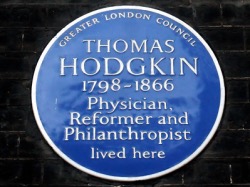
Hodgkin is commemorated with an English Heritage Blue Plaque on his former home at 35 Bedford Square in Bloomsbury. Interestingly the house also bears a plaque to another giant of the medical field – Thomas Wakley, the founder of The Lancet.
The plaque commemorating Hodgkin was erected by the Greater London Council in 1985.
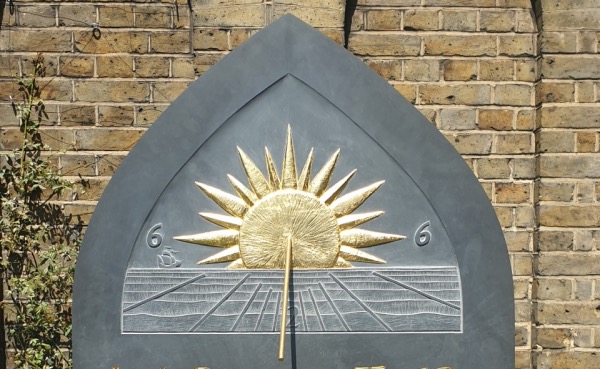
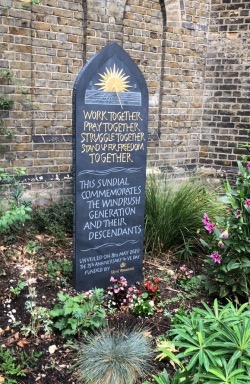 A new sundial and garden have been unveiled in Kensal Green commemorating the Windrush generation. The sundial, the work of carver Martin Cook, is located at St John The Evangelist Church which, according to its vicar, Rev David Ackerman, has relied upon the local Caribbean community to survive and thrive since the 1960s. The sundial has been made of a single piece of slate and carved with the words “Work Together, Pray Together, Struggle Together, Stand Up for Freedom Together” which are taken from Martin Luther King Jr’s famous ‘I have a dream’ speech. An official opening ceremony for the sundial – which was funded by Westminster City Council – was held earlier this month. In a statement, Jonathan Glanz, the Lord Mayor of Westminster, said he hoped the outdoor space would become a “beacon of peace and unity for the local community in troubled times”. PICTURES: Courtesy of the City of Westminster.
Having been granted the honour of having an English Heritage Blue Plaque unveiled at her former Chelsea home last year, Gertrude Bell is actually famous for the time she spent elsewhere.
A traveller, archaeologist and diplomat, Bell’s legacy includes a mountain named after her in the Alps – Gertrudspitze – and the key role she played in the creation of the modern state of Iraq.
 Born on 14th July, 1868, in Washington, County Durham, Bell was the daughter of affluent and progressive mill-owner Sir Hugh Bell and Mary Shield Bell, who died just three years after she was born. Her paternal grandfather was industrialist and MP Sir Isaac Lowthian Bell whose role in international policy-making undoubtedly influenced her interest in the world and politics.
Bell was educated at Queen’s College in London and then at Lady Margaret Hall at Oxford University and was the first woman to graduate in modern history at Oxford with a first class honours degree. Following her graduation in 1892, he travelled to Persia to visit her uncle, Sir Frank Lascelles, a British ambassador based in Tehran.
It was the start of more than a decade of travels which included mountaineering in Switzerland – where she conquered peaks including La Meije and Mont Blanc and recorded 10 new paths or first ascents in the Bernese Alps (one previously uncharted peaks was named after her) – and visits to the Middle East including to Palestine and Syria.
During this period, Bell became fluent in Arabic along with a number of other languages and developed an interest in archaeology, working with Sir William M Ramsay on excavations in Binbirkilise in what was then the Ottoman Empire (and is now modern Turkey).
In 1909 she traveled to Mesopotamia, mapping and describing the Hittite city of Carchemish and visiting Babylon and Najaf. Her last journey across the Arabian Peninsula – a 1,800 mile trek – took place in 1913 during which she travelled from Damascus in Syria to Ha’il in Saudi Arabia.
Bell volunteered with the Red Cross in France during World War I before British intelligence put her to work using her expertise to get soldiers through the deserts, working in places including Basra, Damascus and Baghdad.
Following the war she was involved in mediating between Arab and British officials and played a significant role in the creation of the nation of Iraq, becoming an advisor to Faisal bin Hussein, the first King of Iraq, who named her director of antiquities. She was also among attendees at the 1921 Conference in Cairo.
Bell, who wrote a number of books about her travels, including Safar Nameh: Persia Pictures (1894) and Syria: The Desert and the Sown (1907), returned to Britain in 1925 where she faced family problems and ill-health before returning to Iraq where she died in Baghdad on 12th July, 1928, apparently from an overdose of sleeping pills. She was buried at the British Cemetery there.
PICTURE: An image of Gertrude Bell in Iraq in 1909. (Wikimedia Commons)
The next two entries in Exploring London’s 100 most popular posts countdown…
Having recently been granted protection as a scheduled monument, the landscape feature known as King Henry’s Mound is located in Richmond Park in south-west London.
It is believed to be a prehistoric round barrow, possibly dating from between 2,400 and 1,500 BC – a period spanning the Late Neolithic to the Late Bronze Age.
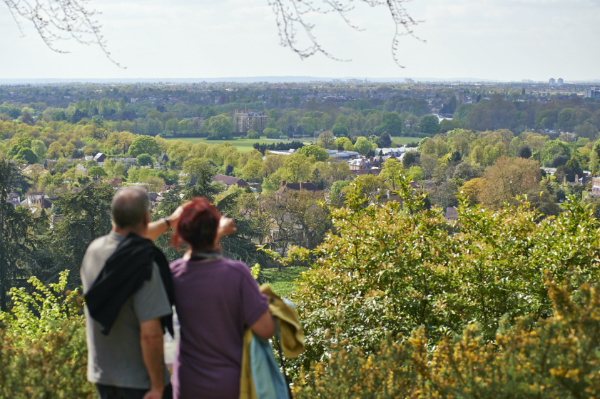
Its name, however, comes from the legend that King Henry VIII waited on top of the mound on 19th May, 1536, watching for a rocket to be launched from the Tower of London that would confirm his wife Anne Boleyn had been executed for treason (and so allow him to marry Jane Seymour).
The truth of that is unlikely – although it is possible to see St Paul’s Cathedral from the mound (it’s a view that is protected, as well as, to the west Windsor Castle and the Thames Valley), King Henry VIII was apparently in Wiltshire at the time.
The mound, however, was linked to kings as far back as 1630 when a map was published listing it as ‘Kings Standinge’, ‘standinge’ being a reference to a platform on which those not involved in a hunt could stand and watch.
Both King Henry VIII and his daughter Queen Elizabeth I are known to have hunted here – in fact, it was King Henry VIII’s father, King Henry VII, who built a royal palace at Richmond and named it after his estate in Yorkshire.
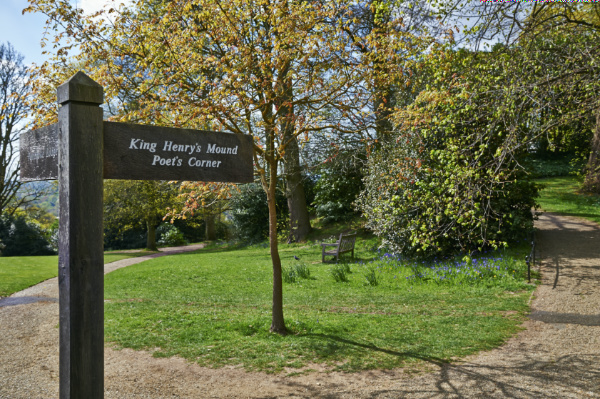
The mound was later incorporated into the gardens of Pembroke Lodge in the 19th century, during much of the latter half of which the property was home to Prime Minister Lord John Russell.
Today the Grade I-listed Richmond Park is managed by the Royal Parks.
For more on Richmond Park, head to www.royalparks.org.uk/parks/richmond-park.
PICTURES: The Royal Parks

• The London Transport Museum Depot in Acton Town has flung its doors open for 10 days of “special family fun”. The depot, which houses more than 320,000 items from the city’s transport history including vintage London buses and classic Tube trains, now features a special family-friendly trail for the 10 day season which takes a look at historic vehicles from the past 200 years including a yellow 1881 horse drawn ‘garden seat’ bus and a red 1938 Stock Tube train. The London Transport Miniature Railway will be running and all children visiting will receive a special sealed pack including a craft kit. Admission charges apply and tickets must be prebooked for times between 11am and 6pm until Sunday, 23rd August, and from Wednesday, 26th to Sunday 30th August. For more, see www.ltmuseum.co.uk/whats-on/depot-summer.
• The Science Museum in South Kensington reopened its doors this week after a closure of five months. As well as the innovative Wonderlab: The Equinor Gallery – which features interactive exhibits and live, socially-distanced science demonstrations – and the world’s largest medical galleries – Medicine: The Wellcome Galleries, visitors will be able to take in the temporary exhibition, Driverless: Who is in control?, the season of which has been extended to January next year. Tickets, which are free, must be pre-booked online and social distancing measures apply in the museum. For more, see www.sciencemuseum.org.uk.
Send all items for inclusion to exploringlondon@gmail.com
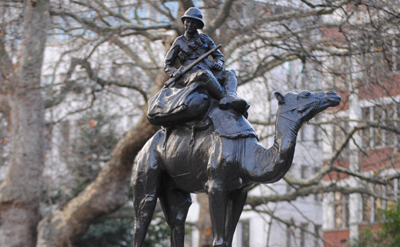 It’s common to associate war memorials with the commemoration of those who died in combat. But disease, too, is a major killer of soldiers in a time of war yet few memorials explicitly mention disease as cause of death.
One which does do so, however, is the Imperial Camel Corps Memorial in Victoria Embankment Gardens.
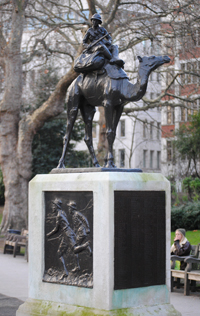 The memorial, which features a bronze figure riding a camel atop a stone plinth has a number of inscriptions and plaques recording the corps’ engagements during World War I and the names of the fallen.
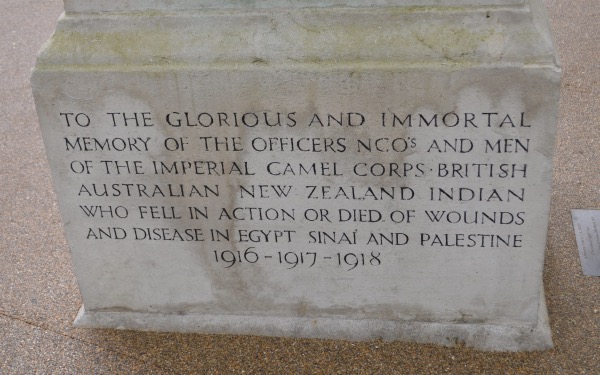
Among them is an inscription which reads “To the glorious and immortal memory of the officers, NCO‘s and men of the Imperial Camel Corps – British, Australian, New Zealand, Indian, who fell in action or died of wounds and disease in Egypt, Sinai and Palestine, 1916 -1917-1918.”
Disease was a significant killer in World War I – it’s estimated that some 113,000 British and Dominion soldiers died of disease – but the number was far fewer than those who died in combat or from wounds, a figure which equates to at least 585,000 (not including the tens of thousands of missing).
Yet, medical advances meant disease was far less a killer than in previous wars – it’s said that in the American Civil War, for example, as many as two-thirds of those who died were the result of various diseases.
The Imperial Camel Corps, which grew to four battalions including two Australian, one British and one New Zealander before it was disbanded after the end of the in 1919, suffered some 246 casualties during World War I – we don’t have a breakdown for how many of those deaths were attributable to disease.
The Grade II-listed memorial, which was sculpted by Major Cecil Brown – himself a veteran of the Corps, was unveiled in July, 1921, in the presence of both the Australian and New Zealand Prime Ministers.
PICTURES: Top and right – David Adams/Below – Matt Brown (licensed under CC BY 2.0)
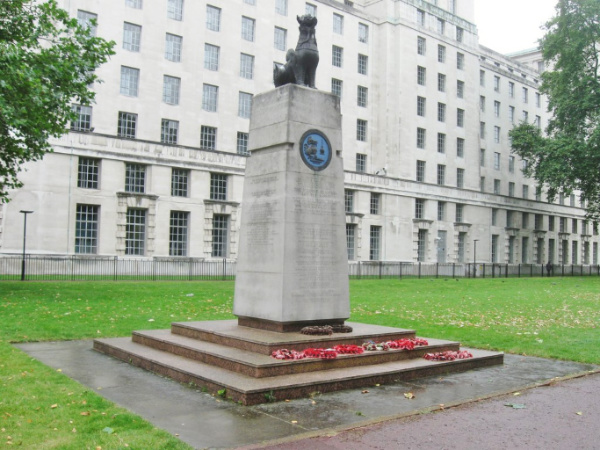
A memorial commemorating the role of the Chindit Special Forces in Burma during World War II has been awarded a Grade II listing on the National Heritage List for England in honour of the 75th anniversary of Victory in Japan (VJ) Day. Located in Victoria Embankment Gardens outside the Ministry of Defence building in Whitehall, the memorial’s granite plinth is topped with a bronze chinthe, a mythical beast that stands guard outside Burmese temples. The Chindit Special Forces, which were formed by British Army officer Major General Orde Charles Wingate and disbanded in early 1945, are credited with helping to turn the tide of World War II against Japan in the Far East. The memorial was designed by architect David Price and the chinthe sculpture the work of Frank Forster. It was unveiled by Prince Philip on 16th October, 1990. On Saturday, as the nation commemorated VJ Day, a military delegation lad a wreath at the foot of the memorial. PICTURE: Derek Voller (licensed under CC BY-SA 2.0).
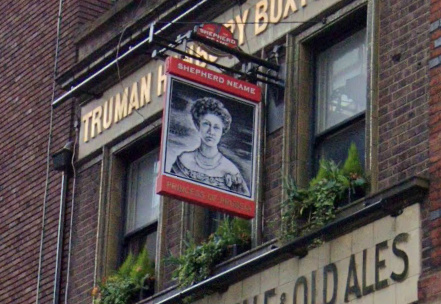
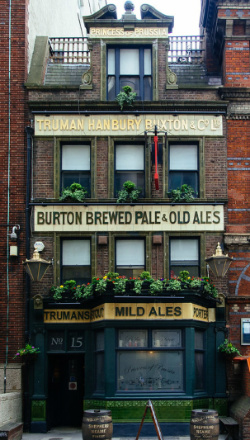 This Whitechapel establishment, located a stone’s throw from Tower Bridge, is a remarkable survivor with roots going back to the Victorian age.
The pub originally dates from around 1880 but the current building was constructed in 1913.
The pub was named in in honour of Princess Victoria (aka “Vicky” to her family), daughter of Queen Victoria, who married Fredrick William, Crown Prince of Prussia, in 1858, and who, following their marriage, went on to have eight children including Kaiser Wilhelm II.
Once an outlet for Truman’s Brewery in East London (and later for Scotland & Newcastle), the pub is now part of the Shepherd Neame chain.
The property at 15 Prescot Street has only recently undergone a renovation (one of several over its lifetime) which saw signboards removed and earlier Truman, Hanbury Buxton & Co signs revealed. It has a dark timbered Victorian interior and a rear garden.
For more, head to www.princessofprussia.co.uk.
PICTURES: Top – Google Maps; Right – R4vi (licensed under CC BY 2.0)
The next two entries in Exploring London’s 100 most popular posts countdown…
 Exploring London