LondonLife – Hats…err, on to London’s statues…

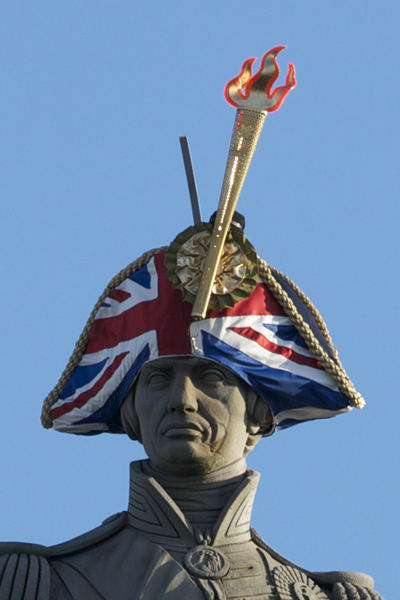
One of the stranger sights in London during this week of Olympic celebration are the many statues around the city adorned with hats – including Trafalgar Square’s iconic statue of Admiral Lord Nelson which now wears a Union Jack hat featuring a replica of the Olympic flame. Designed by Sylvia Fletcher and made by London’s oldest hatters Lock & Co, makers of Nelson’s original bicorn hat, the hat is one of 20 which has been placed upon London statues. It’s all part of Hatwalk, an initiative which aims to take visitors on a tour of the city by bringing some of its most well-known statues to life. Other statues wearing hats include those of former US President Franklin D Roosevelt and former British PM Winston Churchill in Bond Street, the Duke of Wellington near Wellington Arch, and William Shakespeare in Leicester Square. Hatwalk, which features hats designed by some of the UK’s top milliners, was commissioned by the Mayor of London, in partnership with BT, Grazia magazine, the British Fashion Council and the London 2012 Festival. The hats, which appeared on the statues yesterday, will remain on the statues for only four days before they are auctioned for charity. For more on Hatwalk and a map of where the hats are, see www.molpresents.com/hatwalk


Where’s London’s oldest…sports museum?

In honor of the Olympics, we’re staying with a sporting theme over the next couple of weeks and so this week thought we’d take a look at the oldest sports museum in London – and, it is claimed, the world.

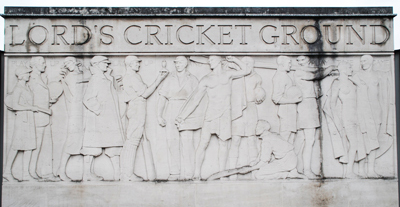
The Marylebone Cricket Club (MCC) Museum is located at Lord’s Cricket Ground in St John’s Wood, just north-west of the City (keep an eye out for our post on Lord’s later this week), and is said to have been collecting cricket-related artefacts since as far back as 1864.

The star sight on display is that tiny urn, known simply as The Ashes, which was given to English captain Ivo Bligh during the English cricket team’s visit to Australia following a game on an estate outside Melbourne on Christmas Eve 1882 (the term was actually first used in August that year when, following an English loss to Australia, at The Oval, The Sporting Times ran an obituary for English cricket and said its ashes would be taken to Australia).

The museum also contains cricket equipment used by some of the game’s greats along with memorabilia celebrating the likes of WG Grace, Victor Trumper, Jack Hobbs, and Donald Bradman as well as more recent players Shane Warne, Rahul Dravid and Paul Collingwood. Other exhibits include the Wisden Trophy, a stuffed sparrow bowled out by Jehangir Khan in 1936 and the battered copy of Wisden’s which EW Swanton used to help him survive a World War II Japanese internment camp.

There is also an extensive collection of cricket-related paintings and photography and a theatre – the Brian Johnson Memorial Theatre – which screens archival cricket footage.

It should be noted that the museum is closed during the Olympics (until 15th August) when Lord’s is playing host to the archery competition (people attending the archery, however, will have free entry). In celebration of the archery, the museum is hosting an exhibition of trophies and pictures related to archery, the centrepiece of which is an arrangement featuring the Musselburgh Arrow and Medals, prizes which have been competed for since 1603.

WHERE: MCC Museum, Lord’s Cricket Ground, St John’s Wood Road, St John’s Wood (nearest Tube Stations are Warwick Avenue, St John’s Wood, Marylebone and Maida Vale); WHEN: Weekdays (with exceptions – check website for details and times); COST: £7.50 an adult/£5 for concessions (or included with tours); WEBSITE: www.lords.org.

Where’s London’s oldest…manufacturing company?

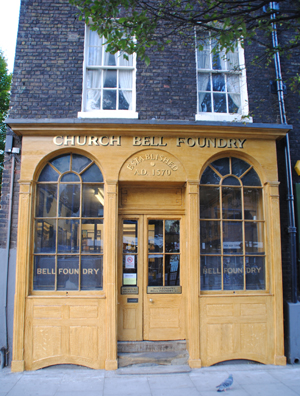
London’s oldest manufacturing company is the same as Britain’s oldest and is, according to the Guinness Book of Records, the Whitechapel Bell Foundry.

The company was established in 1570 (although founders have been discovered operating in the area as far back as 1420) and, according to its website, still concentrates solely on the manufacture of bells and their fittings with large church bells accounting for 80 per cent of the company’s business. The remainder of the business is involved in manufacturing handbells and other smaller bells.

The foundry’s current buildings, apparently originally used as a coaching inn named The Artichoke, date from 1670 and are presumed to have replaced structures consumed in the Great Fire of London. The foundry had earlier been located in smaller premises on the other side of Whitechapel Road.

The foundry has typically operated under the name of the master founder and owner but since 1968 has apparently operated under its current name.

The most famous bells cast at the foundry include the Liberty Bell (1752) – the symbol of American independence which cracked when first rung and was recast in Philadelphia, the Great Bell of Montreal Cathedral, ‘Great Tom’ of Lincoln Cathedral, and, of course, Big Ben (1858) – at 13,760 kilograms, the largest bell ever cast at the foundry.

Westminster Abbey and St Paul’s Cathedral also feature bells cast at the foundry and replacement bells for St Mary-le-Bow and St Clement Danes made here following their destruction in World War II and bells from the foundry have been sent as far afield as Australia and India.

Among the most recent bells to be cast at the foundry are the Royal Jubilee Bells, used in the Thames Diamond Jubilee Pageant and now housed at St James Garlickhythe in the City of London (each of the bells, which bear the Royal Arms, is named after a member of the Royal Family – Elizabeth being the largest with others named Philip, Charles, Anne, Andrew, Edward, William and Henry.)

There is a small exhibition on bell-making in the foundry shop looking at the history of the foundry and bell-making in general, and one-and-a-half-hour tours of the foundry run Saturdays (booking well in advance is usually required). Additional tours are being held every day during the Olympics.

WHERE: 32/34 Whitechapel Road; WHEN: Tours are usually held on Saturdays when no work is being undertaken – see website for dates – but special tours are being held daily from 10am to 5pm, 28th July to 12th August, 2012; COST: The exhibition/museum is free but tours are usually £12 a head for over 14s (Olympic period tours are £10 a head/£25 a family – children under 14 not admitted without adult supervision) – see website for more details on purchasing tickets; WEBSITE: www.whitechapelbellfoundry.co.uk.

Where’s London’s oldest…bank?

While it may not be the oldest (that remains a matter of some dispute), we can say that one of London’s oldest banks stands at 1 Fleet Street.

Child & Co’s origins go back to the mid-1600s when Francis Child entered into a partnership with Robert Blanchard to run a goldsmith’s business. In 1673, the business, now known as Blanchard & Child moved to the premises it now occupies.

Child later married Blanchard’s step-daughter and on Blanchard’s death in 1681, he inherited the entire company, renaming it Child & Co (knighted in 1689, Child later served as a Lord Mayor of London and as an MP) and in 1698 was appointed “jeweller in ordinary” to King William III.

Following Child’s death in 1713, his sons continued the business, transforming it into a bank. It’s first banknote was issued in 1729.

The bank passed into the ownership of the Earls of Jersey in the mid-1800s and in 1880, following the removal of the Temple Bar gate, rebuilt its premises.

The bank, which at one stage had a branch in Oxford, was later sold to London-based commercial bank Glyn, Mills, Currie, Holt & Co and this in turn was acquired by the Royal Bank of Scotland. They remain the current owners.

Interestingly, the bank is said to be the model for Tellson’s Bank in Charles Dickens’ novel, A Tale of Two Cities.

For a book on the financial history of the City of London, check out David Kynaston’s City of London: The History: 1815-2000.

Where’s London’s oldest…Thames foreshore structure?

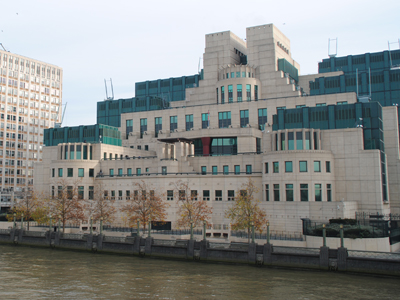
The oldest structure on the Thames foreshore is only a relatively recent discovery. It was in the spring of 2010 that archaeologists found six timber piles driven into the foreshore just in front of the spy agency MI6’s building in Vauxhall (pictured below with the river covering the site). 

The piles – no specific function for which has yet been identified – were up to 0.3 metres in diameter and were found to be more than 6,000 years old.

That date puts them in the Mesolithic period when the level of the river was lower – meaning the structure was probably built on dry land – and the landscape considerably different to what it is today. Radiocarbon dating suggests the trees for the structure were felled between 4790 BC and 4490 BC.

The site, which is at the confluence of the Thames and now largely underground River Effra, was initially kept secret while surveying was carried out. Nearby were found stone tools dating from a similar era to the piles – they included a tranchet adze for woodworking – and pottery fragments from the slightly later Neolithic era.

The discovery near the low tide line was made by archaeologists from the Thames Discovery Programme and the site then surveyed with the assistance of English Heritage and the Museum of London as well as the geomatics teams from Museum of London Archaeology.

The site is 600 metres downstream from a Bronze Age timber jetty (about 1,500 BC) found in the 1990s.

Where’s London’s oldest…shop?

We’re celebrating the bicentenary of the birth of Charles Dickens this year so it’s only fitting that we look at a building which has been, rightly or wrongly, associated with one of his books.

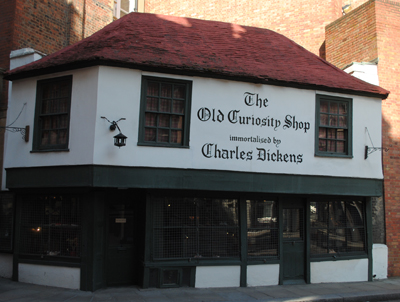
Located at 13-14 Portsmouth Street in Westminster, The Old Curiosity Shop now operates as a shop selling handmade fashions and footwear but the building apparently dates back 1567, making it a strong contender for the title of London’s oldest shop.

The name – The Old Curiosity Shop – was apparently applied to the building some years after Dickens first published his story, The Old Curiosity Shop, in the weekly serial, Master Humphrey’s Clock, in 1840 and 1841. The belief subsequently arose that it was this building the author had in mind when writing the book which tells the tale of Little Nell and her grandfather, a shopkeeper, and their interactions with the evil moneylender Daniel Quilp.

The claim is disputed by some, author Ed Glinert among them. In his book Literary London: A Street by Street Exploration of the Capital’s Literary Heritage he says the model for Dickens’ building was located at either 24 Fetter Lane or 10 Orange Street near Leicester Square and notes that at the end of the novel, Dickens said the building had long since been pulled down.
The Grade II* listed building, which survived the Great Fire of 1666 and the Blitz of World War II, is said to have been made from wood taken from old ships. Apparently at one stage it was a dairy which belonged to an estate awarded by King Charles II to one of his mistresses.

For more, see www.curiosityuk.com.

Where’s London’s oldest…music hall?

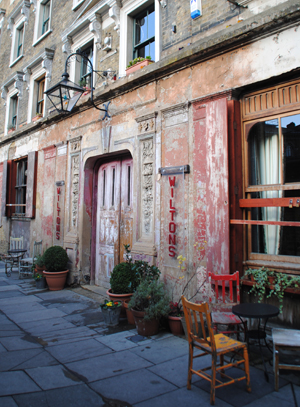
Wilton’s Music Hall  seems to be regularly making news these days so the revelation that it’s London’s oldest (in fact, according to the venue’s website, it’s the oldest surviving grand music hall in the world) probably comes as no surprise.

The hall, located in Graces Alley, Whitechapel, started out life as a pub which stood in the middle of a row of terrace houses. Named the Prince of Denmark, it is said to have had the first mahogany counters in London (hence the ‘Mahogany Bar’ at the front of the music hall today) and incorporated a concert room built at the rear of the ground floor.

The building was taken over by John Wilton in the 1850s. He also bought up the neighbouring terrace homes and subsequently built the grand music hall which still stands today – one of what were then a new generation of large music halls which appeared in London in the mid to latter part of the 19th century but had all but disappeared by 1900.

Wilton’s Music Hall opened on 27th March, 1859, and continued to operate under Wilton’s management for the next couple of decades. In 1877 it was badly damaged in a fire an rebuilt the following year.

Ten years later, however, the Wesleyan Mission took over the building and used it as a hall – dockers were served meals here during their first ever strike in 1889, it was used as a safe house during the so-called Battle of Cable Street of 1936 in which police clashed with protestors opposing a march by the British Union of Facists, and during World War II it was used as shelter for people bombed out of their homes.

The Methodists left in the 1950s and in 1964, the building was scheduled for demolition. Thanks to the intervention of poet John Betjeman, however (he led a campaign to prevent its destruction), the hall was saved. While it’s been undergoing restoration work ever since, more work is still required and the hall is still looking for donations to help fund it.

As well as operating once again as a music venue, it has since appeared in numerous films including Chaplin, The Krays, and the latest Sherlock Holmes film – Sherlock Holmes: A Game of Shadows.

There is a more detailed history of Wilton’s Music Hall at www.arthurlloyd.co.uk/Wiltons.htm, a music hall and theatre site. Wilton’s website can be found here.

Exploring London’s 10 most popular posts for 2011 – Numbers 8 and 7…

Our countdown continues with numbers 8 and 7…

8. Where’s London’s oldest…outdoor statue? – A somewhat controversial post for some, this talks about London’s oldest full-length statue – that of King Alfred the Great in Trinity Square as well as referencing some of the other oldest statues in the city;

7. The Royal Wedding – London’s Royal Wedding Venues – Part of our coverage of the marriage of Prince William and Kate Middleton (now the Duchess of Cambridge) in April, this looks at where royal weddings have taken place in the past, including Westminster Abbey.

Where’s London’s oldest…hotel?

Brown’s Hotel in Mayfair (now officially the Rocco Forte Brown’s Hotel) is generally awarded the accolade of being London’s oldest hotel. 

The hotel, which initially fronted on to Dover Street, was founded in a series of former Georgian townhouses in 1837 by James and Sarah Brown, formerly valet and maid to Lord and Lady Byron.

After being sold to the Ford family in 1859, the hotel was extensively modernised with electricity, the installation of permanent bath tubs, lifts, and in first for London hotels, an on-site restaurant. The building itself underwent a major expansion in the late 1890s when the family bought the St George’s Hotel which backed onto Brown’s and fronted onto Albemarle Street. The two buildings were merged into one, an extra floor added, and a new facade built for the hotel facing out onto Albemarle Street (pictured right). Three further townhouses were incorporated into the building in the early 1900s.

Possibly the most notable event to take place at the hotel was in 1876 when Alexander Graham Bell made the first ever telephone call there. Other visitors included authors Rudyard Kipling (who wrote The Jungle Book while resident) and Agatha Christie (At Bertram’s Hotel is said to be based on Brown’s), royalty such as Queen Victoria and the French Emperor Napoleon III and his wife Empress Eugenie (they stayed in 1871), and world leaders like US Presidents Theodore Roosevelt and Franklin Roosevelt, British Prime Minister Winston Churchill (said to count the bar among his favorities), Cecil Rhodes, founder of Rhodesia, and Emperor Haile Selassie, who took refuge there in 1936 after the Italians invaded Ethiopia.

The hotel, which now features 117 guestrooms, underwent a multi-million pound refurbishment in the mid-Noughties after becoming part of the Rocco Forte Collection of hotels. As well as The Albemarle restaurant and The Donovan Bar, it also serves award-winning afternoon teas at The English Tea Room.

For more about Brown’s Hotel, see www.brownshotel.com.

Where’s London’s oldest…canal?

London’s oldest canal is one that perhaps doesn’t immediately spring to mind when considering the city’s waterways – the Limehouse Cut in the city’s east.

Authorised by an Act of Parliament passed in 1766, the Cut was built in 1770 to link the River Lea (or Lee) – which it joins at Bromley-by-Bow – to the Thames at Limehouse.

It was designed to enable sailing barges coming down the Lee to avoid navigating the rather difficult curves in the lower reaches of the river at Bow Creek (and waiting for the tide to come in to the Thames so the barges could then go around the Isle of Dogs to the docks).

In 1968, the exit lock which led from the cut directly to the Thames was replaced by another short section of canal which linked it to what is now known as Limehouse Basin and was previously known as Regent’s Canal Dock.

The cut these days features an innovative floating towpath which leads under the A12, the northern approach road of the Blackwall Tunnel, and the old factory buildings which once lined it are giving way to modern apartment complexes and office blocks. Pictured is a section of the Limehouse Cut near the Limehouse Basin end.

Where is London’s oldest…tailor?

Founded in 1689, Ede & Ravenscroft is thought to be not only the oldest tailor in London but the world.

The origins of the business can be traced back to William and Martha Shudall, tailors who set up shop in Aldwych in London that year. Their work had soon caught the eye of royalty with the company winning the contract to create robes for the coronation of King William III and Queen Mary II after what is known as the Glorious Revolution.

As well as making robes for the clergy, government officials and those working in the legal and academic professions, the company’s relationship with the Royal Family continued and they have provided robes and tailoring for as many as 12 coronations including that of King George III.

Wig-making was added to the business in the 1800s when Joseph Ede (robe maker to Queen Victoria) married into the Ravenscroft family – already known for their wig-making (the business was renamed from Ede & Son to include the Ravenscroft name in 1902).

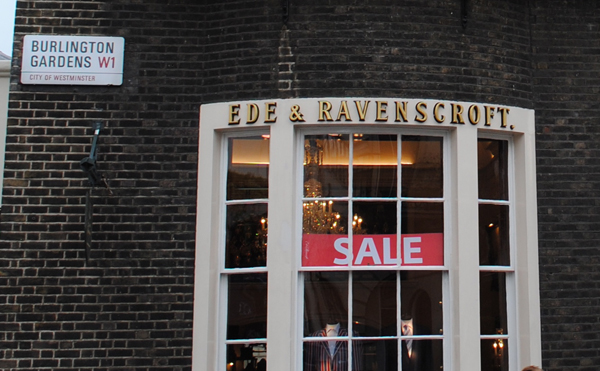
The company, headquartered at 93 Chancery Lane (they also have several other shopfronts including one at Burlington Gardens near Savile Row – see picture), currently holds three Royal Warrants, being official robe-makers to the Queen, Prince Philip and Prince Charles.

LondonLife – SS Robin returns to East London…

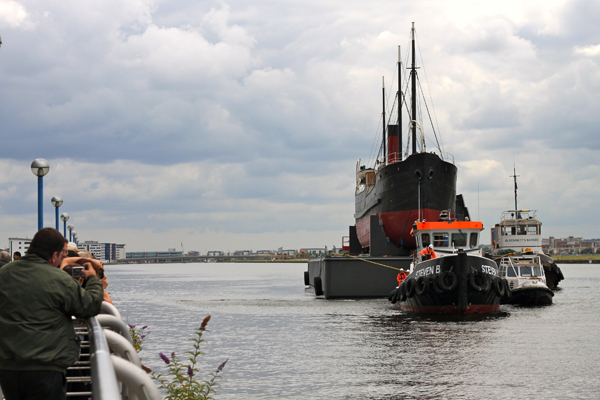
The SS Robin being towed to its new mooring in East London on a floating pontoon. PICTURE: James Spellane/SS Robin Trust.

The world’s oldest complete steamship, the SS Robin, made a dramatic return to the Royal Docks in East London earlier this month. Built in 1890 at the Thames Ironworks shipyard on the River Lea, the coastal cargo steamer was operational for more than 80 years, initially around the coast of Britain and the English Channel and later in Spain where it bore the name Maria. The 300 tonne vessel has just been through a three year restoration project spearheaded by the SS Robin Trust. It has now taken up a temporary mooring on a new floating pontoon while final conservation work is completed. It is anticipated that the steamship – which is listed on the ‘Core Collection’ of the UK National Historic Ships Register meaning it’s seen as historically significant as London’s two other maritime landmarks, the Cutty Sark and HMS Belfast – will be opened to the public. For more information, see www.ssrobin.com.

Where’s London’s oldest…(still-in-use) theatre?

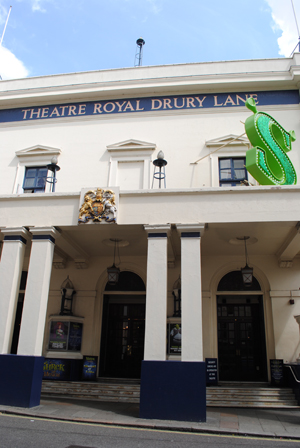
While the remains of some of London’s oldest purpose-built theatres – such as The Rose and The Globe – can be found in once notorious Southwark, London’s oldest, still-in-use theatre is in fact in the West End. The Theatre Royal Drury Lane (not to be confused with the Theatre Royal Haymarket) apparently takes the honor – the latest incarnation of a theatre which has still on the same location since 1663.

First built on the orders of Restoration-era dramatist and theatre manager Thomas Killigrew, the original theatre on the site – where King Charles II’s mistress Nell Gwynn apparently trod the boards and which was originally known as the Theatre Royal in Bridges Street – was burnt down in 1672 only to be rebuilt to the designs of Sir Christopher Wren two years later.

This building lasted for more than a century before it too was demolished – this time to make way for a larger theatre which opened its doors in 1794. Fire seems to have been a perennial problem, for it too burned down in 1809, being rebuilt and opened again in 1812 with a performance of Hamlet (the current building, designed by BenjaminWyatt).

Now owned by star composer Andrew Lloyd Webber via his Really Useful Group, the building has associations with some of London’s theatreland’s finest names – everyone from eighteenth century actor David Garrick (one of the theatre’s managers) to early nineteenth century child actress Clara Fisher and, in more recent times, Monty Python.

Currently hosting Shrek: The Musical, other recent productions there have included Miss Saigon and a musical adaption of Lord of the Rings.

Where’s London’s oldest…public park?

Dating from the early 1600s, London’s oldest public park is Finsbury Circus Gardens, located just to the north of London Wall and east of Moorgate.

The now heritage-listed gardens were open as a public park from 1606 (and was originally known as Moor Fields – the moors were drained and gravel walks laid out in 1527 but it wasn’t until 1606 that the area was laid out with elm trees and benches).

The park wasn’t enclosed until 1815-17 when City of London surveyor William Montague laid the area out according to the designs of prominent London architect George Dance the Younger.

The gardens were acquired by the City of London Corporation in 1900 and in 1909 were replanned. The oval-shaped park, the largest of the City’s gardens, is these days home to the City of London Bowling Club, the only bowling club in the City (founded in 1924; the bowling green dates from the following year and the current pavilion from 1968).

During World War II a barrage balloon was anchored here to deter low level air raids. Among it’s other claims to fame is the Tudor era bat (apparently a forerunner of the modern cricket bat) found on the site in the 1980s and skulls which have also been found dating from the Roman period.

The gardens are currently partly closed due to the Crossrail development.

PICTURE: Wikipedia

Where’s London’s oldest…outdoor statue?

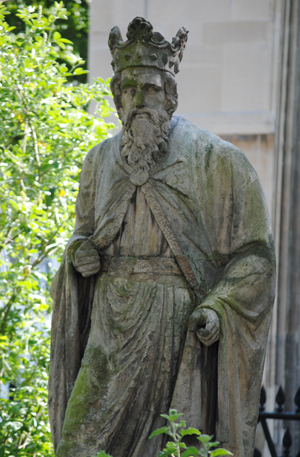
It’s generally believed that London’s oldest outdoor statue is that of King Alfred the Great which stands in Trinity Church Square in Southwark but there are a few others worth mentioning for their age.

But first, to the statue of Alfred the Great. Located now in Trinity Church Square, it is thought to have been made in the late 14th century (although it’s also suggested it could be much younger) in honor of the man who ruled Wessex in the 9th century and is often credited as being the first “king of the English”.

The statue (right) was apparently located at the Palace of Westminster before it was brought to its present location in 1823 at about the time the square was being laid out.

Others among London’s oldest statues is that of King Charles I sitting astride his horse and looking from Whitehall from its position on the southern side of Trafalgar Square.

Credited as being London’s “oldest equestrian bronze”, this statue is the work of French sculptor Hubert Le Sueur and was cast in 1633 (during King Charles I’s rule) at the behest of Richard Weston, one of the king’s favorites, who that year became the 1st Earl of Portland.

It was removed during the Civil War but later reacquired by the Portland family and, following the Restoration, was reinstalled on its current site – once that of the Charing Cross (see our previous entry for more details) – in 1675 by King Charles II.

Another of London’s oldest statues is that of Queen Elizabeth I which stands on the facade of the church St Dunstan-in-the-West in Fleet Street. This statue, which has been attributed to William Kerwin although other names have also been suggested, dates from 1586 (created during her reign) and decorated the west side of Ludgate until its demolition in 1760, after which it was apparently put into storage until being brought to the church in the 19th century.

Standing nearby in the vestry porch as statues of the legendary pre-Roman British king, Lud, and his sons, Androgeus and Tenvantius, which were also removed from Ludgate and probably date from the same period (about 1586).

Where’s London’s oldest…bookshop?

Hatchards on Piccadilly (right next to Fortnum & Mason) is generally accepted as being London’s oldest surviving bookshop.

It was founded in 1797 by John Hatchard in Piccadilly (there seems some dispute over whether it still stands on exactly the same site).

The shop currently holds three royal warrants for the supply of books to the Royal Household.

Among high profile past customers have been Queen Charlotte (wife of King George III), former PMs Benjamin Disraeli and  Arthur Wellesley, the Duke of Wellington, and literary figures such as Rudyard Kipling, Oscar Wilde and Lord Byron.

It remains popular with lovers of literature and is noted for hosting book-signings by prominent authors with many signed book on the shelves.

For more, see www.hatchards.co.uk.

King James I’s London – 3. Golf on Blackheath

When King James I came south to take up the throne England, he is known to have brought that peculiarly Scottish game of golf with him and it is believed that it was at Blackheath, above the then Royal Palace of Placentia in Greenwich, that his courtiers first played the game.

According to the Royal Blackheath Golf Club, now located some way to the south of Blackheath in Eltham (the club moved there is 1923), documentary evidence shows the earliest players included James I’s son Henry Frederick, Prince of Wales, who is known to have gone golfing in 1606. The club itself notes that while it is generally accepted it was established in 1608, no documentary evidence to support this has yet been unearthed (records prior to 1787 are missing).

The first course at Blackheath – which has played a significant role in several events including as a rallying point during the Peasant’s Revolt of 1381 –  apparently consisted of five holes, each of which was played three times.

Where’s London’s oldest…hospital?

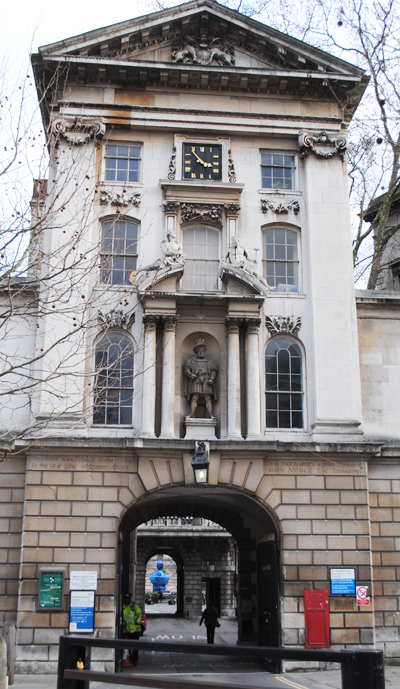
London’s oldest hospital – St Bartholomew’s Hospital in what is known now as Smithfield – was founded in the 12th century.

The hospital owes its foundations – like the neighbouring Priory of St Bartholomew (London’s oldest church – see our previous story on this here) – to Rahere, a courtier (possibly a minstrel or jester) at the court of King Henry I who, tired with triviality, may have become a priest.

In any event, after the death of Henry’s son William – he is believed to have drowned when the White Ship foundered in November 1120 – and that of his wife Queen Matilda, Rahere went on pilgrimage to Rome. He did so but contracted malaria while there and, while under the care of  monks, he vowed to found a hospital for poor men if he recovered.

He did recover and on his return journey had a vision of St Bartholomew who informed him that it was he who had helped him to recover and now desired him to found a church in Smithfield (then known as Smedfield).

Back in London, Rahere as he’d promised and, after petitioning the king, was granted a royal charter in 1122 to found the priory of Augustinian canons and the hospital.Work began in March 1123 and it was completed by 1145 when Rahere died (his tomb can still be seen in the church).

The hospital – one of a number in London at the time – was probably little more than a single hall with a chapel at one end. Other buildings and some cloisters were added later as was the Church of St Bartholomew the Less.

Under a charter of 1147, it was open to the needy, orphans, outcasts and the poor as well as sick people and homeless wanderers. In the 14th century, the definition was honed to include the sick until they recovered, pregnant women (until delivery) and for the maintenance of children born there until they were seven-years-old.

As well as the master (Rahere was the first), other ‘staff’ at the hospital initially included eight Augustinian brothers and four sisters but the hospital gradually became independent of the priory and by 1300, the hospital has its own dedicated master. By 1420, the two institutions had apparently become completely separate.

Following the Dissolution in 1539, the hospital was refounded in the 1540s thanks to a deal brokered between King Henry VIII and the Corporation of the City of London. Along with Bethlem, Bridewell and St Thomas’, St Bartholomews was one of four Royal Hospitals administered by the City.

The first regular physician – a Portuguese man by the name of Roderigo Lopez – was appointed around 1567 (he was later hung, drawn and quartered for an allegedly plotting against Queen Elizabeth I). Among the most famous physicians to serve at St Barts in later years was William Harvey, renowned for having ‘discovered’ the circulatory system.

The hospital survived the Great Fire in 1666 but in the 1700s most of the medieval buildings, with the exception of the tower in the Church of St Bartholomew the Less, were demolished as the hospital was rebuilt to the design of James Gibbs. The new design featured a central courtyard with a Great Hall contained in the north wing, reached by a ‘Grand Staircase’ decorated with images of the Good Samaritan and Christ at the Pool of Bethesda by celebrated artist William Hogarth.

The famous Henry VIII gate (pictured above) dates from 1702, slightly before Gibb’s rebuilding project. Other buildings have been added in more recent times.

In more recent times, the hospital was amalgamated with The Royal London and the London Chest Hospitals in 1994 with the establishment of The Royal Hospitals NHS Trust (now known as the Barts and The London NHS Trust). St Barts is now a specialist cancer and cardiac hospital.

There is a museum at the hospital which houses exhibits including a facsimile of Rahere’s grant of 1137 (now in the hospital’s archives), amputation instruments dating from the early 1800s once used by surgeon John Abernathy and a display on William Harvey. Hogarth’s paintings are visible from the museum.  There are also guided tours of the hospital.

WHERE: Museum at St Barts Hospital (nearest tube station is Barbican); WHEN: 10am to 4pm Tuesday to Friday ; COST: Free (donations welcomed); WEBSITE:  www.bartsandthelondon.nhs.uk/about-us/museums-and-archives/st-bartholomew-s-museum/

King James I’s London – 2. St James’s Park

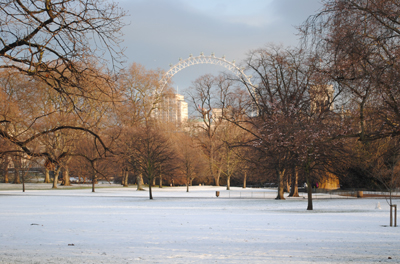
Although royal connections with St James’s Park, the oldest royal park in London, go back to the time of King Henry VIII – it was he who first purchased the marshy watermeadow in 1532 with the idea of creating another of his many deer parks, it was on the accession of King James I that orders were given for the swamp to be drained and landscaped.

The landscape features included a large pool known as Rosamond’s Pond at the west end and, at the east end, a collection of waterways and islands used to attract birds that could then stock the royal larder. There was also a flower garden next to St James’s Palace (this had been built by King Henry VIII).

Among the other uses King James I had for the park were as a site to keep the royal menagerie which included exotic animals like crocodiles and camels. There were also bird aviaries placed along what is now appropriately named Birdcage Walk.

The layout of the park became more formal during the later reign of King Charles II who had been inspired by what he’d seen while in exile in France.

PICTURE: Looking across St James’s Park toward Whitehall in the snow.

WHERE: St James’s Park (nearest tube station is St James’s Park); WHEN: 5am to midnight daily; COST: Free entry; WEBSITE: www.royalparks.gov.uk/St-Jamess-Park.aspx

Where’s London’s oldest…department store?

A 304-year-old institution, Fortnum & Mason on Piccadilly is generally believed (depending, of course, on definition) to be London’s oldest department store.

Founded in 1707, it owes its establishment to the meeting of shopkeeper Hugh Mason and William Fortnum, a footman in the house of Queen Anne, who was his lodger. The story goes that their joint venture began when Fortnum began retrieving the half-used candles discarded by the royal family (they insisted on fresh candles each night) and they started selling them on to ladies at the Royal Court.

Initially founded as a grocery store, Fortnum & Mason, which moved to its current site on Piccadilly in 1756 (see picture to right), become known for its high quality and rare goods – in particular tea.

It has held numerous Royal Warrants since the mid 1800s with the first granted in 1863 when the firm was appointed as grocers to the then Prince of Wales.

A supplier of British officers during the Napoleonic Wars, it was also active during the Crimean War when Queen Victoria had shipments of “concentrated beef tea” sent to Florence Nightingale for use in her hospitals there.

Among its other claims to fame are that the first Scotch egg was created there in 1738 and that in 1886, it became the first store in Britain to stock tins of Heinz baked beans.

The massive clock which hangs on the facade of the building was commissioned in 1964 by Canadian businessman Garfield Weston who bought the business in 1951. Every hour models of Mr Fortnum and Mr Mason come forth and bow to each other.

The store, now famous for its luxury food hampers, underwent a £24 million restoration in the lead-up to its 300th anniversary in 2007. As well as the flagship store, there are now branches – “stores within stores” – in Japan. The firm also reportedly plans to open Fortnum & Mason stand-alone shops in locations like China, the Middle East and India (its last overseas stand alone store was opened on Madison Avenue in New York in the 1930s but the business was short-lived thanks to the Depression).

As well as its array of goods for sale, the Piccadilly store now houses a number of eateries including St James’s Restaurant, The Parlour, The Fountain, The Gallery and the 1707 Wine Bar.

See www.fortnumandmason.com.