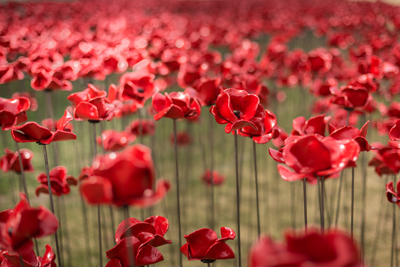
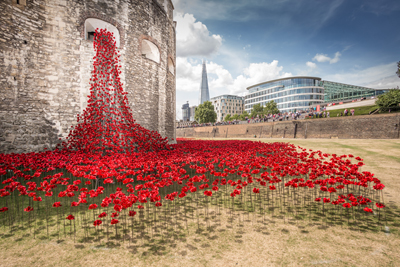
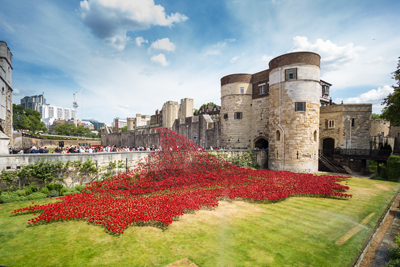
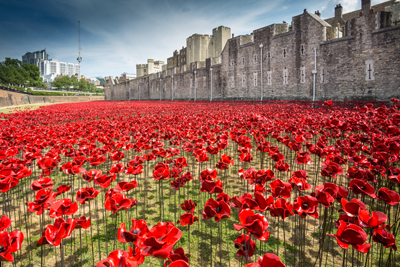
The Tower of London is bidding farewell to the sea of poppies that has filled its dry moat while two major features of the instalment – created to mark the centenary of World War I – prepare to head off on tour. Known as Weeping Window (shown above) and Wave (shown immediately below) – the two features of the Blood Swept Lands and Seas of Red installation will both tour various locations across the UK for the next few years before going on permanent display at the Imperial War Museum in London and Manchester. So, we thought we’d take a look back at what has proved to be one of the most popular and moving memorials to appear in the capital in recent years. Created by ceramic artist Paul Cummins (with setting by stage designer Tom Piper), the project saw as many as 888,246 ceramic poppies – representing all British and Colonial fatalities during the war – planted by volunteers in the moat. The last one was planted on Armistice Day – 11th November – last week before the process of removal began. PICTURES: ©Richard Lea-Hair and Historic Royal Palaces.
Museums
This Week in London – Paddington comes to town; it’s Christmas decorations time; Guards Memorial upgraded; and Grayson Perry…
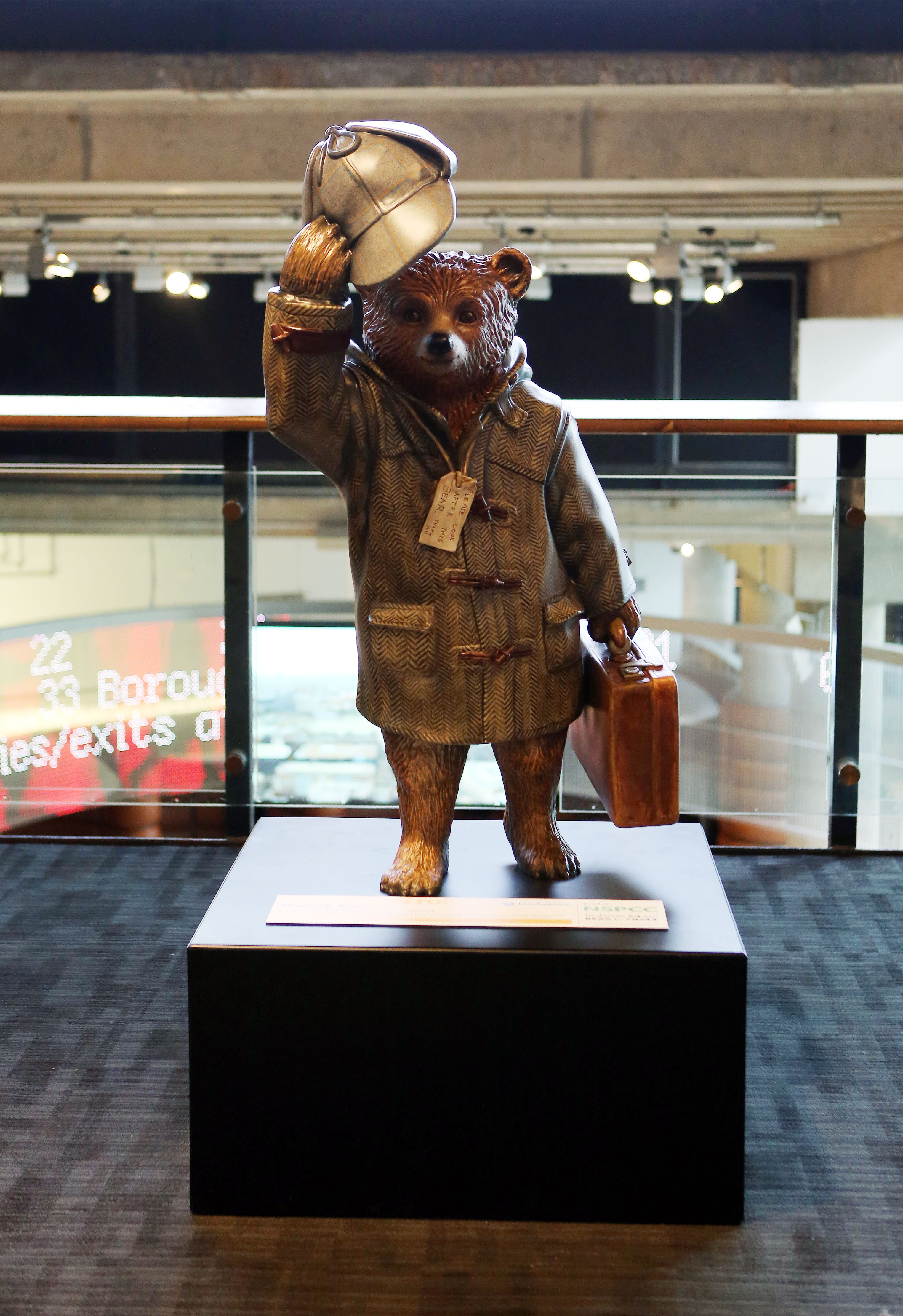
• Paddington comes to the Museum of London in a new exhibition opening tomorrow to coincide with the bear’s big-screen debut. A Bear called Paddington charts the story of the character from his genesis on Christmas Eve, 1956, when creator Michael Bond bought his wife a small toy bear and named him after the railway station near where they loved across the next almost 60 years to today. Objects on display include: a first edition A Bear Called Paddington – dating from 1958, it belonged to Bond’s daughter Karen Jankel; an original illustration of Paddington by Paddy Fortnum; the typewriter Bond used to write Paddington at Work and Paddington Goes To Town; the original Paddington puppet from the 1970s TV animations; and, props from the upcoming film Paddington (released on 28th November). The free exhibition runs until 4th January. See www.museumoflondon.org.uk for more. The museum, meanwhile, is also playing host to a new life-sized statue of the famous bear designed by Benedict Cumberbatch (and known as Sherlock Bear for obvious reasons given Cumberbatch’s penchant for playing a certain detective – pictured). It forms just one stop on the Paddington Trail which, as the work of VisitLondon.com, NSPCC and film-makers StudioCanal, links 50 sites – each with their own statue of the bear – across the capital. Designed by everyone from Mayor Boris Johnson to football star David Beckham and actors Sandra Bullock and Hugh Bonneville, the bears can be found around town until 30th December. For more on the trail, including a map of locations, check out www.visitlondon.com/paddington/.
• While the Oxford Street lights are already switched on (as are those in Covent Garden), Carnaby Street’s Christmas decorations are to be officially launched at 6.30pm tonight. The launch coincides with a shopping party (including 20 per cent discount), live music, free drinks, good bags and “trend masterclasses” with Grazia Magazine’s editor-at-large Angela Buttolph. Oh, and the decorations consist of eight red and white oversized sets of headphones and sunglasses. Meanwhile the Regent Street lights get turned on this Sunday with an event featuring a star-studded cast including Take That’s Mark Owen, Gary Barlow and Howard Donald (who are switching on the lights but not playing). While there’s entertainment along the street from noon, the music kicks off at 4pm and the lights, designed around the theme of the film Night at the Museum: Secret of the Tomb, get switched-on at 5pm and will be followed by a fireworks display. For more, see www.regentstreetonline.com.
• The Guards Memorial in Horseguards Parade, Westminister, has been upgrade to a Grade 1-listed structure on the advice of English Heritage. Unveiled in 1926 by the Duke of Connaught, Senior Colonel of the Guards, and General George Higginson, a Crimean veteran, the memorial commemorates the 14,000 Guardsmen who died in the First World War. Designed by architect Harold Chalton Bradshaw and sculpted by Gilbert Ledward, it features five bronze soldiers, each representing a typical soldier from each of the divisions – Grenadiers, Coldstreams, Scots, Welsh and Irish Guards.
• On Now: Grayson Perry: Who Are You? This exhibition at the National Portrait Gallery near Trafalgar Square features a series of new works created by Perry during the making of his Channel 4 TV series of the same name. Interspersed with 19th and 20th century collections of the gallery, the portraits – which include a tapestry, sculptures and pots – are of families, groups and individuals and include everyone from a young Muslim convert and Celebrity Big Brother contestant Rylan Clark. Runs until 15th March. Entry is free. For more, see www.npg.org.uk.
Send all items for inclusion to exploringlondon@gmail.com.
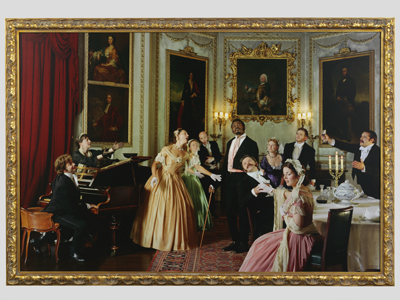
Treasures of London – A fragment of the Berlin Wall…
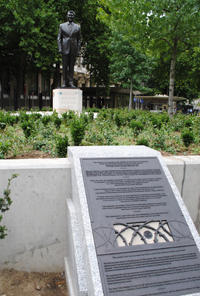
This Sunday marks 25 years since the fall of the Berlin Wall so we decided it was a fitting time to mention the fragment of the wall which accompanies the bronze statue of former US President Ronald Reagan in Grosvenor Square, Mayfair.
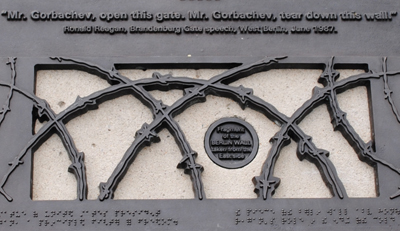
The remnant of the wall, recorded as taken from the “east side”, can be seen through a window in a bronze plaque which commemorates the role President Reagan played in the coming down of the wall.
The plaque also features quotes from President Reagan – including the famous line from his 1987 Brandenburg Gate speech, “Mr Gorbachev, open this gate. Mr Gorbachev, tear down this wall” – and other figures including former UK PM Margaret Thatcher and Mikhail Gorbachev as well as information about the wall itself.
In a dedication to the president, it further reads: “Ronald Reagan, the 40th President of the United States of America, was a principled fighter for freedom. With a clear vision and will, he gave hope to the oppressed and shamed the oppressors. His contribution to world history in the 20th century, culminated in his determined intervention to end the Cold War. President Reagan has left a lasting legacy as a campaigner for global peace.”
The memorial was unveiled on 4th July, 2011, outside the US Embassy by the Ronald Reagan Presidential Foundation, to mark the 100th birthday of the former president. Among those present at the unveiling of the statue were then Foreign Minister William Hague and former US Secretary of State Condoleezza Rice.
There are also larger sections of the wall outside the Imperial War Museum in Lambeth and in the National Army Museum in Chelsea (closed for redevelopment until 2016).
For more on London’s monuments, check out Andrew Kershman’s aptly named London’s Monuments.
This Week in London – Hogarth cartoons; Daniel O’Connell blue plaque; and, Peder Balke paintings on show…
• The works of famed 18th century chronicler of London, William Hogarth, are on show at the Cartoon Museum in Bloomsbury. Marking the 25oth anniversary of his death on the night of 25th/26th October, 1764, the display Hogarth’s London features more than 50 of the artist’s best known satirical prints including A Harlot’s Progress, A Rake’s Progress, The Four Times of Day, Industry and Idleness and Gin Lane and Beer Street. A series of events – including an evening of Baroque dance & music, gin, beer and cartooning on 28th November – accompanies this exhibition which runs until 18th January and is supported by The William Hogarth Trust. Admission charge applies. For more, see www.cartoonmuseum.org/exhibitions/current-exhibitions/hogarth-s-london.
• Nineteenth century Irish political leader Daniel O’Connell has been honoured with an English Heritage blue plaque as his former London home. Known as ‘The Liberator’, O’Connell was an abolitionist who successfully campaigned for civil and Catholic rights – including the right for Catholics to sit in the British Parliament. The first popularly elected MP since the Reformation, he lived in the property at 14 Albermarle Street in Mayfair with his family for several months in 1833 – a year in which a number of his supporters were elected to the House of Commons and in which the act to abolish slavery was given royal assent. For more, see www.english-heritage.org.uk/discover/blue-plaques/.
• On Now: Peder Balke. The first ever UK exhibition focused on the paintings of this 19th century Norwegian artist is underway at the National Gallery on Trafalgar Square. Held in conjunction with the Northern Norway Art Museum, the exhibition features more than 50 paintings, the majority of which have never been seen in the UK before. The display includes works from across Balke’s career, including The Tempest (c 1862), the only painting by a Norwegian artist in the gallery’s collection. This free exhibition runs in the Sunley Room until April. For more, see www.nationalgallery.org.uk.
Send all items for inclusion to exploringlondon@gmail.com.
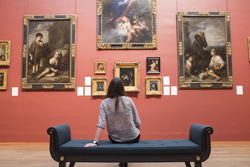
What’s in a name?…Fulham…
This Thameside area in London’s west has a long and storied history and its name is a reflection of it.
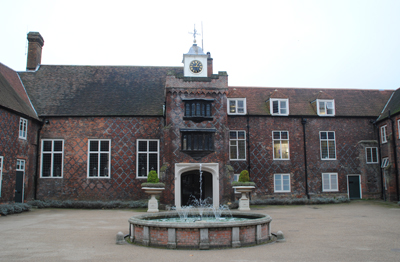
Long home to the ‘country’ manor of the bishops of London (Fulham Palace, pictured above), the name Fulanham is recorded as early as the late 7th century.
While there’s been speculation in the past that the name Fulham (also recorded among other variations as Fullam) was a corruption of ‘fowl-ham’ – relating to the wild fowl that were to be found here – or of ‘foul-ham’, relating to the muddied waters, that’s now apparently generally deemed not to be the case.
Instead, its name most likely owes its origins to an Anglo-Saxon named Fulla and the Old English word ‘hamm’ – a term for a water meadow or piece of land enclosed in a bend in a river (in contrast to the more common ‘ham’ which refers to an estate or homestead) – and referred to the manor he owned here, its boundaries set by a bend in the Thames. (It should be noted there is evidence of earlier occupation of the site by the Romans and as far back as the Neolithic era).
In about 700, the manor of Fulham – which includes the area we now think of as Fulham as well as land stretching as far afield as Acton, Ealing and Finchley – was acquired by Bishop Waldhere of London from Bishop Tyrhtilus of Hereford. Since Tudor times, Fulham Palace was used as the country home of the bishops of London and in the 20th century became their principal residence. It was used as such until 1975 and now houses a museum and reception rooms.
As well as now being used for the area which once contained what became the village of Fulham itself, since 1979 the name has also been used in that of the Borough of Hammersmith and Fulham. Interestingly, Fulham Broadway tube station was known as Walham Green when it first opened in 1880 and was only given its current name in 1952.
The bishop’s palace (and the nearby riverside Bishop’s Park) aside, other landmarks in the area include the Grade I-listed All Saints Church, which is largely late Victorian and which hosts the grave of abolitionist Granville Sharp, and the nearby Powell Almhouses which date from 1869.
It’s also linked by Putney Bridge with Putney on the other side of the Thames; the current bridge is the work of Sir Joseph Bazalgette and was built in 1882 – it replaced an earlier wooden bridge built in 1729 and overlooks where the annual Oxford-Cambridge Boat Race begins (other bridges spanning the river from Fulham include the rather ugly Wandsworth Bridge).
Known during the 18th century as something of a mecca for gambling, prostitution and other debauched leisure activities, these days Fulham is known for its football club, Fulham FC headquartered at Craven Cottage stadium (named for a cottage owned by Baron Craven which once stood here), shopping and is a sought-after residential location.
This Week in London – Science Museum’s new IT gallery; Hornchurch skatepark protected; NHM’s ice rink opens; and Emily Carr at Dulwich…
• Queen Elizabeth II opened the new Information Age gallery at the Science Museum this week by sending her first tweet. Following a tour of the new gallery exploring the way technologies – including everything from the telegraph through to the world wide web – have transformed the way we communicate, the Queen tweeted: “It is a pleasure to open the Information Age exhibition today at the @ScienceMuseum and I hope people will enjoy visiting. Elizabeth R.” The gallery in the South Kensington museum explores the growth of communications technologies through important events such as the sinking of the Titanic in the Atlantic in 1912, the first BBC broadcast in 1922, the TV broadcast of the 1953 coronation of Queen Elizabeth II and the creation of the first international link on the ARPANET network – the forerunner of the internet – by University College London in 1973. Entry to the new gallery is free. For more, see www.sciencemuseum.org.uk.
• In a European first (and only the second time it’s occurred around the world), an East London skatepark has been given heritage protection. Known as ‘the Rom’, the Hornchurch structure was purpose-built in 1978 by leading skatepark designers Adrian Rolt and G-Force. It has been listed as Grade II and is only the second skatepark to in the world to win such protection with the first being the ‘Bro Bowl’ in Tampa, Florida, added to the US National Register of Historic Places in October last year. Heritage Minister Ed Vaizey said the listing is testament to the park’s design. The listing was carried out on the advice of English Heritage.
• The Natural History Museum’s ice rink opens today, the 10th year it’s been positioned outside the stunning South Kensington building. The 1,000 square metre rink has been decorated with 80,000 fairy lights and a 40 foot high Christmas tree, and this year has been joined by an interactive Lindt Christmas chalet where you’ll be able to sample complimentary truffles and join in activities. The rink is open to 4th January. For more, see www.nhmskating.com.
• The works of pioneering Canadian artist Emily Carr are the focus of a new exhibition opening at the Dulwich Picture Gallery in London’s south on Saturday. From the Forest to the Sea: Emily Carr in British Columbia is the first major solo exhibition in Europe dedicated to the modernist artist who lived between 1871 and 1945. It features more than 140 works and indigenous artefacts as well as a recently discovered illustrated journal, Sister and I in Alaska, in which Carr documented her pivotal trip up and down the north-west coast of Canada in 1907. Highlights include Totem and Forest, (Untitled) Seascape and View in Victoria Harbour, one of a number of momentary records left behind in her trunk after her death. Runs until 8th March. Admission charge applies. See www.dulwichpicturegallery.org.uk for more.
Send items for inclusion to exploringlondon@gmail.com.
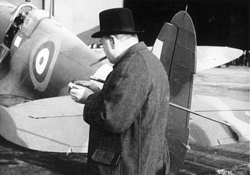
This Week in London – Giovanni Batista Moroni at the RA; German history on show; and, Afghanistan at the IWM…
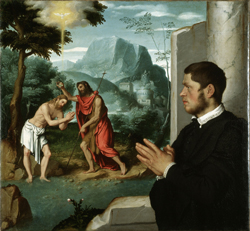
• The works of 16th century artist Giovanni Battista Moroni go on show at the Royal Academy of Arts this week. The exhibition will feature more than 40 works including portraiture as well as his lesser-known religious paintings. They include a number of altarpieces from the churches of Bergamo in northern Italy as well as portraits including Portrait of a Lady (c1556-60), A Knight with a Jousting Helmet (c1556), and The Tailor (1565-1570) – the first known portrait of a man depicted undertaking manual labour. The exhibition in The Sackler Wing, off Piccadilly, runs until 25th January. Admission charge applies. For more, see www.royalacademy.org.uk. PICTURED: A Gentleman in Adoration before the Baptism of Christ, (c.1555-60) (Gerolamo and Roberta Etro).
• This year marks 25 years since the fall of the Berlin Wall and the birth of modern Germany so it’s a fitting time for the British Museum in Bloomsbury to host an exhibition looking at Germany’s tumultuous history. Germany: memories of a nation features 200 objects reflecting themes ranging from ’empire and nation’ to ‘arts and achievement’ and ‘crisis and memory’ spanning a period from the 15th century to today. They include Tischbein’s iconic portrait Goethe in der Campagna, an early edition of Grimm’s fairy tales, a home-made banner from demonstrations in late 1989 and Ernst Barlach’s bronze figure Der Schwebende, designed as a World War I memorial for Gustrow Cathedral. The exhibition, sponsored by Betsy and Jack Ryan, runs until 25th January. Admission charge applies. For more, see www.britishmuseum.org.
• Britain’s 13 year involvement in Afghanistan is the subject of a new display at the Imperial War Museum London in Lambeth. Opening today, War Story: Afghanistan 2014 features new objects, photographs, film and video interviews and looks at the experiences of the Afghan national security forces and UK government and NGO workers as well as those of British troops. Objects, all collected between 2012 and this year, include a beadwork lamp made by Afghan prisoners in training workshops aimed at developing skills prior to their release and an Afghan dress and trousers. The display is part of the War Story project which started in 2009. Runs until 6th September next year. For more, see www.iwm.org.uk.
Send all items for inclusion to exploringlondon@gmail.com.
This Week in London – Sherlock Holmes at the MoL; Rembrandt’s latter years; and, William Morris’ legacy..
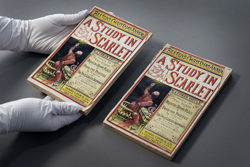
• Sherlock Holmes and his relationship to London, the city in which he lived, is the focus of a new exhibition which opens at the Museum of London from Friday. Sherlock Holmes: The Man Who Never Lived and Will Never Die, the first major temporary exhibition on Sir Arthur Conan Doyle’s famous character to be held in London in more than 60 years, will look at his literary origins and his relationship with late 19th century London, through to his portrayal in popular culture including through stage and screen performances starring everyone from Peter Cushing to Jeremy Brett and Robert Downey, Jr. Highlights of the exhibition include Conan Doyle’s notebook containing the first ever lines of a Sherlock Holmes story and notes in which he experimented with names for his to leading characters (later Holmes and Dr John Watson), a rare oil on canvas painting of Conan Doyle painted by Sidney Paget in 1897 which has never before been on public display in London, the original manuscript of 1903’s The Adventure of the Empty House, the Belstaff coat and the Derek Rose camel dressing gown worn by Benedict Cumberbatch from the BBC series and original pages from Edgar Allan Poe’s 1841 hand-written manuscript of The Murders in the Rue Morgue (Poe was an important influence on Conan Doyle’s writings). The exhibition will also include paintings, drawings, illustrations and photographs of Victorian London along with a vast collection of objects from the period. Runs until 27th April. Admission charge applies. For more, see www.museumoflondon.org.uk/sherlock. PICTURE: Two editions of A Study in Scarlet in which Conan Doyle introduced Holmes and Watson, Beeton’s Christmas Annual 1887.
• The first ever in-depth exploration of Rembrandt’s final years of painting opened at the National Gallery off Trafalgar Square yesterday. Rembrandt: The Late Works features about 40 paintings, 20 drawings and 30 prints with key works including moving The ‘Jewish Bride’ (from Rijksmuseum in Amsterdam), An Old Woman Reading (The Buccleuch Collection in Scotland), Bathsheba with King David’s Letter (Musee du Louvre in Paris) and Lucretia (National Gallery of Art in Washington, DC) as well as the last minute loan of The Conspiracy of the Batavians under Claudius Civilis (from the Royal Academy of Fine Arts in Sweden). The exhibition provides new insights into some of the artist’s most famous works including The Sampling Officials of the Amsterdam Drapers (aka The Syndics), and brings together a number of self-portraits usually seen in different galleries. The exhibition runs in the Sainsbury Wing until 18th January. Admission charge applies. For more, see www.nationalgallery.org.uk.
• The first exhibition devoted to Pre-Raphelite William Morris and his influence on 20th century life opens at the National Portrait Gallery off Trafalgar Square today. Anarchy & Beauty: William Morris and His Legacy, 1860-1960 explores the ‘art for the people’ movement which Morris and the artists of the Pre-Raphelite Brotherhood initiated, reveals the work of Arts and Crafts practitioners inspired by Morris, and shows how Morris’ “radical ideals” influenced the Garden City movement and post-war designers like Terence Conran. Highlights include Morris’ handwritten Socialist Diary, his gold-tooled hardbound copy of Karl Marx’s Le Capital and Burne-Jones’ handpainted Prioresses Tale wardrobe. Admission charge applies. The exhibition runs until 11th January. For more, see www.npg.org.uk.
Send all items to inclusion to exploringlondon@gmail.com.
Famous Londoners – Sir Robert Geffrye…
He lends his name to one of London’s best small museums but who was the person behind the name the Geffrye Museum?
Details about his life are somewhat scant but it is generally believed Sir Robert Geffrye (among a number of variants of the spelling of his name) was born around 1613 in the village of Landrake near Saltash in Cornwall.
Moving to London while still just in his teens, he is believed to have undertaken a seven year apprenticeship, eventually admitted as a member of the Worshipful Company of Ironmongers and freeman of the City of London.
It’s been suggested he was an ironmonger in name only but it seems to be the case that his new status gave him the opportunity to launch his career as a merchant and he apparently made a fortune from investing in African and East Indian trade.
Geffrye – who married Priscilla Cropley, a lawyer’s daughter, at the chapel in the Mercer’s Hall in Cheapside in 1651 and lived in Lime Street – was twice Master of the Worshipful Company of Ironmongers (first in 1667 and then again in 1685).
He was knighted by King Charles II in 1673 (his coat-of-arms can still be seen in the Ironmonger’s Hall) and in 1674, he was appointed a sheriff of London before being elected Lord Mayor in 1685 (his wife Priscilla had died in 1676).
In 1688, Geffrye became president of Bridewell and Bethlehem Hospitals – a role which he held for two years and which apparently saw him attending Bridewell every Friday to judge and sentence prisoners.
He died in February 1704 and was buried in the now long-gone St Dionis Backchurch, where his wife had been buried earlier. Their remains were transferred to the almshouses grounds after the church was demolished in 1878.
Geffrye left behind a substantial fortune and, along with bequests to family, friends and charities, he made a sizeable bequest which funded the building of 14 almshouses in Shoreditch (now home to the Geffrye Museum which this year celebrates its tercentenary) (for more on the museum and alms houses, see our earlier posts here and here).
A replica of an original 1723 statue of Sir Robert still adorns the almshouses which bear his name (pictured above).
For more on the people that made London, see Boris Johnson’s Johnson’s Life of London: The People Who Made the City That Made the World.
This Week in London – Rare chance to see four Magna Cartas together; Covent Garden films; Raymond Chandler’s childhood home recalled; and Rembrandt at Kenwood…
• The only four surviving copies of the original Magna Carta from 1215 will go on display together for the first time ever at the British Library in King’s Cross next February – and you have a chance to be among the 1,215 people to see them. In an event to mark the 800th year of the creation of the document, the library – which holds two copies of the document – along with Lincoln Cathedral and Salisbury Cathedral – each of which holds one copy – are holding a ballot with winners able to attend an event in which they’ll have the unique opportunity to see the documents side-by-side as well as be treated to a special introduction on its history and legacy by historian and TV presenter Dan Jones. The ballot to see the documents is open until 31st October with winners drawn at random. It’s free to enter – head to www.bl.uk/magna-carta to do so. The four documents will subsequently feature separately in displays at each of the three institutions. One not to miss! PICTURE: Salisbury Cathedral’s Magna Carta/Ash Mills.
• The Silent Swoon Free Film Festival kicks off in St Martin’s Courtyard, Covent Garden, next week. The courtyard will be transformed into an open air movie theatre showing a different movie each night – The Talented Mr Ripley on 14th October, Crazy, Stupid, Love on 15th October and Rebel without a Cause on 16th October. Most of the free tickets will be allocated through an online draw but a small number will be allocated each night on a first come, first serve basis. For those with tickets, a range of freebies will be available on the night (including popcorn!). For more information, head to www.stmartinscourtyard.co.uk/silent-swoon-cinema-festival.
• Crime writer and film noir pioneer Raymond Chandler has been remembered with the placement of an English Heritage blue plaque outside his childhood home in Upper Norwood, south east London. Chandler, who received global acclaim for his Philip Marlowe novels and his work on movies like The Blue Dahlia, lived at the home from 1901 after emigrating from the US with his mother, aunt and grandmother at the age of 12. He remained at the double-fronted red brick villa until 1908 – the same year he published his first poem, The Unknown Love. In his early Twenties, Chandler worked as a freelance reporter for London newspapers but, disillusioned with writing, returned to the US in 1912. He spent the next decade working for an oil company before the loss of his job in 1932 pushed him to restart writing. He first novel was published in 1939, and he went on to write further books and movie screenplays to ongoing renown. For more on the blue plaques scheme, see www.english-heritage.org.uk/discover/blue-plaques/.
• Two early works of Rembrandt have gone on display at Kenwood House this month. Anna and the Blind Tobit and Jeremiah Lamenting the Destruction of Jerusalem, both of which date from around 1630, will be seen in the Hampstead landmark until May next year. The two paintings replace Rembrandt’s Portrait of the artist which usually hangs in Kenwood and is on show at the National Gallery and Rijksmuseum in Amsterdam (from where the two paintings now at Kenwood have come). For more, see www.english-heritage.org.uk/kenwood. An exhibition of Rembrandt’s works opens at the National Gallery next week – more details then!
Send all items for inclusion to exploringlondon@gmail.com.
This Week in London – Gothic literature at the British Library; founder of War Graves Commission honoured; and, New Year’s Eve tickets on sale…
•
The UK’s largest exhibition of Gothic literature opens at the British Library in Kings Cross on Saturday (4th October), marking the 250th anniversary of the publication of the breakthrough book, Horace Walpole’s The Castle of Otranto. Terror and Wonder: The Gothic Imagination will feature manuscripts and rare and personal editions of Gothic classics like Bram Stoker’s Dracula, Mary Shelley’s Frankenstein, Robert Louis Stevenson’s Strange Case of Dr Jekyll and Mr Hyde and Charles Dickens’ Oliver Twist as well as the work of contemporary writers like Angela Carter and Mervyn Peake. There will also be Gothic-inspired artworks by the likes of Henry Fuseli and William Blake and modern art, photography, costumes and movies by the likes of Chapman Brothers and Stanley Kubrick. A range of literary, film and music events will accompany the exhibition which runs until 20th January. Admission charge applies. For more, see www.bl.uk/whatson/exhibitions/gothic/. PICTURE: Percival Delivering Belisane from the Enchantment of Urma, Henry Fuselli. © Tate.
• The founder of the Imperial (now Commonwealth) War Graves Commission, Sir Fabian Ware (1869-1949), has been honoured with an English Heritage blue plaque at his former home in Marylebone. Sir Fabian lived at the early 19th century Grade II-listed terraced house at 14 Wyndham Place between 1911 and 1919. It was during this period that he served with the British Red Cross in France and first began recording the graves of soldiers killed in battle. In 1917, the Imperial War Graves Commission was formed with the task of reburying the war dead in permanent cemeteries in France. Knighted in 1920, Sir Fabian was to be director of graves registration and enquiries at the War Office during World War II and it was at this time that he extended the war graves scheme to civilians killed in the conflict. The commission changed its name to the Commonwealth War Graves Commission in 1960. Today it cares for cemeteries and memorials at 23,000 locations in 153 countries. For more, see www.english-heritage.org.uk/discover/blue-plaques/.
• New Year’s Eve in London will be a ticketed event for the first time this year with 100,000 tickets being made available to the public with each costing a £10 administration fee – the entire sum of which will apparently be used to pay for the ticketing system. Making the announcement last month, the Mayor of London, Boris Johnson’s, office, said the growth in numbers of those who have gathered to watch the fireworks on the Thames – from around 100,000 in 2003 to an estimated 500,000 last year – has put an enormous strain on transport and safety infrastructure and meant people have had to turn up earlier and earlier to get a good view, facing hours waiting in cold and cramped conditions, or risk being among the “hundreds of thousands” unable to get a good view or even see the display at all. Booking tickets – people may secure up to four – will guarantee “good views of the celebrations and a better visitor experience”. To book tickets, head to www.london.gov.uk/nye.
Send all items for inclusion to exploringlondon@gmail.com.
This Week in London – Dr Livingstone’s beetles; the Great River Race; Snowdon at the NPG; and Foundlings at War…
• From Dr Livingstone, I presume? A recently unearthed collection of beetles gathered together by Dr David Livingstone during his Zambezi expedition of 1858-64 will go on display in its original box at the Natural History Museum in South Kensington on Friday night. The specimens were found among the museum’s 10 million beetles by beetle curator Max Barclay who stumbled on an unusual box received from a private collector. The collector was later found out to be amateur entomologist Edward Young Western (1837-1924) who apparently bought the specimens from a member of Livingstone’s expedition. The 20 beetles found inside the box are believed to the only surviving specimens known to have been collected by Livingstone. The specimens will be on show as part of Science Uncovered, a free annual after hours event – part of European Researcher’s Night – which will take place at the museum between 3pm and 10.30pm Friday night. Other highlights of the night include the chance to extract DNA from strawberries and bananas, create your own earthquake and chat live with NASA about chasing asteroids. For more, see www.nhm.ac.uk/scienceuncovered. PICTURE: Giant Predatory Ground Beetle, Termophilum alternatum © The Trustees of the Natural History Museum, London.
• Totally Thames – the month long celebration of the great river – is going out with a bang this weekend with more than 300 crews expected to take part in the Great River Race. Running from Millwall to Ham in Surrey, the 21.6 mile long event attracts entries from across the globe. The first boats leave Millwall at 12.40pm. Head to the riverbank between Richmond and Ham at approximately 3.40pm to see the winners cross the line to a cannon broadside. For more on the Great River Race, see www.greatriverrace.co.uk. Other events on as part of Totally Thames this weekend include historic riverside walks – one focused on Brunel and another on London’s ports before the Great Fire of 1666 as well as exhibitions including Richmond’s River at Orleans Gallery House in Twickenham and your last chance to see Florentijn Hofman’s HippopoThames. For more on Totally Thames, see www.totallythames.org.
• Some of Snowdon’s most iconic images will be on show as part of a new exhibition opening at the National Portrait Gallery near Trafalgar Square on Friday. Snowdon: A Life in View will feature studio portraits spanning a period from the 1950s to the 1990s alongside images from Private View, Snowdon’s 1965 examination of the British art world, created in collaboration with art critic John Russell and then director of Whitechapel Gallery, Bryan Robertson. More than 40 black-and-white portraits are included in the display including some works acquired by the gallery last year. To be held in Room 37 and 37a of the ground floor Lerner Contemporary Galleries until 21st June. Admission is free. For more, see www.npg.org.uk.
• On Now: Foundlings at War: World War I. This display at the Foundling Museum in Bloomsbury reveals for the first time the stories of foundlings who fought as well as those of the mothers forced to leave their children at the hospital as a result of bereavement or abandonment of those serving abroad. A free digital ibook, The Foundlings at War: World War I, containing expanded background information was published to coincide with the opening of the display earlier this month and can be downloaded from iTunes. The exhibition is part of a major research project, Foundlings at War, supported by the Heritage Lottery Fund and is the first of several displays examining the institution’s historic links with the military. For more, see www.foundlingmuseum.co.uk.
Send all items for inclusion to exploringlondon@gmail.com.
Treasures of London – Geffrye almshouses…
It’s a big year for the Geffrye Museum in Shoreditch – not only 300 years since the almshouses were first opened to house the poor and elderly, it’s 100 years since the almshouses were converted into the museum which now occupies the site.
With that in mind, we thought we’d take a look at the almshouses themselves (we’ve looked at the museum – which features 11 period rooms from the 17th to 20th centuries – a couple of times previously). The Grade I-listed almshouses were built in 1714 by the Worshipful Company of Ironmongers, using funds that had been bequeathed to them by Sir Robert Geffrye, a Cornishman who became twice-master of the company and a Lord Mayor of London (there’s a fine statue of him adorning the front of the building).
They comprised 14 houses, each of which had four rooms, and provided accommodation for up to 56 pensioners. Arranged in a U-shape around a courtyard, the two storey almshouses came complete with a chapel which still stands at the centre of the the complex and where residents were expected to attend each week (a walkway which runs around the back of the chapel was added in 1914 offers some great views of the garden).
The almshouses, which had originally been built in what was a largely rural context, remained in use until the early 20th century by which time the area had become one of London’s most crowded with poor sanitation. In 1910, the Ironmongers’ decided to sell off the almshouses and move out to the safer, cleaner area of Mottingham in Kent.
In 1912, the houses and gardens were purchased by the London County Council – attracted by the public open space – and following representations from members of the Arts and Crafts movement, the museum opened its doors in 1914.
It’s still possible to visit a former almshouse – number 14 – which was restored and opened in 2002 and has been furnished to show what life was like there for the pensioners (contrast the sparse furnished there with that with some of the more opulent rooms on display in the museum – and don’t forget to allow some time to visit the gardens; there is also a shop and cafe on site).
WHERE: 136 Kingsland Road, Shoreditch. Nearest tube is Liverpool Street or Old Street (a fair walk) or Hoxton Overground Station (next door); WHEN: The almshouses are open on select days only – check website. The museum is open Tuesdays to Sundays, 10am-5pm (gardens open until 31st October); COST: £3 for admission to almshouses/admission to the museum and gardens is free; WEBSITE: www.geffrye-museum.org.uk
This Week in London – Open House London this weekend; the Ming dynasty at the British Museum; John Constable at the V&A; and Totally Thames…
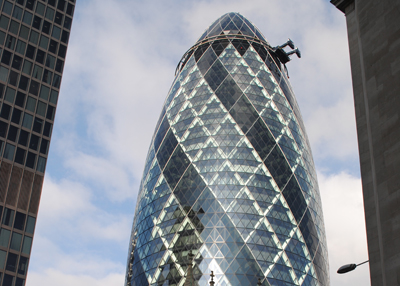
• Open House London is finally here with some 800 buildings across the city – some of them rarely accessible to the public – open for free this weekend, from grand historical institutions and modern skyscrapers through to ‘green’ schools, engineering projects, parks and gardens, and private homes. The weekend – which is being run this year under the theme of ‘revealing’ – also includes a programme of walks, engineering and landscape tours, cycle rides, a bus tour, childrens’ activities and expert talks as well as a moonlit ‘culture crawl’ through London on Friday night and into Saturday morning (a fundraiser for Maggie’s Centres). Among the buildings opening their doors in the festival – created by London-based architecture organisation Open-City – are the ever popular 30 St Mary Axe (aka ‘The Gherkin’), the Foreign and India Office in Whitehall, the Bank of England, Portcullis House and City Hall along with everything from The Leadenhall Building (aka ‘The Cheesegrater’ – pictured), and Temple Church in the City to the Admiral’s House in Greenwich, the Dutch Embassy in Kensington and the steam coaster, the SS Robin, in Tower Hamlets. As mentioned in a previous week, some visits required pre-booking so make sure you check the programme before heading out. For a full copy of the programme of events, see www.londonopenhouse.org. PICTURE: © R Bryant.
• A major new exhibition focusing on China during the “pivotal” 50 years of Ming Dynasty rule between 1400-1450 opens at the British Museum in Bloomsbury today. Ming: 50 years that changed China features some of the finest objects ever made in China – loaned from institutions in China and elsewhere – as it explores some of the “great social and cultural changes” that saw Beijing established as the capital and the building of the Forbidden City. It includes objects from the imperial courts along with finds from three regional “princely tombs”. Four emperors ruled during the period and the display will feature the sword of Yongle Emperor, “the warrior”, the handwriting of the Hongxi emperor, “the bureaucrat”, the paintings of the Xuande emperor, “the aesthete”, and portraits of the regents who ruled while the Zhengtong emperor was a boy. The exhibition runs until 4th January. Admission charge applies. For more, see www.britishmuseum.org.
• The work of 19th century artist John Constable and its debt to 17th century masters is the focus of a new exhibition opening at the V&A on Saturday. Constable: The Making of a Master – which features more than 150 works including celebrated pieces by Constable like The Hay Wain (1821), The Cornfield (1826) and Salisbury Cathedral from the Meadows (1831) as well as oil sketches, drawings, watercolours and engravings – will juxtapose his works with those of 17th century landscape masters like Ruisdael, Rubens and Claude. Among those of their works on display will be Rubens’ Moonlight Landscape (1635-1640) and Ruisdael’s Windmills near Haarlem (c.1650-62). The exhibition runs until 11th January. Admission charge applies. For more, see www.vam.ac.uk/constable.
• And don’t forget, Totally Thames continues to run throughout this month which an extensive programme of river-related events. Those on during the coming week include Londonist Afloat: Terrific Tales of the Thames, a series of discussion sessions on aspects of the River Thames being held aboard the HMS President and London’s River – The City’s Ebb and Flow, a guided walk along the river (held on every Saturday and Monday during September), and Hospital and Troop Ships – Transporting the walking and wounded in the First World War, an exhibition held aboard the HQS Wellington (open Sundays and Mondays in September). For the full programme of events, see www.totallythames.org.
Send all items for inclusion to exploringlondon@gmail.com.
This Week in London – The Magna Carta at the new City of London Heritage Gallery; Tudor monarchs at the NPG; Mapping London; and objects with story at Pitzhanger…
• The 13th century’s finest surviving copy of the Magna Carta is taking centre stage at the new City of London Heritage Gallery which opens to the public this Friday. The 1297 document, which bears a superimposed memo reading ‘make it happen’, is being featured as part of the Corporation’s efforts to mark next year’s 800th anniversary of the signing of the landmark document. Other items on display in the new permanent, purpose-built exhibition space at the Guildhall Art Gallery include the medieval Cartae Antiquae, a volume containing transcripts of charters and statues covering laws enacted between 1327 and 1425 – a period which includes the reign of King Richard III, a poster for a World War I recruitment meeting held at the Guildhall in 1914, and a series of paintings depicting the 25 City Aldermen who were in office in the mid-1400s. The gallery, admission to which is free, will in future feature a rotating selection of rare documents from the City of London Corporation’s archives including the purchase deed William Shakespeare signed on buying a home in Blackfriars in 1613. For more, including opening times, see www.cityoflondon.gov.uk/heritagegallery. For more on events to mark the 800th anniversary of the signing of the Magna Carta next year, see www.magnacarta800th.com. PICTURE: Copyright London Metropolitan Archives.
• Rare depictions of Tudor monarchs will be seen at the National Portrait Gallery in the most complete presentation of their portraiture to date. The Real Tudors: Kings and Queens Rediscovered features the gallery’s oldest portrait – that of King Henry VII – displayed alongside a Book of Hours inscribed by the king to his daughter, six portraits of King Henry VIII along with his rosary (on loan from Chatsworth), portraits of King Edward VI and a page from his diary in which he relates his father’s death, five portraits of Queen Mary I along with her prayer book (on loan from Westminster Cathedral) and several portraits of Queen Elizabeth I displayed alongside her locket ring (on loan from Chequers, the country residence of the PM). There will also be a discussion surrounding the search for a “real” portrait of the ‘nine days queen’, Lady Jane Grey, alongside a portrait of her that dates from the Elizabethan period. With many of the portraits newly examined as part of the gallery’s ‘Making Art in Tudor Britain’ project, visitors to the gallery will also be able to access a specially created app which allowing them to access the new research while looking at the portraits. The display, which will form the core of a larger exhibition in Paris next year, can be seen until 1st March. Admission to the gallery, off Trafalgar Square, is free. For more, see www.npg.org.uk.
• An exhibition of rare maps from London, dating from between 1572 and last year, at gallery@oxo on South Bank, is closing on Sunday. Part of the Totally Thames festival, the Mapping London exhibition shows how the landscape along the River Thames as it passes through the capital has changed over the years. It features the first available map of London, which dates from 1572, as well as a 2013 map of underground London, monumental wall maps, and even a map of London that doubles as fan. The free exhibition at Oxo Tower Wharf is being curated by Daniel Crouch, one of the world’s leading map dealers. For more, see www.totallythames.org/events/info/mapping-london.
• A Crafts Council touring exhibition showcasing the work of 12 contemporary artisans and design studios – each of which uses objects as a means of storytelling – has opened at Pitzhanger Manor House and Gallery in Ealing – its first stop – this week. Crafting Narrative: Storytelling through objects and making explores the potential of objects to reflect on history, culture, society and technology through a combination of new and commissioned works, film text and photography. Works include Hilda Hellström’s The Materiality of a Natural Disaster which consists of food vessels made of soil from a field belonging to the last resident inside the Japanese Daiichi nuclear plant exclusion zone, Onkar Kular and Noam Toran’s archive of objects belonging to the fictional Lövy-Singh clan – an East London family of mixed Jewish and Sikh descent, and Hefin Jones’ The Welsh Space Campaign which features objects such as astronaut boots in the form of traditional Welsh clogs in an attempt to show how Wales has the capacity to explore space. The free exhibition is at the manor until 19th October. For more, see www.pitzhanger.org.uk.
Send all items for inclusion to exploringlondon@gmail.com.
Lost London – The General Post Office (aka GPO East)…
While the history of the General Post Office dates back to the reign of King Charles I, London’s first purpose-built facility for mail was constructed on the east side of St Martins-le-Grand in the 1820s.
The post office headquarters had hitherto been located in the area of Lombard Street but in 1814 it was decided that the site here couldn’t be developed any further. The site in St Martins-le-Grand was subsequently acquired and plans for the building commenced.
Designed by Sir Robert Smirke (famous for his design of the British Museum), the grand structure was built on the site of what were slums between 1825 and 1829 and featured a 400 foot long “Grecian-style” street frontage. The exterior of the building was lit with 1,000 gas burners at night.
As well as serving as the post office’s administrative headquarters, the building also contained the sorting office and the main London public post office. Along with a grand public hall and offices, it contained rooms – including an armoury – for the guards who protected mail coaches and accommodation for clerks charged with receiving foreign mail (obviously at all hours!).
A new building was added to house the telegraph department on the west side of the street in the 1870s and further buildings followed, leading Smirke’s initial building to become known as ‘GPO East’.
In 1910, the facility was bursting at the seams and so the headquarters was moved to the King Edward VII Building. Smirke’s grand building was somewhat controversially demolished in 1912. A fragment – one of the capitals which topped one of the external columns – is apparently located in Vestry Road in Walthamstow.
For more on London’s postal heritage, visit the British Postal Museum & Archive.
PICTURE: Thomas Shepherd/Wikipedia
This Week in London – St Paul’s celebrates Shakespeare; Harvest Festival time; and, Horst at the V&A…
• It’s Shakespeare month at St Paul’s Cathedral as the august London institution hosts a series of special addresses and music recitals in honour of the Bard’s 450th birthday. Kicking off this weekend, the events will see preachers considering Shakespeare’s life and work – particularly in relation to faith – in a weekly address at Sunday Evensong service while a series of voice and piano recitals will present various interpretations of his work through the music of some of Britain’s greatest composers. Shakespeare, the cathedral staff say, would have known the cathedral well – many printers, including his old Stratford friend Richard Field, were located in the Churchyard, and Shakespeare would have had to regularly journey past St Paul’s to have his plays registered at St John’s Gate. See www.stpauls.co.uk for a detailed programme of events.
• The Kensington Gardens Allotment is hosting a free Harvest Festival this Sunday with activities including digging up potatoes and making ‘potato people’ as well as face painting, story telling and a mobile pet farm. Complementary hot and cold drinks will be provided (while stocks last, so don’t be late!). The day runs from 11am to 4pm. Meanwhile, Regent’s Park Allotment Gardens will host its own Harvest Festival on Sunday, 21st September. Along with live folk music, a children’s treasure hunt and the ‘guess the weight of the pumpkin’ competition, the day will also feature a specially-built pizza oven in which visitors will be invited to cook their own pizza. For more, see www.royalparks.org.uk.
• The works of renowned 20th century photographer Horst P Horst (1906-1999) will feature in a new exhibition opening at the V&A in South Kensington this Saturday. Horst: Photographer of Style will feature 250 photographs alongside haute couture garments, magazines, film footage and other ephemera and explores Horst’s collaborations and friendships with the likes of Coco Chanel, Marlene Dietrich, Noel Coward and Salvador Dali. Highlights include previously unpublished prints and more than 90 Vogue covers taken by Horst. Runs until 4th January. Admission charge applies. For more, see www.vam.ac.uk/horst.
Treasures of London – The Wolsey Angels…
Four bronze angels, designed for the tomb of Cardinal Thomas Wolsey, have been temporarily reunited in the V&A’s Medieval & Renaissance galleries as the museum looks for funding to acquire them.
Once thought lost, the Wolsey Angels were commissioned in 1524 from Florentine sculptor Benedetto de Rovezzano for the tomb of Wolsey, chief advisor to King Henry VIII and one of the most powerful men in the kingdom. Each of the angels, which measure around a metre in height, was created between 1524 and 1529 – the period in which Wolsey was trying to have the pope annul Henry VIII’s marriage to Catherine of Aragon.
As is well-known, Wolsey failed to do so and died in 1530 in disgrace. Henry appropriated Wolsey’s assets including the tomb which the king apparently intended to use for himself. The work was slow, however, and when Henry died in 1547, it remained unfinished. His children – King Edward VI, Queen Mary I and Queen Elizabeth I – each said they would complete the tomb as a memorial to their father but didn’t and in 1565, Elizabeth moved parts of the tomb to Windsor.
During the English Civil War elements of the tomb were sold off to raise funds and only the black stone chest – now used to house the remains of Admiral Lord Nelson in the St Paul’s Cathedral crypt – were believed to have survived along with four large gilt-bronze candlesticks which were installed at St Bavo Cathedral in Ghent.
The angels passed out of sight until, in 1994, two of them appeared in a Sotheby’s sale. Acquired by a Parisian art dealer, they were later attributed to Benedetto. The remaining two angels were discovered at Harrowden Hall in Northamptonshire in 2008 – the hall is now owned by the Wellingborough Golf Club – and it was subsequently revealed that the other two had been stolen from the same site 20 years previously.
The V&A has embarked on a campaign – backed by Hilary Mantel, the Booker Prize winning author of Wolf Hall – to acquire the four angels, priced at £5 million. It has already been granted £2 from the National Heritage Memorial Fund and the Art Fund has pledged a further £500,000.
Mantel described the recovery of the angels as “one of those miracles that historians pray for; something that seems irrevocably lost has been there all the time”. “To claim the angels for the nation would connect us to one of the liveliest eras of our history and one of its most remarkable men.”
Donations can be made via the V&A’s website at www.vam.ac.uk/wolseyangels.
PICTURE: Wolsey Angels on display at the V&A/© Victoria and Albert Museum, London
This Week in London – Notting Hill Carnival; St Paul’s treasures on show; Sherlock Holmes on film; and more…
• The August Bank Holiday is upon us which means it’s carnival time! The Notting Hill Carnival kicks off this Sunday with an extravaganza of costumes, dancing, music and food. The carnival’s origins go back to the late Fifties and early Sixties (the exact date is somewhat controversial!) when it started as a way of Afro-Caribbean communities celebrating their cultures and traditions, drawing on the tradition of carnivals in the Caribbean. The carnival is now Europe’s largest street festival and this year’s parade signifies the start of a three year celebration in the lead-up to the Golden Jubilee year of 2016. The carnival kicks off at 9am on Sunday – children’s day – and the same time on Monday – adult’s day – and organisers say the procession should be completed by 7pm. For more, see www.thelondonnottinghillcarnival.com. PICTURE: Wayne G Callender/Notting Hill Carnival.
• A pop-up display of some of St Paul’s Cathedral’s treasures will appear today and tomorrow (Thursday, 21st August, and Friday 22nd August) in the cathedral’s crypt. Put together by Museum Studies students from Leicester University, the display will feature items relating to a royal event from each of the first three centuries of Wren’s church. They include images and objects from the Thanksgiving Service for the recovery of King George III in 1789 as well as items from Queen Victoria’s Diamond Jubilee in 1897 and the wedding of Prince Charles and Lady Diana in 1981. The display will be shown from 1pm to 2pm each day – entry is free via the cathedral’s north west crypt door. Meanwhile, the cathedral is offering a private, behind the scenes evening photography tour of the building for the winner of a photography competition looking for “the most surprising image” of the cathedral. The winner – and five friends – will also be treated to a meal at the Grange Hotel’s Benihama restaurant. The Surprise St Paul’s competition runs until 26th September and entrants just need to tweet or post their images to the church’s Twitter or Facebook pages with the hashtag #SurpriseStPauls. For more, see www.stpauls.co.uk.
• The National Gallery has made free wi-fi available throughout the building. The Trafalgar Square-based gallery says it’s now also welcoming visitor photography and is encouraging visitors to check in on Facebook and comment on Twitter using the hashtag #MyNGPainting. For more, see www.nationalgallery.org.uk.
• Fancy yourself a detective? The Museum of London and the BFI are asking for the public’s help in tracking down a copy of the first ever feature film starring the fictional character Sherlock Holmes. A Study in Scarlet was released 100 years ago this autumn and was directed by George Pearson with then unknown James Bragington playing the part of Holmes. An adaption of Sir Arthur Conan Doyle’s story of the same name, it is based around Brigham Young’s trek across America with his Mormon followers and sees Holmes solve a series of murders. The film was made at Worton Hall studios and on location in Cheddar Gorge and Southport Sands in 1914. The organisations are seeking the film in the lead-up to the Museum of London’s landmark exhibition on Holmes which opens in October. If you do happen to find the film, you can write to Sherlockholmes@bfi.org.uk or make contact via social media using the hashtag #FindSherlock.
• A public ballot has opened for tickets to attend the art installation Fire Garden by renowned French troupe Carabosse at Battersea Power Station this September. The event – which will be held on the nights of Friday 5th and Saturday 6th September – is one of the highlights of Totally Thames, a month-long celebration of London’s great river, and is presented as a tribute to the power station before it’s closed to the public for redevelopment. A free event, it’s expected to be so popular that organisers are holding a ballot for tickets. The ballot closes midday on 27th August. To enter via the Totally Thames website, head here.
Send all items for inclusion to exploringlondon@gmail.com.
This Week in London – Breaker’s Yard opens at Sutton House; WWI remembered; and, preparing for an Open House…
• A former car breaker’s yard in Hackney has reopened as a “pocket park” of “installations and hidden spaces” following an extensive transformation project. Located next to the National Trust’s Tudor manor house, Sutton House, Breaker’s Yard incorporates elements from the site’s history including car tyres, a bus greenhouse, bespoke metal gates made out of more than 1,000 toy cars donated by celebrities, locals and artists, and a multi-storey caravan sculpture, The Grange, created by landscape designer Daniel Lobb who also designed the park in collaboration with arts-based educational charity, The House of Fairy Tales. The flower-filled park also features an ice-cream van, decorated by Rose Blake – daughter of Sir Peter Blake, which will act as a “playful shop”. The park is one of a 100 ‘pocket parks’ created under a $2 programme by the Mayor of London, Boris Johnson, in this case in collaboration with the National Trust and a host of volunteers. Entry to the park is free but admission charge applies to the house. For more on the park and Sutton House, see www.nationaltrust.org.uk/sutton-house/.
• A photographic exhibition, Exploring London’s First World War Memorials, is running at City Hall near Tower Bridge in Southwark. Organised by the Mayor of London with aid from the War Memorials Trust, English Heritage and others, the exhibition is centred on new images of war memorials by London-based photographer James O Jenkins. As well as more traditional monuments, the memorials take the form of everything from fountains to paintings, buildings and landscape features. Entry is free. Runs until 12th September. For more, see www.london.gov.uk/events. Meanwhile, the Guildhall Library is showcasing images taken by photographer Simon Gregor for the Remembrance Image Project. Runs until 12th November and is part of a series of World War I commemorative events the library is running. Others include an installation by artist Rebecca Louise Law called Poppy made up of 8,000 paper poppies from the Royal British Legion. For more on World War I commemorative events at the Guildhall LIbrary follow this link.
• Open House London’s programme is available for download from tomorrow (Friday, 15th August). The event, which will be held over the weekend of 20th and 21st September, will this year be conducted under the theme of ‘revealing’ and will feature more than 800 buildings, from Open House “favourites” like The Gherkin (aka 30 St Mary Axe) and the Foreign and India Office through to lesser known properties like Wandsworth’s Quaker Meeting House or the Butcher’s Hall in the City (some of which have to be booked before the weekend). There will also be a free programme of neighbourhood walks, engineering and landscape tours, cycle rides and talks by experts. To see the programme, head to www.openhouselondon.org.uk.
Send all items for inclusion to exploringlondon@gmail.com.