This Week In London – Kenwood House reopens; robot safari at the Science Museum; Kew Gardens illuminates for Christmas; Vivien Leigh at the NPG; and more…

Kenwood House in north London is being reopened to the public today following a £5.95 million restoration project which has seen the library returned to what Scottish architect Robert Adam had intended it to be. The project, which saw the Hampstead property closed since March last year, has also seen the restoration of three other Robert Adam-designed rooms – the entrance hall, Great Stairs and antechamber or entrance to the library – as well as the redecoration of four rooms in 18th century style, repainting of the exterior and the repair of the home’s roof – a job aimed at protecting the rooms and its stellar

Kenwood-House-Librarycollection of artworks by the likes of Rembrandt and Vermeer. English Heritage has also endeavoured to make the property more homely, replacing ticket desks and rope barriers with an open fire, warm rugs and leather couches on which visitors can relax. The library (pictured) was built and decorated to Adam’s designs between 1767 and 1770 as part of a wider remodelling of the villa for its owner Lord Chief Justice William Murray, 1st Earl of Mansfield. Redecorated many times since, it was restored in the 1960s but this redecoration was later found to be inaccurate. The Caring for Kenwood restoration project, which has also seen restoration of the Kenwood Dairy, was funded by a £3.89 million grant from the Heritage Lottery Fund as well as support from the Wolfson Foundation and other donors. To coincide with the reopening, a new app exploring Kenwood House has been released which can be downloaded for free from the iTunes store. For more, see www.english-heritage.org.uk/daysout/properties/kenwood/. PICTURE: English Heritage/Patricia Payne.

Head out on a “robot safari” this weekend with a special free event at Science Museum in South Kensington. Robot SafariEU, part of Eurobotics week, features 13 biometric robots from across Europe including an underwater turtle robot, a shoal of luminous fish robots, a robotic cheetah cub and Pleurobot, a robotic salamander. Roboticists from across Europe will be on hand to help visitors interact with the bots. Suitable for all ages, the event kicked off on Wednesday night and runs again on the weekend. Admission is free but timed tickets are required. For more, see www.sciencemuseum.org.uk/RobotSafari.

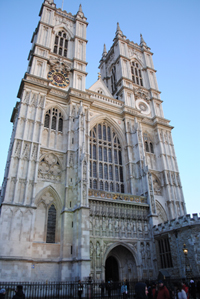
A memorial to author, scholar and apologist CS Lewis was dedicated at Westminster Abbey last Friday – the 50th anniversary of his death. Conducting the service, the Dean of Westminster, the Very Reverend Dr John Hall, said Lewis was “one of the most significant Christian apologists of the 20th century” and the author of stories that had “inspired the imagination and faith of countless readers and film-goers”. Douglas Gresham, younger stepson of Lewis, read from the author’s book, The Last Battle, at the service. The memorial is located in Poet’s Corner in the abbey’s south transept. For more see www.westminster-abbey.org.

A Blue Plaque commemorating Al Bowlly – described as “Europe’s most popular crooner and famous radio and record star” – will be unveiled at his home in Charing Cross Road this week. Bowlly, who lived between 1899 and 1941, was the voice beyond songs like Goodnight Sweetheart and The Very Thought Of You. The English Heritage Blue Plaque will be unveiled at Charing Cross Mansions, 26 Charing Cross Road – his home during the pinnacle of his career. For more, see www.english-heritage.co.uk/discover/blue-plaques/.

Kew Gardens has opened its gates after dark for the first time with a “captivating show of lights, sound and landscape” this festive season. A mile long illuminated trail, created in partnership with entertainment promoter Raymond Gubbay, will take visitors’ through the garden’s unique tree collections, kicking off at Victoria Gate where a Christmas village (and Santa’s Woodland Grotto) is located. The gardens will be open every Thursday to Sunday until 23rd December and then be open every night from 26th December to 4th January from 4.45pm to 10pm. Admission charge applies. For more, see www.kew.org/Christmas.

VivienLeighActress Vivien Leigh is the star of a new exhibition opening on Saturday at the National Portrait Gallery. Starring Vivien Leigh: A Centenary Celebration tells her story with a focus on her Academy Award-winning role in 1939’s Gone With The Wind. The display features more than 50 portraits of Leigh by the likes of Cecil Beaton, Angus McBean and Madame Yevonde – many of which have never been exhibited in the gallery before – and a selection of memorabilia including magazine covers, vintage film stills and press books. Among the photos will be a newly acquired image of Leigh and her husband, Laurence Olivier, taken by British photojournalist Larry Burrows at a garden party in 1949 (pictured), along with two rarely seen portraits of Leigh – one taken on the set of The School for Scandal by Vivienne in 1949 and the other by Paul Tanqueray in 1942. The exhibition will be held in Room 33 and runs until 20th July. Admission is free. For more, see www.npg.org.uk. PICTURE:  Copyright – Larry Burrows Collection 2013.

Famous Londoners – Ben Jonson…

Often noted as the second greatest English dramatist of his generation (after that Shakespeare guy), the playwright Ben Jonson stands tall in his own right as one of the leading literary figures of the late 16th and early 17th century.

Born in 1572, Jonson was educated at Westminster School in London and possibly went on to Cambridge before he started work as a bricklayer with his stepfather and later served as a soldier, fighting with English troops in The Netherlands.

It was on his return to London that he ventured into acting – among his early roles was Hieronimo in Thomas Kyd’s The Spanish Tragedie – and by 1597 he was employed as a playwright.

While one of his early play-writing efforts (The Isle of Dogs, co-written with Thomas Nashe) led to a term of imprisonment in Marshalsea Prison in 1597 (he was also briefly imprison about this time for killing another actor in a duel, escaping a death sentence by pleading “benefit of the clergy”), the following year – 1598 – the production of his play Every Man In His Humour  established his reputation as a dramatist. Shakespeare, whom some suggest was a key rival of Jonson’s during his career – is said to have been among the actors who performed in it.

Further plays followed including Every Man Out Of His Humour (1599), his only tragedy Sejanus (1603), the popular Volpone (1606) and The Alchemist (1610), and Bartholomew Fair (1614) and it was during these years, particularly following the accession of King James I in 1603, that he became an important figure at the royal court).

His political views continued to cause trouble at times – he was again imprisoned in the early 1600s for his writings and was questioned over the Gunpowder Plot after apparently attending an event attended by most of those later found to be co-conspirators – but his move into writing masques for the royal court – saw his star continue to rise.

All up he wrote more than 20 masques for King James and Queen Anne of Denmark including Oberon, The Faery Prince which featured the young Prince Henry, eldest son of King James, in the title role. Many of these masques saw him working with architect Inigo Jones, who designed extravagant sets for the masques,  but their relationship was tense at times.

In 1616 – his reputation well established – Jonson was given a sizeable yearly pension  (some have concluded that as a result he was informally the country’s first Poet Laureate) and published his first collection of works the following year. Noted for his wit, he was also known to have presided over a gathering of his friends and admirers at The Mermaid Tavern and later at the Devil’s Tavern at 2 Fleet Street (Shakespeare was among those he verbally jousted with).

Jonson spent more than a year in his ancestral home of Scotland around 1618 but on his return to London, while still famous, he no longer saw the same level of success as he had earlier – particularly following the death of King James and accession of his son, King Charles I, in 1625.

Jonson married Anne Lewis – there is a record of such a couple marrying at St Magnus-the-Martyr church near London Bridge in 1594 – but their relationship certainly wasn’t always smooth sailing for they spent at least five years of their marriage living separately. It’s believed he had several children, two of whom died while yet young.

Jonson, meanwhile, continued to write up until his death on 6th August, 1637, and is buried in Westminster Abbey (he’s the only person buried upright in the abbey – apparently due to his poverty at the time of his death).

For an indepth look at the life of Ben Jonson, check out Ian Donaldson’s Ben Jonson: A Life.

What’s in a name?…Millbank

Millbank

The origins of this Thames-side district of London are as obvious as they sound – it was the site of a mill which stood on the west bank of the river.

The mill, which had served Westminster Abbey since at least the 16th century, stood here until about 1735 when it was demolished and replaced by a mansion built by Sir Robert Grosvenor, a member of the Grosvenor family responsible for developing parts of Mayfair.

The house was pulled down in 1809 to make way for Millbank Prison, which was the country’s first national prison and which was where prisoners were held before their transportation to Australia.

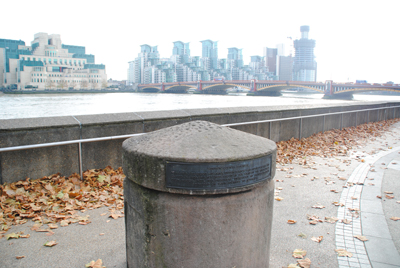
The prison closed about 1890 (a buttress which once stood at the top of the prison’s river steps commemorates the prison – pictured above).

The site is now occupied by some of the more interesting buildings in the area – including the Chelsea College of Arts (buildings formerly used by the  Royal Army Medical School, Tate Britain (which opened in 1897 as the National Gallery of British Art), and a housing development known as the Millbank Estate, constructed to providing housing for 4,500 members of the working class.

While the area was previously known for having been dominated by marshland, land was eventually reclaimed along the waterfront and an embankment established, defining the course of the river.

As well as the district, the name Millbank is also the name of the street which runs along the riverbank between the Houses of Parliament and Vauxhall Bridges.

For more on London’s prisons, check out Geoffrey Howse’s A History of London’s Prisons.

Special – Lord Mayor’s Show…

Lord-Mayor's-Show1

Tomorrow is the Lord Mayor’s Show and once again the great procession will make its through London’s streets so the Lord Mayor may swear their loyalty to the Crown. So, to celebrate, we thought we’d interrupt our regular programming and bring you 10 facts about the Lord Mayor’s Show…

1. The origins of the Lord Mayor’s Show go back to 1215 when King John granted the city the right to elect their mayors but only on condition that they made their way to Westminster to swear their loyalty each year. There is evidence that by the late 14th century, the journey had turned into something of a procession.

2. Lawyer Fiona Woolf is the 686th Lord Mayor, formally taking on the job when outgoing mayor Roger Gifford hands the City insignia to her in what is known as the Silent Ceremony held at Guildhall today. She is only the second woman to ever hold the post; Mary Donaldson was the first to do so in 1983.

3. The person responsible for organising the day is the Pageantmaster. The current Pageantmaster is Dominic Reid – he gets to travel in a ceremonial Landrover.

4. The day was originally held on 28th October, the Feast of St Simon and St Jude, but was moved to 9th November in 1751 when Britain adopted the Gregorian Calendar. Because this meant it call be held on any day of the week, to simplify matters in 1959 it was decided that the Show would be held on the second Saturday in November.

5. Effigies of Gog and Magog, seen guardians of the City of London, have appeared in the Lord Mayor’s Show since at least 1554, during the reign of King Henry V. For more on Gog and Magog, see our Famous Londoners post.

Lord-Mayor's-Show2

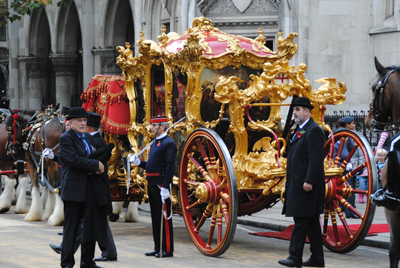
6. Since the early 15th century the Lord Mayor had travelled to Westminster via a pageant on the River Thames. This was dropped in favour of travelling on horseback. The magnificent State Coach used in tomorrow’s procession, meanwhile, was first used to convey the Lord Mayor to Westminster in 1757 (the mayors had ridden in coaches since 1712 after Sir Gilbert Heathcote fell off his horse in 1711). For more on the State Coach, see our Treasures of London article. As happened last year, before the Show starts, the Lord Mayor will once again travel upriver in the QRB Gloriana accompanied by a procession of 24 traditional Thames boats from London’s livery companies and port authorities. The flotilla will leave Vauxhall at 8.30am and travel past Tower Bridge to HMS President.

7. The modern route of the show – which takes in Cheapside, Ludgate Hill, Fleet Street going out from Mansion House to the Royal Courts of Justice and then returns back along Queen Victoria Street – was fixed in 1952 (although occasionally it has been disrupted due to things like roadworks). It apparently features 3,500 manholes, all of which have to be checked before the big day.

8. The modern Lord Mayor’s Show parade, which kicks off at 11am, is three-and-a-half miles long. This year’s procession features more than 7,000 participants.

9. Among those in the parade are representatives of the livery companies including that of the “great 12” –  the Mercers, Grocers, Drapers, Fishmongers, Goldsmiths, Merchant Taylors, Skinners, Haberdashers, Salters, Ironmongers, Vintners and Clothworkers – as well as other companies including some distinctly “new world”.

10. The fireworks display was canceled last year but is back for this year’s festivities. It kicks off at 5pm.

For more on the show – including a downloadable timetable and map – head to www.lordmayorsshow.org.

Around London – The Georgians at the British Library; wartime artist on show; Regent Street’s Christmas lights; Westminster’s new organ; and, celebrating success at the NPG…

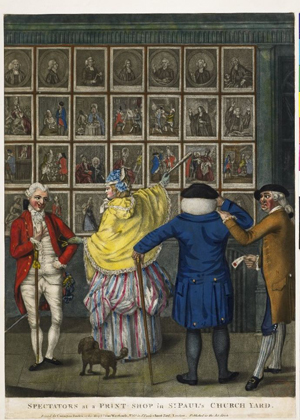
The-GeorgiansThe Georgians are under the spotlight in a new exhibition opening at the British Library tomorrow. Georgians Revealed: Life, Style and the Making of Modern Britain explores the ways in which the Georgian world influenced pop culture in Britain today, everything from fashion and theatre-going to our obsessions with celebrity scandals. The display features more than 200 artefacts from the library’s collection and includes Jeremy Bentham’s violin, Joseph van Aken’s An English Family at Tea, rare books and magazines, and illustrations and designs of landmark building’s such as Sir John Soane’s home (and now museum) in Lincoln’s Inn Fields. The exhibition, which is accompanied by a series of events (see the library website for details) comes ahead of the 300th anniversary of the accession of King George I next year. Runs until 11th March. Admission charge applies. Meanwhile, to mark the exhibition, the library has joined with Cityscapes in launching a new Georgian garden installation on the library’s piazza. Titled Georgeobelisk, the six metre high installation, will remain on the piazza for five months. A tribute to the four King Georges, it also serves as a reminder that it was also during the Georgian era that the British love of gardening was cultivated. For more, see  www.bl.uk/whatson/exhibitions/georgiansrevealed/index.html. PICTURE: Spectators at a Print shop in St Paul’s churchyard © British Museum.

Painting normally housed in “Britain’s answer to the Sistine Chapel” go on display in Somerset House today. The artworks, described as the “crowning achievement” of wartime artist Stanley Spencer, usually grace the walls of Sandham Memorial Chapel but are on display in London while the National Trust carries out restoration work at the Berkshire property. Spencer painted the works – which combine realism and visions from his imagination and were completed in 1932 – after serving as a hospital orderly during World War I.  The free display – Stanley Spencer: Heaven in a Hell of War – can be seen until 26th January. For more, see www.somersethouse.org.uk.

Regent Street’s Christmas lights – a preview of the upcoming DreamWorks film Mr Peabody and Sherman – will be turned on this Saturday night. Actor Ty Burrell, director Rob Minkoff and singer Leona Lewis will have the task of switching on the lights at about 7.15 pm while performers will include Passenger, Eliza Doolittle and former Spice Girls Emma Bunton and Melanie C. The event will be hosted by radio presenters Bunton and Jamie Theakston. The street will be traffic free all day and from 3pm to 7pm, Regent Street retailers will be showcasing fashions on a catwalk located just North of New Burlington Street. Programmes will be available from information points on the day.

A new organ was dedicated in Westminster Abbey’s Lady Chapel on Tuesday. The organ was commissioned by the Lord Mayor of London, Roger Gifford, as a gift to the Queen to mark the 60th anniversary of her coronation in 1953. The Queen agreed the organ, which had briefly resided at the Lord Mayor’s residence the Mansion House, should be installed permanently in the Lady Chapel, built by King Henry VII. The new organ was dedicated by the Earl of Wessex. For more, see www.westminster-abbey.org.

Now On: Achievement: New Photographs 2011-2013. Inspiring Britons at the peak of their professions are the subject of an exhibition running at the National Portrait Gallery. The display of recently acquired and previously un-exhibited photographs depict the likes of writer and presenter Charlie Brooker (by Chris Floyd), actress Gina McKee (Mark Harrison) and Skyfall director Sam Mendes (Anderson & Low). Admission is free. Runs until 5th January in Room 37a. For more, see www.npg.org.uk.

Lost London – The Pillories…

Once a visible sign of London’s legal system, the city had several pillories which were used to degrade and humiliate those offenders put within them.

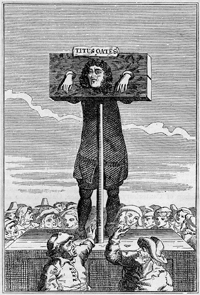
Titus-OatesOriginating in medieval times, the pillories were wooden contraptions in which a standing person’s head and hands were held in place and exposed to the ridicule of the crowd (not to mention their rotten foodstuffs and other less savoury things). They were a similar form of punishment to the stocks and were designed to humiliate those put within them.

They were used to punish a broad range of offenders including everyone from con-men and forgers to traders who didn’t play fair with their customers, people publishing unlicensed literature, and homosexuals.

Some people were pilloried repeatedly and additional punishments could be handed out to some put in the pillory – such as the nailing of the offender’s ears to the structure. There was cases of enraged mobs injuring the person locked in the pillory so badly that they died and the journey to the pillory – a formal parade of the malefactor before the people – was another chance for people to shout abuse and throw things at the offender.

As well as in Charing Cross where the pillory was located just to the south of Trafalgar Square, pillories were found at locations in Cheapside, Cornhill and Old Bailey in the City as well as Old Palace Yard and Tyburn in Westminster.

Among the most famous occupants of London’s pillories was the writer Daniel Defoe. The author of Robinson Crusoe and Moll Flanders, he was placed here on 31st July,1703, due to his publication of pamphlets criticising the church. It didn’t prove the harshest of punishments, however – Defoe was greeted with flowers, not stones, by a crowd rather sympathetic to his cause.

Others to suffer the punishment of the pillory included Titus Oates, who fabricated a plot to kill King Charles II, and puritan William Prynne, who lost both his ears when pilloried for libelling Queen Henrietta Maria  (although they were apparently sewed back on before he lost them again for a subsequent offence).

The punishment was formally abolished in 1837 – the last time it was used was in 1830.

PICTURE: Wikipedia. Image is from Robert Chambers’ Book of Days, 1st edition.

10 fictional character addresses in London – 1. 221b Baker Street…

221b-Baker-Street

Today we kick off our new Wednesday series with a look at some of the most famous addresses in London where fictional characters once lived. Most, if not all, of the addresses we’ll look at are not fictional in themselves – they do actually exist – but the characters said to have lived there owe their lives solely to the imaginations of their creators and the readers and audiences who have loved and admired them.

To kick it off, we take a quick look at what is certainly the most visited address of a fictional character in London – 221b Baker Street, the home of Sherlock Holmes and his associate Dr John Watson.

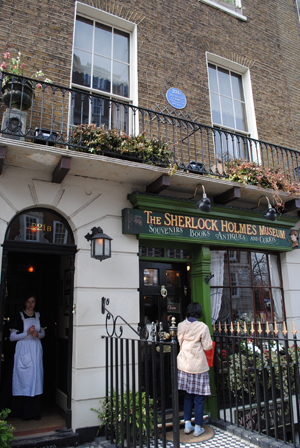
The-Sherlock-Holmes-MuseumWe’ve looked mentioned this Baker Street address in a couple of earlier posts – including a look at the origins of the naming of Baker Street and a piece on Sherlock Holmes himself.

So, to somewhat recap, the writer Sir Arthur Conan Doyle has Holmes and Watson living at this address from 1881 (it becomes their address in the first book featuring them – A Study in Scarlet, published in 1887) to 1904 when Holmes retired (Watson was not a continual presence here, moving in and out a couple of times).

What’s interesting is that the address now belongs to the Sherlock Holmes Museum, although in terms of the other numbers in the street, this is actually located between numbers 237 and 241 (in a street which was, prior to the 1930s, known as Upper Baker Street).

What is now number 221 is a 1930s art deco building formerly known as Abbey House (but this would have been 41 Upper Baker Street in 1887). It was the headquarters of Abbey National which had a long-running dispute with the museum over the right receive mail at the address 221b (since the closure of Abbey House in the early Noughties, the museum has received the mail).

It should be noted that there are also numerous other theories over the ‘real’ location of 221b Baker Street – in particular one which suggests the real address is opposite the former location of Camden House in Baker Street, thanks to a reference in The Empty House.

The museum, which is located in a house built in 1815, is set up as it was in Holmes’ day and contains his first floor study, filled with artefacts relating to the many cases he solved – including his famous pipe as well as his deerstalker hat, magnifying glass, violin, and the wicker chair which was used in Sidney Paget’s famous illustrations.

Other rooms include Dr Watson’s small second floor bedroom and the housekeeper Mrs Hudson’s room.

Worth noting is that there is also reconstruction of Holmes’ study at The Sherlock Holmes pub, located at 10-11 Northumberland Street in Westminster. This had been created for the Festival of Britain in 1951 by the Marylebone Borough Library and Abbey National and was located at Abbey House. For on this, check out the Westminister Libraries & Archives site.

WHERE: The Sherlock Holmes Museum, 221b Baker Street (nearest Tube station is Baker Street);  WHEN: 9.30am to 6pm daily; COST: £8 adults; £5 children (under 16); WEBSITE: www.sherlock-holmes.co.uk.

Treasures of London – The lions of Trafalgar Square…

Lion

Dwarfed by the towering form of Nelson’s Column in the southern part of Trafalgar Square, the four lions at the base of the column’s plinth – known to some as Landseer’s Lions – are now a favourite of tourists and Londoners alike. But it wasn’t always so.

While the column was erected in 1843 and the fountains in 1845, it wasn’t until 1867 that the lions – designed by Sir Edwin Landseer – appeared in the square. The reasons for the delay were apparently several including arguments over the artistic vision of the sculptures and funding and Landseer’s own ill-health.

Indeed, Landseer, best known as a painter of animal subjects, wasn’t the first choice as sculptor but was only commissioned after the models of the first sculptor – Thomas Milnes –  was rejected (there’s a terrific painting by John Ballantyne of Landseer working on the lions in the National Portrait Gallery).

As a result when the lions were eventually unveiled, they were held to general ridicule when they finally arrived, costing thousands of pounds more than what had been budgeted for them.

While the lions were initially going to be made of granite, Landseer’s 20 foot long lions were cast by Baron Marochetti in bronze at his Kensington studio. The form of the lions was apparently modelled on a dead lion which, according to Ed Glinert in The London Compendium, were brought to his studio in St John’s Wood by cab from the London Zoo, although all four lions have distinct faces.

Legend has it that the Grade I-listed lions will come to life if Big Ben chimes 13 times.

There has been concern in recent years about the damage people are doing to the lions in climbing on them with one report recommending that the public be banned from climbing on them.

For more, see our previous posts on Nelson’s Column and Trafalgar Square.

For more on London’s monuments, check out Peter Matthews’ London’s Statues and Monuments (Shire Library).

Where’s London’s oldest…tea shop?

Twinings

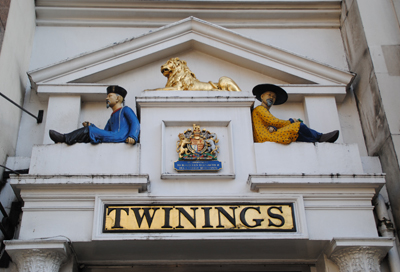
Opened in the Strand in 1706, Thomas Twining’s tea shop can still be found there today.

Twining, a tea merchant whose family originally hailed from Gloucestershire, started selling tea from what had been a coffee house – Tom’s Coffee House – in an effort to tap into tea’s growing popularity. It had apparently been introduced to England by Catherine of Braganza, the Portuguese wife of King Charles II, soon after the Restoration.

Amid resistance from other coffee house owners and despite high taxes on tea, Twining’s venture succeeded, attracting a wealthy clientele which apparently included Jane Austen, thanks at least in part to its location on the border between the City of Westminster and the City of London.

By 1717, Twining had purchased three houses adjacent to his coffee house and converted them into a shop which still stands today at number 216 Strand (the original Tom’s Coffee House was located behind this premises). He was soon selling more dry tea than wet at the sign of the “Golden Lyon”.

Following Thomas’ death in 1741, Twining’s son Daniel took over the business and by the mid-1700s, was exporting to America where he counted the Governor of Boston among his clients (but, apparently it was not Twining’s tea which was tossed into the sea at the Boston Tea Party).

It was Daniel’s son (and Thomas’ grandson), Richard Twining, who was successful in lobbying for the lowering of tea taxes and so paving the way for tea to become the commonly consumed drink it is today. It was also Richard who built the shop’s current entrance portal in 1787 incorporating the golden lion.

The Twinings shop today is the oldest in the City of Westminster while the company’s logo, which dates back to 1787, is the oldest commercial logo in continuous use.

Twinings, which since 1964 had been owned by Associated British Foods, was granted a Royal Warrant in 1837 by Queen Victoria.

For more, see www.twinings.co.uk.

London Pub Signs – Ye Olde Watling…

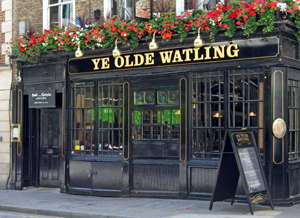
Ye-Olde-WatlingThis pub, located in the City, takes its name from the street upon which it stands – Watling Street.

The street, which is just 180 metres long, bears the same name as a great Roman road which ran all the way from Dover through London to the long gone Roman town of Viroconium (now known as Wroxeter in Shropshire).

The Roman road followed, to some extent, the route of an ancient Celtic pathway. But while the Celtic pathway crossed the Thames at Westminster, the Roman road, once the bridge was constructed, crossed at London Bridge and headed through London, apparently taking in this surviving piece.

The building itself – located on the intersection with Bow Lane – is said to have been constructed from old ship’s timbers by none other than Sir Christopher Wren in 1668. The upstairs rooms were said to have been used as a drawing office during the construction of Wren’s masterpiece, St Paul’s Cathedral. It may have also been used as  pub by the workmen building the cathedral – in fact it’s said to have been the first pub built after the Great Fire of 1666.

The pub is part of the Nicholson group. For more on it, check out www.nicholsonspubs.co.uk/yeoldewatlingwatlingstreetlondon.

PICTURE: Duncan Harris/Wikipedia

10 (more) curious London memorials…3. William Wallace Memorial…

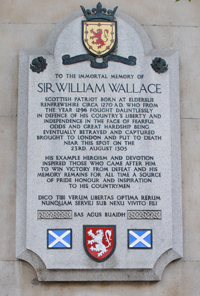
William-Wallace-memorialHe was captured in Scotland but it was actually at Smithfield in London that the Scottish leader, Sir William Wallace, was put to death on 23rd August, 1305.

Erected in 1956 by “Scots and friends at home and abroad”, a plaque located on the wall of St Bartholomew’s Hospital overlooking the former execution ground commemorates the “Scottish patriot” Wallace, saying that from the year 1296 “fought dauntlessly in defence of his country’s liberty and independence in the face of fearful odds and great hardship”. It goes on to note that he was “eventually betrayed”, captured and executed “near this spot”.

Elsewhere the memorial reads: “His example, heroism and devotion inspired those who came after him to win victory from defeat and his memory remains for all time a source of pride, honour and inspiration to his countrymen”.

Having co-led the Scottish to victory against the army of King Edward I at the Battle of Stirling Bridge in 1297, Wallace was later knighted for his efforts and subsequently served as a Guardian of the Kingdom of Scotland.

Following his defeat at English hands in the Battle of Falkirk in 1298, he escaped and continued to evade capture until he was apprehended near Glasgow in August 1305. Brought to London where he was put on trial in Westminster Hall. Summarily found guilty of treason, he was stripped naked and dragged to Smithfield and it was there that he suffered the horrible death of being hung, drawn and quartered.

And while the 1995 movie, Braveheart, had Wallace crying out “Freedom” as he died, his last words are actually not recorded. His tarred head was subsequently displayed on a pike atop London Bridge while his limbs were sent to towns including Stirling in Scotland.

Around London: Masques of the Stuart Court; saving London’s heritage; IEDs at the NAM; and, Eighties fashion at the V&A…

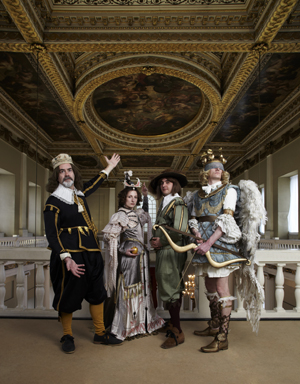
Stuart-masque-at-Banqueting-HouseThe sights and sounds of the elaborate masques of the early Stuart Court – described as a cross between a ball, an amateur theatrical, and a fancy dress party – are being recreated at the Banqueting House in Whitehall. Historic Royal Palaces have joined with JB3 Creative to create an “immersive theatrical experience” for visitors to the building – one of the last surviving parts of the Palace of Whitehall – with the chance to try on costumes, learn a masque dance and witness performance rehearsals for Tempe Restored, last performed in the building in 1632. Inigo Jones will be ‘present’ as masque designer to talk about his vision for the performance. Weekends will also see musicians performing period music and on 27th July there will be a one-off evening event at the Banqueting House based on Tempe Restored. Admission charge applies. Performing for the King opens tomorrow and runs until 1st September. For more, see www.hrp.org.uk/BanquetingHouse/. PICTURE: HPR/newsteam.

A new exhibition looking at how some of London’s great Georgian and Victorian buildings were lost to bombs and developers before, after and during World War II – and how people such as poet John Betjeman campaigned to save them – opened in the Quadriga Gallery at Wellington Arch near Hyde Park Corner yesterday. Pride and Prejudice: The Battle for Betjeman’s Britain features surviving fragments and rare photographs of some of the “worst heritage losses” of the mid-20th century. They include Robert Adam’s Adelphi Terrace (1768-72) near the Strand, the Pantheon entertainment rooms (1772) on Oxford Street, and Euston Arch (1837). The English Heritage exhibition runs until 15th September. Admission charge applies. For more, see www.english-heritage.org.uk/daysout/properties/wellington-arch/.

IEDs (Improvised Explosive Devices) will be ‘uncovered’ in a new exhibition opening tomorrow at the National Army Museum. Unseen Enemy will tell the stories of the men and women in Afghanistan who search for, make safe and deal with the impact of the IEDs through personal interviews, images and mementoes. The exhibition has been developed with “unprecedented access” from the British Army, Royal Air Force and Royal Navy and will include a range of equipment used in detecting and disarming the devices, such as bombsuits and robots as well as medical equipment used to help those injured in explosions. The exhibition is free. For more, see www.nam.ac.uk.

On Now: Club to Catwalk – London Fashion in the 1980s. This exhibition at the V&A explores the “creative explosion” of London fashion during the decade and features more than 85 outfits by designers including John Galliano, Vivienne Westwood and Katherine Hamnett as well as accessories by designers such as Stephen Jones and Patrick Cox. While the ground floor gallery focuses on young fashion designers who found themselves on the world stage, the upper floor focuses on club wear, grouping garments worn by ‘tribes’ such as Fetish, Goth, High Camp and the New Romantics and featuring clothes such as those worn by the likes of Boy George, Adam Ant and Leigh Bowery. The exhibition also includes a display of magazines of the time. Entry charge applies. Runs until 16th February, 2014. For more, see www.vam.ac.uk. Meanwhile, tomorrow (Friday) night the V&A will celebrate the 25th anniversary of designer Jenny Packham with a series of four free catwalk shows in its Raphael Gallery. Booking is essential. Head to the V&A website for details.

Famous Londoners – William Blake…

Poet. Painter. Visionary? William Blake failed to find great success in his lifetime and died in relative obscurity but is now known internationally for his controversial and innovative works in the written word and visual arts.

Blake was born on 28th November, 1757, at 28 Broad Street in Soho, the third son of hosier James Blake and his wife Catherine (he was christened at St James’s Piccadilly). Little is known of his early life although accounts suggest he had some spiritual experiences – including a vision of a tree full of angels – as a young boy and also showed an interest in the visual arts at an early age.

William-BlakeAbout the age of 10, he started attending Henry Par’s drawing school before, at the age of 14, becoming an apprentice to James Basire, engraver to the Royal Society and Society of Antiquaries. Among his early assignments was to make drawings of the monuments and paintings at Westminster Abbey – interestingly, Blake’s earliest extant drawings are of the opening of King Edward I’s coffin on 2nd May, 1774.

In 1779, his apprenticeship completed, Blake enrolled as a student at the Royal Academy of Arts and at the same time, made his living as a copy engraver. His clients included the radical bookseller Joseph Johnson through whom he became introduced to people like Joseph Priestley. He also began producing original works on historical themes apparently with the aim of forging a career in the painting of history.

In 1782, Blake married Catherine Sophia Boucher and they took up life together at a property near Leicester Square, later moving to Lambeth. They were to have no children.

Experimenting with new methods of engraving, in 1788, he published the first of what he was to call his “illuminated books” – All Religions are One, and There is no Natural Religion – with his first illuminated book of poetry, Songs of Innocence, coming a year later (its sequel Songs of Experience was published in 1794). In 1789, he published The Book of Thel, combining his new method of engraving with “prophetic” verse.

Later works in prose and poetry – created while Blake was still working as an engraver – continued to explore his increasingly radical views on religion and politics. They included The Marriage of Heaven and Hell published in 1790, The French Revolution in 1791, America: A Prophecy in 1793 and Visions of the Daughters of Albion the same year.

In 1800, Blake moved to Felpham, West Sussex, thanks to his friendship with one William Hayley who engaged his skills on several projects. It was while living here that Blake began work on his epic poems Milton (printed in 1810-11) and Jerusalem (completed in 1820).

Following an incident in 1803 in which Blake removed a drunk soldier from his garden, Blake was charged with high treason but acquitted after a trial at Chichester.

Having meanwhile moved back to London, in 1809 Blake made a last effort to gain the public’s attention with his work and held an exhibition of his paintings and watercolours at his family home in Broad Street (now home of his eldest brother James). But the exhibition did not elevate his profile as he may have hoped and during his last years, Blake increasingly sank into obscurity amid tightening finances and, although he continued to produce poetry, paintings and engravings, he found it hard to find work.

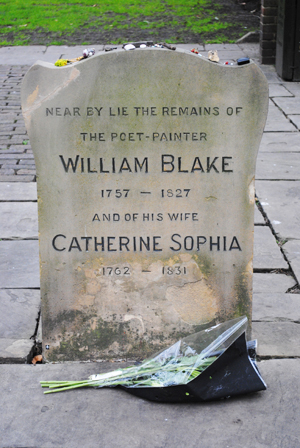
Blake died on 12th August, 1827, at his home at 3 Fountain Court on the Strand and was buried in an unmarked grave at Bunhill Fields. The stone which now stands there (pictured above) was added later.

It was during the Victorian-era that Blake’s work made its way into the hands of a larger audience than it ever had while he was alive, thanks to Blake enthusiasts like his first biographer Alexander Gilchrist and people associated with the Romantic movement.

His work continued to gain attention into the 20th century (in particular around the centenary of his death in 1927) and by mid-century had become what Robert N Essick says in Blake’s entry in the Oxford Dictionary of National Biography, “one of the cultural icons of the English-speaking world”. Interest in Blake and his works has continued both in the UK and around the world.

A new room dedicated to showing Blake’s works opened at Tate Britain in May.

Around London – Sculpture in the City; Taste of London; Paddington’s 1st Festival; and, Gauguin at the Courtauld…

LoveA free outdoor exhibition of nine artworks by world famous artists can be seen in the City of London from today. Works featured in this year’s Sculpture in the City exhibition – the third year the event has run – include Robert Indiana’s iconic LOVE sculpture (found at 99 Bishopsgate), Shirazeh Houshiary’s five spiralling stainless steel ribbons String Quintet (St Helen’s Square), and three giant steel dinosaurs, The Good, The Bad and The Ugly, made by the Jake & Dinos Chapman (30 St Mary Axe). Other artists whose work is featured include Antony Gormley, Keith Coventry, Richard Wentworth, Jim Lambie and Ryan Gander. The works will be on display in the Square Mile for the next 12 months. For more – including the locations of all nine installations – see www.cityoflondon.gov.uk/sculptureinthecity. PICTURE: Robert Indiana ‘LOVE’ (1966)  ∏ Morgan Art Foundation, Artists Right Socienty (ARS), New York – DACS, London. Photograph – A et cetera

The 10th Taste of London festival – London’s biggest outdoor food festival – kicks off in Regent’s Park today and runs over the weekend. This year sees amateur BBQ enthusiasts going head-to-head in a “battle of the BBQs” on Saturday while professionals will hit the grills on Sunday with the winners crowned champions of the Weber BBQ Challenge. Meantime, visitors can experience the food of 40 of the city’s top restaurants, shop at 200 food and drink stalls, enjoy fine wine tasting and watch demonstrations by some of the world’s top chefs including three generations of the Roux dynasty – Albert Roux, Michel Roux Jr and Emily Roux – as well as Rene Redzepi, Raymond Blanc, Ben Tish, Pascal Aussignac and Bruno Loubet. For more, see www.tastefestivals.com/london.

The first ever Paddington Festival – an 11 week showcase of art and culture supported by the City of Westminster – kicks off this weekend. Events include a “puppet theatre barge” at Little Venice and a launch event featuring an appearance by Chucky Venn (Eastenders) and steelpan and performances from local dance group, The Phoenix Dancers, at the Maida Hill Market. For more on the festival and for the full programme, see www.paddingtonfestival.co.uk. Other festivals kicking off this weekend include Shubbak 2013 – an international festival of Arab culture (www.shubbak.co.uk).

On Now: Collecting Gauguin: Samuel Courtauld in the 20s. Opening today, this exhibition at the Courtauld Gallery at Somerset House features the gallery’s collection of works by the Post-Impressionist master Paul Gauguin. The most important collection of Gauguin’s works in the UK, it was assembled by Samuel Courtauld between 1923 and 1929 and includes major paintings and works on paper by  along with one of only two marble sculptures the artist ever created. The exhibition, the gallery’s “summer showcase”, also features two important works formerly in the Courtauld’s collection and now on loan – Martinique Landscape and Bathers at Tahiti. Runs until 8th September. Admission charges apply. Meanwhile, The Courtauld Institute of Art’s MA Curating the Art Museum programme is also launching its annual exhibition, Imagining Islands: Artists and Escape, in response to the gallery’s summer showcase. A “trans-historical” exhibition displayed in two rooms, it explores artists’ fascination with other worlds and the search for utopia. Works include a 1799 engraving of Jan Brueghel the Elder’s Adam and Eve in Paradise, Barbara Hepworth’s 1957 work Icon and John Everett Millais’ 1862 painting, The Parting of Ulysses. For more, see www.courtauld.ac.uk.

Hampton Court Palace Festival; good deeds at the Foundling Museum; Harold Wilson’s memorial; and, the RA’s summer exhibition…

The 2013 Hampton Court Palace Festival kicks off tonight. Highlights include a performance by the Royal Philharmonic Concert Orchestra and fireworks on Saturday night while other artists featured include Jools Holland, Lisa Stansfield, Frank Valli and the Four Seasons, Imeda May, Bjorn Again, Russell Watson, Cliff Richard and Joe Bonamassa and Beth Hart. For the full programme of events over the next couple of weeks, check out www.hamptoncourtpalacefestival.com.

It’s all about good deeds at the Foundling Museum. Opening at the museum in Bloomsbury tomorrow, a ceramic artist Clare Twomey’s exhibition – Exchange: 1,000 Good Deeds at the Foundling Museum – features more than 1,000 cups and saucers with each cup hiding instructions for a good deed underneath. The instructions are only revealed when a visitor selects a cup – they either agree to do the good deed, leaving it exposed and taking home the cup, or, if they’re not able to, can return the cup to its saucer. There is a limit of 10 cups available for exchange each day – ring or check the website for times when the exchanges may take place. Entry is free with museum admission. Runs until 15th September. For more, see www.foundlingmuseum.org.uk.

A memorial ledger stone to former Labour PM, Harold Wilson (later Lord Wilson of Rievaulx), was dedicated in Westminster Abbey this week. Lord Wilson (1916-1995) was PM from 1964 to 1970 and 1974 to 1976. The stone is placed near where Earl Attlee’s ashes were interred at a memorial service attended by Lord Wilson when Prime Minister in 1967. For more, see www.westminster-abbey.org.
On Now: Royal Academy of Arts Summer Exhibition 2013. Coordinated by Royal Academicians printmaker Norman Ackroyd and Eva Jiricna, this year’s exhibition at the Royal Academy in Piccadilly features more than 1,000 artworks with many going on display for the first time. Among the works on display will be Grayson Perry’s series of six tapestries entitled The Vanity of Small Differences – inspired by Hogarth’s A Rake’s Progress, it tells the story of Tom Rakewell. Other highlights include a room dedicated to portraiture – including photographs and works on paper – and a new large scale sculpture by Anthony Caro. Runs until 18th August. Admission charge applies. For more, see www.royalacademy.org.uk.

10 Historic London Garden Squares…6. Grosvenor Square

Grosvenor-Square-1

The largest square in Mayfair, Grosvenor Square was laid out in the 1720s on the orders of  Sir Richard Grosvenor of Cheshire.

Sir Richard owned the Grosvenor Estate, a considerable tract of land in London’s west which includes in its northern part the land upon which the square was created (the estate is now owned by Gerald Cavendish Grosvenor, the 6th Duke of Westminster).

It’s proximity to Hyde Park and Whitehall quickly made it, like many other historic squares, a fashionable place for politicians to live – among those who lived here in the late 18th century were three prime ministers.

The oval-shaped gardens in the middle of the square – which was only opened to the public in 1948 – were once home to a statue of King George I but this was removed at some point. Originally thought to have been laid out by gardener John Alston, they took on their current form in 1948 when they were redesigned by architect BWL Gallannaugh (interestingly, Grosvenor Square is also said to have been the last part of London to exchange gas lighting for electric lighting).

There’s almost no residential buildings on the square these days but among the most prominent buildings (in fact it dominates the west end of the square) is the US Embassy. Designed by Eero Saarinen, the building was completed in 1960 with US President John F Kennedy one of the first visitors.

Grosvenor-Square-2The hulking embassy is only one of the many American connections to the square, connections which at one point led to it being known as “Little America”. Dwight Eisenhower, commander of the US armed forces in World War II, based his headquarters at number 20 in 1944, while number nine – one of the few residences to survive – was home to John Adams, first American ambassador to the Court of St James and later the country’s second president.

The American theme, which has meant the square has been the focus of demonstrations such as those protesting the Vietnam War as well as outpourings of support such as in the wake of the September 11 attacks, is also evident in the statutory in the square’s gardens with grand, full size statues of  President Franklin D. Roosevelt (a bronze by William Reid Dick unveiled by Eleanor Roosevelt on the third anniversary of the president’s death – 12th April, 1948 – it is pictured above), President Eisenhower (a bronze by Robert Dean dating from 1989), and President Ronald Reagan (unveiled on 4th July, 2011, pictured right).

On the eastern side of the garden square is the September 11 Memorial Garden opened in 2003 while on the south side is the Monument to the Eagle Squadrons, the three RAF squadrons in World War II mostly composed of American volunteers before the US entered the war. There’s also a set of memorial “Diplomatic Gates”, installed in 1984 to commemorate the bicentennial of the Treaty of Paris and honour US and UK politician who have worked in the service of peace.

Other notable buildings include number one, the Canadian High Commission (previously the US embassy); and number four, one of  square’s oldest houses. Now demolished, number 44 was the home of the Earl of Harrowby and where the British Cabinet were dining when word arrived of Wellington’s victory at Waterloo.

LondonLife – Celebrating the 60th anniversary of Queen Elizabeth II’s coronation…

Regent-Street-turns-purple-to-celebrate-The-Queen’s-Coronation-

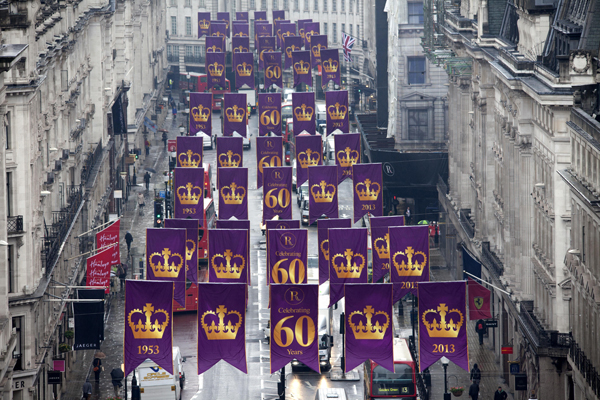
Regent Street is adorned with flags in celebration of the 60th anniversary of Queen Elizabeth II’s coronation, among the many ways in which London has been celebrating the occasion. The official anniversary was on Sunday – it was 2nd June, 1953, some 16 months after the 25-year-old Queen took the throne following the death of her father King George VI, that Queen Elizabeth II was crowned in Westminster Abbey. In celebrations yesterday, the King’s Troop Royal Horse Artillery fired a 41-gun salute in Green Park at midday followed an hour later by a 62-gun salute fired by the Honourable Artillery Company across the River Thames from the Tower of London. The Queen and other members of the royal family (along with some 2,000 guests) is attending a special service at Westminster Abbey today (for more on how the abbey is celebrating the event, see our earlier post here). More than 8,000 people attended the coronation which was watched by an estimated 27 million people across the country. PICTURE: RegentStreetOnline


Around London – Celebrating the Coronation’s 60th anniversary; Benjamin Britten; Keat’s House Festival; and, silver service in Roman Britain…

Westminster-Abbey3Sunday marks 60 years since Queen Elizabeth II’s coronation and Westminster Abbey – site of that event – is celebrating with a series of events. These include a special 60th Anniversary of the Coronation Service on Tuesday (4th June) to be attended by the Queen, Duke of Edinburgh and members of the royal family as well as a public lecture to be given by the Bishop of London Richard Chartres on Friday night (7th June – booking is essential), a concert performed by the abbey choir (13th June), and a new exhibition in the chapter house featuring archive images of the 1953 coronation ceremony and of preparations which took place at the abbey. Meanwhile the Coronation Chair, used in most coronations since the 14th century and having just undergone conservation work, is the subject of a new display in St George’s Chapel, and two new commemorative stained glass windows have been installed in King Henry VII’s Lady Chapel – the first commissioned by the abbey for more than a decade, they have been designed by artist Hughie O’Donoghue. For more on the abbey’s celebrations, see www.westminster-abbey.org.

Composer Benjamin Britten is the subject of a new exhibition opening at the British Library tomorrow. Poetry in Sound: The Music of Benjamin Britten (1913-1976) looks at the poetic and literary influences on the work of the man often described as the greatest English composer since Purcell. In particular it examines his collaboration with WH Auden and the interplay of his work with authors such as William Blake, Wilfred Owen, Alfred Lord Tennyson and William Shakespeare. As well as composition manuscripts, the exhibition features photographs, concert programmes and unpublished recordings of his music. There are a range of events accompanying the exhibition which runs until 15th September. An admission charge applies. For more, see www.bl.uk.

The Keats House 2013 Festival is underway this week with activities ranging from poetry readings to felt-making demonstrations, free family workshops and musical performances. The programme of events runs until 2nd June, all under this year’s theme of ‘Health is My Expected Heaven’: The Body and The Imagination. Poet John Keats lived at the house in Hampstead, not far from Hampstead Heath, from 1818 to 1820 and it is the setting for some of his most acclaimed poetry including Ode to a Nightingale. It was this house that he left to travel to Rome where he died of tuberculosis at the age of 25. For more on the festival programme, follow this link.

On Now: Silver Service – Fine dining in Roman Britain. This free exhibition at the British Museum recreates the experience of dining late in the Roman era and uses the Mildenhall Great Dish, Britain’s finest late Roman silver dining service, as an example of the type of large platter on which food for sharing would have been presented. The exhibition, which runs until 4th August, is free (keep an eye out for our upcoming Treasures of London on the Mildenhall Great Dish). For more information, see www.britishmuseum.org.

A foody feast at Kew; the Queen goes to Westminster; Morecambe & Wise remembered; and, Francis Goodman on show…

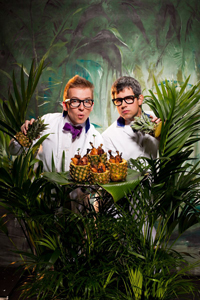
Bompas-&-Parr-with-pineapplesKew Gardens is all about food this summer and autumn with the launch of IncrEdibles: A Festival to Feed the Imagination this Sunday. Visitors are being encouraged to take part in a range of food-related activities including taking a fruit-shaped boat on the Palm House Pond around a floating pineapple island (the Tutti Frutti Boating Lake has been designed by “culinary creators” Bompas & Parr – pictured right), checking out a ‘global gastronomic garden’ featuring more than 90 edible plants on the Great Lawn, and listening to volunteer guides in the Palm House discussing how many of our foods have their origins in the rainforest. The festival also features a range of talks, tours and tastings and you can sample some special foods at the onsite eateries. The festival runs until 3rd November. For more, see www.kew.org. PICTURE: Bompas & Parr

A portrait of Queen Elizabeth II standing on the Cosmati pavement in Westminster Abbey will go on public display for the first time this afternoon at the abbey as part of the celebrations surrounding the 60th anniversary of the Queen’s coronation. The Coronation Theatre: Portrait of Her Majesty Queen Elizabeth II, is the work of Australian-born, London-based artist Ralph Heimans and has been acquired by the abbey for its collection. The painting, which was officially unveiled in London for the Diamond Jubilee last year, was exhibited at the National Portrait Gallery in Canberra until the end of March. The painting can be viewed in the chapter house at the abbey from 2pm today and will remain on display until 27th September. For more, see www.westminster-abbey.org.

A blue plaque commemorating late comic duo Eric Morecambe and Ernie Wise has been unveiled at the Teddington Studios in west London. The Heritage Foundation plaque was reportedly unveiled by Morecambe’s widow Joan and daughter Gail. Teddington’s Studio One was where the last four series of the duo’s show were produced.

On Now: Francis Goodman: Back in Focus. This display at the National Portrait Gallery features more than 40 black and white photographs spanning the career of fashion and society photographer Francis Goodman (1913-1989), from the 1930s to the 1970s and includes portraits of the likes of artists Francis Bacon and Lucian Freud as well as writers including Noel Coward and Nancy Mitford. The exhibition runs until 3rd November. Admission is free. For more, see www.npg.org.uk.

10 Historic London Garden Squares…2. Parliament Square

Located in one of the most prominent sites in London, Parliament Square is these days perhaps best known as a protest site for those wanting to attract Parliament’s eye. And while, unlike say, Trafalgar Square, many visitors to London may not know its name, its proximity to the Houses of Parliament, Whitehall, Westminster Bridge and Westminster Abbey means it’s rarely off anyone’s tourist agenda.

David-Lloyd-GeorgeThe history of the square goes back to 1868 when architect Sir Charles Barry (responsible for the design of the Houses of Parliament) designed a square to improve traffic flow in the area (and demolished many buildings – apparently the area was a slum – in the process).

The roads around the square featured London’s first traffic signals (it used semaphore arms rather than lights and was installed at the meeting of Great George and Bridge Streets) and in addition the square was originally the location for the Buxton Memorial Fountain which moved to its present position in Victoria Tower Gardens in 1940 (see our earlier post on the fountain here). In 1950, the entire square was redesigned by architect George Grey Wornum.

The square is home to a plethora of statues including former PMs Sir Winston Churchill, a relatively recent statue of David Lloyd George (pictured), Sir Robert Peel (also the founder of the Metropolitan Police Force – see our earlier post here), Benjamin Disraeli, the Earl of Derby and Lord Palmerston as well as South African PM Jan Christian Smuts and, (if you count the space in front of Middlesex Guildhall), US President Abraham Lincoln (a replica of a statue in Lincoln Park, Chicago) and former Foreign Secretary and PM George Canning. Among the last statues added was a nine foot high bronze figure of Nelson Mandela which was placed in the square in 2007 after an unsuccessful push to have it located in Trafalgar Square.

Among the most high profile of protests to have been held there is that of the late peace campaigner Brian Haw who camped on the square for 10 years until 2010. Among the most recent protests this year has been a colourful demonstration by beekeepers, calling for a ban on pesticides.

For more on London’s statues, see Peter Matthews’ London’s Statues and Monuments.