London Pub Signs – Ye Olde Watling…

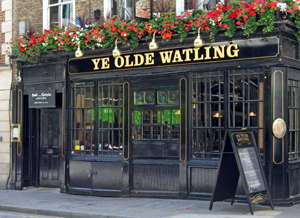
Ye-Olde-WatlingThis pub, located in the City, takes its name from the street upon which it stands – Watling Street.

The street, which is just 180 metres long, bears the same name as a great Roman road which ran all the way from Dover through London to the long gone Roman town of Viroconium (now known as Wroxeter in Shropshire).

The Roman road followed, to some extent, the route of an ancient Celtic pathway. But while the Celtic pathway crossed the Thames at Westminster, the Roman road, once the bridge was constructed, crossed at London Bridge and headed through London, apparently taking in this surviving piece.

The building itself – located on the intersection with Bow Lane – is said to have been constructed from old ship’s timbers by none other than Sir Christopher Wren in 1668. The upstairs rooms were said to have been used as a drawing office during the construction of Wren’s masterpiece, St Paul’s Cathedral. It may have also been used as  pub by the workmen building the cathedral – in fact it’s said to have been the first pub built after the Great Fire of 1666.

The pub is part of the Nicholson group. For more on it, check out www.nicholsonspubs.co.uk/yeoldewatlingwatlingstreetlondon.

PICTURE: Duncan Harris/Wikipedia

10 (more) curious London memorials…3. William Wallace Memorial…

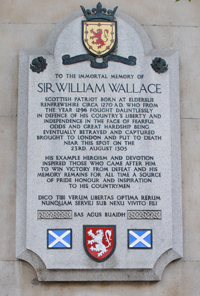
William-Wallace-memorialHe was captured in Scotland but it was actually at Smithfield in London that the Scottish leader, Sir William Wallace, was put to death on 23rd August, 1305.

Erected in 1956 by “Scots and friends at home and abroad”, a plaque located on the wall of St Bartholomew’s Hospital overlooking the former execution ground commemorates the “Scottish patriot” Wallace, saying that from the year 1296 “fought dauntlessly in defence of his country’s liberty and independence in the face of fearful odds and great hardship”. It goes on to note that he was “eventually betrayed”, captured and executed “near this spot”.

Elsewhere the memorial reads: “His example, heroism and devotion inspired those who came after him to win victory from defeat and his memory remains for all time a source of pride, honour and inspiration to his countrymen”.

Having co-led the Scottish to victory against the army of King Edward I at the Battle of Stirling Bridge in 1297, Wallace was later knighted for his efforts and subsequently served as a Guardian of the Kingdom of Scotland.

Following his defeat at English hands in the Battle of Falkirk in 1298, he escaped and continued to evade capture until he was apprehended near Glasgow in August 1305. Brought to London where he was put on trial in Westminster Hall. Summarily found guilty of treason, he was stripped naked and dragged to Smithfield and it was there that he suffered the horrible death of being hung, drawn and quartered.

And while the 1995 movie, Braveheart, had Wallace crying out “Freedom” as he died, his last words are actually not recorded. His tarred head was subsequently displayed on a pike atop London Bridge while his limbs were sent to towns including Stirling in Scotland.

10 of London’s greatest Victorian projects – 8. London’s railways…

London’s railway network stands out as one of the greatest achievements of the Victorian age for it was during the 19th century that much of the railway infrastructure still in use today was first established.

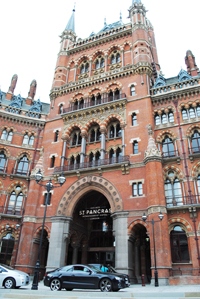
St-PancrasThe first railway line in London opened in February 1836 (six years after the UK’s first line opened) and ran between Spa Road in Bermondsey and Deptford on the south bank of the River Thames. The line was extended to London Bridge in December that same year and again to Greenwich, from cross-Channel steamers left – in April the following year.

That same year – 1837 – the station at Euston opened as the final stop for trains from Birmingham (an earlier terminus as Chalk Farm was deemed too far out). It was followed by Paddington in 1838, Fenchurch Street – the first permanent terminus in the City – in 1841, Waterloo in 1848 and King’s Cross in 1850.

Having seen a boom period during the 1840s, development of new lines took a back seat in the 1850s but resumed apace the following decade with the opening of Victoria Station, connecting the city to Brighton and Dover. Stations followed at Charing Cross, Ludgate Hill and Cannon Street and alongside the grand terminus’ around the outskirts of London where trains arriving from distant destinations arrived, numerous smaller railways began to be built, such as the West End of London and Crystal Palace Railway and the Victoria Station and Pimlico Railway, which took passengers on only short journeys across the city (these smaller railway companies all disappeared by 1923 when the 1921 Railways Act resulted in the creation of what are known as the “Big Four” British railway companies).

And, of course, the London Underground, has its first journey in 1863 but we’ll look at that in more detail next week.

Interesting to note that there were three classes of rail travel and while first and second class passengers had seats, this wasn’t always the case in third class where, writes Michael Paterson in Inside Dickens’ London, passengers, such as those on the Greenwich line, were initially forced to stand in open topped carriages known by some as ‘standipedes’.

Naturally, with the building of the railways came some spectacular stations – among the most spectacular is the late Victorian building which stood at the front of St Pancras Railway Station and housed the Midland Grand Hotel (pictured above). An exemplar of the Gothic Victorian style, it was designed by Sir George Gilbert Scott and, following a massive recent refurbishment, is now home to the five star Renaissance London Hotel and apartments.

We can, of course, only touch on the history of the railways in such a brief article – but we will be looking in more detail at some more specific elements of the system in later posts.

Where’s London’s oldest…Thames tunnel?

While the Greenwich foot tunnel may these days be more well-known due to the fact it is still open to pedestrians, London’s oldest under-Thames tunnel (also credited as the oldest underwater tunnel in the world) actually runs between Rotherhithe on the river’s southern bank and Wapping on the northern.

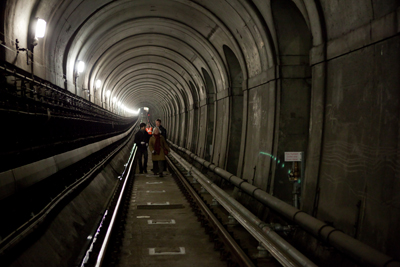
Thames_Tunnel-in-2010First opened in 1843, the Thames Tunnel (pictured left during a brief reopening to pedestrians in 2010) was the first major project of star Victorian engineer (and delightfully named) Isambard Kingdom Brunel (who, at the age of just 19 started work on the job with his father, a French engineer named Marc Isambard Brunel) and was known for a time as the eighth Wonder of the World.

It was constructed after demand grew for a way to transport goods across the crowded Port of London to the east of London Bridge. Given the height of the masts of larger ships, a bridge was deemed impracticable with the ramps required to take wheeled transport to the necessary height far too long (although this problem was overcome at the end of the 1800s by the use of new bascule technology in the construction of Tower Bridge).

Following several failed attempts to dig a tunnel under the Thames, Marc Brunel was given permission to build the new tunnel in the mid 1820s. The project relied on the use of a ‘tunnelling shield’, a then state-of-the-art technological solution to under river tunnelling which had only a few years earlier been patented by Marc Brunel and Thomas Cochrane, and Brunel initially thought the project would only take three years (it ended up taking as many as 18).

Construction by the newly formed Thames Tunnel Company, which had the support of none other than the Duke of Wellington, commenced in early 1825 at the Rotherhithe end. The shield enabled miners to dig out the tunnel while bricklayers came along behind them. While it significantly reduced the risk of a collapse (although several floods still did occur, taking the lives of six men – a fact which didn’t apparently much deter the sightseers who paid for the privilege of seeing the shield in operation), working conditions remained terrible with the men constantly showered with water from the river which was at that time the city’s main sewer. How many died indirectly as a result of working on the project is unknown.

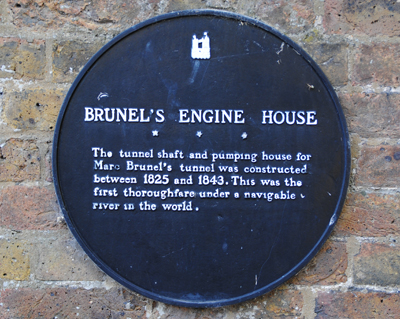
Brunel-plaqueIndeed, such was the stress of the project that Marc Brunel, later knighted for his efforts in building the tunnel, himself suffered a stroke during its construction. Isambard Brunel, who took over as the project’s engineer when the resident engineer fell ill in 1826, himself came close to being killed when he had to flee the flooding tunnel.

After much delay (including seven years in which the unfinished tunnel was left untouched) and several more disasters, the tunnel was finally completed in November, 1841.

After being fitted out with lighting, spiral staircases and roads in the following years, it was finally opened to pedestrians only on 25th March, 1843. While it was originally envisaged that the primary purpose of the tunnel would be to transport goods under the river, this never occurred.

Still, it did capture the public’s attention and as many as 50,000 people walked through the tunnel on the opening day (among the initial visitors to the tunnel was Queen Victoria herself). Within 10 weeks of its opening, a million people (a figure equal to what was then half the population of London) had reportedly passed through it.

Despite the number of people initially using it, however, the tunnel was still not a financial success and over the ensuing years became noted as a gathering place for unsavoury types. In 1865 it was purchased by the East London Railway Company which subsequently incorporated the tunnel into its railway network with both the Wapping and Rotherhithe entrance shafts converted into stations. It later become part of the London Underground network – the  – and since 2010 has been part of the London Overground.

Both stations are still in use and you can get a good sense of what the tunnel was like by riding the overground between Rotherhithe and Wapping. The Brunel Museum in Rotherhithe – actually housed within a building originally used to house machinery for draining the tunnel – see plaque above – is also a great place to find out more about the project and Brunel. Visit www.brunel-museum.org.uk for details.

PICTURES: Top – Lars Plougmann (Wikipedia)/Other – David Adams

For more on the life of Brunel, see Steven Brindle’s Brunel: The Man Who Built the World.

London Pub Signs – Doggett’s Coat and Badge…

Perhaps not so much a sign as a pub name, the strangely monikered Doggett’s Coat and Badge in South Bank is named after a rowing race – said to be the oldest continuous sporting event in the country – in which apprentice waterman traditionally competed for a prize consisting of waterman’s coat and badge and named after Irish-born actor and theatre manager, Thomas Doggett.

The race – which is held in July and runs over a course of four miles and seven furlongs from London Bridge to Chelsea (the starting and finishing points were originally both marked by pubs called The Swan) – was first held in 1715 when it was first organised by Doggett who financed it up until his death in 1721 after which he left instructions in its will for it to be carried on by The Fishmongers’ Company (which it still is today).

While there’s a nice story that Doggett, who managed the Drury Lane Theatre and later the Haymarket Theatre and carving out a name for himself as a ‘wit’, started the race as thanks to Thames watermen for rescuing him when he fell off a watercraft while crossing the Thames, Doggett – a committed Whig – actually started the race to commemorate the ascension of King George I – the first ruler of the House of Hanover – on 1st August, 1714, following the death of Queen Anne.

This year’s race winner was Merlin Dwan (London Rowing Club) who beat four others to finish in 24 minutes, 28 seconds.

The pub, one of the Nicholson franchise, is located in a multiple storey modern building complex and sits along the course of the race in South Bank. It features a range of bars including Thomas Doggett’s Bar and the Riverside Bar as well as a dining room and other function rooms.

For more on the pub, see www.nicholsonspubs.co.uk/doggettscoatandbadgesouthbanklondon/. For more on the race (which we’ll be mentioning, along with more on Thomas Doggett, in more detail in upcoming posts), see www.DoggettsRace.org.uk.

Where’s London’s oldest…bridge over the Thames?

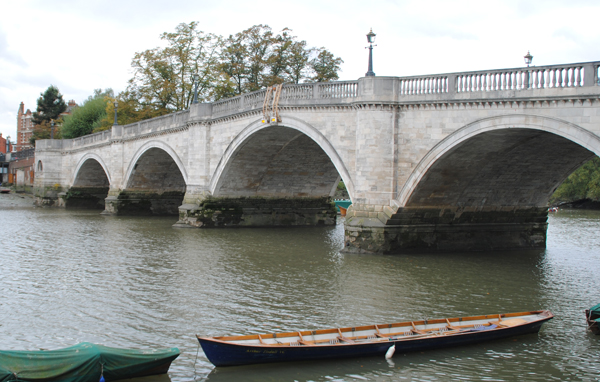
While there’s been a bridge over the River Thames near where London Bridge now stands since Roman times, the bridge which is currently there was built in the early 1970s. To find Greater London’s oldest surviving bridge across the Thames we have to head to Richmond in the city’s west.

The 300 foot long stone arch bridge, made from Portland stone, was built between 1774-77 and replaced a ferry crossing between Richmond to the east and East Twickenham to the west (this had apparently been in operation since shortly after the Norman Conquest and at the time it was discontinued consisted of two vessels – a passenger craft and a ‘horse boat’).

Designed by James Paine and Kenton Couse and built by Thomas Kerr, the bridge features five arches including a 60 foot wide central span which was big enough for larger watercraft and gave the bridge its rather humpbacked appearance. Its construction was privately funded with the £26,000 required to build the bridge partly raised via tontine schemes under which subscribers paid an agreed sum into a fund after which they each receive an annuity, the value of which increases as members of the fund die off.

Initially a toll bridge (the tolls – which were 1/2d for passengers and up to 2s 6d for coaches drawn by six horses – were ended in 1859 when the last tontine shareholder died), the bridge was widened in the late 1930s but – now a Grade I listed structure – remains essentially true to its original design.

It was the eighth bridge to be built across the the Thames in Greater London but is now the oldest still standing (among those which predated it but have been demolished are London Bridge, Westminster Bridge and Blackfriars Bridge) and has been featured in paintings by the likes of  Thomas Rowlandson, John Constable and JMW Turner.

10 Historic London Markets – 1. Borough Market…

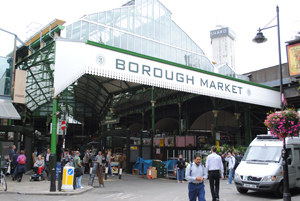
In the first of a new series looking at some of London’s most historic markets, we take a look at the history of Borough Market in Southwark, now the city’s most famous food market.

The origins of a food market in the area go back to at least to the reign of the Anglo-Saxon King Ethelred the Unready in early 11th century (some have suggested as far back as Roman times) with food vendors clustering around the southern end of London Bridge. The market was relocated to Borough High Street in the 1200s.

In 1755, traffic congestion saw Parliament close the market but Southwark residents raised £6,000 and bought a small area of land known as The Triangle – once part of the churchyard of the now long gone church of St Margaret’s – and reopened the market there.

The Triangle still remains at the heart of the market which sits partly under railway arches just to the south of the Southwark Cathedral churchyard. New market buildings were constructed in the mid 1800s but deemed “impractical”, they were replaced by new buildings in the late 1800s and 1930s (the latter was when the art deco entrance on Borough High Street was erected).

The market was refurbished in 2001 and the ornate Grade II-listed Floral Hall, which was originally the south portico on the Floral Hall at Covent Garden (taken down to make way for the Royal Opera House), was installed in 2003.

There are now more than 100 stalls in the wholesale and retail food market, making it one of the largest in London. It is owned by a charitable trust, The Borough Market (Southwark), with the volunteer trustees all local residents. Sections in the market include the Jubilee Market and the Green Market and a blue plaque, declaring the market London’s “oldest fruit and veg market”, was installed by Southwark Council earlier this year.

The amazing variety fine food on offer will tempt even the most jaded of palates but be warned that you have to queue as it can get a little packed with tourists at lunchtimes!

WHERE: 8 Southwark Street (nearest Tube Stations are London Bridge or Borough); WHEN: 10am to 3pm Monday to Wednesday, 11am to 5pm Thursday, 12pm to 6pm Friday, and, 8am to 5pm Saturday; COST: Free entry; WEBSITE: www.boroughmarket.org.uk

Olympics Special – London bridges aglow…

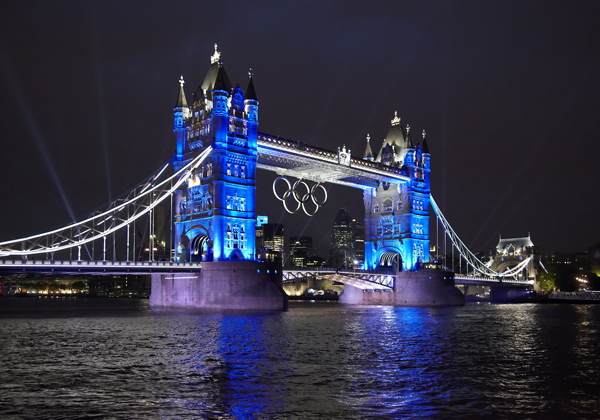
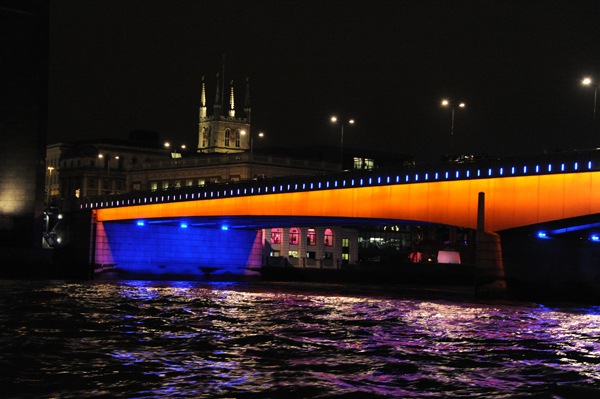
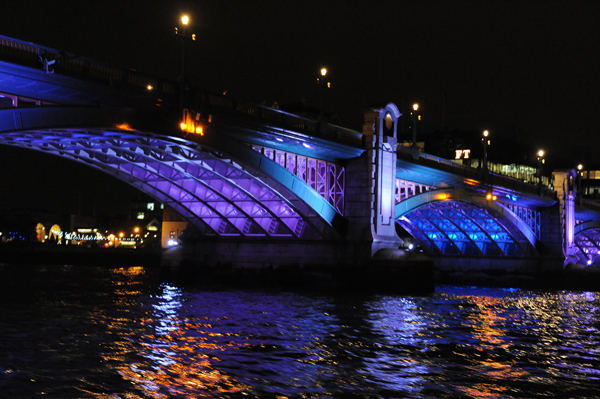
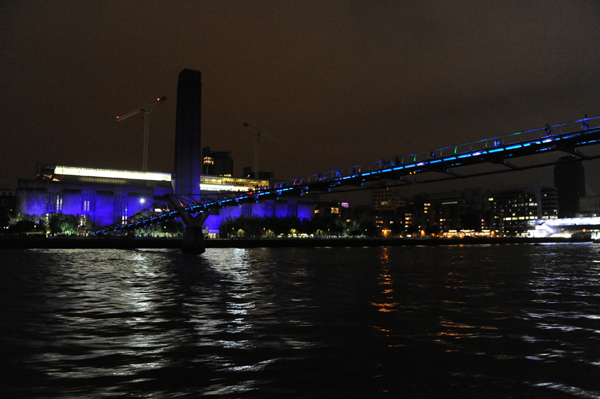
Seven of London’s bridges are being lit up at night until 10th September in an initiative called “Dazzle”. Being run under the Mayor of London Presents program, it celebrates the 50 evenings of the Olympic and Paralympic Games. Here’s just a sample of what you can see…

The most iconic of London’s bridges, Tower Bridge has been a focal point for Olympic celebrations. One of the great structures of Victorian London, it was opened in 1894 and at the time was largest bascule bridge ever built (for more on Tower Bridge, see our earlier post here).

The most recent version of London Bridge, this links Borough High Street in Southwark (you can see Southwark Cathedral in the background) and King William Street in the City and was built in the late 1960s/early 1970s and opened by Queen Elizabeth II in 1973. There have been bridges in this vicinity since as far back as Roman times (for more on the history of London Bridge, see our earlier post here).

The current Southwark Bridge – which links the City of London with the heart of Southwark – dates from 1921 and replaced an earlier bridge designed by John Rennie.

Initially plaqued by the wobbles, the steel suspension walk bridge known as Millennium Bridge is the newest of the bridges that cross the Thames in central London, linking St Paul’s Cathedral on the north bank with the Tate Modern on the south (the looming bulk of which is pictured here). First opened in July 2000, it was closed after concerns over its movement and then reopened to the public in 2002.

Other bridges taking part in Dazzle but not shown here include the Golden Jubilee footbridges, Waterloo Bridge and Blackfriars Bridge.

For more on the program, see www.molpresents.com/dazzle.

PICTURES: All images courtesy of the City of London Corporation.

What’s in a name?…Southwark

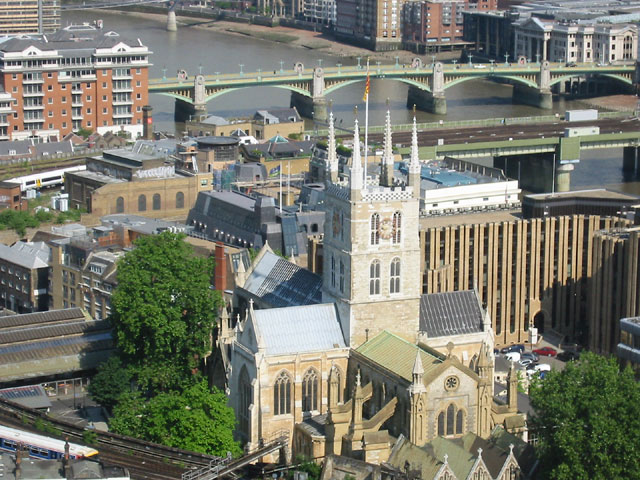
One of those somewhat confusing placenames where the ‘w’ is effectively silent, Southwark (pronounced something like Suh-thuck) is a sizeable district south of the River Thames and one of the city’s oldest areas.

The area, which was settled as far back as Saxon times, takes its name from the Old English words suth or sud weorc which translates as “southern defensive work” and relates to the fact that the site is south of the City of London and at the southern end of London Bridge (the first bridge here was built by the Romans). While it was this name which was recorded in the Domesday Book of 1086, in the 900s the area was recorded as Suthriganaweorc which meant ‘fort of the men of Surrey’.

The name Southwark was also applied to borough which sat south of the river and still exists today – the Borough of Southwark. This in turn became shortened to just Borough, hence the name borough still exists as an alternative for part of Southwark even today (think of Borough Market and Borough High Street).

Part of Roman Londinium, Southwark was effectively abandoned after the end of Roman rule and then reoccupied by Saxons in the late 800s when the ‘burh’ (borough) of Southwark was created. It developed considerably in the medieval period and became known for its inns (think of the pilgrim inn, The Tabard, in The Canterbury Tales).

The area, particularly Bankside – part of the Borough of Southwark, also become known as an entertainment district with theatres and bear-baiting pits as well as a red-light district. It was also known for its prisons, in particular The Clink (controlled by the Bishop of Winchester), Marshalsea and the King’s Bench.

The area was also a centre of industry – everything from brewing to tanning – and came to boast numerous docks and warehouses (when it also became a centre of the food processing industry). With the closure of the docks, it’s retail, tourism, creative industries and the financial services which are dominant in the area today.

Landmarks are many thanks to the area’s long and colorful history (far too many to list in this short piece) but among major sites are Southwark Cathedral, Borough Market, and the George Inn as well as the Old Operating Theatre, Guy’s Hospital, and a replica of Sir Francis Drake’s ship, the Golden Hinde. Personalities associated with the area (again far too many to list here) include Geoffrey Chaucer, William Shakespeare and Charles Dickens.

PICTURE: Southwark Cathedral © Copyright Kevin Danks and licensed for reuse under this Creative Commons Licence

For more, check out Southwark: A History of Bankside, Bermondsey and the Borough

Celebrating Charles Dickens – 9. Dickens’ literary connections, part 2…

In which we continue our look at some of London’s connections with Dickens’ writings…

• ‘Oliver Twist’ workhouse, Cleveland Street. The building, recently heritage listed following a campaign to save it, is said to have served as the model for the workhouse in Oliver Twist and was apparently the only building of its kind still in operation when Dickens wrote the book in the 1830s. Dickens had lived as a teenager nearby in a house in Cleveland Street and was living less than a mile away in Doughty Street (now the Charles Dickens Museum) when he wrote Oliver Twist. Thanks to Ruth Richardson – author of Dickens and the Workhouse: Oliver Twist and the London Poor – for mentioning this after last week’s post.

• Clerkenwell Green. It is here that Mr Brownlow first comes into contact with Oliver Twist and, mistakenly suspecting him of stealing from him, chases him through the surrounding streets. Interestingly, the grass (which you would expect when talking about a green) has been gone for more than 300 years – so it wasn’t here in Dickens’ time either.

• Barnard’s Inn, Fetter Lane. It was here, at one of London’s Inns of Court, that Pip and Herbert Pocket had chambers in Great Expectations. Barnard’s Inn, now the home of Gresham College, is only one of a number of the Inns of Court with which Dickens and his books had associations – the author lived for a time at Furnival’s Inn while Lincoln’s Inn (off Chancery Lane) features in Bleak House and the medieval Staple Inn on High Holborn makes an appearance in his unfinished novel, The Mystery of Edwin Drood. And, as mentioned last week, Middle Temple also features in his books.

• ‘Dickens House’, Took’s Court. Renamed Cook’s Court in Bleak House, the house – located in a court between Chancery and Fetter Lane – was where the law stationer Mr Snagsby lived and worked in the book. It’s now occupied by music promoter and impresario Raymond Gubbay.

• London Bridge. The bridge, a new version of which had opened in 1831 (it has since been replaced), featured in many of Dickens’ writings including Martin Chuzzlewit, David Copperfield and Great Expectations. Other bridges also featured including Southwark Bridge (Little Dorrit) and Blackfriars Bridge (Barnaby Rudge) and as well as Eel Pie Island, south-west along the Thames River at Twickenham, which is mentioned in Nicholas Nickleby.

We’ve only included a brief sample of the many locations in London related in some way to Dickens’ literary works. Aside from those books we mentioned last week, you might also want to take a look at Richard Jones’ Walking Dickensian London,  Lee Jackson’s Walking Dickens’ London or, of course, Claire Tomalin’s recent biography, Charles Dickens: A Life.

Lost London: Gates Special – The Stone Gate, London Bridge

And so we come to the last entry in our special series on Lost London looking at some of London’s gates – this time the only gate located on the south side of the Thames.

Located at the south end of London Bridge, this gate guarded the bridge entry in medieval times. When the first gate was built here remains something of a mystery but it is known that the first stone bridge, built in the late 1100s under the direction of priest Peter de Colechurch (it opened in 1209), certainly included a gatehouse known as the Stone Gateway (referred to by some as Bridge Gate) at the southern end.

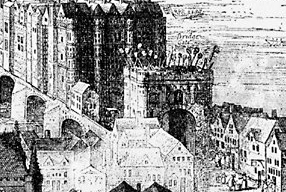
The practice of parboiling the heads of traitors and the dipping them in tar before putting them on pikes above the gate apparently dates from 1305 when Scottish rebel William Wallace’s head was displayed there. The practice apparently continued until 1678 when goldsmith William Stayley’s head was the last to be displayed there.

As we mentioned in our earlier post on London Bridge, famous heads to adorn the gateway over the years included Peasant’s Revolt leader Wat Tyler in 1381, rebel Jack Cade in 1450, the former chancellor Sir Thomas More and Bishop John Fisher in 1535, Thomas Cromwell in 1540 and Guy Fawkes in 1606.

Pictured above is an enlarged detail of a 1616 print showing London Bridge by Claes Van Visscher – the heads are clearly visible on top. One German visitor famously counted 30 heads on top when he visited in 1598.

The gate (and it should be mentioned there was also another gate on the bridge with a drawbridge which was replaced by Nonsuch House in 1577) was presumably removed sometime after 1756 when an Act of Parliament authorised the removal of shops and houses on the bridge.

Of course, there are many other gates in London – some of them smaller gates in the city walls – which have been lost to time. We’ll be looking at some more of these in future posts…

PICTURE: Wikipedia

London Pub Signs – The Old Dr Butler’s Head

Once one of a number of pubs named after King James I’s odd court physician, Dr William Butler, the pub is now the last in the city to bear his image on  a sign.

Bearing the sign of Dr Butler’s head apparently meant it was among an exclusive number of pubs which offered the good doctor’s ‘medicinal ale’. According to ‘Historic Food‘, this was apparently made by hanging a thin canvas bag containing senna, polypody of oak, agrimony, maidenhair and scurvy grass in a barrel of strong ale, making what some have said would result in a strong laxative.

One couldn’t be blamed for being somewhat sceptical without even knowing the ingredients – other ‘cures’ the good doctor came up with included dropping patients suffering nervous disorders through a trapdoor on London Bridge into the Thames and firing pistols near someone to ‘scare away’ their epilepsy.

The pub, located at 2 Mason’s Avenue off Coleman Street in Moorgate, is said to have been originally built in 1610 and had to be rebuilt after the Great Fire of London. It’s since been renovated several times.

For more on the pub, see www.shepherdneame.co.uk/pub/moorgate/old-doctor-butlers-head.aspx.

Lost London: Gates Special – Moorgate

Originally a postern (small or secondary) gate built by the Romans, Moorgate came into its own as a larger gate in the 15th century and survived for more than 300 years before it was demolished in 1761.

The name comes from the area in which it stands – Moorfields, one of the last open pieces of space within the City of London – stood just to the north of the gate. It was originally a sparsely populated marshy expanse – so much so that when the gate was first built, the area around it was often flooded and some local residents used boats as a means of transport – but was later drained. Many people were evacuated here during the Great Fire of London in 1666 and some apparently then settled in the area which later also gained a reputation as a hiding place for highwaymen like Jack Sheppard – we’ll take a closer look at Moorfields in a later post.

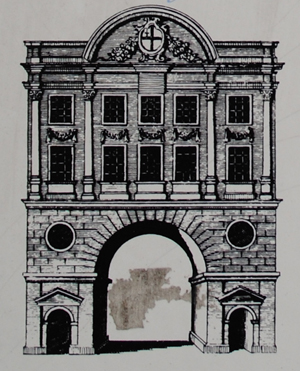
The gate known as Moorgate, meanwhile, was first rebuilt as a full sized gate with towers in 1415 on the orders of then Mayor Thomas Falconer to provide access to the fields without. It was enlarged several times in medieval years before being damaged in the Great Fire. It was replaced with a ceremonial stone gate in 1672 to provide access to the now well-drained fields before being demolished in 1761 (some of the stone was apparently later used to support the newly widened central arch of London Bridge).

The gate’s name now lives on in the street known as Moorgate (originally formally known as Moorgate Street after it was first constructed in 1846) – worth noting is that the Romantic poet John Keats was born in the street. The area around the street also is also known by the name Moorgate and is home to some of the City’s key financial institutions.

There’s a plaque near where the site of Moorgate once stood at the corner of Moorgate and London Wall.

PICTURE: Moorgate in its final, ornate form. Taken from a London Wall Walk plaque.

10 curiously named churches of London – 5. St Magnus the Martyr

St Magnus the Martyr has to be one of the most oddly dedicated churches in London. Indeed, for many years there was confusion over which St Magnus it was dedicated to – candidates including  a second and a third century martyr and a Viking who was slain in the Orkney Isles around 900 years ago.

Revived interest in the latter St Magnus in the early 20th century thanks to the discovery of his remains hidden in a pillar in the Orkney ‘capital’ of Kirkwall , however, led to a confirmation of the church’s dedication in 1924.

There is believed to have been a church on the site since Roman times (a fact which has contributed to the confusion over it’s more recent dedication) but its first known mention as that of St Magnus is shortly after the Norman Conquest.

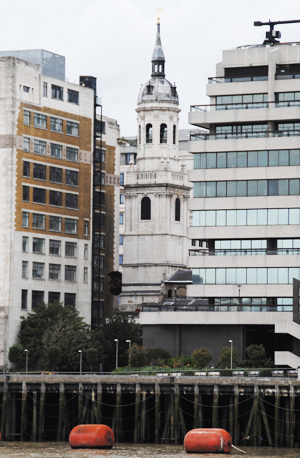
The church’s location, on the approach to London Bridge (see the picture, right, of the church tower overlooking the Thames), meant it occupied an important place in the life of medieval London. Following the Reformation, the patronage of the church was held alternately by the Abbey of Bermondsey and the Abbot and Convent of Westminster – this later passed into the hands of the Bishop of London, Edmund Grindall, and it was he who appointed the church’s most famous rector, Miles Coverdale, best remembered today as a Bible translator (there is a large monument to him in the church).

The church had been repaired in the early 17th century but was destroyed completely in the Great Fire of 1666. It was subsequently rebuilt to the designs of the ubiquitous Sir Christopher Wren.

A fire in 1760 did considerable damage to Wren’s building but it was restored and improvements continued to be made on a sporadic basis until 1831 when Sir John Rennie’s new London Bridge was opened and the old bridge demolished, meaning St Magnus no longer occupied the ‘gateway’ position it had for centuries prior.

The church only received relatively minor damage during World War II when a bomb struck London Bridge but was later restored. Features of the church now include the exterior clock, which dates from 1700, and a piece of wood believed to have one formed part of the Roman wharf which has been placed under the porch.

Among those buried at St Magnus’ during medieval times were Henry Yevele, master mason to King Edward III and King Richard II (his monument was destroyed in 1666). The church still has connections to the Fishmonger’s Company and the Plumber’s Company.

WHERE: Lower Thames Street, London (nearest Tube stations are Monument and London Bridge); WHEN: 10am to 4pm Tuesday to FridayCOST: Free; WEBSITE: www.stmagnusmartyr.org.uk.

Famous Londoners – Simon of Sudbury

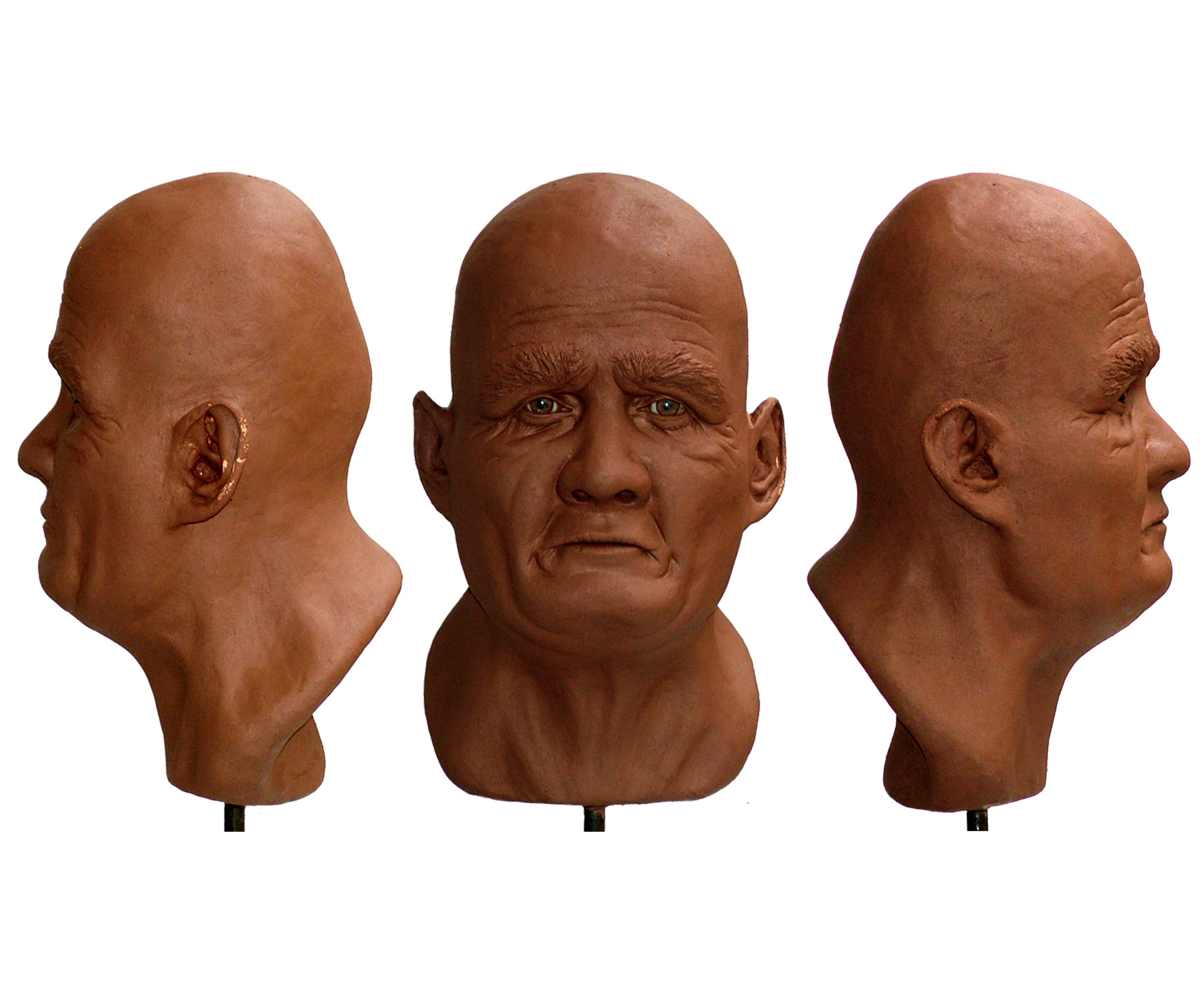
Recently making news headlines thanks to the work of Adrienne Barker of the University of Dundee in reconstructing his face, Simon of Sudbury wasn’t born in London and, in fact, spent much of his early life elsewhere. But, as Bishop of London and Archbishop of Canterbury, he was a key figure in the 14th century city and it was in London that he eventually met his grisly death during the Peasant’s Revolt.

Simon Theobold was born around 1316 – the son of a wealthy Norfolk merchant – and, while details of his early life are scant, it has been suggested he studied at Cambridge before eventually entering the service of William Bateman, the Bishop of Norwich. He apparently became caught in the middle of a dispute between the bishop and the Abbot of Bury St Edmunds (the details of which we don’t have time to get into here) and it was this which is said to have led to the issuing of a royal order for his arrest, a move which forced him to flee England for the papal court at Avignon.

He quickly came to the attention of the popes and took on an official role, the reward for which was the income from various positions in the English church including Chancellor of Salisbury. In 1356, Pope Innocent VI sent him on a peace mission to King Edward III and it was during this mission that he came to the attention of the king. Having never been formally outlawed, he was apparently forgiven his earlier crimes and was soon acting on behalf of the king including at the Papal court.

In 1361, Simon was made Bishop of London and spent the next 10 years in the role, as well as continuing to act for the king, notably as a diplomat.

In 1375 following the death of incumbent William Whittelsey, he was elevated to the position of Archbishop of Canterbury. His time as archbishop was somewhat troubled – as well as facing accusations of being too close to the king, he also faced criticism over his treatment of Bible translator John Wycliffe – but it was his role in secular politics which led to his demise.

Following the accession of King Richard II in 1377, in 1380 Simon was appointed chancellor, a position which meant he bore the ultimate responsibility for the imposition of an extremely unpopular new poll tax. In 1381, there were calls for his death at the outbreak of rebellion in Kent, notably when the rebels entered Canterbury Cathedral. But as the crisis now known as the Peasant’s Revolt gained momentum, Sudbury remained with the king in the Tower of London where he apparently counselled a hard line.

King Richard II when to parley with the traitors at Mile End on 14th June and there apparently indicated that action would be taken against traitors around him (Wat Tyler was killed when the king again met the rebels, this time at Smithfield, the following day). A group of rebels subsequently stormed the tower and dragged out Sudbury and the treasurer, Sir Robert Hales. Taken to Tower Hill, they were there beheaded. Sudbury’s head, which apparently had a skullcap nailed to his skull, was impaled on a lance and put on display over London Bridge. His body was buried in Canterbury Cathedral.

The skull, meanwhile, was apparently taken down by a Sudbury man and taken back to his home town where it was kept at St Gregory’s Church. Some 630 years later, following an approach by Sudbury locals, forensic artist Adrienne Barker from the University of Dundee was asked to recontruct Simon’s head.

Following some CT scans of the skull, Barker – who carried out the work as part of her MSc Forensic Art studies under the tutelage of renowned facial reconstruction expert Professor Caroline Wilkinson – used state-of-the-art reconstruction techniques to recreate Sudbury’s facial features and complete a series of 3-D bronze-resin casts of his head. The models, one of which will be on permanent display at St Gregory’s Church in Sudbury alongside Simon’s skull, were unveiled in September.

PICTURE: University of Dundee

Treasures of London – Tower Bridge

Often confused with London Bridge, Tower Bridge stands as a testament to Victorian engineering ingenuity.

The bridge – a major restoration of which was completed in March this year – was officially opened on 30th June, 1894, by the Prince and Princess of Wales (later King Edward VII and Queen Alexandra) eight years after work on a new Thames crossing commenced, driven by the need for a bridge which was more accessible to people living in East London (at the time pedestrians and vehicles were facing considerable congestions, with some being forced to wait hours before crossing the Thames).

At the time of its completion, Tower Bridge (although not universally acclaimed at the time) was the most sophisticated and largest bascule bridge ever built – the word bascule comes from the French for ‘see-saw’ and refers to the action of the bridge when it swings open. The bascules, which took only a minute to open, were initially operated by a steam-powered hydraulic system although since 1976, they have been driven by oil and electricity.

The 293 feet tall structure was built from steel and clad in Portland stone and Cornish granite to ensure it blended with the nearby tower of London. It was built with two walkways joining to two great towers at a height of 110 feet. Initially open to the elements, these were conceived as a way for people to cross the bridge while the bascules were raised open but due to a lack of use, they were closed in 1910 (they were reopened in 1982 when the first permanent exhibition took up residence at the bridge).

These days as well as providing a thoroughfare across the river for pedestrians and vehicles (and still opening for larger boats and ships from time to time although 24 hours notice is required), the bridge – which, along with four other London bridges, is maintained by the Bridge House Estates trust, a charity whose roots go back to the 11th century – houses an exhibition which tells the story of its construction. The walkways provide wonderful views down the river.

Interestingly, the iconic colors of Tower Bridge only date from 1976 when the structure was painted red, white and blue for the Queen Elizabeth II’s Silver Jubilee. Before that, the bridge was painted a chocolate brown though it was originally a greenish blue color.

One of the most interesting stories associated with Tower Bridge is that of a bus driven by Albert Gunton. On the bridge when it started opening in December 1952, he had to make the bus jump the gap – at three foot wide – to avoid the bus toppling into the river below. Passengers only suffered minor injuries and Gunton was later awarded a bravery award for his actions.

A list of times when the bridge will be lifted (this happens around 1,000 times a year) is kept on the Tower Bridge website.

WHERE: The exhibition entrance is located at the north west tower of the bridge (nearest Tube stations are Tower Hill or London Bridge); WHEN: 10am to 6.30pm (last admission 5.30pm) daily until end of September, then 9.30am to 6pm (last admission 5pm) until March; COST: £6 an adult/£4.20 concessions/£2.50 children aged 5 to 15 (under fives are free)/£12.50 for a family; WEBSITE: www.towerbridge.org.uk

Around London – Apsley House history goes online; Australian landscapes at the British Museum; Dame Judy Dench awarded Freedom of the City of London; and, Out of this World on at British Library

A detailed history of Apsley House, the former home of Arthur Wellesley, 1st Duke of Wellington, has gone live online as part of a pilot project aimed at “deepening the public’s understanding of English history”. The property, known as Number 1, London, is one of 12 initially being profiled in depth in a pilot project on the new English Heritage online resource, Portico. Others include Down House, the former home of Charles Darwin, located in Kent, as well as Beeston Castle, Brough Castle, Byland Abbey, Carlisle Castle, Dunstanburgh Castle, Easby Abbey, Kenilworth Castle, Lullingstone Roman Villa, Rievaulx Abbey and Wroxeter Roman City near Shrewsbury. Brief historical details are also provided for an additional 220 lesser known free sites including Dunster Yarn Market in Somerset. For more see www.english-heritage.org.uk/professional/archives-and-collections/portico/.

The West Lawn of the British Museum Forecourt has been turned into an image of the Australian continent as part of a five year partnership programme between the museum and the Royal Botanic Gardens, Kew. The landscape moves from the vegetation of the eastern Australia’s coast through to the red centre and onto a rocky Western Australian outcrop. It showcases some of the continent’s unique and highly threatened flora. The  construction of the landscape, which follows one showcasing that of South Africa last year, is part of the museum’s ‘Australian season’. Runs until October. Admission is free. See www.britishmuseum.org.

• Dame Judy Dench was awarded the Freedom of the City of London for services to acting at a ceremony at the Guildhall last week. The winner of an Academy Award, nine BAFTAs and three Laurence Olivier Awards, Dame Judy is an icon of stage and screen. She is reportedly looking forward to driving her sheep over London Bridge and occasionally wearing a sword in public – both privileges of those awarded the Freedom of the City of London. The Freedom of the City’s origins are believed to date back to 1237 and enabled recipients to carry out their trade. Today people are nominated for or apply for the Freedom for the link with the City or are awarded it for a significant contribution to London life. Many of the traditional privileges – such as driving your sheep over London Bridge or being hanged with a silken rope – no longer exist.

Now On: Out of this World: Science Fiction but not as you know it. The British Library’s first exhibition which explores science fiction through literature, film, illustrations and sound. Guest curated by Andy Sawyer, director of science fiction studies MA at the University of Liverpool, the exhibition traces the evolution of the genre from Lucian of Samosata’s True History, written in the 2nd century AD, through to the recent writings of Cory Doctorow and China Mieville. Highlights include a 1516 edition of Sir Thomas More’s Utopia, a 1647 edition of Lucian’s True History, and a 1906 edition of HG Wells text, The War of the Worlds. Runs until 25th September. For more see, www.bl.uk/sciencefiction.

Lost London – London Bridge

In the first of a new regular series looking at “lost” London, Exploring London takes a look at London Bridge.
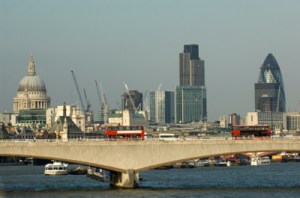
It’s a commonly confused fact that many first-time visitors to London think Tower Bridge and London Bridge are the same. As Londoners know, London Bridge (pictured right with St Paul’s and the city in the background) lies west of Tower Bridge. It’s not a particularly inspiring bridge having been built in the early Seventies. But there’s been a bridge spanning the Thames here for almost 2,000 years. So what happened to Old London Bridge?

The first bridge built across the River Thames on or close to the current site of London Bridge is thought to have been a wooden pontoon bridge constructed by the Romans around 50 AD. It was quickly followed by a more permanent bridge (rebuilt after it was destroyed by Boudicca and her marauding army in 60 AD).

Following the end of the Roman era, the bridge fell into disrepair although it’s known that there was a wooden Saxon bridge on the site by around the year 1,000. A succession of Norman bridges followed the Conquest and in 1176, during the reign of Henry II, construction of a new stone bridge began under the supervision of the priest Peter de Colechurch to service to growing numbers of pilgrims travelling from London to Thomas a Becket’s shrine in Canterbury. The new bridge, which had a chapel dedicated to St Thomas at the centre, wasn’t finished until 1209.

The bridge had 19 arches sitting on piers surrounding by protective wooden ‘starlings’ and a drawbridge and defensive gatehouse. The design of the bridge meant the water shot rapidly through the arches, leading boatmen to describe the practice of taking a vessel between the starlings as “shooting the bridge”.

King John, in whose reign the bridge was completed, licensed the building of houses on the bridge and it soon became a place of business with some 200 shops built upon its length, many of them projecting over the sides and reducing the space for traffic to just four metres. Many of the buildings actually connected at the top, creating a tunnel-like effect.

One of the more remarkable buildings on the bridge was Nonsuch House, built in 1577. A prefabricated building, it had been assembled in the Netherlands before being taken apart, shipped to London, and then reassembled. No nails were used in its construction, just timber pegs.
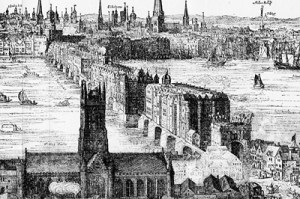
The practice of putting the heads of traitors on pikes above the southern gatehouse (see picture right, dating from 1660) started in 1305 with Scottish rebel William Wallace’s head and continued until it was stopped after 1678 when goldsmith William Stayley’s head was the last to be displayed there. Famous heads to adorn the gateway over the years included Peasant’s Revolt leader Wat Tyler in 1381, rebel Jack Cade in 1450, the former chancellor Sir Thomas More and Bishop John Fisher in 1535, Thomas Cromwell in 1540 and Guy Fawkes in 1606.

Some of the bridge’s arches collapsed over the years and had to be restored and there were several fires which destroyed houses upon it, including those which occurred during the Peasants’ Revolt in 1381 and Jack Cade’s rebellion in 1450.

Congestion reached such a state by the 18th century that in 1756 Parliament passed an act which allowed for the demolition of all the shops and houses upon it (it had remained the only bridge spanning the Thames east of Kingston until Westminster Bridge was completed in 1750). This was carried out in 1758-62 along with the removal of two central arches which were replaced with a single wider span.

With traffic only increasing – by 1896, 8,000 people and 900 vehicles were reportedly crossing the bridge every hour – it was clear a new bridge was needed and work on a new stone bridge with five arches – following a design competition won by John Rennie – began in 1824. The old bridge, located about 30 metres east of the new one, remained in use until the new one was opened in 1831. Widening work carried out the early 20th century, however, was too much for the bridge’s foundations and it began to sink.

What followed was one of the strangest episodes in the bridge’s history when in 1967 the Common Council of the City of London decided to sell the bridge. It was sold the following year to Missourian entrepreneur Robert P. McCulloch of McCulloch Oil for $US2.5 million.

Carefully taken apart piece by piece, the bridge was then transported to the desert resort of Lake Havasu City in Arizona in the US and rededicated in 1971.

The current London bridge, designed by Mott, Hay and Anderson, was built from 1967 to 1972 and opened by Queen Elizabeth II in 1973. It stands on the same site as the previous bridge.

As for the song, “London Bridge is falling down”? There’s several stories to explain its origins – one being that it came about as the result of an attack by a joint force of Saxons and Vikings on Danish held London in 1014 during which they pulled the bridge down, and another being that it became popular after Henry III’s wife, Queen Eleanor, was granted the tolls from the bridge by her husband but instead of spending them on maintenance, used it for her own personal use. Hence, “London Bridge is falling down, my fair lady”.

PICTURES: Top: © Steven Allan (istockphoto.com); Bottom – London Bridge (1616) by Claes Van Visscher. SOURCE: Wikipedia.